Introduction
The Arctic is a dynamic space that has been critical for the advancement of scientific research focused on understanding both natural and social systems (Graham and Fortier Reference Graham and Fortier2005). More recently, it has become a particularly important landscape for better understanding the mechanisms and impacts of global environmental change (Chylek and others Reference Chylek, Hengartner and Lesins2014; Hinzman and others Reference Hinzman, Bettez and Bolton2005; Rayner and others Reference Rayner, Parker and Horton2003; Shindell and others Reference Shindell, Rind and Lonergan1998). The Arctic is also home to northern indigenous peoples, who have been living upon, and developing a profound understanding of, their environment for generations (Krupnik and Jolly Reference Krupnik and Jolly2002; Laidler and Ikummaq Reference Laidler and Ikummaq2008; Riedlinger and Berkes, Reference Riedlinger and Berkes2001).
For the purpose of this paper a stakeholder is defined as follows:
Any group of people, organised or unorganised, who share a common interest or stake in a particular issue or system; they can be at any level or position in society, from global, national and regional concerns down to the level of household or intra-household, and be groups of any size or aggregation (Grimble and Wellard Reference Grimble and Wellard1997: 175)
Stakeholder engagement in northern research in Canada
Local participation has a long history within northern research in Canada, for reasons including access, logistics, and guidance (Bocking Reference Bocking2007; Chitty and Elton Reference Chitty and Elton1937). However, for modern indigenous peoples in the north, much of the right to self-determination and consequent engagement in research has emerged from long struggles to regain control over their traditional territories, knowledge and artefacts. Many indigenous groups have negotiated land claims agreements providing, in some cases, surface and subsurface control of large areas of land (for example Aboriginal Affairs and Northern Development Canada 1993). As the potential end users of much northern research, indigenous communities have voiced the need for knowledge generated through research to be useful and locally relevant, a need that has become increasingly recognised in Canada's northern research policies (Davidson-Hunt and O'Flaherty Reference Davidson-Hunt and O'Flaherty2007). This recognition has often been described as being part of a new northern research paradigm, associated with ensuring partnership, mutual benefits for research stakeholders and the empowerment of local researchers (Office of Polar Programs (OPP) and Barrow Arctic Science Consortium (BASC) 2004; Graham and Fortier Reference Graham and Fortier2005; Southcott Reference Southcott2011; Wolfe and others Reference Wolfe, Humphries and Pisaric2011). Such a ‘paradigm shift’ in northern research fits within a broader transition that has been observed in international research policy, described by Gibbons and others (1994) as a shift from Mode 1 (traditional forms of scientific discovery) to Mode 2 (knowledge generated in the context of application) approaches to knowledge production (Brunet and others Reference Brunet, Hickey and Humphries2014a). An expanding literature also refers to the increasing policy desire for socially robust research, in which knowledge production involves the end-users, bringing together diverse forms of knowledge, experience and expertise to produce new knowledge that is then strengthened and modified through use and testing in the social world (Klenk and Hickey Reference Klenk and Hickey2013; Nowotny 2003). The extent to which Canadian northern research is socially robust is not clear, although numerous studies, reports, and reviews, focused primarily on researcher perspectives and reflections, have indicated that engagement has become a priority and that it has had numerous benefits for local stakeholders and researchers, albeit with some challenges (such as balancing local and research priorities and saturation in some Arctic communities) (for example Dutheil and others Reference Dutheil, Tester and Konek2013; Parlee and Furgal Reference Parlee and Furgal2012).
Previous research suggests that there are a number of important challenges associated with local engagement in northern research that persist despite the policy emphasis on ensuring local participation in Canada's Arctic (Brunet and others Reference Brunet, Hickey and Humphries2014a; Gearherd and Shirley Reference Gearheard and Shirley2007; ITK and NRI 2007; Pearce and others Reference Pearce, Ford and Laidler2009; Wolfe and others Reference Wolfe, Armitage and Wesche2007). Recognising this, there remains a need to improve our understanding of the factors affecting northern research partnerships with a view to informing local, regional and federal research policies that seek to promote local participation in, and local relevance of, scientific research activities (Brunet and others Reference Brunet, Hickey and Humphries2014b; Garnett and others Reference Garnett, Crowley and Hunter-Xenie2009; Pearce and others Reference Pearce, Ford and Laidler2009; Phillipson and others Reference Phillipson, Lowe and Proctor2012).
The policy landscape for northern research in Canada
Canada's policy landscape for stakeholder participation and partnership development in northern research is heterogeneous yet consistently oriented around community involvement and relevance. There are requirements for community support and participation in international and federal funding mechanisms (for example International Polar Year (IPY); Social Science and Humanities Research Council of Canada (SSHRC) and National Science and Engineering Research Council of Canada (NSERC)) as well as within provincial, territorial, regional permitting processes. These are permit granting bodies that offer access to knowledge, people, places and artefacts for research purposes (for example Inuit Tuttarvingat Reference Tuttarvingat2012). For instance, the IPY 2007–2008 framework stated that ‘key objectives are to attract and develop the next generation of polar researchers and engineers, and to engage the interest and involvement of polar residents, and of schoolchildren, the general public, and decision-makers, worldwide’ (Rapley and others Reference Rapley, Bell, Allison, Bindschadler, Casassa, Chown, Duhaime, Kotlyakov, Kuhn, Orheim, Pandey, Petersen, Schalke, Janoschek, Sarukhanian and Zhang2004: 9). The results of this framework have provided important lessons regarding best practices for community collaboration and engagement in both research and decision-making (Cuerrier and others Reference Cuerrier, Downing and Jonhston2012; Grimwood and others 2012; Parlee and Furgal Reference Parlee and Furgal2012). At the federal level, the NSERC Northern Research Chairs programme (2000–2010) clearly stated in its objectives that developing meaningful northern partnerships was a priority: ‘The aim here is to ensure that new knowledge generated in the Chair's research program is relevant to northern needs. Possible partners in northern research are diverse and may include northern and aboriginal communities and organizations, territorial and provincial governments, federal departments, industry, and non-government organizations. All of these groups need research results for their policies, resource management and decision making’ (NSERC 2010: 1). A recent call for proposals from the Canadian High Arctic Research Station (CHARS) 2015–2016 makes significant funding available to regional and community groups and other northern organisations. While positive, the interest in, and capacity of, such groups to obtain competitive research funding remains to be seen.
Each Canadian territory and some provinces have established clear policies for research being conducted in the north, mostly under scientific research legislation that requires permits and some level of community consultation. For instance, in the Northwest Territories, research ‘needs to be defined clearly, conducted ethically, and used constructively in order to promote cooperation and mutual respect between researchers and the people of the North’ (Aurora College Reference College1999: 1). Some communities also have individual permit processes and policies. For instance, the community of Old Crow in Yukon Territory requires researchers to obtain a local research permit via a formal application process. Applications are then assessed for their potential impacts and benefits by a local review committee (general information available at the Cultural Services Branch, Department of Tourism and Culture, Government of Yukon, 2008).
The heterogeneity within this policy system reflects the needs and priorities of the various governments and community-based organisations involved. However, for researchers, this policy and permit landscape can be quite daunting. A review of research policies across Canada revealed a high degree of variability across provinces in the degree to which permits are required for research in their northern regions, while certain communities have strict requirements and processes and others have none. This makes the process of developing, monitoring and maintaining northern community-researcher partnerships complex. Recognising that there remains a lack of empirical evidence to inform northern science research policies promoting community-researcher partnerships at various scales, we conducted a survey of stakeholder experiences and perceptions across Canada the better to understand the opportunities and challenges associated with northern research partnerships.
Methods
Data collection
Data were collected through an online survey of northern research stakeholders in Canada. We used a broad definition of research including all fields of study (social, life, physical) conducted in the north. Such surveys have been widely used in the evaluation of research policy and planning (Garrett-Jones and others Reference Garrett-Jones, Turpin and Diment2005; Klenk and Hickey Reference Klenk and Hickey2013; Klenk and Hickey Reference Klenk and Hickey2011; Turpin and Garrett-Jones Reference Turpin and Garrett–Jones2009). As the population and composition of northern research stakeholders in Canada is unknown, we used a purposive sampling strategy to obtain diverse perspectives from different stakeholder groups and help reduce coverage bias (Sue and Ritter Reference Sue and Ritter2012). Potential participants were subsequently identified using online searches, phone calls to key research organisations, governments and other agencies, and through research-policy networks such as ArcticNet and International Polar Year. This resulted in a list of 178 potential survey participants from across Canada which included federal, territorial and local government employees, university researchers (professor), local/ territorial college professors, university/college doctoral students and post-doctoral fellows, non-government organisation employees, northern organisation or association employees, community researchers, field assistants/guides, funding agency employees, community liaisons, permitting body representatives, and northern community residents/members that had been engaged, at some point, in northern research activities.
In order to reduce the potential for survey bias, we developed and pre-tested the questionnaire with five participants, resulting in adjustments to improve clarity based on their feedback (Folz Reference Folz1996; Sue and Ritter Reference Sue and Ritter2012). The online survey (see Appendix 1) was then distributed via personalised email to all 178 potential participants between October and December 2013. We subsequently received 49 survey responses, 39 of which were complete, representing a satisfactory completed response rate of 21.9%. Importantly, the non-probablistic and exploratory nature of our survey means that our results are not appropriate for generalisation beyond our respondents. We therefore present the results in a primarily descriptive and summative form with a view to informing northern research theory and discourse.
The survey began with respondent profile questions, followed by questions regarding the context of northern research (history, policy, etc.), questions regarding the research process (proposal development, field work, results dissemination, etc.) and assessing the importance of partnerships during the different phases of research, and finally, the outcomes of research partnerships (Appendix 1). Most questions were closed-ended, in which participants were asked to rank responses or were given multiple choices. Questions that explored more theoretical concepts had definitions and explanations to guide the respondent and reduce response bias (Rooney and others Reference Rooney, Steinberg and Schervish2004). Options for ranked and multiple choice questions were based on detailed literature review and the findings of previous case study research conducted in Old Crow, Yukon (Brunet and others Reference Brunet, Hickey and Humphries2014b). We also provided open-ended questions in each section to allow participants to elaborate on their responses further, provide context through qualitative responses, or raise concerns with the questions being asked to reduce response order effects (Choi and Pak Reference Choi and Pak2005). Response bias was also reduced by providing context for the questions being asked (Schwarz and others Reference Schwarz, Knauper and Hipler1991).
Because our sample (n) was not equal throughout the study, we tested for non-response bias in order to assess respondent characteristic changes throughout the study (Sue and Ritter Reference Sue and Ritter2012). Non-response bias was tested by comparing average results for all socio-geographical indicators (Section 3.1) from those who responded at n = 49 and those who responded at n = 39. Based on the results of a Welsh two sample t-test in the program R, we found that groups did not differ significantly (p = 0.996). We also report the n values for each of the results being presented.
Analysis
Given the heterogeneous nature of our questionnaire, we used a multi-method approach for our analysis (Appendix 1). For section 1 of our survey, we conducted simple descriptive statistics to characterize our respondent profile (mostly % of total respondents). For section 2, given the nature of the question (rank 7 of 7 options), we were able to complete a series of different analyses using the pmr package for ranked data in the software R (Lee and Yu Reference Lee and Yu2013). Tests included mean rank, pairs matrix, marginals matrix and boxplot. The pairs matrix provides the number of observations for which the first item (row) is more preferred than the second item (column). The marginal matrix provides the number of observations which the item factor (row) is ranked 1–7 (column). For section 3, we scored the top five ranked outcomes from 5 points (ranked 1) to 1 point (ranked 5), then calculated the mean score for each outcome. For section 4 of the questionnaire, we conducted a boxplot analysis and determined significance using a Welsh 2 sample t-test. This allowed us to test if partnerships were perceived as more beneficial for community partners or researchers using significance tests.
The final section was an open-ended question exploring policy directions that would allow for the positive outcomes of research to be maintained or enhanced as a result of northern research partnerships. We used qualitative data coding and content analysis to uncover trends in stakeholder responses, which involved assigning codes to specific response categories and counting the number of times respondents mentioned each category to determine the top three strategies favoured by respondents (Charmaz Reference Charmaz2006; Folz Reference Folz1996; Glaser and Strauss Reference Glaser and Strauss1967). We also present illustrative quotes from the survey to place our quantitative findings in context where relevant.
Results
Respondent profile (n = 49)
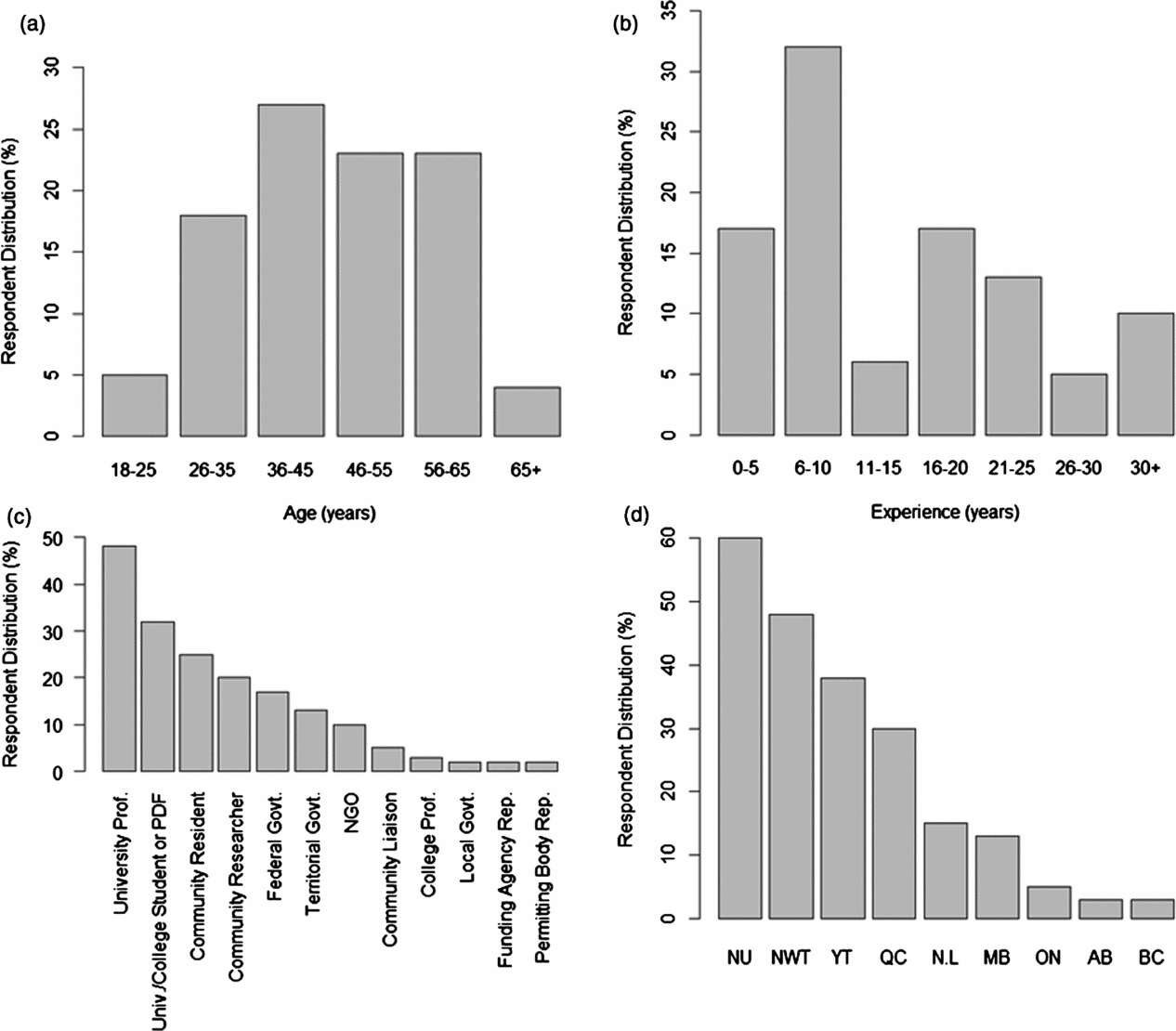
Our sample was 53% female and 47% male and was well distributed in terms of age groups and years of involvement in northern research (Figs. 1a and 1b). 45% of our respondents had more than 16 years of experience working in northern research.
a-d. Respondent profile. Panels a and b are discrete categories where respondents could only select one option. Panel a represents the age distribution of respondents. Panel b represents their number of years of experience in Northern research. In Panels c and d, respondents could select multiple options. Panel c represents the distribution in terms of respondent roles in Northern research. Panel d represents the location of respondent involvement in Northern research (NU = Nunavut, NWT = North West Territory, YT = Yukon Territory, QC = Quebec, N.L = Newfoundland and Labrador, MB = Manitoba, ON = Ontario, AB = Alberta, BC = British Columbia).
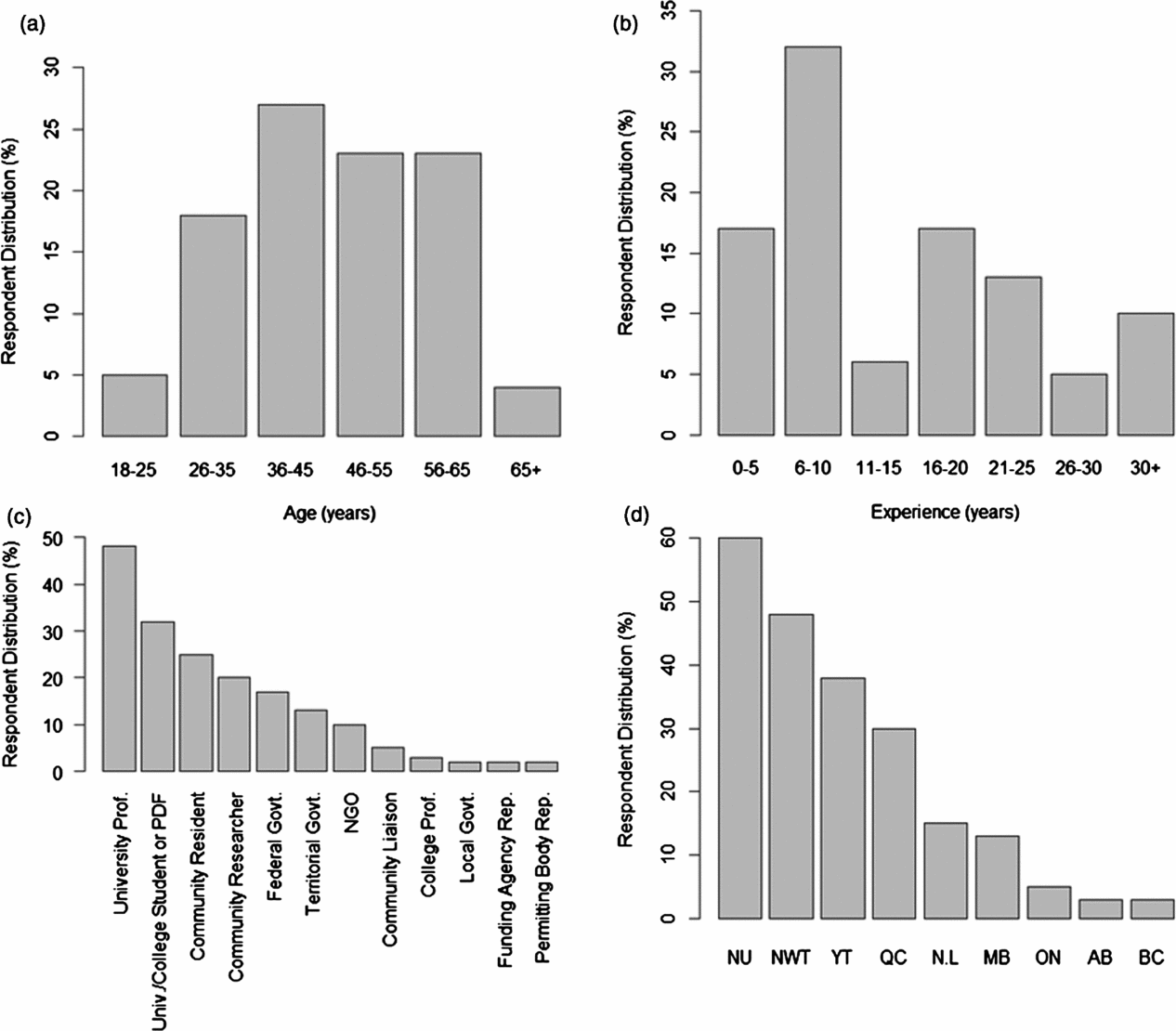
Fig. 1c presents the role of our respondents in northern research programmes, showing a large percentage of university researchers (48%). However, 25% of our respondents also identified as northern residents or community members, with over 10% indicating that they were members of a first nation or Inuit community. Overall, we received responses from all role categories which provided an important diversity of perspectives on northern research partnerships in Canada.
Respondents were also well distributed in terms of the geographical locations of their research activities, representing all northern regions of Canada (Fig. 1d). The largest proportion of respondents were involved with research projects in the territory of Nunavut (60%) followed by Northwest Territories (48%) and Yukon (38%). Many (70%) respondents also identified working and/or living in several northern regions.
Success factors for community-researcher partnerships (n = 48)
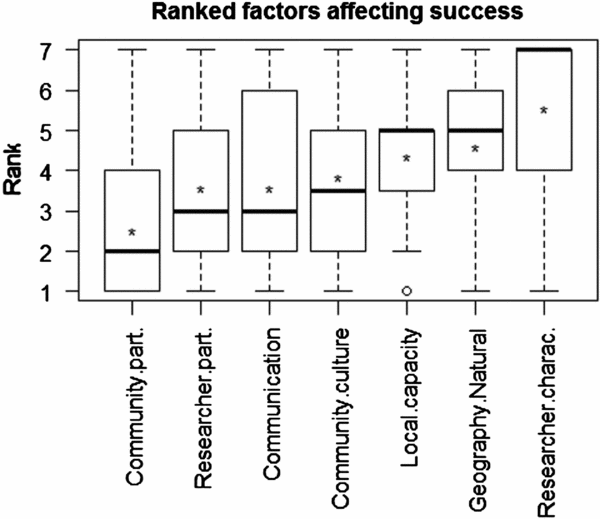
Fig. 2 presents a boxplot of respondent rankings of the success factors as well as mean scores. The results indicate that Community participation in research processes had the highest mode score (2) with a range from 1 to 4. Researcher participation in local processes and community culture: awareness, perceptions, history had the same range from 2 to 4, although Researcher participation in local processes did have a lower mode score (3). Although Early and ongoing communication (3) had a mode score that was higher than Community culture: awareness, perceptions, history (3.5), it did have a wider range from 2 to 6, meaning that there was less consensus regarding its importance. Characteristics of academic research and researchers, once again, was the least favoured factor (mode score of 7). All factors (except Local community capacity) had the maximum variance (1 to 7).
Boxplot of success factor rankings. * are mean ranks.

The pairs matrix test (Table 1) shows that Community participation in research processes was consistently chosen prior to the other factors (values between 29 and 40 out of a maximum of 47). The marginal matrix test (Table 2) confirms this finding, indicating that this factor was ranked first the most times (17) followed by Early and ongoing communication (11). The marginal matrix test also indicates that although Early and ongoing communication came third in mean rank, it was considered the first rank for more respondents than Researcher participation in local processes (2nd in mean rank).
Pairs matrix of success factors. Represents the numbers of times a factor was ranked before another factor.
Marginals matrix of success factors. Represents the number of times a factors was ranked from 1 to 7.
Outcomes of community-researcher partnerships (n = 41)
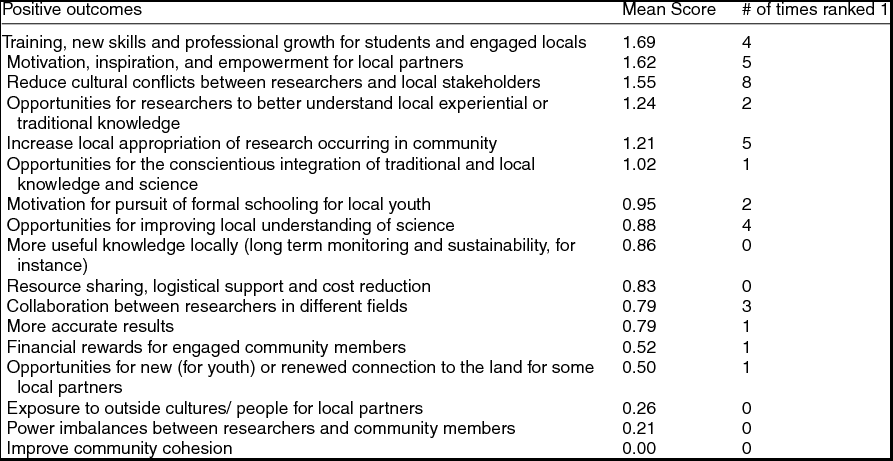
Recognising that a number of positive outcomes are associated with successful collaboration between researchers and partner communities, we asked respondents to rank their top five positive outcomes from a list. Results from the weighted scoring (Table 3) suggests that the most important positive outcome of research partnerships was training, new skills and professional growth for students and engaged locals, followed closely by motivation, inspiration, and empowerment for local partners and a reduction of cultural conflict between researchers and local stakeholders. We also reviewed the number of times each outcome was ranked first, finding that the reduction of cultural conflict between researchers and local stakeholders had the highest score (8), followed by increase local appropriation of research occurring in community (5) and motivation, inspiration, and empowerment for local partners (5).
Ranked positive outcomes (5 is the highest mean score, 0 when not selected in top 5)
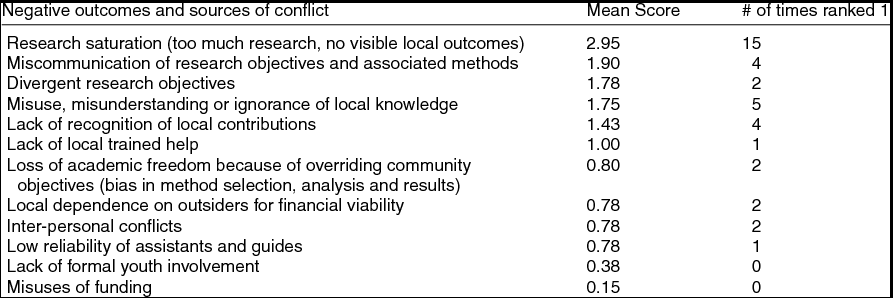
Recognising that certain conflicts can arise during the development of northern research partnerships as well as limitations that can have negative impacts on the research process, we asked respondents to rank their top five negative outcomes and sources of conflict from a list. We found that research saturation was overwhelmingly ranked the highest with a mean score of almost 3 (Table 4). It was also selected as the first negative outcome 15 times followed by misuse, misunderstanding or ignorance of local knowledge (5). Miscommunication of research objectives and associated methods was also considered important by our respondents, with a mean score of 1.9.
Ranked negative outcomes (5 is the highest mean score)
Overall benefit of community-researcher partnerships
We also explored the extent to which our participants believed that research partnerships between communities and researchers were beneficial to both researcher and local partners. We found that more than 70% of our sample felt that research partnerships are at least very beneficial for researchers compared to around 25% who believed they were very beneficial for community partners. We then assigned a score to each response category. Our results show that researchers had a median benefit score (3) and score range (2-4) that was higher than results for community counterparts (2 and 1–3). Overall, researchers were perceived by our respondents to benefit significantly more than community partners as a result of research partnerships (p = 0.002; 95% confidence interval). The mean community benefit score was also lower at 2.27 versus a researcher score of 2.98. The following quotes from northern community residents provide interesting perspectives on this disparity in terms of benefits:
Often the benefits are more one-sided - the researcher receives money, in the form of grants, fellowships, scholarships, etc. The researcher advances their career, obtains notoriety, becomes a ‘northern expert’ (often after only one field season in the north. . .!) and then moves on with their career, feeling enriched by their ‘northern adventure’, while local folks are left wondering ‘what ever happened to that young person to came to speak to us. . .what was the outcome of their research? Where did those stories go? Why did we trust that person?’ I believe the real benefit is that northern communities have become wise to the ways of academia and they are now able to talk the talk of the academic world, obtain research funds themselves and conduct their own, truly community-based, projects, in an authentic and beneficial manner. Local experts are finally being recognized and communities are realizing they can do their own research. . .or not! College/university student, northern resident, first nation, NWT, Yukon
Academic researchers get all the glory. Many people have made their careers by speaking about the north, even though they may not have sincere, mutual, lasting relationships with northern people. Northern resident, Yukon, NWT.
A colleague of mine once said, ‘The north is sexy’. In terms of public perception and scientific/knowledge capital, researchers benefit hugely from northern research partnerships. Territorial government employee, university researcher, northern resident, NWT, Nunavut.
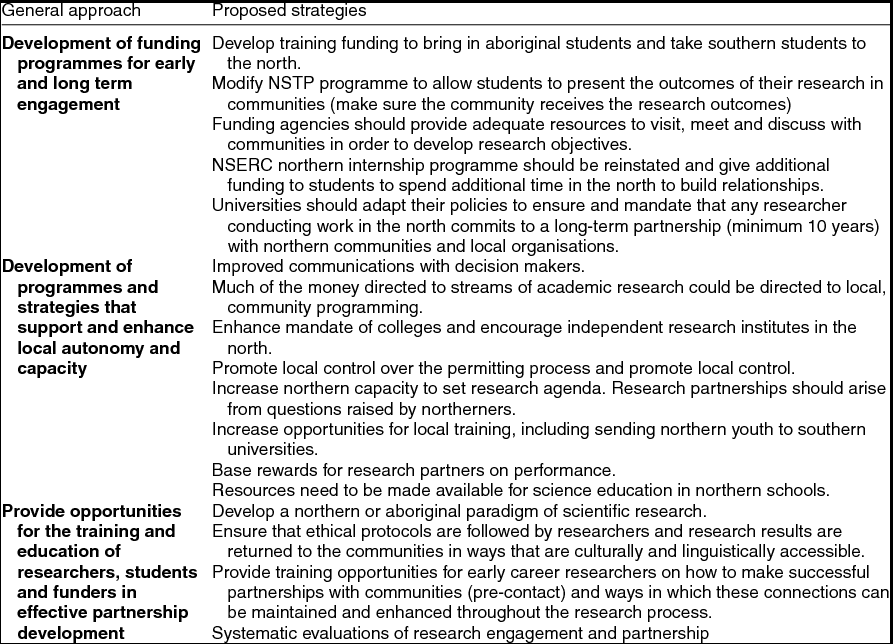
The results of the coding and content analysis based on the 30 qualitative responses provide interesting insights regarding the ways that federal research policy in Canada could ensure more effectively that the benefits of partnered approaches to northern research are maintained and enhanced over time. Responses revealed that three principal strategies could be placed in priority including the development of funding programmes for early and long-term engagement, the development of programmes that support and enhance local autonomy and capacity and further opportunities for the training and education of researchers, students and funders in areas such as effective partnership strategies and the respect of northern values and cultural protocols. Detailed responses also provided a number of specific suggestions (Table 5). Another important finding was that many stakeholders expressed some level of frustration regarding the maintenance or enhancement of benefits once programmes were completed, often noting that partnerships generally have a very limited legacy in partner communities.
Coding and content analysis of stakeholder opinions on policy strategies for research partnerships.
Discussion
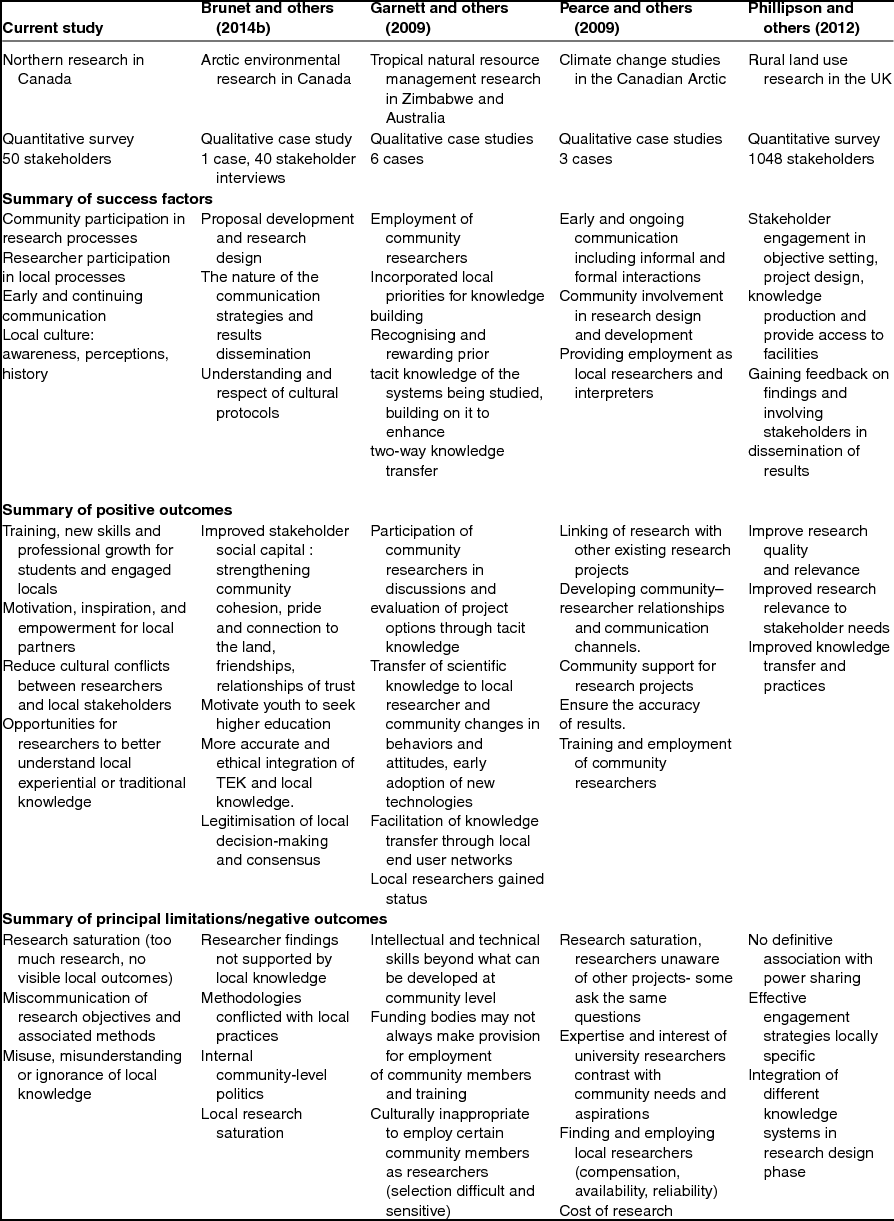
As few quantitative empirical studies have assessed participation (Abreu and others Reference Abreu, Grinevich, Hughes and Kitson2009; Phillipson and others Reference Phillipson, Lowe and Proctor2012), the perspectives of our diverse sample of research stakeholders across northern Canada provide important insights for policy and practice. While our sample was biased towards the perspectives of university-based researchers, the results do allow us to ground key aspects of the northern research policy discourse in Canada, which has been largely informed by qualitative case studies (Brunet and others Reference Brunet, Hickey and Humphries2014b; Gearheard and Shirley Reference Gearheard and Shirley2007; Pearce and others Reference Pearce, Ford and Laidler2009) and reviews and reports on research at the community or individual research project scale (Ford and others Reference Ford and Pearce2010; ITK and NRI 2007; Korsmo and Graham Reference Korsmo and Graham2002; Kruse and others Reference Kruse, White and Epstein2004; Nickels and others Reference Nickels, Furgal, Casteldon, Krupnik and Jolly2002; Parlee and Furgal Reference Parlee and Furgal2012; Pearce and others Reference Pearce, Ford and Laidler2009; Wolfe and others Reference Wolfe, Humphries and Pisaric2011; Wolfe and others Reference Wolfe, Armitage and Wesche2007). In order to help us draw out the main findings from our survey, we compared and contrasted our results with a selection of recent empirical research projects examining community-research partnerships in environmental research (see Table 6).
Comparative review of recent empirical research on community-researcher partnerships in environmental research.
Factors affecting community-researcher partnerships
Our results support the need for the early engagement of local partners at the research design and objective setting phases to ensure a successful partnership development process. For example, a community researcher and northern resident in the Yukon and NWT commented: ‘if they (researchers) speak to the community and develop their research questions with the community's concerns in mind and maintain the partnership throughout then the community does see that there is benefit’. According to Brunet and others (Reference Brunet, Hickey and Humphries2014b), local participation at this phase is often associated with dimensions of trust and power distribution, key elements of partnership development that have also been identified in numerous other contexts (Christopher Reference Christopher2005; Christopher and others Reference Christopher, Watts and McCormick2008; Fisher and Ball Reference Fisher and Ball2003; Weaver Reference Weaver1997).
Our results support other studies indicating that maintaining the benefits of collaborative research design and objective-setting throughout the research process is generally maximised through two important factors: employment of community researchers, guides, field assistants and the participation of researchers in local activities beyond research. Garnett and others (Reference Garnett, Crowley and Hunter-Xenie2009) stressed the importance of employing local stakeholders as co-researchers, noting that the interaction of researchers with local communities would have been minimal or impossible had the community researcher not been engaged. The dissemination of results was identified as another key priority for building successful partnership development by respondents, a finding supported by Brunet and others (Reference Brunet, Hickey and Humphries2014b) and Phillipson and others (Reference Phillipson, Lowe and Proctor2012) who identified that engagement of local participants in results dissemination through various means, from actual participation in disseminating results to providing feedback or being informed in a timely and transparent manner, were important.
Open-ended survey responses suggested that community research partnerships ‘increased local institutional capacity to plan, initiate, and manage research partnerships’; are important vehicles for the ‘empowerment of the community as a whole to be able to use scientific data to inform land management decisions and promote local stewardship (College/university student, field assistant, Yukon Territory) and may inspire some participants to pursue careers in science: ‘I had one youth say to me “Sometimes, you make me want to be a scientist’ (University student, Yukon Territory). Further, stakeholder participation was reported to improve not only the research but also university researcher capacity. Reported partnership outcomes for university researchers included: ‘Increased cultural sensitivity of researchers, and development of their skills to communicate across cultural and linguistic barriers’ and ‘these relationships often enrich the individual researcher’ (Territorial government representative, Nunavut). Based on the results from other studies (Table 6), there appears to be a degree of consensus that research partnerships are associated with improved local capacity to understand and use scientific information for management and planning purposes.
Our survey respondents attributed negative outcomes and limitations of community-researcher partnerships to a lack of long term commitment to partnership development, a poor process of results dissemination and integration of research into action and policy and a lack of coordination between studies that can lead to overuse of certain resources and people. Also mentioned were difficulties integrating or balancing inputs from local versus academic knowledge and the availability of reliable and skilled local help. There appears to be a need for more reflection on these issues in northern research policy from the national to the local level. Some of our respondents also mentioned having ‘difficulty “staying on the radar” of busy partners’ and ‘partners are very busy with many other commitments and are already over committed within work environments’ (University researcher, Nunavut). Overall, our results indicate that research is sometimes perceived as a disruption of local livelihood and traditional activities, a factor that warrants more explicit consideration in policies seeking to increase the level of interaction between researchers and communities.
Another important finding that emerged from our study was a general underlying lack of social capital (trust and reciprocity) between academic and local stakeholders. For example, a first nation resident and community researcher in our sample suggested that on the one hand there was a ‘lack of confidence in local researchers, elders, heritage workers, local experts, etc.’ as well as a ‘lack of belief in community ability to conduct research in a professional manner.’ On the other hand, another respondent believed there was ‘too much academic control over research - people coming into a community thinking they will help, when really they're just fulfilling their own objectives and/or academic requirements’ as well as ‘a lack of sincerity in research partnerships on the part of outside academics’ (College student, NWT and Yukon). Overall, issues related to bridging social capital (that is social ties that cut across differences such as race, class or ethnicity) (Sandler and Lowney Reference Sandler and Lowny2006) are known to be crucial to the success of research partnership strategies in indigenous contexts (Brunet and others Reference Brunet, Hickey and Humphries2014b) where many communities have been analysed, stereotyped and exploited by outside groups (Christopher Reference Christopher2005; Christopher and others Reference Christopher, Watts and McCormick2008; Fisher and Ball Reference Fisher and Ball2003; Weaver Reference Weaver1997). Interestingly, the development of bridging social capital between communities and researchers may ultimately be the most important benefit of, and limitation to, successful scientific research partnerships (Klenk and Hickey Reference Klenk and Hickey2013; Turpin and Garrett-Jones Reference Turpin and Garrett–Jones2009), and this is an area that requires further critical discussion and reflection in the context of Canada's northern research policy frameworks.
Strategies for strengthening community-researcher partnerships
Recognising the link between bridging social capital and partnership success (Christopher and others Reference Christopher, Watts and McCormick2008; Taylor Reference Taylor2000), our results from a diverse sample of stakeholders working in northern research suggest that policy in Canada (federal, provincial and local) could do more to support equity in partnership development by focusing more explicitly on the relational (that is quality) dimensions of research partnerships rather than on the structural (that is configuration). Partnerships in research generally require a decentralisation of power in order to strengthen trust between partners (Pain and others Reference Pain, Kesby and Askins2011). However, existing funding structures tend towards placing priority on questions of relevance to the government and the academic community, even though they also invite northerners to submit proposals (see for example CHARS 2014–2015). Southern-based researchers also play a prominent role in setting research agendas within government which can result in a lack of transparency concerning to whom certain priority research questions are actually important.
These questions relate to a broader discourse occurring in research and science policy internationally concerning the desirability (or not) of a move towards more ‘socially robust’ research (Gibbons Reference Gibbons1999), in which issues of power sharing, trust and reciprocity are central, issues recognised by many as a priority in Arctic research (Ford and others 2010; ITK and NRI 2007; Korsmo and Graham Reference Korsmo and Graham2002; Kruse and others Reference Kruse, White and Epstein2004; Nickels and others Reference Nickels, Furgal, Casteldon, Krupnik and Jolly2002; Parlee and Furgal Reference Parlee and Furgal2012; Pearce and others Reference Pearce, Ford and Laidler2009; Wolfe and others Reference Wolfe, Humphries and Pisaric2011; Wolfe and others Reference Wolfe, Armitage and Wesche2007). Such an approach requires a high degree of reflexivity in the policy and research frameworks that support research partnerships to enable continuous learning, adaptation and innovation in the nature of knowledge production and the roles of partners and collaborators (Hendriks and Grin Reference Hendriks and Grin2007; Klenk and Hickey Reference Klenk and Hickey2013; Klenk and Hickey Reference Klenk and Hickey2011). University-level policies and initiatives can contribute to this process. For example, a ten year partnership agreement between Wilfrid Laurier University and the Government of the Northwest Territories was established in 2010 to expand the territories’ capacity to conduct environmental research and monitoring, and to help train people with the new expertise needed to manage its natural resources (http://nwtwlu.com/). This partnership works to develop trust, in part, through collaborative research design which leads to research questions of relevance to northern partners (Brunet and others Reference Brunet, Hickey and Humphries2014b). It also seeks to build trust over time through its length and direct linkages with previous programmes.
Another factor identified in our study is the need for better targeted and long term funding and mechanisms that can support researchers and local stakeholders to develop social capital in support of successful research partnerships. This finding is supported by Christopher and others (Reference Christopher, Watts and McCormick2008), who identified a lack of funding for the initial stages of project development to be an important barrier to building trust in research partnerships (see also Minkler and others Reference Minkler, Blackwell and Thompson2003). Such mechanisms could include the funding of regular social networking events between researchers and interested communities, informal community-researcher festivals and community events. Through the International Polar Year 2007–2008 (http://www.ipy.org/), coordinators at the territorial and regional levels in Canada were hired to facilitate relationship building and logistics between the northern stakeholders and southern-based researchers. In Brunet and others (Reference Brunet, Hickey and Humphries2014b), this was found to be highly beneficial in developing early ties between partners, cultivating trust, and providing opportunities for collaborative proposal development. Another (now discontinued) initiative was the Northern Internships Program, which allowed students to spend long periods in northern communities, therefore developing important ties with partners (Wolfe and others Reference Wolfe, Humphries and Pisaric2011). The importance of this programme was also mentioned by our survey respondents (see Table 6). However, beyond their benefits for partnership development, longer term funding programmes have also been found to be sometimes poorly planned and unfocused, limiting opportunities for new researchers and local partners with new questions to access funds (Lindenmeyer and Likens Reference Lindenmayer and Likens2009). Such situations can lead to ‘rich get richer’ scenarios in the research community and among local partners.
There are also important barriers at the community level that have yet to be thoroughly explored in Canada's northern research policy frameworks. For instance, there is a tension between some territorial and local governments in terms of who controls access to sites and is responsible for issuing research permits. Many indigenous communities in Canada, through land claims processes, have obtained the right to govern ancestral lands. Territorial governments have often not shared or relinquished control over the permitting process for research. Therefore, indigenous communities sometimes take a position of opposition to research, declaring a potential for exploitation and invoking their right to reject research. Ultimately there will be a need for such conflict to be resolved with a view to empowering communities in the northern research enterprise.
Our survey results suggest that meaningful opportunities for northern community-driven research may still be missing in Canada, yet could go some way towards enhancing the benefits accrued through research partnerships by fostering varied forms of participation from different societal sectors in knowledge production and agenda setting processes. Providing local and/or community stakeholders access to funds and processes to assess and review the extent to which research funding allocations address their needs and interests could also work to improve the democratic legitimacy of northern academic studies (Klenk and Hickey Reference Klenk and Hickey2013; Real and Hickey Reference Real and Hickey2013). This is an area that would benefit from further research and critical reflection in Canada's diverse array of northern research policy.
Conclusion
In this study we sought better to understand some of the contemporary factors affecting community-researcher partnerships in Canada's north with a view to informing research policy at various scales. Our broad survey of northern research stakeholders provides additional empirical support for many case study-based findings that have been reported in the literature. Overall, researchers were perceived to benefit more from research partnerships than their community counterparts. This asymmetry is an overarching and critical limitation to effective partnership development. Our results suggest that partnerships need to be better supported by policies and frameworks that focus on building social capital and equity between partners in the research process. This may be achieved through the early engagement of stakeholders in research design and objective setting phases, the longer term employment of community researchers within and between research projects, and engagement in and transparency of results dissemination strategies.
Successful community-researcher partnerships in northern research will ultimately require greater decentralisation of power to strengthen social capital. This could be achieved by allowing non-academic principal investigators to receive funding, or by involving communities in research priority-setting, proposal review and funding allocation processes through councils or advisory groups. This is no simple task, challenging many of our most entrenched cultural, organisational and institutional norms and these issues are further compounded by an apparent lack of availability of interested local stakeholders. Real and Hickey (Reference Real and Hickey2013) found that promoting communication between local advisory groups or councils and academic interest groups and public funders is critical to ensuring the legitimacy and relevance of participatory mechanisms but is very difficult to achieve. Appropriate representation within such groups is also difficult to establish given the heterogeneity in goals, needs and aspirations of local stakeholders, raising issues regarding the selection of actors and their role in decision-making (Hall and others Reference Hall, Sulaiman and Clark2003). Ultimately, according to Bogner and others (2012), the decentralisation of power and control over research processes within a centralised context of funding and setting research priorities has been found to undermine the legitimacy of the participatory processes. Applying participatory principles to the development of northern research programmes is a significant challenge and will require much discussion and continued reflection between all stakeholders in order to ensure that policy frameworks are appropriate and feasible in diverse research contexts.
Acknowledgements
We would like to thank all of the participants in this study who took the time to respond to our survey. We are also grateful for the reviewer comments. Nicolas Brunet's research was supported by the Fond Québécois de Recherche sur la Société et la Culture, McGill University and the NSERC Northern Research Chairs programme.
Appendix 1. Survey questionnaire
Exploring perceptions regarding community- researcher partnerships in the Canadian north
Canada's northern research landscape has been changing, from greater use of participatory research methods and more stringent licensing procedures to new ethical requirements. This is challenging both researchers and stakeholders to consult, employ and communicate with northern communities and other local agencies. Research funding programmes and agencies have now adopted strategies promoting cross-cultural collaboration, public participation and local involvement in science. However, to date, relatively little research attention has been directed at understanding researcher-community partnership processes and outcomes in the north. This study seeks to better understand the benefits and challenges associated with northern research partnerships in Canada.
The aim in this survey is to build up a picture of the research partnership process from initial contact to project completion with a view to informing future northern research policy and practice. The findings of the survey should provide valuable insights to the factors that enable or constrain the success of community-researcher partnerships in the north.
We would be very grateful if you would assist us by completing this short on-line survey, consisting of multiple-choice and short answer questions. It should take no longer than 10–15 minutes and is completely anonymous.
Confidentiality:
This is an anonymous online survey. Your responses will not be associated with you or your organisation. The results from this survey will be disseminated in the form of a PhD dissertation and publication in peer reviewed journals. For further information related to the study, please contact Nicolas Brunet, Department of Natural Resource Sciences, McGill University, nicolas.brunet@mail.mcgill.ca; +1 514 398 7912; Gordon Hickey, Associate Professor, McGill University, gordon.hickey@mcgill.ca; +1 514 398 7214; or Murray Humphries, Associate Professor, McGill University, murray.humphries@mcgill.ca; +1 514 398 7885 If you have any questions or concerns about your rights or welfare as a participant in this research study, please contact the McGill Ethics Officer at 514-398-6831.
Informed Consent:
I understand that my participation in this study is entirely voluntary and that I may refuse to participate or withdraw from the study at any time. I understand that this survey is anonymous and that my name will not appear anywhere in the results of this survey. I consent to participate in this survey.
Please choose only one of the following:
• Yes
• No
Section 1:
1. Biographical Information
2. What is your gender?
• Male
• Female
3. What is your age?
• 18–25
• 26–35
• 36–45
• 46–55
• 56–65
• 65 and over
4. How many years of experience do you have conducting northern research or working with northern researchers in any capacity?
• 0–5
• 6–10
• 11–15
• 16–20
• 21–25
• 26–30
• 30 and over
5. Please select the role(s) that best represent your involvement in northern research.
Please choose all that apply:
• Federal government representative, employee
• Territorial government representative, employee
• Local government representative, employee
• University researcher (professor)
• Local/territorial college professor
• University/College student or post-doc
• Non-government organisation employee
• Other local northern organisation or association
• Community researcher
• Field assistant/guide
• Funding agency representative
• Community liaison
• Permitting body representative
• Northern community resident/member
• Other:
6. Which provinces or territories have you conducted northern research in?
Please choose all that apply:
• Yukon Territory
• Northwest Territory
• Nunavut
• British Columbia
• Manitoba
• Ontario
• Quebec
• Labrador
• Other:
Section 2: What makes research partnerships work?
In this section, we are seeking your opinion on the importance of the different components of the research partnership development process.
7. Based on your experience, please rank the following factors affecting successful research partnerships in order of importance. You may also add comments or new factors that are not listed.
Examples for each of the factors are provided below in the help section.
Please number each box in order of preference from 1 to 7
• Early and ongoing communication
• Community participation in research processes
• Researcher participation in local processes
• Community culture: awareness, perceptions, history
• Local- community capacity
• Geographic factors, characteristics of the natural environment
• Characteristics of academic research and researchers
Below are some examples for each aspect of the research process that we are asking you to rank:
Early and ongoing communication
• Local understanding and valuing of research objectives
• Transparency in results dissemination
• Local understanding of research methods including site selection, negotiation and adaptation in research design
Community participation in research processes
• Local participation in research design
• The Integration of local knowledge is essential in ensuring the success of research partnerships
• Community control over research process
• Community engagement in research design
Researcher participation in local processes
• The respect of local culture (such as researcher participation in community events, communication with elders)
• The respect of the local research process and cultural protocols
Community culture: awareness, perceptions, history
• A positive community history with researchers
• A positive local perception and treatment of outsiders (inc. researchers)
• A strong local attachment, connection to the land and ancestral culture
• A strong local concern over environmental change and sustainability
Local- community capacity
• The presence and engagement of community liaisons
• Self-government and strong local leadership
• The availability of trained local assistants and equipment
Geographic factors
• Adequate access and availability of places of interest for researchers in different fields
• Isolation, community size and remoteness
Characteristics of academic research and researchers
• Academic reward and merit systems and funding opportunities that support long-term partnership development and community engagement in research
• Academic programs and funding opportunities that support long stays in partner communities and informal interaction with local stakeholders
• The motivation of research directors (PI) and dedication of their students to the engagement process through sensitization and education
8. If you feel that there are other factors that are important to successful community-researcher partnerships that have not already been listed, please provide them here.
Section 3: The outcomes of research partnerships
Previous research suggests that a number of positive outcomes may be associated with successful collaboration between researchers and partner communities.
9. Based on your experience working in the north, please select and rank the five most important outcomes that you feel are associated with successful research partnerships.
Please select between 3 and 5 answers
Please number each box in order of preference from 1 to 17
Please choose at least 3 item(s)
Please choose no more than 5 item(s)
• Training, new skills and professional growth for students and engaged locals
• Motivation for pursuit of formal schooling for local youth
• Opportunities for new (for youth) or renewed connection to the land for some local partners
• Exposure to outside cultures/people for local partners
• Motivation, inspiration, and empowerment for local partners
• Opportunities for improving local understanding of science
• Increase local appropriation of research occurring in community
• Financial rewards for engaged community members
• Improve community cohesion
• Collaboration between researchers in different fields
• Resource sharing, logistical support and cost reduction
• Opportunities for researchers to better understand local experiential or traditional knowledge
• Opportunities for the conscientious integration of traditional and local knowledge and science
• More accurate results
• More useful knowledge locally (long term monitoring and sustainability, for instance)
• Reduce Power imbalances between researchers and community members
• Reduce cultural conflicts between researchers and local stakeholders
10. Are there any other positive outcomes that you generally associate with research partnerships?
Previous research also suggests that certain conflicts can arise during the development of research partnerships which can have negative effects on the research process.
11. Based on your experience conducting research in the north, please select and rank the five most important sources of conflict which can hinder the research partnership process.
Please select between 3 and 5 answers
• Local dependence on outsiders for financial viability
• Research saturation (too much research, no visible local outcomes)
• Lack of formal youth involvement
• Lack of recognition of local contributions
• Misuses of funding
• Inter-personal conflicts Lack of local trained help
• Low reliability of assistants and guides
• Loss of academic freedom because of overriding community objectives (bias in method selection, analysis and results)
• Misuse, misunderstanding or ignorance of local knowledge
• Divergent research objectives
• Miscommunication of research objectives and associated methods
12. Are there any other sources of conflict that you believe are important to consider in developing research partnerships?
13. To what extent do you believe that research partnerships between communities and researchers are beneficial to community (local) stakeholders?
Please select from the following choices. You may also add comments.
Please choose only one of the following:
• Not at all beneficial
• Slightly beneficial
• Moderately beneficial
• Very beneficial
• Extremely beneficial
• No opinion
Make a comment on your choice here:
14. To what extent do you believe that research partnerships between communities and researchers are beneficial to researchers?
Please select from the following choices. You can also add comments.
Please choose only one of the following:
• Not at all beneficial
• Slightly beneficial
• Moderately beneficial
• Very beneficial
• Extremely beneficial
• No opinion
Make a comment on your choice here:
15. This is the last question of our survey. Based on your experience, in what ways can Canada's research policy better ensure that the benefits of partnered approaches to Northern science are maintained and enhanced?
Thank you for taking the time to complete this survey. If you would like to receive a copy of the publication resulting from this research please contact Nicolas Brunet at nicolas.brunet@mail.mcgill.ca.