Significant outcomes
MIA is associated with long-term schizophrenia-like behaviour and elevated levels of IL-1β and increased expression of NLRP3 inflammasome.
Limitations
In this research, did not study all the potential mechanisms responsible for human long-term alterations, but only the isolated effect of MIA on neurocognitive impairment. In addition, the concept of sickness behaviour could help in elucidating some of the mechanisms associated with neurocognitive dysfunction after MIA.
Introduction
Brain development is defined as an elaborate process that occurs during the prenatal period. It is in this period that the first neural connections are formed (Knuesel et al., Reference Knuesel, Chicha, Britschgi, Schobel, Bodmer, Hellings, Toovey and Prinssen2014). In the course of brain development, any changes, such as maternal exposure to infectious or inflammatory insults, may compromise the development of foetal brain function (Bale Reference Bale2001). These insults during development may contribute to long-term changes in the brain that may persist into adulthood (Knuesel et al., Reference Knuesel, Chicha, Britschgi, Schobel, Bodmer, Hellings, Toovey and Prinssen2014).
In this context, studies showed that maternal immune activation (MIA) is associated with an increased risk of developing neuropsychiatric disorders in the offspring such as schizophrenia (Uhlhaas & Singer, Reference Uhlhaas and Singer2010; Fineberg & Ellman, Reference Fineberg and Ellman2013; Parboosing et al., Reference Parboosing, Bao, Shen, Schaefer and Brown2013; Jiang et al., Reference Jiang, Xu, Shao, Xia, Yu, Ling, Yang, Deng and Ruan2016; Trépanier et al., Reference Trépanier, Hopperton, Mizrahi, Mechawar and Bazinet2016; Scola & Duong, Reference Scola and Duong2017). Schizophrenia is characterised as a neurodevelopmental psychiatric disorder that affects 1% of the world’s population and patients with the diagnosis live on average 12–15 years less than the average lifetime (WHO, 2019). The symptoms usually begin in adolescence and early adulthood, leading to cognitive, social and operational deficits (Cuesta et al., 2015; Van and Kapur, 2009). According to the World Health Organization (WHO), in 2019, neurodesenvolviment and mood disorders will be, until 2030, the main compromising factors of the professional and social productivity of the population (WHO, 2019).
Studies have been demonstrated that patients diagnosed with schizophrenia have an imbalance in the immune response associated with changes in cytokine levels (Cohen et al., Reference Cohen, Solowij and Carr2008; Cuesta et al., 2015). The nod-like receptor pyrin domain-containing protein 3 (NLRP3) inflammasome is a cytoplasmic multiprotein complex of the innate immune system that can trigger a series of immune-inflammatory reactions. Once activated, NLRP3 recruits the adapter apoptosis-related speck-like protein (ASC), which contains a caspase recruitment domain and pro-caspase-1. The pro-caspase-1, in turn, proteolytically cleaves pro-interleukin (IL)-1β and pro-IL-18 into their active forms, thus aggravating the inflammatory reaction (Thornberry et al., Reference Thornberry, Bull, Calaycay, Chapman, Howard, Kostura, Miller, Molineaux, Weidner and Aunins1992; Pétrilli et al., Reference Pétrilli, Dostert, Muruve and Tschopp2007; Martinon et al., Reference Martinon, Mayor and Tschopp2009; Coll et al., Reference Coll, Robertson, Chae, Higgins, Munoz-Planillo, Inserra, Vetter, Dungan, Monks, Stutz, Croker, Butler, Haneklaus, Sutton, Núñez, Latz, Kastner, Mills, Masters, Schroder, Cooper and O’Neill2015). Some studies have suggested that NLRP3 inflammasome contributes to the development of the depressive disorder and memory impairment (Pan et al., Reference Pan, Chen, Zhang and Kong2014; Li et al., Reference Li, Wang, Qin, Qu and Ma2016; Sui et al., Reference Sui, Luo, Xu and Hua2016; Alcocer-Gómez et al., Reference Alcocer-Gómez, Casas-Barquero, Williams, Romero-Guillena, Cañadas-Lozano, Bullón, Sánchez-Alcazar, Navarro-Pando and Cordero2017). However, how NLRP3 inflammasome participates in schizophrenia-like behaviour associated with MIA is not clear.
Although the aetiology of schizophrenia is multifactorial and may involve intrinsic and extrinsic factors, it is suggested that the probability of developing schizophrenia is increased by ruptures in utero environment (Antonelli, Reference Antonelli2015). In particular, maternal inflammation during pregnancy is placed to play an important role in the pathogenesis of schizophrenia (Knuesel et al., Reference Knuesel, Chicha, Britschgi, Schobel, Bodmer, Hellings, Toovey and Prinssen2014). Some authors showed that MIA can be considered as a ‘disease primer’ to make an individual more susceptible to the effects of genetic mutations and environmental exposures in triggering disease-related symptoms later in life. Several maternal cytokines have been identified as critical mediators of MIA on disease-related phenotypes in offspring (Meyer, Reference Meyer2014; Ayhan et al., Reference Ayhan, McFarland and Pletnikov2016). In this context, it is not still totally clearly known how maternal cytokines alter foetal brain development. Thus, it is necessary to understand the involvement of NLRP3 inflammasome in schizophrenia-like behaviour, hypothesising that MIA may result in changes in the inflammatory profile along with brain development and exacerbate schizophrenia-like behaviour in the juvenile offspring.
Material and methods
Animals
Male and female adult C57BL/6 mice from our breeding colony were used for the experiments. All procedures were approved by the Animal Care and Experimentation Committee of UNISUL/Brazil 18.002.4.01.IV and were in accordance with the National Institute of Health Guide for the Care and Use of Laboratory Animals (NIH publication no. 80-23), revised in 1996.
Maternal immune activation
Initially, the animals were mated and kept in a cage overnight (from 6:00 to 8:00 p.m.) at the rate of one female for each male. The next day, the presence or absence of a vaginal plug was evaluated. In the case of vaginal plug formation, this day will be defined as day 0 gestational (G0). On the 15th gestational day (defined as G15), females were received an i.p. injection of lipopolysaccharide (LPS) (Escherichia coli 026: B6). The LPS was dissolved in phosphate-buffered saline (PBS) at a storage concentration of 150 μg/ml. To induce the MIA model in mice, the i.p. injection had 50 μg/kg of LPS in 100 μl of PBS. The same equivalent volume of PBS was injected into the animals of the control group. Animals were monitored daily after LPS injection for signs of vaginal bleeding, weight loss or unhealthy behaviour, such as increased temperature and immobility (Meyer et al., Reference Meyer, Murray, Urwyler, Yee, Schedlowsk and Feldon2008).
Design
The day the animals were born was defined as P0. A part of the animals, when completing 7 and 14 days postnatal (P7 and P14), underwent an assisted painless death, receiving an injection of an excessive dose of anaesthetic (40 mg/kg of pentobarbital; intraperitoneally). The brain was dissected and stored at −80°C for further biochemical analysis. Another part of the animals, upon completing 21 days of life, were left in the original housing box and were sexing. Separated into females and males, the animals were conditioned in boxes containing five animals where they would remain with the same care described above. When they had completed 45 days (P45), they were submitted to behavioural tests.
After the end of the behavioural tests, the animals were submitted to an assisted painless death, receiving an injection of an excessive dose of anaesthetic. The brain was dissected and stored at −80°C for biochemical analysis. In this context, the animals were divided into six experimental groups: (1) PBS 7P, (2) PBS 14P, (3) PBS 45P, (4) 60LPS 7P, (5) LPS 14P e and (6) LPS 45P. The decision to start the experiments at these ages was based on the literature to conduct a longitudinal evaluation in the offspring exposed to LPS in their prenatal life. These studies have shown that major behavioural changes are observed when the offspring reach late adolescence or early adulthood, recapitulating clinical and biochemical observations related to schizophrenia (Zhang et al., Reference Zhang, Cazakoff, Thai and Howland2012). Recent studies have shown that there is an increase in the expression of TLR-2 and TLR-4 receptors in the amygdala only 45 days after birth and an increase in IL-1β levels in the amygdala only 7 days after birth (Zhang et al., Reference Zhang, Cazakoff, Thai and Howland2012).
Behaviour tests
Open field test
The behavioural test of habituation to the open field was carried out in an apparatus called open field, with 40 cm × 60 cm surrounded by walls of 50 cm of height, being three walls of wood and one of transparent glass. The open field floor has squares designed to mark the quadrants to be crossed. This behavioural test refers to all activities related to obtaining information about the environment, which encompass not only immediate reflex responses but also typical voluntary responses. The adoption of this type of test has a clear convenience for the ease of behavioural registration when compared to the study in the natural environment. The basic assumption involved in confinement studies in a new environment is that, to explore the environment, the animal needs to move around in it. In this way, the amount of movement becomes an indicator of exploratory activity. The exploratory response of standing up on the front (rearing) legs is also very common in rodents and has been used as a measure of the level of excitability since this behaviour often correlates with other activities such as defence, sexual reactions and motor activity (crossing), where the number of quadrants that the mouse traverses is quantified.
Stereotyped movements
Stereotyped movements are defined as rapid and repetitive movements of the head and forearm. The behaviours evaluated were sniffing, grooming (self-cleaning movements), swinging head, biting nails and walking in circles. For the test, one animal was placed at a time in the box for evaluation. The animals were observed 1 h for 1 min at intervals of 10 min (Faro & Fenner, Reference Faro and Fenner1998).
Social interaction
Before the social interaction test, the animals were socially isolated for 6 h. The social interaction test consists in placing two animals from different boxes (same experimental group) in a 41 cm × 34 cm × 16 cm polypropylene box for 15 min. During this period, three criteria were evaluated: latency for the first interaction among animals, number of interactions and the total time that the animals remained together (File & Seth, Reference File and Seth2003).
Biochemical analyses
L-1β levels
IL-1β levels in the hippocampus were measured by anti-IL-1β sandwich-ELISA kit, according to the manufacturer instructions (Chemicon, USA). Briefly, the rat brain was homogenised in a phosphate-buffered solution with 1 mM phenylmethylsulfonyl fluoride and 1 mM EGTA. Microtiter plates (96-well flat-bottom) were coated for 24 h with the samples diluted 1 : 2 in sample diluent and standard curve ranging from 7.8 to 500 pg/ml of IL-1β. The plates were then washed four times with sample diluents, and monoclonal anti-IL-1β rabbit antibody diluted 1 : 1000 in sample diluent was added to each well and incubated for 3 h at room temperature. After washing, a peroxidase-conjugated anti-rabbit antibody (diluted 1 : 1000) was added to each well and incubated at room temperature for 1 h. After the addition of streptavidin enzyme, substrate and stop solution, the amount of IL-1β was determined by absorbance at 450 nm. The standard curve demonstrates a direct relationship between optical density and BDNF concentration. Total protein in the hippocampus was measured by the BCA method, using bovine serum albumin as a standard.
NLRP3 quantification for western blot
Samples (50 μg) were macerated in RIPA buffer and denatured at 100°C for 5 min and then electrophoresed on polyacrylamide gel (SDS-PAGE 12%) for 1 h and 30 min at 110 V, followed by transfer to PVDF membrane. After the transfer, blocking the membrane in TBS buffer containing 0.2% Tween 20 (TBST) and 5% albumin (1 h) thereafter, the primary antibody (antibody rabbit polyclonal anti-NLRP3, 1 : 1000 in blocking buffer), which will remain under agitation for 2 h, and as a loading control, anti-beta-actin (1 : 10 000) was used. After this time, the secondary anti-rabbit and anti-mouse in-frame antibody (Uniscience) diluted in TBST (1 : 20 000, 30 min) was added. After this procedure, the membrane was then photo-documented (Odyssey LI-COR Biosciences) and densitometry performed by Image Studio (LI-COR Biosciences).
Statistical analysis
The Statistical Package for the Social Sciences 15.0 was utilised for statistical analyses. All data were presented as mean ± SEM (the data were normally distributed). Differences among experimental groups were determined by student t-test. p-Values < 0.05 were considered statistically significant.
Results
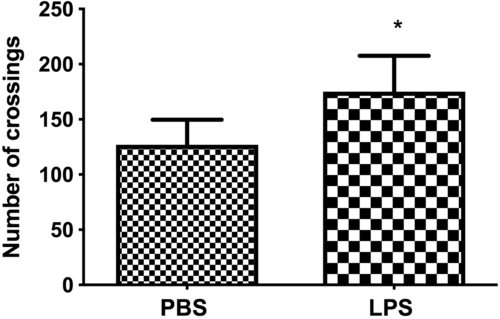
Fig. 1 shows the locomotor activity data obtained in the open field test. It was observed that, at 45 days old, the animals exposed to LPS in the gestational period had a significantly higher number of crossing when compared to the control animals, demonstrating an increase in locomotor activity (t = 3.431; df = 14; p = 0.0041).
Locomotor activity. Data are expressed by the mean and standard deviation. *p < 0.05 versus PBS.

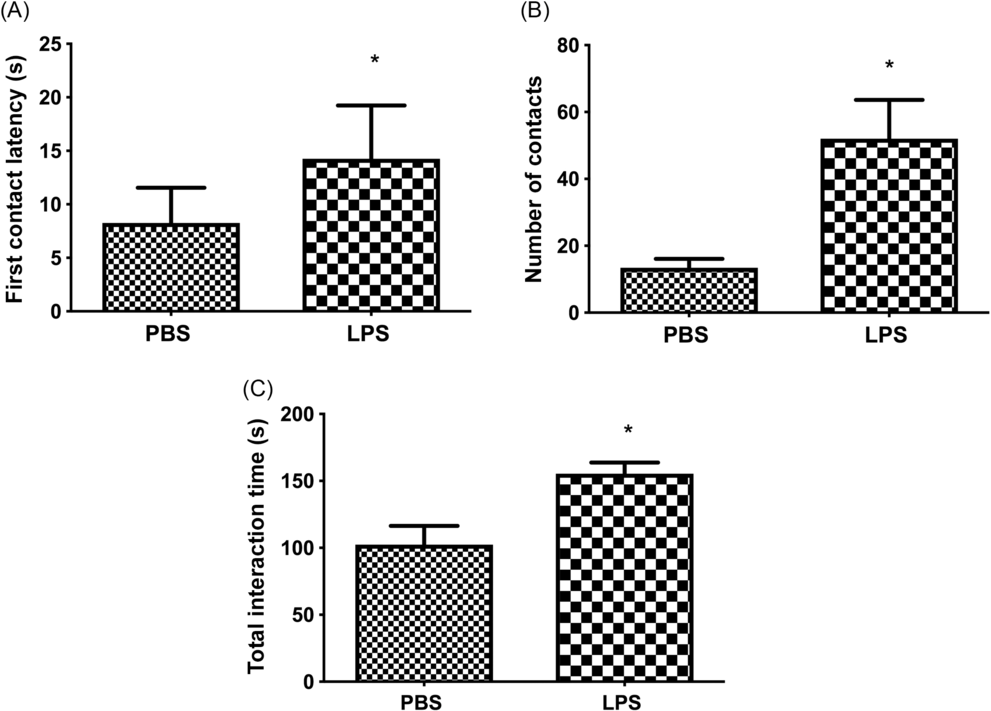
Fig. 2 demonstrates the results obtained in the social interaction test through first contact latency (Fig. 2(A)), the number of contacts (Fig. 2(B)) and total interaction time (Fig. 2(C)) between the LPS and PBS animals at 45 days old. It was observed that there was a statistically significant increase in the latency time of the first contact of the group exposed to LPS in the gestational period when compared to the control animals (t = 2.005 df = 6; p = 0.0918; Fig. 2(A)). Regarding the number of contacts, there was a significant increase in the group of animals exposed to LPS in the gestational period (t = 9.674 df = 10; p = 0.0001; Fig. 2(B)). Finally, in the total time of interaction, there was a significant increase in the animals exposed to LPS in the gestational period, when they completed 45 days of life, and when compared to the animals that received only PBS (t = 5.292 df = 10; p = 0.0004; Fig. 2(C)).

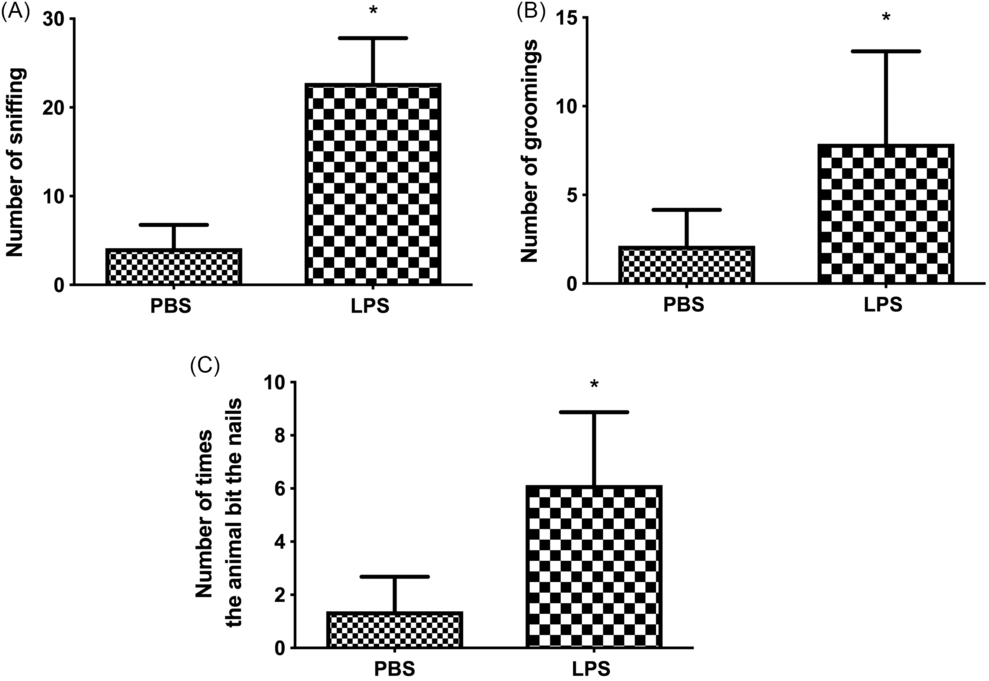
Fig. 3 expresses the results of stereotyped movement tests by the number of sniffing (Fig. 3(A)), the number of groomings (Fig. 3(B)) and the number of times the animal bit the nails (Fig. 3(C)) between the animals of the LPS and PBS group upon completing 45 days of life. It was observed that the animals exposed to LPS in the gestational period demonstrated an increase in the number of sniffing (t = 9.223 df = 14; p ≤ 0.0001; Fig. 3(A)), grooming (t = 2.903 df = 14; p = 0.0116; Fig. 3(B)) and the number of nail bites (t = 4.417 df = 14; p = 0.0006; Fig. 3(C)) when compared to the PBS group, demonstrating an increase in the amount of stereotyped movements in the animals at 45 days exposed to LPS in the gestational period. With regard to the data on the number of times the animals swung their heads and the number of times they circulated on the axis, it can be observed that the animals exposed to LPS in the gestational period presented only 1 balance and 15 circulations while the group of control animals did not present this type of behaviour (data not shown in graphs).

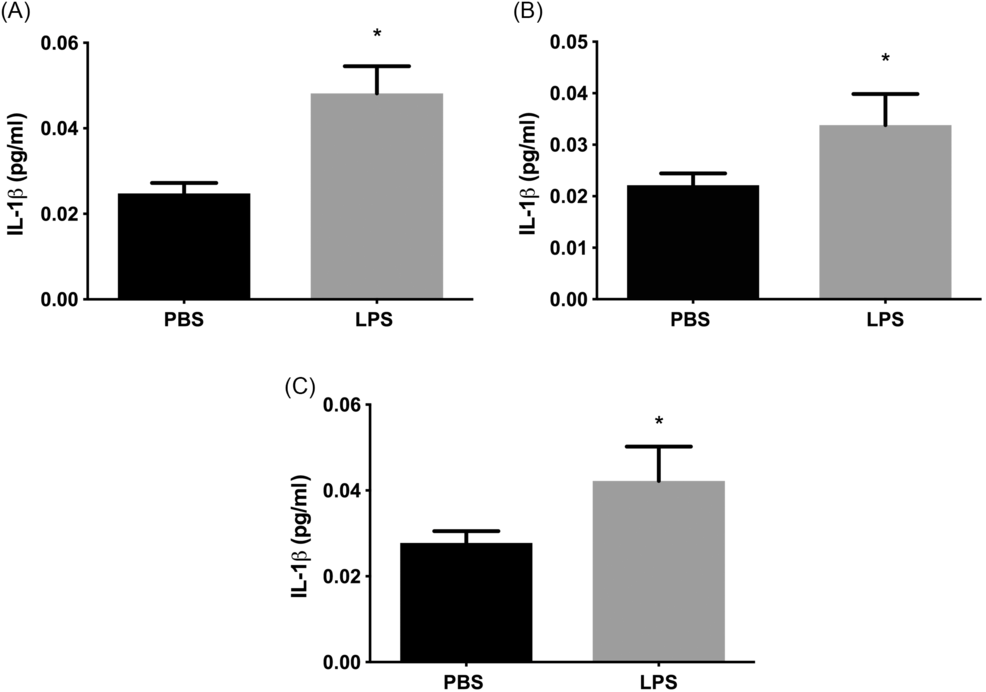
Fig. 4 documented the IL-1β levels. At 7 postnatal days, there was a significant increase in IL-1β levels in the brain tissue of animals exposed to LPS in the gestational period when compared to the control group (t = 7.656 df = 8, p = 0.0001; Fig. 4(A)). After 14 (t = 4.026 df = 8, p = 0.0038; Fig. 4(B)) and 45 (t = 3.804 df = 8, p = 0.0052; Fig. 4(C)) postnatal days, it can be observed that this increase was maintained in the animals exposed to LPS in the gestational period when compared to the control animals.

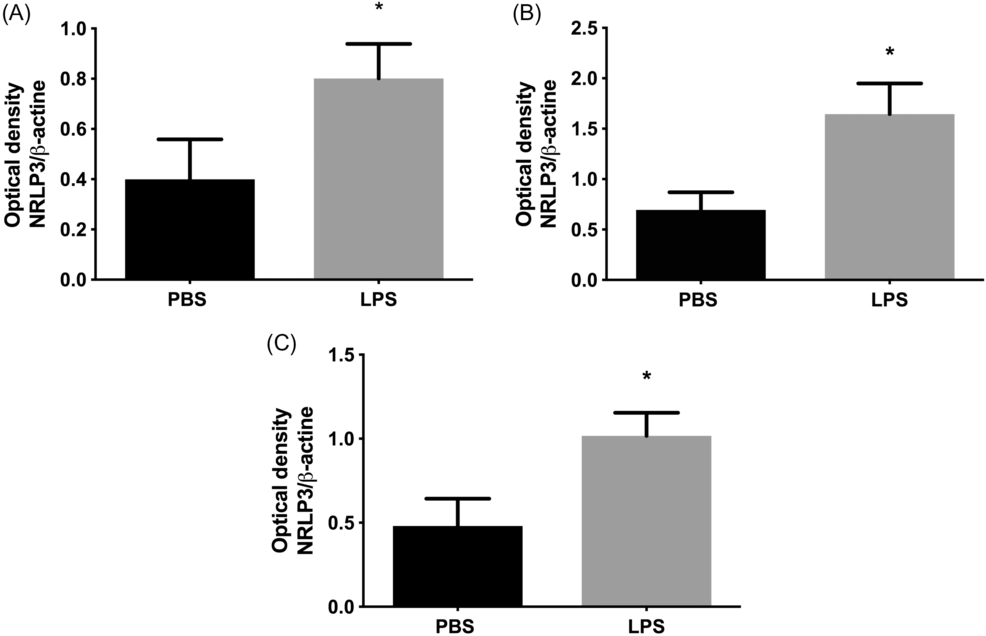
Data from analyses of the quantification of NLRP3 inflammasome can be visualised in Fig. 5. There was an increased quantification of inflammasome in brain tissue of animals exposed to LPS in the gestational period after 7 (t = 3.824 df = 6, p = 0.0087; Fig. 5(A)), 14 (t = 4.705 df = 4, p = 0.0093; Fig. 5(B)) and 45 postnatal days (t = 4.364 df = 4, p = 0.0120; Fig. 5(C)) when compared to control animals.

Discussion
In summary, it has been observed that MIA is associated with schizophrenia-like behaviour, increased in the IL-1β levels and NLRP-3 inflammasome expression in the brain tissue. The association between maternal systemic inflammation and the pathogenesis of psychiatric disorders has been reported in the literature (Maki et al., Reference Maki, Veijola, Jones, Murray, Koponen, Tienari, Miettunen, Tanskanen, Wahlberg, Koskinen, Lauronen and Isohanni2005; Meyer & Feldon, Reference Meyer and Feldon2010). The activation of the maternal immune system, regardless of the specific cause, may be responsible for the outcome in the offspring (Boksa, Reference Boksa2010; Bauman et al., Reference Bauman, Iosif, Smith, Bregere, Amaral and Patterson2014; Murray et al., Reference Murray, Bhavsar, Tripoli and Howes2017).
Evidence suggests that maternal immune response is the central key for the predisposition to neurodevelopmental disorders; however, the pathophysiology of this response is still unclear (Borrell et al. Reference Borrell, Vela, Arevalo-Martin, Molina-Holgado and Guaza2002 Ashdown et al., Reference Ashdown, Dumont, Ng, Poole, Boksa and Luheshi2006; Boksa, 2010; Meyer & Feldon, Reference Boksa2010). In this study, it was reported that animals exposed to MIA on the 15th gestational day caused changes in locomotor activity, social behaviour and stereotypy in offspring after 45 days of birth. In the literature, it is possible to observe that the MIA is associated with long-term behavioural changes such as locomotor hyperactivity (Fortier et al., Reference Fortier, Joober, Luheshi and Boksa2004; Zuckerman & Weiner, Reference Zuckerman and Weiner2005; Kirsten et al., Reference Kirsten, Taricano, Maiorka, Palermo-Neto and Bernardi2010; Baharnoori et al., Reference Baharnoori, Bhardwaj and Srivastava2012) and cognitive and social interaction deficits in the offspring (Harvey & Boksa, Reference Harvey and Boksa2012; Taylor et al., Reference Taylor, Veenema, Paul, Bredewold, Isaacs and de Vries2012; Lavelle et al., Reference Lavelle, Healey and McCabe2014). Our results, as well as those found in the literature, reinforce the hypothesis that MIA may be related to the schizophrenia-like behaviour in young animals.
In addition to behavioural changes, an increase in IL-1β levels and NLRP-3 expression in short- and long-term brain tissue was observed. These findings may be associated with the vulnerability that the brain presents during the development. Studies have shown that cytokines play an essential role in modelling synapses not only in adulthood but also especially during development (Smith et al., Reference Smith, Li, Garbett, Mirnics and Patterson2007; Cunningham et al., Reference Cunningham, Stansfield, Patel, Menon, Kienzle, Allan and Huston2013). Studies with rodents have established that perinatal exposure to proinflammatory cytokines can lead to neural changes that resemble those observed in schizophrenia, including altered morphology of pyramidal cells and elevated levels of activated microglia (Tanaka et al., Reference Tanaka, Ide and Shibutani2006; Boksa, Reference Boksa2010; Weir et al., Reference Weir, Forghany and Smith2015). Clinical studies have demonstrated an increased risk of schizophrenia among children exposed to high levels of proinflammatory cytokines in maternal serum (Buka et al., Reference Buka, Tsuang, Torrey, Klebanoff, Bernstein and Yolken2001; Brown et al., Reference Brown, Begg, Gravenstein, Schaefer, Wyatt and Bresnahan2004; Eller et al., Reference Eller, Bunch, Wantland, Portillo, Reynolds, Nokes, Coleman, Kemppainen, Kirksey, Corless, Hamilton, Dole, Nicholas, Holzemer and Tsai2010; Meyer, Reference Meyer2013; Miller et al., Reference Miller, Culpepper, Rapaport and Buckley2013).
High levels of IL-1β are associated with schizophrenia and it is released when there is an activation of NLRP3. The activation occurs when LPS counts, inducing caspase-1 cleavage and transcription of IL-1β and IL-18 cytokines (Mariathasan et al., Reference Mariathasan, Weiss, Newton, McBride, O’Rourke, Roose-Girma, Lee, Weinrauch, Monack and Dixit2006; Bauernfeind et al., Reference Bauernfeind, Horvath, Stutz, Alnemri, MacDonald, Speert, Fernandes-Alnemri, Wu, Monks, Fitzgerald, Hornung and Latz2009; Compan et al., Reference Compan, Baroja-Mazo, López-Castejón, Gomez, Martínez, Angosto, Montero, Herranz, Bazán, Reimers, Mulero and Pelegrín2012; Ramos et al., Reference Ramos, Lanteri, Blahnik, Negash, Suthar, Brassil, Sodhi, Treuting, Busch, Norris and Gale2012). An additional study compared the expression of NLRP3-related proteins in postmortem brain tissue from patients diagnosed with bipolar disorder and schizophrenia where they found elevated levels of NLRP3 and ASC in mitochondrial fractions derived from the frontal cortex (Kim et al., Reference Kim, Andreazza, Elmi, Chen and Young2016). Activation of NLRP3 inflammasome may be responsible for maintaining a persistent neuroinflammatory state in the CNS and be associated with behavioural changes.
The literature suggests that the NLRP3 inflammasome may contribute to the development of mood disorder and memory impairment (Zhang et al., Reference Zhang, Cazakoff, Thai and Howland2012). A recent preclinical study demonstrated that NLRP3 activation is associated with a depression-like behaviour and an increase in IL-1β, IL-18 and TNF-α levels, a decrease in IL-10 levels and an increase in activation of microglia in brain tissue (Zhu et al., Reference Zhu, Cao, Feng, Chen, Wan, Lu and Wang2017). In this study, it was shown that the changes in cytokines and in the expression of the inflammasome started 7 days after the birth of the offspring and extended up to 45 days. It is important to emphasise that at 45 postnatal days, the animals showed a schizophrenia-like behaviour. The increase in the long-term IL-1β levels observed in this study may be due to the activation of NLRP3 inflammasome in the offspring.
Data suggest that although MIA leads to a variety of behavioural changes consistent with schizophrenia in offspring, the mechanism of these changes may be a consequence of more subtle changes in cytokine effects on neural plasticity during development, which would also justify the high levels of cytokine during the period in which the infectious focus was no longer available (Meyer, Reference Meyer2013; Miller et al., Reference Miller, Culpepper, Rapaport and Buckley2013; Ratnayake et al., Reference Ratnayake, Quinn, Walker and Dickinson2013). In the present study, it was concluded that MIA is associated with long-term schizophrenia-like behaviour and elevated levels of IL-1β due to increased expression of NLRP3 inflammasome in the brain tissue from the early days of life. This evidence may base future studies on the relationship between neuroinflammation and psychiatric disorders.
Authors contributions
L.V. conceived of this study, participated in the design of the study and drafted the article; V.F., V.B.T., P.D., M.L.D. and B.B.S. participated in the design of the study and performed experimental analyses; A.D.S. and C.M.C. participated in the design of the study and drafted the article.
Financial support
This research was supported by grants from UNISUL (CMC) and FAPESC (CMC).
Conflict of interest
None of the authors or funding sources have conflict of interest.
Ethical standards
The authors assert that all procedures contributing to this work comply with the ethical standards of the relevant national and institutional guides on the care and use of laboratory animals.