Introduction
Sex difference in occupational choice and participation has been a topic of scientific interest for quite some time. The proportion of women’s participation relative to men varies across a range of occupations (Manning et al. , Reference Manning, Reimers, Baron-Cohen, Wheelwright and Fink2010). Although socio-cultural factors are generally held responsible for this sex-biased distribution across occupations, biological factors, e.g. sex hormones, have also been implicated in these differential gender-associated choices. Among children aged 6–10 years, the preference for male-type play has been shown to have a positive association with testosterone level in amniotic fluid prenatally (Auyeung et al., Reference Auyeung, Baron-Cohen, Ashwin, Knickmeyer, Taylor, Hackett and Hines2009). Females with congenital adrenal hyperplasia (CAH), having been exposed to higher than normal prenatal androgen levels, and adult females affected with CAH, have been found to have a significantly higher inclination towards male-typed toys, leisure activities and occupations from childhood through adulthood, compared with females without CAH (Cohen-Bendahan et al., Reference Cohen-Bendahan, van de Beek and Berenbaum2005; Frisén et al., Reference Frisén, Nordenström, Falhammar, Filipsson, Holmdahl and Janson2009). Occupational differences in testosterone concentration have indeed been reported between different types of professionals (Dabbs et al., Reference Dabbs, Alford and Fielden1998). White et al. (Reference White, Thornhill and Hampson2007) found that individuals with higher testosterone levels and family business backgrounds were more likely to create new business ventures. The scientific literature also provides strong support for androgen influences on interest in occupations characterized by working with things versus people (Beltz et al., Reference Beltz, Swanson and Berenbaum2011).
The causes of differential prenatal exposure to testosterone could be genetic or environmental (Manning et al., Reference Manning, Bundred, Newton and Flanagan2003). For example, mothers’ exposure to sunlight or the length of day during early gestation might affect fetal androgen levels (Szwed et al., Reference Szwed, Kosinska and Manning2017). However, a proxy indicator of this prenatal testosterone exposure is the relative length of the second (2D) to fourth digit (4D) in an individual. Males tend to have longer 4D relative to 2D compared with females, with some overlap between the sexes. Thus in general, males have lower second-to-fourth digit length ratios (2D:4D) than females (Manning et al., Reference Manning, Scutt, Wilson and Lewis-Jones1998; Cohen-Bendahan et al., Reference Cohen-Bendahan, van de Beek and Berenbaum2005). This ratio correlates negatively with prenatal testosterone and positively with prenatal oestrogen levels (Manning et al., Reference Manning, Scutt, Wilson and Lewis-Jones1998; Zheng & Cohn, Reference Zheng and Cohn2011). Experimental studies on animals have also reported this association (Zheng & Cohn, Reference Zheng and Cohn2011; Auger et al., Reference Auger, Le Denmat, Berges, Doridot, Salmon, Canivenc-Lavier and Eustache2013). The 2D:4D gets fixed in a relatively short developmental period at the end of the first trimester of prenatal development (Malas et al., Reference Malas, Dogan, Evcil and Desdicioglu2006; Galis et al., Reference Galis, Ten Broek, Van Dongen and Wijnaendts2010). After this it does not change substantially with age and is little affected by puberty (McIntyre et al., Reference McIntyre, Ellison, Lieberman, Demerath and Towne2005). Therefore, 2D:4D is thought to contain information on the relative amounts of testosterone and oestrogen in this narrow ‘window’ of fetal development from about the 8th to 10th weeks of gestation. In this critical period of prenatal growth the sex steroids exert ‘organizational’ effects on organ systems such as the brain, skeleton, muscles and circulatory system (Durdiakova & Ostatnikova, Reference Durdiakova and Ostatnikova2011; Zheng & Cohn, Reference Zheng and Cohn2011).
Sex-biased personality traits exhibited in later life, such as assertiveness and risk-taking behaviour, have been found to be associated with exposure to a higher concentration of prenatal testosterone (Manning & Taylor, Reference Manning and Taylor2001; Manning et al., Reference Manning, Reimers, Baron-Cohen, Wheelwright and Fink2010). Hines (Reference Hines2000) found that females exposed to an increased level of prenatal testosterone or other androgens demonstrated behaviours typical of males later in life. Greater physical and athletic prowess has very often been found to be associated with a lower (masculine) digit ratio (Voracek et al. , 2006; Hönekopp & Schuster, Reference Hönekopp and Schuster2010; Zhao et al., Reference Zhao, Yu, Zhang and Zheng2013). Risk-taking behaviour, which shows a positive male bias (Daruvala, Reference Daruvala2007; Ball et al., Reference Ball, Eckel and Heracleous2010), has been linked with prenatal hormone exposure (Apicella et al., Reference Apicella, Dreber, Campbell, Gray, Hoffman and Little2008) and also with lower 2D:4D (Garbarino et al., Reference Garbarino, Slonim and Sydnor2011; Hönekopp, Reference Hönekopp2011). The 2D:4D has been negatively associated with an enterprising nature and interest in male-dominated jobs (Weis et al., Reference Weis, Firker and Hennig2007) and sensation- and/or thrill-seeking behaviour (Fink et al., Reference Fink, Neave, Laughton and Manning2006; Austin et al., Reference Austin, Manning, McInroy and Mathews2012; Koziel et al., 2013). Lower 2D:4D has been associated with choice of participation in individual rather than group sports among Polish men (Koziel et al., Reference Koziel, Kociuba, Ignasiak and Chakraborty2016) and with choosing to participate in specific types of sports among Polish women (Kociuba et al., Reference Kociuba, Kozieł and Chakraborty2016). Brosnan (Reference Brosnan2006) demonstrated that there was a significant difference in 2D:4D between faculties of science and social science departments. A lower digit ratio among women has also been found to be associated with ‘male-typical’ jobs in a range of occupations (Manning et al., Reference Manning, Reimers, Baron-Cohen, Wheelwright and Fink2010; Kociuba et al., Reference Kociuba, Kozieł and Chakraborty2016).
In view of these background findings indicating a strong relationship between sporting and occupational choices and 2D:4D in different populations, including Polish people (Kociuba et al., Reference Kociuba, Kozieł and Chakraborty2016, Reference Kociuba, Kozieł, Chakraborty and Ignasiak2017), the aim of this cross-sectional study was to examine whether 2D:4D differed between police officers and students on civil courses in Poland. It was hypothesized that police officers would have a lower 2D:4D than the civil students irrespective of gender.
Methods
Subjects and setting
This cross-sectional study included 147 male and 55 female police officers with a mean (SD) age of 33.86 (5.45) and 34.09 (5.07) years, respectively. In addition, 91 male and 75 female control students on civil courses at the General Kościuszko Military Academy of Land Forces (GKMALF) in Wrocław (mean age 29.87 (4.93) years and 22.57 (2.99) years, respectively) were included in the study. Written permission for the study was obtained from the Provincial Chief of Police and the authority of the GKMALF before commencing the study. Written consent from all participants was also obtained. Ethical guidelines according to the Helsinki Declaration were adhered to (Goodyear et al., Reference Goodyear, Krleza-Jeric and Lemmens2007). The study was conducted in October 2015 and September–October 2016. Measurements were taken from the police officers before 12 noon in a sports hall during an annual test of physical fitness. The control groups were measured during their physical education sessions. Three males and one female were later excluded from the study due to injuries to their digits.
Police officers in Poland, as a rule, have to undergo rigorous tests of physical ability during the recruitment process. They have to pass an agility obstacle course test consisting of eight exercises: forward rolls of body, back rolls of body, carrying a 20 kg weighted manikin, steeplechase, five 3 kg weighted medicine ball throws of a distance of at least 5 m, ten sit-ups with a 2 kg weighted medicine ball handed over the head, getting over four gymnastic boxes with a height of 1.1 m and shuttle run of 10×5 m. The agility obstacle course and time limits were set equally and evaluated for male and female candidates. Additionally, every police officer needs to pass an annual physical fitness test, which includes: a 3 kg (2 kg for women) weighted medicine ball throw, 30-second sit-ups in a lying position, a shuttle run and a 1000 m (800 m for women) run.
The civil course students who served as controls did not need a mandatory standard of physical ability, or to undergo any fitness tests. They had a normal student life as a civilian and tended to opt for normal civilian jobs (Kociuba et al., Reference Kociuba, Kozieł and Chakraborty2016). The civil student data were used as control for two reasons. First, the student group on civil courses at the GKMALF were, more or less, representative of the general Polish population. The civil course is not specialized for any military or similar physically challenging job bearing relatively high risk of life or a job requiring particularly higher physical fitness or agility. Potentially, civil students can work in various civil jobs in their future careers. Secondly, there was a logistic advantage to measuring the study variables in this student group in a controlled setting, rather than among the general population. In particular, the GKMALF had the infrastructure to conduct physical fitness tests. The differences in height and BMI between groups, nevertheless, were statistically controlled, since these variables were included in analysis.
Anthropometry
Body height was measured with a stadiometer to the nearest 1 mm and body weight with a standardized digital scale to the nearest 1g following standard protocols. During the measurement session the subjects wore light garments. The lengths of the second and fourth digits of each hand were measured to the nearest 0.1 mm by a trained physical anthropologist (MK) using a digital caliper (TESA SHOP-CAL). Finger lengths were recorded on the ventral surface of the hand, from the mid-point of the basal crease (most proximal to palm) to the tip of the digit (Manning et al., Reference Manning, Scutt, Wilson and Lewis-Jones1998). The measurement of every tenth person was repeated in order to assess the intra-observer error, which accounted for 0.35 mm and 0.31 mm and 0.35 mm and 0.29 mm for second and fourth digits of the right and left hands, respectively. The hand grip strength (HGS) of both hands was measured using a standard isometric dynamometer (Saehan Corporation, South Korea). The subject held the dynamometer in the hand being tested, with the arm freely dropping along trunk but without contact with the body. The base of the instrument rested on the first metacarpal, and the handle on the middle of the four fingers. The subject squeezed the dynamometer with maximum isometric effort for about 2 seconds. No other body movement was allowed. The test was repeated twice for each hand and the better result was recorded with an accuracy of 1 kg for each hand.
Statistical analysis
Differences in means of digit ratios between the police and control groups within each sex were assessed using Student’s t-test for independent samples. Two-way analysis of variance was used to assess the significance of differences in means of digit ratios between sex and police/control group and the significance of the second-order interaction between sex and groups. Tukey’s test for unequal sample size was used for post hoc comparison. Additionally, analysis of covariance was employed, where digit ratio was the dependent variable and police/control group was the independent factor. Height, BMI and HGS were set as covariates. This analysis was implemented using the Generalized Linear Model with logit function separately by sex. All calculations were done using Statistica version 13.1.
Results
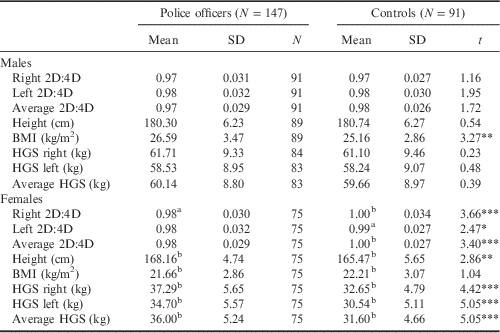
The descriptive statistics of all the biological measures are presented in Table 1. Both the policemen and policewomen had a significantly higher age than the control males and females, respectively (males: t=5.68; p<0.001; females: t=16.21; p<0.001) (results not shown). Male police officers also had a higher mean BMI than the control males (t=3.27, p<0.01). Females showed significant differences in all features, between the police officers and the controls, except for BMI. Female police officers showed significantly lower digit ratios than the control females in both hands and also in the average of the two hands. The former were also taller and had greater HGS in both hands, compared with the latter. Interestingly, male and female police officers differed slightly in their right hand digit ratio but not in their left hand or average for two hands digit ratios, whereas the control group showed significant differences in all digit ratios, with higher values for females.
Descriptive statistics of police officers compared with control student groups

Difference between police officer and control groups within each sex: *p<0.05; **p<0.01; ***p<0.001.
Difference between males and females within police officer and control groups: a p<0.05; b p<0.001.
HGS: hand grip strength.
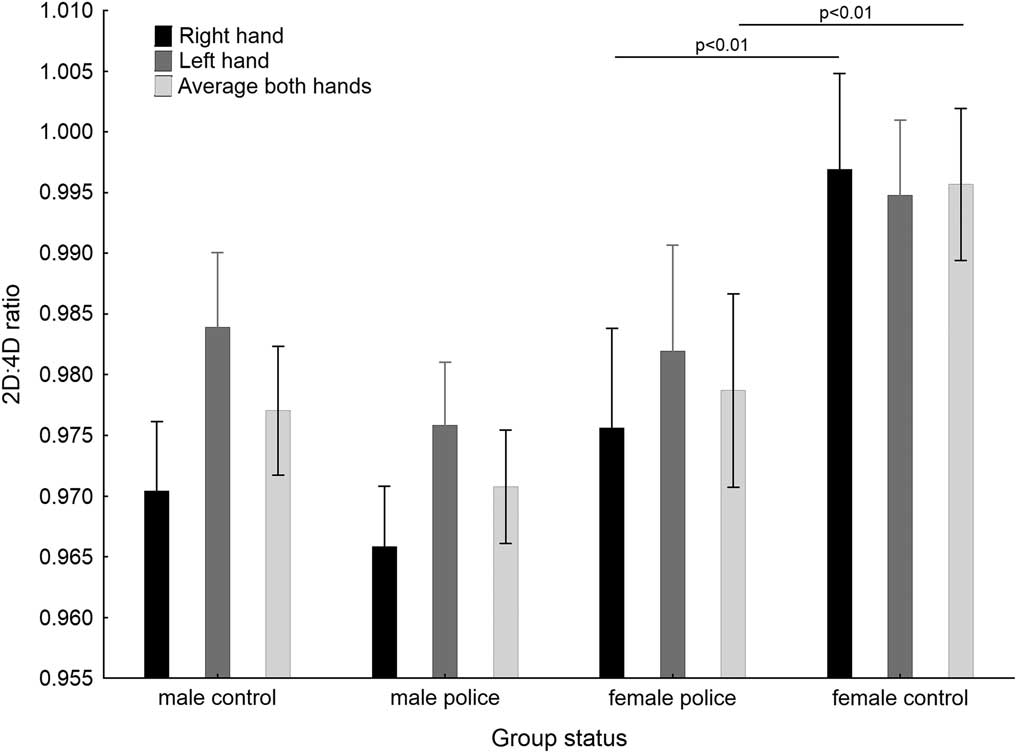
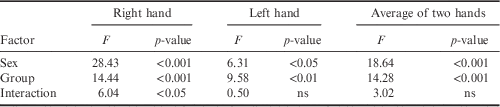
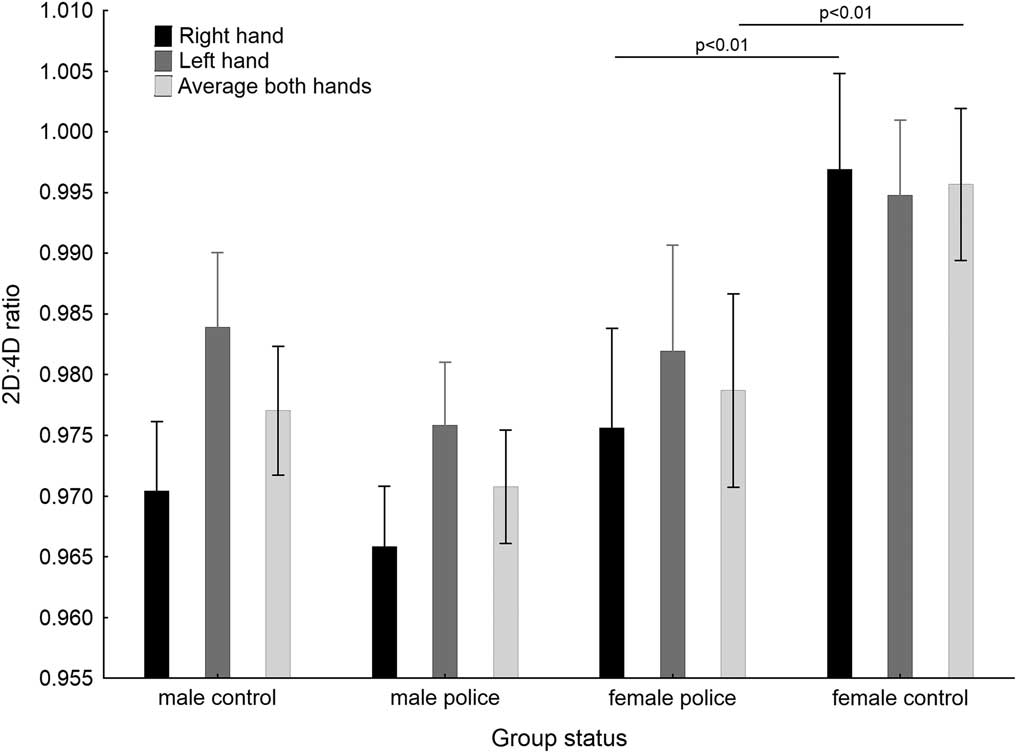
The results of the two-way analyses of variance showed that sex as well as group had a significant effect on right, left and average 2D:4D (Table 2). Thus, the 2D:4D differed by both sex and group. However, there was a significant second-order interaction by sex and group only for the right hand digit ratio. This implies that the statistical difference in the right hand 2D:4D between the groups was not independent of sex. Tukey’s post hoc test was used for comparisons between groups within each sex (i.e. male police vs male controls and female police vs female controls). This showed a significant between-group difference in females for both the right hand and average 2D:4D, but not in males (Fig. 1).
Results of post hoc analyses of variance showing mean values (±95% CI) of the right hand, left hand and average of both hand 2D:4D ratios.
Results of univariate two-way analysis of variance showing significance of difference in 2D:4D by sex and group (police officers vs civil students)
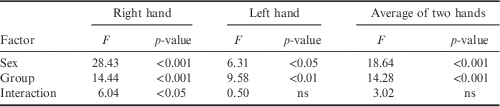
Dependent variable: 2D:4D; ns: not significant.
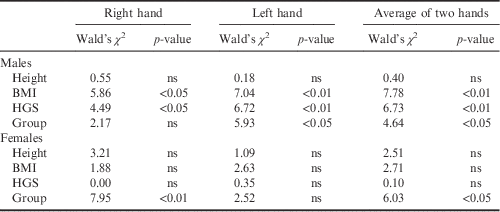
The results of the covariance analyses (Table 3) showed that, even after controlling for height, BMI and HGS, the differences in the 2D:4D for the right hand and the average of both hands between police officers and control groups persisted among females. However, height, BMI and HGS showed no significant effect on 2D:4D in either hand or on the average ratio in females. However, in the case of males, the effects of HGS and BMI were also significant. This is interesting since the male groups differed only in BMI, which was higher in police officers. In this analysis, males, however, showed significant group difference in 2D:4D for the left hand and for the average of the two hands, after allowing for BMI and HGS.
Results of the ANCOVA by Generalized Linear Model with 2D:4D as the dependent variable, group (control vs police) as the independent variable and height, BMI and hand grip strength (HGS) as covariates
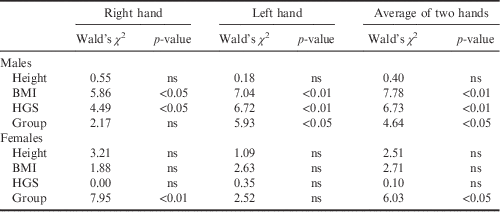
ns, not significant.
Discussion
This study investigated whether the 2D:4D ratio differed between police officers and a selected control group of civilians from the general Polish population, and assessed the sex variation of any difference. Both the policemen and policewomen had a higher mean age than their counterparts in the control group. Although small changes in digit ratio have been reported during childhood growth (Manning et al., Reference Manning, Trivers, Thornhill and Singh2000; Trivers et al., Reference Trivers, Manning and Jacobson2006), and there have been some exceptional results showing a limited effect of age on the right hand digit ratio in a small sample of adults (van Dongen, Reference Van Dongen2009), several other studies have established that the 2D:4D does not change substantially with age (Manning et al., Reference Manning, Scutt, Wilson and Lewis-Jones1998), even in children (Manning et al., Reference Manning, Stewart, Bundred and Trivers2004), and is little affected by the pubertal spurt (McIntyre et al., Reference McIntyre, Ellison, Lieberman, Demerath and Towne2005). The present study was on adults, and so the age difference between groups was not considered to be important enough so as to affect the group differences (police vs control and male vs female) in digit ratio. The results showed that the female police officers had a significantly lower 2D:4D in the right hand and also in the average of the two hands compared with the female civil students. The former were also taller and had stronger hand grips in both hands than the civil females. In general, the 2D:4D was not significantly different between the police and the control groups of males (Table 1). However, the male and female police officers differed slightly only in the right hand digit ratio but not in the left hand or average 2D:4D of two hands. On the other hand, the control group showed a significant sex difference in all digit ratios, with higher (feminine) mean values in females. Manning and Taylor (Reference Manning and Taylor2001) showed that professional athletes as a group had a lower 2D:4D than local general population controls, whereas Voracek et al. (Reference Voracek, Pum and Dressler2010) did not find a lower 2D:4D in fire-fighters compared with a local control group.
In Poland, more men than women are reportedly enrolled in the police force; women constitute about 15% (ENP, 2017). A low 2D:4D has been found in individuals in male-dominated occupations, and this finding has been shown to be particularly prominent among females, suggesting that prenatal testosterone might have a stronger relationship with occupational choice in women than in men (Govier, Reference Govier2003; Manning et al., Reference Manning, Reimers, Baron-Cohen, Wheelwright and Fink2010). A lower 2D:4D has been found to be associated with more enterprising careers among women (Weis et al., Reference Weis, Firker and Hennig2007). In the present Polish sample, the expected sex difference in 2D:4D (i.e. a lower ratio among males) was markedly prominent among civil students, but not in police officers. In police officers, compared with civilians, the difference between males and females was only slightly evident in the right hand ratio only. Among the civil students, in contrast, the sex difference was much stronger in the right hand and in the average ratio, and also significant for the left hand ratio. It is worth mentioning here that the right 2D:4D may be more sensitive to fetal testosterone (Szwed et al., 2017). Some studies have found the gender difference in 2D:4D to be more pronounced in the right hand than in the left (Ertuğrul, 2013; Zhao et al., Reference Zhao, Yu, Zhang and Zheng2013). In other words, the sex difference in 2D:4D was found to be diminished among police officers. A recent study has demonstrated similar findings, where the sex difference in 2D:4D was only significant among civil students but not in students on a more challenging military training course (Kociuba et al., Reference Kociuba, Kozieł and Chakraborty2016).
Weis et al. (Reference Weis, Firker and Hennig2007) related low 2D:4D to a ‘masculinized’ score for career interests for both males and females according to different scales. As regards a job in the police force, it is probably beyond doubt that this carries a much higher risk than other civil occupations. The choice of a career as a police officer might also indicate a thrill- or sensation-seeking attitude. The process of selection for this job is also highly competitive in terms of physical ability and endurance. A lower (masculine) 2D:4D has very often been found to be associated with activities and performances requiring greater physical strength: for example, higher hand grip strength in Chinese males (Zhao et al., Reference Zhao, Yu, Zhang and Zheng2013). Performance in endurance running has been found to be associated with a low 2D:4D in both men and women (Hönekopp & Schuster, Reference Hönekopp and Schuster2010). In the present sample, the policewomen had a higher hand grip strength and a lower 2D:4D than the civil women. The personality measures of competitiveness and sensation-seeking have also been found to be higher, not only in males compared with females (Franken et al., Reference Franken, Hill and Kierstead1994), but also in females with higher testosterone levels (Cashdan, Reference Cashdan2003). Men have been shown to exhibit less risk aversion than women in economic experiments (Daruvala, Reference Daruvala2007; Ball et al., Reference Ball, Eckel and Heracleous2010). Prenatal testosterone has definite ‘organizational’ effects on the brain during its early development and thus determines behaviour to a great extent (Zheng & Cohn, Reference Zheng and Cohn2011). Intrauterine hormone exposure has indeed been suggested to be linked with risk-taking behaviour in later life (Apicella et al., Reference Apicella, Dreber, Campbell, Gray, Hoffman and Little2008). A lower 2D:4D has been frequently shown to be associated with risk-taking behaviour. An online study indicated that self-reported risk-taking was linked with a lower right hand 2D:4D among German women (Hönekopp, Reference Hönekopp2011). Association of a higher 2D:4D with a dislike of or aversion to higher risk has also been found even within one sex; the involvement with higher financial risk has been associated with a lower 2D:4D within each sex, but the sex difference disappeared at both extremes of 2D:4D values (Garbarino et al., Reference Garbarino, Slonim and Sydnor2011). Kociuba et al. (Reference Kociuba, Kozieł, Chakraborty and Ignasiak2017) showed that voluntary participation in relatively high-risk sports was associated with lower 2D:4D in Polish females independent of their physical ability. Trivers et al. (Reference Trivers, Hopp and Manning2013) found that the association between lower 2D:4D and endurance was stronger among Jamaican females compared with males.
Besides the above-mentioned qualities, the personality of a police officer is expected to include attitudes of dominance and fearlessness. Fear-reducing properties, status-seeking and social dominance in humans have been linked to testosterone (Eisenegger et al., Reference Eisenegger, Haushofer and Fehr2011). Exposure to high levels of prenatal testosterone might also promote higher risk-taking to achieve status and social dominance by reducing fear and stress responses linked with challenging and risky jobs such as the military service (Huh, Reference Huh2012). A lower 2D:4D in police officers than the civil controls was therefore expected, and a significantly lower value was indeed found in the present study. The normally expected sex difference in 2D:4D was significant only among the controls. However, the results also revealed that in females, hand grip strength also significantly predicted group difference in right, left and average digit ratios, with a higher value in policewomen compared with the control females. However, in males, the effect of hand grip strength was not statistically significant. These findings together suggest that there was a group difference in the 2D:4D in females independent of physical strength. The overall trend of these results corresponded well with those of Kociuba et al. (Reference Kociuba, Kozieł and Chakraborty2016) among Polish military and civil cohorts, which showed that the sex difference in digit ratio was markedly reduced among police officers. However, in their study, the difference in 2D:4D between the cohorts was only significant in females. In the present study the difference in the right hand 2D:4D between police officers and civil students was only evident among the women, and not the men. It is worth mentioning here that the 2D:4D has consistently been shown to have more dimorphism in the right hand than in the left in humans (Manning et al., Reference Manning, Scutt, Wilson and Lewis-Jones1998; Williams et al., Reference Williams, Pepitone, Christensen, Cooke, Huberman and Breedlove2000; McFadden & Shubel, Reference McFadden and Shubel2002). Several studies on the relationship between 2D:4D and psychological factors have demonstrated a stronger or sole effect on the right hand 2D:4D (Williams et al., Reference Williams, Pepitone, Christensen, Cooke, Huberman and Breedlove2000; Csatho et al., Reference Csatho, Osvath, Bicsak, Karadi, Manning and Kallai2003a, Reference Csatho, Osvath, Karadi, Bicsak, Manning and Kallaib). It has also been suggested that the androgenization process affects the right hand more than the left (Williams et al., Reference Williams, Pepitone, Christensen, Cooke, Huberman and Breedlove2000; McFadden & Shubel, Reference McFadden and Shubel2002; Brown et al., Reference Brown, Finn, Bradley and Breedlove2002). Therefore the presence of a right hand 2D:4D difference between groups in women but not in men seemed to be more important than the left hand difference between the groups among males.
The most plausible explanation for the diminished sex difference in 2D:4D among the police officers and the right hand 2D:4D difference among policewomen and civil women could be the previously proposed hypothesis of a two-stage selection process in the case of females who choose professions like the military or police service (Kociuba et al., Reference Kociuba, Kozieł and Chakraborty2016). First, females attributed with higher physical ability and a motivation to choose challenging jobs might have opted to join the police force. Among these females, in the next stage of the selection process, those with higher endurance, physical strength and fitness succeed in getting admitted in the force. Indeed, the female police officers in this study showed significantly higher mean hand grip strength than the female civil students. This was not the case for males. Thus the female police officers having ‘masculine’ physical qualities did not have as much difference in their 2D:4D as their male counterparts.
Choosing a challenging job by women is not usual in most cultures. Females often encounter social and psychological prejudices and inhibitions before taking such unconventional decisions. This phenomenon is closely equivalent to a theoretical concept known as the ‘female-athlete paradox’, applied in the case of choosing high-risk sports by females (Dworkin, Reference Dworkin2001; Krane et al., Reference Krane, Waldron, Michalenok and Stiles-Shipley2001). In fact, in another recent study among Polish women, a preference for high-risk martial art rather than routine aerobic exercise was found to be associated with a lower 2D:4D, which might be linked to a higher relative impulsivity and disinhibition as components of sensation-seeking behaviour (Kociuba et al., Reference Kociuba, Kozieł, Chakraborty and Ignasiak2017). Perhaps the psychological threshold of deciding to opt for a high-risk profession could be higher for females compared with men. Besides, selection in such occupations needs a genuinely higher standard of physical performance to surpass the culturally constructed and socially predominant negative perception about the female gender. Thus females with considerably higher ‘masculine’ qualities were found more among the police officers than among the civil women. They thus showed a lower mean 2D:4D than the civil women.
In conclusion, the present study showed an association between 2D:4D, an indicator of differential fetal exposure to prenatal testosterone, and choice of occupation. Persons choosing or being selected for the police service were found to have a higher probability of having a relatively low 2D:4D compared with the general population. The association between low 2D:4D and an inclination towards male-dominated jobs requiring greater relative fitness and physical endurance were particularly prominent among the study females. These empirical findings are a further indication of a higher possibility of women with a lower 2D:4D being in typically male-dominated professions (Manning et al., Reference Manning, Reimers, Baron-Cohen, Wheelwright and Fink2010; Kociuba et al., Reference Kociuba, Kozieł and Chakraborty2016). Further research on the development of choice in growing children and adolescents with reference to 2D:4D could reveal the causal relationships between these factors.
Acknowledgments
The authors thank the Provincial Chief of Police, Wrocław, the Chancellor and authority of the General Kościuszko Military Academy of Land Forces, Wrocław, the Polish Academy of Science and all the participants in the study.