Introduction
Male-perpetrated intimate partner violence (IPV) is internationally recognized as a fundamental violation of women's health and human rights and affects a large proportion of women and girls throughout the world (United Nations General Assembly, 1993; WHO & London School of Medicine and Tropical Hygiene, 2010). Two recent multi-country studies on violence against women indicate that 15–75% of women experience physical and/or sexual violence by an intimate partner at some point in their lives (Garcia-Moreno et al., Reference Garcia-Moreno, Jansen, Ellsberg, Heise and Watts2006; Hindin et al., Reference Hindin, Kishor and Ansara2008). Within India, IPV is widespread and has been linked to adverse physical, sexual and mental health consequences (for a synthesis of available evidence see Jejeebhoy et al., Reference Jejeebhoy, Santhya and Acharya2010). Current estimates from a national survey indicate that 35% of married women aged 15–49 had experienced physical violence from their current or former husband over the course of their married lives (IIPS & Macro International, 2007).
Reflecting the growing global emphasis on the prevention and control of IPV, studies in the past decade have examined the specific risk or protective factors associated with martial violence in India and have found factors such as low household economic status, low level of education, young age at marriage and dowry requests after marriage to be associated with an increased risk of reported partner violence (Jejeebhoy & Cook, Reference Jejeebhoy and Cook1997; Verma & Collumbien, Reference Verma and Collumbien2003; Koenig et al., Reference Koenig, Stephenson, Ahmed, Jejeebhoy and Campbell2006; Jeyaseelan et al., Reference Jeyaseelan, Kumar, Neelakantan, Peedicayil, Pillai and Duvvury2007; Ackerson et al., Reference Ackerson, Kawachi, Barbeau and Subramanian2008; Rocca et al., Reference Rocca, Rathod, Falle, Pande and Krishnan2009). To date, the overwhelming majority of research on risk factors for IPV in India and other parts of the world has focused on identifying individual and household risk factors in general; less research has been conducted specifically on the role of socio-cultural factors in influencing the risk for IPV victimization.
Past research shows that in many regions of South Asia, social and familial norms create a climate of disempowerment that often lead to marginalization of women (Krishnan, Reference Krishnan2005; Khosla et al., Reference Khosla, Dua, Devi and Sud2005; Naved et al., Reference Naved, Azim, Bhuiya and Persson2006), yet studies examining the role of such norms on risk of IPV victimization remain sparse. Son preference is a common socio-cultural norm in many South Asian countries, including India (Stash, Reference Stash1996; Arnold et al., Reference Arnold, Choe and Roy1998; Jayaraman et al., Reference Jayaraman, Mishra and Arnold2009). Prior research has identified some important social, religious and economic reasons that may potentially contribute to the presence of son preference in these countries, such as the financial and labour contributions of sons to the family, their perpetuation of the family name (Arnold, Reference Arnold, Sathar and Phillips2001), inflow of wealth due to dowries received upon their marriages (Das Gupta et al., Reference Das Gupta, Zhenghua, Li Bouha and Chung2003) and their sole entitlement to perform certain religious ceremonies (Vlassoff, Reference Vlassoff1990). Past studies document the adverse consequences of son preference such as excess female child mortality and poor health of girls relative to boys, including access to preventive care (Basu, Reference Basu1998; Borooah, Reference Borooah2004; Pande & Astone, Reference Pande and Astone2007). Studies in the past have examined the demographic manifestations of son preference, including the slowing of the transition towards achieving a low fertility pattern (couples bear children till they have sons) (DasGupta & Bhat, Reference DasGupta and Bhat1997; Clark, Reference Clark2003); increased use of sex-selective abortion and female infanticide (Sudha & Rajan, Reference Sudha and Rajan1999); and skewed population sex ratios at birth (Visaria & Visaria, Reference Visaria and Visaria1995; DasGupta & Bhat, Reference DasGupta and Bhat1997).
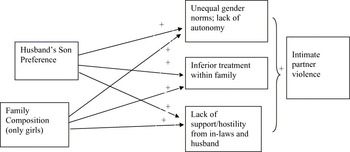
Despite this evidence, studies examining the influence of son preference on health and well-being of women, including their risk of IPV victimization, are limited. The few studies from South Asia that have been conducted on this issue are limited to qualitative studies that examine the impact of family composition on the status of women within the family (Winkvist & Akhtar, Reference Winkvist and Akhtar2000; Rodrigues et al., Reference Rodrigues, Patel, Jaswal and de Souza2003; Bose & South, Reference Bose and South2003; Hussain & Khan, Reference Hussain and Khan2008). The qualitative evidence from these studies clearly documents that societies in which son preference is highly prevalent, not having a son influences the status and well-being of the woman in numerous ways such as lack of support and/or hostility from her husband and in-laws (Rodrigues et al., Reference Rodrigues, Patel, Jaswal and de Souza2003), increased risk for non-consensual sex (Hussain & Khan, Reference Hussain and Khan2008) and marriage dissolution (Bose & South, Reference Bose and South2003). Clearly, failure to bear a son can compromise the health and well-being of women in societies characterized by son preference. Further and more detailed investigation of this issue is critically needed to identify the key risk factors that impact the status and health of women in such societies.
Past research has also investigated the role of actual family composition in influencing women's risk of IPV victimization. Evidence from these studies, however, is mixed; for instance, a few studies conducted in India found the presence of living male children as being protective against risk for IPV victimization (Schuler et al., Reference Schuler, Hashemi, Riley and Akhter1996; Rao, Reference Rao1997; Mitra, 2006). However, other studies do not corroborate these findings (Jejeebhoy, Reference Jejeebhoy1998; Srinivasan & Bedi, Reference Srinivasan and Bedi2007). While these studies add to our understanding about the relationship between family composition and IPV, they are limited in their scope since they are based on evidence from rural India and are therefore not generalizable to other parts of the country.
Given the plausibility of a positive association between son preference and risk of IPV victimization among women in India, it is important to evaluate whether such as association is present across a nationally representative population-based sample. The present study seeks to build upon the small but growing body of research on the role of socio-cultural factors in influencing women's health by quantitatively examining the role of son preference in impacting women's risk for physical and sexual IPV in India. The present study uses data from the latest National Family Health Survey (2005–06) to investigate the association between husband's son preference and sex composition of children on wife's risk for IPV victimization.
Methods
Data source
Cross-sectional data from the Indian National Family and Health Survey-3 (2005–06) were used for this study. This is a nationally representative population-based survey conducted in all 29 states of India by the International Institute for Population Sciences and Macro International from November 2005 to August 2006. Participants were selected through a stratified, multistage, cluster sampling design. Within each state a two-staged process was adopted for rural areas and a three-stage one for urban areas. In rural areas, the first stage consisted of the selection of primary sampling units (PSUs), which are villages, with probability proportional to the population size (PPS), followed by the random selection of households within each PSU at the second stage. For urban areas the following procedure was adopted: first, wards were selected with PPS sampling; next, one census enumeration block (CEB) was randomly selected from each sample ward and finally, households were randomly selected within each selected CEB. Using these procedures, 3850 primary sampling units were identified.
Confidential questionnaires were administered verbally to male and female participants separately by trained personnel and administered in either English or the principal language of each Indian state, depending on the preference of household members (IIPS & Macro International, 2007). Household-based recruitment was conducted by trained research assistants, who obtained written informed consent immediately before data collection. Using these steps, 131,596 eligible women aged 15–49 years were identified, of which 124,385 completed the survey (response rate 95%; 124,385 of 131,596). Of these, 85,373 eligible men aged 15–54 years were identified, and 74,369 completed the survey (response rate 87.1%; 74,369 of 85,373). The present analytic sample was restricted to husband–wife dyads. The NFHS-3 did not explicitly sample husband–wife dyads; instead, male participants' responses were matched to those of their married female partners in order to create a sample of husband–wife dyads (n=39,257) subsequent to data collection. The analytic sample was further restricted to dyads for whom IPV survey information was available and to couples, if having any children, whose last child was born 12 months prior to the survey (n=26,850). This was done in order to ensure temporal ordering of the key exposure variable; the measure of violence (violence in the past 12 months) was preceded by birth of children, enabling more effective testing of whether sex composition of children led to violence within marriage. The final sample size was 26,284 husband–wife dyads, after exclusion of 566 dyads based on incomplete information on outcomes or any other pre-specified covariates. Overall 2% of the data were excluded because of missing information.
Measures
Outcome measures
Intimate partner violence victimization status in the past 12 months was assessed via a self-report in accordance with recommendations from the World Health Organization (WHO, 2001). A positive answer to any of the following items indicated IPV victimization from the husband in the last 12 months: ‘push you, shake you, or throw something at you’; ‘slap you’; ‘punch you with a fist or something harmful’; ‘kick, drag, or beat you up’; ‘try to choke or burn you on purpose’; ‘threaten or attack you with a knife, gun, or any other weapon’; ‘physically force you to have sexual intercourse with him even when you did not want to’; or ‘force you to perform any sexual acts that you did not want to’. A binary variable was created to define IPV if the respondent reported ‘yes’ to any of the items described above.
Exposures
A major addition to the NFHS-3 was that of questions to men on fertility preferences, ideal and actual number of children and preference for sons or daughters. Men who had living children at the time of the survey were asked: ‘If you could go back to the time you did not have any children and could choose exactly the number of children to have in your whole life, how many would that be?’ Those who responded to either question with a number were then asked the follow-up question: ‘How many of these children would you like to be boys and how many would you like to be girls?’ Responses were entered as a number of boys, girls, either or other response. A binary variable was created to assess husband's son preference, with husband reporting a desire for one or more sons greater than the number of daughters coded as ‘yes’, and those reporting preference for either sex or ‘daughter preference’ coded as having ‘no’ son preference. The NFHS-3 asked each woman about all her living children. A categorical variable with three categories was created: only daughters, only sons and mixed households.
Covariates. The following pre-specified socioeconomic and demographic variables were included: wife's age, wife's education, husband's education, urban/rural status, religion, caste and wealth index. Caste refers to legislatively defined marginalized classes and includes the following four categories: scheduled caste (SC), scheduled tribe (ST), other backward classes (OBC) and general class. Education levels of both husbands and wives were defined in terms of four categories of level of education. Wealth index includes a relative index of household wealth calculated on the basis of interviewer-observed assets. The resulting score was then divided into quintiles yielding categories of socioeconomic status. A parity variable, i.e. number of children ever born to the mother, was also used. In models that used husband's son preference as the main predictor variable, parity was defined as three categories: no children, 1–2 children and 3 or more children. In models including a measure of children's composition couples having no children were excluded, and instead a dichotomous variable of parity was used: 1–2 children and 3 or more children.
Statistical analyses
Prevalence estimates of past year IPV victimization and husband's son preference were created. Differences in IPV victimization and son preference based on demographic characteristics were assessed via χ2 analyses; significance for all analyses was set at p<0.05. Assessment of the extent to which husband's son preference and family composition represents a marker for wife's risk of IPV victimization was conducted by using a generalized estimating equation-modified Poisson regression approach with robust error variance to produce direct assessments of risk ratios (RRs). All models accounted for clustering within PSUs. Women's national domestic violence weight was applied in all models. Using the approach described above, adjusted and unadjusted models were fitted for both outcomes with separate models for husband's son preference and family composition as the main predictor variables. Risk ratios and 95% confidence intervals (CIs) were computed for both crude and adjusted models. First, a bivariate model (Model A) was fitted with son preference as the independent variable and past year IPV as the outcome variable. Next a multivariable model (Model B) was fitted with son preference as the main predictor variable and the following covariates: wife's age, wife's education, parity (no children as reference category), husband's education, household wealth, caste, religion and rural/urban residence. Similar bivariate and multivariable models were also fitted with sex composition of the household as the main predictor variable (Models C and D). Finally, a combined model was fitted that included both husband's son preference and sex composition of the household, along with the other covariates (Model E).
Human subjects
Data collection procedures for NFHS-3 were approved by the ORC Macro Institutional Review Board; analyses of these data were exempted from the Harvard School of Public Health institutional review board based on the anonymous nature of the database. For the domestic violence modules special protocols were implemented to ensure the safety and confidentiality of the participants. Informed consent was obtained three times before asking questions relating to IPV. Interviews were conducted in very private conditions and the IPV module was not implemented if privacy could not be ensured. If several eligible women resided in the same household, then only one woman was selected to answer questions about IPV (IIPS & Macro International, 2007).
Results
Descriptive results
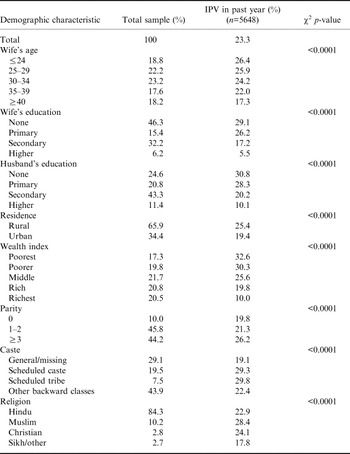
The prevalence of past year IPV victimization among wives was 23.3% (Table 1). Prevalence of IPV victimization was inversely related to wife's education, husband's education and household wealth and wives living in rural areas were more likely to report IPV victimization. Muslim wives and those belonging to scheduled castes reported a higher prevalence of IPV victimization compared with those of other religions and castes. Finally, women with one or more children were at a higher risk for IPV victimization compared with women with no children.
Prevalence of IPV and associations with demographic characteristics among married Indian women (N=26,284)

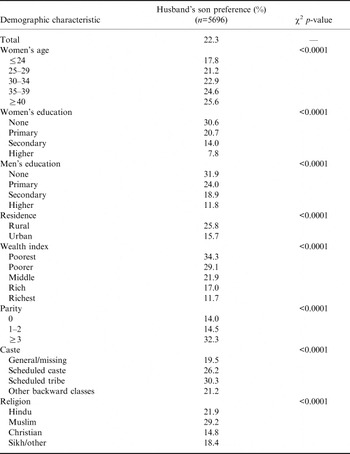
Sample demographic characteristics and associations with husband's son preference (N=26,284)

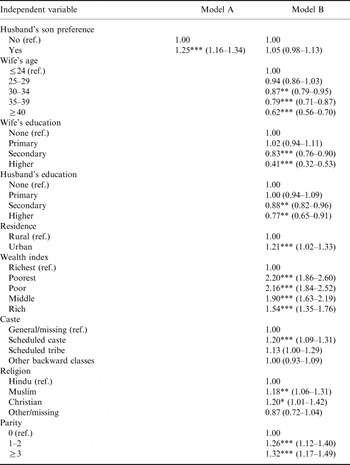
Risk ratios and 95% CIs for associations between husband's son preference and wife's risk for IPV victimization among married Indian women (N=26,284)

* p<0.05;
** p<0.01;
*** p<0.001.
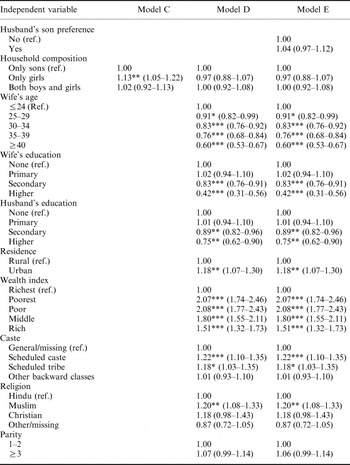
Risk ratios and 95% CIs for associations between husband's son preference, family composition and wife's risk for IPV victimization among married Indian women with at least one child (N=23,634)

* p<0.05;
** p<0.01;
*** p<0.001.
In the present sample of husband–wife dyads 22.3 % of men reported a preference for sons. The prevalence of son preference was found to be inversely related to wife's education, husband's education and household wealth. Husbands residing in rural areas were more likely to report son preference compared with those residing in urban areas. Muslim husbands and those belonging to scheduled castes reported a higher prevalence of son preference compared with those of other religions and castes. Finally, women with 3 or more children had husbands who were more likely to report son preference compared with women with 1 or 2 children or those with no children.
Association of husband's son preference and women's IPV status
Among all couples, husband's reported son preference was associated with wife's risk for past year IPV victimization in the unadjusted model (RR: 1.25; 95% CI: 1.16–1.34). In the fully adjusted model, after accounting for socio-demographic factors, husband's reported son preference was no longer significantly associated with wife's risk for IPV victimization (RR: 1.05; 95% CI: 0.98–1.13).
Association of family composition and women's IPV status
Among this sample of married Indian women with at least one living child, family composition of the household was found to be statistically significantly associated with wife's risk of IPV victimization in the unadjusted model such that households with mixed composition had mothers who were more likely to be victims of IPV compared with households with only sons (RR: 1.13; 95% CI: 1.05–1.22). However, in the adjusted model, which also included the total number of children even born to the mother (parity), household family composition was not found to be statistically significantly associated with mother's risk for IPV victimization.
Discussion
In recent years, there has been a growing interest in identifying the role of social and cultural norms in influencing the status and well-being of women within the family. A number of studies within the South Asian context have indicated that failure to bear a son can compromise the health and well-being of women in societies characterized by son preference (Winkvist & Akhtar, Reference Winkvist and Akhtar2000; Rodrigues et al., Reference Rodrigues, Patel, Jaswal and de Souza2003; Bose & South, Reference Bose and South2003; Gill & Mitra-Khan, Reference Gill and Mitra-Kahn2009). The majority of research in this area, however, has been conducted using qualitative methods with relatively small sample sizes, which does not allow for estimation of statistically significant relationships. The present study addresses the possible association between husband's desire for sons and risk for IPV victimization. Using nationally representative population-based data, no robust or consistent association was found between son preference among husbands, sex composition of the household and risk for IPV victimization. While unadjusted relationships found husband's son preference to be associated with a small but significant increase in risk for IPV victimization, this relationship attenuated into insignificance once adjustment was made for socio-demographic factors.
Conceptual model.

This finding is consistent with evidence from studies in rural India that failed to find an association between sex composition and women's risk for IPV victimization (Jejeebhoy, Reference Jejeebhoy1998; Srinivasan & Bedi, Reference Srinivasan and Bedi2007) and contrary to a few studies that found the presence of living male child(ren) to be protective against risk for IPV victimization (Schuler et al., Reference Schuler, Hashemi, Riley and Akhter1996; Rao, Reference Rao1997; Mitra, 2006). The null findings in this study may be a function of the practice of sex-selective abortion and female infanticide, which are thought to be prevalent across India (Dasgupta, Reference DasGupta and Bhat1997; Arnold et al., Reference Arnold, Kishor and Roy2002; Jha et al., Reference Jha, Kumar, Vasa, Dhingra, Thiruchelvam and Moineddin2006); it is estimated that about 100,000 sex-selective abortions are performed annually (Arnold et al., Reference Arnold, Kishor and Roy2002). In other words, it is possible that the use of sex-selective abortion minimizes the discrepancy between actual and desired family composition and thus the composition of children is no longer a factor that contributes to the inferior treatment and violence against married women.
Taken together findings from this study indicate the lack of strong relationship between desired and actual sex composition of children and wife's risk for IPV victimization. Although the study found a statistically significant relationship between both husband's son preference and family composition and risk for IPV victimization in unadjusted models, it failed to find this association after controlling for a range of socio-demographic variables. This implies that although women whose husbands report a preference for sons are over-represented among those who are victims of IPV, other factors in the lives of these couples, that also increase the likelihood of high son preference among husbands, are responsible for this effect.
While the current study contributes to the growing literatures on the role of cultural norms in influencing risk for IPV victimization in India, the present findings should be considered in the light of several limitations. The cross-sectional design of the National Family and Health Survey limits our ability to disentangle the chronology of certain factors critical to the present findings: for example, the timing at which childbearing patterns impact experiences of IPV among married women in India. Furthermore the construct of son preference measured as an attitude is socially undesirable and it is possible that it has been under-reported in the present study.
In conclusion, this study presents evidence that there is no consistent association between son preference and physical/or sexual IPV among ever-married women in India after adjusting for a range of commonly considered covariates. Given evidence from past small-scale and qualitative studies regarding the relationship between son preference and risk of IPV victimization, further research in needed to understand the plausible reasons for the lack of observed association. The absence of association between son preference and IPV victimization does not negate the importance of policies and interventions that seek to minimize son preference in India and promote gender equitable norms and attitudes. This paper adds to the existing literature by rigorously measuring the magnitude of influence of son preference on women's risk for intimate partner violence.