1. Background
In the July 2015 issue of New Testament Studies, the present author published an article entitled ‘The Gospel of Jesus’ Wife: Textual Evidence of Modern Forgery’.Footnote 1 The article expanded on previous observations that the Gospel of Jesus’ Wife (GJW) appears to be little more than a ‘patchwork’ of words and short phrases culled from the lone extant Coptic manuscript of the Gospel of Thomas (GTh) found in Nag Hammadi Codex ii (NHC ii).Footnote 2 It also provided detailed evidence suggesting that the Coptic text of GJW was created by someone using a specific PDF edition of this manuscript posted online in November 2002, ‘Grondin's Interlinear Coptic/English Translation of the Gospel of Thomas’ (‘Grondin's Interlinear’).Footnote 3
Since the publication of the previous article, there have been two significant developments that potentially shed additional light on the origin of GJW. First, in August 2015, Karen King released an interlinear translation of GJW that the owner of the papyrus fragment had provided her.Footnote 4 It was released at the request of the Boston Globe,Footnote 5 following suggestions that a translation of GJW that King had received from the owner could provide critical evidence confirming that the text was created using Grondin's Interlinear.Footnote 6 The ‘Owner's Interlinear’, as the document released in 2015 will be labelled here, provides a brief description of the fragment and presents GJW in both Coptic and English.Footnote 7 Scholars immediately recognised that the English ‘translation’ it contains seemed to be dependent on Grondin's Interlinear, just like the Coptic of the papyrus fragment.Footnote 8
Second, in June 2016, journalist Ariel Sabar published an article about his research exploring the provenance of GJW. In it, he reported that one of those he interviewed, Walter Fritz, provided him with a statement asserting, ‘I am the sole owner of a papyrus fragment … which was named “Gospel of Jesus's Wife” … I warrant that neither I, nor any third parties have forged, altered, or manipulated the fragment and/or its inscription in any way since it was acquired by me.’Footnote 9 According to the article, Fritz also ‘confessed that he'd in fact translated [GJW and another papyrus fragment] himself, using a Coptic dictionary and grammar book from his university days’.Footnote 10 A former Egyptology student at the Freie Universtät Berlin, Fritz is said to have admitted that he concealed his background ‘because he didn't want to be “embarrassed” if his Coptic skills had grown rusty’.Footnote 11
Regardless of whether Fritz is the owner of the papyrus fragment or possesses a Coptic lexicon and grammar, the interlinear translation of GJW that King received clearly seems to be derived from Grondin's Interlinear. As explained below, it presents GJW in a format that looks like a crude imitation of Grondin's edition of GTh. Its English ‘translation’ of GJW appears to have been copied almost entirely from Grondin's Interlinear. Thus, it seems that GJW must have been created by someone ‘cutting and pasting’ brief excerpts of GTh from Grondin's Interlinear sometime after November 2002.Footnote 12
2. The Owner's Interlinear
The Owner's Interlinear was apparently emailed to King in the form of a JPG file, and it looks like a digital photograph of a single-page computer print out.Footnote 13 The first line of text is in bold and reads, ‘Coptic Papyrus, Sahidic, Gnostic Gosple [sic], probably 3–5th Centruy [sic] A.D.’ The following line states, ‘Recto: 8 lines, writing bleached out’. The central portion occupies most of the page and provides a transcription of each individual line of Coptic text on the recto (→) of the papyrus fragment with an English translation beneath. A two-line note near the bottom reads, ‘Verso: Left 2/3 (approx. 2’ [sic]) of the upper papyrus layer missing. On the remaining 1/3 probably 5– … lines of unreadable Coptic inscription. Only light shadows of the letters visible.’Footnote 14
The central portion of the Owner's Interlinear bears a striking resemblance to Grondin's Interlinear. It provides a line-by-line edition of the manuscript containing GJW in a Coptic–English interlinear format, just as Grondin's work provides a line-by-line edition of the manuscript containing GTh in the same type of format. In addition, the two interlinears use fonts that are almost indistinguishable. The Coptic font in the Owner's Interlinear appears to be ‘CS Coptic Manuscript’, which is nearly identical to the ‘Coptic2’ font used in Grondin's Interlinear.Footnote 15
The most noticeable difference between the two interlinears is the quality. In contrast to Grondin's work, the Owner's Interlinear provides an appalling Coptic transcription: none of the superlinear strokes that appear on the papyrus are reproduced,Footnote 16 djandja (ϫ) on the fragment is invariably represented by delta (ⲇ),Footnote 17 and the standard scholarly conventions for annotating editions of papyri have not been followed.Footnote 18 In addition, all text in the Owner's interlinear is left justified with English words separated only by single spaces. As a result, Coptic words are not vertically aligned with the corresponding English text as they would be in a properly prepared interlinear translation.
3. Analysis of the Owner's Interlinear
3.1 Recto (→), Line 1
All the Coptic letters of GJW →1 in the Owner's Interlinear also appear in the pertinent parallels to GTh in Grondin's Interlinear (Fig. 1).Footnote 19 All ten English words in the two interlinears are the same, but they should not be. In his work, Grondin chose to place ‘for’ before ‘my mother’ rather than directly beneath the corresponding Greek loanword ⲅⲁⲣ. The Coptic of GJW does not even include ⲅⲁⲣ, but nonetheless ‘for’ still appears in the English translation of the Owner's Interlinear.Footnote 20 It seems obvious that ‘for’ in the English translation of GJW provided by the owner was copied directly from Grondin's edition of GTh.
Comparison of GJW →1 in the Owner's Interlinear and the pertinent parallels to GTh in Grondin's Interlinear. Coptic letters and English words that are the same in the two interlinears are underlined. English words that are potential evidence of copying are double underlined.

3.2 Recto (→), Line 2
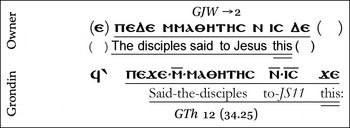
Almost all the Coptic letters of GJW →2 in the Owner's Interlinear also appear in the pertinent parallel to GTh in Grondin's Interlinear;Footnote 21 the only exception is the first letter of the line (Fig. 2).Footnote 22 All six English words in the two interlinears are the same, and there is only a minor difference in order.Footnote 23 The Owner's Interlinear uses standard English word order for the phrase, ‘The disciples said.’ Grondin has endeavoured to keep English words beneath the corresponding Coptic text; as a result, the word ‘said’ precedes ‘the disciples’ in his translation.
Comparison of GJW →2 in the Owner's Interlinear and the pertinent parallel to GTh in Grondin's Interlinear.

The apparently telltale sign of copying in GJW →2 is the rendering of the Coptic conjunction ϫⲉ as ‘this’. In his work, Grondin routinely used ‘this’ as ‘filler’ beneath each ϫⲉ introducing direct discourse in GTh. Yet, ϫⲉ is untranslatable in such a grammatical construction, and it would never actually be translated by the English word ‘this.’ The only plausible explanation for why the Owner's Interlinear renders ϫⲉ as ‘this’ in GJW →2 seems to be that it was copied directly from Grondin's edition of GTh.
3.3 Recto (→), Line 3
The Coptic transcription of GJW →3 in the Owner's Interlinear has clearly identifiable parallels to GTh in Grondin's Interlinear, but the Coptic name ⲙⲁⲣⲓⲁⲙ (‘Mary’) appears to have been specially inserted into the ‘patchwork’ text (Fig. 3).Footnote 24 Also, two pronominal affixes are different: a third-person feminine singular pronominal affix (ⲥ) precedes the infinitive ⲁⲣⲛⲁ and a second-person masculine singular pronominal affix (ⲕ) completes the preposition ⲙ̄ⲙⲟ⸗ in the Owner's Interlinear, while a third-person masculine pronominal affix (ϥ) appears in both places in GTh.Footnote 25 Where the Coptic transcriptions agree and a translation of GJW is provided, all five corresponding English words are the same in both interlinears.
Comparison of GJW →3 in the Owner's Interlinear and the pertinent parallels to GTh in Grondin's Interlinear.

Two aspects of GJW →3 seem to suggest dependence on Grondin's Interlinear. Grondin's translation of ⲁⲣⲛⲁ as ‘abdicate’ in GTh 81 is unusual. None of the standard lexicons that probably would have been used to translate the Greek loanword (ἀρνέομαι) from which the Coptic infinitive is derived suggests such a definition;Footnote 26 yet, the Owner's Interlinear contains Grondin's seemingly unprecedented translation of ⲁⲣⲛⲁ. Also, it shares a minor error with Grondin's edition of GTh. In translating ⲙ̄ⲡϣⲁ in GTh 80, Grondin evidently copied the dictionary form of the verb (‘be worthy’) by accident rather than translating it in the present tense (‘is worthy’) as required by context.Footnote 27 The Owner's Interlinear contains the same mistake as Grondin's work and, consequently, abandons proper English grammar by stating ‘Mary be worthy’ rather than ‘Mary is worthy’.
3.4 Recto (→), Line 4
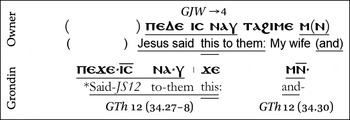
With the exception of ⲧⲁϩⲓⲙⲉ (‘my wife’), all the Coptic letters of GJW →4 in the Owner's Interlinear also appear in the pertinent parallels to GTh in Grondin's Interlinear (Fig. 4).Footnote 28 Where the Coptic transcriptions agree and a translation of GJW is provided, all five corresponding English words are the same in both interlinears.Footnote 29 There are just two minor differences in word order. First, the Owner's Interlinear uses standard English word order for the phrase ‘Jesus said’. Grondin has endeavoured to keep English words directly below the corresponding Coptic text; as a result, the word ‘said’ precedes his abbreviation for ‘Jesus’.Footnote 30 Second, the Owner's Interlinear has the word ‘this’ before (instead of after) ‘to them’.
Comparison of GJW →4 in the Owner's Interlinear and the pertinent parallels to GTh in Grondin's Interlinear.

The presence of ‘this’ in GJW →4 in the Owner's Interlinear is unexpected. The English word is clearly intended to correspond to ϫⲉ (as it does in the GJW →2), but the Coptic conjunction does not actually appear in GJW →4.Footnote 31 Further, the Owner's Interlinear incorrectly translates the Coptic word (ϫⲉ) found in GTh (but not in GJW) in a manner attributable to a misunderstanding of Grondin's work.Footnote 32 ‘This’ in GJW →4 seems to be indisputable evidence that the person responsible for the Owner's Interlinear copied English words directly from Grondin's Interlinear.
3.5 Recto (→), Line 5
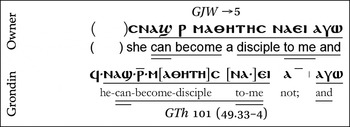
With the exception of the pronominal affix at the start of the line, all the Coptic letters of GJW →5 in the Owner's Interlinear also appear in the pertinent parallel to GTh in Grondin's Interlinear (Fig. 5).Footnote 33 Where the Coptic transcriptions agree and a translation of GJW is provided, six of the seven corresponding English words are the same in both interlinears; the only difference in wording is that the Owner's Interlinear has an indefinite article (‘a’) before the word ‘disciple’ and Grondin's work does not.Footnote 34
Comparison of GJW →5 in the Owner's Interlinear and the pertinent parallel to GTh in Grondin's Interlinear.

The precise verbal correspondence of the English in both interlinears at two points in GJW →5 is notable. Grondin has used a simplified translation (‘can’) for the combination of the future auxiliary ⲛⲁ– and the verbal auxiliary ϣ–; the Owner's Interlinear gives the same translation, even though the formally literal translation of ‘will be able to’ for ⲛⲁϣ would have been suitable. Grondin has used a formally literal translation for the Coptic words ⲙⲁⲑⲏⲧⲏⲥ ⲛⲁⲉⲓ (‘disciple to me’); the owner's edition of GJW gives the same translation, even though a simplified translation (‘my disciple’) is commonly employed in rendering these Coptic words into English. The fact that the two interlinears alternate between simplified and formally literal English translations in exactly the same manner seems to be another subtle indication of copying.
3.6 Recto (→), Line 6
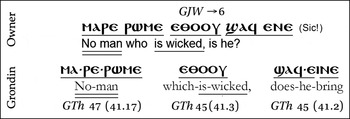
All the Coptic letters of GJW →6 in the Owner's Interlinear are found in the pertinent parallels to GTh in Grondin's Interlinear, but the iota (ⲓ) in ϣⲁϥⲉⲓⲛⲉ is absent (Fig. 6). This is probably because a copy error is present on the papyrus fragment. As previously observed, the third-from-last character appears to be some kind of epsilon–iota hybrid;Footnote 35 detailed measurements of every epsilon (ⲉ) and iota (ⲓ) are consistent with this observation.Footnote 36 Apparently, the copyist first wrote epsilon (ⲉ) or iota (ⲓ) and then attempted to correct the mistake. The ‘(Sic!)’ at the end of the line suggests that the person responsible for the Owner's Interlinear believed there was a copy error in the final word of the line. Four of the first five English words in the interlinears agree; the only difference in wording is that the Owner's Interlinear has ‘who’ instead of ‘which’, presumably because the antecedent of the relative clause is ⲣⲱⲙⲉ (‘person’, ‘man’) in GJW and ⲡⲉϥⲉϩⲟ (‘his treasure’) in GTh. The question mark immediately after ‘is he’ at the end of the line evidently indicates that a translation is impossible because the corresponding Coptic text is corrupt.Footnote 37
Comparison of GJW →6 in the Owner's Interlinear and the pertinent parallels to GTh in Grondin's Interlinear.

Perhaps the only conceivable reason why ⲙⲁⲣⲉ ⲣⲱⲙⲉ would be rendered as ‘no man’ in the Owner's Interlinear is if it were copied from Grondin's edition of GTh. The dialect of GTh has been characterised as ‘crypto-Subakhmimic’;Footnote 38 that is, it is ‘Sahidic with a fluctuating mixture of features from Lycopolitan’.Footnote 39 In GTh 47 (NHC ii 41.17), ⲙⲁⲣⲉ– functions as a negative aorist conjugation base (as in Lycopolitan).Footnote 40 Thus, a formally literal translation of ⲙⲁⲣⲉ ⲣⲱⲙⲉ in GTh might be, ‘People do not …’; Grondin has used a simplified (if not gender neutral) translation, ‘No man’.Footnote 41 Yet, the Owner's Interlinear characterises GJW as a ‘Sahidic’ text, and ⲙⲁⲣⲉ– is the standard jussive conjugation base in this dialect. Thus, the owner's version should translate ⲙⲁⲣⲉ ⲣⲱⲙⲉ something like, ‘Let people …’, but it does not. Instead, it seemingly repeats Grondin's simplified (non-gender neutral) translation of a dialectical variant in GTh.
3.7 Recto (→), Line 7
With the exception of the pronominal affix that completes ⲛⲙⲙⲁ⸗, all the Coptic letters of GJW →7 in the Owner's Interlinear also appear in the pertinent parallels to GTh in Grondin's Interlinear (Fig. 7). Where the Coptic transcriptions agree and a translation of GJW is presented, all four corresponding English words are apparently intended to be the same in both interlinears: ‘within’ is presumably a typographical error.Footnote 42
Comparison of GJW →7 in the Owner's Interlinear and the pertinent parallels to GTh in Grondin's Interlinear.

Admittedly, GJW →7 is the line of text with the least evidence of copying from Grondin's Interlinear. Still, the English rendering of ⲁⲛⲟⲕ ϯϣⲟⲟⲡ as ‘I exist’ is suspicious. A better translation of ϯϣⲟⲟⲡ in the context of GJW might have been ‘I am’ or ‘I dwell’. In addition, when an independent personal pronoun appears before a verb in Coptic, the extraposited pronoun is commonly indicated in English translation by a prepositional phrase at the head of the sentence (e.g. ⲁⲛⲟⲕ ϯϣⲟⲟⲡ: ‘As for me, I am …’). Of course, a person with limited knowledge of Coptic would not know to follow this convention in translating because Grondin merely provided the formally literal translation of ⲁⲛⲟⲕ (‘I’) beneath the word in his work.
3.8 Recto (→), Line 8
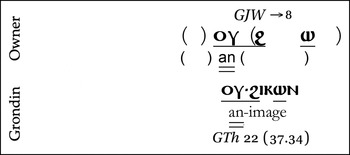
All four Coptic letters of GJW →8 in the Owner's Interlinear also appear in the pertinent parallel to GTh in Grondin's interlinear (Fig. 8). It is unclear why the noun ϩⲓⲕⲱⲛ has not been fully transcribed: it is faint but readable on the papyrus fragment. Regardless, without identifying the noun, the person responsible for the owner's edition of GJW should not have been able to determine that the diphthong ⲟⲩ ought to be translated as an indefinite article preceding a noun beginning with a vowel in English (‘an’). While ⲟⲩ frequently functions as an indefinite article in Coptic, the diphthong also appears in so many other words that its meaning cannot be deduced without context. It seems clear that the person responsible for the Owner's Interlinear relied on more than just the papyrus fragment for information about the text of GJW and how to translate it.
Comparison of GJW →8 in the Owner's Interlinear and the pertinent parallel to GTh in Grondin's Interlinear.

4. Conclusion
The shared line-by-line Coptic-English interlinear format and nearly identical fonts provide only an initial hint of the connection between the edition of GJW that the owner provided to King and Grondin's Interlinear. Textual analysis reveals that the Owner's Interlinear was almost certainly prepared by someone using Grondin's work. The extensive verbal correspondence between the English translations of the two interlinears strongly suggests a direct literary relationship.
Only ⲙⲁⲣⲓⲁⲙ (‘Mary’), ⲧⲁϩⲓⲙⲉ (‘my wife’) and three pronominal affixes appear to have been translated from the Coptic of GJW in the Owner's Interlinear without the assistance of Grondin's edition of GTh.Footnote 43 Essentially all of the remaining English ‘translation’ appears derived from Grondin's Interlinear. Where the Coptic transcriptions of the two interlinears agree and a translation of GJW is given, forty of the corresponding forty-two English words are the same: the only differences are the apparent addition of an indefinite article (‘a’) before ‘disciple’ in GJW →5 and the apparent switch of ‘which’ to ‘who’ in GJW →6 in the Owner's Interlinear.Footnote 44 The three minor differences in word order suggest only that the person responsible for the Owner's Interlinear wanted the ‘translation’ to use English (rather than Coptic) word order.Footnote 45 Anyone who knew English could easily have rearranged the pertinent words from Grondin's Interlinear.
Most strikingly, the two interlinears contain a series of verbal agreements that seem all but inconceivable as the work of independent translators. Every single line of the owner's purported ‘translation’ includes some textual feature suggestive of copying. The Owner's Interlinear seems to repeat both Grondin's unprecedented translation of ⲁⲣⲛⲁ as ‘abdicate’ and his minor mistake in rendering ⲙ̄ⲡϣⲁ as ‘be worthy’ instead of ‘is worthy’ in GJW →4. It alternates between simplified and formally literal translations in GJW →5, exactly as Grondin does in his translation of the pertinent parallels in GTh. It treats ⲙⲁⲣⲉ– as a Lycopolitan negative aorist rather than a Sahidic jussive in GJW →6, precisely where Grondin's translation reflects the dialectical influence of Lycopolitan on GTh. Perhaps most tellingly, the Owner's Interlinear seems to translate two Coptic words found in GTh but not in GJW.Footnote 46
Since Grondin certainly did not copy anything from the Owner's Interlinear,Footnote 47 the already carefully documented thesis that GJW was prepared by someone using Grondin's Interlinear now appears to have been fully confirmed.Footnote 48 It would be bizarre for anyone to attempt to decipher a papyrus fragment of unknown content using an interlinear translation of another text, and it hardly seems plausible that someone with limited knowledge of Coptic could have identified the pertinent parallels to GTh in GJW without prior knowledge of its ‘patchwork’ nature. In the judgement of this author, the person responsible for the Owner's Interlinear must at least have been aware that the Coptic text of GJW had been created by copying specific excerpts from Grondin's Interlinear and that, consequently, the same dual-language edition of GTh could conveniently be used to prepare an English ‘translation’ of the new text. While more information may be needed to identify the specific person(s) responsible for devising GJW with complete certainty, it now seems safe to assume that this ‘ancient gospel’ was actually created quite recently by someone reworking material from Grondin's Interlinear sometime after November 2002.