Introduction
Materials composed of carbon nanopores have been proposed for use in a wide variety of applications, including the desalination of salty water, filtration of contaminated water, gas separations, chemical sensors, nanoscale pumps, energy-conversion devices, components in high-speed chromatography, and many others. These applications take advantage of the extremely rapid flow of molecules that have been measured in carbon nanotubes and graphene. Reference Holt, Park, Wang, Stadermann, Artyukhin, Grigoropoulos, Noy and Bakajin1,Reference Majumder, Chopra, Andrews and Hinds2 In addition, most of these applications also require the preferential transport of specific molecules when compared to others. For example, for nanoporous membranes to be used for the desalination of salty water, it is essential that the membranes are able to rapidly pass water while blocking the passage of ions. Similarly, any filtration or separation application relies upon selective passage of specific molecules through pores, or the blockage of others.
The feasibility of these applications is supported by experimental reports of divergent rates of transport of differing gases, Reference Holt, Park, Wang, Stadermann, Artyukhin, Grigoropoulos, Noy and Bakajin1,Reference Skoulidas, Ackerman, Johnson and Sholl3–Reference Zhang, Zhao, Wang, Liang, Qiu, Zheng and Yang7 liquids, Reference Majumder, Chopra, Andrews and Hinds2,Reference Majumder, Chopra and Hinds4 and ions Reference Wu, Gerstandt, Zhang, Liu and Hinds8,Reference Choi, Ulissi, Shimizu, Bellisario, Ellison and Strano9 through carbon nanotubes and graphene nanopores, as well as the rejection of ions Reference Fornasiero, In, Kim, Park, Wang, Grigoropoulos, Noy and Bakajin10,Reference Fornasiero, Park, Holt, Stadermann, Grigoropoulos, Noy and Bakajin11 and size-selective transport of aqueous solutes. Reference Huang, Song, Wei, Shi, Mao, Ying and Sun12 However, utilizing these promising materials requires a careful understanding of how selective transport arises, so that it can be enhanced or targeted toward the molecules of choice.
In recent years, there has been a specific focus on understanding how ions can be removed from water or how selective transport of ions can be achieved using carbon nanotubes and graphene. This is due, in part, to the simplicity of the molecules involved, the similarities with essential biological processes, and the fact that ions can flow through nanoporous materials at rates far exceeding those through conventional materials. Reference Wu, Gerstandt, Zhang, Liu and Hinds8,Reference Choi, Ulissi, Shimizu, Bellisario, Ellison and Strano9 Much of this work has centered on the use of molecular simulations, as they allow for the physical factors involved in transport to be dissected. However, as we will describe, the simplifications and approximations used in the simulations also allow for uncertainties to arise. We explore this literature to help explain the physical mechanisms involved in ion rejection and selectivity in carbon nanotubes and graphene. Not only can this aid in designing the materials to optimize the selectivity of the pores, it can help determine how selection for other molecules can be achieved.
Ion rejection in narrow pores
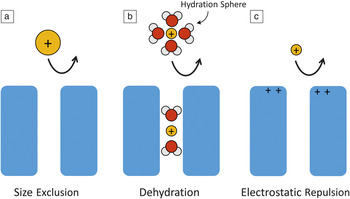
The easiest way to stop an ion from passing through a narrow pore is to make the pore narrower than the size of the ion; that is, to make use of size exclusion ( Figure 1a). While molecular sieving is useful for blocking the passage of larger ions such as ammonium, nitrate, or sulfate, it is not as useful for small ions such as Na+ or K+ if water is to simultaneously pass through the pore as well. Simulations have suggested that water will only pass through carbon nanotubes with ≥3.5 Å internal diameter.Footnote * In the case of nanotubes with internal diameter of 3.5–4.5 Å, water only passes through intermittently. Reference Hummer, Rasaiah and Noworyta13–Reference Song and Corry15 Given that the diameter of Na+ is ∼2 Å, it would clearly be impossible to exclude this ion on the size of the bare ion alone while still allowing water to pass. Simulation studies have suggested, however, that Na+ (and other ions) can be largely excluded from carbon nanotube pores as wide as 10 Å, Reference Corry14–Reference Thomas and Corry17 indicating that other factors prevent the passage of small ions.
Physical mechanisms of ion rejection. (a) Size exclusion, in which the ion is larger than the size of the pore, (b) dehydration barriers created by the necessity to remove water from an ion to enter the pore, and (c) electrostatic repulsion between the ion and the pore. The ion is shown in orange in each case.

Ion exclusion from narrow carbon nanotubes can be explained as a consequence of dehydration barriers. Reference Corry14,Reference Peter and Hummer16 In bulk solution, ions attract a “shell” of surrounding water molecules due to the electrostatic interaction between the charge on the ion and the water dipole (Figure 1b). Although water molecules in the shell are exchanged over time, this so-called “hydration sphere” effectively increases the size of the ion. For example, Na+ has a bare dia. of ∼2.04 Å, but with the hydration sphere, this increases to 6.4 Å. If a pore is smaller than the size of the hydration sphere, the hydration sphere will not fit inside unless it undergoes rearrangement. To do this, water molecules can adjust their geometry around the ion, allowing it to squeeze into slightly smaller spaces at a small energy cost. Alternatively, water molecules can be removed from the hydration shell, reducing the effective size of the hydration sphere and allowing the ion to fit into a smaller pore. However, removing each water molecule increases energetic cost. Reference Song and Corry15,Reference Corry18
Therefore, unless there is a compensating attraction between the ion and the pore, the dehydration barrier can prevent ions from entering the pore. Narrow hydrophobic pores such as carbon nanotubes tend to allow only a discrete number of water chains to form through the interior of the pore. (∼1 chain in a 4.7 Å dia. pore, ∼2 chains in a 5.9 Å pore, and 4 chains in a 7.5 Å pore). Reference Corry14,Reference He, Zhou, Lu and Corry19 As shown in Figure 1b, when the ion enters the narrow pore, many water molecules may have to be removed from the hydration shell. In addition, the attraction between a bare hydrophobic pore and the ion is small, as there are no permanent charges in a pristine carbon nanotube to generate strong electrostatic interactions in this situation. The dehydration barrier can effectively prevent ions from passing through the pore.
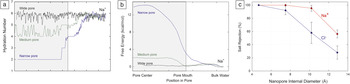
The number of water molecules in the hydration shell of Na+ are plotted in Figure 2a as a function of the position of the ion within carbon nanotubes with different diameters. In the narrowest pore shown (4.7 Å dia. pore), the number of water molecules in the hydration shell is significantly less than in bulk. The corresponding energy barrier for the ion to enter the pore is indicated in Figure 2b, highlighting the large energetic cost for ion transport in narrow pores caused by partial dehydration. The inability to overcome this energetic barrier is the reason why ions do not pass through these narrow pores unless a large driving force is applied (salt rejection decreases as the driving force increases). Reference Thomas and Corry17 Even if the number of water molecules in the hydration shell in the pore is not significantly different from that in bulk, an energy barrier can remain due to rearrangement of the hydration sphere or removal of more distant water molecules. Reference Song and Corry15 As the dehydration barrier gets smaller, the chance of an ion overcoming it due to thermal motion or a driving force increases, and the ion rejection declines with increasing pore diameter as seen in Figure 2c. Once the pore is wide enough that water does not have to rearrange or be stripped from the hydration sphere, ion rejection from dehydration is lost.
Origin, size, and consequences of dehydration barriers. (a) Coordination number of Na+ as it enters a narrow (4.7 Å), medium (5.9 Å), and wide (7.5 Å) carbon nanotube. Reference Corry14 (b) Free-energy barrier experienced by Na+ as it enters a narrow, medium, and wide carbon nanotube. Reference Corry14 Labels on x-axis in (b) apply to (a) also. (c) Rejection of Na+ and Cl– versus diameter for bare carbon nanotube pores. Reference Thomas and Corry17

Blockage of ions through dehydration barriers can be overcome if there are attractive ion–pore interactions. For example, near complete ion rejection was seen in simulation studies of graphene nanopores when the rim of the pore was essentially hydrophobic (contained only hydrogenated edges). But, increasing the polarity of the pore rim with hydroxyl groups reduced the salt rejection (except in very narrow pores) as ion–pore interactions began to compensate for and overcome the dehydration barriers. Reference Cohen-Tanugi and Grossman20
While molecular dynamics simulations have predicted a high degree of ion rejection in pores up to 10 Å dia. due to dehydration barriers, Reference Corry14,Reference Song and Corry15,Reference Thomas and Corry17 it has been difficult to reproduce this experimentally. Fornasiero et al. experimentally measured ion rejection in sub-2-nm dia. carbon nanotubes. This rejection was attributed to electrostatic effects due to the dependence on pH and ion concentration. Reference Fornasiero, In, Kim, Park, Wang, Grigoropoulos, Noy and Bakajin10,Reference Fornasiero, Park, Holt, Stadermann, Grigoropoulos, Noy and Bakajin11 Ions have also been measured to pass through <1.4 nm dia. nanotubes under an electric field. Reference Wu, Gerstandt, Zhang, Liu and Hinds8 The disparity between simulations and experiments could be due to many causes. First, simulations are typically conducted on one or a few nanotubes, whereas experiments are conducted using a large number of nanotubes and are likely to include a variety of sizes and chemical functionalization. The presence of a few wide pores, those with favorable electrostatic interactions with the ions or membrane defects, could allow for ion transport, even if narrow, pristine pores block ion flow. It is also possible that the simulations overestimate the degree of ion rejection due to simplifications in the models used. Chief among these is likely to be the interatomic potentials used in most models that do not allow for electronic polarization, which prevents us from adequately modeling the stabilization of ions in the pores and cation–π interactions due to movement of electrons in the extended aromatic nanotubes. There can also be a disparity of many Å in terms of how the tube diameters are measured in simulations and experiments, making a direct comparison difficult.
Another way to prevent ions from passing through nanotubes is to make use of repulsive electrostatic interactions. For example, the presence of charged groups at the entrance of narrow pores will effectively exclude ions having the same charge as the pore entrance from entering the pore, as indicated in Figure 1c. Reference Corry21,Reference Hughes, Shearer, Shapter and Gale22 But while dehydration acts to prevent the passage of both cations and anions, charged functional groups will attract one ion species into the pore. Whether the passage of this ion type is slowed or sped up is difficult to predict—more rapid transport is expected due to the increased local concentration of the ion, but slower passage can arise if the ion remains bound to the charged group for a prolonged time. The presence of neutral but polar groups also produces complex behavior, but in general, is not enough to prevent one ion type from passing through the pore. However, zwitterionic groups (neutral molecules with both positive and negative electrical charges) at the pore mouths have been shown to be effective at preventing ion transport, with simulations showing that the passage of both Na+ and Cl– is blocked in nanotubes up to 16.9 Å dia., due to electrostatic repulsion of both ion types. Reference Chan, Chen, Surapathi, Taylor, Shao, Marand and Johnson23 Rejection of both cations and anions has been demonstrated in experimental measurements of zwitterion functionalized CNT/polyamide nanocomposite membranes. Reference Chan, Chen, Surapathi, Taylor, Shao, Marand and Johnson23
Ion selection in pristine and functionalized nanotubes
Selection in bare hydrophobic pores
Differing dehydration barriers for different ions can lead to the passage of one ion being favored more than another. The size of the dehydration barrier for an ion depends upon how tightly it holds the surrounding water molecules and how many must be removed to enter the pore. In general, large ions hold more water in the hydration shell than small ones, simply because there is more space around these ions in which to pack water molecules. However, small ions bind each water molecule more tightly because the water can reside closer to the ion, yielding a stronger electrostatic attraction.
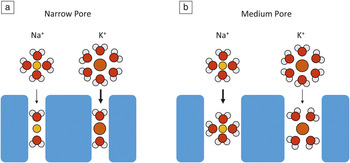
All ion types must be largely dehydrated to enter a very narrow pore. For example, in a <5 Å dia. pore, no ion can contact more than two water molecules, as only a single water chain fits inside the pore, as shown schematically in Figure 3a. Thus, small ions are impeded the most since there is a greater energy cost in removing their tightly bound water. This leads to the slightly counterintuitive consequence that a narrow hydrophobic pore (with limited pore–ion interactions) will favor the passage of large ions more than small ones. Reference Song and Corry15,Reference Sint, Wang and Kral24 This is the situation in biological potassium channels that favor the passage of the larger K+ more than the smaller Na+ despite being extremely narrow (although ion–pore interactions also play a role in this highly polar pore). In contrast, small ions can fit through wider pores with a near complete hydration shell, therefore, these face a smaller dehydration barrier than large ions (Figure 3b). A wider pore likely favors the passage of small ions more than large ones. Reference Song and Corry15 Once the pore is much wider than the size of the hydration sphere, selectivity is lost.
Dehydration-based ion selectivity in pristine nanotubes. (a) In narrow pores, all ions must be largely dehydrated to enter the pore. Thus, the larger ions with smaller hydration free energies can enter most easily. (b) In a medium diameter pore, the larger ions still require dehydration, while smaller ions can enter with a near complete hydration shell. Thus, the passage of smaller ions is favored.

The different dehydration barriers faced by ions are essential for explaining and identifying which ions will pass through carbon nanopores and polymeric water filtration membranes. For example, fluoride (F–) and nitrate (NO3 –) are common anionic contaminants in drinking water. Fluoride is small, but holds water tightly in its hydration shell. It is effectively removed from water by nanofiltration and reverse osmosis membranes even though these contain pore sizes much larger than the diameter of fluoride itself. Nitrate is much harder to remove from water because there is only a small dehydration penalty for this larger, weakly hydrated ion to enter the porous filtration membrane. Reference Richards, Richards, Corry and Schäfer25–Reference Richards, Schäfer, Richards and Corry27 Hydration-based ion selectivity has been directly measured in intrinsic defect pores in graphene Reference Garaj, Hubbard, Reina, Kong, Branton and Golovchenko28 and in isolated sub-2-nm graphene nanopores. Reference Jain, Rasera, Guerrero, Boutilier, O’Hern, Idrobo and Karnik29,Reference Rollings, Kuan and Golovchenko30
Selection in functionalized pores
Most carbon nanopores contain some degree of chemical functionalization due to oxidation, defects, or intentional chemical modification. In these cases, there are a huge range of factors that can generate ion selectivity in addition to dehydration. The literature elucidating selectivity in biological pores is extensive and a large variety of physical mechanisms have been discussed. Although we often think of biological pores as being more complex than synthetic nanopores, comprehending selection in the latter is complicated by the fact that, in general, we do not have precise control or knowledge over what functional groups will be present at exactly what position in the pore—unlike in biological pores.
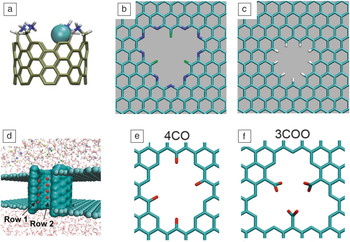
Perhaps the simplest way to generate selective ion transport in a nanopore is to add charged groups to the pore walls. As previously noted, the presence of charged groups has been shown in simulations to aid the passage of oppositely charged ions, while hindering the passage of like charged ions ( Figure 4a). Reference Corry21,Reference Hughes, Shearer, Shapter and Gale22 The same principles have been realized experimentally, Reference Majumder, Chopra and Hinds4,Reference Majumder, Chopra and Hinds31–Reference Majumder, Zhan, Andrews and Hinds33 showing that charged groups can create cation/anion selection even in quite wide pores.
Chemically functionalized pores that generate ion selectivity. (a) Tip functionalized carbon nanotubes that can generate anion versus cation selectivity or enhance salt rejection. Reference Corry21 (b) A cation selective F–N-terminated graphene pore and (c) an anion selective H-terminated graphene pore. Reprinted with permission from Reference Reference Sint, Wang and Kral24. © 2009 American Chemical Society. (d) A carbonyl lined carbon nanotube with Na+/K+ selectivity that depends on the precise positions of the functional groups. Rows of functional groups are added as labeled. Reprinted with permission from Reference Reference Gong, Li, Xu, Wang and Yang35. © 2010 American Chemical Society. (e) A K+ selective carbonyl lined graphene pore and (f) a carboxylate lined Na+ selective pore. Reference He, Zhou, Lu and Corry36 Note: 4CO, four carbonyl groups lining the pore; 3COO, three carboxylate groups lining the pore.

Charged pore walls can be obtained not only by adding fully charged functional groups, but also by creating polarity in a net neutral pore. Sint et al. Reference Sint, Wang and Kral24 used computational models to show that the addition of fluorine atoms on the rim of a graphene pore creates a large polarity in the sheet and a negatively charged pore rim (Figure 4b), such that only cations will pass through the pore. Similarly, the presence of hydrogen atoms at the rim has the opposite effect, favoring the passage of anions (Figure 4c). In this case, discrimination among the ions was further modulated by the ion size due to the dehydration barriers previously described, with the larger ions being favored in the narrow pores studied. An inherent selectivity of K+ over Cl– has been measured experimentally for graphene nanopores up to 2 nm dia. Reference Rollings, Kuan and Golovchenko30 It is proposed that this originates from oxygen-containing groups existing on the graphene surface (from partial oxidation) that carry a negative charge at neutral pH, attracting cations and repelling anions.
Controlling selectivity among the cations or anions is challenging and mostly remains the realm of simulation studies trying to mimic biological pores. The most common ion pair studied in this context is Na+ and K+, as discrimination between these similar ions is critical in biology. Selecting K+ over Na+ is easier than the reverse since the lower dehydration cost of transporting K+ can be utilized. Biological potassium channels contain carbonyl groups lining the pores that attract cations and generate selection of K+ over Na+ that can be up to 1000:1. Reference Lemasurier, Heginbotham and Miller34 This arrangement has been mimicked in carbon nanotubes (Figure 4d), Reference Gong, Li, Xu, Wang and Yang35 but surprisingly, this did not yield selection of K+ over Na+. A similar approach in graphene nanopores (Figure 4e) did yield K+ selectivity, but nowhere near the extent seen in biological pores, Reference He, Zhou, Lu and Corry36 indicating how precise control over the geometry of the functional groups is essential to gain the high degree of selectivity seen in biological potassium channels. This is reinforced by the fact that small modifications in the arrangements of carbonyl groups in carbon nanotubes can shift the selection toward either Na+ or K+. Reference Gong, Li, Xu, Wang and Yang35
Biological Na+ selective channels contain highly polar or charged groups that favorably bind smaller ions over larger ones because small ions can move closer and have stronger electrostatic interactions. Reference Payandeh, Scheuer, Zheng and Catterall37 However, copying this selectivity in a synthetic pore requires careful control over pore geometry. Na+ selection could only be achieved if the charged pore was small enough to ensure single file transport, such that Na+ ions passing through the pore block the passage of other ions (Figure 4f). Reference He, Zhou, Lu and Corry36,Reference Kang, Zhang, Shi, Zhang, Liang, Wang, Agren and Tu38 If this is not the case, the stronger binding of Na+ slows its passage without blocking K+, allowing for faster transport of K+ compared to Na+. The fact that selection between Na+ and K+ (and presumably other similar ion pairs) is difficult to predict and requires fine control over the location and type of chemical modification means that rationally designing such selectivity into synthetic nanopores is a significant challenge.
Challenges
While simulation studies of simple pores have helped dissect the physical mechanisms yielding ion rejection and selectivity in carbon nanopores, it remains a challenge to experimentally replicate many of the simplified situations. Direct comparisons between simulations and experiment remain difficult due to the differences in the systems being studied. This is critical if the interatomic interactions in the simulations are to be carefully parameterized. There are also important differences between transport in elongated carbon nanotubes and atomically thin graphene nanopores that have not been fully discussed here. For example, more complete dehydration and extensive electrostatic interactions are possible in a nanotube, whereas an ion passing through graphene is likely to remain partly in contact with bulk water and can only have electrostatic interactions close to the graphene plane. Recently, extended pores formed by the space between adjacent graphene sheets have also emerged as an interesting option for filtration applications and allow for a new variety of pore geometries to be explored. Exploiting the potential of these remarkable materials in purification and filtration applications requires harnessing the physical principles reviewed here and uncovering any additional factors that can influence transport, as behavior at the nanoscale is often surprising.
Acknowledgment
This work was supported in part by funding from the Australian Research Council (FT130100781).

Ben Corry is an Australian Research Council-funded Future Fellow at the Research School of Biology, The Australian National University, Australia. His research interests include understanding transport in synthetic porous membranes for water filtration and energy conversion, as well as the study of biological membrane proteins for biomedical applications. His research utilizes a range of computational and fluorescence methods to uncover the physical principles that relate the structure of pores to their functional properties. Corry can be reached by phone at +61 2 6125 0842 or by email at ben.corry@anu.edu.au.