Introduction
Alzheimer's disease is a common neurodegenerative disease in older people. Progressive memory impairment is a major manifestation of Alzheimer's disease (Arshavsky, Reference Arshavsky2010). A growing body of evidence suggests that non-memory domains are also frequently found, including impaired language presentation, hearing impairment, cataract, and other visual dysfunctions (Mendez et al., Reference Mendez, Lee, Joshi and Shapira2012; Pal et al., Reference Pal, Sanyal, Biswas, Paul and Das2013; Lai et al., Reference Lai, Liao, Liao, Muo, Liu and Sung2014b; Hung et al., Reference Hung, Liao, Muo, Lai, Chang and Hung2015).
Glaucoma has raised a public health concern due to its high prevalence and its being the major cause of irreversible vision loss in the world (Tham et al., Reference Tham, Li, Wong, Quigley, Aung and Cheng2014). The estimated prevalence of glaucoma among population aged 40–80 is about 3.54% in the world (Tham et al., Reference Tham, Li, Wong, Quigley, Aung and Cheng2014).
Recent reports have demonstrated that although not fully understood, glaucoma may be related to neurodegeneration and there may be a link between glaucoma and Alzheimer's disease (Tsolaki et al., Reference Tsolaki2011; Valenti, Reference Valenti2011; Ghiso et al., Reference Ghiso, Doudevski, Ritch and Rostagno2013; Javaid et al., Reference Javaid, Brenton, Guo and Cordeiro2016). The current evidence has demonstrated that mitochondrial dysfunction and reactive oxygen species (ROS) may be involved in glaucoma and Alzheimer's disease (Onyango and Khan, Reference Onyango and Khan2006; Lee et al., Reference Lee2011; Chrysostomou et al., Reference Chrysostomou, Rezania, Trounce and Crowston2013; Flynn and Melov, Reference Flynn and Melov2013). Mitochondrial dysfunction may leads to increased ROS and oxidative stress (Onyango and Khan, Reference Onyango and Khan2006; Lee et al., Reference Lee2011; Chrysostomou et al., Reference Chrysostomou, Rezania, Trounce and Crowston2013; Flynn and Melov, Reference Flynn and Melov2013). Oxidative stress may induce degeneration of retinal ganglion cells commonly found in glaucoma, which may lead to retrograde loss of nerve fiber layer tissue, and then may progressively cause damage to hippocampal neuronal cells, whose functions are related to memory (Valenti, Reference Valenti2011; Javaid et al., Reference Javaid, Brenton, Guo and Cordeiro2016). That is, degeneration of retinal ganglion cells may be an early finding of Alzheimer's disease (Valenti, Reference Valenti2011; Javaid et al., Reference Javaid, Brenton, Guo and Cordeiro2016). In Albers et al. (Reference Albers2015) review focusing on sensory and motor changes in aging and Alzheimer's disease, the authors reported that dysfunctions of the visual, olfactory, auditory, and motor systems may occur prior to the onset of cognitive impairment of Alzheimer's disease by several years and may be associated with increased risk of developing Alzheimer's disease later ().
To date, no systematic research focuses on the relationship between glaucoma and Alzheimer's disease in Taiwan. In view of severe economic burden of Alzheimer's disease in Taiwan (Hung et al., Reference Hung2016), and the potential blindness related to glaucoma, if glaucoma is an early manifestation of Alzheimer's disease in older people, clinicians can early detect Alzheimer's disease when old people present with glaucoma and other non-memory manifestations. Therefore, we conducted a population-based, retrospective, case-control study using the database of the Taiwan National Health Insurance Program to test whether glaucoma may be a non-memory manifestation of Alzheimer's disease in older people.
Materials and methods
Data source
Taiwan is an independent country with more than 23 million people. This population-based, retrospective case-control study was conducted to use the database of the Taiwan National Health Insurance Program. The insurance program began in March 1995 and has covered 99% of the entire population of 23 million people living in Taiwan (Database, (cited in April 1, 2017, English version)). The details of the program can be found in previous studies (Lai et al., Reference Lai, Liao, Liao, Muo, Liu and Sung2010; Liao et al., Reference Liao, Lai, Li and Chen2012; Hung et al., Reference Hung2013; Yang et al., Reference Yang2015; Tsai et al., Reference Tsai2016). The study was approved by the Institutional Review Board of China Medical University and Hospital in Taiwan (CMUH-104-REC2-115).
Study subjects
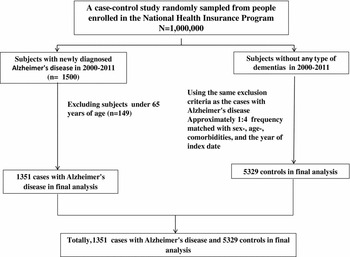
Subjects aged 65 years or older with new diagnosis of Alzheimer's disease were identified as the cases in 2000–2011 (according to International Classification of Diseases, Ninth Revision, Clinical Modification, ICD-9 code 331.0). The index date for each case was defined as the date of case being diagnosed with Alzheimer's disease. To increase statistical power, for each subject with Alzheimer's disease, approximately four subjects aged 65 years or older without any type of dementias (ICD-9 codes 331.0, 290.0-290.4, and 294.1) were randomly selected as the controls. The cases and control subjects were matched for sex, age (within five years), and index year of being diagnosed with Alzheimer's disease (Figure 1).
Flow chart showing the selection of cases with Alzheimer's disease and control subjects for the study.

Medical conditions related to Alzheimer's disease
Medical conditions potentially related to Alzheimer's disease were included as follows: glaucoma (ICD-9 codes 365.1 and 365.2), alcohol-related disease (ICD-9 codes 291, 303, 305.00, 305.01, 305.02, 305.03, 571.0–571.3, 790.3, and V11.3), cerebrovascular disease (ICD-9 codes 430–438), chronic kidney disease (ICD-9 codes 585–586 and 588.8–588.9), chronic obstructive pulmonary disease (ICD-9 codes 491, 492, 493, and 496), diabetes mellitus (ICD-9 code 250), hyperlipidemia (ICD-9 codes 272.0, 272.1, 272.2, 272.3, and 272.4), and hypertension (ICD-9 codes 401–405). The diagnosis accuracy based on ICD-9 codes has been completely examined in previous studies (Lai et al., Reference Lai, Chen, Lin and Liao2013a; Reference Lai, Lin and Liao2013b; Reference Lai, Chen, Lin and Liao2014a; Chen et al., Reference Chen, Lin, Lai and Kao2016; Shen et al., Reference Shen, Liao, Tsai, Lin and Lai2016; Wong et al., Reference Wong, Liao, Lin, Lin, Chen and Lai2016; Hsu et al., Reference Hsu, Sheu, Lin, Hsieh and Lai2017; Hung et al., Reference Hung, Lin, Hung, Lin and Lai2017; Laio et al., Reference Liao, Cheng, Lin and Lai2017a; Reference Liao, Cheng, Lin and Lai2017b; Lin et al., Reference Lin, Liao, Lin and Lai2017). In order to avoid subjects who could be mistakenly diagnosed, mistakenly coded by accident, or mistakenly coded by similar clinical features with unconfirmed diagnosis, only those who had the same diagnosis in two consecutive clinical records during the study period could be included for analysis. Therefore, Alzheimer's disease, glaucoma, and other comorbidities were recorded for two or more visits.
Statistical analysis
We compared the distributions of the demographic status, glaucoma, and other comorbidities between the cases with Alzheimer's disease and the control subjects using the χ 2 test for categorized variables and Student's t-test for continuous variables. The univariable and multivariable unconditional logistic regression models were used to calculate odds ratio (OR) and 95% confidence interval (CI) for the association between glaucoma and the risk of Alzheimer's disease. Only variables found to be significantly associated with Alzheimer's disease in the univariable unconditional logistic regression model were further examined by the multivariable unconditional logistic regression model. All analyses were performed using SAS statistical software (version 9.2; SAS Institute, Inc., Cary, North Carolina, USA). The results were considered statistically significant when two-tailed P values were less than 0.05.
Results
Characteristics of the study population
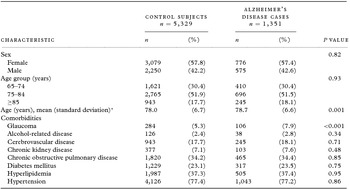
We identified 1,351 cases with new diagnosis of Alzheimer's disease and 5,329 control subjects without any type of dementias in 2000–2011 (Table 1). The cases with Alzheimer's disease and the control subjects had a similar distribution of sex. The mean ages (standard deviation) were 78.7 (6.6) years in cases with the Alzheimer's disease and 78.0 (6.7) years in control subjects, with a statistical significance (Student's t-test, P = 0.001). The cases with Alzheimer's disease were more likely to have a higher proportion of glaucoma than the control subjects (7.9% vs. 5.3%, χ 2 test, P < 0.001). There was no significant difference in distribution of other comorbidities between the cases with Alzheimer's disease and the control subjects (χ 2 test, P > 0.05 for all).
Characteristics between Alzheimer's disease cases and control subjects

Data are presented as the number of subjects in each group, with percentages given in parentheses, or mean with standard deviation given in parentheses.
χ 2 test for categorical variables.
*Student's t-test for continuous variables comparing subjects with Alzheimer's disease and control subjects.
Association of Alzheimer's disease with glaucoma and other comorbidities
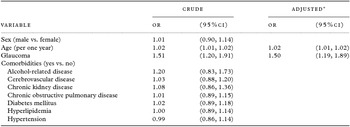
Variables found to be significantly associated with Alzheimer's disease in the univariable unconditional logistic regression model were further examined by the multivariable unconditional logistic regression model. Therefore, only age was matched with this criterion for adjustment. The multivariable unconditional logistic regression model demonstrated that the adjusted OR of Alzheimer's disease was 1.50 for subjects with glaucoma (95% CI 1.19, 1.89), compared to subjects without glaucoma (Table 2). In addition, every one-year increase in age was associated with 1.02-fold increased odds of Alzheimer's disease (95% CI 1.01, 1.02).
Odds ratio and 95% confidence interval of Alzheimer's disease associated with glaucoma and other comorbidities

* Variables found to be significantly associated with Alzheimer's disease in the univariable unconditional logistic regression model were further examined by the multivariable unconditional logistic regression model. Adjusted for age.
In further analysis, the adjusted ORs of Alzheimer's disease were 1.47 for subjects with primary open-angle glaucoma (95% CI 1.13, 1.92), and 1.46 for subjects with primary angle-closure glaucoma (95% CI 1.12, 1.91), compared to subjects without glaucoma (Table 3).
Odds ratio and 95% confidence interval of Alzheimer's disease associated with subtypes of glaucoma

* Variables found to be significantly associated with Alzheimer's disease in the univariable unconditional logistic regression model were further examined by the multivariable unconditional logistic regression model. Adjusted for age.
Discussion
In this population-based, retrospective, case-control study, we found that patients with Alzheimer's disease were more likely to have a higher proportion of glaucoma than those without any type of dementia (7.9% vs. 5.3%, P < 0.001). This finding was compatible with Bayer et al's., (Reference Bayer, Ferrari and Erb2002) study in which patients with Alzheimer's disease had a higher prevalence of glaucoma than those without Alzheimer's disease (25.9% vs.5.2%). Pelletier et al's., (Reference Pelletier2014) study also demonstrated that glaucoma was more prevalent in patients with Alzheimer's disease than those without Alzheimer's disease (9.5% vs. 4.1%, P = 0.023).
After adjustment for confounding variables, patients with glaucoma were associated with 1.5-fold increased odds of Alzheimer's disease (Table 2). In further analysis, patients with primary open-angle glaucoma or primary angle-closure glaucoma still had the odds (Table 3). These findings indicate that both common types of glaucoma are associated with increased odds of Alzheimer's disease.
Although there is a lag period between the onset of memory impairment and confirmed diagnosis of Alzheimer's disease, we could not definitely differentiate whether glaucoma was diagnosed before or after the onset of memory impairment from this retrospective, case-control study. However, the diagnosis of glaucoma was clinically made before the diagnosis of Alzheimer's disease in the present study. Therefore, we suggest that clinicians should consider the possibility of Alzheimer's disease when old people present with glaucoma and other non-memory manifestations, including impaired language presentation, hearing impairment, cataract, and other visual dysfunctions. (Mendez et al., Reference Mendez, Lee, Joshi and Shapira2012; Pal et al., Reference Pal, Sanyal, Biswas, Paul and Das2013; Lai et al., Reference Lai, Liao, Liao, Muo, Liu and Sung2014b; Hung et al., Reference Hung, Liao, Muo, Lai, Chang and Hung2015)
The mechanisms underlying the relationship between glaucoma and Alzheimer's disease cannot be fully illustrated in this observational study. Increasing evidence indicates that that glaucoma and Alzheimer's disease may be affected by mitochondrial dysfunction and ROS. That is, aging and genetic risk factors may be associated with mitochondrial dysfunction (Onyango and Khan, Reference Onyango and Khan2006; Lee et al., Reference Lee2011; Chrysostomou et al., Reference Chrysostomou, Rezania, Trounce and Crowston2013; Flynn and Melov, Reference Flynn and Melov2013). Mitochondrial dysfunction further leads to increased ROS (Onyango and Khan, Reference Onyango and Khan2006; Lee et al., Reference Lee2011; Chrysostomou et al., Reference Chrysostomou, Rezania, Trounce and Crowston2013; Flynn and Melov, Reference Flynn and Melov2013). When this process potentially overwhelms the cellular antioxidant defense systems, oxidative stress may develop (Onyango and Khan, Reference Onyango and Khan2006; Lee et al., Reference Lee2011; Chrysostomou et al., Reference Chrysostomou, Rezania, Trounce and Crowston2013; Flynn and Melov, Reference Flynn and Melov2013). Oxidative stress may induce degeneration of retinal ganglion cells in glaucoma and hippocampal neuronal cells in Alzheimer's disease (Onyango and Khan, Reference Onyango and Khan2006; Lee et al., Reference Lee2011; Chrysostomou et al., Reference Chrysostomou, Rezania, Trounce and Crowston2013; Flynn and Melov, Reference Flynn and Melov2013). Mitochondrial dysfunction may enhance cell death by resetting apoptosis (Rego and Oliveira, Reference Rego and Oliveira2003; Kong et al., Reference Kong, Van Bergen, Trounce and Crowston2009; Hroudova et al., Reference Hroudova, Singh and Fisar2014). During the degenerative process, degeneration of retinal ganglion cells in glaucoma may even happen before the degeneration of the hippocampus, a region related to memory function (Valenti, Reference Valenti2011; Javaid et al., Reference Javaid, Brenton, Guo and Cordeiro2016). That can partially explain why glaucoma may be a non-memory manifestation of Alzheimer's disease. In addition, recent evidence indicates that age-related hearing impairment, and age-related cataract could be associated with the risk of frailty and Alzheimer's disease (Klein et al., Reference Klein, Klein and Knudtson2006; Panza et al., Reference Panza, Solfrizzi and Logroscino2015b; Panza et al., Reference Panza2015c; Fukuoka and Afshari, Reference Fukuoka and Afshari2017). In the meanwhile, increased age is found to be associated with the risk of glaucoma (Le et al., Reference Le, Mukesh, McCarty and Taylor2003; Suzuki et al., Reference Suzuki2006). Given that cognitive impairment, Alzheimer's disease, and other dementias are causally linked with frailty (Panza et al., Reference Panza2015a, Reference Panza, Solfrizzi and Logroscino2015b), we hypothesize that age-related glaucoma could be potentially associated with frailty and Alzheimer's disease. This rational hypothesis can be partially tested by our finding that patients with glaucoma were associated with 1.5-fold increased odds of Alzheimer's disease (Table 2).
Some limitations in this study should be discussed. First, due to the inherent limitation of this database, there was no record on cognitive impairment, memory impairment, or other non-memory manifestations of Alzheimer's disease. We could not definitely determine whether glaucoma was diagnosed before or after the onset of cognitive impairment, memory impairment, or other non-memory manifestations. Second, due to the same limitation, a few of risk factors for Alzheimer's disease, such as alcohol consumption and cigarette smoking, were not documented in this database. Alcohol-related disease was included instead of alcohol consumption, and chronic obstructive pulmonary disease was included instead of cigarette smoking. Third, due to the same limitation, we could not know what the criterion for diagnosing glaucoma was. Glaucoma should be diagnosed by optic nerve disc cupping and visual field defects that corresponds with the loss of the area of the optic neuronal rim. In general, it is difficult for the patients with cognitive impairment to perform the visual fields test. Similarly, visual difficulties can interfere with the diagnostic tests, such as Mini-Mental State Examination or Clinical Dementia Rating, which is usually used for the diagnosis of Alzheimer's disease. Therefore, it could overestimate the diagnosis of Alzheimer's disease in patients with visual difficulties. Fourth, due to the same limitation, we could not provide the status of lens such as phakia, aphakia, or pseudophakia because cataract surgery could prevent from the occurrence of primary angle closure glaucoma.
In spite of various limitations, the strength of this study is using a well-organized data base to increase its unbiased results. The introduction, methodology, results, discussion, and limitations are appropriate. The result from this epidemiological study is interesting for researchers, who are studying Alzheimer's disease and related disorders.
In conclusion, older people with glaucoma are associated with 1.5-fold increased odds of Alzheimer's disease. Glaucoma may be a non-memory manifestation of Alzheimer's disease in older people. Further prospective studies are warranted to have better knowledge on the true nature of the association between glaucoma and Alzheimer's disease.
Conflict of interest
The authors disclose no conflicts of interest
Description of authors' roles
Shih-Wei Lai planned and conducted this study. He substantially contributed to the conception of the paper, initiated the draft of the paper, and critically revised the paper. Cheng-Li Lin conducted the data analysis and critically revised the paper. Kuan-Fu Liao planned and conducted this study. He participated in the data interpretation and also critically revised the paper.
Acknowledgments
This study was supported in part by Taiwan Ministry of Health and Welfare Clinical Trial Center (MOHW106-TDU-B-212-113004), China Medical University Hospital, Academia Sinica Taiwan Biobank Stroke Biosignature Project (BM10501010037), National Research Program for Biopharmaceuticals (NRPB) Stroke Clinical Trial Consortium (MOST 105-2325-B-039 -003), Tseng-Lien Lin Foundation in Taichung in Taiwan, Taiwan Brain Disease Foundation in Taipei in Taiwan, and Katsuzo and Kiyo Aoshima Memorial Funds in Japan. These funding agencies did not influence the study design, data collection and analysis, decision to publish, or preparation of the manuscript.