Introduction
The ideological space in Western Europe is shifting as a consequence of globalization (e.g., Kriesi et al., Reference Kriesi, Grande, Lachat, Dolezal, Bornschier and Frey2008, Reference Kriesi, Grande, Dolezal, Helbling, Hoeglinger and Hutter2012; Bornschier, Reference Bornschier2010; Azmanova, Reference Azmanova2011). Globalization polarizes the population into groups of winners and losers that do not necessarily follow classical cleavage divisions, such as the class or confessional divides identified by Lipset and Rokkan (Reference Lipset and Rokkan1967). In a nutshell, losers of globalization are citizens who see their life chances reduced by the effects of globalization while winners are those who consider themselves to have benefitted from globalization. Coherent ideological and attitudinal positions underlie the poles of this new conflict: each of these groups tends to support antagonistic positions regarding ‘denationalization’ (Zürn, Reference Zürn1998), which refers to the opening-up of national borders for a range of international exchange and interaction. In the following, we demonstrate that the operationalization of winners and losers of globalization should encompass both objective socio-demographic characteristics and subjective measurements such as subjective deprivation, the perception of globalization as a threat and collective identities. Moreover, we show that this new globalization-driven conflict encompasses more than attitudes toward the opening or closing of borders and is underpinned, additionally, by cosmopolitan and communitarian ideological dispositions. This complexity brings the conflict closer in line with what we would expect of a new cleavage (cf. Bartolini and Mair, Reference Bartolini and Mair1990) rather than simply a new socio-political divide.
Thus far, most of the empirical literature on this new conflict focuses on political parties, leaving the attitudes of the population relatively understudied (with some exceptions, see for instance Van der Brug and van Spanje, Reference Van der Brug and van Spanje2009; Ecker-Ehrhardt, Reference Ecker-Ehrhardt2011). In this article, we further investigate this new conflict among European citizens. We use the terminology of ‘social conflict’ rather than cleavage, since we only assess this divide from the side of citizens in this article, leaving aside the positions of political parties (cf. Bartolini and Mair, Reference Bartolini and Mair1990). We use detailed survey items on issues of immigration and European integration that measure not only citizen positions toward the EU but also the ideologies underpinning the positions toward the EU. This enables us to provide a fine-grained analysis of the cosmopolitan and communitarian ideological poles of the new conflict line. Specifically, our analysis addresses four key questions. First, to what extent can we find a divide among Europeans in attitudes toward denationalization? Second, how much do objective and subjective factors influence citizens’ positions along this divide? Third, does this divide reveal itself in similar patterns in Central and Eastern European countries (CEEC)? Finally, is there evidence that globalization causes such a divide in both Western Europe and CEEC?
Our findings extend current research by further clarifying the ideological profiles of citizens on both sides of the new conflict line and show the importance of cosmopolitan and communitarian ideological viewpoints in structuring these profiles. Moreover, we draw on studies on cosmopolitan dispositions to refine the previous findings that comparative politics scholars have provided thus far: we show that the operationalization of winners and losers of globalization should encompass both objective socio-demographic characteristics and subjective measurements such as perception of globalization as a threat or opportunity. Furthermore, we include both Western European countries and CEEC in the analysis, which provides a clear extension to the existing literature that has hitherto focused predominantly on Western Europe only. The results show similar patterns in both Western Europe and Central and Eastern Europe – supporting the theory that it is indeed globalization, rather than something specific to Western Europe, that generates this divide. Additionally, we show that those citizens from countries with higher degrees of globalization are less likely to have a cosmopolitan perspective of the EU and more likely to consider the EU in communitarian terms.
The article proceeds as follows: first, we briefly summarize the arguments on the rise of a new conflict. Second, we discuss characteristics of citizens and countries that should be taken into account when investigating the salience of a new divide among Europeans. Third, we define the two poles of the new conflict line in more detail. This theoretical section develops clear hypotheses, which are then tested using survey data in a fourth step. For this test, we use the 2009 wave of the Eurobarometer survey (71.3), which provides detailed items relevant for our purpose.
The rise of a new societal conflict caused by globalization
Hanspeter Kriesi et al. (Reference Kriesi, Grande, Lachat, Dolezal, Bornschier and Frey2008) claim that globalization leads to new societal conflicts that result in the rise of a new cleavage. Globalization, according to their theory, is manifested in an increase in economic competition, (e.g., competition in the global economy, international pressure toward deregulation) that is exacerbated by increasing cultural competition. This cultural competition is due to the growing cultural diversity caused by immigration in West European countries. Such diversity leads to a perception of ethnic competition for scarce resources (such as jobs) and of threat to the collective identity and lifestyle of the native population (Kriesi et al., Reference Kriesi, Grande, Lachat, Dolezal, Bornschier and Frey2008). The increasing authority of international and supranational institutions, above all the EU, provides a further bone of contention (Hooghe and Marks, Reference Hooghe and Marks2009; De Wilde and Zürn, Reference De Wilde and Zürn2012; Zürn et al., Reference Zürn, Binder and Ecker-Ehrhardt2012). Taken together, we witness a process of ‘politicization’ in which globalization-related issues become more salient, an increasing number of citizens become aware of the issues at stake, and opinion becomes more polarized as both opponents and proponents become better organized, clearly identifiable, and more vocal (cf. De Wilde, Reference De Wilde2011). In support of this expectation, Kriesi et al. (Reference Kriesi, Grande, Lachat, Dolezal, Bornschier and Frey2008) argue that these new forms of competition lead to the polarization of citizens into groups of winners and losers of globalization who support antagonist positions toward the opening up of borders: losers tend to support demarcationist positions toward denationalization while winners tend to endorse integrationist positions. Losers of globalization are citizens who consider their social status and security protected by the nation state, who strongly identify with the national community, and who are attached to its exclusionary norms and political institutions. They perceive the opening of national borders as a threat to their life chances. By contrast, winners of globalization have universal norms and see opportunities in the opening of borders (Kriesi et al., Reference Kriesi, Grande, Lachat, Dolezal, Bornschier and Frey2008, Reference Kriesi, Grande, Dolezal, Helbling, Hoeglinger and Hutter2012; Bornschier, Reference Bornschier2010; Azmanova, Reference Azmanova2011). Identity and interests thus stand at the core of this conflict.
Most commonly, winners and losers of globalization are identified based on socio-demographic characteristics. For instance, Kriesi et al. (Reference Kriesi, Grande, Lachat, Dolezal, Bornschier and Frey2008, Reference Kriesi, Grande, Dolezal, Helbling, Hoeglinger and Hutter2012) and Bornschier (Reference Bornschier2010) use education and employment status as main explanatory characteristics for their empirical analyses. Education is hypothesized to provide citizens with the necessary specialized skills to benefit from the opening up of borders. Employment status determines whether the sector or position is at risk from the pressures of globalization (Walter, Reference Walter2010). Nevertheless, and as mentioned previously, such scholars agree that the subjective perception of threat due to globalization also matters in polarizing citizens along the new societal conflict. For instance, Mau (Reference Mau2005) showed that the self-characterization of personally losing or winning through European integration is significantly associated with attitudes toward the EU to a greater extent than are socio-demographic characteristics.
In addition to objective demographics and subjective threat perceptions, subjective collective identities are associated with both structural factors and positions toward opening and closing of borders. For instance, Diez Medrano (Reference Diez Medrano2010) and Fligstein (Reference Fligstein2008) show that citizens with a European identity will support European integration to a greater extent than those citizens holding exclusively national identities. Furthermore, supranational identification is positively associated with tolerance toward immigrants (Phillips, Reference Phillips2002; Pichler, Reference Pichler2009b, Reference Pichler2012). Without the presence of group consciousness, a divide among citizens along structural factors cannot lead to the necessary potential for political mobilization and, thus, for a true conflict.
Drawing on these previous studies, in addition to the findings of the comparative politics literature, enables us to refine the operationalization of winners and losers of globalization in several ways. First, the objective attributes of winners and losers of globalization should include age, immigrant origin, place of residence and internet use besides education and employment status. Indeed, Pichler (Reference Pichler2009a, Reference Pichlerb) showed that young age, urban living conditions, immigrant background, high education, and white collar jobs make citizens have more integrationist attitudes. Additionally, the frequent use of the internet increases contact with, and consumption of, foreign cultures and is therefore likely to increase integrationist positions such as support of ethnic diversity (Phillips and Smith, Reference Phillips and Smith2008; Kendall et al., Reference Kendall, Skrbis and Woodward2009). By accounting for these control variables, we investigate the power of subjective perception of threat in polarizing the population in attitudes toward immigration and European integration. Specifically, we include two measurements of threat in the analysis: we use an item referring to the evaluation of the financial situation of the household (subjective deprivation) and items in which respondents evaluate globalization as a threat or as an opportunity. We expect citizens who feel deprived to hold more demarcationist positions (H1). For the perception of globalization as a threat or opportunity, we expect the subjective evaluation of globalization as an opportunity to be significantly associated with positive attitudes toward immigration and European integration (H2). Finally, we assess the association of local, national, European, and world collective identities with attitudes toward immigration and European integration. We expect sub- and national identifications to be positively related to demarcationist positions and supranational identification to be positively related to integrationist positions (H3). The empirical debate surrounding this globalization-centered conflict line focuses predominantly on Western European democracies (but see for instance Herzog and Tucker, Reference Herzog and Tucker2010 about European integration in CEEC). This narrow focus is arbitrary, as we would expect similar globalization pressures in CEEC. Azmanova (Reference Azmanova2009) argues that attitudes toward regained political sovereignty and national identity in CEEC are indeed structured along a cosmopolitan–sovereigntist dimension that comprises immigrants, minorities, and EU issues. She claims that a division of the population in groups of winners and losers of globalization is at work in both the old and new democracies of Europe (Azmanova, Reference Azmanova2009: 1032). Accordingly, we expect the aforementioned subjective measurements (i.e., subjective deprivation, perception of globalization as a threat, (sub)national and supranational identities) to be associated with demarcationist and integrationist positions in a similar way in both CEEC and Western European countries (H4).
Even if we expect a similar divide in CEEC and Western European countries, this does not mean that the extent to which Europeans endorse integrationist or demarcationist positions is constant across all EU countries. Indeed, we know from previous studies that support for EU and tolerance toward immigrants do vary across EU countries (Lubbers and Scheepers, Reference Lubbers and Scheepers2010; Schlueter et al., Reference Schlueter, Meuleman and Davidov2013). Such varying degrees of globalization could explain these country differences: if globalization leads to a growing divide between winners and losers, a country’s degree of exposure to its pressures is likely to affect the constellation of integrationist and demarcationist attitudes among citizens in different countries differently. We see globalization as a meta issue, which affects more than just Western Europe and advanced democracies. More specifically, we expect the importance of the divide to increase with the national degree of globalization with citizens’ attitudes becoming more consolidated around both extremes in highly globalized countries (H5). In other words, the conflict between winners and losers of globalization will be more intense in highly globalized countries: the polarization of citizens along the globalization-centered dimension is expected to be positively associated with the country’s degree of globalization (see Kriesi et al., Reference Kriesi, Grande, Dolezal, Helbling, Hoeglinger and Hutter2012: 57 for a similar conceptualization of polarization among political parties).
The cosmopolitan and communitarian underpinning of the new societal conflict
While Kriesi et al. (Reference Kriesi, Grande, Lachat, Dolezal, Bornschier and Frey2008) use the terms integration and demarcation to define the poles of the new social conflict for the cultural dimension, Azmanova (Reference Azmanova2011) speaks of cosmopolitanism and sovereigntism in reference to the same divide. She claims that, because of globalization, an ‘opportunity-risks cleavage’ is emerging within the population. This cleavage crosscuts the traditional left–right axis and encompasses, on one side, cosmopolitan and open economic positions and, on the other, sovereigntist and closed economic positions. Similarly to Kriesi et al. (Reference Kriesi, Grande, Lachat, Dolezal, Bornschier and Frey2008, Reference Kriesi, Grande, Dolezal, Helbling, Hoeglinger and Hutter2012), Azmanova (Reference Azmanova2011) interprets immigration and European integration as key issues fueling this opportunity-risks cleavage. Kriesi et al.’s terminology refers solely to preferences regarding the opening and closing of national borders, while the terminology used by Azmanova goes a step further by assuming an ideology to underlie these preferences. Such more or less coherent value sets function as rallying points for coalition partners and as cognitive short-cuts to arrange diverse political issues into a single political cleavage. For these reasons, the presence of ideological underpinnings is a core component of a cleavage (cf. Bartolini and Mair, Reference Bartolini and Mair1990). This, naturally, raises the conceptual question of which two ideologies best fulfill this function. For reasons discussed below, we follow other recent scholarship and conceptualize the two underlying ideologies of the conflict as communitarianism and cosmopolitanism (cf. Zürn, Reference Zürn2012, De Wilde and Zürn, Reference De Wilde and Zürn2013; Lacewell and Merkel, Reference Lacewell and Merkel2013).
Pogge (Reference Pogge1992) identifies a combination of individualism and universalism as the basis of a cosmopolitan disposition, which then comes in two different strands. First, legal cosmopolitanism refers to the commitment to an institutionalized global order of rule of law and justice. Second, moral cosmopolitanism requires the respect of every human being’s status as ultimate units of moral concern (Pogge, Reference Pogge1992). Following this definition, moral cosmopolitanism can be considered a prime candidate for the normative foundation of tolerance toward immigrants, while legal cosmopolitanism underpins support for the EU as a regional vanguard of global political order (Eriksen, Reference Eriksen2009). Hence, the cosmopolitan perspective is linked directly to both tolerance toward immigrants and support for European integration.
Similar to Bornschier (Reference Bornschier2010), we consider communitarianism as the ideology underlying the other pole of this new social conflict. In our understanding, communitarianism refers to the support of closing borders in order to favor and protect constitutive communities. These are ‘constitutive’ communities in the sense that membership in them is non-voluntary, cannot be easily renounced, and forms a corner-stone of identity (Bell, Reference Bell1993). Communitarians believe that justice is socially bound and, as such, can be realized only within the confines of such constitutive communities (Sandel, Reference Sandel1998: 11f). The communitarian ideology thus represents a counter-pole to the individualistic and universalist conception of community (Bornschier, Reference Bornschier2010: 23) that we defined as cosmopolitanism. The communitarian perspective leads to a rejection of both immigration and European integration since both processes dilute the community’s potential to realize, collectively, its particular understanding of justice. In that sense, communitarianism implies a broader value-base and set of concerns than the more narrow concerns with sovereignty that Azmanova assumes under sovereigntism.
Data and methods
We use the data from the Eurobarometer wave 71.3 administered in summer 2009 for all 27 EU countries. This wave of the Eurobarometer is the only one that includes the necessary items to test our hypotheses, namely questions regarding respondents’ attitudes toward immigrants, ideological perspective on the EU, subjective evaluations of globalization, and identifications (from local to global). The sample is composed of 26,830 respondents. We use a multilevel linear regression analysis in order to account for the hierarchical structure of the sample and to assess the hypotheses at both the individual and country levels.
Independent variables
Subjective deprivation is measured with the item ‘How would you judge the current financial situation of your household’ (from very bad (1) to very good (4); mean: 2.66; std. dev.: 0.76). The evaluation of globalization is measured with an additive scale (mean: 3.41; std. dev.: 1.57) ranging from 0 (globalization as a threat) to 7 (globalization as an opportunity) summarizing the following items: ‘Globalization is an opportunity for economic growth’ (totally disagree (0) to totally agree (3)); ‘Globalization increases social inequalities’ (totally agree (0) to totally disagree (3)) and ‘Globalization represents a threat to employment and companies in [country] (0) vs. Globalization represents a good opportunity for national companies thanks to the opening-up of markets (1)’.
For the identification measurements, respondents selected, on a four-point Likert scale, the extent to which they personally felt inhabitants of their region, nationals, Europeans, and citizens of the world. A factor analysis resulted in a two-factor solution with the local and national identification items loading on one factor and the European and global identification loading on the second factor. Therefore, we built one additive scale for subnational and national identification (mean: 5.42; std. dev.: 0.98) and one additive scale for European and global identification (mean: 3.87; std. dev.: 1.59). These two scales range from 0 to 7, where a high value means high identification. The (sub)national and supranational identification scales correlate by 0.16. Thus, one can simultaneously hold strong national and supranational identities.Footnote 1
The four subjective measurements are not independent from socio-demographic characteristics. For instance, previous studies have shown that citizens with a strong supranational identity are more likely to be young, highly educated and to live in urban areas (e.g., Pichler, Reference Pichler2009a; Hanquinet and Savage, Reference Hanquinet and Savage2013). Therefore, and in order to assess the additional power of these subjective measurements in explaining Europeans’ cosmopolitan and communitarian positions, we also account for the structural characteristics that have been shown to be associated with the dependent variables. Controlling for these structural variables will enable us to avoid overestimating the power of the subjective measurements in explaining cosmopolitan and communitarian positions. We test our hypotheses by controlling for the following socio-demographic characteristics: gender, age, age at which respondents stopped full-time education, a dummy for internet use, size of place of residence, immigrant origin, and socio-economic status. The immigrant background is measured with three categories: nationals (born in country of residence and both parents born in country of residence); EU migrant (born in an EU country or at least one parent born in another EU country); non-EU migrant (born in a non-EU country or at least one parent born in a non-EU country). The socio-economic status is measured with the following categories: unemployed, students, unskilled manual workers, skilled manual workers, office workers, professional workers, self-employed, owner of a company, middle-range manager and top manager. Table A in the online appendix presents summary statistics of these control variables and their associations with the four subjective measurements. As can be seen, the four subjective measurements significantly differ across the socio-demographic characteristics. It is therefore necessary to control for the effect of these socio-demographic characteristics when assessing the additional power of the subjective measurements in explaining differences in cosmopolitan and communitarian positions among Europeans.
At the country level, we differentiate CEEC from other EU countries. Moreover, we use the (centered) KOF index of globalization for 2008 (std. dev.: 6.02; ranges from −12.84 to 9.44) which measures the economic, social, and political dimensions of globalization (Dreher et al., Reference Dreher, Gaston and Martens2008). While it would be theoretically more interesting to include each dimension of the KOF index (economic, political, and social) separately in the models, the high correlation between the three does not allow for this. Since the KOF-index does not take into account country size, we also control for the (centered) size of country’s population.Footnote 2
Dependent variables
We investigate the profiles of winners and losers of globalization along the two key issues that are thought to divide citizens along the new societal conflict: immigration and European integration.
Attitudes toward immigrants
The Eurobarometer 71.3 wave is composed of six items measuring respondents’ positions toward immigrants. These items were answered with a three-point-Likert scale (tend to agree, it depends, tend to disagree). These items are: (1) ‘People from other ethnic groups enrich the cultural life of [country]’; (2) ‘The presence of people from other ethnic groups is a cause of insecurity’ (reverse coded); (3) ‘The presence of people from other ethnic groups increases unemployment’ (reverse coded); (4) ‘We need immigrants to work in certain sectors of our economy’; (5) ‘The arrival of immigrants in Europe can be effective in solving the problem of Europe’s ageing population’; and (6) ‘Immigrants can play an important role in developing greater understanding and tolerance with the rest of the world’. A factor analysis resulted in a one-factor solution with an eigenvalue of 1.70 and Cronbach’s α is 0.70. A single additive scale can summarize these items. This scale ranges from 0 to 10, where a high value means tolerance toward immigrants and ethnic groups (mean: 4.89; std. dev.: 2.95).
Meanings of the EU
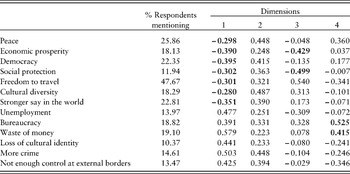
The Eurobarometer data provides items that measure not only the positive or negative position toward the EU but also the meanings respondents give to the EU. The use of this detailed set of items rather than items measuring simple support for the EU enables us to assess the social divide on cosmopolitan and communitarian dispositions underlying support and opposition toward the EU. We will therefore use the multiple answer question ‘What does the European Union mean to you personally?’ for the measurement of the meaning respondents ascribe to the EU. The percent of respondents mentioning each category is given in Table 1. The coefficient of association of these 14 answer categories can be found in Table B in the online Appendix.Footnote 3 We ran a categorical principal component analysis (CatPCA) on this set of items in order to summarize the 13 categories of EU meanings into a few dimensions. Similar to a factor analysis, CatPCA aims at identifying the underlying components of a set of variables while maximizing the amount of variance accounted for by the components in those variables. The CatPCA results in a solution of four dimensions with an eigenvalue higher than 1.0 explaining 45% of the total variance of the 13 items. Table 1 presents the loadings of each item on the four dimensions. Items with similar values on one dimension are highly related to each other. Moreover, the larger the loading of an item, the larger its contribution to the dimension. An inspection of these loadings on the four dimensions enables the clustering of the items according to their similarities. Graphs A–C in the online Appendix plot the items according to their loadings along the four dimensions.
Component loadings of CatPCA

In bold are the items that relate strongly to each other for each dimension.
Dimensions 1 and 2 cluster the items into two groups (see Graph A in the online Appendix): one group is composed of the items with a positive connotation and the other one contains the items with a negative meaning. According to the third dimension, the positive items need to be further differentiated into two clusters: the two items referring to material advantages (i.e., social protection and economic prosperity) have similar high loadings and are opposite to the other positive items. We label this dimension ‘utilitarian’ due to the prominence of consequentialist reasoning. The second set of positive items is composed of democracy, peace, strength in the world, cultural diversity, and freedom to travel and relates to (legal) ‘cosmopolitanism’. The last dimension helps further differentiate the negative items. Bureaucracy and wastes of money have very high and similar loadings in contrast to the other negative items. Therefore, one can regroup the negative items into two clusters. The first group is composed of the items bureaucracy and wastes of money and is interpreted as ‘libertarian’. The second group contains the items unemployment, crime, loss of cultural identity and not enough control at external borders. This group of items relates to negative consequences of the EU for the constitutive community and is collectively labeled ‘communitarian’.
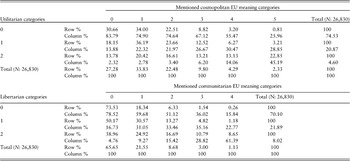
To summarize, the results of the CatPCA show that the meaning of the EU falls into four different perspectives among Europeans. Indeed, the 13 items on the meaning of the EU compose four distinct clusters of EU perspectives: ‘utilitarian’, ‘cosmopolitan’, ‘libertarian’, and ‘communitarian’. Table 2 provides detailed information on the association between the two positive and two negative clusters of EU meaning.
Distribution of the number of mentioned cosmopolitan EU meaning categories by the number of mentioned utilitarian categories and of the number of mentioned communitarian EU meaning categories by the number of mentioned libertarian categories

As can be seen in the first part of Table 2, citizens who have a strong cosmopolitan perspective on the EU are also likely to consider the EU in utilitarian terms. The second part of Table 2 shows that those who have a strong communitarian perspective on the EU also consider it as bureaucratic and a waste of money (i.e., the two libertarian categories). By contrast, citizens who mentioned the two libertarian categories are unlikely to hold a communitarian perspective.
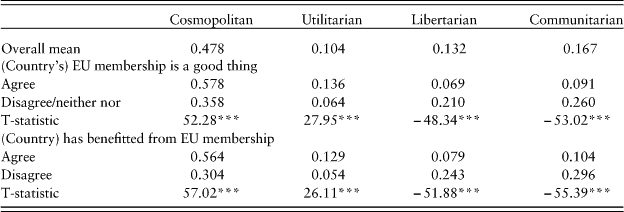
We built a scale ranging from 0 to 1 for each of these four clusters that is then used for the analysis of the perspectives on the EU. For each of the clusters, the scale is composed of the sum of the mentioned items belonging to the specific cluster divided by the total number of items mentioned by the respondent. These four scales measure the relative frequency with which the respondent associates each ideological frame to the EU. In other words, these scales measure the salience of each ideological frame (see the definition of salience provided by Kriesi et al., Reference Kriesi, Grande, Dolezal, Helbling, Hoeglinger and Hutter2012: 55). The analysis of these four scales enables us to assess the extent to which the cosmopolitan and communitarian perspectives differ from the utilitarian and libertarian ones with regard to their associations with the independent variables. Table 3 presents the overall means and the mean differences of the four perspectives across two items measuring support for one’s country’s EU membership.
Means of the cosmopolitan, utilitarian, libertarian and communitarian EU meanings by support for and opposition to country’s EU membership

***p<0.001.
As Table 3 shows, the most salient perspective among Europeans is a cosmopolitan one, followed by the communitarian, libertarian, and finally utilitarian perspectives. Furthermore, citizens who support their country’s EU membership have cosmopolitan and utilitarian perspectives to a significantly larger extent than citizens who oppose it. By contrast, opponents to their country’s EU membership have libertarian or communitarian perspectives to a significantly larger extent than supporters. Thus, cosmopolitan and utilitarian viewpoints underpin EU support, while opposition to the EU is grounded in communitarian and libertarian viewpoints. Moreover, the strong negative correlation between the cosmopolitan and communitarian perspectives (−0.54) shows evidence that these two meanings underpin the two poles of a single underlying dimension – confirming our theoretical assumptions. In addition, the scale measuring tolerance toward immigrants correlates highly with both the communitarian (−0.23) and cosmopolitan (0.21) perspective. Thus, respondents who base their evaluation of the EU in a cosmopolitan perspective tend to be tolerant toward immigrants and ethnic minority groups as well as support European integration and EU membership while Europeans who consider the EU in a communitarian light are likely to reject immigrants and ethnic minorities as well as the EU. These correlations demonstrate that European integration and immigration are closely linked issues. Moreover, these results are in line with our theoretical assumption: cosmopolitanism and communitarianism are the two most salient ideologies underpinning integration and demarcation positions toward the EU.
Results
In a first step, the four perspectives on the EU and the anti-immigrant attitudinal scale are regressed on the socio-demographic characteristics by taking country disparities into account (see Table C in online appendix). Taken individually, results for the control variables (socio-economic status, education, age, gender, immigrant origin, internet use, and size of area of residence) are as we would expect given the findings of previous scholars such as Kriesi et al. (Reference Kriesi, Grande, Lachat, Dolezal, Bornschier and Frey2008) or Pichler (Reference Pichler2009a, Reference Pichlerb). Overall, the socio-demographic characteristics have a moderate impact on the four perspectives and the anti-immigrant attitudinal scale: they explain solely between 0.44% and 7.77% of the total variance of the three key dependent variables.
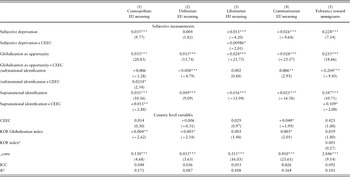
In a further step, we introduce the subjective measurements and country variables by controlling for the socio-demographic characteristics of Table C. This enables us to investigate the power of the subjective measurements in explaining the four EU perspectives and the anti-immigrant attitudinal scale in addition to the control variables. Moreover, in order to assess potential differences between citizens in CEEC and in Western European countries, we include cross-level interactions between the CEEC dummy and the subjective measurements. Table 4 presents the results of a multilevel regression in which the two threat measurements (i.e., subjective deprivation and the evaluation of globalization as an opportunity), the (sub)national and supranational identification variables, and the country-level variables are added to the model containing the socio-demographic characteristics presented in Table C.
The four EU-meaning dimensions (cosmopolitanism, utilitarian, libertarian, communitarianism) and attitudes toward immigrants regressed on perception of threat, identification and national level of globalization (controlling for socio-demographic characteristics and country size)

Table reports multilevel regression maximum likelihood estimates. T-statistics in parentheses; R² values were calculated following the formula proposed by Snijders and Bosker (Reference Snijders and Bosker1999: 102). Due to computational issues, the table shows solely cross-level interactions that are significant.
*P<0.05, **P<0.01, ***P<0.001.
To begin, Table 4 shows that respondents who feel less deprived and who perceive globalization as an opportunity are significantly more likely to hold a cosmopolitan understanding of the EU. The associations between these two threat measurements and the cosmopolitan perspective on the EU hold in both Western European countries and CEEC. In addition, the stronger the supranational identification, the more salient the cosmopolitan perspective on the EU. This positive association between supranational identity and the cosmopolitan understanding of the EU is significant in all EU countries, but of lower magnitude in CEEC. By contrast, the extent to which citizens identify with their region and country is not significantly associated with a cosmopolitan view on the EU in Western European countries. However, we find in CEEC a significant positive association between (sub)national identification and the cosmopolitan EU perspective. Thus, in CEEC the cosmopolitan understanding of the EU is more salient among citizens who identify strongly with both the (sub)national and supranational communities. Compared with the cosmopolitan perspective, the coefficients of these subjective measurements go in the opposite direction for the communitarian pole of the new societal divide for the EU issue: respondents who feel personally deprived, who perceive globalization as a threat and who identify weakly with supranational communities are significantly more likely to have a communitarian view on the EU. In addition, the stronger the national identification, the stronger the adherence to the communitarian perspective. All four subjective measurements exert a similar effect for citizens of both Western European countries and CEEC. Thus, for both poles of the conflict dimension with regard to the EU issue, supranational identity matters. By contrast, (sub)national identification is only associated with the communitarian pole in Western European countries, but is positively associated with both the communitarian and cosmopolitan EU understandings in CEEC. Moreover, subjective threat measurements are significantly associated with the cosmopolitan and communitarian perceptions of the EU similarly in all EU countries.
If we now look at the other key issue for the new conflict, all four subjective measurements have a significant coefficient on tolerance toward immigrants: respondents who feel less deprived and perceive globalization as an opportunity are more likely to show tolerance toward immigrants. Moreover, the weaker the identification with the (sub)national community and the stronger the identification with the supranational level, the more tolerant the attitudes toward immigrants. These results hold for citizens of both Western European countries and CEEC. However, and similar to the findings on the cosmopolitan understanding of the EU, the magnitude of the supranational identification coefficient on tolerance toward immigrants is somewhat lower among citizens of CEEC. Taken together, the results for the two key issues of the new societal conflict confirm H1 and H2 and partly confirm H3 and H4. Indeed, being subjectively deprived and perceiving globalization as a threat are significantly associated with the three key variables in the expected directions (H1 and H2). For the two identification measurements, supranational identification is significantly associated with the three key variables in the expected direction in all EU countries, while (sub)national identification has only a significant coefficient in the expected direction on the attitudes toward immigrants and the communitarian EU meaning. This partially confirms our third hypothesis: collective identification does matter in the positions of respondents on the globalization conflict, but supranational identification plays a more important role than (sub)national identity in that matter.
Finally, we expected in our last hypothesis that, at the individual level, the four subjective measurements would be associated with the three key dependent variables similarly in both CEEC and Western European countries. Our findings partly confirm this fourth hypothesis: the coefficients of subjective deprivation and the perception of globalization as a threat on the three key dependent variables in both Western European countries and CEEC are similar. However, the associations of (sub)national and supranational identifications with the three dependent variables differ slightly in CEEC. The effect of supranational identification on tolerance toward immigrants as well as on the cosmopolitan and communitarian EU perspectives is significant and in the same direction in both Western Europe and CEECs. However, the magnitude of the coefficients is slightly lower for the cosmopolitan EU meaning and tolerance toward immigrants in CEEC compared to Western European countries. Moreover, in CEEC, a strong (sub)national identity is significantly related to a more salient cosmopolitan EU meaning, while it remains non-significant in Western European countries. The interaction term between CEEC and (sub)national identification is significant only for the cosmopolitan EU meaning and remains non-significant for the two other key dependent variables. Thus, supranational identification seems to contribute to a lesser extent to the new social divide among citizens of CEEC. Moreover, (sub)national identification is related to a greater salience of the cosmopolitan EU meaning among citizens of CEEC. A previous study on the significant components of a European identity among citizens across European countries can shed light on these striking findings. Jiménez et al. (Reference Jiménez, Górniak, Kosic, Kiss and Kandulla2004) showed that national and European identities are compatible and not exclusive among both citizens from CEEC and Western European countries. However, the elements considered as significant in building a European identity differ between Western European citizens and citizens in CEEC: Western Europeans mainly define European identity in instrumental terms (e.g., freedom of movement and residence), while citizens from CEEC base their European identity on ethno-cultural elements such as a common ancestry and history or a common civilization. The ethno-cultural component of the European identity among Central and Eastern Europeans could explain why the significant positive association between supranational identification and cosmopolitan EU meaning and tolerance toward immigrants is weaker among citizens in CEEC. Moreover, it could also shed light on the fact that both (sub)national and supranational identifications are positively related to the cosmopolitan EU perspective among citizens of CEEC.
The introduction of these four subjective measurements into the model more than doubles the amount of explained variance of the model containing solely the socio-demographic characteristics for the three key variables (Model of Table C): R² values range now from 16.40% to 18.09% for these dependent variables, while they range between 2.91% and 7.77% for the model containing only the socio-demographic control variables. Thus, the stratification of the European population into groups of winners and losers of globalization includes an objective component as well as an important subjective component composed of collective identities and the perception of threat that cannot be reduced to mere socio-demographic disparities.
Turning now to the country level, citizens in CEEC do not differ greatly from other European citizens in their cosmopolitan and communitarian positions: the proportion of citizens in CEEC holding a cosmopolitan understanding of the EU is significantly lower than in other EU countries, but the proportion of citizens in CEEC endorsing a communitarian perspective on the EU and holding tolerant attitudes toward immigrant and ethnic minorities is the same as in other EU countries. Lastly, our H5 has to be rejected. Indeed, we expected the polarization on the cosmopolitan and communitarian divide to increase as a function of the national degree of globalization. That is, we expected a stronger presence of both cosmopolitanism and communitarianism the more globalized a country is. For this H5 to be confirmed, the findings should point to a positive coefficient for the KOF globalization index on both the cosmopolitan and the communitarian EU meanings and a significant coefficient for the squared effect of the KOF globalization index on tolerance toward immigrants.
The results for the anti-immigrant attitudinal scale show that neither the main effect for the KOF globalization index, nor its square, is significant. With regard to the EU issue, the coefficients of the KOF globalization index are significant and negative for the cosmopolitan perspective and significant and positive for the communitarian one. In other words, the higher the degree of globalization, the larger the proportion of citizens considering the EU in communitarian terms and the lower the proportion of citizens holding the cosmopolitan EU perspective. Thus, contrary to our expectations, the relationship of the degree of globalization and the new conflict is a linear one and does not follow a U curve. In other words, a higher degree of globalization is not associated with a stronger polarization of winners and losers of globalization, but rather with a more crystalized presence of communitarian opposition.
Conclusion
In this article, we investigated the new societal conflict that pits winners of globalization against losers in Europe. Citizens at the two poles of this conflict are said to hold antagonist positions toward the opening-up of national borders. We focused the analysis on the two key issues that are theorized to foster the new conflict line: immigration and European integration (Kriesi et al., Reference Kriesi, Grande, Lachat, Dolezal, Bornschier and Frey2008; Van der Brug and van Spanje, Reference Van der Brug and van Spanje2009; Azmanova, Reference Azmanova2011). Based on a very detailed set of items on the meaning of the EU, we analyzed not only the positions toward the opening-up of national borders, but also the ideologies underlying the poles of the new conflict among Europeans. Indeed, the endorsement of positive or negative positions toward the EU can be associated with different types of values. Our analysis showed the relevance of cosmopolitanism and communitarianism in structuring the positions of citizens along the two poles of the new conflict. The meanings Europeans attribute to the EU constitute distinct dimensions, two positive and two negative: the first one refers to the idea of the EU as a supranational political institution with an overarching principle of rule of law and justice, which we named cosmopolitanism. The second dimension – utilitarianism – relates to material advantages associated with the EU. The third dimension deals with the negative perception of the institutional structure of the EU (libertarian). The last ‘communitarian’ dimension refers to the negative consequences of the EU for the constitutive community. Additionally, we show that the cosmopolitan and communitarian ideologies are the most salient perspectives of the EU among Europeans. A scale introduced to measure tolerance toward immigrants and ethnic groups correlates strongly with both the communitarian (−0.23) and the cosmopolitan (0.21) perspectives. Moreover, the cosmopolitan and communitarian understanding of the EU and the scale measuring tolerance toward immigrants are, by and large, similarly affected by socio-demographic characteristics, by subjective deprivation, by the perception of globalization as a threat, and by supranational identification. This provides evidence that cosmopolitan and communitarian understandings of the EU and attitudes toward immigrants tap into the same underlying dimension, which refers to broader ideological positions toward the opening-up of national borders. Therefore, our findings point to cosmopolitanism and communitarianism as the two ideologies underpinning the two poles of the new conflict. However, due to data limitations, we could only assess the normative ideologies underlying support and opposition to EU, leaving aside the normative elements underpinning the positions toward immigrants. Future research could test whether antagonist positions toward immigrants are also grounded in cosmopolitanism and communitarianism.
For this research, we operationalized winners and losers of globalization not only in structural terms (socio-demographic characteristics), but also by considering subjective threat perception and collective identities. This comprehensive operationalization of winners and losers of globalization helps to refine previous studies (e.g., Kriesi et al., Reference Kriesi, Grande, Lachat, Dolezal, Bornschier and Frey2008, Reference Kriesi, Grande, Dolezal, Helbling, Hoeglinger and Hutter2012; Van der Brug and van Spanje, Reference Van der Brug and van Spanje2009). Indeed, the perception of threat and collective identities explain a large amount of variance in cosmopolitan and communitarian positions, even by controlling for various socio-demographic characteristics: the divide on the cosmopolitan–communitarian dimension cannot be reduced to mere socio-demographic differences. Indeed, threat perceptions and (sub)national identity are significantly and positively associated with communitarian positions, while supranational identity is significantly and positively related to cosmopolitan positions, even when the various socio-demographic characteristics are taken into account. We can also sketch out, more comprehensively, the profiles of those who are against the opening-up of borders. That is, those considering the EU a threat to the constitutive community and who reject immigrants and ethnic minorities. Opponents of globalization are more likely to be unemployed, less educated, and to hold weak supranational identity and strong (sub)national identities. In addition, they are more likely to perceive globalization as a threat and to feel subjectively deprived. By contrast, citizens who conceive the EU as a supranational political institution with an overarching principle of rule of law and justice and who accept immigrants and ethnic groups show an opposite profile: citizens with cosmopolitan dispositions are more likely to be students, highly educated, to identify strongly with supranational communities and weakly with their region and country. Moreover, they consider themselves as well off and perceive globalization as an opportunity. The inclusion of objective and subjective measurements in the operationalization of winners and losers of globalization enabled us to explain between 16% and 18% of the variance of the positions on the cosmopolitan–communitarian conflict. Such a large amount of explained variance leads us to the conclusion that the stratification of Europeans into groups of winners and losers of globalization underpinned by cosmopolitan and communitarian perspectives is highly salient. Moreover, we showed that group consciousness is an important explanatory factor in the division of Europeans along the cosmopolitan–communitarian dimension in addition to socio-demographic characteristics. Thus, our results suggest that the necessary potential for political mobilization along the new conflict line is present among Europeans. We can therefore confirm with confidence the presence of the new conflict pitting cosmopolitans against communitarians in Europe.
Nevertheless, we showed that the distribution of losers and winners within a population varies across national contexts. The communitarian frame of the EU is less salient among citizens of CEEC. Moreover, citizens from countries with higher levels of globalization hold a stronger communitarian understanding of the EU and a weaker cosmopolitan understanding. In contrast to the cosmopolitan and communitarian EU meanings, tolerance toward immigrants was not significantly affected by the country’s level of globalization. Still, this significant association between national degree of globalization and meanings of the EU points to the role of globalization in shaping this new societal conflict across EU countries. So far, empirical studies on the rise of a new cleavage focused mainly on Western European countries. Our results show that the profile of winners and losers of globalization is similar in both Western European countries and CEEC: relative deprivation, the perception of globalization as a threat, (sub)national and supranational identifications are similarly related to cosmopolitan and communitarian positions. With the exception of a significant positive association between (sub)national identity and the cosmopolitan EU perspective in CEEC, all other subjective measurements are similarly associated with tolerance toward immigrants, the cosmopolitan and communitarian EU perspectives in both Western European countries and CEEC. Thus, our results confirm the theoretical argument of Azmanova (Reference Azmanova2009): CEEC are facing a polarization of their populations due to globalization pressures in similar ways to what has been observed in Western European countries. Future studies should therefore include a broader geographical focus, since this new societal conflict is not a mere Western European phenomenon.
In contrast to the polarization of political parties, which has received the bulk of scholarly attention, this article provides one of the first attempts to investigate thoroughly the divide among citizens along the new conflict line dealing with permeability of borders. In order to be able to speak of a new cleavage caused by globalization, more research about the divide within the population concerning the opening-up of national borders is needed. For instance, while we focused our analysis on citizen and country disparities, the investigation of factors leading to regional differences in the distribution of losers and winners of globalization within Europe could push forward the debate on the rise of a new globalization divide (for a first attempt in this direction see work by Lubbers and Scheepers (Reference Lubbers and Scheepers2010) for the European integration issue and Teney (Reference Teney2012) for the immigration issue).
Acknowledgments
This article is part of a research project called ‘The political Sociology of Cosmopolitanism and Communitarianism’ funded by the WZB and directed by Prof Dr Ruud Koopmans, Prof Dr Wolfgang Merkel, PD Dr Bernhard Weßels and Prof Dr Michael Zürn. We would like to thank Juan Diez Medrano, Ruud Koopmans, Michael Zürn and the participants of the MIT Colloquium at the WZB for their insightful comments on a previous version of the manuscript. Furthermore, we would like to thank two anonymous reviewers of EPSR for their constructive comments.
Supplementary material
To view supplementary materials for this article, please visit http://dx.doi.org/10.1017/S1755773913000246.