Introduction
The way cancer patients respond emotionally to the diagnosis and treatment of cancer is a long-standing concern in the psycho-oncology field. During the cancer trajectory, patients tend to exhibit signs and symptoms of emotional distress (Holland & Mastrovito, Reference Holland and Mastrovito1980). The presence of stress and anxiety and depressive symptoms among cancer patients is well documented in the literature. Studies indicate that depressive symptoms are significantly more common in depressed and nondepressed patients, regardless of the stage of the disease (Mitchell et al., Reference Mitchell, Lord and Symonds2012). In fact, approximately 16% of the cancer patients experience major depression, and about 22% exhibit minor depression and dysthymia combined (Mitchell et al., Reference Mitchell, Chan and Bhotti2011). High stress levels are also reported in different phases of the cancer trajectory—at the beginning of chemotherapy treatments (Faul et al., Reference Faul, Heather and Williams2010) as well as at the completion of the treatment (Garafalo et al., Reference Garafalo, Choppala and Hamann2009).
Psychological morbidity may interfere with the effectiveness of cancer treatments, compromising significantly patients’ survival. The emotional stress triggered by the disease seems to affect the immunosuppressive function of the immune system, favoring the progression of malignancy (McDonald et al., Reference McDonald, O'Connell and Lutgendorf2013). Also, the emotional stress as well as the depressive symptoms may also increase the risk of recurrence (Antoni et al., Reference Antoni, Lechner and Diaz2009; Spiegel & Giese-Davis, Reference Spiegel and Giese-Davis2003). Also, empirical evidence has suggested that when patients have stress management skills or are helped to develop these skills, the anxiety and depression symptoms as well as the stress levels tend to decrease, and their mental health tends to improve (Faul et al., Reference Faul, Heather and Williams2010). The evaluation, monitoring, and treatment of emotional distress have been recognized as an important practice with clinical and economic benefits for cancer patients and their families. Some studies pointed to the importance of this practice to improve the effectiveness of the oncology treatment (e.g., Bultz & Holland, Reference Bultz and Holland2006).
The assessment of emotional distress in clinical settings was initially focused on the identification of symptomatic cases of anxiety, stress, and depression in cancer patients. However, this assessment procedure immediately began to be questioned. In fact, the instruments used (despite their recognized validity and reliability) were too long (Mitchell, Reference Mitchell, Holland, Breitbart and Jacobsen2010a). Moreover, the inclusion of items about the experience of somatic symptoms created problems in differentiating signs and symptoms of emotional disorders and the common side effects of treatments for cancer (Jacobsen & Heather, Reference Jacobsen and Heather2008). Also, this type of assessment conferred a psychopathological and psychiatric connotation to the emotional distress experienced by the cancer patient resulting from the oncological disease (Mitchell, Reference Mitchell2010b). Therefore, a scientific term more suited to represent the emotional experience of people affected by cancer diagnosis was developed and is currently defined as “emotional distress” (National Comprehensive Cancer Network, 2007).
Based on this new concept, emotional distress is now recognized as the sixth vital sign and, for that reason, should be periodically monitored among cancer patients, along with the other vital signs such as blood pressure, temperature, or pain (Bultz & Holland, Reference Bultz and Holland2006). Thus, the National Comprehensive Cancer Network developed specific guidelines for the screening of emotional distress among cancer patients in clinical settings. The first brief instrument recommended for screening the emotional distress in clinical settings was the Distress Thermometer (DT). Different studies have proven the reliability and the accuracy of this instrument to identify emotional distress in cancer patients as compared to other longer instruments (i.e., Psychological Distress Inventory, Hospital Anxiety and Depression Scales, Brief Symptoms Inventory [BSI]). Furthermore, the DT has revealed the same precision of these longer measures, but it advantages are its brevity and ease of administration and scoring. For these reasons, it has been considered as a more cost-effective way for screening emotional distress among cancer patients and is therefore preferred by the researchers as an appropriate instrument to be used in clinical settings (Gessler et al., Reference Gessler, Law and Daniells2008; Gil et al., Reference Gil, Grassi and Travado2005; Mitchell, Reference Mitchell2007; VanHouse et al., Reference VanHouse, Black and Doty2015).
However, more recently, other instruments, such as the Emotion Thermometers (ET; Mitchell et al., Reference Mitchell, Baker-Glenn and Granger2010a) has been recognized to have greater scientific sustainability with regard to the precision in the screening of emotional distress in cancer patients. The ET is a combination of five visual analog scales in the form of four predictor domains (distress, anxiety, depression, anger) and one outcome domain (need for help). In comparison to the DT, the ET gives a more precise evaluation of the level of emotional distress (Mitchell et al., Reference Mitchell, Baker-Glenn and Granger2010a). When applied alone, the Anxiety Thermometer can identify higher levels of emotional suffering (93.9% of accuracy) compared with the assessment obtained by the DT (54.4% of accuracy), thus revealing an increased sensitivity for identifying emotional complications in cancer patients (Mitchell et al., Reference Mitchell, Baker-Glenn and Granger2010a). Anxiety and Depression Thermometers also have a statistically significant relationship with the anxiety and the depression subscales of the Hospital Anxiety and Depression Scales (Beck et al., Reference Beck, Tan and Lum2016). Against the Beck Depression Inventory, the ET has also shown good accuracy (>80%) for diagnosing depression in cancer patients (Schubart et al., Reference Schubart, Mitchell and Dietrich2015).
In Portugal, a preliminary study to validate the ET has been performed in 104 cancer patients (the majority were middle-age women) recruited from the outpatient clinic of the Portuguese League Against Cancer. Descriptive analyses showed that participants scored higher in the Anxiety and the Depression thermometers, followed by the distress and the anger thermometers. Correlational analyses revealed that all of the five ET were associated with the anxiety, depression, and hostility subscales of the BSI (personal communication).
The ET represents an advance in screening for anxiety and depression in the psycho-oncology field (Mitchell et al., Reference Mitchell, Baker-Glenn and Granger2010a, Reference Mitchell2010b). The reasons to recommend the ET as an appropriate instrument for use in clinical settings is its ability to screen for emotional distress in cancer patients and allow a quick and appropriate referral for an adequate therapeutic response (Gusani et al., Reference Gusani, Schubart and Wise2009; Mitchell, Reference Mitchell2007, Reference Mitchell, Holland, Breitbart and Jacobsen2010a, Reference Mitchell2010b; Schubart et al., Reference Schubart, Wise and Deshaies2010, Reference Schubart, Mitchell and Dietrich2015). Despite the presence of guidelines and recommendations for the use of appropriate screening tools, the emotional distress of patients often goes unnoticed by oncologists in their clinical practice (Jacobsen, Reference Jacobsen2007). Although the international recommendations for the need to screen the emotional distress of cancer patients, this practice is still not consistently implemented (Fallowfield et al., Reference Fallowfield, Ratcliffe and Jenkins2001; Pirl et al., Reference Pirl, Muriel and Hwang2007). In fact, since 2004, the Canadian Strategy for Cancer Control (Rebalance Focus Action Group, 2005) has worked on the development of a treatment protocol, which includes the integration of a periodic monitoring of the patients' emotional distress in the physician's daily clinical routine (Bultz & Holland, Reference Bultz and Holland2006; Carlson & Bultz, Reference Carlson and Bultz2003). This highlights the need of validating ET across countries to include the emotional screening as a regular practice in the care offered to cancer patients.
In Portugal, the National Comprehensive Cancer Network recommendations for screening the emotional suffering of cancer patients is not yet widely implemented given the lack of information about the validity (in terms of specificity and sensitivity) of the ET among Portuguese cancer patients. Thus, the purpose of this study was to determine the cutoff and the specificity and sensitivity of the emotion thermometers in the Portuguese oncology population to enable an early detection of emotional disorders among cancer patients, and to facilitate and accelerate the referral for psychosocial services, thereby contributing to the improvement of cancer care in Portugal. Therefore, the present study presented the diagnostic cutoff scores of each thermometer scale (distress, anxiety, depression, anger, and help). The establishment of cutoff scores is an important step to contribute to consolidate the emotional distress screening as a regular practice in Portugal and to help health care professionals to make faster and important decisions regarding the patients who may need psychosocial support.
Methods
Participants
Participants were 147 cancer patients attending a cancer support institution or a major hospital in Portugal. Ninety-eight (66.7%) patients were female and 48 (32.7%) were male. The mean age of the sample was 49.2 years (SD = 12.6; median = 50), and the mean disease duration was 6.8 months (SD = 7.3; median = 5), suggesting that this was predominantly an early cancer sample. A total of 101 (68.7%) patients were active and 23 (15.6%) were retired. Ninety-one (61.9%) patients were married, 23 (15.6%) were single, 19 (12.9%) were divorced/separated, and 10 (6.8%) were widowers. The mean years of education was 9.4 years (SD = 4.0; median = 9).
The most common diagnosis was breast cancer (n = 54, 36.7%), followed by bowel cancer (n = 15, 10.2%). The mean number of chemotherapy sessions was 4.1 (SD = 2.2; median = 4). Forty-two (28.6%) had metastasis and 115 (78.2%) were being treated with QT-EV. Eighty-five (76.6%) had already undergone surgery, 42 (37.8%) had been administered intravenous chemotherapy, and 32 (28.8%) had undergone radiotherapy. The aim of the current treatment was to provide a cure for 36 (24.5%), maintain adjuvant therapy for 32 (21.8%), focus on neoadjuvant therapy for 26 (17.7%), and provide palliative care for 11 (7.5%) patients.
Instruments
ET
The ET (Mitchell et al., Reference Mitchell, Baker-Glenn and Granger2010a) is used in clinical practice to assess the severity of emotional disorders in cancer patients. It consists of five thermometers assessed on an 11-point Likert scale (range 0–10) and includes four emotional domains, DT, Anxiety (AnxT), Depression (DepT), and Anger (AngT), and one nonemotional domain, Need for Help (HT). All the domains include a visual analog scale. A high score indicates higher levels of distress, anxiety, depression, anger, and more need for help. The Cronbach's alpha of the original ET (Mitchell et al., Reference Mitchell, Baker-Glenn and Granger2010a) was .91, whereas in the present study was .93.
BSI
The BSI (Derogatis & Spencer, Reference Derogatis and Spencer1982) is a self-report questionnaire that allows assessing clinical symptoms standards. The questionnaire comprises 53 items scored on a 5-point Likert scale (range 0–4). For the purpose of this study. only the depression, anxiety. and hostility subscales were used. A high score on these dimensions indicates higher levels of depression, anxiety, and hostility. The Cronbach's alpha of the original scale ranged from .71 to .85 (Derogatis & Spencer, Reference Derogatis and Spencer1982). This measure was translated and adapted to the Portuguese population by Canavarro (Reference Canavarro, Simões, Gonçalves and Almeida1999) that found an adequate internal consistency (alphas between .62 and .80). In the present study, the alphas were .92, .93, and .90 for the subscales of depression, anxiety, and hostility, respectively.
The Subjective Experiences of Illness Suffering Inventory (SEISI)
The SEISI was developed by McIntyre and Gameiro (Reference McIntyre, Gameiro, Soares, Araújo and Caíres1999) in a sample of Portuguese cancer patients for assessing the suffering associated with their oncological disease. The questionnaire includes 44 items scored on a 5-point Likert scale (range 1–5). It assesses five domains: physical suffering, psychological suffering, existential suffering, socio-relational suffering, and positive experience of suffering. Only the total score was used in the present study, with higher scores indicating higher suffering. Alphas in the original version ranged from .69 to .85 (.93 for the total score) (McIntyre & Gameiro, Reference McIntyre, Gameiro, Soares, Araújo and Caíres1999). In this study, the alpha was .97.
Procedure
Data were collected at the Portuguese League against Cancer or at the Central Hospital of Oporto (both institutions are located at the North of Portugal). Psychologists working in these institutions invited cancer patients to take part in the study. These cancer patients were receiving active treatment, but none was hospitalized. Participation was voluntary, and all patients signed an informed consent. Participants were asked to indicate the number that best described their levels of distress, anxiety, depression, anger, and need for help, in the thermometer, over the past 7 days. The study was approved by the review board of the Portuguese League against Cancer and the Ethical Committee of the Central Hospital. It follows all principles outlined in the Declaration of Helsinki.
Results
Thermometer variables
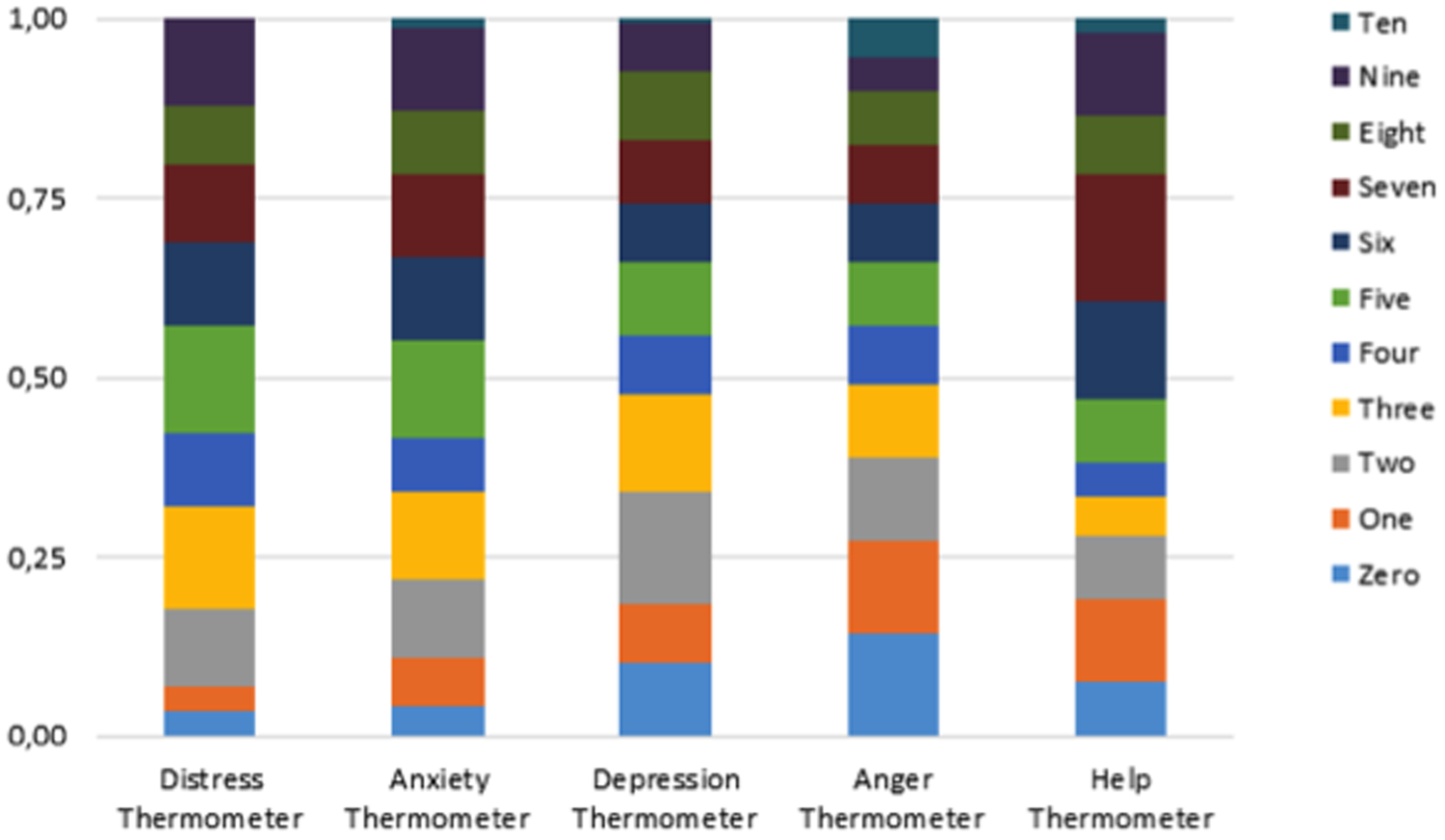
M and SD were obtained for the five scales. The mean score on the DT was 5.05 (SD = 2.51), 5.02 (SD = 2.70) on AnxT, 4.19 (SD = 2.80) on the DepT. On the AngT, the M obtained was 4.07 (SD = 3.09), and on the HT the M was 5.04 (SD = 2.96). Significant positive large correlations (p < 0.001) were found among all the thermometers (ranging from r = .66 to r = .85) (Table 1 and Figure 1).
Distribution of scores on the emotion thermometers.

Descriptive statistics and correlations of the emotion thermometers

Note: AngT, Anger thermometer; AnxT, Anxiety thermometer; DepT, Depression thermometer; DT, Distress thermometer; HT = Need for Help thermometer.
* p < 0.05.
Diagnostic validity
Validity using the BSI-anxiety for AnxT
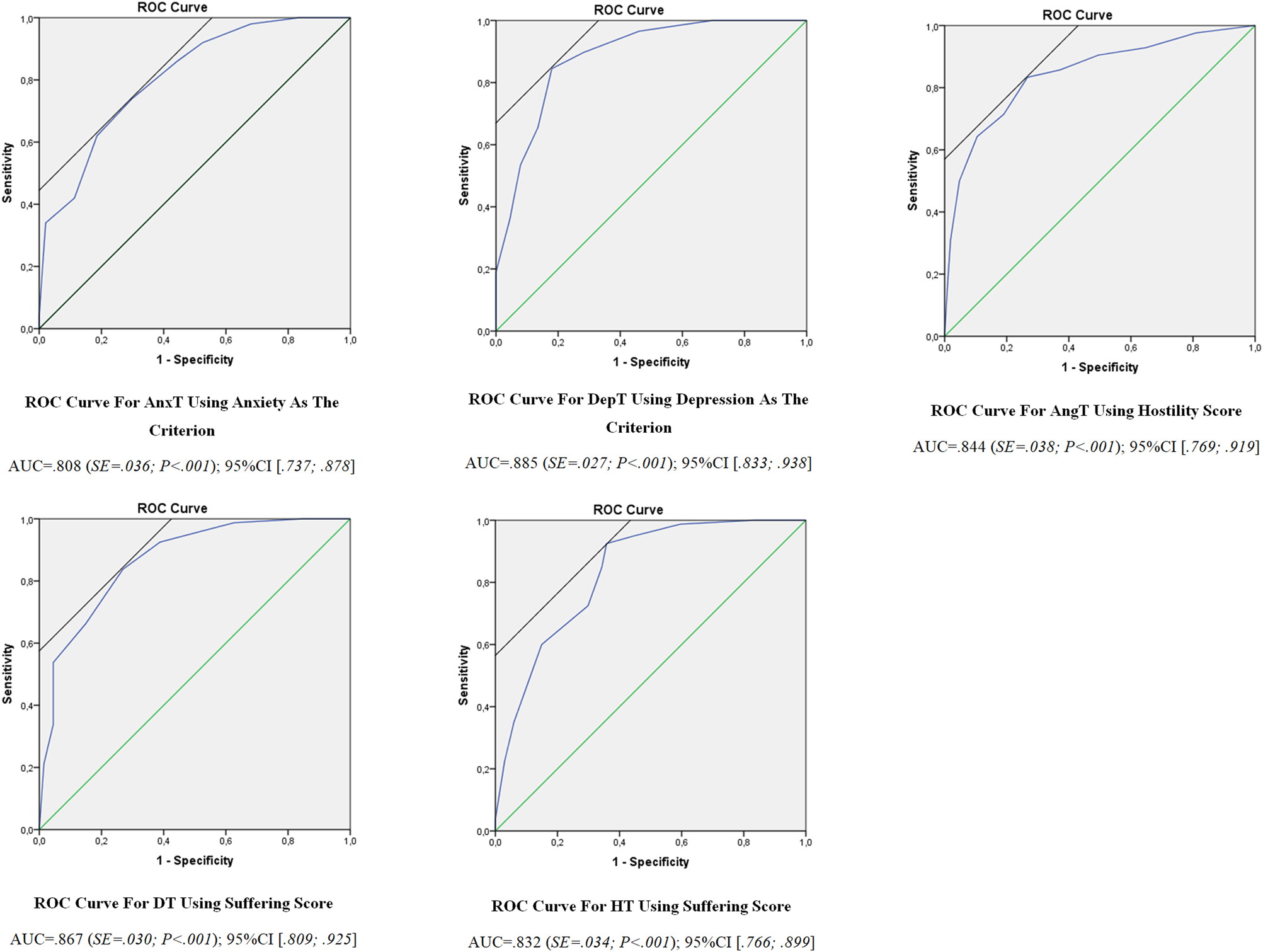
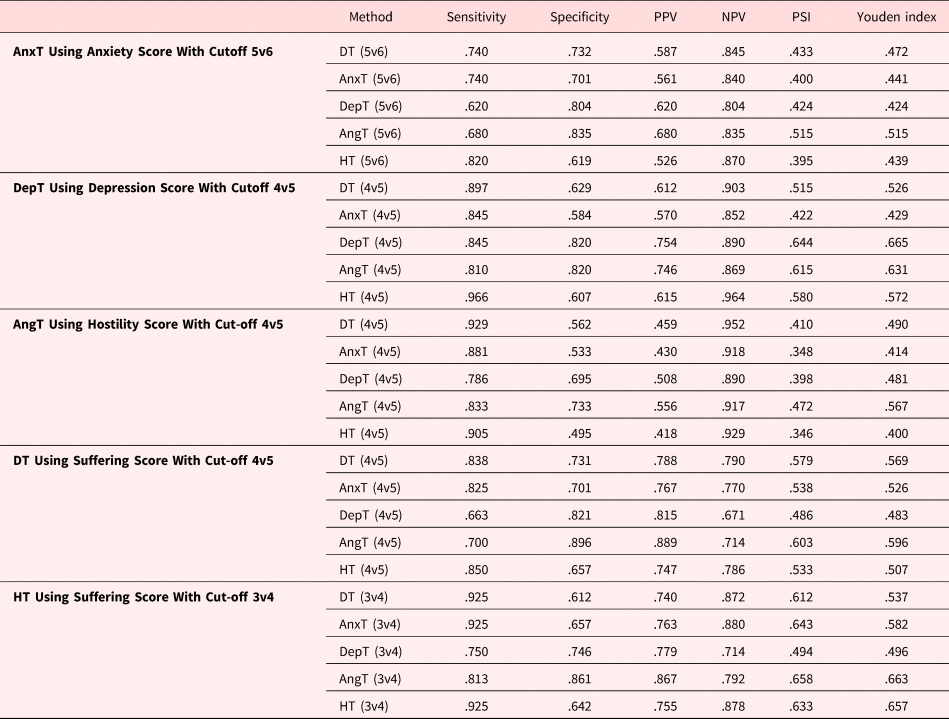
Using a cutoff of 1.753 in BSI-anxiety as the criterion (the cutoff found in the Portuguese population; Canavarro, Reference Canavarro, Simões, Gonçalves and Almeida1999), 50 patients (34.0%) were identified as experiencing clinically significant anxiety. The received operating characteristic (ROC) analysis for AnxT found an area under the curve (AUC) of .81 (SE = .04; p < 0.001; CI 95% [.74, .88]), indicating an excellent discrimination (Figure 2). The optimal cutoff point equally favoring sensitivity (Ss; 74%) and specificity (Sp; 70%) was 5v6 (until 5 and 6 or more). Table 2 shows the rule in accuracy (positive predictive value [PPV]) and summary measures and rule-out accuracy (negative predictive value [NPV]).
ROC curves. AngT, Anger Thermometer; AnxT, Anxiety Thermometer; AUC, area under the curve; CI, confidence interval; DepT, Depression Thermometer; DT, Distress Thermometer; HT, Need for Help; ROC, receiver operating characteristic.

Validity of the thermometers

AngT, Anger thermometer; AnxT, Anxiety thermometer; DepT, Depression thermometer; DT, Distress thermometer; HT, Need to Help thermometer; NPV, negative predictive value; PPV, positive predictive value; PSI, predictive summary index.
Validity using the BSI-depression for DepT
Using a cutoff of 1.828 in BSI-depression as the criterion (the cutoff found in the Portuguese population; Canavarro, Reference Canavarro, Simões, Gonçalves and Almeida1999), 58 patients (39.5%) were identified as experiencing clinically significant depression. The ROC analysis for DepT obtained the AUC of .89 (SE = .03; p < .001; CI 95% [.83, .94]), indicating an excellent discrimination (Figure 2). The optimal cutoff point equally favoring Ss (85%) and Sp (82%) was 4v5 (until 4 and 5 or more). Table 2 shows the rule in accuracy (PPV) and summary measures and rule out accuracy (NPV).
Validity using the BSI-hostility for AngT
Using a cutoff of 1.411 in the BSI-hostility as the criterion (the cutoff found in the Portuguese population; Canavarro, Reference Canavarro, Simões, Gonçalves and Almeida1999), 42 patients (28.6%) were identified as experiencing clinically significant hostility. The ROC analysis for AngT obtained the AUC of .84 (SE = .04; p < .001; CI 95% [.77, .92]), indicating an excellent discrimination (Figure 2). The optimal cutoff point equally favoring Ss (83%) and Sp (56%) was 4v5 (until 4 and 5 or more). Table 2 shows the rule in accuracy (PPV) and summary measures and rule out accuracy (NPV).
Validity using the emotional suffering score for DT
Using a cutoff of 2.75 in suffering score as the criterion (because the SEISI has not a cutoff for clinical diagnosis, we have used the weighted mean obtained for the Portuguese population; Gameiro, Reference Gameiro1999), 80 patients (54.4%) were identified as experiencing clinically significant suffering. The ROC analysis for DT obtained the AUC of .87 (SE = .03; p < 0.001; CI 95% [.81; .93]), indicating an excellent discrimination (Figure 2). The optimal cutoff point equally favoring Ss (84%) and Sp (79%) was 4v5 (until 4 and 5 or more). Table 2 shows the rule in accuracy (PPV) and summary measures and rule out accuracy (NPV).
Validity defined the suffering score for HT
Using a cutoff of 2.75 in suffering score as the criterion (weighted mean obtained for the Portuguese population; Gameiro, Reference Gameiro1999), 80 patients (54.4%) were identified as experiencing clinically significant suffering. The ROC analysis for HT obtained the AUC of .83 (SE = .03; p < .001; CI 95% [.77; .90]), indicating an excellent discrimination (Figure 2). The optimal cutoff point equally favoring Ss (93%) and Sp (64%) was 3v4 (until 3 and 4 or more). Table 2 shows the rule in accuracy (PPV) and summary measures and rule out accuracy (NPV).
Discussion
The presence of anxiety, depression, and anger among cancer patients, and their negative consequences for the process of adaptation to the cancer experience, highlights the importance of identifying appropriate tools for distress screening. The literature recommends the use of brief instruments capable of offering relevant information to help healthcare professionals in developing a differential diagnosis between normal symptomatology and pathological symptomatology (Mitchell, Reference Mitchell2010b). Studies have shown that visual analog scales have superior metrical characteristics in comparison to discrete scales (e.g., Reips & Funke, Reference Reips and Funke2008). The DT has been widely used in Portugal; however, a reliable measure to evaluate other emotional changes in cancer patients is needed. This is the first study examining the ET tool (Mitchell et al., Reference Mitchell, Baker-Glenn and Granger2010a) in a Portuguese sample of cancer patients. The main aim was to establish the diagnostic validity of the ET with the BSI (anxiety, depression, and hostility subscales) and a global measure of suffering (SEISI). Previous studies have not examined an Anxiety Thermometer, Depression Thermometer, and Anger Thermometer against a standardized instrument to evaluate symptoms of psychopathology (BSI), or compared the results from the ET's Distress and Help thermometers against a measure of suffering.
The results of the present study showed that the criterion validity of the ET was established using ROC analysis with BSI subscales, which is considered a gold standard. The AUC of AnxT against BSI anxiety subscale was .81, whereas the AUC of the DepT thermometer against BSI depression subscale was .89. The AUC of AngT against BSI hostility subscale was .84. The AUC of the DT against the total score on SEISI was .87. Finally, the AUC of HT thermometer against the total score on SEISI was .83. Also, all the ETs were positively intercorrelated, as found in previous studies (Hinz et al., Reference Hinz, Mitchell and Dégi2019; Mitchell et al., Reference Mitchell, Baker-Glenn and Granger2010a), suggesting that the set of thermometers measure a more general “emotional distress” construct. However, although intercorrelations were high, they were not high enough for considering the ETs as a unidimensional measure, but a measure assessing different dimensions of emotional distress. Also, it is possible that patients may have difficulties in qualifying what is distress, anxiety, or depression, as suggested by previous studies (e.g., Beck et al., Reference Beck, Tan and Lum2016) leading to high intercorrelations among ETs.
Overall, the AUC values indicated that ETs have an excellent discrimination. These findings are in line with the results obtained by Mitchell et al. (Reference Mitchell, Baker-Glenn and Granger2010a), which examined the discriminative value of the ETs among a sample of British cancer patients. Concerning the cutoffs for the Portuguese, using the BSI-Anxiety as the criterion, the optimal thermometers were AngT and HT; using the BSI-Depression as the criterion, the optimal thermometers were DepT and HT; and using the BSI-Hostility as the criterion, the optimal thermometers were AngT and DT. However, when the total suffering score was used as the criterion, the optimal thermometers were AngT and DT. When the total suffering score was used as the criterion, the optimal thermometers were AngT and AnxT. As found in the Mitchell's et al. study (Reference Mitchell, Holland, Breitbart and Jacobsen2010a), the AngT showed to be better/optimal for detecting overall distress. Yet, the author recommended a combination of items to be more accurate (Mitchell et al., Reference Mitchell, Baker-Glenn and Park2010b). In the present study, only the DepT showed to be optimal for detecting depression, because it presented a greater sensibility and specificity. The ETs have been found to have a good performance in detecting major depression (against Diagnostic and Statistical Manual of Mental Disorders, 4th edition, depression) within other contexts (e.g., cardiovascular disease, epilepsy) (Mitchell et al., Reference Mitchell, Morgan and Petersen2012; Rampling et al., Reference Rampling, Mitchell and Von Oertzen2012).
Many studies emphasize the need of evaluating emotion deregulation in oncology settings, mainly distress, anxiety, and depression (Cordes et al., Reference Cordes, Scherwath and Ahmad2014; Pandey et al., Reference Pandey, Sarita and Devi2006). However, although the literature has recognized the importance of anger assessment in oncology settings (Penedo et al., Reference Penedo, Dahn and Kinsinger2006; Philip et al., Reference Philip, Gold and Schwarz2007), anger has been rarely examined. To our knowledge, this is the first study evaluating anger/hostility in a Portuguese sample of cancer patients. The use of the AngT should be of great utility because is an imperative deregulator of coping for individuals facing a cancer diagnosis and treatment. Anger is often one of the first emotional reactions a person has to a cancer diagnosis. Many cancer patients wonder “Why me?”; this can lead to feelings of angry and frustration. According to Lown (Reference Lown2007), anger may represent a disruption in the doctor–patient relationship, and it is important for physicians to adjust their behavior and communication accordingly. In this study, however, the AngT has the lowest PPV. From all the ETs, the AngT presented the lowest mean. It is possible that among these participants, anger is not so prevalent, which can lead to the existence of a high proportion of false positives. Probably, and to reduce false positives, the value of the AngT should be more restricted. Further research is needed with regard to the AngT.
The need for help of cancer patients should also be a concern for healthcare professionals. Indeed, more important than identifying distress and its prevalence, is to provide care for cancer patients in need (Mitchell, Reference Mitchell, Holland, Breitbart and Jacobsen2010a). In fact, HT was the one with the highest PPV values: when using with suffering scores, reinforcing its utility for identifying cancer patients who need most psychosocial support. This is even more important because studies have shown that only one-third of cancer patients with significant distress (using the DT), report wanting professional help for emotional problems (Graves et al., Reference Graves, Arnold and Love2007). According to Baker-Glenn and Mitchell (Reference Baker-Glenn and Mitchell2008), the most usual requests are face-to-face psychological support and complementary therapies. In Portugal, cancer patients who are undergoing treatment in public and private hospitals do not always get the psychological help they need. This is often due to a lack of effective communication between health professionals and patients. So, the HT can be a useful tool to identify and refer to adequate psychosocial support cancer patients who need help.
Having a screening tool capable of detecting the emotional distress experienced by cancer patients is of high importance given its role in protecting patients from future adjustment disorders (Iscoe et al., Reference Iscoe, Williams, Szalai and Osoba1991) and on reducing costs associated with the lack of treatment of these disorders (Boberg et al., Reference Boberg, Gustafson and Hawkins2003). The ET has several advantages related to its brevity and ease administration and scoring. In fact, it can be administrated by health professionals with no mental health training (e.g., nurses). This is an advantage because cancer services do not always have the support of a mental health professional; and patients have much more contact with non-mental health professionals (even in cancer services that have the support of mental health professionals). When patients screen positive, healthcare professionals can refer them for further assessment by mental healthcare professionals (Beck et al., Reference Beck, Tan and Lum2016). Because the administration of ETs only requires that patients circle the number that best describe their levels of distress, anxiety, depression, anger, and need for help, and because clinical cutoffs are established for scoring ETs, we do not anticipate any limitation if ETs are administered by non-mental healthcare professionals.
There are some limitations in this study. The sample size is modest and patients were predominantly in the early stages of the disease. Future studies should be conducted with larger samples and with cancer patients in different stages of the disease (especially late-stage cancers). However, for early-stage cancer, ETs seem to be a valid screen tool. Moreover, the ETs were not compared with the DT. Further research is needed with Portuguese cancer patients to study if ETs expand on the strengths of the DT, as found in a previous study (Mitchell et al., Reference Mitchell, Baker-Glenn and Park2010b). Finally, the SEISI does not have a clinical cutoff to establish a diagnosis, which can limit the findings. Future studies should validate ETs against other diagnostic instruments.
Some implications for clinical practice can be derived from this study. For health professionals working in oncological settings, the AnxT, DepT, AngT and HT provide an easy way to assess and identify patient's emotional needs.
Distress has been referred to as the sixth vital sign in cancer care, requiring that providers assess and treat it with the same importance as any physical illness (Bultz & Carlson, Reference Bultz and Carlson2006; Mitchell et al., Reference Mitchell, Lord and Symonds2012; Mitchell & Coyne, Reference Mitchell and Coyne2009). Screening identifies unmet needs, but screening alone is an ineffective strategy requiring the availability of psychosocial services (Schubart et al. Reference Schubart, Mitchell and Dietrich2015). In the United States, the American College of Surgeons (2012) now requires that cancer centers implement screening programs for psychosocial distress using validated instruments with established clinical cutoffs. In Portugal, further studies are needed to evaluate how health professionals use the information collected with the ET to improve patient care and how this information affects long-term patient outcomes.
Author ORCIDs
Ricardo João Teixeira, 0000-0003-3820-1660; José C. Machado, 0000-0003-2552-118X; Sara Faria, 0000-0001-9792-5816; Sónia Remondes-Costa, 0000-0003-4282-3964; Tânia Brandão, 0000-0001-7865-2445; M. Graça Pereira, 0000-0001-7987-2562