Introduction
In coastal areas, where human activities are concentrated and more intense, marine protected areas (MPAs) have increasingly become utilized as a management tool to secure the conservation of fish stocks, habitats and endangered species (Goñi et al., Reference Goñi, Ramos Espla, Zabala, Planes, Perez-Ruzafa, Francour, Badalamenti, Polunin, Chemello, Voultsiadou, Barthel, Barth, Bohle-Carbonell, Fragakis, Lipiatou, Martin, Ollier and Weydert1998; Roberts et al., Reference Roberts, Hawkins and Gell2005; Edgar et al., Reference Edgar, Ru, Babcock, Connell and Gillanders2007; Galil, Reference Galil and Goriup2017). These areas are monitored to determine their level of success (Halpern & Warner, Reference Halpern and Warner2002; Wood et al., Reference Wood, Fish, Laughren and Pauly2008; Giakoumi et al., Reference Giakoumi, Scianna, Plass-Johnson, Micheli, Grorud-Colvert, Thiriet, Claudet, Di Carlo, Di Franco, Gaines, García-Charton, Lubchenco, Reimer, Sala and Guidetti2017), with numerous studies demonstrating favourable results for fisheries in terms of biomass, density and average organism size, both worldwide (Halpern & Warner, Reference Halpern and Warner2002) and in the Mediterranean Sea (Giakoumi et al., Reference Giakoumi, Scianna, Plass-Johnson, Micheli, Grorud-Colvert, Thiriet, Claudet, Di Carlo, Di Franco, Gaines, García-Charton, Lubchenco, Reimer, Sala and Guidetti2017; Dimarchopoulou et al., Reference Dimarchopoulou, Dogrammatzi, Karachle and Tsikliras2018). When evaluating the effectiveness of MPAs, the different regulations of uses and subsequent varying levels of protection need to be taken into account since there are numerous implemented zoning and management schemes, from no-take to multiple-use areas (Horta e Costa et al., Reference Horta e Costa, Claudet, Franco, Erzini, Caro and Goncalvez2016).
Globally, only 6% of MPAs function as no-take zones, while the rest have less restrictive regulations (Costello & Ballantine, Reference Costello and Ballantine2015). In the Mediterranean Sea, while 6% of the basin is covered by MPAs (still short of the 10% target agreed upon by member states of the United Nations following the Convention on Biological Diversity), it is only 0.23% of the basin that is fully and effectively protected (Claudet et al., Reference Claudet, Loiseau, Sostres and Zupan2020). Although studies have shown that partially protected areas can have higher biomass and abundance compared with open access areas (Lester & Halpern, Reference Lester and Halpern2008; Sciberras et al., Reference Sciberras, Jenkins, Mant, Kaiser, Hawkins and Pullin2015), it is often the case that partial protection may not be effective for targeted species (Denny & Babcock, Reference Denny and Babcock2004; Lester & Halpern, Reference Lester and Halpern2008; Di Franco et al., Reference Di Franco, Bussotti, Navone, Panzalis and Guidetti2009). Indeed, commercial and non-commercial species have been shown to respond differently to protection (Claudet et al., Reference Claudet, Pelletier, Jouvenel, Bachet and Galzin2006; Dimarchopoulou et al., Reference Dimarchopoulou, Dogrammatzi, Karachle and Tsikliras2018).
Fish communities can be monitored with fisheries-dependent and fisheries-independent techniques (Armada et al., Reference Armada, White and Christie2009). The fisheries-dependent techniques consist of data obtained through the normal operation of commercial and recreational fisheries. However, such methods cannot be applied in no-take zones where fishing is not allowed. The fisheries-independent techniques can be extractive, such as experimental fishing, or non-extractive, and thus suitable for no-take zones, such as remote sensing, acoustics, underwater visual census (UVC) and underwater video (Murphy & Jenkins, Reference Murphy and Jenkins2010). As opposed to the traditional UVC method, video recordings have the following advantages (Langlois et al., Reference Langlois, Harvey, Fitzpatrick, Meeuwig, Shedrawi and Watson2010; Unsworth et al., Reference Unsworth, Peters, McCloskey and Hinder2014): (i) they provide the freedom of repeated and standardized samplings that can even be conducted by non-scientific staff at various depths, inaccessible locations and prolonged durations with affordable multiple camera units, (ii) they provide a detailed image of the habitat types sampled, (iii) they minimize the observer bias regarding species identification, estimations of fish length and sample unit area, and (iv) they provide a permanent video record that can be examined several times and by different observers in the laboratory.
The main underwater video techniques include the Remote Underwater Video (RUV) which can be also baited (BRUV) and has been growing in popularity in MPA monitoring studies, especially in Australia (Harvey et al., Reference Harvey, McLean, Goetze, Saunders, Langlois, Monk, Barrett, Wilson, Holmes, Ierodiaconou, Jordan, Meekan, Malcolm, Heupel, Harasti, Huveneers, Knott, Fairclough, Currey-Randall, Travers, Radford, Rees, Speed, Wakefield, Cappo and Newman2021), towed video, Diver Operated Video (DOV) and stereo-video (Mallet & Pelletier, Reference Mallet and Pelletier2014). Remotely Operated Vehicles (ROVs) with mounted cameras have predominantly been used for deep-sea research in fish behavioural and community surveys (Sward et al., Reference Sward, Monk and Barrett2019). Lately, ROVs started to be used sporadically in shallow habitats, e.g. for shark (Raoult et al., Reference Raoult, Williamson, Smith and Gaston2019) and turtle behavioural studies (Smolowitz et al., Reference Smolowitz, Patel, Haas and Miller2015). While some studies have indicated that the disturbance of fish due to the light, sound, speed and size of ROVs can result in over- or underestimation of the abundance (Stoner et al., Reference Stoner, Ryer, Parker, Auster and Wakefield2008; Laidig et al., Reference Laidig, Krigsman, Mary and Yoklavich2013), Raoult et al. (Reference Raoult, Tosetto, Harvey, Nelson, Reed, Parikh, Chan, Smith and Williamson2020) tested the use of ROVs as a substitute for snorkelling surveys in shallow waters and found higher abundance and richness of fish when using an ROV. The same authors suggested that fish behaviour could be less affected by a mini-ROV compared with a snorkeller and recommended further investigation into the difference of the two approaches (Raoult et al., Reference Raoult, Tosetto, Harvey, Nelson, Reed, Parikh, Chan, Smith and Williamson2020). Another recent study (Wetz et al., Reference Wetz, Ajemian, Shipley and Stunz2020) reported no significant difference in richness between Roving Diver Surveys (RDS) and ROVs, but higher abundances while conducting RDS and indicated a higher species-specific detection in ROVs. In this study we chose to use a mini-ROV to explore coastal fish communities in a marine protected area, given that it is a non-destructive and cost-effective method that gives the opportunity for videos to be saved and analysed at the laboratory at a later stage and by different scientists for verification.
The National Marine Park of Alonissos in Northern Sporades (NMPANS) was the first multiple-use national marine park in Greece to be established in 1992 (although it remained unmanaged for 11 years) aiming to conserve natural habitats, as well as the local wild fauna (focusing on the endangered Mediterranean monk seal Monachus monachus) and flora (Dikou & Dionysopoulou, Reference Dikou and Dionysopoulou2011). The NMPANS fish assemblages have been included in two Mediterranean wide studies which investigated the effects of the varying protection levels on the biomass and trophic structure of fish populations (Guidetti et al., Reference Guidetti, Baiata, Ballesteros, Di Franco, Hereu, Macpherson, Micheli, Pais, Panzalis, Rosenberg, Zabala and Sala2014), as well as the effects of various biological and environmental parameters, including protection level and primary productivity, on fish biomass and habitat type (Sala et al., Reference Sala, Ballesteros, Dendrinos, Di Franco, Ferretti, Foley, Fraschetti, Friedlander, Garrabou, Güçlüsoy, Guidetti, Halpern, Hereu, Karamanlidis, Kizilkaya, Macpherson, Mangialajo, Mariani, Micheli, Pais, Riser, Rosenberg, Sales, Selkoe, Starr, Tomas and Zabala2012). Based on landings data between 1985 and 1992, Cebrian-Menchero (Reference Cebrian-Menchero1998, Reference Cebrian-Menchero2013) examined the impact of the protection enforcement on the biomass of commercial fish species, as well as on monthly fluctuations and composition of landings. Furthermore, reports on the biomass and commercial catch composition during the period 2006 to 2008 based on landings data (MOm, 2009) and on the fish stocks and fishing fleets of the NMPANS (Tsikliras et al., Reference Tsikliras, Dimarchopoulou, Michailidis, Aletra, Papadopoulou and Pardalou2018, Reference Tsikliras, Keramidas, Nalmpanti, Tektonidis, Issari, Pardalou and Dimarchopoulou2020) have been published.
The aim of the present study was to investigate the effectiveness of the NMPANS to protect coastal fish species by recording and comparing fish communities in three locations of different protection level and resulting fishing pressure, using a non-destructive video recording method with an ROV. Sampling was conducted once in 2018 and once in 2019 and particularly in early summer, right at the beginning of the fishing and touristic season, and also in late summer, as it was hypothesized that these human activities would disturb the fish communities encountered in each sampling site within the marine park. In particular, the study focused on community-level metrics and specifically species richness, abundance and diversity of commercial and non-commercial fish species. All in all, the hypotheses investigated here were: (1) the level of protection has a significant effect on community-level metrics; (2) anthropogenic activities negatively affect the coastal fish community within the park; (3) commercial and non-commercial fishes respond differently to protection.
Materials and methods
Study area and sampling sites
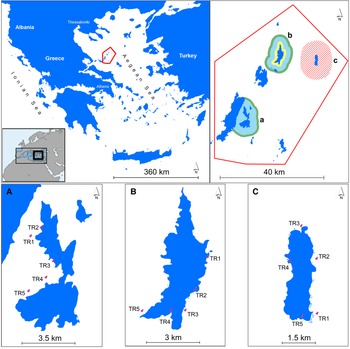
The NMPANS is a 2265 km2 area in the north Aegean Sea, Greece that includes seven islands and 22 rocky islands and reefs (Figure 1). It was declared the first national marine park of Greece in 1992 (Presidential Decree PD 519/28-5-92), aiming to conserve the terrestrial and marine resources of the area, protect the important biotope of the endangered Mediterranean monk seal Monachus monachus, and preserve other rare plant and animal species that inhabit the islands (Oikonomou & Dikou, Reference Oikonomou and Dikou2008; Dikou & Dionysopoulou, Reference Dikou and Dionysopoulou2011).
Map of Greece and the National Marine Park of Alonissos in Northern Sporades (red polygon), as well as the three sampled islands: (a) least protected area LPA – Peristera (2 nm trawl ban – green, 1.5 nm purse seine ban – light blue, professional coastal and recreational fishing, including spearfishing, allowed), (b) partially protected area PPA – Gioura (2 nm trawl ban – green, 1.5 nm purse seine ban – light blue, 0.5 nm recreational fishing ban – yellow, professional coastal fishing allowed), (c) fully protected area FPA – Piperi (no vessels allowed to approach within 3 nm from the coast – red hatch pattern). Each pin corresponds to a transect.

The NMPANS is divided into two main protection zones (Zone A: 1587 km2 and Zone B: 678 km2), as well as several subareas within the main zones according to the level of protection (Dikou & Dionysopoulou, Reference Dikou and Dionysopoulou2011): Zone A is the top priority area for the protection of the Mediterranean monk seal where trawling and purse seining are prohibited within 2 and 1.5 nautical miles from the coasts, respectively. Particularly in Piperi Island, which is the core of the park and a no-take zone, no vessel is allowed to approach closer than 3 nm from its coasts. The remaining area of Zone A, including Gioura Island, is under moderate fishing pressure used mainly by the professional coastal fishing fleet and by recreational fishers under specific gear restrictions. Zone B, including Peristera Island, is a higher fishing pressure zone where the same restrictions apply for trawlers and purse seiners, but professional coastal fishing vessels and recreational fishers can operate using more gears. For a detailed description of the NMPANS, the responsible Management Body and the applied regulations, the readers are referred to the Government Gazette D’ 621/19-06-2003 (in Greek) and the webpage http://alonissos-park.gr/ (also available in English).
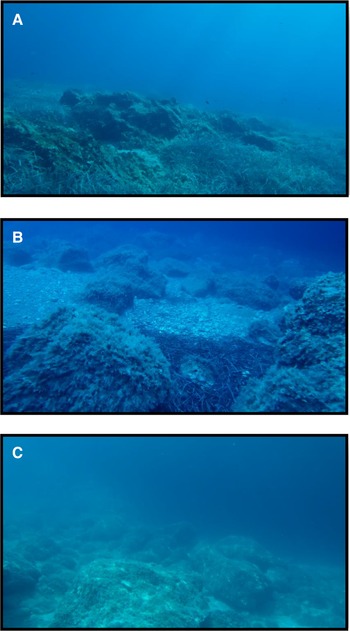
Sampling took place around three islands of different protection level within the NMPANS: Piperi (Fully Protected Area: FPA), Gioura (Partially Protected Area: PPA) and Peristera (Least Protected Area: LPA). The underwater survey was conducted twice at the same transects, during early (June) and late (August) summer, i.e. right at the beginning and towards the end of a period of increased touristic attraction marked by a parallel increase in the traffic and fishing pressure from both recreational and professional fishing vessels. A remotely operated underwater drone, i.e. a mini-ROV (PowerRay equipped with PowerSeeker, dimensions: 465 × 270 × 126 mm, weight: ~3.8 kg: https://www.powervision.me/en/product/powerray) with a 12 megapixel 4 K FHD camera was deployed with lights off to record marine fish in 5 transects at each location (Figure 1). The drone, equipped with 3 thrusters (2 horizontal and 1 vertical), was navigated at 2–3 m above the sea bottom, with its speed kept constant at 1 knot (low speed mode), recording the surroundings for an average of 6 min, equal to about 186 m per transect. The location of each transect was the same for both seasons (coordinates were recorded with a standard handheld GPS), chosen to ensure accessibility, coverage and similar habitat among locations. The depth of locations ranged from 6–14 m at Piperi (FPA), 6–16 m at Gioura (PPA) and from 7–12 m at Peristera (LPA). The mean water temperature in all sampling locations was 20.8°C (19–22°C) in early summer, and 25.2°C (23–26.5°C) in late summer. The habitat was similar in all three islands, being characterized by a mixture of hard and soft substrate with patches of algae, rock and Posidonia oceanica coverage (Figure 2).
Example screenshots of the habitat in the three sampled islands of the National Marine Park of Alonissos Northern Sporades: (A) least protected area LPA – Peristera; (B) partially protected area PPA – Gioura; (C) fully protected area FPA – Piperi. The habitat was similar in all three islands, being characterized by a mixture of hard and soft substrate with patches of algae, rock and Posidonia oceanica coverage.

Data analysis
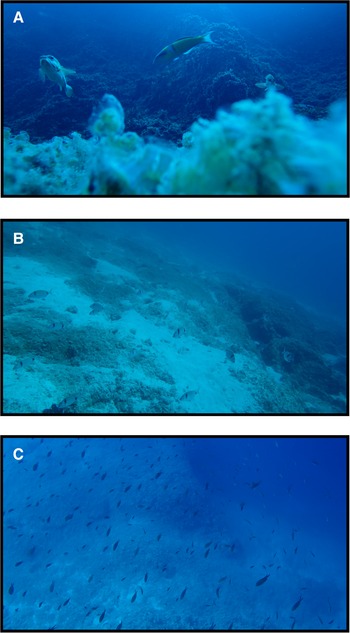
For each video recording (transect) the species name and the total number of individuals per species were recorded throughout each transect (Figure 3). For the analysis, the species were divided into commercial and non-commercial species according to Dimarchopoulou et al. (Reference Dimarchopoulou, Stergiou and Tsikliras2017). Here, we considered as commercial those species for which there are official catch time series recorded by the Hellenic Statistical Authority (HELSTAT) at the species level. These species are considered to be the prime targets of the Greek small-scale coastal fisheries (Tsikliras et al., Reference Tsikliras, Tsiros and Stergiou2013, Reference Tsikliras, Touloumis, Pardalou, Adamidou, Keramidas, Orfanidis, Dimarchopoulou and Koutrakis2021), which are multi-métier and multi-species (Tzanatos et al., Reference Tzanatos, Dimitriou, Katselis, Georgiadis and Koutsikopoulos2005). Species richness was expressed as the number of species identified at each transect per minute of video (number of species/min).
Example screenshots of the underwater recordings in the National Marine Park of Alonissos Northern Sporades, Greece, showing different fish species abundance classes: (A) class 1 depicting 1–10 individuals, here one ornate wrasse Thalassoma pavo and two combers Serranus cabrilla; (B) class 2 depicting 11–20 individuals, here common two-banded seabreams Diplodus vulgaris; (C) class 11 depicting more than 100 individuals, here damselfish Chromis chromis.

In some cases, especially for schooling species, the exact number of individuals (abundance) could not be counted. As a result, we followed the approach of Consoli et al. (Reference Consoli, Esposito, Battaglia, Altobelli, Perzia, Romeo, Canese and Andaloro2016) who estimated fish abundance with ROVs by counting single fish up to 10 individuals and using abundance classes (11–30, 31–50, 51–100, 101–200, 201–500) for schools of fish. For each class, the arithmetic mean of the upper and lower bounds, rounded down, was used to represent the abundance of each species, i.e. 20, 40, 75, 150, 350, respectively (Harmelin-Vivien et al., Reference Harmelin-Vivien, Harmelin, Chauvet, Duval, Galzin, Lejeune, Barnabe, Blanc, Chevalier, Duclerc and Lasserre1985).
Abundance per species was expressed as the number of individuals (described above) divided by the length of the recording (individuals/min). Total abundance was the sum of the abundance of all species (individuals/min). Relative abundance of each species was expressed from the following equation: Species abundance/Total abundance × 100 (%).
Species diversity H’ was calculated using the Shannon–Wiener Index (Shannon & Weaver, Reference Shannon and Weaver1949). The equation is the following:

where s is the number of taxa in the sample and P i is the relative abundance of taxon i, measured as discussed above.
Statistical analysis
Statistical analysis was performed using PRIMER 7 with the add-on package PERMANOVA + (PRIMER-E Ltd, UK). A univariate two-way Permutational Analysis of Variance (PERMANOVA) based on the Bray–Curtis coefficient (Bray & Curtis, Reference Bray and Curtis1957) was used to test the contribution of protection level (FPA: Fully Protected Area – Piperi; PPA: Partially Protected Area – Gioura; LPA: Least Protected Area – Peristera), sampling period and the interaction between protection level and sampling period, to species richness, total abundance and species diversity. PERMANOVA was run using 999 random Monte Carlo permutations as suggested by Anderson et al. (Reference Anderson, Gorley and Clarke2008) for a small number of unique permutations, and a posteriori pair-wise comparisons were added on the significant terms. The significance level was set at 0.05.
Results
Fish community
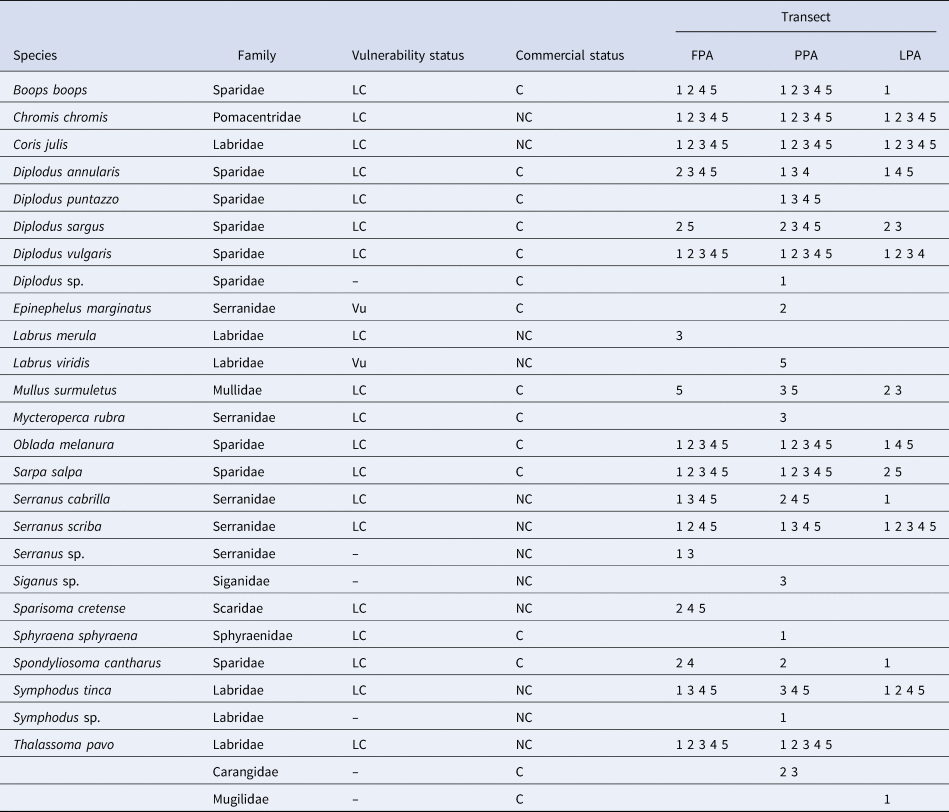
In total, 185 min of recording were analysed, in which 27 fish taxa were identified, with 21 of them being identified at the species level (Table 1). One invasive taxon, Siganus sp., was identified at the partially protected area (PPA; Gioura) in late summer. All species identified belonged to the ‘Least Concern’ category regarding their vulnerability status and only two species (the green wrasse Labrus viridis and the dusky grouper Epinephelus marginatus) were vulnerable (IUCN, 2020). Both species were found at the partially protected area. The most abundant species at all sites was the damselfish Chromis chromis, consistently occupying over 35% of the abundance. At almost all locations, the common two-banded seabream Diplodus vulgaris was present in high abundances, while bogue Boops boops, Mediterranean rainbow wrasse Coris julis and salema Sarpa salpa were also found in high numbers at half of the sites.
Fish species (scientific names validated through FishBase: Froese & Pauly, Reference Froese and Pauly2022) identified in the sampled transects 1–5 (FPA, Fully Protected Area – Piperi; PPA, Partially Protected Area – Gioura; LPA, Least Protected Area – Peristera), along with their vulnerability (LC, Least concern; Vu, Vulnerable; IUCN, 2020) and commercial status (C, commercial; NC, non-commercial; Dimarchopoulou et al., Reference Dimarchopoulou, Stergiou and Tsikliras2017)

In the fully protected area (FPA; Piperi), three out of the five most dominant species (damselfish, bogue and common two-banded seabream) were the same during both sampling time periods. The other two were salema (12%) and comber Serranus cabrilla (6%) in early summer and saddled seabream Oblada melanura (7%) and ornate wrasse Thalassoma pavo (5%) in late summer. In the partially protected area, the composition of the most abundant species changed between the two sampling periods; only the damselfish and salema were the same. The common two-banded seabream (5%), sharpsnout seabream Diplodus puntazzo (4%) and ornate wrasse (4%) were the most abundant species in the early summer sampling, whereas in late summer the most abundant species were bogue (11%), saddled seabream (5%) and Mediterranean rainbow wrasse (4%). In the least protected area (LPA; Peristera), the dominant species in descending order of abundance during both sampling periods were the damselfish, common two-banded seabream, Mediterranean rainbow wrasse and east Atlantic peacock wrasse Symphodus tinca.
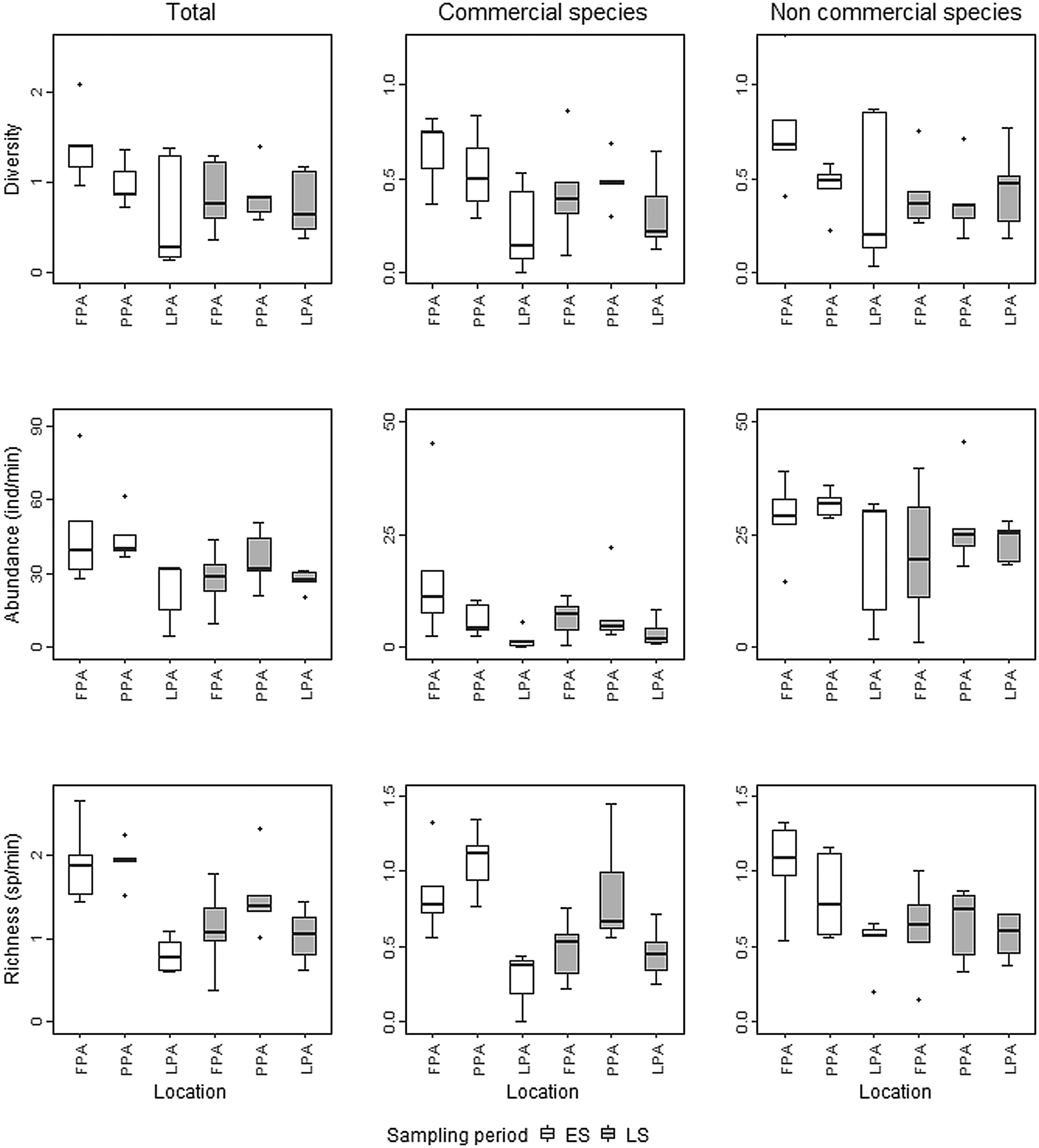
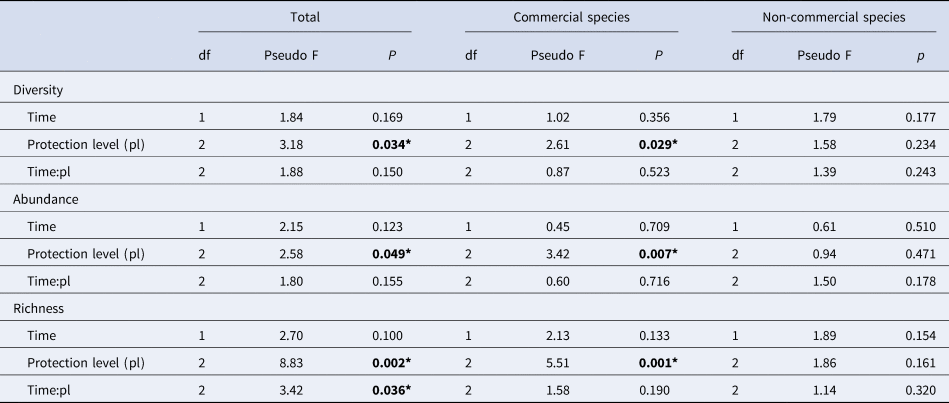
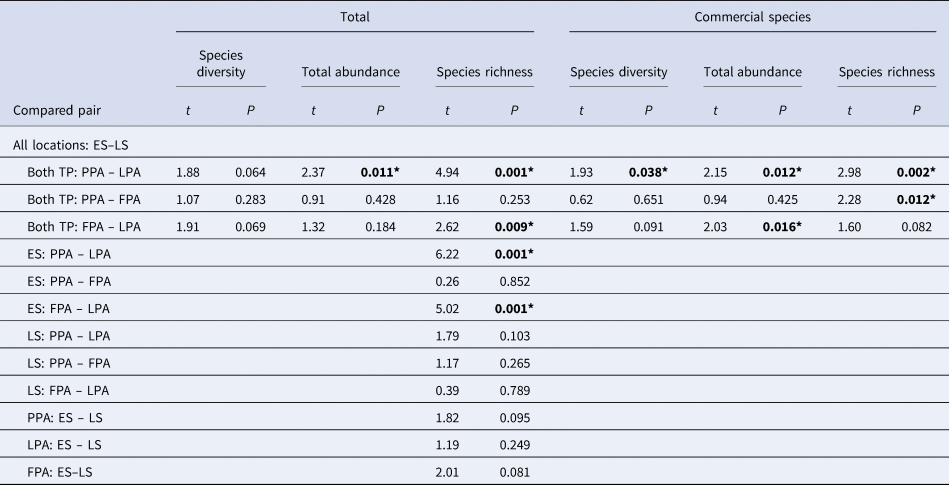
According to the PERMANOVA analysis, the protection level had a significant effect on fish species diversity, abundance and richness of the entire fish community (P < 0.05 for all; Table 2), with the fully and partially protected areas having significantly higher species richness than the least protected area (Figure 4), but not differing from one another (Table 3). The partially protected area also had significantly higher abundance compared with the least protected area (Table 2; Figure 4). When analysing commercial and non-commercial species separately, it was shown that the commercial fish species differed significantly among the protection levels in terms of diversity, abundance and richness (P < 0.03 for all; Table 2), in contrast to the non-commercial species that did not exhibit any significant difference between protection levels and time periods (P > 0.05 for all; Table 2). Species diversity, abundance and richness of the commercial species were significantly lower in the least protected area compared with the partially protected area (P < 0.05 for all; Table 2). Commercial species in the fully and least protected area differed significantly only regarding their abundance (P < 0.05), which was lower in the fully protected area (Table 2; Figure 4). The partially protected area had significantly more commercial species than the fully protected area (Table 2; Figure 4). It should be noted that even if some pair-wise comparisons were not statistically significant (total PPA-LPA and FPA-LPA diversity, total FPA-LPA abundance, commercial FPA-LPA diversity and richness: Table 3), the P-values were close to the significance threshold, thus giving an indication of the underlying relationship: community-level metric values were generally higher in the fully and partially protected areas compared with the least protected area, especially in the early summer sampling.
Box plots of species diversity (Shannon–Wiener index), abundance (abundance scale/minute) and richness (species/minute) for the total fish community in the National Marine Park of Alonissos Northern Sporades, as well as the commercial and non-commercial species separately (for more details see Materials and methods). Results are presented per protection level area (fully protected area FPA – Piperi; partially protected area PPA – Gioura; least protected area LPA – Peristera) and per sampling time period (ES, early summer, white; LS, late summer, grey). Note the difference in the y-axis between the graphs of the total community and the commercial/non-commercial species.

Results of the univariate two-way PERMANOVA on species diversity, total abundance and species richness (for commercial and non-commercial species separately, as well as the total community) based on protection level (FPA, Fully Protected Area – Piperi; PPA, Partially Protected Area – Gioura; LPA, Least Protected Area – Peristera) and sampling period (ES, early summer – right at the beginning of the touristic and fishing season; LS, late summer – towards the end of the disturbance period) (Factors: protection level [pl] and time)

*Indicates significant difference at the 0.05 level.
Results of the pair-wise comparisons on species richness, total abundance and species diversity, examined after the PERMANOVA (only the significantly different cases were further examined), based on protection level (FPA, Fully Protected Area – Piperi; PPA, Partially Protected Area – Gioura; LPA, Least Protected Area – Peristera) and sampling time period (ES, early summer – right at the beginning of the touristic and fishing season; LS, late summer – towards the end of the disturbance period) for the entire fish community and the commercial species separately.

*Indicates significant difference at the 0.05 level.
The sampling period had no significant effect on the studied community's species diversity, abundance or richness (P > 0.05 for all; Table 2; Figure 4). However, the combination of sampled island (i.e. protection level) and time period significantly affected total species richness (P < 0.04; Table 2). Specifically, in the early summer sampling, the fully and partially protected areas had significantly higher species richness compared with the least protected area (Table 3; Figure 4). However, this pattern did not hold in late summer, as species richness decreased significantly over the summer in both the fully and partially protected areas.
Discussion
Marine protected areas (MPAs) have long been advocated as emerging tools for conserving and managing biodiversity, among others (Lubchenco et al., Reference Lubchenco, Palumbi, Gaines and Andelman2003). Certain aspects of biodiversity can be measured with community-level metrics, such as abundance, species richness and Shannon diversity, which can therefore be used to monitor and evaluate the effects of MPAs on biodiversity (Soykan & Lewison, Reference Soykan and Lewison2015). The emergence and increased interest in more holistic ecosystem-based management has shifted the focus towards managing communities and entire ecosystems, rather than single populations (Halpern et al., Reference Halpern, Lester and McLeod2010) and, as a consequence, there has been a growing demand to find suitable community-level indicators that could facilitate assessing the effectiveness of established MPAs (Pelletier et al., Reference Pelletier, Claudet, Ferraris, Benedetti-Cecchi and Garcia-Charton2008). In this study, we used a non-destructive sampling method (video recordings with an underwater drone, i.e. a mini-ROV) to record the fish fauna and compare community-level metrics between different islands of varying protection level within a marine park in Greece (NMPANS: National Marine Park of Alonissos, Northern Sporades) that has been protected for about 20 years (30 years on paper: Dikou & Dionysopoulou, Reference Dikou and Dionysopoulou2011).
Although the underwater visual census by a diver or snorkeller has been historically the most common non-destructive method to describe and assess fish communities, it has several disadvantages including the need for a skilled diver with scientific training and the risk that the diver's presence may drive fish away (Williams et al., Reference Williams, Walsh, Tissot and Hallacher2006; Dearden et al., Reference Dearden, Theberge and Yasué2010; Emslie et al., Reference Emslie, Cheal, MacNeil, Miller and Sweatman2018). Nevertheless, many of these problems can actually be overcome with the use of video sampling methodologies (Sward et al., Reference Sward, Monk and Barrett2019; Raoult et al., Reference Raoult, Tosetto, Harvey, Nelson, Reed, Parikh, Chan, Smith and Williamson2020), which may date back to the 1950s, but have been gaining increasing interest more recently (Mallet & Pelletier, Reference Mallet and Pelletier2014). Even though, admittedly, none of these visual approaches can reliably estimate small, crypto-benthic species such as blennies and gobies (Patzner, Reference Patzner1999; Prato et al., Reference Prato, Thiriet, Di Franco and Francour2017), the method used in this study, i.e. video recording using a mini-ROV, has been shown to detect more species and individuals (higher species richness and abundance) in shallow marine environments than the underwater visual census by a snorkeller, thus potentially leading to more accurate and adequate estimates that could be used to inform management and conservation planning (Raoult et al., Reference Raoult, Tosetto, Harvey, Nelson, Reed, Parikh, Chan, Smith and Williamson2020).
In the NMPANS, the different level of protection within the marine park (FPA: Fully Protected Area – Piperi; PPA: Partially Protected Area – Gioura; LPA: Least Protected Area – Peristera), was the factor that consistently impacted species richness, diversity and total abundance of the total fish community, as well as of the commercial fish species separately. All of the studied islands have different perimetrical fishing bans that define their protection level (Figure 1), they are uninhabited and no anthropogenic activities take place on their land (Dikou & Dionysopoulou, Reference Dikou and Dionysopoulou2011). The differences were mainly driven by the lower values of the studied community-level metrics in the least protected area. Former studies have also indicated the ecological benefits of protected areas demonstrating that fish and invertebrate populations within no-take zones or low fishing pressure areas exhibit higher density, biomass and diversity and comprise larger individuals (Halpern & Warner, Reference Halpern and Warner2002; Lester et al., Reference Lester, Halpern, Grorud-Colvert, Lubchenco, Ruttenberg, Gaines, Airamé and Warner2009; Caselle et al., Reference Caselle, Rassweiler, Hamilton and Warner2015; Dimarchopoulou et al., Reference Dimarchopoulou, Dogrammatzi, Karachle and Tsikliras2018; Sini et al., Reference Sini, Vatikiotis, Thanopoulou, Katsoupis, Maina, Kavadas, Karachle and Katsanevakis2019). In a study of 30 shallow rocky reef locations across the Mediterranean Sea, including the NMPANS, Guidetti et al. (Reference Guidetti, Baiata, Ballesteros, Di Franco, Hereu, Macpherson, Micheli, Pais, Panzalis, Rosenberg, Zabala and Sala2014) report higher biomass and richness in the no-take areas compared with the open access areas, but no difference in terms of density. Nevertheless, Lester et al. (Reference Lester, Halpern, Grorud-Colvert, Lubchenco, Ruttenberg, Gaines, Airamé and Warner2009) and Caselle et al. (Reference Caselle, Rassweiler, Hamilton and Warner2015) documented a significant increase of biomass in fish and invertebrates in areas outside the marine reserves, potentially indicating the spillover of adults, juveniles or larvae towards adjacent unprotected waters (Gell & Roberts, Reference Gell and Roberts2003; Goñi et al., Reference Goñi, Hilborn, Díaz, Mallol and Adlerstein2010; Di Lorenzo et al., Reference Di Lorenzo, Guidetti, Di Franco, Calo and Claudet2020) and supporting the concept that successful MPAs cause a reserve effect boosting the stock status of their surroundings as well. Usually, due to the lack of appropriate historical data, the effectiveness of an MPA is not measured by comparing variables before and after its establishment (Lester et al., Reference Lester, Halpern, Grorud-Colvert, Lubchenco, Ruttenberg, Gaines, Airamé and Warner2009), but by using data collected inside and outside the protected area as in this study.
Our results indicate that the differences between the more and less protected areas can be attributed to commercial species. Previous studies have also shown that it is the highly targeted species (usually of higher trophic levels as indicated by Pauly et al., Reference Pauly, Christensen, Dalsgaard, Froese and Torres1998) that have greater abundances and biomass, and reach larger sizes within reserves (Guidetti et al., Reference Guidetti, Baiata, Ballesteros, Di Franco, Hereu, Macpherson, Micheli, Pais, Panzalis, Rosenberg, Zabala and Sala2014; Caselle et al., Reference Caselle, Rassweiler, Hamilton and Warner2015; Dimarchopoulou et al., Reference Dimarchopoulou, Dogrammatzi, Karachle and Tsikliras2018) since they are the species directly benefiting from the fishing ban. On the other hand, in the present study, the population of non-commercial species did not differ between the studied locations, thus indicating that the factors responsible for the observed biodiversity patterns were indeed the fishing effort and resulting protection level. This was also corroborated by the fact that the prevailing conditions (water temperature, depth, habitat type) were similar in all three protection level areas and in both sampling periods. This finding is in accordance with previous studies in which fish of no commercial value were not shown to be impacted by protection (Guidetti et al., Reference Guidetti, Baiata, Ballesteros, Di Franco, Hereu, Macpherson, Micheli, Pais, Panzalis, Rosenberg, Zabala and Sala2014; Caselle et al., Reference Caselle, Rassweiler, Hamilton and Warner2015; Dimarchopoulou et al., Reference Dimarchopoulou, Dogrammatzi, Karachle and Tsikliras2018) or were even negatively affected by the fishing ban due to increased predation or competition (Micheli et al., Reference Micheli, Halpern, Botsford and Warner2004). In general, commercial species that are primarily targeted by fisheries are most affected by fishing and exhibit lower biomass compared with stocks that are only occasionally collected as by-catch or those that inhabit environments that are not accessible to fishing fleets (Dimarchopoulou et al., Reference Dimarchopoulou, Dogrammatzi, Karachle and Tsikliras2018; Tsikliras et al., Reference Tsikliras, Touloumis, Pardalou, Adamidou, Keramidas, Orfanidis, Dimarchopoulou and Koutrakis2021). Changes in the population of non-targeted species within reserves could be linked to indirect effects caused by trophic cascades since their predators are usually carnivore species that are targeted (Guidetti & Sala, Reference Guidetti and Sala2007; Guidetti et al., Reference Guidetti, Baiata, Ballesteros, Di Franco, Hereu, Macpherson, Micheli, Pais, Panzalis, Rosenberg, Zabala and Sala2014). As the targeted stocks are less healthy in terms of biomass (Tsikliras et al., Reference Tsikliras, Touloumis, Pardalou, Adamidou, Keramidas, Orfanidis, Dimarchopoulou and Koutrakis2021), any protection against fishing will benefit those species the most, in contrast to species that are of secondary or no importance to fisheries.
The complete prohibition of fishing within the no-take zone could result in increased fishing effort close by (‘fishing-the-line’: Kellner et al., Reference Kellner, Tetreault, Gaines and Nisbet2007) due to the perception of the fishers that the adjacent areas have more and larger fish (Lester & Halpern, Reference Lester and Halpern2008; Caselle et al., Reference Caselle, Rassweiler, Hamilton and Warner2015). This is the reason why Carr & Reed (Reference Carr and Reed1993) suggested that when establishing a no-take zone and thus reducing the fishing areas, the neighbouring waters should also undergo some partial restrictions (the partially protected area in the NMPANS seems to serve as such a kind of buffer zone) so that the gains of the reserve are not countervailed by the overexploitation of the fish stocks in the adjacent regions. Even more recent studies agree that reducing fishing effort outside MPAs or extending full protection inside existing multiple-use marine protected areas can deliver both conservation and fisheries benefits (Belharet et al., Reference Belharet, Di Franco, Calo, Mari, Claudet, Casagrandi, Gatto, Lloret, Seve, Guidetti and Melia2020). In this study, no differences were found in the parameters tested between the fully and partially protected areas, neither for the entire fish community, nor for the non-commercial species separately. Nevertheless, interestingly, commercial species richness was significantly higher in the partially protected area compared with both the fully and least protected areas. The results of a Mediterranean-wide MPA assessment, that included the NMPANS, shows that total density of commercial species is lower in the fished areas but does not differ between the fully and partially protected areas (Guidetti et al., Reference Guidetti, Baiata, Ballesteros, Di Franco, Hereu, Macpherson, Micheli, Pais, Panzalis, Rosenberg, Zabala and Sala2014). Indeed, even very small, partially protected areas can provide benefits to fishes that are impacted by intense fishing (Floeter et al., Reference Floeter, Halpern and Ferreira2006). However, unlike the findings of this study, in some cases, especially when considering the commercial species, which are primarily impacted by fisheries, partially protected areas are not considered to be so effective and no-take reserves are suggested to be introduced instead, in order to gain significant ecological benefits (Denny & Babcock, Reference Denny and Babcock2004; Lester & Halpern, Reference Lester and Halpern2008). Since the small number of studies that have focused on the role of partially protected areas report contrasting results, there is a need for further data to support any conclusions regarding the effectiveness of partially protected areas that usually surround no-take zones (Di Franco et al., Reference Di Franco, Bussotti, Navone, Panzalis and Guidetti2009).
Nevertheless, the overall lack of differences between the partially and the fully protected areas in this study could be an indicator that the fully protected area might be inadequately protected and that some fishing activities might actually be taking place despite the prohibitions. The phenomenon of ‘fishing-the-line’, i.e. the harvesting tactic of concentrating professional fishing effort at the boundary of a marine reserve, does have a significant effect on the spatial patterns of catch per unit effort and fish density both within and outside the reserve and it could potentially play a role in the observed pattern (Kellner et al., Reference Kellner, Tetreault, Gaines and Nisbet2007). Interestingly, previous studies considered the fully protected area (Piperi) a low enforcement or a non-enforced MPA (Guidetti et al., Reference Guidetti, Baiata, Ballesteros, Di Franco, Hereu, Macpherson, Micheli, Pais, Panzalis, Rosenberg, Zabala and Sala2014; Giakoumi et al., Reference Giakoumi, Scianna, Plass-Johnson, Micheli, Grorud-Colvert, Thiriet, Claudet, Di Carlo, Di Franco, Gaines, García-Charton, Lubchenco, Reimer, Sala and Guidetti2017), where low values of fish biomass comparable to unprotected areas have been recorded and many fishing lines tangled on the bottom as well as fishing spears stuck on rocks have been observed (Sala et al., Reference Sala, Ballesteros, Dendrinos, Di Franco, Ferretti, Foley, Fraschetti, Friedlander, Garrabou, Güçlüsoy, Guidetti, Halpern, Hereu, Karamanlidis, Kizilkaya, Macpherson, Mangialajo, Mariani, Micheli, Pais, Riser, Rosenberg, Sales, Selkoe, Starr, Tomas and Zabala2012). Indeed, the illegal activity of both professional fishers and recreational spear fishers within the fully protected area (Management Body, unpublished data) is challenging to be effectively managed since the area is considerably far away from inhabited ports. Nevertheless, as the effectiveness of a reserve is insufficient if the prohibitions are not well enforced (Guidetti et al., Reference Guidetti, Milazzo, Bussotti, Molinari, Murenu, Pais, Spanò, Balzano, Agardy, Boero, Carrada, Cattaneo-Vietti, Caud, Chemello, Greco, Manganaro, Notarbartolo di Sciara, Fulvio Russo and Tunesi2008; Claudet, Reference Claudet2018), during the last two years patrolling efforts of the NMPANS and the fully protected area in particular by the local Management Body and the Port Police (with the contribution of the non-profit environmental organizations MOm and Thalassa Foundation) have been intensified (unpublished data).
Apart from the spatial component, another key aspect of this study was its temporal part. Generally, the sampling period alone did not affect the status of the fish communities. Rather, it was the combination of time and location that affected species richness. The two sampling time periods, i.e. early and late summer, that are linked to the beginning and the end of the fishing and touristic season, respectively, could reflect the impacts of the increasing fishing pressure and general disturbance only on the species richness of the fish communities. In early summer, the fully and partially protected areas were in a better state than the least protected area in terms of species richness. However, the species richness status of the three studied islands seemed to be homogenized over the summer when touristic and fishing activities are at their peak (Konaxis, Reference Konaxis2020). Indeed, the number of entry permits for professional fishing vessels as well as the number of fishing days is more than double over the summer months in the NMPANS (Management Body unpublished data; Tsikliras et al., Reference Tsikliras, Keramidas, Nalmpanti, Tektonidis, Issari, Pardalou and Dimarchopoulou2020). Furthermore, recreational fishing is a quite widespread activity in the area that lies at the juncture of tourism and fishing, thus adding to the environmental impacts of commercial fishing on stocks and ecosystems (Lewin et al., Reference Lewin, Weltersbach, Ferter, Hyder, Mugerza, Prellezo, Radford, Zarauz and Strehlow2019) and increasing catch uncertainty due to its unregulated nature (Karachle et al., Reference Karachle, Dimarchopoulou and Tsikliras2020). It has actually been shown that recreational fishing may be more intense within partially protected areas than that found outside MPAs, thus questioning their conservation efficiency (Zupan et al., Reference Zupan, Bulleri, Evans, Fraschetti, Guidetti, Garcia-Rubies, Sostres, Asnaghi, Caro, Deudero, Goñi, Guarnieri, Guilhaumon, Kersting, Kokkali, Kruschel, Macic, Mangialajo, Mallol, Macpherson, Panucci, Radolovic, Ramdani, Schembri, Terlizzi, Villa and Claudet2018). In any case, since the effect of sampling period alone was not significant on any of the studied community-level metrics, it seems that the studied fish communities are not affected by the more intense fishing and touristic activity over the summer. Therefore, the species richness differences may just be reflecting seasonal movements in habitat use.
To sum up, our study of the coastal fish community at the multiple-use marine protected area of the NMPANS demonstrated some first results indicating the positive effects of the protection on the diversity, abundance and richness of the entire fish community and especially the commercially important species that seem to be provided with a refuge within core areas of the marine park. At the same time, increased fishing and touristic activity over the summer did not seem to significantly affect the studied fish communities. The non-destructive method of using a mini-ROV was useful in this case since biomass sampling was not allowed in this MPA, not even for scientific purposes. However, beyond this study regarding community-level metrics and other previous works on the status of local fish stocks and fishing fleets (Tsikliras et al., Reference Tsikliras, Dimarchopoulou, Michailidis, Aletra, Papadopoulou and Pardalou2018, Reference Tsikliras, Keramidas, Nalmpanti, Tektonidis, Issari, Pardalou and Dimarchopoulou2020), length-based surveys are needed to complement this survey and consistent long term monitoring will be necessary to understand the impact of fishing pressure in the area of the NMPANS and assess the effectiveness of truly enforced protection over time. Indeed, the age of an MPA, its size and habitat quality, as well as the level of enforcement and compliance play an important role in the outcome of the protection effort (Lester & Halpern, Reference Lester and Halpern2008; Edgar et al., Reference Edgar, Stuart-Smith, Willis, Kininmonth, Baker, Banks, Barrett, Becerro, Bernard, Berkhout, Buxton, Campbell, Cooper, Davey, Edgar, Försterra, Galván, Irigoyen, Kushner, Moura, Parnell, Shears, Soler, Strain and Thomson2014).
Acknowledgements
The authors would like to express their gratitude to Ioannis Keramidas, as well as the non-profit environmental organizations ‘Thalassa Foundation’ and ‘MOm’ (Hellenic Society for the Study and Protection of the Monk Seal) for their valuable contribution during fieldwork.
Financial support
This work was supported by the non-profit environmental organization ‘Thalassa Foundation’.
Conflict of interest
None.