Introduction
Economic recession tests the efficacy of social policy with rising unemployment in particular threatening to increase both the incidence and depth of poverty and leaving long-term scarring effects. In the UK, the policy regime that was in place in 2008/09 differed greatly from that of 1991 and the consequent effects of recession on employment and poverty are likely to differ too. This paper considers the effect that the recent recession in the UK has had on women who are married or cohabiting with men, a group termed here as ‘partnered women’.
Why are partnered women of particular policy interest? Since 1991, the UK has adopted a series of supply-side measures to improve work incentives and make work pay, alongside increasing the coverage, strictness and effectiveness of employment programmes. This approach matched that of international models of employment policy (Calmfors, Reference Calmfors1994), but was also a reaction to the experience of the early to mid-1990s when increasing numbers of ‘workless households’ were seen to be a persistent post-recession phenomenon with the result that employment was increasingly polarised between ‘work-rich’ and ‘work-poor’ households (Gregg and Wadsworth, Reference Gregg, Wadsworth and Hills1996). Tax and benefit reforms since 1999 have focused on boosting incomes and work incentives for families with children. These reforms had particularly strong effects for work incentives for women, although the effects for partnered women and mothers differed substantially to those for lone parents. The tax credit evaluation literature for partnered women to date has highlighted particular problems of poor work incentives for those with working partners, although these findings are largely focussed on the periods around the introduction of the tax and benefit reforms (from 1999 to the mid 2000s). As the economy entered recession in the third quarter of 2008, an important but neglected question is to what extent these reforms influenced partnered women's decisions to remain in or enter employment if their partner became unemployed and what the consequent impact on the distribution of jobs across households was, in particular on the number of workless households.
Unemployment reached 7.9 per cent in the third quarter of 2009, a rise of 2.6 percentage points (ppt) since 2007. Male unemployment was higher, standing at 9 per cent. Findings from the recessions in the 1980s and early 1990s showed that partnered women frequently followed their partners into unemployment (Layard et al., Reference Layard, Barton and Zabalza1980; Bingley and Walker, Reference Bingley and Walker2001). Did such effects still occur in 2008/09? This paper uses cross-sectional and panel data from the Labour Force Survey to examine the effect of male non-employment on their partners’ employment between 2006 and 2009, and to assess the implications for the number of workless households. It focuses on the impact that recession has had on this relationship, and contrasts the effects in the pre-recessionary period (2006–07) with those during the recession (2008/09). The results show that women whose partners lost their jobs in the 2008/09 recession were more likely to remain in work than before and that this has helped to mediate the growth in workless couple households. The findings reported here also echo those of recent US studies, which have shown an increasing reliance on women as breadwinners during the recession (Boushey, Reference Boushey, Boushey and O'Leary2009; Smith, Reference Smith2009).
The policy context (Family Credit, Working Families Tax Credit and Working Tax Credit)
The UK has one of the longest-standing systems of in-work transfers for low-income working families. The earliest scheme, Family Income Support (FIS), had low coverage, affecting 55,000 households in 1971 rising to 220,000 in 1987, when it was replaced by a more generous system, Family Credit (FC) (Dilnot and McCrae, Reference Dilnot and McRae1999). Subsequent reforms extended entitlement to lower hours of part-time work (sixteen hours per week) in 1992, and in 1995 an additional credit was introduced for those working thirty hours of more. Consequently, coverage grew to 788,000 families by 1999. From 1999, Working Families Tax Credit (WFTC), which was considerably more generous than FC, extended support to those much further up the income distribution, and by 2003 1.4 million families were claiming WFTC, including 694,000 couples.
WFTC was a transitory measure to bridge the gap between the 1997 FC regime and the introduction of a fully integrated system of work and child tax credits (Brewer, Reference Brewer2003). In 2003, WFTC was replaced by a new system of tax credits, the Child Tax Credit (CTC) and the Working Tax Credit (WTC). Two major structural changes resulted. First, CTCs integrated entitlements to in-work and out-of-work means-tested benefits into a single family-related benefit and, although in-work CTC was means tested, it remained available to families with incomes of up to around £58,000 in 2009. Second, WTC was a means-tested in-work transfer available to all those with incomes below a certain threshold, whether or not they had children. In addition, tax credits were changed to reflect annual income and the taper was reduced to 39 per cent for those with incomes under £50,000 giving an overall 70 per cent effective marginal tax rate (EMTR). These reforms have resulted in considerably more couples receiving tax credits; in December 2009, 3.2 million couples were in receipt of WTC or CTC, with 883,000 working couples claiming both benefits.
The increased generosity of benefits available to working families has substantially increased the incentives for women to work if their partner is not employed, even when the jobs available are either low paid or part time.Footnote 1 This is particularly true for families with children; for couples without children out-of-work income has risen much more slowly and, prior to the introduction of WTC/CTC in April 2003, rewards for working, and in particular working part time, were small with work being incentivised (at longer hours or higher pay) mainly by keeping benefits low. These changes have meant that by the 2008/09 recession tax credits had considerably improved incentives for women with non-employed partners to work compared with earlier policy regimes.
Expansion and reform in other social policy areas since 1999 have also particularly benefited mothers of young children, with longer entitlement to maternity leave and greater subsidies for childcare. These changes, together with favourable economic conditions, and an expansion of public sector employment has led to sustained employment growth among prime-age women (those aged twenty-five to fifty-four) in couples over the last fifteen years. Women with working partners have even higher employment rates and these too had grown from 75 per cent to 79 per cent by 2008.Footnote 2 Studies of female labour supply show that their elasticities are becoming more like men's, meaning women are more likely to work irrespective of wage rates, possibly reflecting increasing divorce rates and increasing career orientation of women. This too may mean that smaller change in female employment might be expected in response to male unemployment during the current recession (Goldin, Reference Goldin1990; Blau and Kahn, Reference Blau and Kahn2007).
Evidence from past recessions
Evidence from past recessions suggests that there may be a particular threat to female jobs, not only because women are themselves directly at risk of losing their jobs but also because when men lose their jobs their partners often find work economically unviable and also exit the labour force. That the wives of employed men are more likely to work than wives of the unemployed is something that has been observed in numerous UK studies from the 1970s onwards, and has been a major contributor to the rise in ‘workless households’ (Gregg and Wadsworth, Reference Gregg, Wadsworth and Hills1996), although Berthoud (Reference Berthoud2007) has suggested a levelling off in the growth in workless households from around 1998. Layard et al. (Reference Layard, Barton and Zabalza1980) looked at married couples, and controlling for other factors found ‘wives’ of unemployed men to be 31 ppt less likely to be working than ‘wives’ with working husbands.
What explains this difference? The UK tax and benefit system has been shown to be a crucially important factor with financial disincentives to work lowering employment rates among partnered women in the 1980s and 1990s as means testing increased and high EMTRs became increasingly predominant (in excess of 100 per cent in some cases – see for example Layard et al., Reference Layard, Barton and Zabalza1980; Dilnot and Kell, Reference Dilnot and Kell1987; Bingley and Walker, Reference Bingley and Walker2001). However, there are several reasons, over and above the design of the tax and benefit system, to expect partnered men's and women's employment decisions to be correlated. First, low employment rates of women partnered to unemployed men may reflect partner selection: less skilled men are more likely to be partnered to low skilled women, raising the probability of unemployment for both. Most studies have shown that, even after accounting for such selection, there remains a negative relationship between husbands’ unemployment and wives’ work (see for example Bingley and Walker, Reference Bingley and Walker2001; Layard et al., Reference Layard, Barton and Zabalza1980; Dilnot and Kell, Reference Dilnot and Kell1987; Greenhalgh, Reference Greenhalgh1980). Second, the economic literature on family labour supply has long postulated that there is an ‘added worker effect’ (AWE) that suggests women will increase their labour supply (either by entering work or increasing their hours) if their partner exits work (see Woytinsky, 1942; Lundberg, Reference Lundberg1981; Hausman and Rund, Reference Hausman and Rund1984; Blundell and Walker, Reference Blundell and Walker1986). But empirical studies, even in the US where benefits are low in both coverage and generosity, find either no evidence, or a very small, AWE (see for example Lundberg, Reference Lundberg1985; Heckman and Macurdy, Reference Heckman and Macurdy1980; Spletzer, Reference Spletzer1997). One explanation for this may be that unemployment is most commonly a transitory phenomenon and thus the expected employment response of partners will also be small within a life-cycle framework (Heckman and Macurdy, Reference Heckman and Macurdy1980). Second, benefits will also reduce the AWE if reductions in earnings are offset by increased entitlements to other benefits; in the US, unemployment insurance has been demonstrated to have such an effect (Gruber and Cullen, Reference Gruber and Cullen1996). Third, the ‘discouraged worker effect’ may offset the AWE if women take their partners unemployment to be a signal of poor labour market prospects and reduce their job search (OECD, 1996). Reviewing the evidence, Layard et al. (Reference Layard, Barton and Zabalza1980: 62) report ‘In time series analysis it has been found in Britain (Corry and Roberts, Reference Corry and Roberts1974) and the United States (Mincer, Reference Mincer and Groves1962) that female participation typically falls when employment opportunities deteriorate, the substitution (discouraged worker) effect outweighing the income (added worker) effect of husbands losing their jobs.’ Similarly, Bingley and Walker's (Reference Bingley and Walker2001) analysis of married couples, which matched regional unemployment data to individual data, found that a 1 per cent rise in unemployment led to a 0.8 per cent fall in married women's participation and of this three-quarters were discouraged workers.
Finally, preferences and cultural facts may also help explain the joint nature of (non)employment decisions. One possible reason for the joint nature of labour supply decisions of couples may be that they choose to synchronise their time use (Hamermesh, Reference Hamermesh2002), with studies of unemployed couples using data from the 1980s suggesting complementarity of leisure may be an important factor in explaining correlations in partners’ employment (Pudney and Thomas, Reference Pudney and Thomas1993; Doris, Reference Doris1999). Another reason may be, Berthoud (Reference Berthoud2007) suggests, that social conventions mean that it may not always be acceptable for women to replace men as breadwinners.
Evidence on the role of work incentives and the tax and benefit system
The previous section has discussed some reasons for the relationship observed between male unemployment and their partners’ non-employment. In addition, financial incentives in the tax and benefit system are important to individuals’ work decisions. The dependence on benefits for family income rather than individual incomes creates a particular set of work disincentives for partnered women. Layard et al. (Reference Layard, Barton and Zabalza1980), Brown (Reference Brown1990), Moylan et al. (Reference Moylan, Millar and Davies1984), Dilnot and Kell (Reference Dilnot and Kell1987) and Bingley and Walker (Reference Bingley and Walker2001) have all, in studies spanning the 1970s to 1990s, found a strong link between work incentives and the employment of married women, with the system producing particularly strong disincentives for work if their partners were unemployed for six months or over, and for part-time work.
Since 1997, a consistent policy aim of improving employment rates among families with children in order to reduce the very high levels of child poverty has endured. While lone parents were particularly targeted by reforms, all families with children realised large improvement in incentives to work because incentives were designed to ‘make work pay’. First, the national minimum wage was introduced in 1999. Second, income taxes and national insurance contributions (NICs) were reformed to improve work incentives for the low paid. Third, benefit reforms have made out-of-work benefits increasingly conditional on seeking or preparing for employment and made in-work benefits more generous to reward and support job entry. Such reforms have particularly targeted ‘workless households’, especially those with children, and aim to get at least one person in a household into employment. These reforms meant that by 2009 the UK benefit and tax credit system was increasingly a hybrid of joint and individual taxation, with tax schedules and rates based on individual incomes, tax credits and benefits dependent on family income. This increasingly joint nature of taxation has incentivised work for first earners but second earners’ incentives remain relatively weak. The design of the tax and benefit system also means that work incentives do more than just support job entry, with rules on hours of work influencing the amount of work undertaken. In order to qualify for tax credits, couples must work a minimum of sixteen hours, with those working thirty hours or more being entitled to an additional tax credit. Working fewer than sixteen hours has little financial benefit, with benefit income being reduced at a 100 per cent EMTR in most cases.
Evaluations of the effect of these post-1997 policy reforms on employment have been conducted in a period of sustained economic growth. The focus has been placed on the incentives created for lone-parents and second earners (women married to employed-men) to enter work. Evidence up to and including 2007 has shown that these reforms increased employment among lone parents (Gregg et al., Reference Gregg, Harkness and Smith2009) but that the effect on partnered women has been much smaller. Blundell's (Reference Blundell2000) simulation of the effects of WFTC on wives' employment suggested that policy reforms would lead to a rise in work for those with unemployed husbands, but a small fall in employment for women in dual-earner households. Using real data rather than models Francesconi et al. (Reference Francesconi, Rainer and Van Der Klaauw2009), found that policy reforms had a negligible overall impact of the employment rate of partnered women with children. They also argued that, while the overall response was small, it was very heterogeneous with women partnered to lower earning or non-employed men having an increased likelihood of employment, in particular full-time employment.
Partnered women's employment rates and male non-employment
As the economy entered recession in 2008, an increasingly important question is how the tax and benefit system influences partnered women's decision to remain in employment if their partner loses his job. Policy reforms have radically changed the incentives for the employment of a single-earner among couples, even for low-paid, part-time work (Evans and Harkness, Reference Evans and Harkness2010) while increasing female employment may also influence the potential impact of job loss on household employment. The following sections analyse how households have responded to increasing male non-employment in the current recession using cross-sectional and panel data from the Labour Force Survey.Footnote 3
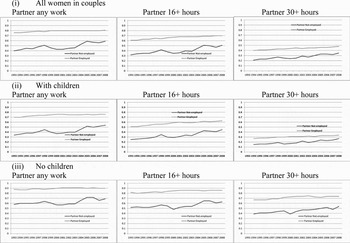
Figure 1 shows changes in cross-sectional employment rates of women in ‘prime-aged’ couples (those aged twenty-five to fifty four)Footnote 4 over the period 1993–2008 for those partnered to (i) employed and (ii) non-employed (unemployed or inactive) men. To reflect the incentives provided by the UK system of tax credits, data are reported for those doing (i) any work; (ii) working sixteen or more hours and (iii) working thirty or more hours. Partnered women with a working spouse saw a small rise in employment between 1993 and 1999, of around 4 ppt, with employment rates flat at around 80 per cent from 1999 onwards. For women with non-working partners, employment probabilities have increased substantially over the last fifteen years, although they remain considerably lower than for women with working partners. In 2008, 59 per cent of women partnered to non-employed men worked, a rise of 19 ppt from a low of just 40 per cent in 1993. The second and third panels show that, particularly at thirty hours plus work per week, the gap between women with working and non-working spouses is considerably smaller (at 13 ppt in 2008 compared to 22 ppt for any work) in all periods. These data suggest that the employment deficit between partners of working and non-working men is driven by poorer prospects for part-time rather than full-time work. Figure 1 also shows the situation for those with and without children. For both these groups, there is a gap between the employment rates of those with working and non-working partners, but for those with children in particular this gap has declined over time and in addition becomes smaller at longer hours of working.
Employment rate of women in couples (aged 25–54) by partner's employment status – 1993–2008

Figure 1 does not consider the specific impact of recession (and in particular rising male non-employment) on partnered women. To see how women's employment has responded to increasing non-employment among their partners, cross-sectional data from the Quarterly Labour Force Survey for 2006–09 is used. ‘Recession’ is defined as the years 2008 and 2009 as, while the economy did not officially enter recession until the third quarter of 2008, output had begun to fall by the second quarter of 2008 and male unemployment was rising from the first quarter (ONS, 2008, 2010). The effect of having a non-employed partner on partnered women's likelihood of working is estimated using a probit model. The effect is allowed to vary between the recessionary and non-recession periods by interacting male non-employment with a dummy variable for recession.Footnote 5 As noted in the earlier discussion, there are several reasons to expect different employment responses according to economic conditions: for example, if economic conditions are weak, then women may react to an increased risk of a fall in their partners income by increasing labour supply (either by entering work or working longer hours) or alternatively they may be more likely to become ‘discouraged’ and withdraw further from the labour force.
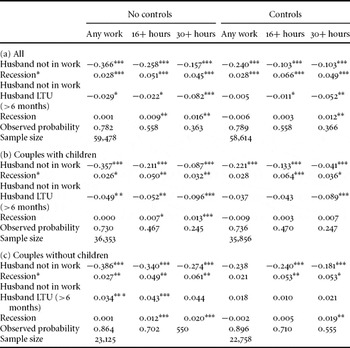
We report results in Table 1: (i) without any controls to give an indication of the overall likelihood of a woman not working when her partner does not and (ii) with a full set of controls, which give an estimate of the relationship between men's non-employment and their women partners’ likelihood of working. As in Figure 1, results are reported for any work, working sixteen hours or more and working thirty hours or over. The results confirm the results presented in the literature reviewed earlier, which showed that having a non-employed partner in the pre-recession period is associated with a reduced likelihood of women working (at any hours) by 24 per cent (panel (a), column 5, row 3) and of working more than sixteen hours by 10 per cent (panel (a), column 6, row 3). However, in sharp contrast to the results reported in studies using earlier data, the results suggest that the negative effect of having a non-employed partner fell as the economy entered recession in 2008 (same columns, row 4).Footnote 6 One reason for this difference may be that women are more likely to work now compared to the early 1990s and that rising male non-employment may be more likely to reduce the chances of women who were out-of-work before their partners became non-employed remaining out-of-work rather than encouraging those in-work to leave employment. This is unpacked further in the subsequent section by looking at household employment dynamics. Two other results in Table 1 are also worth noting. First, having a male partner who has been unemployed for more than six months does reduce the probability of partnered women working in full-time jobs but has little association with working in jobs with shorter hours. Second, the recession does not appear to have had any direct effect on the probability of partnered women working and if anything has had a small positive effect on the probability of them working in full-time jobs. This result is likely to have been driven by partnered women working more hours in response to the increased threat of their partners losing their jobs and/or a reduction in their partners’ hours of work, and provides some evidence of an ‘added worker effect’. This is explored further in the subsequent section.
Probability of women working by partners employment status 2006–09
(age 25–54): marginal effects from a probit model (dF/dX)

Notes:
1. Data: Quarterly Labour Force Survey, April–June quarters 2006–09.
2. *** significant at 0.01 level; ** significant at 0.05 level; * significant at 0.10 level.
3. Controls for housing tenure (local authority, private rental, owner occupier); education (degree, higher, A levels, GCSEs A–C, other and no qualifications); dummy variable for children in household and children under 5; 21 regional dummy variables and partners present/last occupation dummies (managers and senior officials; professional occupations; associate professional and technical; administrative and secretarial; skilled trades occupations; personal service occupations; sales and customer service occupation; process, plant and machine operatives; elementary occupations and never worked). Recession is defined as 2008 and 2009.
Splitting the results between those with and without children allows us to show some differences which are likely to be partly driven by the design of the tax and benefit system. For both groups, having a non-employed partner reduces the probability of working by over 20 per cent. For those with children however, this is mainly a result of partnered women being less likely to work part time (the effect on full-time working is much smaller at just 4 per cent), while for those without children the effect is mainly driven by a fall in full-time work. The effect of recession has again been to reverse these negative effects, with women with children now being less likely to be out of work when their partner is not employed and in particular being more likely than before the recession to be employed for more than sixteen hours a week (although the coefficient for any work is not significant). For those without children, the negative relationship is also smaller during the recession for those working longer (sixteen-plus) hours.
The recession has also influenced the number of hours people work. In some jobs, overtime and basic hours of work may have been reduced and the impact of recession may therefore have had wider effects than purely job loss. As a result, partnered women may be increasingly likely to respond to changes in their partners’ employment status, pay or working hours by changing their own working hours. This response is likely to be increasingly common in view of the large increases in women's employment, and in particular part-time employment, that have occurred over recent decades. However, the tax and benefit system also has a role to play in influencing hours of work; for those whose partners lose their job, there is an incentive to work sixteen hours so as to qualify for tax credits. An analysis of cross-sectional dataFootnote 7 shows that, for couples with children, partnered women worked around three hours fewer each week if their partner was out of work in the pre-recessionary period (an average of seventeen hours compared to twenty hours for those with working partners). Part of this difference was accounted for by personal and job characteristics, but even after controlling for these differences hours were lower by on average two hours each week. Since the recession began this effect has disappeared and partners of out-of-work men now work on average four hours more each week than those with employed partners (an average of twenty-four hours a week). This difference remains even after controlling for differences in characteristics. For couples without children, hours worked by women married to out-of-work men were lower too in the pre-recession period, at twenty-three hours each week, but increased during the recession to an average of thirty hours each week. This difference between those with employed and out-of-work spouses is again partly accounted for by characteristics, but the pattern of increasing hours as unemployment rises remains even after including controls.
Employment transitions; evidence from panel data
This section uses longitudinal data from Labour Force Survey five-quarter panel data to look at the effect of men moving out of employment on their female partners’ employment (again focussing on those aged twenty-five to fifty-four). The previous section demonstrated that the effect of having a non-employed partner on women's likelihood of working appears very different in the current recession compared with earlier years. One reason for this difference could be that those men who are no longer in employment were partnered to women who were working. Longitudinal data however show that, among partnered men who lost their job between 2006 and 2009,Footnote 8 two-thirds lived in families with working spouses and the majority of these spouses stayed in work (89 per cent) and increased their weekly hours (from twenty-one to twenty-eight hours). The other third of men who lost their jobs came from single-earner ‘male breadwinner’ families and these families where much more likely to become workless; among women who did not work prior to their partners’ job loss just 9 per cent entered work over the subsequent year. These transitions have a large part to play in explaining the pre- and post-recessionary differences seen in the earlier cross-sectional analysis.
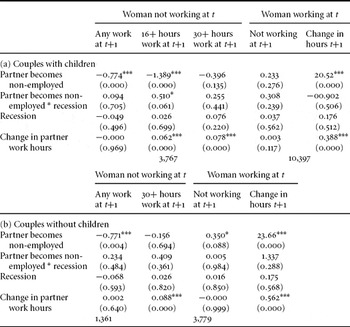
Table 2 reports results for the estimated effect of men becoming non-employed: (a) on their non-working partners entering work at any, sixteen-plus and thirty-plus hours; and (b) on their working partners either exiting work or adjusting their work hours.Footnote 9 As before, the effect of male partners’ job loss is allowed to vary between the pre- and post-recessionary periods. The model uses a fixed-effect specification to take account of all time-invariant characteristics. Controls are also included for changes in male partners’ working hours, a dummy variable for the effect of recession and a variable controlling for the birth of a child. One limitation of the analysis is that the panel element of the Labour Force Survey shows relatively few employment transitions over a single year (for example only 250 men are observed to leave work over five quarters among our sample). As before, a distinction is made between couples with and without children. Both groups show that, for a non-working female partner, the probability of entering any work (and in particular part-time work) is significantly lower if her partner losses his job, although her chance of entering full-time employment is not affected. In all cases, the coefficient for non-employment during the recession reduces this effect, although the coefficients are statistically insignificant (except at the 10 per cent level at sixteen-plus hours for families with children). For working women however, partners’ job loss is associated with a small increase in the likelihood of remaining in work and an increase in hours worked. The interaction term (between partners’ job loss and the recession dummy variable) shows a positive but insignificant association with the probability of working. The recession dummy variable, perhaps surprisingly, does not show any significant effects on the likelihood of women either entering or exiting work. This result is however compatible with recent government data which showed only a very small decline in female employment over this period and a rise in the number of women working part time (ONS, 2008, 2010). Finally, changes in partners’ work hours appear if anything to be positively correlated and suggest there may be other factors than those discussed above driving this.
Fixed effects models of the effects of male non-employment, changes in working hours and the recession on female labour supply (age 25–54)

Note: Data are Quarterly Labour Force Survey, 5-quarter panel. Birth of a child is also controlled for. P-values in brackets.
The results from the panel data analysis suggest that the earlier findings from the cross-sectional data, which showed men's non-employment to have a smaller effect on their partners’ job prospects during the current recession, have been driven by the growth in female employment, with women now more likely to hold on to their jobs if their partner exits work (even if part time or relatively low paid). On the other hand, women who were not working prior to their partner leaving work are not more likely to enter work. This change in the dynamics around job retention for has been particularly important in driving the fall in the penalty to having a non-working spouse during the current recession.
The distribution of employment across families (2007–09)
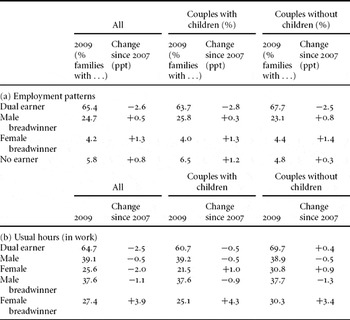
Are job losses today more evenly distributed across families than in the late 1980s and early 1990s, when rising male non-employment gave rise to increasing numbers of workless households? Table 3 (panel (a)) shows how patterns of employment among couples have changed since the employment peak of 2007. Over the two-years to June–August 2009, there was a 2.1 ppt fall in the share of men in couples who were at work (2.6 ppt coming from the fall in dual-earner families while there was a 0.5 ppt rise in male breadwinner families), all of this decline coming from a drop in the number of dual-earner families. As a result of declining male employment, the share of ‘workless’ couples rose by 0.8 ppt and the number of families headed by a female breadwinner rose 1.3 ppt. Among families with children, the drop in male employment was greater, with a 2.8 ppt decline in the number of men working, and this entire decline a result of a decrease in the share of dual-earner families. For these families, male non-employment was more likely to lead to worklessness, a 1.2 ppt rise over the period and a resulting increase in worklessness to 6.5 per cent (1.7 ppt greater than the rate among families without children).
Changes in couples employment (age 25–54; 2007–09)

Note: Data for April–June quarters of the Quarterly Labour Force Survey.
The second panel of Table 3 looks at changes in couples’ work hours across different family types over the same period. The results suggest that the largest loss in working hours has been concentrated among single male-earner families, while women, both in dual-earner families and who were single earners, are working longer hours than before (although those with a single female earner still have lower total hours and are likely to be worse off than dual-earner and male breadwinning families). The results again show that those at most risk in the current recession have been single-earner families, with male breadwinner families in particular being most likely to become workless or have reduced work hours.
Conclusions
Since the recession began in 2008, there has been a 2.1 ppt rise in the number of prime-age couples with no male earner. This paper has looked at the impact that this has had on the employment of their partners and the implications for the number of workless households. Historically, it has been the case that the partners of non-employed men have had lower employment probabilities than other women, and this negative relationship has tended to be stronger when unemployment is higher. The results reported here have shown that among couples it remains the case that women partnered to men who are out of work are much less likely to work than if their partner is employed. However, the employment gap between women with working and non-working partners has been falling, and this has particularly been the case since the economy entered recession in 2008. This change has been particularly large for families with children; for these families, once account is taken for differences in individual characteristics, the gap in employment probabilities between those with working and non-working spouses falls to under 7 per cent at over sixteen hours of work and just 1 per cent for those working thirty hours or more. There have also been large changes in hours of work at the ‘intensive margin’; while before the recession working women with non-employed partners worked on average fewer hours than those with employed partners, since the economy entered recession their working hours are now on average longer.
Longitudinal analysis helped disentangle some of the reasons for these changes. Simple descriptive statistics show that two-thirds of men who lost their jobs between 2006 and 2009 had working partners and of these working partners almost all remained in work. But for the one in three men who were sole earners prior to losing their job just one in ten had partners who entered into employment. More formal analysis using fixed-effect panel data models shows that having a partner who exits work is associated with a reduced chance of non-employed partnered women entering into a job (although only at under thirty hours) but has no influence on the probability of women already in work leaving (indeed these women are likely to increase their working hours). The combination of increased job retention and the growth in number of families with two earners means that the influence of male job loss on women's employment prospects is now substantially lower than in the past. Indeed, while earlier studies for the 1980s and early 1990s showed increasing non-employment rates to be associated with falling employment prospects for partnered women, here precisely the reverse is found. These new dynamics around couples’ employment patterns are likely to have been driven, at least in part, by changes to the tax and benefit system, which now makes it feasible for women to remain in low-paid and part-time employment if their partner loses his job as the extension of in-work support has substantially improved the financial incentives for work. What are the likely longer-term implications of these findings? The 1991 recession had long term consequences for poverty and inequality because those households that lost jobs during the downturn were not always the main beneficiaries from the recovery. As a result, even as the labour market improved the distribution of work became increasingly polarised across households. Today a key concern for policy makers must be that the rise in male non-employment, which has occurred during the current recession, will be slow to fall, again leading to long-term increases in the number of workless households. The good news for policy makers is that the results presented here suggest that the rise in male non-employment since the 2008/09 recession may have a smaller impact on the number of workless couple households than before. Simple tabulations show that the overall effect of rising male non-employment on couples’ employment has been to reduce the number of dual-earner families, with this fall being translated into an increasing number of no-earner families but an even larger rise in single female-earner families. This increased reliance on ‘female breadwinners’ is something that has been noted not just in the UK but also in the US during the current recession (Boushey, Reference Boushey, Boushey and O'Leary2009; Smith, Reference Smith2009). The implication of this change is that the distributional effects of job loss during the current recession may be less damaging than during previous recessions, leading to a smaller rise in the number of workless households. However, families headed by female breadwinners remain vulnerable, with poverty rates among these families being significantly higher than those among other family types (Harkness, Reference Harkness2010). Additional policies to support female earnings, for example by addressing the pay gap, would go some way to reduce the implications of male job loss for poverty (Smith, Reference Smith2009).
The results suggest welfare reform has substantially improved incentives for women to seek or retain work over non-employment, even where that work is part time or low paid. Yet more could be done to guard against rising worklessness among couples. In particular, it can be seen that, while women are more likely to stay in their jobs if their partner exits work, if women are not already working prior to their partner leaving employment, they are unlikely to enter work. Policies which support women in the labour market, regardless of their partner's employment position, could do much to guard against polarisation of work in the future. Evidence presented elsewhere (Lyon et al., Reference Lyon, Barnes and Sweiry2006; Brewer et al., Reference Brewer, Saez, Shephard, Mirrlees, Adam, Besley, Blundell, Bond, Chote, Gammie, Johnson, Myles and Poterba2010; Evans and Harkness, Reference Evans and Harkness2010) has shown that the current design of the tax and benefit system produces relatively weak incentives for second earners (90 per cent of whom are women). Introducing a separate tax-credit allowance for second earners is one way in which their work incentives could be considerably improved, while policies currently targeted at those on jobseekers allowance, which supports individuals to prepare and move into work, could be extended to this group.Footnote 10
The data presented here take account of the effects of recession in 2008/09. Up to this point, the effects of the recession have largely fallen on private sector employment, where the number of jobs declined by 985,000 between December 2007 and December 2009. Over the same period, public sector jobs (which comprise 21 per cent of all jobs) grew by 313,000. As growth returns, private jobs are set to recover (CIPD, 2010), but government spending cuts are likely to lead to substantial public sector job losses in the coming years. Given women's over-representation in the public sector, large increases in female non-employment may yet alter the medium- to long-term ability of partnered women's employment to smooth out the distribution of work across households.