The Tibet issue is a contentious one, full of intrigue and controversy. Since the People's Republic of China annexed central Tibet in 1951, there has been constant resistance from Tibetans against their forcible incorporation into the Chinese body politic. Over the past 60 years, uprisings and social unrest have marked Beijing's uneasy control of the Tibetan plateau.Footnote 1 More significantly, the broad support that Tibetans enjoy internationally, and particularly the internationalization of the Tibetan cause in the West, has made the resolution of the Tibet issue extremely difficult.Footnote 2 Although the Dalai Lama has recently called for genuine autonomy under the framework of the PRC constitution, there remain great rifts both within the community of Tibetan exiles with regards to the independence issue, as well as between the Tibetan government in exile and the Chinese government on issues such as the future status of “greater historical Tibet,” which includes not only the Tibetan Autonomous Region (TAR), which is often called political Tibet,Footnote 3 but also areas that ethnicFootnote 4 Tibetans inhabit in the Chinese provinces of Qinghai, Gansu, Sichuan and Yunnan (which the Tibetans call Amdo and Kham), also known as “ethnic Tibet.”
The relationship between ethnic Tibetans and the Chinese state is a confrontational one. Sporadic protests and occasional outbursts of mass political mobilization have characterized Tibetan political resistance against Chinese rule. Certainly, a fraction of the Tibetan population has been co-opted into the Chinese state through subsidies, but the political, social and economic exclusions of the majority of Tibetans in China have been increasing.Footnote 5 The dynamics of such exclusions breed a sense of desperation among many Tibetans, as demonstrated by recent incidents of self-immolation in ethnic Tibetan areas. It appears that as long as the Chinese government continues with its current policies in Tibet and refuses to engage in meaningful dialogue with the Dalai Lama, political resistance by Tibetans will only continue and intensify.
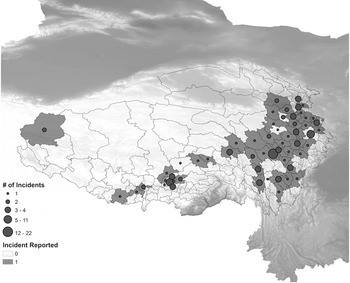
It therefore seems imperative to conduct a more rigorous analysis to understand the complex dynamics of Tibetan political resistance to Chinese rule. However, although there are conventional studies on Tibet that often come from the disciplines of history and anthropology, there has been a lack of serious scholarship that engages extensively with literature on ethnic conflict in the political science and economics disciplines.Footnote 6 Looking at the 2008 protest movements in ethnic Tibetan areas as our primary focus, this article presents a quantitative analysis of factors that underlie specific patterns of political resistance among ethnic Tibetans in China. In the spring of 2008, ethnic Tibetan regions in China witnessed one of the largest waves of protest and social unrest in recent decades. The protests spread from Lhasa, the capital city of the TAR, to other ethnic Tibetan areas in Sichuan, Gansu and Qinghai. This spread of protests across the TAR and other provinces is remarkable for its pervasiveness and scope. However, a closer examination of the geographic locations of the protests shows that the spread was uneven and that there is a specific clustering of political mobilization in certain localities with specific characteristics (see Map 1).
Protest Incidents in Tibet, 2008

In a novel approach to studying political mobilization among ethnic Tibetans in China, we propose to answer the following general questions: what roles do religion, particularly given the Chinese state's repressive policies towards Tibetan Buddhism, play in fomenting Tibetans' political resistance? And what implications can be drawn from the changing ethnic demography in Tibet about Tibetans' conflict behaviour? In order to address these issues, we consult several geo-referenced datasets drawn from various sources. First, we utilize Geographic Information System (GIS) data on China's officially registered religious sites. We use these data to infer the extent to which Tibetan Buddhism has been exposed to the Chinese state's political control, including both monitoring and repression. We also introduce new data on the spread of different Tibetan religious sectsFootnote 7 in these regions, used as measures of the historical religious importance of certain Tibetan counties. For additional control variables, we use various indicators from China's historical population census data at the county level.
Our outcome variable comes from the 2008 protest records. This recent wave of protests marked the very first time in Tibet that incident reports with detailed location information were recorded and made available, allowing for a systematic analysis of the political mobilization and conflicts in the region. However, we acknowledge several caveats in using the data and in conducting the following simple regression analysis. First, given that there is only a single year to draw empirical data from, the regressions inevitably run into potential biases common in cross-country analysis; neither county- nor period-specific effects can be controlled for. In addition, there is potentially an ecological fallacy problem, in that all the records can only be disaggregated to the county level, thereby averaging out effects specific to smaller administrative units. Our analysis also does not explicitly resolve potential endogeneity issues arising from omitted variables and cross-causal inferences. These concerns lead us to believe that the aggregate analysis as conducted here only captures the broad trend of protest movements in the given year, and provides no specific insight into the micro-mechanism within each county. Furthermore, the empirical results should be interpreted as largely descriptive, with no causal inference.
With these caveats in mind, the main results of our analysis indicate that the spread and frequency of protests in ethnic Tibetan areas are significantly associated with the number of officially registered Tibetan Buddhist sites, as well as the historical dominance of particular Tibetan religious sects. Furthermore, our analysis shows that the effect of Han 汉 Chinese settlement on Tibetan political activism is more controversial than previously thought. In support of the empirical findings, we argue that monasteries in Tibet have historically acted as cultural and political centres for Tibetans, promoting a stronger sense of unity and identity among the people. The Chinese government's continual repressive measures towards Tibetan Buddhism have exacerbated Tibetans' frustration with the Chinese state and have made Buddhist monasteries nuclei of Tibetan political activism. At the same time, the Chinese government's push for the migration and settlement of Han Chinese in ethnic Tibetan areas seems particularly controversial in that increased Han Chinese migration and settlement appears negatively correlated with Tibetan political activism. The empirical findings therefore showcase the adverse outcomes of China's policies towards Tibetan religion and the implications of ethnic demographic change on the Tibetan plateau for Tibet's short-term political future.
The 2008 Tibetan Uprising
In March 2008, Tibetans throughout ethnic Tibetan areas, including both lay people and monks from urban and rural areas, protested against the Chinese state, signifying that “the phenomenon of Tibetan nationalism and the idea of Tibet as a distinct nation are much more widespread than 20 years ago.”Footnote 8 It all started in October 2007, when monks at Drepung monastery in Lhasa were reportedly arrested by Chinese security forces whilst attempting to celebrate the awarding of the US Congressional Gold Medal to the Dalai Lama.Footnote 9 On 10 March 2008, the 49th anniversary of the Tibet Uprising in 1959, several hundred monks from the same monastery staged protests calling for the release of the arrested monks. Later, monks from Sera monastery mounted a separate protest, during which monks shouted pro-independence slogans and waved the banned Tibetan nationalist snow lion flag.Footnote 10 Other protests were also reported that day in Qinghai, Gansu and Sichuan provinces, indicating the wide scale of the protests.Footnote 11 One distinct feature of the protests is that many took place in rural areas as well as in small towns, which might represent the fast pace of urbanization occurring in ethnic Tibetan areas. There followed a severe crackdown by Chinese authorities and patriotic education teams and/or paramilitary troops were sent into local monasteries.Footnote 12 Throughout the spring, there were more than 100 protests in ethnic Tibetan areas.
The protests throughout the ethnic Tibetan areas were mostly peaceful, but there were exceptions. On 14 March, protests in Lhasa turned violent as rioters attacked businesses and civilians, resulting in 18 deaths, mostly Han Chinese. Outbreaks of violence were also reported in Qinghai and Sichuan; according to Robert Barnett, it was “normal for large-scale, lay-dominated protests to lead to violence.”Footnote 13 Furthermore, in several places Tibetan protesters managed to storm government buildings and replace the Chinese flag with the Tibetan national flag.Footnote 14 As a result of this widespread Tibetan uprising against Chinese rule, a tight lock-down of ethnic Tibetan areas was imposed to prevent any reporters or foreigners from entering the region.
Explaining Tibetan Resistance
As mentioned above, the timing of the uprising was not random and coincided with the 49th anniversary of the 1959 uprising which had led to the flight of the Dalai Lama to India that year. Moreover, the year 2008 also provided a golden opportunity for gaining international media attention as it was the year that Beijing was to host the Olympic games. The community of Tibetan exiles in India had publicized plans to disrupt the preparations for the games by organizing a march to Tibet on 10 March.Footnote 15 There was a widespread belief among Tibetans, both within China and in exile, that “China would be less likely to use lethal force on protestors in the run-up to the Olympics.”Footnote 16 Furthermore, the awarding of the US Congressional Gold Medal to the Dalai Lama might have also strengthened the Tibetans' perception of the amount of international support they would receive. All these factors explain at least in part why these protests occurred in the spring of 2008, a period of rare opportunity that encouraged ethnic Tibetans throughout the region to vent their political frustrations and discontent towards the Chinese government.
Similarly, the organization and coordination of events can also explain the specific pattern and scale of the protests. The Chinese government put the blame squarely on the community in exile, with Chinese premier Wen Jiabao 温家宝 alleging that, “There is ample fact and plenty of evidence proving this incident was organized, premeditated, masterminded and incited by the Dalai clique.”Footnote 17 However, the exact details of how the uprising was instigated cannot be easily obtained. Some argue that the initial protests in Tibet took Dharamsala by surprise. More likely factors behind the coordination of the protests might be found in the extensive use of mobile phones, online social networks and radio broadcasts to spread information.Footnote 18
Aside from these immediate causes, when analysing Tibetan resistance against the Chinese government and how protests occur, scholars and concerned parties, such as various pro-Tibetan NGOs, often tend to focus on the lingering grievances held by Tibetans as a result of Chinese state suppression of religious and cultural freedom, as well as the demographic pressure caused by increasing Han Chinese migration and settlement in ethnic Tibetan areas.Footnote 19 Therefore, our analysis starts with these two most commonly utilized structural factors to explain Tibetan resistance – religion and ethnic demography.
Repression of Tibetan Buddhism
Buddhism is the key defining feature of Tibetan identity. The traditional fusion of religious and political systems in Tibet means “Buddhist ideology and values dominated the population's worldview and the state's raison d'être.”Footnote 20 Buddhism in Tibet also has the distinct feature of mass monasticism that encourages people, particularly males, to join monasteries. Before 1951, there were thousands of monasteries throughout Tibetan areas. A 1930 estimate reported that between 10 to 20 per cent of Tibetan males were monks.Footnote 21 Tibetan monasteries were the largest landowners with manorial labour. From the point of view of the Chinese Communist Party (CCP), this peculiar political system was the main obstacle to socialist reforms, although the Party tolerated it in political Tibet between 1951 and 1959 as per the Seventeen-Point Agreement for the Peaceful Liberation of Tibet (Zhongyang renmin zhengfu he Xizang difang zhengfu guanyu heping jiefang Xizang banfa de xieyi 中央人民政府和西藏地方政府关于和平解放西藏办法的协议) signed by the Tibetan government and the Chinese central government.
During the first few years, the Chinese government abided by the Seventeen-Point Agreement and allowed the Tibetan government to function with relative autonomy, and the CCP generally respected the Dalai Lama's power and authority. However, the Seventeen-Point Agreement only applied to political Tibet and not to ethnic Tibetan areas outside of it. Thus, democratic reforms (minzhu gaige 民主改革) were carried out to collectivize and redistribute land and restructure class relations in these areas. These radical policies immediately led to widespread revolt in ethnic Tibetan regions in Kham and Amdo in 1956. The Khampa rebellion in Sichuan during the mid-1950s met with a particularly draconian response from PLA troops, including the aerial bombing of entire Tibetan monasteries thought to be sheltering rebels.Footnote 22
The Khampa rebellion significantly damaged the already tense relationship between the Tibetan government and the CCP. The flight of the Dalai Lama in 1959 signalled the end of the Tibetan religious and political system in Tibet. The Dalai Lama's exile and the failure of the CCP to resolve tensions peacefully led to a severe crackdown on Buddhism in Tibet, with the CCP immediately abolishing mass monasticism and destroying numerous monasteries. Violent suppression of Tibetan Buddhism and culture reached its peak during the Cultural Revolution, when people were mobilized to destroy religious objects and cultural artifacts and symbols. Being an officially atheist political party, the CCP also strove to eliminate Buddhism from people's hearts and minds, and Tibetans “were forced to abandon deeply held values and customs.”Footnote 23 This persecution of Buddhism in Tibet has left deep scars on Tibetan identity, and memories of revolutionary violence are arguably a unifying force for Tibetan grievances against the Chinese state. Buddhism continues to define the political discourse of Tibetan nationalism to this day.Footnote 24
Starting in 1980, several years after the Cultural Revolution had ended, many of the CCP's religious policies in Tibet were reversed. After Deng Xiaoping 邓小平 initiated reform and opening-up, and particularly during the time when Hu Yaobang 胡耀邦 served as CCP general secretary, the CCP changed many of its repressive policies towards Tibetan Buddhism and started to show a significant degree of tolerance towards a Tibetan religious and cultural revival.Footnote 25 The late 9th Panchen Lama also played a significant role in the Chinese government's moderation in its policies towards Tibet.Footnote 26 In fact, ethnic Tibetan areas witnessed an upsurge in religious activities: monasteries were refurbished or rebuilt and allowed to reopen, and Tibetans began to send their sons once more to the monasteries. Matthew Kapstein estimated that, in the 1990s, there were more than 100,000 Tibetan monks in ethnic Tibetan areas, largely as a result of liberalized religious policies.Footnote 27
However, owing to waves of Tibetan protests, such moderate policies came to an end in the TAR in the late 1980s.Footnote 28 The repression that followed these protests culminated in the 1989 imposition of martial law in Lhasa by Hu Jintao 胡锦涛, then CCP secretary of the TAR. However, the relatively moderate policies were not rolled back in ethnic Tibetan areas outside of the TAR. Instead, those areas continued to enjoy more leeway in religious revival as the TAR itself became subject to more scrutiny and control.Footnote 29 Therefore, a disproportionately large number of Tibetan monasteries outside the TAR were allowed to function with relative independence, and many large monasteries in Sichuan, Gansu and Qinghai played host to thousands of monks.Footnote 30
However, the more moderate religious policies outside the TAR also began to experience a gradual reversal in the 1990s as the CCP became increasingly uneasy with the proliferation of Buddhist monasteries and the growing number of monks in those areas. While in many respects certain cultural religious spaces continued to be tolerated, overall the Chinese state started to impose tighter monitoring and control of religious expression in all Tibetan areas. In 1994, the Third National Forum on Work in Tibet (Disanci Xizang gongzuo zuotanhui 第三次西藏工作座谈会) was held in Beijing and marked the resumption of severe restrictions on Tibetan religious activities.Footnote 31 Measures were taken to control Buddhist curricula, limits were placed on the number of monks and nuns, and registration of Tibetan Buddhist sites became compulsory.Footnote 32 In particular, the government started a new propaganda campaign denouncing the Dalai Lama. A ban on the possession and display of the Dalai Lama's picture was introduced, first in the TAR and subsequently in other ethnic Tibetan areas.Footnote 33 Education teams went to Tibetan monasteries and required monks and nuns to denounce publicly the religious authority of the Dalai Lama.Footnote 34 The ban on worship of the Dalai Lama and the persistent personal attacks on his name and standing by the Chinese state provoked the ire of Tibetan monasteries and Tibetan lay people who consider the Dalai Lama as the fully enlightened Buddha and the apex of the Tibetan religious and political order.
The CCP's reversal of its moderate religious policies towards Tibet has had severe consequences, as reflected by the Tibetans' reaction towards the Chinese state. The liberal policies of the 1980s gave rise to the proliferation of Tibetan monasteries and monks, especially in areas outside of the TAR, which continued well into the early 1990s. Tibetan Buddhism and its monasteries have regained much of their previous social and religious influence, and have also become the social nuclei of political dissent and Tibetan nationalism. However, Tibetans found the tightening of control as a way to take back their newly enjoyed “religious freedom” too much to swallow. Furthermore, the mandatory registration of monasteries also exposed those monasteries – and the monks residing there – to constant monitoring and repression from the Chinese state. Thus, we argue that there is a strong correlation between monasteries and Tibetan political resistance.
State repression of Tibetan Buddhism is not necessarily distributed evenly across the various religious sects. Within Tibetan Buddhism, the Dalai Lama's Gelug sect is the largest and has historically enjoyed significant political domination over other sects, such as Kagyu, Nyingma, and Sakya, as well as the non-Buddhist Bon sect. For example, the three major Gelug monasteries around Lhasa – Drepung, Sera and Ganden – used to exert considerable influence on the Tibetan government's political decision-making up until the 1950s. Thus, the Gelug sect was the one that arguably lost most of its political influence and perhaps suffered the most at the hands of the CCP after the annexation of Tibet in 1951. For this reason, we posit that monasteries that belong to the Gelug sect tend to be more politically active and more resistant to Chinese rule.Footnote 35
Dynamics of ethnic demography
Fears and grievances about Han Chinese migration and settlement in ethnic Tibetan areas are also manifest in Tibetan resistance to the Chinese state. In 1987, during an address to the US congress, the Dalai Lama put forward a five-point proposal in which he demanded that China should abandon its population transfer policy.Footnote 36 In 2008, the Dalai Lama once again claimed that Beijing was planning the mass settlement of Han Chinese and Hui 回 MuslimsFootnote 37 in Tibet to dilute Tibetan culture and identity.Footnote 38 This fear of demographic takeover is not groundless. Historically, Chinese dynasties used the settlement of Han Chinese populations in peripheral regions to consolidate their control.Footnote 39 During the late Qing dynasty, in the face of the growing threat from an expanding Russian empire, the Manchu court encouraged the settlement of Han Chinese in Inner Mongolia and Manchuria to reinforce its control over these areas. Prior to the Chinese annexation, the Han Chinese population in Tibet was almost non-existent, particularly in political Tibet. However, since the 1950s, large numbers of Han Chinese have settled in ethnic Tibetan areas in Sichuan and Qinghai.Footnote 40 Although many of these early Han Chinese settlements were balanced by large exoduses following the Great Leap Forward and the Cultural Revolution,Footnote 41 it is undeniable that there is significant Han Chinese settlement in ethnic Tibetan areas outside of the TAR. Within the TAR itself, since the 1990s, waves of Han Chinese migrants have come to take advantage of the availability of trading licences there.Footnote 42 As a result, the number of Han Chinese and Hui Muslim migrants has grown significantly and their presence is increasingly visible, especially in urban areas. Although Tibet's high altitude and less hospitable climate might prevent the mass settlement of Han Chinese to the same extent experienced in Inner Mongolia and Manchuria, it is the perception of being swamped by an urban-centric Han population that matters.Footnote 43 Unsurprisingly, much of the unrest in ethnic Tibetan areas over the past decade has increasingly focused on Han Chinese and Hui Muslim businesses in urban areas.
Data Description
To systematically study the patterns of protest in ethnic Tibetan areas, we obtained our data from several sources. Unlike previous accounts of protests that were mainly anecdotal with limited resources for verification, both the central Chinese government and the foreign press filed detailed reports of the incidents that occurred throughout 2008. The protest data were mainly gathered from TibetInfoNet,Footnote 44 with details supplemented by a 2008 report from the International Campaign for Tibet (ICT).Footnote 45 The data were then cross-checked with information gathered by the Department of Information and International Relations at the Central Tibet Administration in India.Footnote 46 In the few cases where the reports of a single incident differed, the observations were dropped.Footnote 47 Since most accounts recorded in these sources gave only county-level location information, observations were aggregated to the county level. For each county, this article uses data on whether a protest occurred or not, as well as how many incidents occurred. However, we place more significance on the former because the current classification of what constitutes a single incident – as opposed to several – is subjective and often made unclear. For example, in counting the number of incidents, a single demonstration of flag-burning by a student is given the same weight as an incident involving hundreds of protestors and leading to numerous casualties.Footnote 48 It is therefore difficult to assess variations in the level of protest intensity based on the number of protests; what we observe more objectively instead is whether protests occurred in a region, controlling for population density and total population.
Records of the total number of Tibetan monasteries officially recognized by the Chinese government come from the Atlas of Religions in China. The information is collected by the National Bureau of Statistics of China and distributed by the University of Michigan China Data Center. This GIS-based data product has integrated those official religious data from the 2004 China Economic Census and the ZIP maps of mainland China. The atlas provides locations of all the registered religious sites in China as of 2004, and the census provides an index of geographic and demographic variables for each county. We only consider Buddhist religious sites in ethnic Tibetan areas, including the TAR and Tibetan autonomous prefectures in neighbouring provinces. Buddhist sites include temples of various sizes, as well as sites described as committees, associations and management groups related to Buddhism in general. The actual number of all religious sites is most likely underrepresented, as the data provided by the Atlas only report those that are officially registered. Given this reporting issue, the number of these sites is not a good indicator of the actual distribution of Buddhist religious sites across Tibetan areas. We argue instead that the numbers actually reflect the extent to which Tibetan Buddhism is exposed to monitoring and repression by the Chinese state. For the following analysis, we interpret the site variable as a measure of the Chinese state's repression of Tibetan Buddhism across counties.
In addition, we control for the historical spread of religion in Tibetan areas. Here, we introduce another religion variable that pertains to the identification of Tibetan religious sects dominating each county in history. A map obtained from the Tibet-Institut in Switzerland specifies the distribution of different religious sects in counties in Tibet between 1280 and 1965.Footnote 49 On the map, different coloured markers indicate the degree of presence of Tibetan religious sects in different counties. For each of the four sects of Tibetan Buddhism – Gelug, Kagyu, Nyingma and Sakya – as well as the pre-Buddhist Bon religion, the number of markers is related to how each sect is recorded. We interpret this number as a sect's historical presence in each county.
For additional control variables, we use the National Bureau of Statistics of China's Historical China County Population Census Data, with GIS maps for 2000 (the year for which the most recent census data at the county level are available) to obtain a list of socio-demographic variables. These include urban population, illiteracy levels, college education attainment, population density as measured by population per square kilometre, and total county population. In order to control whether ethnic group distribution can potentially explain protest outcomes, the empirical study includes the portion of population identified as Han Chinese.Footnote 50 It also includes a measure of ethnic polarization among different groups based on their relative population in each county as an additional control for group heterogeneity.Footnote 51 Finally, geopolitical variables include each county's proximity to the provincial capital (road distance to the capital and the time it takes to get there). The distance and time variables are obtained from Google Maps searches and represent the different levels of geopolitical salience of each county. The distance and time variables reflect each county's location, terrain conditions, as well as size. One would expect that the Chinese state would hold more influence over the counties closest to the provincial capital.
One potential concern that relates to the wide spread of protests in 2008 relative to previous years is that the development of mobile phone technology and the internet have made the coordination of protestors much easier.Footnote 52 In order to assess how much impact the availability of mobile phones and the internet had on protests, one would ideally look at the location of mobile phone towers and internet coverage in Tibet and the surrounding areas prior to the protests. However, there are reports indicating province-wide shutdowns of both mobile phone and radio reception after 2008, and because such issues are highly political, it was not feasible to obtain coverage data. What we do include in a separate set of regressions is the number of mobile phone and landline users in 2007, prior to the protests, as additional controls. The data are obtained from the University of Michigan China Data Center's China Province Statistical Yearbook. Unfortunately, the county-level data are available only for Qinghai and Sichuan provinces for the year 2007. For the TAR, Gansu and Yunnan provinces, county-level statistics are not available and therefore are excluded from the analysis.
Empirical Analysis
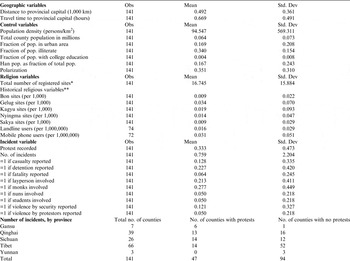
Summary statistics (see Table 1) show that 141 counties are included in the data, with the highest number of counties included coming from the TAR. Nearly one-third of all counties included in the analysis experienced a protest in 2008, mostly with a single reported incident. Surprisingly, only about 30 per cent of all incidents reported the direct involvement of monks, and an even lower percentage (5 per cent) was reported as involving nuns. The highest number of incidents was reported in the TAR and Sichuan province, with 14 counties each, and was closely followed by Qinghai province, which saw 13 counties experiencing protests. On the other hand, six out of seven counties in the Gannan 甘南 Tibetan Autonomous Prefecture, Gansu province, had protests, in contrast to those in Yunnan, which experienced none. The wide spread of protests is evident in the statistics, which also suggest that there are significant intra-province variations in terms of incident occurrence. Map 1 describes occurrences of incidents and the actual number of incidents recorded.

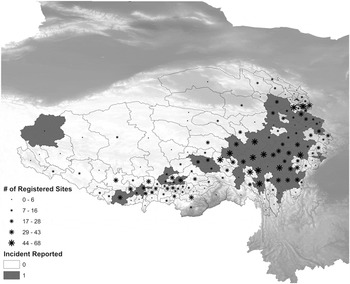
The mean number of Buddhist sites per county is 17, with the number of sites ranging from zero to 68. Counties with more than 50 registered Buddhist sites are in Qinghai and Sichuan provinces and the TAR. Map 2 shows that, in general, there are more officially registered Buddhist sites in ethnic Tibetan areas outside of the TAR than inside. We also notice variations in the distribution of the Tibetan Buddhist sects. From the Tibetan religious sect map data, the Gelug sect is commonly found across all counties; the average county has at least one Gelug temple. The TAR has the highest concentration of temples of all the sects overall, suggesting that central Tibet has historically been the area with the greatest proliferation of religion.
Religious Sites in Tibet

When looking at other control variables, we find that there are many intra-province variations, especially in indicators such as urbanization rate, illiteracy rate and percentages of the population with a college education. On average, 17 per cent of a county's population lives in urban areas, while 34 per cent is illiterate and less than 1 per cent has a college education. In the absence of group-level local economic performance measures, these variables indirectly measure the extent to which certain counties are exposed to “modernizing forces.”Footnote 53
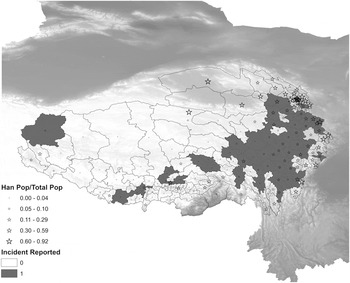
Summary statistics also show that the mean total population for a given county is 64,000. On average the population density is 95 persons per square kilometre, with large variations across counties. Within each county's population, the average Han population as a fraction of the total is 0.17. Map 3, which shows the Han population measure in ethnic Tibetan areas for the year 2000, shows that the concentration of Han relative to the total county population is the highest in the Tibetan counties that border non-Tibetan counties in Qinghai, Gansu, Sichuan and Yunnan.
Han Population in Tibet, 2000

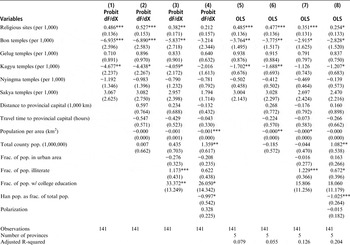
Table 2 presents results with the incidental dependent variable (equal to 1 if an incident was reported, 0 otherwise). Columns 1 to 4 present marginal effects under probit estimation, and columns 5 to 8 replicate the specifications, but with the province fixed effect OLS estimation to control for any province-specific characteristics. The total number of Tibetan Buddhist sites has a highly significant and positive coefficient value, which remains robust in magnitude and significance throughout different specifications. This result holds especially after controlling for both total population and population density.
Religious Sites and Protest Incidents

Notes: Standard errors in parentheses. *** p < 0.01, ** p < 0.05, * p < 0.1.
The relationship between the number of registered Buddhist sites and Tibetan protest patterns can potentially be interpreted in several ways. As discussed above, the total number of temples can be construed as the extent to which certain counties have been exposed to the Chinese state's religious repression. The presence of more Tibetan Buddhist sites in a certain county means there are denser religious networks that can potentially facilitate the organization of resistance against the Chinese state. On the flip side, more Buddhist sites can also mean a higher intensity of repression and political interference by the Chinese state. As we have discussed above, since the mid-1990s, the Chinese state has stepped up its attacks on the Dalai Lama and introduced tighter control of religious activities in ethnic Tibetan areas outside the TAR. Therefore, our results might mean that while the Chinese government's relative religious tolerance in the past is correlated with the number of monasteries, the later reversal of these moderate policies and the repression that followed have inevitably drawn more discontent from ethnic Tibetans. A higher number of registered sites might have meant more religious freedom in the past, but now it means more places for the Chinese government to monitor. Consequently, it is the counties with the highest number of registered sites that experience more protests.
If one were to take a causal view of the relationship between religious sites and subsequent protests, column 3 in Table 2, for example, measures the average effect of the number variable on the probability that a county experienced at least one protest. Each registered religious site per 1,000 people in a county increases the probability of a protest occurring by 38 per cent. The coefficient value remains very significant under the OLS estimation with province dummies, and robust to various specifications.
In addition, our analysis finds that a long-standing religious presence also plays a role. The presence of the pre-Buddhist Bon religion seems statistically significant; in contrast with counties that have more Gelug temples, larger numbers of Bon temples are associated with fewer protests. There are two ways to interpret the significance of the Bon religion. The Bon religion historically endured periods of persecution at the hands of Buddhists, and Bon temples tended to be built in areas where Buddhism had less influence.Footnote 54 The Buddhist Gelug sect lost its dominant political position in Tibet after the CCP abolished the theocratic system there, so the sect's followers and monks presumably hold more grievances against the Chinese state. Gelug followers are also aggrieved by the Chinese state's attacks on the Dalai Lama, head of the Gelug sect. This is not the case with followers of the Bon religion, or at least not to the same extent. Another interpretation is that the Bon religion is really a minority religion in Tibet and so its temples do not possess as many resources as Buddhist temples. The Bon followers therefore may have less capacity to mobilize the public to protest against the Chinese state.
The Han Chinese presence is shown to have a strong correlation with the dependent variable. A higher percentage of Han in the total county population is correlated with fewer protests in the same areas, controlling for total population, population density and polarization index. The coefficient value under column 4, for example, suggests that the likelihood of experiencing one or more protests decreases by 10 per cent as the total percentage of Han population increases by 10 per cent. The Han presence factor appears to play an important role that is independent of the total number of residents and population density; that is, even if there were a significant number of Tibetans in a heavily populated area, if the percentage of Han population were significantly large, that area would be less likely to experience any form of protest.
Given that areas with a greater Han presence have fewer Tibetans, the decreased likelihood of protest movements in Han-dominated counties may at first appear to reflect an outcome of decreased Tibetan presence. However, the fact that the Han presence remains strongly correlated (negatively) with incidents of protest (even after controlling for total population) suggests additional interpretations. It seems the Han migration and settlement policies pursued by the Chinese government may have been successful in reducing both Tibetan dominance over the population and other factors contributing to Tibetan political activism against the government. That is, a stronger Han presence factor may be interpreted as a weaker capability of Tibetans to organize political protests, regardless of how many Tibetans reside in a given area. It may also mean that a stronger Han Chinese presence indicates more state security apparatus and thus makes Tibetan political mobilization less likely.
However, we acknowledge our data might be skewed for the following two reasons. One is the inclusion in our data of border counties that geographically straddle the Tibetan and Han Chinese spheres. Many of these border counties, although claimed by the Tibetan government in exile as being part of the “Greater Historical Tibet,” are no longer particularly Tibetan, having been populated by Han, Hui, Qiang 羌, Yi 彝, and other ethnic groups for quite some time. These types of counties are in fact not representative of the trend in highland Tibetan areas, yet may well have driven the negative association between the Han Chinese population and Tibetan protest movements. In addition, we take note of a possibility that our results might be skewed owing to the existence of areas in Tibet predominantly settled by Han Chinese, such as those with military bases and new transportation and mining towns, for example, Golmud. Indigenous Tibetan populations in these areas are extremely sparse, with barely any indigenous towns or religious sites of any significance to start with. Thus, we would not expect any protests to take place in these areas anyway.Footnote 55
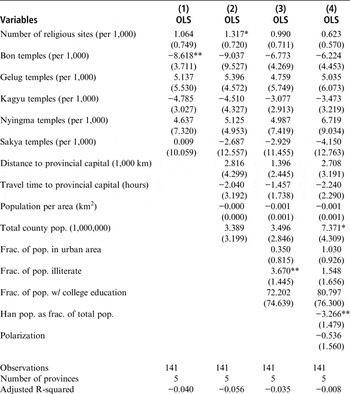
We also run additional tests using the same controls but treating the total number of recorded incidents as the dependent variable (reported in Table 3). While the results are similar to Table 2 in that the number of religious sites appears positively correlated with the number of protests, the coefficient values are no longer statistically significant. The variation in the dependent variable also introduces large standard errors for the coefficient values, possibly owing to the subjective issue of categorizing the episodes of incidents, as discussed above.
Religious Sites and Number of Protests

Notes: Robust standard errors in parentheses. *** p < 0.01, ** p < 0.05, * p < 0.1.
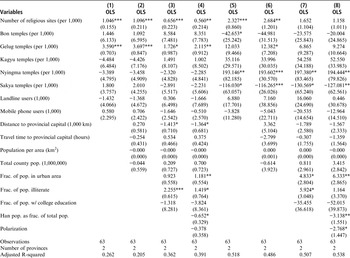
Finally, this article considers the argument that the recent spread of protests in Tibet was wider than in 1989 owing to the advances in technology and communications. Table 4 presents results from the two provinces (Sichuan and Qinghai) that provide county-level information on the total number of mobile phone users and landline users. While we cannot compare the direct impact of technological advances over the two periods, we can show whether in 2008 a county with more networks experienced more protests. The regression results are from OLS estimation with robust standard errors and province fixed effects.Footnote 56 When the dependent variable is binary (whether or not a county experienced one or more protests), the total number of religious sites remains an important factor strongly correlated with the dependent variable. In comparison with results in Tables 2 and 3, we see that the magnitude of the coefficient increases more than twofold. This suggests that when technological advances are taken into consideration, the independent impact of religious monitoring on protest movements is even larger than previously predicted. Han population also remains statistically significant, but the “Bon religion” effect no longer applies to the two provinces. Furthermore, neither the mobile phone nor landline variable has statistically significant coefficient values, suggesting that at least for the two provinces, technological progress was not the main determining factor behind the spread of the protests.
Spread of Technology and Protests

Notes: Robust standard errors in parentheses. *** p < 0.01, ** p < 0.05, * p < 0.1.
From the tables we can see that both the religion and Han population variables in particular show robust coefficient values across different specifications in 2008.Footnote 57 We argue that this result, while still interpreted as correlational, offers an alternative background to these protests. The argument differs from Fischer, who suggests that it is the economic polarization between Han immigrants and the Tibetan population that led to the protests escalating.Footnote 58 We do not have a good measure for this economic polarization data, since the income levels for each population group at the county level are not available from the census or the yearbook (although we do control for district-level urban, college education and illiterate population as proxies for overall economic development). However, we argue that economic polarization is likely a factor independent of the religious site registration for the following reasons.
First, most economic polarization in Tibetan regions occurred at the beginning of the 21st century, when Beijing used various incentives to encourage Han migration through the Open Up the West programme (xibu dakaifa 西部大开发). Economic polarization occurring by 2008 therefore came after the registration of religious sites, which took place in the 1990s. Even if the measure of state monitoring and migration were related, the number of registered sites would have not been an outcome of the administration's migration initiative, but rather the antecedent.
Second, if the Han population in Tibetan areas in fact drives economic development and the subsequent polarization between the two groups, as seems plausible from Fischer's argument, we control for this factor in our regression (fraction of Han population in county), along with the polarization index. In this regard, economic polarization is itself an intervening variable, endogenous to the migration movement, but not related to the religious sites. The impact of Han population on the protest level, after controlling for both total population and population density, appears to be a negative one. Our main hypothesis is based on religious monitoring and does not contradict Fischer's economic polarization story, but rather presents another factor strongly related to protest. If economic polarization is directly correlated to group polarization, then our polarization index also controls for Fischer's economic polarization hypothesis, and we still obtain significant results for our main variable of interest.
Theoretical Implications
Our analyses of the 2008 Tibetan protests and the pattern of Tibetan political activism have two main theoretical implications. The first relates to the relationship between repression and political mobilization. One of the main findings of the protest pattern shows that counties with more registered Buddhist sites also experienced more political mobilization. As we noted earlier, the regions that appear to have benefited the most from the Chinese state's earlier more tolerant approach to religion, as reflected by the number of officially registered sites, are located in the provinces outside the TAR. For example, in Sichuan there are 615 officially registered sites in 26 counties. Likewise, Qinghai has 571 sites across 39 counties. In total, there are 1,300 officially registered sites in ethnic Tibetan areas outside the TAR, while there are only 1,061 sites in the TAR. Given the historical importance and spread of Buddhism in the TAR relative to the surrounding prefectures, the lower number of registered sites in the TAR indicates that the more liberal religious policies were implemented to a greater degree in the prefectures outside the TAR in the 1980s.
However, we have also noted that there was a reversal of these more tolerant religious policies in both the TAR and surrounding areas, and how a clampdown against Tibetan Buddhism affected ethnic Tibetan areas outside the TAR in a more dramatic way, leading to Tibetan protests. Several works explain this outcome as representative of an authoritarian state's use of both concession and repression to control its citizens. For example, Goldstone and Tilly argue that authoritarian regimes typically use repression and threats of repression inconsistently with partial concessions, depending on how costly it becomes for the government to suppress the opposition.Footnote 59 That is, although the government's first choice is to repress, sometimes it will resort to concessions in order to curb an insurgency. However, in order for concessions alone to pacify potential protesters, these concessions have to be significant enough; small concessions may lead to more protest activities, as they encourage the protestors to push for further concessions.Footnote 60 In the case of ethnic Tibetan areas outside of the TAR, concessions had been made, but they were later combined with repression equal in measure to what occurred in the TAR. As Lichbach proposes, this combination of concessions and repression increases dissent and protest activity, as the former encourages protests for more concessions, and the latter induces anger and rebellion against the government.Footnote 61 In the case of Tibet, rising political activism appears to follow closely the general implications of the concession versus repression theories.
The secondary finding of our study shows a more complicated picture of ethnic demography. Scholars of ethnic conflict have long noticed that ethnic demography and group settlement patterns are good indicators of group conflict behaviour.Footnote 62 Ethnic groups that are geographically concentrated are more likely to mobilize politically for their causes.Footnote 63 Thus, geographically concentrated groups are either more likely to consider the land as indisputably theirs and are therefore more willing to fight for it, or group concentration offers a favourable opportunity structure to facilitate collective action.Footnote 64 While we do not test the causal mechanisms in this article, the results of our analyses do show that in areas where more Han Chinese are present and ethnic Tibetans are less concentrated, there appear to be fewer opportunities for Tibetan political activism. This result should indeed be taken with a grain of salt, as we have indicated our data might be skewed, and more research is needed to study the temporal effects of demographic changes on the Tibetan plateau.
Conclusion
The continuing tension on the Tibetan plateau marks the failure of China's nation-building policies. There are no easy solutions to the Tibet issue in sight or easy ways to improve the current situation. As our analyses have shown, the intensity of Tibetan political activism is highly correlated with the number of registered Buddhist sites in each locale. As a result of a period of relaxation in the Chinese government's religious policies in the 1980s, ethnic Tibetan areas outside of the TAR experienced a boom in religious activities, with a great number of monasteries being built or rebuilt. However, the reversal of these policies in the 1990s seems to have caused much anger and resentment among the Tibetan people in these areas. Compulsory registration of Buddhist sites has also enabled the Chinese state to target its religious repression more effectively. The loosening of religious controls, followed by their tightening, has made life increasingly unbearable for a very religious society. In this way, Tibetan Buddhism not only acts as the source of public grievance, but also provides a channel for the coordination of political activism.
The migration and settlement of Han Chinese in ethnic Tibetan areas are thorny issues that could be quite significant for the future of Tibetan political activism. The huge influx of Han Chinese has provoked fear among the less populous Tibetans of a future of demographic domination and cultural assimilation, as witnessed in other ethnic minority regions in China. Han Chinese settlement in Manchuria over the last centuries has turned that region into one overwhelmingly dominated by Han Chinese, where ethnic Manchus have been completely assimilated. Similarly, in Inner Mongolia, ethnic Mongols have become a minority, which might also explain the relatively “pacified” nature of ethnic Mongol activism.Footnote 65 Anger over Han Chinese migration and settlement continues to provoke conflict in the Xinjiang Uyghur Autonomous Region.Footnote 66 As the results of our analysis show, there is some tentative evidence indicating that a lower concentration of Tibetan population in a given area might be correlated with less political activism. This is indeed one of the Tibetan government in exile's worst nightmares.
The implications of our research are twofold. First, the Chinese government should moderate its religious control policies in ethnic Tibetan regions to allow more freedom of worship. Their campaigns to vilify the Dalai Lama should stop as they only serve to strengthen the resolve of the Tibetans, as shown by the desperate acts of martyrdom in recent cases of self-immolation. The second implication is more controversial. Not necessarily extending empirical support for the Chinese government's intentional use of demographic pressure to “pacify” the Tibetans, we argue that the danger of demographic imbalance and cultural assimilation of the Tibetans is real and should be prevented, or at least mitigated to preserve the political and cultural integrity of the Tibetan people.