Implications
Knowledge of nutrient composition, ruminal degradability and whole-tract digestibility of feed is necessary to formulate energy and protein-balanced rations. However, ruminal degradability may also affect feed intake and performance of ruminants, because rumen function and metabolism play an important role in regulating feed intake. The results of this study show that feed intake and milk production of dairy cows increase with rising effective ruminal degradability of whole crop maize silage (WCMS). Thus, production of WCMS should focus on increasing ruminal degradability by choosing highly degradable varieties.
Introduction
Whole crop maize silage is often used in cattle rations because of its usually high concentration of metabolisable energy (ME) and net energy for lactation (NEL) compared to other forages like grass silage or hay. Thus, the feed value of WCMS is mainly determined by its energy concentration. According to the Gesellschaft für Ernährungsphysiologie – Ausschuss für Bedarfsnormen (GfE) (1991), ME and NEL concentration of feeds is affected by the concentration of the nutrients in the feed and its digestibility. As a result, a higher feed value of forage maize can be achieved by increasing the proportion of energy-rich nutrients, like starch or crude fat, or by increasing the digestibility of the feed. Starch concentration in forage maize depends mainly on the ear percentage and the nutrient composition of the ear. In contrast, the digestibility of forage maize is affected mainly by the ruminal degradability and whole tract digestibility of the stover. However, the starch concentration of the ear and the digestibility of the stover are negatively correlated, which is mainly due to the contrary development of these two parameters with progressing maturity (Johnson et al., Reference Johnson, Harrison, Hunt, Shinners, Doggett and Sapienza1999).
In recent decades, maize breeders have focussed on improving stover degradability and digestibility, which led to the introduction of brown midrib 3 (bm3) varieties and so-called leaf types into the market. In previous studies, bm3 varieties had a higher ruminal degradability of dry matter (DM) and NDF, despite their higher NDF concentration compared to conventional varieties (Oba and Allen, Reference Oba and Allen1999; Ballard et al., Reference Ballard, Thomas, Tsang, Mandebvu, Sniffen, Endres and Carter2001). In both studies, higher ruminal degradability had a positive effect on the feed intake and milk production of dairy cows. However, the yield of bm3 varieties was lower than that of the conventional variety in the study by Ballard et al. (Reference Ballard, Thomas, Tsang, Mandebvu, Sniffen, Endres and Carter2001). Other studies examined leafy and grain maize types and found that leafy types also had a higher DM and NDF degradability compared to grain types (Kuehn et al., Reference Kuehn, Linn, Johnson, Jung and Endres1999; Thomas et al., Reference Thomas, Mandebvu, Ballard, Sniffen, Carter and Beck2001). In the experiment by Thomas et al. (Reference Thomas, Mandebvu, Ballard, Sniffen, Carter and Beck2001), feeding the leafy variety also resulted in a higher milk production in dairy cows.
Oba and Allen (Reference Oba and Allen1999) concluded that a higher feed intake of bm3 varieties may reduce the effective whole tract digestibility of WCMS due to the feed’s higher passage rate from the rumen to the abomasum. In contrast, Ivan et al. (Reference Ivan, Grant, Weakley and Beck2005) proposed that the higher turnover of fibre-rich WCMS in the rumen was influenced more by the higher ruminal degradability than by a higher passage rate. This would indicate that high degradability would both increase the nutrient availability of WCMS and the feed intake of dairy cows.
The aim of this study was to investigate the correlation between ruminal degradability and feed intake as well as effects on milk production of current maize varieties. The hypotheses of this study were: (I) maize variety and harvest year affect nutrient composition, ruminal degradability and whole tract digestibility of WCMS as well as the feed intake and milk production of dairy cows. (II) Effective ruminal degradability of WCMS is positively correlated with feed intake and milk production in dairy cows.
Material and methods
Cultivation and harvest
In 2007, 2008 and 2010, nine currently common maize varieties were cultivated on a field in Upper Austria (Bad Wimsbach-Neydhardting; geographic coordinates: 48° 4’ N, 13° 54’ E). The 2009 harvest could not be used for the study because a thunderstorm seriously damaged the maize plants. In the whole vegetation period (May to September), average temperatures were 17.7°C, 17.6°C and 17.1°C, and overall precipitation levels were 503, 437 and 577 mm in 2007, 2008 and 2010, respectively. During the harvesting period (September), temperatures and overall precipitation levels averaged 13.4°C and 158 mm in 2007, 14.0°C and 79 mm in 2008 and 13.8°C and 45 mm in 2010 (data provided by the Central Institute for Meteorology and Geodynamics (ZAMG), Vienna, Austria).
All maize varieties were planted between 25 and 30 April each year. The soil type was luvisol, and eight rows of each variety (75 cm distance between rows) were planted in a strip 100 m in length. The following nine varieties were chosen by experienced Austrian maize experts based on their importance in Central European forage maize production in 2007 (Food and Agriculture Organization of the United Nations maturity indexes in brackets): Nuestro (230), NK Falkone (250), ES Beatle (260), Roberto (270), PR39T45 (280), Ronaldinio (290), DK315 (320), PR39F58 (320) and Friedrixx (330). Varieties were classified in three maturity groups (MG) according to their maturity index. Maturity group 1 consisted of Nuestro, NK Falkone and ES Beatle; MG 2 included Roberto, PR39T45 and Ronaldinio; and MG 3 consisted of DK315, PR39F58 and Friedrixx.
The harvest was carried out at the dough stage of grain maturity (target ear DM concentration: 500 to 550 g/kg). Consequently, harvest dates differed between varieties and years, to ensure the same physiological stage of the maize plants at harvest. Maize plants were harvested with a Pöttinger MEX 2S chopper (Grieskirchen, Austria, theoretical chopping length: 4 mm) and ensiled in silage bales (diameter: 1.20 m; average weight: 1000 kg). These silage bales were used for investigating whole tract digestibility, feed intake and milk production. For the analysis of ruminal degradability, samples of each variety were ensiled in small plastic canisters (volume: 6 l). Afterwards, silage bales and plastic canisters were brought to the Agricultural Research and Education Centre (AREC) Raumberg-Gumpenstein (Irdning-Donnersbachtal, Austria) for further analyses.
Nutrient composition
Silage bales and plastic canisters were opened 3 months after ensiling, and separate analyses of nutrient composition were carried out for subsequent experiments to determine nutrient intake, ruminal degradability and whole tract digestibility. Samples of WCMS were freeze-dried and afterwards used for nutrient analysis and for determining ruminal degradability. During the digestibility and feed intake trials, samples of WCMS were taken each day. Two pooled samples of each WCMS were analysed per period of the feed intake trial (three periods, each lasting for 28 days), resulting in six nutrient analyses per variety and year. These samples were dried at 50°C to 55°C for 48 h. In all experiments, analysis of nutrient composition included proximate analysis and determination of cell wall constituents, which were carried out in the on-site laboratory according to the methods prescribed by Verband Deutscher Landwirtschaftlicher Untersuchungs- und Forschungsanstalten (2012): DM, method 3.1; CP, 4.1.1; crude fat, 5.1.1; crude fibre, 6.1.1; crude ash, 8.1; NDF assayed with heat stable amylase and expressed exclusive of residual ash (aNDFom), 6.5.1; ADF expressed exclusive of residual ash (ADFom), 6.5.2; ADL, 6.5.3. Losses of volatile substances during the drying process of the samples were accounted for using the method described by Weissbach and Kuhla (Reference Weissbach and Kuhla1995). The concentration of non-fibre carbohydrates (NFC) was calculated according to the method described by Sniffen et al. (Reference Sniffen, O’Connor, Van Soest, Fox and Russell1992) (NFC = 1000 – aNDFom – CP – crude fat – crude ash).
Ruminal degradability and whole-tract digestibility
Ruminal degradability of WCMS was tested with four rumen-fistulated steers (Brown Swiss and Holstein, average age 8.3 years and ~1200 kg BW) according to the method by Ørskov et al. (Reference Ørskov, Hovell and Mould1980). Steers were fed a ration consisting of hay, grass silage, WCMS and concentrates, at a proportion of 25% each (DM basis). The ration was divided into four meals (each 2 kg DM) and provided at 0800, 1100, 1400 and 1800h.
The feed samples were ground to pass through a 2-mm screen. Afterwards, 5.7 g of each sample were placed in 10×20 cm nylon bags with a pore size of 50μm (Part # R1020; ANKOM Technology, Macedon, NY, USA). Nine incubation periods were used to examine the kinetics of ruminal degradability of feeds (0, 3, 6, 10, 14, 24, 48, 72 and 96 h). The incubation period 0 h was used to determine the washing loss. At incubation periods of 0 to 48, one bag per feed and steer was incubated, while at the two longest incubation periods (72 and 96 h), the number of bags was doubled because lower amounts of residues were expected. Ruminal organic matter (OM), aNDFom and NFC degradability was calculated by weighing samples and analysing nutrient concentration before and after incubation using the same methods as described earlier. A more detailed description of the analysis of ruminal degradability and the equations used to calculate effective ruminal degradability are published in Gruber et al. (Reference Gruber, Terler and Knaus2018).
Examination of whole tract digestibility was carried out according to GfE (1991). For each batch of maize silage, four wethers (Mountain sheep) were used and fed ~1 kg maize silage (DM) per day. In addition, 150 g soya bean meal, 20 g mineral supplement and 4 g salt per day (fresh matter (FM) basis) were supplemented to meet the protein and mineral requirements of the wethers. Feed intake and amount of faeces were recorded daily and a pooled sample of feed and faeces from each experimental period was analysed. The nitrogen (N) concentration of faeces was determined in fresh material to prevent N losses during the drying process. Faecal samples were analysed using the same methods as for the feed samples. In addition, whole tract digestibility of the soya bean meal used in this study was analysed in a separate digestibility trial. Faecal nutrients originating from the soya bean meal were subtracted from the amount of faecal nutrients in the WCMS digestibility trial. Whole tract nutrient digestibility of WCMS was then calculated based on feed intake and adjusted faeces amount. The concentrations of ME, NEL and utilisable CP (uCP, equation No. 9) in WCMS as well as ruminal nitrogen balance (RNB) were calculated according to GfE (2001). Required values for undegradable dietary protein (UDP) were taken from feed value tables for ruminants (Deutsche Landwirtschaftsgesellschaft (DLG), 1997). However, for soya bean meal, the more up-to-date value (300 g UDP/kg CP) given by Bayerische Landesanstalt für Landwirtschaft (2017) was used. A more detailed description of the whole tract digestibility trial is published in Gruber et al. (Reference Gruber, Terler and Knaus2018).
Feed intake and milk production
Overall, 27 dairy cows (Brown Swiss, Holstein and dual-purpose Simmental) were used to determine feed intake and milk production. In each experimental year (2007, 2008 and 2010), nine cows were divided into three sub-groups of three animals, considering number of lactations, lactation stage and milk yield. The average number of lactations was 2.5 (40% first-lactating cows) and the average lactation stage was 141±64 days after calving. All cows in a sub-group received three different varieties in three consecutive feeding periods, each of which consisted of a 1-week adaptation period and a 3-week sampling period. The varieties Nuestro, Roberto and DK315 were fed to sub-group 1; NK Falkone, PR39T45 and PR39F58 to sub-group 2; and ES Beatle, Ronaldinio and Friedrixx to sub-group 3. Between two experimental years, cows in sub-groups were changed. As a result, nine cows per variety were used to examine feed intake and milk production.
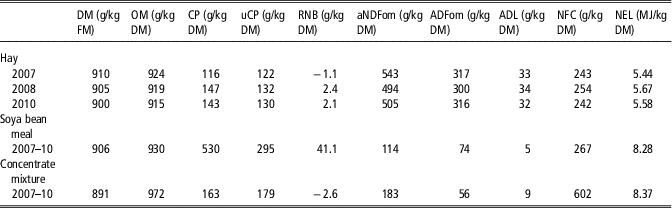
The dairy cows were kept in a stanchion barn at AREC Raumberg-Gumpenstein and fed twice daily at 0530 and 1630h. The experimental diet consisted of 75.0% WCMS of the respective variety, 8.5% hay (second cut of permanent grassland), and 16.5% soya bean meal on a DM basis. The components of the diet were offered separately. The amount of feed offered per cow and day was 5% higher than the average daily feed intake of the respective cow in the previous week to ensure ad libitum conditions for feed intake. In addition, a mineral mixture, salt and calcium carbonate were fed to meet the cows’ requirements. Cows producing more than 26 kg milk per day additionally received 0.39 kg concentrate mixture per kg of additional milk production, which consisted of 83.5% barley and 16.5% soya bean meal. The nutrient composition of hay, soya bean meal and the concentrate mixture is presented in Table 1.
Nutrient composition of hay, soya bean meal and concentrate mixture1 used in the feed intake trial with dairy cows

DM = dry matter; OM = organic matter; uCP = utilisable CP; RNB = ruminal nitrogen balance; aNDFom = NDF assayed with heat stable amylase and expressed exclusive of residual ash; ADFom = ADF expressed exclusive of residual ash; NFC = non-fibre carbohydrates; NEL = net energy for lactation; FM = fresh matter.
1 Concentrate mixture for cows producing more than 26 kg milk/day (83.5% barley and 16.5% soya bean meal).
Amounts of offered feeds and feed residues were determined twice daily and DM concentrations of both were determined daily for maize silage and weekly for hay and concentrates. Daily dry matter intake (DMI) was calculated by subtracting the amount of feed residue from the amount of feed offered. For nutrient analyses, feed samples were taken every day and two pooled samples of WCMS as well as one pooled sample of hay and concentrates were analysed from each feeding period. Dairy cows were milked twice daily at 0500 and 1600h. Daily milk yield was recorded and fat, protein, lactose and urea concentration of the milk was analysed daily by Milkoscan (Foss Electric, Hillerød, Denmark) using pooled samples of morning and evening milk. In addition, the cows’ BW was recorded weekly.
Statistical analysis
Statistical analyses were carried out using the statistical package SAS 9.4 (SAS Institute Inc., Cary, NC, USA). Nutrient composition, ruminal degradability and whole tract digestibility were analysed using the GLM Z ij = μ+V i + Y j + ε ij, where Z represented the observed value, V i the fixed effect of variety i (i = Nuestro, NK Falkone, … , Friedrixx) and Y j the fixed effect of year j (j = 2007, 2008, 2010). The interaction V×Y ij was not used in the analysis of these parameters due to a lack of significance (P<0.05).
Before statistical analysis, feed intake and milk production parameters were averaged within the 3 sampling weeks of each feeding period. Afterwards, feed intake and milk production parameters were analysed with procedure MIXED using the same model as described above. In addition, BW, overall feed intake and energy-corrected milk production (ECM) of the cows in the week before the adaptation period were used as co-variates. Cow within year was used as RANDOM effect, and the variance components covariance structure was chosen based on the Akaike information criterion (AIC). Experimental week within feeding period was used as repeated factor and cow within variety was chosen as subject in the REPEATED statement. Furthermore, the autoregressive covariance structure was used based on the AIC.
Multiple comparisons of least squares means were carried out using the Tukey test. Differences between varieties and years were considered significant if statistical analysis resulted in P-values <0.05, and differences were considered tendential if P-values were between 0.05 and 0.10. Pearson correlation coefficients between parameters were calculated using procedure CORR.
Results
Feed value of whole crop maize silage
Nutrient composition
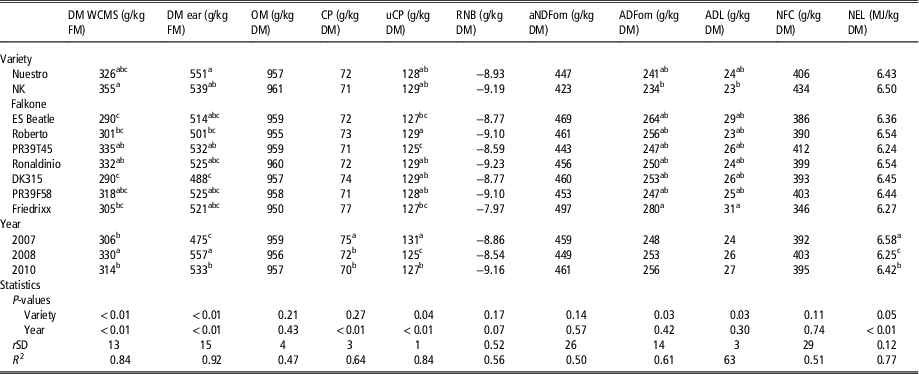
Although all varieties were harvested at the same physiological stage of maturity, DM concentration of WCMS differed between varieties and years (Table 2). Variety did not influence OM, CP, aNDFom and NFC concentration, or RNB of WCMS. However, variety had a significant impact on ADFom, ADL and uCP concentration as well as a tendential effect on NEL concentration (P = 0.05). Roberto and Ronaldinio had the highest and PR39T45 the lowest NEL concentration. Harvest year affected CP, uCP and NEL concentration of WCMS.
Effect of variety and year on dry matter (DM) content of whole crop maize silage (WCMS) and ensiled ear as well as on nutrient composition of WCMS fed to dairy cows and wethers

OM = organic matter; uCP = utilisable CP; RNB = ruminal nitrogen balance; aNDFom = NDF assayed with heat stable amylase and expressed exclusive of residual ash; ADFom = ADF expressed exclusive of residual ash; NFC = non-fibre carbohydrates; NEL = net energy for lactation; FM = fresh matter.
a,b,cValues within a column with different superscripts differ significantly at P < 0.05.
Ruminal degradability
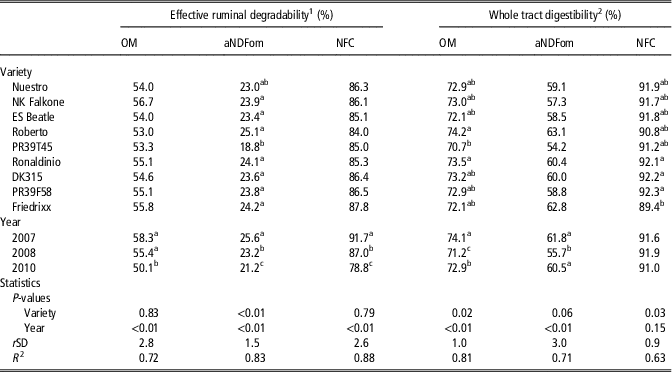
Effective ruminal OM and NFC degradability at a passage rate of 5%/h did not differ between varieties (Table 3). However, variety had an influence on effective ruminal aNDFom degradability. PR39T45 had the lowest effective aNDFom degradability, which differed from all other varieties, except for Nuestro. Effective OM, NFC and aNDFom degradability differed significantly between years.
Effect of variety and year on effective ruminal degradability (tested with rumen-fistulated steers) and whole tract digestibility (tested with wethers) of whole crop maize silage

OM = organic matter; aNDFom = NDF assayed with heat stable amylase and expressed exclusive of residual ash; NFC = non-fibre carbohydrates.
a,b,cValues within a column with different superscripts differ significantly at P < 0.05.
1 Effective ruminal degradability was estimated for a passage rate of 5%/h using the equation first published by Ørskov and McDonald (Reference Ørskov and McDonald1979) and revised by Südekum (Reference Südekum2005).
2 Data on whole tract digestibility was first published in Gruber et al. (Reference Gruber, Terler and Knaus2018).
Whole tract digestibility
Variety had a significant influence on whole tract digestibility of OM and NFC, and a tendential effect on whole tract digestibility of aNDFom (P = 0.06, Table 3). Roberto had the highest and PR39T45 the lowest OM and aNDFom digestibility. The lowest NFC digestibility was found for Friedrixx, which differed significantly from that of Ronaldinio, DK315 and PR39F58. Whole tract digestibility of OM and aNDFom was affected, while NFC digestibility was not significantly influenced by harvest year.
Feed intake and milk production
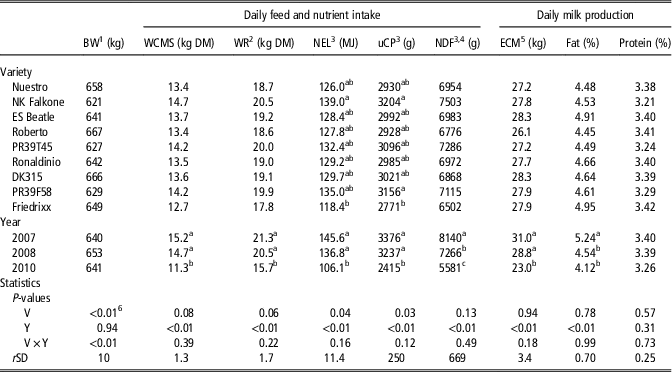
Maize silage intake (P = 0.08) and overall feed intake (P = 0.06) differed tendentially between varieties (Table 4). In both parameters, NK Falkone had the highest values, differing by 2.0 kg (WCMS) and 2.7 kg (overall) from the variety with the lowest feed intake (Friedrixx). Variety had a significant impact on NEL and uCP intake of dairy cows, while aNDFom intake was not affected by variety. The low intake from the ration containing Friedrixx resulted in the lowest NEL and uCP intake, which differed significantly from NK Falkone and from PR39F58 (only in the case of uCP intake). In contrast, ECM as well as the fat and protein concentration of the milk were not influenced by variety. All feed intake parameters, ECM and fat concentration of milk were affected by harvest year.
Effect of maize variety and year of harvest on dry matter (DM), net energy for lactation (NEL), utilisable CP (uCP) and NDF intake, daily milk production of dairy cows and milk composition

WCMS = whole crop maize silage; WR = whole ration; ECM = energy-corrected milk production; V = Variety; Y = Year.
a,b,cValues within a column with different superscripts differ significantly at P < 0.05.
1 Average BW over the feeding period.
2 Whole ration consisted of 75.0% WCMS, 8.5% hay and 16.5% soya bean meal (DM basis).
3 NEL, uCP and NDF intake from whole ration.
4 NDF assayed with heat stable amylase and expressed exclusive of residual ash (aNDFom).
5 ECM was calculated with following equation: ECM [kg] = Milk [kg]×((0.38×fat [%] + 0.21×protein [%] + 0.95)/3.2).
6 Tukey test did not show significant differences between varieties, unlike GLM.
Correlations
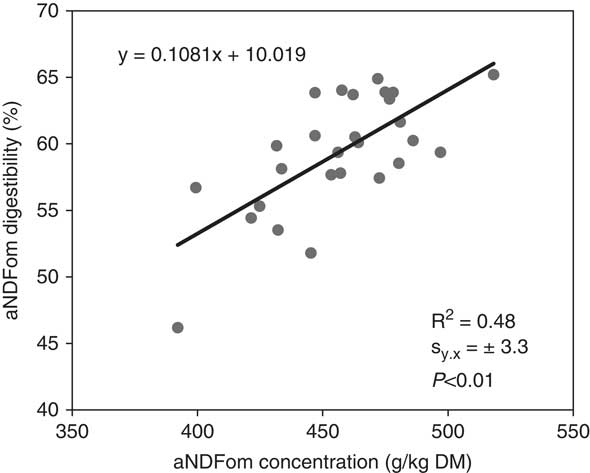
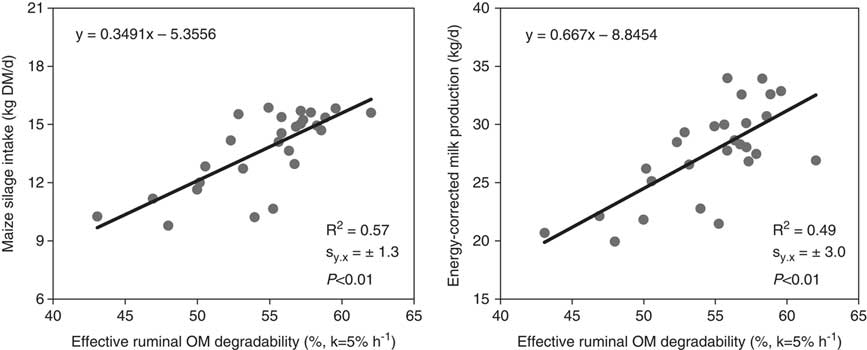
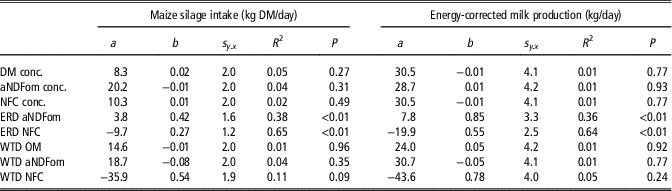
The whole tract aNDFom digestibility was positively correlated to aNDFom concentration of WCMS (Figure 1). The aNDFom digestibility rose by 1.08% units as aNDFom concentration of WCMS increased by 10 g/kg DM. The rising aNDFom digestibility also led to an increase in OM digestibility of WCMS (R 2 = 0.58, P < 0.01, data not shown). Ruminal OM degradability of WCMS showed a significant correlation to feed intake and milk production (Figure 2). Maize silage DMI rose by 0.35 kg/day, and ECM production rose by 0.67 kg/day as effective ruminal OM degradability of WCMS increased by 1 percentage point. Effective ruminal aNDFom and NFC degradability were also significantly correlated to WCMS intake and ECM (Table 5). In contrast, DM, aNDFom and NFC concentration as well as whole tract digestibility of OM, aNDFom and NFC were not correlated to WCMS intake and ECM.
Correlation between concentration and whole tract digestibility of aNDFom (tested with wethers) of whole crop maize silage. aNDFom = NDF assayed with heat stable amylase and expressed exclusive of residual ash; DM = dry matter.

Correlation between effective ruminal organic matter (OM) degradability of whole crop maize silage (WCMS) and WCMS intake (left figure) as well as milk production (right figure) of dairy cows (k = passage rate). DM = dry matter.

Relationship between parameters of nutrient composition, effective ruminal degradability and whole tract digestibility of whole crop maize silage (independent variables) and maize silage intake as well as energy-corrected milk production of dairy cows (dependent variables)

a = intercept of linear regression; b = regression coefficient of linear regression; DM = dry matter; conc. = concentration; aNDFom = NDF assayed with heat stable amylase and expressed exclusive of residual ash; NFC = non-fibre carbohydrates; ERD = effective ruminal degradability at a passage rate of 5%/h; WTD = whole tract digestibility; OM = organic matter.
Discussion
In this study, variety did not influence the concentration of CP, aNDFom or NFC in WCMS, while ADFom and ADL concentration, whole tract digestibility of OM and NFC, and ruminal aNDFom degradability were significantly affected by variety. As NEL and uCP concentration depend on ruminal degradability and whole tract digestibility (GfE, 2001), these parameters also differed significantly (uCP) or tendentially (NEL) between varieties. The values for OM digestibility as well as NEL and uCP concentration in this study are in accordance with the feed value tables by DLG (1997), which are currently used in Germany and Austria.
In other studies, in vitro degradability of DM (Kuehn et al., Reference Kuehn, Linn, Johnson, Jung and Endres1999; Nennich et al., Reference Nennich, Linn, Johnson, Endres and Jung2003) and whole tract digestibility of NDF (Ferraretto and Shaver, Reference Ferraretto and Shaver2015) were also affected by variety, although the varieties had a similar NDF concentration. However, like in the current experiment, varieties differed significantly in ADL concentration in the study by Ferraretto and Shaver (Reference Ferraretto and Shaver2015). These results show that the composition and digestibility of NDF has a greater impact on the feed value of WCMS than the NDF concentration. In contrast, NDF and ADF concentration as well as effective NDF degradability were significantly affected by variety in the study by Peyrat et al. (Reference Peyrat, Nozière, Le Morvan, Férard, Protin and Baumont2014).
Oba and Allen (Reference Oba and Allen1999) found a 9.7% unit higher in vitro NDF degradability for a bm3 as compared to a conventional hybrid after a 30 h incubation period. However, whole tract NDF digestibility only differed by 2.2% units between those varieties. They concluded that at a certain incubation period, ruminal degradability may lead to inaccurate results due to varying degradation rates of the different varieties. Thus, both ruminal degradability and whole tract digestibility should be determined to obtain exact information on the value of certain feeds.
Ali et al. (Reference Ali, van Duinkerken, Cone, Klop, Blok, Spek, Bruinenberg and Hendriks2014) showed that effective ruminal aNDFom degradability is positively affected by aNDFom concentration and negatively affected by ADFom concentration. However, in their study, a rising aNDFom concentration decreased effective DM and OM degradability. Ferret et al. (Reference Ferret, Gasa, Plaixats, Casañas, Bosch and Nuez1997) found similar results in a trial with sheep, in which the degradation rate of DM and apparent NDF digestibility were positively correlated, while apparent OM digestibility was negatively correlated to NDF concentration of WCMS. In a comparison of four types of maize varieties, Ferraretto and Shaver (Reference Ferraretto and Shaver2015) reported that the maize types with the highest whole tract NDF digestibility also had the lowest whole tract starch digestibility. Thus, whole tract digestibility of DM and OM was not affected by maize type in their experiment. However, in the current study the correlation between whole tract NDF and starch digestibility could not be analysed as starch concentration and starch digestibility were not tested.
The studies by Ferret et al. (Reference Ferret, Gasa, Plaixats, Casañas, Bosch and Nuez1997) and Ali et al. (Reference Ali, van Duinkerken, Cone, Klop, Blok, Spek, Bruinenberg and Hendriks2014) are in agreement with the results of the current study with regard to the correlation between aNDFom concentration and whole tract aNDFom digestibility. However, in the current trial, whole tract aNDFom digestibility was also positively correlated to whole tract OM digestibility. Kuehn et al. (Reference Kuehn, Linn, Johnson, Jung and Endres1999) and Thomas et al. (Reference Thomas, Mandebvu, Ballard, Sniffen, Carter and Beck2001) also found a higher in vitro DM degradability for leafy and fibre-rich varieties as compared to grain types. There are therefore contradictory results regarding the effect of aNDFom concentration on ruminal degradability and whole tract digestibility of DM and OM, meaning that further research is needed to clarify the effect of increased aNDFom concentration on ruminal degradability and whole tract digestibility of WCMS.
Due to declining aNDFom concentration with progressing maturity (Peyrat et al., Reference Peyrat, Nozière, Le Morvan, Férard, Protin and Baumont2014; Gruber et al., Reference Gruber, Terler and Knaus2018), higher ruminal aNDFom degradability and whole tract aNDFom digestibility may be expected at an early harvest date. However, Peyrat et al. (Reference Peyrat, Nozière, Le Morvan, Férard, Protin and Baumont2014) did not find an effect of stage of maturity on effective NDF degradability, and in the study by Gruber et al. (Reference Gruber, Terler and Knaus2018), effective ruminal aNDFom degradability decreased between the middle (366 g DM/kg FM) and late harvest date (412 g DM/kg FM), while remaining constant between the early (343 g DM/kg FM) and middle harvest date. These results indicate that ruminal aNDFom degradability decreases at higher DM concentrations in WCMS.
In this study, variety had a tendential impact on DMI and a significant influence on NEL and uCP intake of dairy cows. However, milk production was not affected by variety, which is in accordance with the findings of Nennich et al. (Reference Nennich, Linn, Johnson, Endres and Jung2003). Kuehn et al. (Reference Kuehn, Linn, Johnson, Jung and Endres1999) and De Boever et al. (Reference De Boever, Goossens, Peiren, Swanckaert, Ampe, Reheul, De Brabander, De Campeneere and Vandaele2017) also concluded that variety does not affect milk production parameters if the ration is balanced to meet the cows’ energy and protein requirements. The insignificant effect of variety on milk production despite the significant difference in DMI in the current study might be due to BW changes during the experimental period. However, due to the short period of the experiment, BW change was not evaluated to avoid a confounding effect with other influencing factors.
Other authors found significant differences in milk production between bm3 and conventional hybrids (Oba and Allen, Reference Oba and Allen1999; Ferraretto and Shaver, Reference Ferraretto and Shaver2015), as well as between a leafy and a dual-purpose variety (Thomas et al., Reference Thomas, Mandebvu, Ballard, Sniffen, Carter and Beck2001). Further studies have shown that DMI (Bal et al., Reference Bal, Shaver, Al-Jobeile, Coors and Lauer2000; Ferraretto and Shaver, Reference Ferraretto and Shaver2015) and milk production (Ferraretto and Shaver, Reference Ferraretto and Shaver2015) of cows can be increased by using WCMS from varieties with a high NDF concentration and high in vitro NDF digestibility. These results indicate that DMI of WCMS and milk production increase with rising NDF concentration. Thus, DMI and milk production may be highly correlated to the stover characteristics of different varieties.
Ivan et al. (Reference Ivan, Grant, Weakley and Beck2005) also compared varieties with different NDF concentrations and NDF digestibility levels and found a higher DMI and fat-corrected milk production for the variety with the highest NDF concentration and digestibility when WCMS was substituted on a DM basis. When the ration was balanced for NDF concentration in the Ivan et al. (Reference Ivan, Grant, Weakley and Beck2005) trial, DMI and milk yield were not affected by variety. However, feeding the variety with the higher digestibility led to a higher fat concentration in the milk and thus to a higher fat-corrected milk yield. This indicates that higher NDF digestibility may also have a positive influence on the fat concentration of milk due to a higher acetate to propionate ratio in the rumen (Ivan et al., Reference Ivan, Grant, Weakley and Beck2005). In contrast, in the current study, fat concentration of the milk was not affected by variety, despite significant differences in nutrient digestibility.
Effective ruminal degradability of OM, aNDFom and NFC was positively correlated to WCMS intake and ECM in this project. These results are in accordance with the findings of Oba and Allen (Reference Oba and Allen1999), Fernandez et al. (Reference Fernandez, Martin, Champion and Michalet-Doreau2004) and Ivan et al. (Reference Ivan, Grant, Weakley and Beck2005). However, Oba and Allen (Reference Oba and Allen1999) concluded that DMI and milk production depend more on the passage rate than on the degradation rate of the WCMS. The significant correlation between the effective degradability of WCMS and cows’ DMI might be also the main reason for the significant differences in DMI between years in the current experiment. In 2010, the effective degradability of WCMS was markedly lower than in both other years, resulting in significantly lower DMI and milk production. Oba and Allen (Reference Oba and Allen1999) and Ivan et al. (Reference Ivan, Grant, Weakley and Beck2005) also found that high yielding cows benefit more from a higher NDF digestibility than low yielding cows, which can be explained by these animals’ higher nutrient requirements and the resulting higher feed intake.
In earlier studies, effective ruminal DM (Peyrat et al., Reference Peyrat, Nozière, Le Morvan, Férard, Protin and Baumont2014) and OM degradability (Ali et al., Reference Ali, van Duinkerken, Cone, Klop, Blok, Spek, Bruinenberg and Hendriks2014; Gruber et al., Reference Gruber, Terler and Knaus2018) declined with increasing DM concentration of WCMS. Although this could lead to the conclusion that DMI declines with increasing DM concentration of WCMS, in previous experiments, DMI (Khan et al., Reference Khan, Yu, Ali, Cone and Hendriks2015) and milk production (Bal et al., Reference Bal, Coors and Shaver1997; Khan et al., Reference Khan, Yu, Ali, Cone and Hendriks2015) even rose till a DM concentration in WCMS of 330 to 350 g/kg before dropping again at a higher maturity stage. In contrast, Ettle and Schwarz (Reference Ettle and Schwarz2003) reported an increase of WCMS intake and total DMI as the DM concentration of the WCMS rose from 300 to 320 g/kg to 380 to 420 g/kg. In the current study, all WCMS were harvested at the same physiological stage of the maize plants. This might be the reason why DMI and ECM were not significantly affected by DM concentration of WCMS in this experiment.
Conclusions
Whole crop maize silage from various maize varieties differ in ruminal degradability and whole tract digestibility, while differences in nutrient composition are relatively low. Results of this and earlier studies indicate that whole tract aNDFom digestibility increases with rising aNDFom concentration of WCMS. Besides aNDFom digestibility, whole tract digestibility of OM and NFC as well as ruminal degradability of nutrients also have an impact on the feeding value of WCMS. An increasing ruminal degradability not only has a positive effect on nutrient digestibility, but also on cows’ feed intake and milk production. Production of WCMS should therefore focus on optimising ruminal degradability by choosing highly degradable varieties. However, the year of harvest might also influence effective ruminal degradability and thus the DMI and ECM of dairy cows.
Acknowledgements
The authors thank Franz Kastenhuber, the experts from the Austrian Chamber for Agriculture and the Austrian Agency for Health and Food Safety for technical and material support in this project and the Austrian Ministry for Sustainability and Tourism for funding the experiments. The authors are also grateful to the Central Institute for Meteorology and Geodynamics for providing weather data and to Kathleen Knaus for English language editing.
Ethics Statement
All animal experiments were carried out in accordance with the Austrian Animal Experiments Act and were approved by the office of the Styrian provincial government.
Declaration of interest
The authors declared no potential conflicts of interest.
Software and data repository resources
None of the data were deposited in an official repository.