1 Introduction
1.1 The issue
This article is concerned with the syntax of non-canonical Negative Inversion (henceforth NI). NI occurs in African American English (AAE) and in some non-canonical varieties of European American English, including what authors have labeled Alabama English (Feagin Reference Feagin1979), Appalachian English (Wolfram & Christian Reference Wolfram and Christian1976), Smoky Mountain English (Montgomery & Hall Reference Montgomery and Hall2004) and Ozark English (Christian Reference Christian1984). NI is typically characterized by a clause-initial negative auxiliary followed by a negative indefinite noun phrase or negative polarity item. NI receives a declarative reading, and prosodically, NI constructions co-occur with a falling intonation (Sells, Rickford, & Wasow Reference Sells, Rickford and Wasow1996).Footnote 2
(1) Can't nobody beat ’em.
‘There is nobody who can beat them.’ (African American English; Labov et al. Reference Labov, Cohen, Robins and Lewis1968)
(2) Can't a man in this place say he happy bout nothin’/a damn thing.
‘There isn't a man in this place who can say he's happy about anything.’ (Unspecified non-canonical English; Martin Reference Martin1992)
(3) Didn't nobody get hurt or nothin’.
‘There wasn't anybody who got hurt or anything.’ (Appalachian English; Wolfram & Christian Reference Wolfram and Christian1976)
(4) Didn't nobody live up there.
‘There wasn't anybody who lived up there.’ (Alabama English; Feagin Reference Feagin1979)
The non-canonical word order of NI has drawn the attention of researchers in dialectology, sociolinguistics and formal linguistics alike. The majority of discussions of NI have analyzed the word order as the result of auxiliary movement to a position in the left periphery, or as the result of expletive deletion in the there-insertion existential construction. I provide evidence that neither of these analyses is correct, and I advance a third analysis, namely that NI results from leftward movement of the negative indefinite NP.
1.2 Terminology
As the name implies, NI exhibits similarities with canonical negative inversion. Both NI and canonical negative inversion involve subject auxiliary inversion associated with clause-initial negation.
(5) With no job would Mary be happy. (Haegeman Reference Haegeman, Horn and Kato2000a: 21)
However, there are a number of differences. The first element of NI is always a negative auxiliary, whereas the first element in canonical negative inversion is always a fronted negative prepositional phrase (e.g. with no job), a negative adverb (e.g. never), or what has been called a ‘weak negative’ (e.g. rarely), followed by the inverted auxiliary or verb. NI also receives a negative concord reading; both negative elements are interpreted as if there were only one negative element. By contrast, canonical negative inversion tends to occur in varieties without negative concord. I discuss further differences between NI and canonical negative inversion in section 3, and I will show that these are two separate phenomena. Given previous authors’ use of the term ‘negative inversion’ to refer to examples (1) through (4), I continue to refer to this type of construction as NI, and I will refer to examples such as (6) as ‘canonical negative inversion’.
1.3 The facts
In varieties where we find NI, we also find non-inverted constructions with a negative indefinite subject in the canonical clause-initial position.
(6) Nothing don't come to a sleeper but a dream.
‘Nothing comes to a sleeper but a dream.’ (original gloss) (AAE; Green Reference Green2002a)
(7) None of em didn’ hit the house.
‘None of them hit the house.’ (Alabama English; Feagin Reference Feagin1979)
NI is directly linked to negation; we do not find positive counterparts.
(8) *Can somebody beat ’em.
‘There is somebody that can beat them.’
NI can occur in relative and embedded clauses:
(9) I know a way that can't nobody start a fight.
‘I know a way that there won't be anybody who can start a fight.’ (Labov et al. Reference Labov, Cohen, Robins and Lewis1968: ex. 370)
(10) They told me (that) didn't none of the children see anything. . .
‘They told me (that) there weren't any of the children who saw anything.’ (Green Reference Green2002b: 5)
Although we find what appears to be NI in embedded questions in AAE (example 11), AAE allows inversion in embedded questions in general, including in embedded positive questions (example 12). Thus, there is no clear way to determine whether embedded interrogative inversion and embedded interrogative NI are the same grammatical phenomenon.
(11) It's against the law – that's [why don't so many people do it.] (Labov et al. Reference Labov, Cohen, Robins and Lewis1968: ex. 376)
(12) I don't know [what's his name.] (Labov et al. Reference Labov, Cohen, Robins and Lewis1968: ex 417)
In some dialects that have NI, such as Alabama English, Appalachian English and Smoky Mountain English, we find constructions that are identical to NI save for a clause-initial expletive, as in examples (13) and (14).
(13) There wouldn’ nothin’ go down through there.
‘There wasn't anything that would go down through there.’ (Alabama English; Feagin Reference Feagin1979)
(14) They didn't none of us ever get snakebit, but their work animal did.
‘There wasn't any of us that ever got snakebitten, but their animal did.’ (Smoky Mountain English; Montgomery & Hall Reference Montgomery and Hall2004)
Note that in all of the dialects in which NI occurs, expletives include it, dey and they. Like NI, these constructions contain a negative auxiliary followed by a negative indefinite noun phrase. However, NI does not necessarily imply the availability of these types of constructions. Present-day AAE does not permit NI constructions that start with an expletive (Green Reference Green2002b; Weldon Reference Weldon1994). Note that example (15) is ungrammatical with the presence of the AAE expletives.
(15) *{It/Dey} didn't nobody see it.
‘There wasn't anybody who saw it.’ (AAE; Weldon Reference Weldon1994: 6)
Although present-day AAE does not permit a clause-initial expletive with NI, we do find such examples from earlier AAE.
(16) But they'd give me a note so there wouldn’ nobody interfere with me.
‘But they'd give me a note so there wasn't anyone who would interfere with me.’ (Bailey, Maynor & Cukor-Avila Reference Bailey, Maynor and Cukor-Avila1991)Footnote 3
AAE also allows NI in constructions with aspectual be (also known as habitual be), an aspectual marker that indicates an event occurs habitually or on an ongoing basis. The marker occurs to the right of the subject.
(17) Don't nobody beasp drinking tea.
‘It is usually the case that not a single person is drinking tea.’ (original gloss) (AAE; Green Reference Green2006)
Finally, I do not consider examples (18) or (19), in which the auxiliary is existential be, to be true NI.
(18) Ain't nothin’ happenin’. . .
‘There is nothing happening.’ (AAE: Labov et al. Reference Labov, Cohen, Robins and Lewis1968: ex. 350)
(19) Won't be no doctor in the office tonight.
‘There won't be any doctor in the office tonight.’ (Green Reference Green2001: 29)
These constructions are the equivalent of there-insertion existential constructions; the clause-initial auxiliary is the result of phonological deletion of the expletive or syntactically motivated expletive absence (see also Green Reference Green2001; Martin Reference Martin1992; Labov et al. Reference Labov, Cohen, Robins and Lewis1968; Sells, Rickford & Wasow 1994). These constructions differ from NI insofar as they permit expletives across all dialects, and they can occur within positive constructions provided that they have an expletive. Moreover, these types of constructions are available in any number of non-canonical varieties of English that do not allow NI, as well as colloquial fast speech canonical English, which does not allow NI. I will argue that true NI results from a separate syntactic operation from these existential constructions. However, I will also show that the two types of constructions are pragmatically linked.Footnote 4
This article is organized in the following way. In section 2, I sketch the theoretical framework that serves as the backdrop for this discussion, and outline the syntax of NI. In section 3, I point out drawbacks for prevailing analyses, and propose what a cogent analysis of NI needs to accomplish. In section 4, I advance an alternative view of NI. In section 5, I address cross-dialectal distinctions that are manifested in NI. In section 6, I discuss remaining issues and questions for NI. Section 7 provides a summary of this article.
2 Syntactic components of Negative Inversion
I discuss NI in generative terms, though it is possible to adapt this analysis to other frameworks without losing the basic generalizations. My primary aim is to show that NI patterns differently from either inversion/fronting constructions or existential constructions, and that an alternative analysis is syntactically and pragmatically motivated.
I adopt the following schematic representation of Present-Day English syntax:
(20) CP >IP >NegP >VP
The complementizer phrase (CP) is responsible for illocutionary force, associated with, for example, complementizers (e.g. that, if, whether), interrogative words (e.g., what), and topicalized and focused elements (Rizzi Reference Rizzi and Haegeman1997). The Inflectional Phrase (IP) hosts agreement, tense, mood and aspect, and is generally where auxiliaries and copula ‘be’ are located in a declarative derivation. The negation phrase (NegP) hosts negation, and in the case of sentential negation in English, NegP hosts not (Pollock Reference Pollock1989). The verb phrase (VP) is the source of predicative elements and thematic arguments. To illustrate the location of these elements, example (21) provides a tree diagram of a declarative sentence. (Note that elements in parentheses in all tree diagrams indicate an element's position prior to movement.)
(21) Mildred does not sing.

The verb is generated within the head of the VP and the thematic subject is merged in the specifier of VP. Observe that each layer has a specifier (abbreviated as Spec), which may act as a landing site for raised elements. The subject noun phrase (NP) has one of two options. Either it raises to the specifier of the IP, resulting in a subject verb word order (example 21), or it remains in the specifier of VP. In the latter case an expletive, or dummy subject – so-called due to the fact that it has no thematic role – is merged in the position of the IP, resulting in an existential there-insertion construction (example 22).
(22) There is a horse outside.
English generally requires that the canonical subject position (i.e. the specifier of IP) be filled; this requirement, described by Chomsky (Reference Chomsky1982, Reference Chomsky1995), is known as the Extended Projection Principle (EPP). The standard view is that the subject specifies agreement morphology with the IP, where the information for tense and agreement is encoded. In those cases where the thematic subject does not move to the specifier of IP, an expletive merges to the spot in order to specify the agreement between the verb and the associated subject (i.e. the thematic subject). In discussions of languages that allow null subjects, it has been argued that no expletive is required in languages that have zero verbal morphology, precisely because there is no agreement morphology to specify (Jaeggli & Safir Reference Jaeggli and Safir1989; Speas Reference Speas1995). However, English has weak morphology, and therefore requires an expletive subject to specify agreement on the verb.
One possible analysis of NI constructions is that they are essentially existential there-insertion constructions, except, to quote Gertrude Stein's famous line, ‘There is no there there’, nor are any of the other expletive variants available (e.g. it, dey, they). Example (23) illustrates what this analysis would look like.
(23) Can't nobody hurt me.
This approach is adopted by, for example, Martin (Reference Martin1992), Parrott (Reference Parrott, Antrim, Goodall, Schulte-Nafeh and Samiian2000) and Sells et al. (Reference Sells, Rickford and Wasow1996), among others. According to Martin's phonotactic explanation, expletive deletion results from prosodic constraints on stress and negation. In negative constructions heavier stress is assigned to the negative auxiliary and to the following thematic subject in the specifier of VP, which results in de-stressing the expletive subject to the point of deletion (Reference Martin1992: 65). Approaching the problem from a strictly syntactic angle, Sells et al. (1994) argue that NI is achieved via ranking of optimality theoretic constraints: a NegFirst constraint, which requires that negation c-command (i.e. precede) a negative indefinite NP, is ranked more highly than a FillSpec constraint, which requires that the specifier of IP be filled by the negative indefinite subject. In either case the negative auxiliary resides in IP, but because the subject remains in its base-generated position in the specifier of VP, the auxiliary precedes the subject, creating the illusion of inversion.
Another possibility is that NI patterns with English inversion constructions, such as question inversion. In the literature, inversion generally occurs when some element raises to the left periphery in the CP and triggers inversion of the subject and auxiliary (e.g. Culicover Reference Culicover1993). As mentioned above, the CP encodes and hosts elements associated with illocutionary force, topic and focus, which Rizzi (Reference Rizzi and Haegeman1997) argues are represented within a layered CP: ForceP > TopicP > FocusP (each of which I represent in diagrams only when relevant). In wh-questions, the wh-word moves to the specifier of the Force Phrase in the CP and triggers inversion of the subject and auxiliary, so that the auxiliary raises to the head of the Force Phrase. Example (24) illustrates the derivation of a wh-question.
(24) What could I do?
The syntactic motivation for inversion is that the auxiliary carries a question feature that must check with the question feature on the wh-word in a specifier–head relationship. Discussed in various terms in the literature, this requirement is defined by Rizzi (Reference Rizzi and Haegeman1997) as the Wh-Criterion, requiring that the question elements be in a specifier–head relationship (i.e. two elements occupy the head and specifier of a single phrase).
Other types of criteria are posited for other types of inversion. For example, Haegeman (Reference Haegeman2000b) proposes a similar syntax for canonical English negative inversion.
(25) With no job would Mary be happy. (Haegeman Reference Haegeman, Horn and Kato2000a: 21)
She argues that the negative element – in this case, with no job – raises to the specifier of a focus phrase within the CP as a type of negative focus, which triggers inversion of the auxiliary. According to Haegeman, the auxiliary carries a negative feature and raises to the head of the focus phrase to be in a specifier – head relationship with the negative prepositional phrase as an instantiation of the Neg-Criterion (Haegeman & Zanuttini Reference Haegeman and Zanuttini1991, Reference Haegeman, Zanuttini, Belletti and Rizzi1996), stated here as (26):
(26) The Neg-Criterion
(a) Each Neg X head must be in a Specifier–head relation with a Negative operator;
(b) Each Negative operator must be in a Specifier–head relation with a Neg X head.
Under this view, the negative prepositional phrase raises to the specifier of a Focus Projection in the CP, and the auxiliary is in the head of the Focus Projection. Movement of the negative element to a Focus phrase accounts for the stylistically marked word order, and the Neg-Criterion's involvement accounts for the direct link to negation.
In step with these inversion analyses, it is possible that NI results from auxiliary raising. Under this view, the thematic subject raises from the specifier of the VP to the specifier of the IP, and the auxiliary raises to the head of the FocusP within the CP (after not has cliticized to the auxiliary as n't). A negative feature on the auxiliary checks with a negative feature on a null operator in the specifier of the FocusP. I-to-C movement alone accounts for NI word order.
(27) Can't nobody hurt me.
This is the approach adopted by Green (Reference Green2006, Reference Green2002b). She argues that the auxiliary movement is a type of negative focus (Reference Green2002b: 26), as indicated by her gloss of example (28) in which nobody is glossed as ‘not a single person’ (italics mine).
(28) Don't nobody want tea.
‘Not a single person wants tea.’ (original gloss)
Paralleling Haegeman's analysis of canonical negative inversion, Green argues that the negative auxiliary hosts a negative focus feature and raises to the head of the Focus Phrase. The specifier of the Focus Phrase hosts a negative focus feature, such that the two features are in a specifier–head relationship, as an instantiation of a special type of Neg-Criterion. One difference is that in canonical negative inversion, such as example (26), an overt negative element is in the specifier of the Focus Phrases, whereas the element in NI must be covert.
This analysis captures Labov et al.'s (Reference Labov, Cohen, Robins and Lewis1968) suggestion that NI is used for emphasis and affect: ‘This is an optional process which gives additional prominence to the negative, and takes different forms in different dialects. It has a strongly affective character wherever it occurs’ (288).
3 Discussion
In this section, I evaluate the two analyses just described, and argue that neither analysis adequately captures the facts of NI.
3.1 Strengths of an inversion analysis
A strength of the inversion analysis is that it accounts for the ban on expletive subjects with NI constructions in present-day AAE.
(29) *{It/Dey} didn't nobody see it.
‘There wasn't anybody who saw it.’ (Weldon Reference Weldon1994: 6)
The auxiliary is in the head of the CP, while the subject is to the right in the specifier of IP. Because the negative indefinite NP is in the specifier of the IP, there is no landing site for an expletive subject. This rules out NI with an expletive.
Existential analyses do not predict the ungrammaticality of an expletive with NI in AAE. Sells et al. (Reference Sells, Rickford and Wasow1996) consider NI and subject-less negative existential constructions such as Ain't nothin’ happenin’ to be one and the same. In order to account for the instances in which an expletive does appear in the latter (example 30), they argue that a FillSpec constraint (which dictates that a subject fill the specifier of IP) is more highly ranked than a NegFirst constraint (which dictates that the negative auxiliary precede the negative indefinite NP). However, this ordering of constraints would also generate the ungrammatical example (30).
(30) It ain't nothin’ happenin’.
‘There isn't anything happening.’
We also find evidence that the ban on expletives is not prosodic (contra Martin Reference Martin1992), based on the ungrammaticality of expletives in embedded NI in AAE. If expletive deletion were a phonotactic phenomenon associated with the left periphery, then an embedded NI clause with an expletive should be able to survive the deletion. Yet, as the following example demonstrates, an expletive in an embedded clause is still ungrammatical in AAE.
(31) They told me that *{it/dey} didn't none of the children see anything. . .
‘They told me that there weren't any of the children who saw anything. . .’
A second strength of the auxiliary inversion analysis over the existential analysis is that it explains why some dialects permit negative existential constructions without an expletive, such as example (18), but do not permit NI constructions such as example (1) (repeated here as (32) and (33), respectively).
(32) Ain't nothin’ happenin’.
‘There is nothing happening.’
(33) Can't nobody beat ’em.
‘There's nobody who can beat them.’
An existential analysis equates these two constructions; both result from expletive deletion. Yet far more dialects allow the first example than the second; a single operation would predict that the first would entail the second. A subject auxiliary analysis neatly separates the two structures as products of separate operations; only a restricted set of dialects have the NI operation available to them.
A third strength of the inversion analysis is that it accounts for the word order of the negative indefinite noun phrase with relation to habitual be in AAE. As noted in section 1, habitual be is an AAE aspect marker denoting that an event or state is habitual. Green (Reference Green, Bailey, Baugh, Mufwene and Rickford1998) demonstrates that the marker is located in an aspectual phrasal projection between the IP and NegP projections to the left, and the VP projection to the right. According to Green (Reference Green2006), if the subject precedes aspectual be, then the subject cannot be in the VP specifier.
(34) Don't nobody beasp drinking tea.
‘It is usually the case that not a single person is drinking tea.’ (original gloss) (Green Reference Green2006)
3.2 Strengths of an existential analysis
An existential analysis has its own advantages. Although the inversion analysis explains the ban on expletives with NI constructions in present-day AAE, it cannot include as NI those constructions that are identical to NI but are preceded by an expletive, such as the examples from Alabama English, Smoky Mountain English and earlier AAE, repeated here.
(35) There wouldn’ nothin’ go down through there.
‘There wasn't anything that would go down through there.’ (Alabama English; Feagin Reference Feagin1979)
An existential analysis predicts that expletives should be allowed to co-occur with NI, given the empty canonical subject position in the specifier of IP. In contrast, an inversion analysis precludes the possibility of an expletive, given that the negative indefinite NP is in the specifier of IP. Of course, it would be possible to posit that NI in present-day AAE is the result of inversion, and so does not allow expletives because the specifier of IP is filled with the thematic subject, and that NI in Alabama English, Smoky Mountain English and earlier AAE results from expletive deletion in an existential construction, so that expletives are allowed. However, two analyses seem undesirable for a phenomenon that is in most ways similar and is restricted to a group of geographically neighboring dialects (or historically geographically related in the case of northern cities AAE). If no dialect-internal generalizations are lost, a better solution is a single analysis that can also account for dialectal idiosyncrasies.
A second strength of the existential analysis is that it accounts for the occurrence of embedded NI despite the debatability of a focus reading. As noted previously, the complementizer that resides in the head of the CP.
(36) I know a way that can't nobody start a fight.
‘I know a way that there won't be anybody who can start a fight.’ (Labov et al. Reference Labov, Cohen, Robins and Lewis1968: ex. 370)
Under an existential account, the word order is straightforward. The auxiliary, in the head of IP, follows the complementizer. Under an inversion analysis, in which NI patterns with canonical negative inversion, the auxiliary would raise to the head of an embedded Focus Phrase. Such a derivation is no problem in and of itself given a layered CP (as discussed in section 2), but it is not clear that such movement is motivated by a focus reading for NI. Green (Reference Green2002a: 80) notes that several factors may determine how emphatic negation in a clause really is (e.g. intonation), and that a non-inverted clause can be as emphatically negative as an NI construction. Elsewhere, she notes: ‘speakers do not always detect a difference between the NI and non-inverted constructions’ (Reference Green2002b: 14).
This observation is borne out empirically. Sells et al. (1994) note that in their corpus of AAE, NI actually occurs with greater frequency than non-inverted forms. This word order preference for NI suggests that, at least for the speakers in Sells et al.'s source corpus, NI is no more stylistically marked than non-inverted forms (see section 4 for further discussion on the quantitative split). Without a focus meaning difference, there is no reason to suppose that the negative auxiliary moves to a focus projection in the left periphery. Furthermore, even if NI received a focus reading, subject–auxiliary inversion without a fronted element is a typologically marked means of focus. As Haiman (Reference Haiman2002: 585) notes, in focus inversion constructions, the verb demarcates the fronted focused element from the pre-suppositional information following the verb, but there are very few languages that allow the verb itself to be the focused element. Therefore, the non-inverted structure, in which the negative indefinite NP precedes the auxiliary, is actually a structurally better candidate for negative focus than NI.
The final supporting argument for an existential analysis over an inversion analysis is the presence of the Definiteness Effect (Milsark Reference Milsark1974), which is associated with there-insertion existential constructions. The Definiteness Effect is the observation that definite NPs are infelicitous in existential constructions.
(37) !There is the fly in my soup.
As Martin (Reference Martin1992: 65) points out, the Definiteness Effect also holds for NI construction.
(38) *Can't those six boys who went to the store buy nothin’.
‘*There aren't those six boys who went to the store to buy anything.’
(39) *Don't John believe a word that man say.
‘*There isn't John who believes a word that man says.’
An existential analysis explains why the Definiteness Effect obtains in both there-insertion and NI constructions.
3.3 Summary
We have seen that both analyses encounter problems. Before advancing a third alternative, let us summarize what any theory of NI should accomplish.
First, an analysis should account for the relationship between negation and inversion, and explain why affirmative inversion is ungrammatical:
(40) *Can somebody beat us.
‘There is somebody who can beat us.’
Second, an analysis should account for the Definiteness Effect:
(41) *Can't those six boys who went to the store buy nothin’.
‘*There aren't those six boys who went to the store to buy anything.’
What is it about NI that conflicts with definite NPs? Non-inverted constructions do not show any such bar, as the non-inverted counterpart of (41) illustrates.
(42) Those six boys who went to the store can't buy nothin’.
Third, an analysis that seeks to account for NI across dialects and diachronically should explain expletive asymmetries.
- (43)
(a) They didn’ nothin’ go right.
‘There wasn't anything that went right.’ (Alabama English; Feagin Reference Feagin1979)
(b) *{It/Dey} didn't nobody see it.
‘There wasn't anybody who saw it.’ (AAE; Weldon Reference Weldon1994: 6)
Fourth and finally, an analysis should account for the word order of NI with habitual be.
(44) Don't nobody beasp drinking tea.
‘It is usually the case that not a single person is drinking tea.’ (Green Reference Green2006)
If the negative indefinite subject isn't in the specifier of IP to the left of habitual be, where else it? In the following section I propose an alternative analysis to the NI puzzle.
4 Negative Inversion reconsidered
4.1 Syntactic alternation between NI and non-inversion
I suggest that the negative auxiliary does not move to the head of CP, as argued by inversion analyses; it remains in the head of the IP. Neither does the negative indefinite subject remain in the specifier of VP, as argued in existential analyses; rather, it raises out of the specifier of VP to the specifier of the Negative Phrase (i.e. NegP), which is assumed to occur in English between IP and VP (see section 2). This movement of the subject is an instantiation of the Neg-Criterion. Example (45) shows the derivation for NI constructions.
(45) Can't nobody tag you then.
‘There isn't anyone who can tag you then.’ (AAE; Labov et al. Reference Labov, Cohen, Robins and Lewis1968: ex. 366)
The negative indefinite subject raises to the specifier of NegP, in a specifier–head relationship with the trace of the Neg head, thereby satisfying the Neg-Criterion, which serves to ensure a negative concord reading.
As noted in section 1, NI constructions receive a negative concord reading, wherein multiple negative elements are interpreted as a single instance of sentential negation. Negative concord has been discussed at length in the formal literature on negation (cf. Deprez Reference Deprez and Forget1997; Herburger Reference Herburger2001; Giannakidou Reference Giannakidou2000) and on negation in non-canonical varieties of English (e.g. Labov Reference Labov1972). Under some accounts the negative features on multiple negative elements factor out once they are in a specifier–head relationship (Haegeman & Zanuttini Reference Haegeman and Zanuttini1991, Reference Haegeman, Zanuttini, Belletti and Rizzi1996), while others have posited a type of agreement between negative elements (Zeijlstra Reference Zeijlstra2004; Haegeman & Lohndal Reference Haegeman and Lohndal2010). Under these views a negative feature on the negative indefinite NP needs to check with the negative feature on the head of the NegP in order to receive a negative concord reading. According to Haegeman & Zanuttini (Reference Haegeman, Zanuttini, Belletti and Rizzi1996), this relation can occur at logical form (LF; i.e. the semantic interpretation which may or may not correspond structurally to the utterance) or at S-structure (the syntax as realized in production).
Negative elements in the specifier of NegP can be overt negative operators, such as English nobody and nothing, or they can be covert operators (i.e. phonologically null elements) co-indexed with a negative element elsewhere in the sentence. In the latter case, the idea is that the covert operator acts as a type of place-holder for an overt negative element. Similarly, the negative element in the head can be an overt negative element such as English not, or a covert negative element such as the trace of a moved head.
The variation between NI and non-inverted constructions illustrates the distinction between an overt and covert operator in the specifier of NegP.
(46) Can't nobody tag you then.
‘There isn't anyone who can tag you then.’ (AAE; Labov et al. Reference Labov, Cohen, Robins and Lewis1968: ex. 366)
(47) Nobody can't tag you then.
‘Nobody can tag you then.’
In example (46) the negative indefinite subject satisfies the Neg-Criterion at S-Structure through movement of the negative subject to the specifier of NegP. In the non-inverted construction the negative indefinite subject raises to the specifier of IP from the specifier of VP via the specifier of NegP, and the phonologically covert negative operator in the specifier of NegP checks the Neg-Criterion.Footnote 5 At LF the negative indefinite subject adjoins to the covert negative operator in order to achieve a negative concord reading.
Haegeman & Zanuttini (Reference Haegeman and Zanuttini1991, Reference Haegeman, Zanuttini, Belletti and Rizzi1996) propose this operation for West Flemish, where a negative indefinite undergoes movement to the specifier of the NegP to satisfy the Neg-Criterion.
(48)

Here, the negative operator, niemand ‘nobody’, is in a specifier–head relationship with the trace of the Neg head and a negative concord reading is achieved.
4.2 Difference in meanings associated with NI and non-inversion
Having provided a syntactic account for the alternation between (46) and (47), what factors constrain this variation? Is variation between the two operations entirely optional, and thus a true form of syntactic variation? The answer is no.
Sells et al. (Reference Sells, Rickford and Wasow1996) note that in their corpus of AAE, NI occurs with greater frequency than non-inverted forms. Yet, as noted in section 3.2, there is no clear reason to suppose an affective difference or negative difference. As mentioned previously, if the NI version were the marked form (i.e. marked by affective emphasis or negative focus), it would be curious that the speakers feature a greater majority of emphatic forms/affective forms than unmarked forms. I offer an alternative account of the variation, one that is facilitated by the Neg-Criterion, but pragmatically and semantically motivated by a preference for negative indefinite noun phrases to be positioned later in an utterance. This explanation will draw a clear distinction between NI and existential constructions.
The NI and non-inverted construction alternation parallels the alternation between there-insertion existential constructions and counterparts in which the thematic subject (or ‘associate subject’) is in the canonical pre-verbal position.
(49) There is a dragon in the courtyard.
(50) A dragon is in the courtyard.
Both NI constructions and there-insertion constructions give rise to an existential interpretation, whereas non-inverted constructions and canonical subject position constructions favor a generic interpretation.
Beaver, Francez & Levinson's (Reference Beaver, Francez and Levinson2005) analysis of there-insertion existential constructions sheds light on this asymmetry. The authors argue that the position of a subject relative to the verb is determined by its subject properties. They note that, cross-linguistically, existential interpretations correspond to non-canonical subject positions. In English, the canonical subject position is SV, whereas the non-canonical subject position is VS. The thrust of Beaver et al.'s argument is that the less canonical the subject, the less likely it is to occur in the canonical SV order. Following Silverstein (Reference Silverstein and Dixon1976) and Aissen (Reference Aissen1999), they define canonical subjects as having prominent thematic roles (e.g. a local person or agent), and conveying hearer-old information (Reference Beaver, Francez and Levinson2005: 5). In contrast, weak indefinites and newly introduced information make for canonically bad subjects and are poor candidates for a canonical subject position. Weak indefinites are therefore ideal for non-canonical positions – in the case of English, in the VS order.
Crucially, the word order alternation between SV and VS is preferential, not categorical. In a corpus analysis, the authors find that downward monotone NPs (e.g. nothing) – the weakest kind of indefinite – are the most likely candidates for the post-verbal existential position (Reference Beaver, Francez and Levinson2005: 15).
Tying the Beaver et al. analysis of existential constructions back to the present analysis of NI, we see that the Definiteness Effect found in both NI and there-insertion existential constructions is directly linked to an English preference to realize non-canonical subjects – such as negative indefinites – as VS. The greater occurrence of NI vs non-inverted constructions in Sells et al.'s corpus of AAE is likely due to the fact that the grammar allows for negative indefinites to move to the specifier of NegP, where they may stay put, felicitously, given the negative indefinite's weak candidacy as a canonical subject. The Neg-Criterion and non-canonical subject-hood of negative indefinite NPs work hand in glove to produce the auxiliary–subject word order of NI.
However, although the information structure in NI parallels existential constructions, it is important to note that the subjects do reside in different locations.Footnote 6 Sells et al. (Reference Sells, Rickford and Wasow1996) argue that NI and Ain't nothin’ happenin’ existential constructions should share a single derivation given their structural similarity and co-occurrence in AAE. Yet, as discussed in section 3.2, there are distributional differences between the two types of constructions that a single analysis does not capture.
4.3 Summary
Let us summarize the ways in which this analysis captures the facts of NI. It explicitly accounts for the relationship between negation and the non-canonical word order of NI, as well as the parallels between NI and existential constructions. However, maintaining distinct analyses for NI and negative existential constructions captures differences between the two types of constructions. NI is a separate syntactic mechanism from expletive reduction, deletion, or absence in existential constructions, thereby explaining why certain dialects permit expletive-less negative existential constructions, but do not permit NI; NI entails the merging of a negative indefinite NP into the specifier of NegP, whereas existential constructions, be they negative or positive, entail merging the subject no higher than the specifier of the VP.
The separate merge site of the NegP accounts for why we have cases of NI in AAE in which the negative indefinite precedes aspectual be. As noted in section 3.2, aspectual be is located in a projection between NegP and VP. In this example, the negative indefinite nobody must be in a VP-external position.
(51) Don't nobody beasp drinking tea.
‘It is usually the case that not a single person is drinking tea.’ (Green Reference Green2006)
This analysis also keeps NI separate from the stylistically marked canonical negative inversion, which is a type of focus construction, thereby accounting for Green's (Reference Green2002b: 14) observation that many AAE speakers do not perceive a difference in emphasis between NI constructions and their non-NI counterparts; there is no structural evidence of a negative focus feature in NI.
Cases of NI with expletives pose no problem for this analysis, as there is an open position in the specifier of IP. Although most varieties of English (canonical or otherwise) limit the occurrence of expletives to constructions with copular predicates (e.g. be, exist, came, appear), expletives do co-occur with non-copular auxiliaries cross-linguistically. In fact, several Germanic languages permit expletive non-copular auxiliaries. We find transitive expletive constructions in German (52), Dutch (53) and Icelandic (54).
(52)
(53)
(54)
Further, we find a direct link between negation and the co-occurrence of expletives and modal auxiliaries in earlier dialects of English. In Expletive Negative Constructions in Late Middle English, Ingham (Reference Ingham2000, Reference Ingham2003) analyzes examples of expletives that specifically co-occur with auxiliaries (e.g. shall and should) and negative indefinite subjects.Footnote 7Footnote 8
(55) Ther shal no thyng hurte hym.
‘Nothing shall hurt him.’
(56) Ther shold no process go agyenst Wilm Est. of Wycombe.
‘No legal action should be taken against W. of W.’ (Ingham Reference Ingham2003: 413)
Ingham (Reference Ingham2000) notes that these types of construction only occurred with negative NPs and that negative indefinite NPs had the option to reside in the specifier of NegP or in the usual SpecIP position. The following example (adapted from Ingham Reference Ingham2000: 293) illustrates the operation.
(57) Ther shal no thyng hurte hym.
According to Ingham, overt movement of a negated subject to the specifier of NegP was an operation available in Late Middle English to satisfy the Neg-Criterion. Here the subject bearing the negative feature raises to the specifier of a functional projection bearing a Neg feature, i.e. NegP. In Late Middle English a negated subject could either continue to raise to the SpecIP position, or it could raise only as far as the specifier of NegP while the expletive filled the SpecIP position.
Ingham also notes that existential be constructions co-occur with an overt expletive with both positive and negative subjects, but that these remain in the specifier of the VP. Evidence that the post-verbal negated subjects are in specifier of NegP, rather than the specifier of VP, come from examples of passive constructions and unaccusative verbs, in which no specifier for VP is projected:
(58) . . .that ther shall no defaute be founde in here.
‘. . .that there shall no default be found in here.’
(59) Ther shold no more com wyth hym but Hegon.
‘There should no more come with him but Hegon.’ (Ingham Reference Ingham2000: 28)
The only position between IP and VP is the specifier of NegP.
Expletive Negative Constructions in Late Middle English, negative concord construction in West Flemish and NI in non-canonical varieties of English all provide visible evidence of the Neg-Criterion. In order to fully capture the data for NI, we need to address the expletive asymmetries between present-day AAE, on the one hand, and Alabama, Appalachian, Smoky Mountain English and earlier AAE, on the other. In the next section I suggest a way of thinking about this loose end.
5 NI and expletive asymmetries
If, as I argue, the syntactic mechanism responsible for NI is uniform across all dialects, why are expletives grammatical with NI constructions in some dialects (e.g. Alabama English, Appalachian English, early AAE) but not grammatical in others (e.g. present-day AAE)? This question forces us to consider other differences between the dialects in question. Just as, for example, typologists have pursued correlations between word order and other phenomena in groups of languages (e.g. Dryer Reference Dryer1992; Greenberg Reference Greenberg and Greenberg1963), Henry (Reference Henry1995) and others have pointed out that differences between closely related dialects should force us to look for differences elsewhere. Barbiers (Reference Barbiers2009: 1608) notes that ‘small morphosyntactic differences such as the absence of an inflectional morpheme are expected to have effects on syntactic structure’. Indeed, I will argue that cross-dialectal differences between expletive distribution and NI are directly tied to inflectional morphological differences.
What marks NI as non-canonical is the rightward position of the subject. If, as I have argued, the negative auxiliary is in the head of I, and the subject is in the specifier of NegP, the EPP requirement predicts that an expletive subject is required (see section 2 for discussion). The cross-dialectal expletive asymmetry can be explained by looking at the relationship between subjects and verb agreement.
Let us consider subject requirements in present-day AAE, which does not allow expletives in NI. In contrast, expletives variably occur in AAE existential be constructions.
(60) (It) should be some candy in the dish.
‘There should be some candy in the dish.’ (Green Reference Green2001: 29)
As discussed in section 2, it is generally held that the role of expletives in English is to specify agreement on the verb; languages that have no verbal morphology do not require an expletive, as there is no morphology to be specified (Jaeggli & Safir Reference Jaeggli and Safir1989; Speas Reference Speas1995).
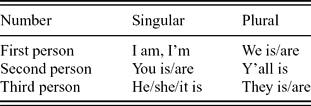
Agreement marking in AAE varies between being weak, as in canonical English, and being non-existent. In the case of copula be, there is always some degree of morphological distinction of the first person singular from the other inflectional markings, as illustrated in table 1.
Copula ‘be’ paradigm in present-day AAE (Labov et al. Reference Labov, Cohen, Robins and Lewis1968)
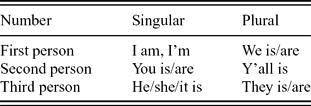
Otherwise, verbal marking on main verbs in AAE is arguably absent in the present tense. Although speakers of AAE may use -s marking for the third person singular, Green (Reference Green2002a) and Labov et al. (Reference Labov, Cohen, Robins and Lewis1968) describe the paradigm as being uniform. This discrepancy underscores the variability of certain forms in AAE, and the complexity of studying language in diglossia. A popular interpretation is that third person -s marking is an inflection used by speakers of a variety of AAE that lies on a point in the continuum closer to canonical English, whereas the AAE grammar that is more ‘vernacular’ lacks any overt marking on main verbs in the present tense (cf. Rickford & Rickford Reference Rickford and Rickford2000, inter alia).
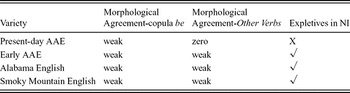
Working from the notion that main verbs in AAE exhibit zero marking in the verbal morphology for the present tense, we begin to make sense of the ban on expletives in NI. NI always involves modal auxiliaries with a main verb other than be as a complement. If the view that modal auxiliaries are raising verbs is correct (see, e.g., Wurmbrand Reference Wurmbrand, Bird, Carnie, Haugen and Norquest1999), and the main verb specifies agreement, then it is no surprise that no expletive is required to specify agreement, because there is no overt morphological marking to be specified. Therefore, NI constructions should not project a canonical subject position of expletive subjects. Crucially, Alabama, Smoky Mountain and Appalachian English – varieties in which expletives with NI have been documented – exhibit third-person singular -s agreement near categorically on the verb.Footnote 9 I suggest that the asymmetry in expletive distribution with NI in the different dialects is directly related to differences in agreement morphology. In AAE, lack of agreement morphology in all main verbs other than copula be prevents the projection of the canonical subject position for expletive subjects in NI constructions because no agreement morphology needs to be specified.Footnote 10 In Alabama and Appalachian English, on the other hand, verbal agreement is weak; therefore the canonical subject position is projected for expletive subjects. Variation between an overt expletive and a zero expletive in NI in dialects that allow expletives may be phonological, or the alternation may be syntactically motivated; further inquiry into this matter is beyond the scope of this article, but does not impinge upon the main argument.
Diachronic support for the idea that verbal morphology determines whether expletives are permitted in NI comes from earlier AAE. Above, I noted examples from earlier AAE that appeared to be NI constructions with an expletive.
(61) But they'd give me a note so there wouldn’ nobody interfere with me.
‘But they'd give me a note so there wasn't anyone who would interfere with me.’ (Bailey et al. Reference Bailey, Maynor and Cukor-Avila1991: 33)
Evidence from ex-slave narratives indicates that the verbal morphology of early AAE was richer than in present-day AAE. Schneider (Reference Schneider1989) reports that the -s ending for third-person singular present occurs in 67.6 percent of all cases where third-person singular verbs occur.Footnote 11 Likewise, Cukor-Avila (Reference Cukor-Avila, Nagle and Sanders2003) and Poplack & Tagliamonte (Reference Poplack and Tagliamonte1994) argue that the -s ending was much more frequent in earlier AAE than in contemporary varieties, suggesting that the -s was the predominant ending in early AAE. The correlation between the (un)grammaticality of expletives in NI constructions in early and present-day AAE with the shift in the verbal paradigm, combined with the correlation between the expletive asymmetry and morphology asymmetry in present-day AAE and the other varieties that allow NI, provides synchronic and diachronic support for this analysis of expletive distribution with NI.
Table 2 summarizes the occurrence of expletive subjects with respect to verbal morphology in present-day AAE, earlier AAE, and Alabama English and Smoky Mountain English.
Expletives and verbal morphology across dialects

6 Remaining issues and further questions
6.1 NI, expletives and aspectual be in African American English
A remaining issue for the current analysis of NI is the expletive asymmetry in AAE with respect to aspectual be. The following examples differ syntactically in two ways. An expletive is optional in the first example, but banned in the second. The negative indefinite follows aspectual be in the first example, but precedes it in the second example.
(62) (It) don't be nobody drinking tea.
‘Usually, there isn't anybody drinking tea.’ (original gloss)
(63) (*It) don't nobody be drinking tea.
‘Usually, not a single person is drinking tea.’(original gloss) (Green Reference Green2006: 4)
Green (Reference Green2002b) argues that the NP occupies the pre-verbal subject position in example (63), and therefore does not allow an expletive, whereas the NP in (62) is still within the VP.
I agree that the word order differences are due to the fact that example (62) is not true NI, but simply an existential construction in which the NP has remained in the VP, below aspectual be (recall Green's Reference Green, Bailey, Baugh, Mufwene and Rickford1998 argument that aspectual be resides in a position between NegP and VP). However, I argue that example (63) follows the operation I have laid out for other types of NI. The NP is in the specifier of NegP, and it therefore precedes aspectual be.
The second issue is why expletives are permitted in (62) but not (63) given that both constructions occur with aspectual be. I have argued that, in AAE, existential be constructions permit expletive subjects due to weak agreement, whereas NI constructions do not project a canonical subject position for expletives due to zero agreement for main verbs. Where does aspectual be fit? On the one hand, it can behave like the auxiliary be, as in (64):
(64) Bruce be running.
‘Bruce is usually running’ or ‘Bruce usually runs’ (original gloss) (Green Reference Green2002b: 48)
Alternatively, it can behave like copula be, as in (70):
(65) . . .her checks be big. . .
‘. . .her checks are usually big. . .’ (original gloss) (Green Reference Green2002b: 48)
However, in addition to adding a habitual meaning, it resides in its own projection and has zero agreement, like an auxiliary. Yet there is little research on whether there is an underlying auxiliary or copula be in separate projections in aspectual be constructions. For now, the present analysis does not provide an answer to the expletive asymmetry in aspectual be constructions, and leaves open the question of the interaction between aspectual be, expletive subject projections and possible underlying verbs.
6.2 The rarity of expletives with NI
Cases of NI with expletives are uncommon. Montgomery (p.c., 2006) notes that expletives in NI in Appalachian and Smoky Mountain English are ‘quite rare’. Examples with expletives provided by Feagin (Reference Feagin1979) are few relative to those without. In addition to the early AAE examples from ex-slave narratives, I found a handful of examples of NI with expletives in the literary dialogues of Charles Chesnutt, written at the turn of the last century.
(66) dey didn’ nobody hab ter stan’ over ’em. . .
(a) ‘there wasn't anybody who had to stand over them. . .’
(b) ‘theyi didn't, any of themi, have to stand over them. . .’ (Chesnutt & Sollors Reference Chesnutt and Sollors2002)
The dey is ambiguous between an expletive and an anaphoric pronoun linking to what would be a resumptive pronominal nobody. Examples such as these are limited by the fact that they are literary, but they are consistent with findings from ex-slave narratives. The rarity of expletives in all varieties is expected, given the progressive erosion of English verbal morphology combined with my argument that no position for an expletive is projected if there is no morphology for a subject to specify. The expletive occurrence in Ingham's Expletive Negative Constructions in Late Middle English is predicted based on the fact that verbal morphology in Late Middle English was richer than it is today, with a distinct form for singular first, second and third persons (-e, -es(t), -eth/-es, respectively), and plural (-e(n)). A question for historical linguistics is whether we would find a higher use of expletives in examples of NI that occurred at points in which the dialectal predecessors had a richer verbal morphology.
It might be tempting to posit that NI is historically related to Expletive Negative Constructions in Late Middle English. However, there is a 500-year gap between Ingham's data and the examples of NI cited in this article. There is also the question of why NI does not occur in varieties of English in the UK (nor anywhere else outside North America), if the historical origins were British. A historical relationship seems unlikely.
6.3 The relationship between NI and negative concord
Another issue for future research is a better understanding of the relationship between negative concord and NI. Henry, Maclaren, Wilson & Finlay (Reference Henry, MacLaren, Wilson and Finlay1997: 269) note that Belfast English, another variety of English with negative concord, does not have NI constructions, nor have I been able to find any other varieties outside North America that have NI. Smith (Reference Smith2002) notes that negative concord occurs in wider contexts in New World varieties of English than in Old World varieties, suggesting that the availability of NI correlates with a wider range of negative concord constructions. Whereas Labov (Reference Labov1972) works towards formalizing negative concord throughout non-canonical varieties of English, more detailed descriptions of differences among the systems of English negation and negative concord (e.g. Henry et al. Reference Henry, MacLaren, Wilson and Finlay1997) will help address this relationship.
7 Conclusion
I have offered an analysis of NI that posits that the non-canonical word order results from the interaction of pragmatic and syntactic constraints: a pragmatic inclination on the part of negative indefinite NPs to be in a non-canonical subject position coupled with the possibility for negative movement. I propose that NI is an example of negative movement of a negative operator to the specifier of a negative head. I have explained this movement in light of Haegeman & Zanuttini's (Reference Haegeman and Zanuttini1991, Reference Haegeman, Zanuttini, Belletti and Rizzi1996) Neg-Criterion and Beaver, Francez & Levinson's (Reference Beaver, Francez and Levinson2005) analysis of existential constructions and subjects. I have shown that although NI parallels there-insertion existential constructions, NI is unique.
This analysis also accounts for synchronic and diachronic differences in the distribution of expletives in NI. AAE's absent agreement in verbal morphology in NI constructions results in a ban on expletives, whereas weak morphology in other varieties allows for expletives. I have also suggested that weak morphology in earlier AAE allowed overt expletives in NI constructions, and that a ban on expletives in present-day AAE has developed because the verbal morphology has become almost uniformly absent for person and number.