1. Introduction
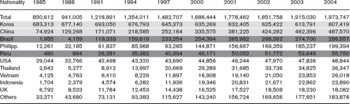
Japan maintains strict restrictions on immigration and prohibits unskilled immigrant labor. Japan's nationalist ‘ideology of common ethnic ancestry’Footnote 3 laid the foundation for the establishment of the 1990 Immigration Control and Refugee Recognition Act (heretofore 1990 Immigration Act) and teijusha (long-term residence) visa that allows second and third generation Nikkeijin (Japanese descendants) from Brazil, Peru, and around the world to legally emigrate, live, and work in Japan on the basis of their Japanese ‘blood descent’ or ethnicity.Footnote 4 Spouses and children are also able to stay for up to one year both with unlimited renewals enabling a mass transnational family immigration. As Brazil and Peru have two of the largest Nikkeijin communities in the world, most Latin American Nikkeijin (heretofore LAN) in Japan originate from those countries.Footnote 5 Although they were originally thought to be ‘dekasegis’ (temporary migrant laborers) in Japan, the realities of their increasing permanence have become evident over time.Footnote 6 Between 1985 and 2004, the number of registered Brazilians and Peruvians in Japan jumped from 2,475 to 342,307.Footnote 7 In 2004, the number of registered foreign nationalsFootnote 8 in Japan hit a new record high of 1,973,747 or 1.55% of Japan's total population of 127,687,000Footnote 9 (see Table 1).
Changes in the number of registered foreign nationals in Japan by nationality (place of origin)

Source: “2005 Immigration Control”, 11th Issue of the “Immigration Control Report”, Japan. Immigration Bureau. Ministry of Justice, “Section 2 – Foreign Nationals Residing in Japan,” From Table on pg. 30.
This paper discusses the political incorporationFootnote 10 of LAN from Brazil and Peru in Japan between 1990 and 2004. Shared ethnicity implies ‘full community membership’Footnote 11 that facilitates immigrant integration and political incorporation. Few Nikkeijin or other foreign residents and their descendants in Japan have political rights or citizenship.Footnote 12 Many LAN are second or third generation born in Latin America with little Japanese language ability or cultural familiarity.Footnote 13 LAN youth are sometimes negatively stigmatized in the media through an association with crime.Footnote 14 While many studies analyze the challenges of LAN social-cultural and labor incorporation in Japan,Footnote 15 few have adequately addressed their political incorporation within the context of Japan's liberal democracyFootnote 16 in the English language. In his analysis of the political incorporation of immigrant non-citizen guestworkers from Turkey, Algeria, and Morocco in Europe, MillerFootnote 17 found, prior to and after being extended political rights, non-citizen guestworkers in Europe engaged in ‘extra-electoral’ politics or political participation, not necessarily inclusive of electoral politics. This includes participation in homeland politics from immigrant organization in the host countries; consultative voice arrangements between immigrant organizations and host governments; active involvement in unions and factory councils, political, religious, and civic organizations; and extraparliamentary opposition or political movements that choose not to take part in electoral politics. LAN non-citizen workers in Japan are in a similar situation to the non-citizen guest workers in Europe, but one would assume easier social and political incorporation on the basis of their shared ethnicity that allowed them to legally emigrate to Japan. Considering long-held assumptions regarding Japanese homogeneity, one would assume that claims around Japanese ethnic affinity would easily precede the claims of the long-term resident Zainichi Koreans or Chinese.Footnote 18
When LAN are compared to older resident groups such as Zainichi Koreans, there is a marked distinction in terms of immigrant political incorporation. Naturalizations from the Zainichi Korean and Chinese minority communities to the Japanese nationality have traditionally been very limited due to the restrictive and assimilatory naturalization requirements. However, changes in law and attitudes have produced a noticeable increase in naturalizations from these communities. Zainichi Koreans have their own very politically powerful ethnic civil society organizations, such as Mindan (the pro South Korean Korean Residents Union) and Chongryun (the pro North Korean organization), dedicated to political advocacy. Mindan and Chongryun actively promote opposing positions on voting rights for foreigners with permanent residency. The pro-Taiwanese Overseas Chinese Association of Tokyo also is supportive of Mindan's efforts toward foreign suffrage. Zainichi Korean demands for participation and representation on the local level have been met with the establishment of fora, e.g. the Kawasaki Foreign Residents Assembly, now replicated in various localities. The first self-declared openly ethnically Korean member of the Japanese parliament as well as one of Taiwanese background was elected in 2004. Political parties such as New Komeito party, presumably interested in the electoral potential of Zainichi Koreans who comprise significant membership of their affiliated Buddhist organization Soka Gakai, have advocated for Zainichi Korean voting rights as permanent residents on the local level.
In contrast to Zainichi Korean and Chinese communities, LAN communities in Japan, despite the shared ethnicity that enables their legal residency in Japan via the teijusha visa, are not naturalizing at nearly the same rate and their political participation and representation is much more limited. My findings suggest many LAN socio-cultural organizations, e.g. Brazilian and Peruvian soccer clubs, but a dearth dedicated to political advocacy between the years 1990 and 2004. Unlike the Zainichi Korean or Chinese organizations dedicated to political advocacy, there is no unified or prominent LAN national organization other than Kaigai Nikkeijin Kyokai (Association of Japanese and Nikkei Abroad); sponsored by the Japanese government and founded in 1957 and recognized by the government with NPO special status in 1967, it is an international organization funded by the JICA (Japan International Cooperation Association) of the Japanese Ministry of Foreign Affairs, as well as municipalities and corporations, and is engaged in mostly cultural and educational activities. Covenio Kyokai, founded in 1989 by several Peruvian Nikkei organizations with the assistance of the Embassy Peru in Japan, also provides help to LAN communities through facilitating remittances to home countries as well as access to Latin American products and services. Both of these organizations provide some limited support, but, for the most part, are not dedicated to or engaged in political advocacy. My research indicates very limited LAN immigrant political incorporation at the national, local, and civil society levels in Japan, demonstrating that shared ethnicity does not necessarily facilitate immigrant political incorporation. The findings suggest there was no extension of citizenship or political rights to the Nikkeijin because the original intent of the 1990 Immigration Act was based on temporary stay rather than permanent residency. There is clearly a disconnect between central and local levels on immigration policy. Although there has been policy innovation towards more incorporation on the local level, i.e. Foreign Residents Assemblies, referenda, and ombudsmen, they have been piecemeal and inadequate. The 1990s electoral system reform to a mixed member system, combining proportional representation and single member districts, diminished some previous single party dominance of the Liberal Democratic Party (LDP) privilege and dominance and has produced a few more women and ethnic minorities in parliament but not one LAN descendant. It is noteable that these ethnic minority politicians were elected as part of the Democratic Party of Japan (DPJ). The politicians and policy makers I interviewed on the national and local levels expressed the sentiment that Zainichi Koreans and other long-term excluded groups be extended voting rights before the Nikkeijin. Most bills introduced for foreign suffrage have been aimed at permanent residents (Zainichi Koreans and Chinese) and not those on the teijusha visa (i.e., Nikkeijin). Although there is media coverage of groups and even political partiessuch as the New Komeito party advocating for voting rights for Zainichi Koreans and other permanent residents, one rarely sees media coverage or groups advocating for local voting rights specifically for Nikkeijin on the basis of their Japanese blood descent.
This paper addresses the following questions: Why does the Japanese government not extend political rights or full legal citizenship to Nikkeijin like the German, Italian, and other governments do for their overseas coethnics? As coethnicity is what provides the eligibility for the teijusha visa that makes Nikkeijin legal in Japan, what role does coethnicity play in both formal and informal political processes? What limits or facilitates the political incorporation of Nikkeijin coethnic immigrants from Latin America in Japan? I argue Japan's changing ethnic citizenship regime, characterized by a racially and ethnically determined jus sanguinis basis for citizenship, the conservative LDP's single party dominance of the political opportunity structure, and the ways in which Japan's civil society is structured that, up until recently, made it difficult to formally establish political advocacy organizations, combined with language difficulties, relative newness of residence, small size, low minority status, and a powerful myth of return among the LAN immigrant communities limit their political incorporation in Japan. This case tells us much about the relational and perspectival nature of the politics of ethnicity and nationality and the ways in which sentiment around them can be instrumentalized by both state and non-state actors. The paper will first focus on the study's methodology and then discuss Japanese nationalism and state policies of emigration and later immigration in historical national and international contexts. It will then address how Japan's changing ethnic citizenship regime, political opportunity structure and structure of its civil society along with the LAN Japanese language difficulties, newness of residence, small size, low minority status, and a powerful myth of return combine to limit LAN political incorporation between 1990 and 2004.
2. Methodology
My methodological approach is historical and empirical. I use quantitative demographic, naturalization, and other statistical data from local and national governments and qualitative data in the form of interviews and textual analysis of relevant government and community organizations, and NGOs (non-government organizations) to look at the political incorporation of first generation LAN immigrants in Japan between 1990 and 2004. In light of the fact most LAN lack formal citizenship or political rights, I looked for signs of both formal and extra-electoral participation. While naturalization statistics illustrate something about the incentives and level of inspiration to formal citizenship for immigrants, interviews and textual analysis say much more than voting statistics. Interviews provided answers to difficult ‘how and why’ questions.
Towards these ends, along with the collection of demographic and other statistical data from both government and NGOs, I conducted over 25 structured and semi-structured interviews over several months in 2006 with national and local politicians, policymakers, NGOs, community organizations, community activists, journalists, diplomatic representatives, as well as local governments with older and newer high concentrations of Brazilian and Peruvian Nikkeijin and other immigrants, namely Toyota City, Hamamatsu City, and Kawasaki City. These are municipalities with sizeable LAN populations located in different parts of Japan. I identified informants through newspapers and websites and employed a snowball sampling technique, making contacts for my interviews through government officials, scholars, political party leaders, activists, and community organizations initially in the New York area, followed by outreach on the ground. Interviews were conducted in Japanese, Portuguese, Spanish, and English with interpreters employed as needed.
3. Constructing the nation
The LAN case points to the ways in which political circumstances have determined changing definitions of membership in the Japanese nation from the Meiji era to the present. Interpretations of Japan's nationhood are reflected in the several writings of several prominent theorists of nationalism, including Gellner'sFootnote 19 notion of nationalism as a tool of modernization, Hobsbawn'sFootnote 20 idea of invented tradition, Anderson'sFootnote 21 concept of ‘imagined community’, and Brubaker'sFootnote 22 analysis of how nationalism is manipulated by various political actors who legitimize policy preferences by associating with different definitions of the nation. Japanese nationalism has evolved around the concept of modernization and has influenced both emigration and immigration policy. The LAN are products of previous Japanese government sponsored migrations of Japanese to the Americas from the time of the Meiji Restoration up until after World War II from parts of Japan that were perceived as unproductive, poor, and/or overpopulated. A historical look at Japanese nationalism and the construction of an ‘ethnic regime’ type where ‘nation, language, race and culture’Footnote 23 are joined provides useful insights into its political functionality in the form of state policies that both include and exclude LAN. As an entity late in state formation or a ‘late state’ like Germany, Japan's ‘ethnic regime’ type is closely linked with the nineteenth-century nationalism used to consolidate nation state formation from a disparate populace. This state consolidation culminates in the rise of the Japanese nation-state in the nineteenth century with the modernization agenda of the Meiji Restoration. There was an initial impetus to modernize to be able to compete with the West and ward off Western colonization. Komai'sFootnote 24 analysis helps us to understand why LAN have been both included in and excluded from Japanese nationality in contemporary times. In a similar vein to Lie,Footnote 25 KomaiFootnote 26 argues that, before World War II, Japan was moving towards the multicultural and multiethnic incorporation of its long-term residents, such as the Koreans and Chinese, from its colonies in the tradition of belonging to the ‘nation of citizens’ and ‘community of nations’ models. He suggests Japan initially confronted its problems with multiethnicity in 1895 when it colonized Taiwan during the Sino-Japanese War. The government was presented with the problem of how to treat the Taiwanese people who were distinct from the Japanese, but whose land had become a Japanese territory. It also had become necessary for foreigners to live among the Japanese in order to have revisions of unequal treaties with some Western powers. Although some argued that problems in the United States were an indication against multiethnic societies, others maintained that the Japanese were in fact a people of mixed blood because many of its people originally came from the Korean Peninsula. Due to this reasoning, the Mixed Residence Order of 1910 was instituted. This along with the annexation of Korea in 1910 prompted the government to give both groups the status of Japanese, but under the policy of ‘Kominka’ (transformation into subjects of the Emperor) they were denied suffrage when resident in Taiwan or Korea. Lie suggests modern Japan has been characterized by (multiethnic) imperialism rather than (monethnic) nationalism.Footnote 27
Several authors have described the way in which the mythical concept of Japan as a homogenous nation reemerged after World War II. After Japan's defeat in World War II in 1945, Japan came under Allied occupation until 1952. Koreans and Taiwanese were no longer under Japanese colonial rule but the question of their nationality while residing in Japan was still being contested. KashiwazakiFootnote 28 notes that the Japanese government began to associate former colonial subjects with social disorder, and this, along with the heightened tensions caused by the Korean War and the failure to reach agreement on postwar settlement with South Korea, prompted Japan to declare the loss of Japanese nationality for all former colonial subjects as of April 1952 when the San Francisco Peace treaty went into effect. This set into place the nationality law then based on the paternal line, the 1951 Immigration Control Regulation, and the 1952 Foreign Registration Law.Footnote 29 Kashiwazaki and Komai have made the case that both the Japanese and US authorities used the idea of Japanese homogeneity in post-war Japan for the purposes of political consolidation in the face of a variety of perceived internal and external threats and influences from communist enemies. For Lie, signaled by imperial collapse and hence reduction of ethnic diversity, belief in Japanese ethnic homogeneity became dominant after World War II in what he calls ‘the unmixing of Japan’. He argues a new nationalism emerged in the post-1960s that associated homogeneity with Japans peaceful prosperity in direct opposition to the past imperial multiethnic and militarist Japan.Footnote 30 Some contend Japanese homogeneity was a key factor in its postwar reconstruction and modernization.Footnote 31 For these and others, the impact of the government's idea of Japanese homogeneity on immigration has been such that these policies are viewed as for the maintenance of public order and not integration. Despite sizeable traditional ethnic minorities, i.e. the indigenous Ainu (24,000), Okinawans (1 million), Koreans (600,000 plus), and the outcaste Buraku (3 million),Footnote 32 the myth of Japanese homogeneity was reinforced by the relatively small ‘foreign’ population.Footnote 33 Hence, changing definitions of Japanese nationhood from the Meiji era to the present suggest political circumstances have determined national membership of who is ‘Japanese’ at different points in history.Footnote 34
4. Setting the stage for the 1990 Immigration Control and Refugee Recognition Act
As previously discussed, due to concerns about communist influences, the postwar Japanese and American authorities discouraged labor migration, and immigration policy was subsequently established around the maintenance of public order.Footnote 35 By the 1980s, businesses in prosperous Japan were recruiting workers to perform the 3K (kitsui, kitanai, kiken) (demanding, dirty, and dangerous) jobs the Japanese no longer wanted to do. However, this recruitment was complicated by the fact that Japan has an official policy of only allowing ‘skilled’ workers to legally enter and work. Many of these workers came from Asia and were previously employed in the then declining Middle East oil industry.Footnote 36 Hence, falling oil prices and the subsequent firing of workers produced an Asian worker migration to Japan in both documented but increasingly undocumented circumstances. Debates then ensued during the course of the bubble economy of the 1980s among those wanting to maintain Japan's ‘homogeneity’ by restricting the much-needed unskilled foreign laborers and those advocating the opening and internationalization of Japan. KashiwazakiFootnote 37 notes that the presence of the aforementioned Asian workers was perceived by some as a threat to social order. Some Japanese authorities were also aware at this time that the significant Nikkeijin populations of the declining economies of Latin American were, given the circumstances, becoming increasingly willing to come and work in Japan.
Within this context, some suggest that the Japanese government wanted to satisfy the need for cheap unskilled labor, especially for small and medium sized manufacturing firms, as well as maintain its ‘ideology of common ethnic ancestry’ and prohibition against unskilled foreign labor.Footnote 38 Tsuda argues due to business interests represented among the LDP, the Ministry of Justice's (MOJ) desire to maintain Japan's racial and ethnic identity, as well as some civil society groups that wanted Japan's restrictive immigration policy lifted, ‘the legal admission of the Nikkeijin became an increasingly attractive option for the Japanese government.’Footnote 39 Goto contends that the influx of Asian foreign workers from the declining Middle East oil industry of the 1980s was one of the main catalysts for the 1990 Immigration Act enabling LAN to emigrate to Japan.Footnote 40 Others note the discourse within the MOJ and the implementation of the teijusha visa to accommodate people who have been living in Japan for a long time by equalizing residence privileges among third generation immigrants, including Zainichi Koreans and Nikkeijin.Footnote 41 Most agree that the 1990 Immigration Act was a political compromise which created a ‘side door’Footnote 42 for unskilled labor by establishing the teijusha visa allowing Nikkeijin to legally live and work in Japan.Footnote 43 It was thought that their Japanese ‘ethnicity’ would make them less of a risk to public order.Footnote 44 Although this was originally presented as a way for overseas Nikkeijin to experience their ‘homeland’, it was clearly to satisfy demands for cheap unskilled foreign labor and balance the Japanese ideology of homogeneity and prohibition against unskilled foreign labor.Footnote 45 Initially, the mostly working and middle-class LAN were reluctant to become ‘dekasegis’ employed as low-skilled contract laborers in factory jobs. However, the poorly performing Brazilian and Peruvian economies along with the prospect of using their ‘Japanese ethnicity’ to legally migrate to Japan eventually presented a perception of an opportunity to significantly increase their incomes and someday return with some wealth and prosperity. LAN are normally recruited on short-term contract labor jobs in Japan by job brokers in Japan or Latin America known as ‘haken gyôsha’ who have tremendous control over their lives because many lack Japanese language skills and cultural competencies. Job brokers charge substantial fees for their services with the result that LAN are unable to save as much money as they had anticipated.Footnote 46 During the 1990s, more than 200,000 LAN came to reside in areas including Hamamatsu City, Toyota City, and Kawasaki City, localities with job opportunities in small and medium sized factories and for other types of low and unskilled labor. In 2004, the Brazilian and Peruvian registered populations were estimated to be about 342,307Footnote 47 and the total number of South American foreign nationals registered was 358,211 or 18.1% of registered foreign nationals in Japan.Footnote 48 It is assumed that most registered foreign nationals in Japan from Brazil, Peru, and other Latin American countries are Nikkeijin.
5. Japan's ethnic citizenship regime
My findings indicate Japan's jus sanguinus ‘ethnic citizenship’ regime type facilitates the emigration of those with shared blood ties, but it is also one of the principle facts that limits the LAN and other foreigners political incorporation in Japan. I argue that LAN find themselves included outside of Japan and excluded once in the country. Japan can be characterized as an ‘ethnic citizenship’Footnote 49 regime for its similarity to the German ‘ethnic citizenship’ regime or ‘Volksgemeinschaft’Footnote 50 that is less integrative of immigrants because of its racially and ethnically determined jus sanguinis basis for citizenship. Despite limited liberalization of nationality laws, Japan classifies itself as a non-immigration country, and in 1990 implemented the Immigration Control Act and the teijusha visa that selects on the basis of blood descent or ethnicity. Zolberg argues ‘Japan comes closer than any other economically advanced constitutional democracy to retaining a funadamentalist version of jus sanguinus.’ Footnote 51 Kashiwazaki notes that Japan's jus sanguinus basis for nationality and citizenship implies ‘not conceptualizing’ its resident aliens as ‘future citizens’.Footnote 52 Tsuda points out that Japan maintains restrictive policies in the areas of naturalization and immigrant rights with no policy for immigrant integration.Footnote 53 Hence, in the context of Japan's ‘ethnic citizenship regime’, as earlier indicated, nation, race, language, and culture are joined to produce and reinforce an ‘us’ and ‘them’ dichotomy.Footnote 54 This poses formidable challenges for persons of foreign origin and for other traditionally marginalized groups in Japan, and therefore elicits an obvious question, Why wouldn't an ethnic citizenship regime make steps to socially and politically incorporate its coethnics? Following many others, my contention is that the teijusha visa was created because the stay of Nikkeijin was always intended to be for temporary labor and not for permanent settlement. Hence, the arguments around blood affinity appear as both an official rhetoric employed as a matter of economic convenience as well as a signal for a deeper ambivalence with regard to Japanese ethnicity and nationality. The rationalization and compromise in the admission of the Nikkeijin was predicated on temporary labor. However, in the event that they did remain in Japan, there was an expectation of easier assimilation due to shared blood ties. In response to my question regarding the rationale and intent of the 1990 Immigration Act, an MOJ official remarked:
In 1990, the revision was not just to get the Nikkeijin a visa. Around that time 1990, we were seeing increasing numbers of foreigners coming to be residents in Japan and we decided to review the various status and residency categories. We added various new residency categories at that time. And also we created a category for the status of resident or the teijusha. Prior to 1990, there was not any specific kind of status which included the Nikkeijin so it was on a case by case basis. The usual practice was that those Nikkeijin often had to apply and the Ministry of Justice would have to make a decision whether to approve their application as a special case. From 1990, the law was refined and also we introduced the regulations regarding the teijusha.Footnote 55
When asked further about the teijusha visa and the notion of Japanese descendants being less of a risk to public order, the response was even more revealing:
In any country, if people have blood ties or descendants from that nationality, the same nationality then of course it is easier to accept those people. It is also true to say in Japan. This qualification about the status of teijusha which includes the Nikkeijin and is not limited just to the South American Nikkeijin. It also includes of course the US, China, all around the world, anyone who has got Japanese blood connections.Footnote 56
A Brazilian Consulate official suggested that LAN are very much social, cultural, and linguistic, and political ‘outsiders’ in Japan.
What the Japanese have, I think, discovered is that having a Japanese face doesn't mean you are Japanese. They have finally come to that conclusion. When they revised the law (1990 Immigration Act), I think that was their conception, if you are of Japanese blood you have inherited Japanese culture as well. 50 years ago maybe this was the case with the first immigrants. First generation, second generation. Very close knit communities, they passed on their own culture, they passed on language, they passed on everything. Now in Brazil, fourth generation, there is a degree of intermarriage and this is over 60%. Brazil is a mixture of over 60 different races. They (the Japanese) have come to the conclusion that its not the fact that you look Japanese that you be Japanese.Footnote 57
One Japanese official from the Kawasaki International Association, a local organization providing assistance to foreign residents, characteristically describes the situation and frustration with and amongst LAN immigrants:
A lot of trauma takes place with the Nikkeijin. Just because they look Japanese, people automatically assume that they speak Japanese while they don't. So, they are complex from there because (Japanese) people think that they can understand what they are thinking but they can't because the other person doesn't know Japanese well. It's not being understood that the other person does not speak Japanese. Problems involving this kind situation do take place.Footnote 58
The initial waves of LAN came to Japan expecting to be accepted as part of the Japanese nation only to find out that they are often discriminated against and not necessarily made to feel a part of it. The Japanese director of a community organization working with LAN communities in Toyota City put the dilemmas of LAN coethnicity and their recognition in this way:
When they come to Japan, they can come because of Japanese blood, they consider themselves as Japanese but here they are considered as foreigners and they will be discriminated in a lot of media. I think Nikkeis here don't consider themselves as Japanese. Q: And do the Japanese consider the Nikkei Japanese, part of them? NO! (My emphasis).Footnote 59
Several LAN informants told me of their strong feelings of Brazilian or Peruvian identity and nationality once in Japan and their treatment by the larger Japanese society as ‘outsiders’. A Brazilian Nikkeijin catholic priest and activist remarked that most Nikkei Brazilians feel Brazilian.
Q: So they (the Nikkeijin) still feel themselves as Brazilians or Japanese?
They (the Brazilian Nikkei) feel themselves as Brazilian. They (Nikkei children) might be born in Japan but their nationality is Brazilian and they don't take the Japanese nationality.Footnote 60
Gellner writes, ‘Two men are of the same nation only if they recognize each other as belonging to the same nation.’Footnote 61 I argue Japan's ‘ethnic citizenship’ regime does not adequately recognize LAN once they are resident in Japan to have a positive effect on their political incorporation. One young Brazilian Nikkeijin community member described her feeling about herself as much more Brazilian than Japanese. She noted:
If we (Nikkei) go to Brazil, we are foreigners, we are Japanese, but if we come here (Japan) they say we are Brazilians.Footnote 62
The expectation of recognition of ‘shared membership’ on both the Japanese and LAN sides and the realities of non-recognition limits LAN social and political incorporation in Japan. LAN are not classified by their Japanese blood status that makes them legal immigrants in Japan but rather are categorized according to their Brazil, Peruvian, or other nationalities. The education of foreign national children is not compulsory in Japan thus creating problems with truancy and becoming involved crime or drugs.Footnote 63 Most informants, including the Japanese government, Japanese NGOs, community organizations, foreign consulates, and LAN individuals see the LAN as ‘foreign’, ‘Brazilian’, ‘Peruvian’, or Latino rather than ‘Japanese’. Discrimination plays a major role in the lives of LAN communities in Japan. In spite of what he views as an overall positive response, Takao notes, ‘the massive influx of these foreigners into local communities resulted in a wide range of discriminatory practices relating to labor, medical care, housing, and education’.Footnote 64 In this way, Japan's ethnic citizenship regime does not recognize its LAN coethnic immigrants once within Japan. LAN residents in Japan are now embracing the identities of their countries of origin, building their own Brazilian and Peruvian communities with separate schools, restaurants, stores, newspapers, etc. These factors of non-recognition within Japan's ethnic citizenship regime serve to function as barriers to being and feeling a part of the Japanese community.
Naturalization in Japan's changing ethnic citizenship regime
As formal political rights are most commonly attached to legal citizenship, one of the most deleterious effects of ‘ethnic citizenship regime’ types is the limited opportunity for naturalization, hence limiting the extension of formal political rights. It is estimated that only between 9% and 13% of LAN have formal Japanese citizenship/nationality with voting rights, access to a Japanese passport, etc.Footnote 65 Despite relative marginalization, Japanese ‘blood ties’ do make it easier for Nikkeijin to legally naturalize to Japanese nationality due to the close link between Japan's family registration system and Japanese nationality. Although many anecdotal accounts reference the former naturalization requirements of changing one's name to a Japanese name, mastery of the Japanese language, and cultural inspections by government officials to assess the degree of ‘Japaneseness’ and acceptability as a Japanese, the naturalization process has been liberalized with the 1984 revision of the Nationality Law. However, administration of Japan's naturalization process is still ‘characterized by a complicated set of documentation with an emphasis on precise records, family-based naturalization, and criteria for assimilation and good conduct’.Footnote 66
The aforementioned Brazilian Nikkeijin catholic priest put this within the context of the difficulties of naturalization for the Nikkeijin communities:
(Q) If they had the opportunity, do you think that people (Nikkei) would become Japanese?
Japan's law is quite strict so its very hard . . . And (once they naturalize) then they have to give up the Brazilian nationality? Yes, that's right. (Q) Many people don't want to do that (give up the Brazilian nationality)? They (Nikkeijin) don't want, especially this. And Japan's rules are very strict. Hard headed. They don't find out the foreigners point of view, only there point of view. And their many rules that the foreigners can not find out what to do. In some foreign countries, there are laws preventing discrimination, we don't have that in Japan.Footnote 67
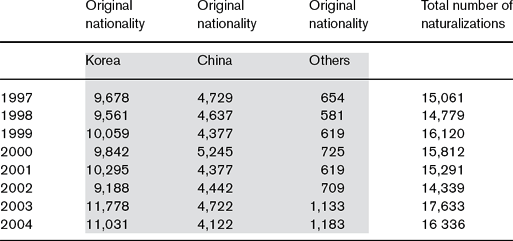
As previously indicated, the naturalization rates of Zainichi Koreans and Chinese compared to the LAN suggest some changing attitudes about Japanese nationality. It has been noted that some 90% of Korean Japanese have not naturalized’.Footnote 68 According to Japan's MOJ, about 15,000, mostly Zainichi Korean Japanese and Chinese Japanese, naturalize every year. Between 1997 and 2004, some 185,371 persons naturalized with most being originally Korean or Chinese nationals (see Table 2). As Table 2 indicates, naturalizations have actually increased but not necessarily from Brazilian, Peruvian, or other smaller LAN communities.
Naturalizations to the Japanese nationality 1997–2004
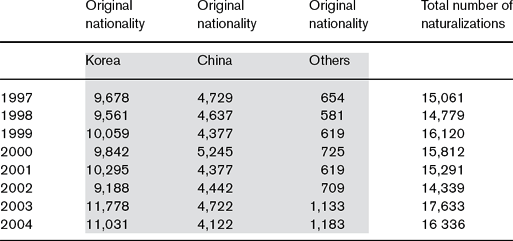
Source: “Issue of Nationality: Number of Naturalization in the Past 10 Years”. Japan Ministry of Justice website, http://www.moj.go.jp/TOUKEI/t_minj03.html (Accessed 6/16/2007)
One newspaper report notes that since 1965 only 300,000 foreign-born persons have naturalized to the Japanese nationality and thus met the requirements of a five-year stay, fluency in the Japanese language, and evidence of ‘culturalization’ to Japan.Footnote 69 Although the 1984 nationality law revision has somewhat liberalized the naturalization process, all foreigners must renounce the citizenship of their country of origin to acquire Japanese citizenship and many LAN therefore do not choose to naturalize due to the possibilityFootnote 70 or the intention of going back to their home countries. There is also no ‘as of right’ acquisition of citizenship for the second generation born in Japan. Hence, despite the increasing LAN permanency in Japan, these factors additionally compound the limitations of LAN social and political incorporation. However, this is not the case for the comparatively large Zainichi Korean and Chinese communities that are increasingly obtaining Japanese nationality. Despite decades of discrimination, these multigenerational communities are becoming more of a force in Japan's politics and changing political opportunity structure, and their long-term residence, Japanese language ability, and cultural familiarity are increasingly seen as more legitimate and may trump LAN claims to membership around blood descent and ethnic affinity.
6. Political opportunity structure
I argue that changes in Japan's political opportunityFootnote 71 structure between 1990 and 2004 have opened up access to participation for some excluded groups but not necessarily the LAN. I use Tarrow's notion of political opportunity structure to describe Japan's political system or political resources external to LAN communities and not purely in the sense of collective action or social movement in the way the term was developed. Up until the recent change of government in summer 2009 with the DPJ's electoral victory, my research indicates the conservative LDP single party dominanceFootnote 72 of the political opportunity structure as a key factor to further explain the limited LAN as well as other legal foreigners’ (i.e. Zainichi Koreans) political incorporation. Joppke argues trends in immigration policy towards ‘de-ethnicization’ (easing access for all immigrants) or ‘re-ethnicization’ (reinforcing ties with emigrants abroad) are dependent on the ideological leaning of the government, with the liberal left favoring ‘de-ethnicization’ and the conservative right opting for ‘re-ethnicization’.Footnote 73 The LDP's one party dominance created self-sustaining systems of patronage and corruption, where Nikkeijin ‘blood descent’, hence ‘re-ethnicization’, was privileged for culturally acceptable and politically expedient cheap temporary labor but not necessarily formal citizenship. Moreover, suffrage for the multigenerational Zainichi Koreans, and even less so for the Nikkeijin and other ‘foreign groups’, has never been a consistent priority for the LDP. Hence, LDP dominance and the bureaucratic structure of a one party system further explain this policy of ‘re-ethnicization’ with little plan of social or political incorporation. Milly argues that the Japanese state's administrative character ensures many immigrant policy related matters are addressed without consideration by the legislature and point out the lack of ‘political leadership’ in the legislature advocating for foreign residents.Footnote 74
I contend the 1994 electoral system reformFootnote 75 has resulted in the lessening of LDP privilege and the limited incorporation of some previously unrepresented communities such as the Zainichi Koreans and Taiwanese but not from the LAN communities. This has much more to do with the political parties’ electoral calculus around the size and status of potential constituencies rather than ethnic affinity. Neary argues that the 1990s electoral reform changed the balance and relations between the political parties. He notes ‘since 1993 the LDP has not been the sole party in power and the role of the zoku (tribes) and habatsu or party factions has declined’ and the overall influence of elected politicians may be increasing.Footnote 76
Due to the 1994 reform, the Japanese electoral system is a mixed parliamentary system, combining both single seat constituency and proportional representation systems. The lower house has 300 seats that represent single member districts and 180 chosen by proportional representation. The upper house has 152 single member seats and 100 chosen by proportional representation by a single nationwide electoral district. Members of the lower house are elected for four-year terms and the half of the upper house are elected every third year for a six-year term. This combined system that moved from Single nontransferable vote (SNTV) to First Past the Post Single Member districts and proportional representation was intended to combine the name recognition of single member districts where members run by name with the fairness of proportional representation to allow for the representation of smaller parties. The individual voters select one candidate and one party and hence may vote for a candidate from one party on the single seat ballot and another party on the proportional representation list.Footnote 77
It is often argued proportional representation systems can be more effective for promoting the election of women and minorities because, unlike others systems such as single member districts, in order for women and minorities to be elected it simply requires they be placed high on the list and there is much less of a need for individual campaign finance because the party rather than the individual usually finances the campaign. Another contention is proportional representation systems tend to produce more voter choice and a multiparty system. Following Lijphart, consociational theorists argue proportional systems are more likely to be conducive to accommodation of minorities and hence produce more legitimate and stable democracy.Footnote 78 My findings suggest a correlation between the introduction of electoral reforms, particularly proportional representation, and more women, minority and foreign community concerns, and opposition in Japanese national politics. Although several commentators argue the reforms are inadequate, I contend electoral reform has enabled the beginning of some leadership on the behalf of immigrants in Japan's legislature. In regard to recently elected politicians of foreign background in Japanese politics, I note most have been elected by proportional representation and, up until recently, from opposition parties such as the DPJ created in the late 1990s. Despite the re-ethnicization of Japan's immigration policy, my analysis reveals no foreign born politicians of LAN background being elected in any national contest. However, much evidence suggests the reforms enabled other long-standing resident foreign origin persons to run and be elected. Among the elected foreign origin non-Nikkeijin persons include Mr Tsurunen, a naturalized Japanese and former Finnish national and the first foreign born politican in Japanese history to be elected to the upper house in 2001, and Mr Haku, a naturalized Japanese in 2002 of mixed Korean and Japanese parentage from the Korean minority, and the self-declared first politician to openly express his Korean background to be elected to the upper house in 2004. Although not elected by proportional representation, M. Ren Hou, a naturalized Japanese in 1985 of mixed Taiwanese and Japanese parentage was elected in 2004 to the upper house by SMD representing Tokyo from the DPJ. As Ms Hou is a prominent television journalist, this is consistent with the theory that SMD relies more on individual name recognition. Her election, like the others of foreign origin, is also confirmation of the results of multimember district reform. It should also be taken into account that Mr Tsurunen is the only non-Japanese descent and foreign born elected politician in the Diet. The others, such as Mr Haku and Ms Hou, are people of mixed parentage who have been born and raised in Japan but only fairly recently became naturalized Japanese, enabling them to vote and run for office. One house member, a former Tokyo bureau chief for the Seoul, Korea-based Chosun Ilbo daily newspaper, reflected on what he perceives as attitudinal change towards the Zainichi Korean population.
I was the first to be elected as a publicly known Korean Japanese. My mother's country is Japan and my father's country is Korea. All the people here that know me, know my origin. It's very popular in a special way . . . The Japanese people voted for me. Nowadays, the Japanese people are changing. Maybe, in my case, maybe 10 years ago, a Korean (people think)’no’, ‘no’, ‘no’, but nowadays, a Korean, ok (I will) vote. I think it is a very significant thing that you have only one vote and you are giving your vote to a Korean (foreign) person.Footnote 79
It is of note both Mr Haku and Ms Hou proclaim to use their offices for the improvement of relations between Japan and their parents home countries. As for women, Ogai indicates the number of women in the Diet increased in the 1996 and 2000 elections mostly in the proportionally elected seats.Footnote 80 It is noteworthy that the reforms produced 35 women who won seats in the lower house election of 2000 as opposed to the 23 in the previous Diet. The previously mentioned centrist New Komeito party emerged as a player after the 1996 elections soon after the reforms were put in place.
Another sign of change in relation to electoral reform is the LDP's running of certain candidates to try to capture overseas voters. Mr Michio Takakura, publisher and president of the Japanese language Nikkei Journal based in Paraguay, was an LDP candidate in the 2004 upper house proportional representation elections. Mr Takakura, a Japan born and raised emigrant to Paraguay where he lived for some 28 years, returned to Japan and holds Japanese citizenship as well as permanent residency in Paraguay.Footnote 81 He ran to try to raise the status of Nikkeijin immigrants in Japan and to promote international expatriate ties. Although unsuccessful this has been viewed as an attempt by the LDP to be able to compete with the DPJ's promotion of ‘internationalized’ candidates of foreign origin as well as to appeal to some 610,000 overseas Japanese voters due to the 1998 election law amendment which allows Japanese nationals living overseas to vote in the proportional representation section of national elections.Footnote 82 Mr Kawauchi's election, a DPJ politician, to the lower house in 1996 and his subsequent re-elections in 2000, 2003, and 2005 all by proportional representation (enabling overseas nationals abroad to vote for him) along with his embrace of the issues of the Nikkeijin community of the Dominican Republic, several of whom, originate from his home district of Kyushu, also denote a change in the interests in the electoral potential of ‘overseas’ Japanese communities and Nikkeijin communities abroad with Japanese citizenship. Mr Kawauchi, a born and raised Japanese, has taken up the case of Japanese emigrants who were sent by the Japanese government to the Dominican Republic in the latter half of the 1950s with promises of prosperous land only to find out once they arrived there that the land was rather unproductive. After the release of government documents in 1999, the Dominican Nikkeijin with the help of Mr Kawauchi as Secretary-General of the Japan-Dominican Parliamentarians League lobbied and took the Japanese government to court, and, although they lost the case due to statute of limitations, they won an apology and some compensation in 2006.Footnote 83 Although Mr Takakura and Mr Kawauchi are both born and raised in Japan, their actions and interests along with the LDP and DPJ reflect a change and an opening of the political system, particularly with regard to ‘overseas Japanese’. Not necessarily in terms of simple ethnic affinity but rather around the electoral opportunities of the expanded political constituency of ‘overseas Japanese’ with Japanese citizenship by virtue of electoral reform. However, this has little impact on most LAN who characteristically lack Japanese nationality.
I argue that changes in Japan's electoral and party systems have transformed Japan's political opportunity structure and realigned cleavages that privilege older excluded groups, namely Zainichi Koreans, due to length of residence and linguistic and cultural affinity and a long history of claims over newer excluded groups such as the LAN. My research indicates that the demands of the Zainichi Koreans are seen as more legitimate in comparison to the LAN. It is of note that virtually no media reports discuss the extension of political rights to LAN on the basis of their coethnicity but rather argue the benefits and detriments of extending local voting rights to foreign nationals in general and Zainichi Korean ‘special permanent residents’ in particular. As noted by Pak, the only advocacy for foreigners at the national level has been for local suffrage and these demands mostly reflect the wishes of the Zainichi Korean community.Footnote 84 The real push behind the extension of foreign voting rights came from Mindan, and the Zainichi Korean community of ‘special permanent residents’, many of whom are descendants of Japanese colonial subjects and one of the best organized of Japan's minority communities.Footnote 85 These efforts are supported by the pro-Taiwanese Overseas Chinese Association of Tokyo. Mindan has been campaigning for suffrage since 1986 arguing ‘foreigners with permanent residency are a part of Japanese society’.Footnote 86 One councillor responded to a question I had about the extension of formal political rights or citizenship to Nikkeijin was surprised by the question and responded in the following way:
I never thought about it. If they start to demand it, it could be possible. It is a good question. I have never thought about it. But maybe that could be the exception even for LDP members because the ancestors were Japanese so maybe. Maybe that is one step. It's not impossible.Footnote 87
The preceding quote speaks to the ambivalence of legislators regarding the political incorporation of LAN communities beyond privileged emigration to Japan on the basis of shared Japanese blood relations. One former Tokyo Immigration Office official who now heads the first and only policy think tank on immigration policy remarked:
Japanese politicians don't show much interest in foreign migrant issues. Very very few. Probably two or three. Foreigners in Japan are very small in number and also they don't have the vote so there's not so much movement yet but in the future I don't know, it might change.Footnote 88
The opposition of Japanese conservatives persists in the LDP's argument that foreigners should naturalize because voting rights for foreigners works against the interests of Japanese citizens in national security and education and would lead to a right at the national level.Footnote 89
Despite this, the issue of foreign suffrage continues to periodically rise to the surface and is regularly defeated. Although the LDP and the New Komeito Party had some agreement on the issue when they formed a coalition government along with the now defunct Liberal Party in 1999, the LDP has shied away from this due to opposition from powerful conservative members. As written in the Japan Times, ‘while New Komeito Secretary General Teysuzo Fuyushiba has said it is unfair that non-Japanese (permanent) residents who are part of communities and pay taxes cannot take part in policy making, the highest hurdle to clear is the Liberal Democratic Party’.Footnote 90 The New Komeito and the Conservative Party submitted an unsuccessful bill regarding local suffrage for all permanent residents in 2000.Footnote 91 Additionally, amidst the contest of the Upper House election of 2004, New Komeito came with a manifesto promoting suffrage rights for permanent foreign residents. As previously indicated, many speculate that the interest of New Komeito in promoting these bills is in capturing the votes of the many Zainichi Korean members of Sokka Gakkai, New Komeito's affiliated Buddhist organization.Footnote 92 Since 1998, several bills introduced and defeated around these issues include the ‘Bill to Grant Voting Rights in Local Elections to Foreign Residents with Permanent Residency’ proposed by the Komei Party and the Democratic Party and the ‘Bill to Grant Foreign Residents with Permanent Residency the Rights to Vote and Run for Office in Local Elections’.Footnote 93
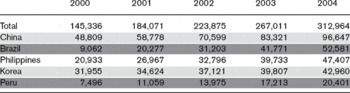
One can observe from the preceding that many of these foreign suffrage bills have been aimed at ‘permanent residents’, namely the Zainichi Korean and Chinese communities of ‘special permanent residents’ (see Table 3). I have already noted in Table 2 that an increasing number of former Korean and Chinese nationals have taken Japanese nationality which will eventually increase their power as a political constituency. As Table 4 illustrates, there has been an increase in ‘permanent residents’ between 2000 and 2004, particularly from the LAN Brazilian and Peruvian communities but still it is rather small compared to the Zainichi Korean and Chinese communitiesFootnote 94 (see Table 4). These data indicate the priority of the Zainichi Korean and Chinese communities as actual constituencies in electoral politics rather than the LAN.
Changes in number of alien registrations of special permanent resident by nationality(place of origin)

Source: “2005 Immigration Control”, 11th Issue of the “Immigration Control Report”, Japan. Immigration Bureau. Ministry of Justice, From Data Section, Table 28 “Changes in the Number of Alien Registrations of Permanent Resident by Nationality”, pg. 178.
Changes in number of alien registrations of permanent resident by nationality (place of origin)

Source: “2005 Immigration Control”, 11th Issue of the “Immigration Control Report”, Japan. Immigration Bureau. Ministry of Justice, From Data Section, Table 24 “Changes in the Number of Alien Registrations of Permanent Resident by Nationality”, pg. 176.
One Kawasaki International Association representative remarked:
So, it terms of priority, I do believe those who are living in Kawasaki for a longer time are the Korean residents should be considered first priority when giving right to vote instead of Nikkeis.Footnote 95
An official from Japan's largest human rights organization spoke about the Buraku (outcaste) minority as the strongest politically and in terms of finance. He noted the effect of the leadership's lack of interest in organizing those without voting rights as something that prevents them from representing foreigners’ interests in electoral politics. In this way, LDP dominance of the political opportunity structure and the ‘ethnic citizenship’ regime restrictions on voting rights and naturalization reinforces the limited LAN and other foreigners’ political incorporation.
It is because (most Nikkeijin and other foreigners) don't have voting rights. In order to win elections, we need to organize those who have voting rights or citizenship. As a result, the election campaign of the BLL representatives were not quite fully involved with those who are not recognized as minorities like Okinawa people (Okinawa people have the vote because they are legal Japanese citizens) or foreigners or the migrant community who don't have voting rights. But I was saying the importance of the BLL leader to become a senator is to channel noncitizens or not recognized minorities onto the political stage, but it's political.Footnote 96
Despite LAN coethnicity, the preceding addresses the political realities of this immigrant population, its recent arrival, relatively small size, along with the fact of no voting rights. This seems to translate into an unnecessary and hence little considered element of political parties and interest groups electoral calculus. My informants noted the DPJ's internal divisions on the issue of foreigners’ suffrage.
In spite of lack of legislation enabling foreign nationals to vote in local elections, Pak,Footnote 97 Neary,Footnote 98 and TakaoFootnote 99 note local extra-electoral participation in the forms of Foreign Residents Assemblies, local referenda, and ombudsmen to facilitate legal foreign citizens’ participation in local decision making. However, I contend the lack of a recognition and accommodation policy on the part of the national government and failure to collaborate with local governments further explains the lack of LAN and other foreigners’ political incorporation on the local level. It must be noted that the Kawasaki Foreign Resident Assembly, the first foreign residents’ assembly in Japan, was brought about through the initiative and mutual trust between the Zainichi Korean and Japanese communities and is now replicated by several municipalities in Japan.Footnote 100 Foreign are generally considered a positive development with regard to foreigners’ local political incorporation. However, as Foreign Residents Assemblies are limited to passing proposals that may or not be considered by the mayor or city council, the appointment of representatives by Japanese local government officials lacks the democratic practice of participatory decision making. Additionally, the character of local referenda open to foreign nationals dependent on the politics of each locality compounds this lack of participatory democratic access for LAN and all foreign national residents.
Brody questions how the measures towards suffrage for ‘special permanent residents’, for the most part focused on Zainichi Koreans and Chinese, will apply to LAN permanent residents as well as how potential future measures to integrate LAN would impact the Zainichi Korean community.Footnote 101 As the LAN Brazilian and Peruvian communities move from the teijusha visa to permanent residency, it could be just a matter of time before the LAN community makes political demands similar to those of the Zainichi Korean community. However, for the time being, the privileged groups seeking and being sought after for foreign local suffrage are the Zainichi Korean and Chinese communities.Footnote 102 Although ethnicity is still quite relevant, most informants viewed the long-term Zainichi Korean community as ultimately sharing and having more of a stake in membership in local communities and most deserving community of foreign local suffrage over the more recent LAN immigrants. Thus, challenging the coethnicity hypothesis and supporting CarensFootnote 103 notion that citizenship claims vary with degree and length of social ties and residence. This is to say that the long history of the marginalized Zainichi Korean and Chinese claimsmaking is having an impact in relation to the presence of LAN in Japan's changing ethnic citizenship regime and political opportunity structure.
7. Structure of civil society
I define civil society as organizations formed outside of the state, market, and family.Footnote 104 My research indicates a conspicuous lack of LAN civil society organizations dedicated to political advocacy. PakFootnote 105 notes newcomer foreigners, like the LAN, have yet to form political organizations representing their own interests. Shipper argues legal foreigners such as Nikkeijin do not form secular immigrant associations for ethnic identification or political voice, but rather establish ‘ethnic enclaves’ that depend on assistance from ethnic businesses.Footnote 106 Takao suggests most newcomers are not well organized in contrast to the very well-organized oldcomer Zainichi Korean community.Footnote 107 Yamanaka notes the existence of Brazilian Nikkei social and religious groups and networks of formal and informal immigrant women's organizations in Hamamatsu City.Footnote 108 However, she notes and attributes the lack of political activism among the Brazilian Nikkeijin to “enhance their rights” to their temporary employment status in the manufacturing industry and perhaps a lack of political consciousness due to an intention to return to Brazil.Footnote 109 As LAN are widely perceived as working and sometimes middle-class and educated people in their countries of origin and some 86.0% are employed in the manufacturing industry in Japan,Footnote 110 one could assume class as a basis for collective action and/or participation. However, this does not seem to be the case and has much do with how civil society is structured in Japan. Due to the fact that most of Japan's 20,000 unions are organized on the basis of company-specific enterprise unions rather than industry and these unions generally do not allow part-time workers and many LAN and other workers are generally on temporary contracts and not formally employed by the companies for which they work, the ways in which unions are organized can act as an impediment to collective action.Footnote 111 Despite this fact, a few community unions, which are generally open to any individual including some that work with foreign workers, i.e. the Kanagawa City Union in Kawasaki City,Footnote 112 have proven a viable avenue for some LAN and others with regard to labor consultation and labor disputes.Footnote 113
Takao points out that from the mid-1980s to mid-1990s predominantly Japanese citizens organized grassroots support groups as service providers to foreigners.Footnote 114 ShipperFootnote 115 suggests the involvement of support groups organized by Japanese citizens to assist undocumented foreigners have been more effective than groups organized by the immigrants themselves. In addition to the some 200 foreigner support organizations, TsudaFootnote 116 and BrodyFootnote 117 have observed LAN organizations engaged in socio-cultural activities and assistance on the national and local levels, including Comite de Assitencia Trabalhadores Latino Americanos (CATLA) and the Comite dos Latino Americanos Nikkeis (CLAN).Footnote 118 As a large segment of LAN are Catholic, support has also been made available from religious organizations.Footnote 119 In Toyota City, the Centro Latino-Americano de Homigaoka (Celaho)/Paolo Freire school provides bilingual education and other services to local Latin American communities. As previously noted, Kaigai Nikkeijin Kyokai and Covenio Kyokai provide support and assistance to the LAN community in Japan. Additionally, LAN have an active ethnic press with a significant readership of the Portuguese and Spanish language newspapers of the International Press as well as Mundo Latino and Mushashi and other publications that address areas ranging from entertainment to labor and social issues. In spite of this, there is an absence of LAN organizations dedicated to political advocacy. I argue that the ways in which the state has structured Japanese civil society, along with the relative newness, small minority size and weak status, the difficulties of the Japanese language, and a ‘powerful myth of return’ among Nikkeijin immigrants are contributing factors to the dearth of LAN civil society organizations dedicated to political advocacy in Japan.
Although the 1998 Nonprofit Organization (NPO) has made civil society more viable, up until recently, it was very difficult to establish a political advocacy organization in Japan. Pekkanen argues Japan has a dual pattern of civil society in which there are many neighborhood associations but very few professional advocacy organizations. He explains that Japan's political institutions, its regulatory framework, financial flows, and political opportunity structure, account for this pattern of civil society.Footnote 120 The state structure of incentives create this civil society pattern and ‘a strict legal framework, limited funding pattern, indirect regulations (such as postal regulations that make bulk mailing for civil society organizations prohibitively expensive) and the profile of opportunities that a state's political structure creates for influencing policy – all these factors profoundly affect the development of civil society in Japan’.Footnote 121 Both PharrFootnote 122 and PekkanenFootnote 123 argue, up until recently, Japan's Civil Code, dating back to 1896, made it very difficult to gain legal standing as a ‘public interest’ organization without getting past several hurdles. For this reason, many NPO's could not become legal persons and created difficulties for both growth and independence and this has implications for political advocacy. Additionally, obtaining tax-exempt status remains difficult. Although lobbying is permitted, this lack of access to tax deductible contributions makes most groups who already lack resources less viable in issue advocacy. PekannenFootnote 124 argues this creates difficulties for movements to institutionalize as demonstrated by the lack of institutionalization of Japan's social and environmental movements of the 1960s and 1970s.
The 1998 Nonprofit Organization (NPO) is important because it is the first significant change in legal regulation of Japan's civil society since the Meiji period of the late nineteenth century. For PekkanenFootnote 125 as well as Shipper,Footnote 126 the 1998 Nonprofit Organization (NPO) Law has had some impact on Japan's civil society. The law grants smaller volunteer and other civic groups corporate status. For Shipper (2008), this has been limited to service-providing NGOs such as women's support groups and medical NGOs.Footnote 127 While PekannenFootnote 128 sees the 1998 Nonprofit Organization (NPO) Law as accompanying the 1990s electoral reforms and hence a different set of incentives for political actors and interest group lobbying, ShipperFootnote 129 argues the law has not had much impact on the growth of small issue-oriented groups. He contends the state has not been active in promoting or discouraging ‘ethnic immigrant’ organizations in Japan but rather this development is more the product of intergroup competition from ideological differences.Footnote 130 One long-term foreign resident expressed the difference between the LAN and Zainichi Korean communities’ political advocacy in a way that summed up the generally perceived more legitimate claims of the long-term and multigenerational resident Zainichi Korean community as opposed to the post-1990 LAN community.
Well, Korean residents in Japan have long established groups. They have big voices in politics here. Those voices have been around a lot of the change in laws related to foreigners in Japan. For example, the elimination of finger prints from the foreign registration cards took place about 7–8 years ago that was primarily because of pressure from Korean residents. That is also the same basis for local representation for non-citizens in politics primarily to appease Korean interests both North and South because the two groups of expatriate residents keep very separate political agendas here. Of course, other foreigner groups in Japan have taken advantage of the efforts that they have made. Because of the special historical relationship between Japan and Korea, its just logical and natural and the Koreans being probably the biggest group (of foreigners) in terms of population.Footnote 131
When asked why there are very few LAN organizations that engage in political advocacy, my informants’ responses ranged from cultural arguments stating Latin Americans are simply disorganized, to LAN need the social network only for jobs, etc. but the political aspect is not yet relevant, to LAN are too busy to organize politically because of their demanding work schedules, or fixated on the notion of going back to their countries of origin. My research suggests in addition to the aforementioned structural variables including Japanese civil society structure which, up until recently, made it very difficult to incorporate and engage in political advocacy, language, relative newness of residence, small size, low minority status, and a powerful myth of return limits LAN immigrant political incorporation between 1990 and 2004.
8. Conclusion
This case says much about the conditionalities of membership and the ways in which they are instrumentalized by both state and non-state actors. It tells us much about how ethnic sentiments can inform immigration policy and the perspectival and relational nature of the politics of ethnicity and nationality. My research indicates very limited LAN immigrant political incorporation at all levels in Japan, demonstrating that shared ethnicity does not necessarily facilitate immigrant political incorporation. The findings suggest the Japanese government did not extend political rights or full legal citizenship to Nikkeijin, as do the German, Italian, and other governments for their overseas coethnics, because the original intent of the 1990 Immigration Act and teijusha visa was always intended to be for temporary labor and not permanent settlement. Hence, the arguments around ethnicity seem to be both an official rhetoric employed as a matter of economic convenience as well as signaling a deeper ambivalence with regard to Japanese ethnicity and nationality. Although coethnicity is what provides the eligibility for the teijusha visa that makes LAN legal in Japan, it seems to play little role regarding precedence in formal and informal political processes. There is a clear disconnect and analytical distinction between the logic of the motivation for the 1990 Immigration Act to be put in place and its effects. Additionally, there is a clear disjuncture between central and local policy, and existing local policy innovation towards more immigrant incorporation has been generally initiated by Zainichi Korean activism. The 1990s electoral reform to a mixed member system has transformed some previous LDP privilege and produced a few more women and minorities in parliament but interestingly not one LAN immigrant. The politicians and policy makers I interviewed expressed the sentiment that Zainichi Koreans and other long-term excluded groups should be extended voting rights before the LAN. Although there is media coverage of groups and even political parties (New Komeito party) advocating for voting rights for Zainichi Koreans and other permanent residents, one rarely sees media coverage or groups advocating for local voting rights for Nikkeijin. I find little evidence of LAN organizations that mobilize for political advocacy. However, it is possible that LAN political advocacy may change over time as more become permanent residents and the ethnic citizenship regime, political opportunity structure, and civil society continue to transform. This case demonstrates both the use of the ‘symbolic politics’Footnote 132 of ethnicity and membership as well as the ‘gap hypothesis’Footnote 133 or the gap between the goals of national immigration policy and outcomes. Oddly enough, although this policy was established to maintain homogeneity, it may have helped to push open the doors wider to the realities of an increasingly multicultural Japan.
About the author
Michael Orlando Sharpe is an Assistant Professor of Political Science in the Department of Behavioral Sciences at York College of the City University of New York. Prior to coming to York College/CUNY, Dr Sharpe was a senior research associate at the Howard Samuels Center at the CUNY Graduate Center. Before these more recent experiences, Dr Sharpe was employed as a political analyst for the Consulate General of Japan in New York and earlier in Tokyo, Japan as a project coordinator for the United Nations affiliated non-governmental organization the International Movement Against All Forms of Discrimination and Racism (IMADR) of which he now serves as a member of its board of directors. Dr Sharpe's areas of expertise are comparative politics and international relations and his research interests concern looking comparatively at the politics of migration, immigrant political incorporation, and political transnationalism.