




No CrossRef data available.
Article contents
Dialect contact in a Southern Basque town
Published online by Cambridge University Press: 25 November 2003
Abstract
This article describes five dialect-based changes in progress in the Southern Basque town of Oiartzun. Based on data collected in sociolinguistic interviews with thirteen local Basque speakers, this article examines dialectal variation in elements chosen from different parts of the grammar: two lexical items, two morphosyntactic alternations on auxiliary verbs, and a phonological process, apheresis. In particular, several claims are made about dialect contact in Oiartzun. Strong apparent-time evidence exists that four out of five of these elements are undergoing change. Older speakers tend toward forms characteristic of dialects to the east of Oiartzun, whereas younger speakers prefer western forms. In each case, male speakers appear to be leading the process of change; men show significantly higher frequencies of incoming western forms than women. The data, however, provide little support for the hypothesis that the recently introduced Basque literary standard has influenced young people's vernacular.I am deeply grateful to the people of Oiartzun for their generous support and hospitality during my stay in their beautiful town. Special thanks to Iñaki Arbelaitz for sharing with me his encyclopedic knowledge of local culture, language, and geography. Also, thanks to Larraitz Sanzberro, Katrin Abal, Inazio Retegi, Xabier Artiagoitia, Roslyn Frank, and Toki Alaiko denak. Thanks to John Singler for invaluable theoretical and methodological guidance in this study and to Renée Blake, Begoña Echeverria, Gregory Guy, John Singler, Koldo Zuazo, and two anonymous reviewers for helpful comments on earlier drafts. All shortcomings are my own.
Information
- Type
- Research Article
- Information
- Copyright
- © 2003 Cambridge University Press
INTRODUCTION
Recent dialectological work on Basque suggests that a series of isoglosses in the central Basque Country is moving eastward. Over the last few centuries, several features of western Gipuzkoan1
Many place names used herein have both Basque and Spanish (and French) spellings. In this article, Basque orthography is used for all place names with the exception of the provinces Nafarroa, and Bizkaia, which will be referred to using the established English spellings, Navarre and Biscay respectively.
Basque and Oiartzun
The Southern Basque Country
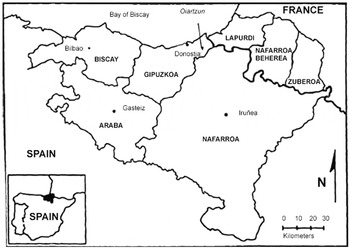
The map in Figure 1 shows the seven historical Basque provinces. The four largest provinces—Araba, Biscay, Gipuzkoa, and Navarre (the Southern Basque Country)—fall on the Spanish side of the border and the three smaller provinces—Lapurdi, Lower Navarre, and Zuberoa (the Northern Basque Country)—fall on the French side. Today, there are roughly 660,000 speakers of Basque (Trask, 1997:5), who make up a third of the roughly two million inhabitants of the Basque Country. All but approximately 80,000 speakers live in the southern provinces (Trask, 1997:5).

The Basque Country (adapted from Trask, 1997).
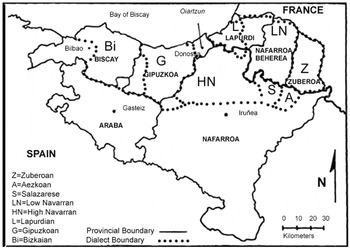
The map in Figure 2 shows that the predominantly Basque-speaking areas are clustered in the northern part of the Southern Basque Country along the mountains bordering the coast. Basque has been losing ground to Spanish, retreating northward, since at least the seventeenth century, and by the mid-eighteenth century most of southern Navarre and Araba were largely Spanish-speaking (Trask, 1997:46). During the Franquist dictatorship (1937–1975), Basque continued to recede rapidly, partly as a result of official oppression of the Basque language, but also as a result of massive immigration to Basque factory towns from other parts of the Iberian peninsula, especially Andalucia, Extremadura, and Galicia (Urla, 1987).

Basque dialects (adapted from Trask, 1997).
Immigration to urban areas helps explain another important factor bearing on Basque dialect contact: Basque lacks an important urban center that can serve as a metropolitan prestige variety. Basque has receded from the southern provincial capitals, Iruñea (Navarre), Gasteiz (Araba), and Bilbao (Bizkaia), but it is still used to some degree in the Gipuzkoan capital, Donostia, where it is the mother tongue of 28% of the population (Basque Statistical Office, 1996).
Oiartzun
Oiartzun is located in the northeastern corner of Gipuzkoa, a ten-minute drive from the provincial capital, Donostia. To the east and south it borders the municipalities of Lesaka and Goizueta across the provincial border with Navarre. To the west, it borders the Gipuzkoan municipalities of Lezo and Errenteria and, to the north, Irun, which shields it from the French border, just 10 minutes by car (see the map in Figure 2).
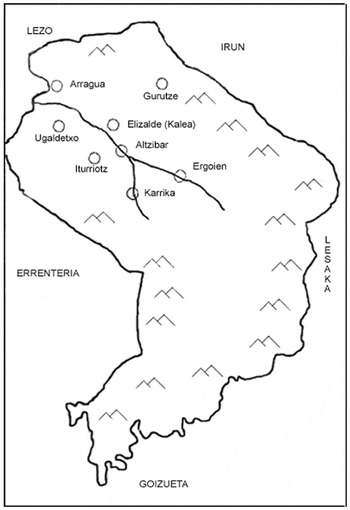
Oiartzun's political boundaries are roughly contiguous with a geographical boundary. Oiartzun lies in a valley closed on three sides. The valley opens to the northwest, along its border with the municipalities of Errenteria and Lezo (see the map in Figure 3). Immediately past Errenteria is the industrial port town of Pasai where the Oiartzun River drains into the Bay of Biscay. The eastern and southern parts of the valley, bordering the Navarran municipalities of Goizueta and Lesaka, are especially mountainous. Oiartzun's villages (auzoak), where most of the population lives, are clustered in the flatter, central parts of the valley.

Oiartzun (adapted from Fraile & Fraile, 1996).
In recent centuries, Oiartzun's economy was based not only on agriculture, but also on mining, metallurgy, and timber production. However, especially after the end of the Franquist dictatorship, Oiartzun began to diversify economically. Several tracts of land along the Oiartzun River, especially in the northern and western parts of the valley, were rezoned for industrial activity and a large shopping center. In addition, a major highway connecting Donostia with the French border in Irun was cut through the northern tip of the municipality in the early 1970s. Table 1 shows that today a relatively small part of the economically active population works in agriculture.
Employed population aged 16 and over, by branches of activity

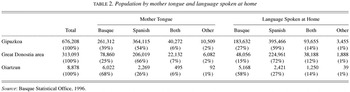
Oiartzun is similar to other towns in the greater Donostia area in terms of economic activity. However, Oiartzun differs from the other towns around Donostia, including its immediate neighbors, Errenteria and Lezo, in that industrialization came much later and immigration has been relatively light. Persons born outside the Basque Autonomous Community2
The Basque Autonomous Community consists of the southern provinces of Araba, Gipuzkoa, and Biscay. It excludes Navarre and the three northern provinces.
Population by mother tongue and language spoken at home

In 1967, toward the end of the Franquist dictatorship, a clandestine Basque-medium school (ikastola) was established in Oiartzun (as in many other Southern Basque towns) in defiance of the Franquist government's ban on Basque language instruction. The school survived the remaining years of the dictatorship (until 1975) and later obtained legal status as a private school and flourished in the post–Franquist period of Basque language and cultural activism. During the 1980s, Oiartzun's other school—a public school—also began offering Basque-medium instruction, and today the overwhelming majority of students in Oiartzun's two schools are enrolled in Basque-medium programs. The remainder are enrolled in bilingual programs in which both Basque and Spanish are used as the medium of instruction. No students are enrolled in exclusively Spanish-medium programs (informant data; see Basque Statistical Office, 1996).
The development of Basque-medium instruction in Oiartzun is directly relevant to the present study because the Basque used in schools is a standardized variety called Batua (B). It seems plausible, then, that the use of B as a classroom language would influence speech outside the classroom and hence shape the development of the local dialect over time. Moreover, because B has been introduced only in the last thirty years, locals' exposure to it varies by age. All of the younger speakers in the present study (20–25 years old), but none of the middle-aged and older speakers (over 40), received B-medium primary and secondary instruction. Indeed, the possibility that B's use in the classroom has shaped young people's nonclassroom speech is part of the popular local discourse about language. When I commented to informants and other locals that young people seemed to speak very differently from older people, several people explained the difference in terms of the use of B in the classroom (and in the media). One of the goals of the present study was to examine this claim.
Dialect contact
The Gipuzkoa–Navarre border is roughly contiguous with a dialect boundary. Basque dialectologists have traditionally grouped the varieties to the east of the border into a dialect called Goinaparrera (High Navarran: HN) and varieties to the west of the border into a dialect called Gipuzkera (Gipuzkoan: G) (Bonaparte, 1863; Irizar, 1992; Zuazo, 1998a, 1998b). However, Oiartzun and the neighboring municipalities of Lezo, Irun, Hondarribia, and Errenteria have historically formed an exception to this rule. Although politically these towns have belonged to the province of Gipuzkoa since the fourteenth century, the local dialects are historically much closer to HN than to G (Bonaparte, 1863; Zuazo, 1998a, 1998b).
However, over the last few centuries, the dialect of Oiartzun has increasingly adopted the features of G and lost many of the features of HN. In 1745, Larramendi, a Jesuit priest and philologist, reported that -en was the suffixal future marker used in Oiartzun for the class of verbs ending in -n (i.e., the form used in most Navarran dialects) (Zuazo, 1997). But by 1863, Louis-Lucien Bonaparte noted that -go was the future form used exclusively in Oiartzun (i.e., the form used in G). Recent evidence from several authors has suggested that many of these changes may still be in progress. Older speakers tend to use eastern HN forms, and younger speakers prefer western G forms (Fraile & Fraile, 1996:237; Zuazo, 1997:419–420).
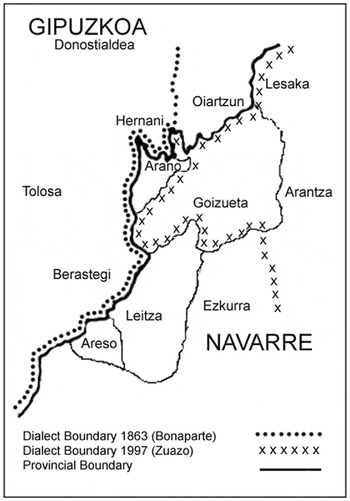
This process of dialect shift is not unique to Oiartzun. Similar shifts involving the same linguistic features discussed here have been reported along the length of the dialect boundary (Olano, 2000; Zuazo, 1998b; Zubiri, 2000). Zuazo (1997, 1998a) argued that this process has advanced far enough that the dialect boundary should be redrawn to group Oiartzun and several other historically HN-speaking towns as varieties of G rather than HN. The map in Figure 4 compares Bonaparte's dialect boundaries with Zuazo's updated boundaries, redrawn to reflect dialect shift over the intervening 134 years.

Bonaparte's 1863 dialect boundary and Zuazo's 1997 boundary (adapted from Olano, 2000).
Several factors may help explain this change in Oiartzun. First, during the late middle ages, Oiartzun changed hands politically from Navarran to Gipuzkoan control. During the middle ages, Oiartzun belonged to the Kingdom of Navarre,3
It is a matter of some debate to what extent present-day dialect boundaries reflect pre-Roman tribal boundaries. The Greco-Latin geographers, Pliny, Strabon and Ptolemy, all mention the settlement of Oiartzun (Oiason, oearso, oeaso) as the westernmost point of occupation of the Vascones, the Basque-speaking tribe who occupy present-day Navarre and whose descendants occupy roughly the same area. These authors are clear in excluding Oiartzun from the area occupied by the Varduli, the tribe who occupied most of the present-day dialect area of Gipuzkera (Caro Baroja, 1971:28–29, 54–55; Lekuona, 1995:124).
Second, for the last few centuries, Oiartzun has had much closer trade ties with its G-speaking neighbors to the west than with its HN-speaking neighbors to the east. This is partly a consequence of the local geography. As mentioned before, Oiartzun lies in a valley enclosed on three sides. From the open western side Oiartzun is easily accessible, but the mountains surrounding the valley make Oiartzun much less easily accessible from the other three sides, particularly from the east and south (i.e., from Navarre). Today, only one paved road, built just sixty years ago, connects Oiartzun directly with its Navarran neighbors across the mountains. As a result, the people of Oiartzun have had much closer trade ties with neighbors to the west than with those to the east and south.
Gipuzkoan towns to the west have provided markets or access to markets for some of Oiartzun's most important products. From Roman times through the 1980s, mining and metallurgy were important economic activities in Oiartzun. The mountains forming Oiartzun's eastern and (to a lesser extent) southern borders were rich with iron and other mineral deposits. This, combined with the fact that the Oiartzun River and its tributaries provided ample hydraulic power for foundries and easy access to the nearby seaport of Pasai, made Oiartzun an ideal location for metallurgy. At the port of Pasai to the west, Oiartzun exported its metal products and occasionally imported raw minerals for processing in Oiartzun's foundries (Lekuona, 1995:140). Oiartzun's mountainous topography and generous annual rainfall also made it an ideal location for timber production. Historically, much of the timber produced was consumed as fuel in Oiartzun's foundries. However, the shipyards at the port of Pasai were also an important market for Oiartzun's timber (Lekuona, 1995:142).4
Lekuona (1995) suggested that Oiartzun has mainly looked west for its sources of grain, particularly to the market of Tolosa and the port of Donostia.
The fact that, in recent centuries, Oiartzun has had relatively strong commercial ties to western towns and relatively weak ties to eastern towns may help explain why western features have increasingly replaced eastern features in local speech. Olano (2000:141–142) suggested that similar historical factors may explain a dialect shift in Areso and Leitza, two Navarran towns to the south of Oiartzun along the dialect boundary. According to Olano, as the nearby Gipuzkoan town of Tolosa (across the dialect boundary) developed as an important market, locals increasingly came into contact with G speakers and lost contact with other HN speakers (particularly from Iruñea). As a result, eastern G features have increasingly replaced western Navarran elements in the local speech.
A third factor explaining the encroachment of G in historically HN-speaking areas is the emergence of G as a prestige dialect in the Southern Basque Country since the eighteenth century (Zuazo, 2000:37–60).5
Thanks to R. L. Trask for a helpful discussion of this process.
While the [Basque] Country was becoming more Spanish speaking, in Gipuzkoa, an important movement to promote the Basque language developed, in the area of grammar and literature and in popular use. Its best champions were not the public institutions. It was the secular and regular clergy, especially the Jesuits led by Larramendi. They gave the language a scientific base. They and other religious leaders, including Franciscans and Capuchins, gave the language prestige and promoted it from the pulpits. (Jimeno Jurío, 1998:139; my translation)6
Original text: “Mientras el País se castellanizaba, en Gipuzkoa se produjo un importante movimiento de promoción de la lengua vasca, en el terreno de la gramática y la literatura y en el del uso popular. Sus mejores paladines no fueron las instituciones públicas. Lo fue el clero secular y regular, singularmente los jesuitas encabezados por Larramendi. Ellos proporcionaron a la lengua una base científica. Ellos y otros religiosos, como los franciscanos y capuchinos, la prestigiaron desde los púlpitos.”
At the same time, Gipuzkoa was emerging as the center of literary production in Basque, and most of the new texts were written in G. This literary flourishing was led by Larramendi and his followers, including the Oiartzuarran Mendiburu (1708–1782) and Agustín Kardaberaz (1703–1770) from nearby Hernani. During the same period, Navarre lacked any serious literary production in Basque (Jimeno Jurío, 1998:142).
Several pieces of evidence suggest that church services were a primary conduit through which G was introduced into the non-G-speaking towns bordering the G dialect area (Olano, 2000:143). The following quote from author Fernando Artola, a resident of the neighboring port town of Hondarribia, highlights the difference between the G verbal forms det/degu used in sermons and the Navarran form dut/dugu used in day-to-day speech outside of church:
Portu aldi horretan … du, dut, badugu. Elizan, “Sinisten det Jaungoiko Aita guztiz poderoso.”
In that port area … du, dut, badugu [HN Aux forms]. In the church, “Sinisten det [‘I believe’ G Aux form] in God, the Father, the Almighty.” (cited in Zuazo, 1997:419)
A similar process seems to have occurred along the dialect boundary between G and its western neighbor, Bizkaian (see the map in Figure 2). The following quote from the Biscayan priest Uriarte, discussing the Bizkaian-speaking Deba valley in 1859, shows that G was also the language used in sermons, even in certain Bizkaian-speaking areas:
It is the case in all of these towns that they look with disdain on the Basque of Biscay and they are quite fond of the [Gipuzkoan] dialect of Beterri: the sermons and talks are given in that dialect of Beterri and many, many people study that dialect, as a result of which they create a mix; but they still have not been able to “Gipuzkoanize” the vernacular. (cited in Zuazo, 2000:49; my translation)7
Original text: “Sucede en todas estas poblaciones que miran con desdén el bascuence de Vizcaya y son muy apasionados al dialecto del Beterri: Los sermones y pláticas se predican en ese dialecto de Beterri, y muchísimas personas hacen estudio de este dialecto, por cuyo motivo hacen una mezcla; pero todavía no han podido ‘guipuzcoanizar’ al vulgo.”
The following quote from Louis-Lucien Bonaparte, in 1863, makes a similar observation that G was the language used in sermons in the Bizkaian-speaking town of Bergara:
When I speak of Bergara as Bizkayan and not Gipuzkoan, I know very well that this manner of speaking displeases the Bergarans who fancy themselves to be pure Gipuzkoans. I do not deny this, just as I do not deny that the sermons of their most learned priests and often even the normal language of the most elevated persons is not only in Gipuzkoan, but in the purest Beterri dialect. (cited in Zuazo, 2000:49; my translation)8
Original text: “Quand je dis biscayen et non pas guipuscoan de Vergara, je sais fort bien que cette manière de parler déplait à Messieurs les Vergarais que se piquent d'être de purs guipuscoans. Je ne dis pas non, de même que je ne nie pas que les sermons de leurs curés les plus instruits et que suvent même le langage ordinaire des personnes les mieux élévées soient non seulement en guipuscoan, mais même dans la variété la plus pure de Beterri.”
Hence, the church seems to have been a primary vehicle through which G came to be seen as a prestige variety outside the G dialect area. At the same time that G was emerging as a prestige dialect, however, HN was decreasing in importance. During the seventeenth century, the presence of Basque in the Navarran capital, Iruñea, weakened considerably (Jimeno Jurío, 1998:144–146) and the province found itself without a Basque-speaking cultural center. As a result, Basque speaking towns in the western areas of the province increasingly looked to Gipuzkoa for cultural and commercial purposes (Olano, 2000:142; Zuazo, 2000:57).
Over the last thirty years, this dialect contact scenario has been complicated by the emergence of a literary standard: B. The development of a literary standard has been a goal of Basque language planners since the birth of The Basque Language Academy (Euskaltzaindia) in 1918. The development of B was interrupted by the civil war (1936–1939) and the Franquist dictatorship, but was resumed in the 1960s. In 1964, the academy published a standard orthography for B, and since then it has gradually developed syntactic and morphological norms to serve as a standard. These norms mainly come from the most central dialect, G, but include contributions from all dialects, especially the Northern Basque dialects, Lapurdian and Low Navarran (Trask, 1997). Today, B is used in most print publications and on the region's Basque-language television station and radio stations. More importantly, B is the language of instruction in all government-run Basque-medium schools and in the overwhelming majority of private Basque-medium schools.
Research on language attitudes in the Basque Country has suggested that this process of constructing B as a standard has been remarkably swift (Amorrortu, 2000; Echeverria, 2000; Urla, 1987, 1993), and field observations for the present project supported this view. One informant observed that, when Oiartzuarrans appear as interview guests on the local town radio station, they often suddenly begin speaking with more B forms. Another reported not liking to write e-mails to friends in B, as opposed to the local dialect, because “it seems formal to me.”
Linguistic forms in variation in Oiartzun
Zuazo (1997) discussed thirty features that distinguish G and HN dialects. This article focuses on five of these: two are individual lexical items, two are vowel alternations in auxiliary verbs, and the final one is the presence or absence of apheresis on a set of main verbs. These features were chosen in the present study for three reasons. First, it was clear from field observations and the dialectological literature (Fraile & Fraile, 1996; Zuazo, 1997) that there is substantial variation in all of these forms in local speech. Second, all are high-frequency items and hence are likely to produce a sufficient number of tokens with which to perform multivariate analysis. Finally, these elements come from different parts of the grammar. One is a phonological process, and the other four concern the lexical selection of three types of morphemes: auxiliary verbs, a conjunctive operator (akin to English but), and an adverb (akin to English well).
Auxiliary verbs
Basque has two types of verbs: synthetic and analytic. Synthetic verbs contain the verb stem and all associated inflectional material in a single word. By contrast, analytic forms divide the verbal labor between a main verbal chunk, to which aspectual morphemes may suffix, and an auxiliary containing tense and inflectional material. The auxiliary includes (i) a root, (ii) an optional past tense morpheme, (iii) an optional potentiality morpheme, and (iv) person and number morphemes that agree with the subject, object, and indirect object (Artiagoitia, 2000). The verbal root encodes the fact that the selection of the auxiliary depends on whether the verb form is transitive/intransitive, on one hand, or indicative/subjunctive (potential, imperative), on the other.9
Hence, there are four different auxiliary roots: izan (indicative, intransitive), *edun (indicative, transitive), *edin (subjunctive/imperative/potential, intransitive), and *ezan (subjunctive/imperative/potential, transitive). The verbs *edun, *ezan, and *edin are starred in observance of the fact that these forms never surface in the free-standing infinitive forms given here, but are always inflected.

In (1), the transitive verb *edun is selected because the verb takes a (pro-dropped) direct object (‘us’), which it agrees with in person and number. By contrast, the intransitive verb ‘go’ in (2) requires the selection of izan.
In addition to serving as auxiliary verbs, izan and *edun also function as the verbs ‘be’ (cop) and ‘have’, respectively. (3) and (4) are examples of these alter egos for izan and *edun.11
When serving as a verb akin to English ‘have’ rather than as an auxiliary, these forms are often described in Basque grammars as forms of ukan, which is an infinitive form expressing ‘have’.

(3) and (4) show that, in these verb forms, agreement functions exactly as described for auxiliaries. In (3) izan agrees with the pro-dropped subject, and in (4) *edun agrees with both the pro-dropped 1sg subject and the overt object ‘that’.
The root vowel in certain forms of izan and *edun is one of the features that distinguish G and HN dialects (Zuazo, 1997, 1998a). Let us consider the verbal forms and linguistic environments in which these alternations appear.
izan
Table 3 compares inflectional paradigms for izan in HN, G, and B. (The capitalized forms are the elements in variation examined in the present study.) This table shows dialectal alternations in the root vowel for 2sg formal, 2pl, and 1pl forms. The root vowel is a in HN and B forms and e in G forms. As mentioned before, the new standard, B, is largely based on G, but the verbal paradigms discussed here are the exception to this pattern.
izan, present tense

In Oiartzun's dialect (and in other central dialects), intervocalic /r/-deletion applies, so that the capitalized forms in Table 3 almost always surface as z[a]/z[e.a] and g[a]/g[e.a]. This is problematic for the purpose of the present analysis because it obscures the underlying forms of z[a]/g[a]. One possibility is that z[a]/g[a] are underlyingly /gara/ and /sara/ and are derived through intervocalic /r/-deletion followed by vowel shortening, as in (5).

A second possibility is that g[a]/z[a] are underlyingly /gera/ and /sera/ (just like g[e.a]/z[e.a]) and are derived through intervocalic /r/-deletion followed by /e/-deletion, as in (6).

The second possibility would mean that there is no lexical variation between the capitalized forms in Table 3, since both [ge.a] and [ga] are underlyingly /gera/, and that variation between forms is orthogonal to the question of the shifting isogloss between G gera and HN gara. However, this possibility seems implausible because /e/-deletion before /a/ is otherwise absent from the local phonological system. A convenient minimal pair is the discourse marker zera ‘like’, ‘I mean’, which is homophonous with 2sg formal in G. In Oiartzun, this ubiquitous element never surfaces as *z[a] but always as z[e.a]. The unavailability of *za as a discourse marker would be mysterious if there were a rule of /e/-deletion, as in (6). We assume, then, that ga and za have the derivation shown in (5) and that lexical variation exists between /e/-root forms and /a/-root forms, as described in other towns along the dialect boundary (Olano, 2000; Zuazo, 1997, 1998b; Zubiri, 2000).
*edun
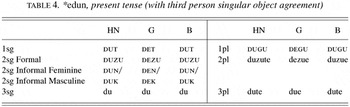
Table 4, which compares inflectional paradigms for *edun in B, G, and HN, shows variation between all first and second person forms. The root vowel of *edun is e in G forms and u in HN and B forms. Notice also that 2sg informal forms agree with the gender of the interlocutor: the form is dun when addressing female interlocutors and duk for male interlocutors. As with izan, HN and B forms for *edun are identical, except for 2pl formal.
*edun, present tense (with third person singular object agreement)

In the auxiliary system described so far, adressee agreement is only triggered when a familiar interlocutor is an argument of the verb, as a subject, object, or indirect object. This system is referred to as zuka. However, Basque also has a parallel set of auxiliary forms with allocutive agreement: that is, agreement is triggered even when the interlocutor is not an argument of the verb. In the Southern Basque Country, this set of forms, referred to as hika, is used only in informal speech (Echeverria, 2000).12
Some Northern dialects have an additional set of allocutive forms for formal addressees (Oyharçabal, 1983).

In the forms in (8), the final n morpheme on the auxiliary marks agreement with the interlocutor's gender (feminine) even though the latter is not an argument of the verb. These examples also show that allocutive agreement triggers an alternation in auxiliary selection: *edun is selected even though the construction is intransitive (Oyharçabal, 1983:94, fn. 7). Because they are subject to the same pattern of root vowel alternation as discussed for nonallocutive forms, allocutive forms have been included in the present data set.
Apheresis
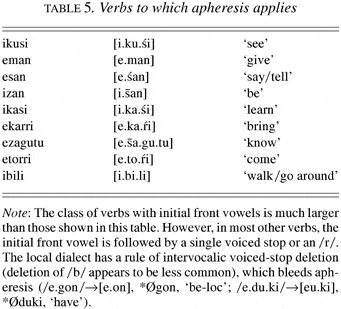
A second feature identified by Zuazo (1997) as distinguishing G and HN dialects is apheresis: deletion of a word-initial atonic vowel when the following syllable is stressed. Apheresis is a characteristic feature of HN varieties but is uncommon in G dialects. The dialectological literature on apheresis in HN communities (Fraile & Fraile, 1996; Txillardegi, 1987; Zuazo, 1997, 1998b) and field observations for the present study suggest that the rule applies only to front vowels /i/ and /e/ and much less so to the back vowel /a/; it does not target /u/, /o/, or any diphthongs. Apheresis is especially common in the set of high-frequency verbs shown in Table 5. When apheresis applies, these verbs lose the word-initial front vowel (/i/ or /e/): for example, /i.ku'.śi/→[Øku'.śi].
Verbs to which apheresis applies

Historically, the word-initial elements were derived from a verbal marker (/*e/) that applied to verbs (Trask, 1997:154). Over time /*e/ raised to [i] before a high vowel in verbs with more than two syllables (Trask, 1997:154). Note, however, that both izan and ikasi appear to violate this rule: both have an initial i- and no following high vowel (and in addition, izan is bisyllabic). In the case of izan, initial i- forms part of the verb root (visible in the form na-iz in Table 3) and is not a prefix. Ikasi, on the other hand, seems to be a true exception to this rule (Trask, 1997:154).
Nonverbs also undergo apheresis. In the interviews conducted for this study several nonverbs, such as

‘house’ and ‘house’ and

[local neighborhood name], were also observed. For the present study, though, only the verbs in Table 5 were examined.
Lexis
Zuazo (1997, 1998b) identified a set of lexical items whose forms vary in G and HN. The present study focused on two of the most frequently occurring items: mino/baino ‘but’ and ondo/ongi ‘well’.
mino/baino
The conjunction akin to English ‘but’ is typically

(mino and bino in Basque orthography) in HN dialects and

(baino) in G dialects (Zuazo, 1997, 1998b). The B form is

(baina). In the present data, several intermediate forms of the first vowel also occurred, such as

. Mino and baino also serve in their respective dialects as the comparative conjunction, akin to English ‘than’. Occurrences of these forms in comparatives, however, were not considered here.
ongi/ondo
English adverbial ‘well’ typically appears in G dialects as ondo [on.do] and in HN dialects as ongi

. In B, both forms are used. These elements are transparently bimorphemic. The first syllable in each, on, exists as a free-standing adjective meaning ‘good’ in both dialects. The second elements, -ki/-to, are adverbial markers. Dialectal alternation in the adverbial suffix is visible in a handful of other forms (e.g., hobe-ki/ hobe-to ‘better’), but only ondo/ongi were considered here.
Hypotheses
The primary goal of the study was determine whether quantitative, apparent-time evidence exists for changes in progress in the forms discussed here. If, as the dialectological literature suggests, these isoglosses are moving eastward, then we could expect older speakers to prefer HN forms (ongi, mino, HN forms of auxiliary verbs, and apheresis) and younger speakers to prefer G forms (ondo, baino, G forms of auxiliary verbs, and absence of apheresis). Indeed, many of the dialectological sources (Fraile & Fraile, 1996; Zuazo, 1997) have suggested that these changes are occurring relatively rapidly.
Hypothesis 1: Older speakers would favor HN features: apheresis, ongi, mino, and HN forms of *edun and izan. Younger speakers would favor G features: absence of apheresis, ondo, baino, and G forms of *edun and izan.
Irizar (1992) and Fraile and Fraile (1996) both observed differences among Oiartzun's villages in the use of these features. In general, Fraile and Fraile (1996:237) found that speakers in the eastern villages of Gurutze and Ergoien, which border Irun and the Navarran municipality of Lesaka, were particularly likely to use eastern HN features. Likewise, Irizar noted a higher use of G verbs in the western village, Iturriotz, which borders the Gipuzkoan municipality of Errenteria.
During the Franquist dictatorship (1939–1975), mobility in Spain was more restricted than it is today. Through the 1970s, few people in Oiartzun owned cars, and train and bus service was relatively limited. One 45-year-old informant recalled as a child never dreaming of owning a car. Another 41-year-old informant remembered as a child knowing of only four or five cars in the whole town and recounted a period of transition when people began acquiring cars very rapidly.13
Original text: “Ni(k) mutixkortan iza(g)utu ditik, ba lau, bost kotxe Oiartzunen. Urte gutxian izandu dek deusezetik, dene(r)a.”
Until about 1980, children attended the small village schools where they tended to form tight friendship networks. As a result, according to informants, residents typically developed strong allegiances to their village. An important way in which local village identity is expressed and reproduced is the annual jaiak. During the summer, each village holds a local festival in which the residents gather for several days for food, drinks, music, dancing, and a variety of sports. During one year's jaiak in the village of Iturriotz, one informant recalled a large banner in the plaza that expressed the village's pride at the expense of the town: Iturriotz saluda a Oiartzun ‘Iturriotz sends greetings to Oiartzun.’
In the early 1980s, the village schools were closed, and children were sent to one of two centralized schools serving the entire town.14
One informant jokingly described the centralization of schooling in Oiartzun as a form of “globalization.”
Hypothesis 2: The participant's home village would be a stronger determinant of use of HN versus G forms for older speakers than for younger speakers.
In her research on language, identity, and gender in Donostia secondary schools, Echeverria (2000) discussed how the use of prestige language in Basque is gender-patterned: informal, allocutive (hika) forms are much more common among male speakers than among female speakers. The author's field observations and interview data suggested a similar pattern in Oiartzun. Community members reported that men used hika much more than women, and several younger women informants reported not “knowing” hika at all. In addition, older speakers were found to use hika more than younger speakers. Data collected in sociolinguistic interviews generally supported these views. In the recorded data, hika was used by male speakers of all ages, but especially older speakers. In contrast, the few female speakers who did use these forms were over 70 years old.
Echeverria explained this difference in terms of an ideological link between language use and gender. Masculinity is iconically linked (Gal & Irvine, 1995) to allocutive use through its connotations of “spontaneity, directness, naturalness, anger, and fun,” which in turn index masculinity (reminiscent of Bourdieu's discussion of la gueule), and through its association with traditional Basque life. The use of allocutive forms is associated with “authentic” Basque life partly because these forms are most common in rural areas. Echeverria argued that men have much greater visibility in popular representations of these traditional spheres than women, and that “authentic” Basque-ness is thereby constructed as masculine. In the school materials she examined, images of individuals engaged in “authentic” Basque roles, such as farmers and fishermen, or in traditional sports were much more often male than female. Echeverria argued that this gendered opposition between solidarity and prestige forms is recursive (Gal & Irvine, 1995) at other linguistic levels, including the oppositions Basque/Spanish and Batua/dialect. Echeverria's finding that the use of prestige versus solidarity forms in the Southern Basque Country is broadly gender-patterned is consonant with work in other Western contexts (Gal, 1979; Labov, 1972; Trudgill, 1995) suggesting that women tend toward prestige forms more than men.
The opposition between G and HN could be hypothesized to carry similar symbolic value. G is historically a prestige form associated with formal domains including the Church and literature. Field observations suggest that contemporary speakers continue to perceive G as prestigious. One informant described G as sounding pijua ‘snobby’. Another described G /e/-root *edun forms, such as det, as being xuabeagoa ‘softer, smoother’ than HN /u/-root forms, such as dut (see Table 4). If, indeed, the greater use of G forms in Oiartzun reflects a change from above, then we could expect that female speakers would use G forms more than male speakers.
Hypothesis 3: Male speakers would use more local forms and fewer regional prestige forms than female speakers.
DATA AND METHODOLOGY
Interviews
The data presented here were collected in sociolinguistic interviews by the author in July and August of 2001. Two aspects of the interview context were likely to favor the use of B and G forms. First, although certain standard measures were taken to elicit the vernacular, the formal nature of an interview tends to favor more self-conscious forms and disfavor the vernacular (Labov, 1972). Recent work on language attitudes in the Southern Basque Country has suggested that B has come to be seen by many speakers as the appropriate variety for formal contexts (Echeverria, 2000; Urla 1987, 1993).15
Amorrortu (2000) presented data from matched guise experiments in which college-aged respondents rated Bizkaian guises higher than standard Batua guises in both solidarity and professionalism dimensions.
Second, the fact that the interviews were conducted by the author, a nonnative speaker of Basque and a nonmember of the community, may have favored more careful speech (Douglas-Cowie, 1978; Rickford & McNair-Knox, 1994). Several comments by participants during the interviews suggested that they were aware that the interviewer was a nonnative speaker. For example, one speaker offered a repair—‘without charging anything’ (ezer kobratu gabe)—for a colloquial expression meaning ‘free’ (musutruk). Another speaker interrupted a narrative describing the collection of gorse (otea) to ask, “Do you know what it is?” Because gorse is abundant in the Basque Country, this question would not likely have been posed to a native speaker. Because B is the variety used in schools and in adult Basque-language classes, B is widely associated with nonnative speakers (euskaldunberriak); indeed use of “pure” B without salient dialectal features is often taken as a tell-tale sign of a nonnative speaker (Amorrortu, 2000; Echeverria, 2000; Urla, 1987). Hence, because the interviewer was a nonnative speaker, younger participants may have tended to converge using B.
Older and middle-aged speakers, who are generally much less familiar with B, may have converged using G, which until 30 years ago served as a de facto Basque standard. This explanation is in keeping with comments by informants. One informant remarked that Oiartzuarrans often considered Goierri (an area of Gipuzkoa) Basque to be cleaner sounding than the local dialect, and that when people try to speak more clearly they often used G forms.
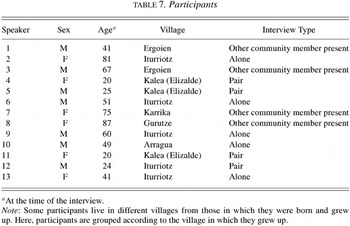
Two measures were taken to minimize these possible effects. First, the interviewer used HN forms as much as possible to signal that he was familiar with the local dialect and also to help establish an informal mood. Second, whenever possible, informants were interviewed in pairs or with another community member participating. Eight of the thirteen participants who provided data for this study were interviewed in pairs or with another community member present; the remaining five were interviewed one-on-one by the author. The fact that the interview situation varied across speakers introduces a different methodological problem as the effect of the interview situation was not constant for all speakers. Differences in data among speakers may partially reflect differences in the interview situation rather than the effects of the independent social and linguistic variables under study. To address the problem of a noncommunity member interviewer, tokens were also coded for interview type.
Participants were told that the purpose of the study was to learn about the language and local life of Oiartzun, and that the interview itself would focus on these topics. The interview questions were organized into the following modules: childhood, local life and traditions, personal experiences, goals/aspirations, language, and background/biographic information. However, because the goal of the interview was to elicit maximally unself-conscious speech, the interviewer did not interrupt participants when they occasionally strayed from the interview topics to issues that held greater interest for them.
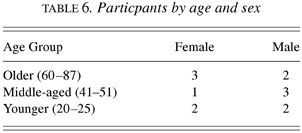
In order to construct an effective test of the three hypotheses, participants were recruited with a view toward creating an even distribution of speakers across the categories age, sex, and village of origin. Table 6 shows that a relatively even distribution of participants by age and sex was achieved. Participants were much less evenly distributed by village. Oiartzun has eight villages, of which only six were represented in the present data; the villages Altzibar and Ugaldetxo were unrepresented. Morever, if, as Fraile and Fraile (1996) suggested, the main dialectological division within Oiartzun is between the eastern villages of Gurutze and Ergoien, on one hand, and the other central and western villages, on the other, then the data presented here are not ideally representative. Only three of the thirteen participants were from Gurutze and Ergoien. Table 7 shows the participants' age, sex, village, and interview type (alone, in pairs, or with another community member present.) The data were analyzed using goldvarb, version 2.0 (Sankoff & Rand, 1990), a variable rule application for Macintosh computers. Results of these analyses are presented and discussed next.
Particpants by age and sex

Participants

RESULTS AND DISCUSSION
The following sections present the results for each of the five dialectal features: apheresis, auxiliary verbs, and a selection of lexical items for ondo/ongi and baino/mino.
Apheresis
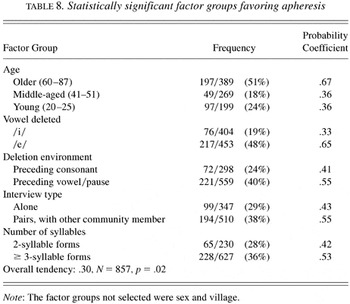
Table 8 presents statistically significant factor groups for apheresis.16
All tables presenting multivariate analyses show factor groups in order of decreasing significance.
Statistically significant factor groups favoring apheresis

Table 8 also shows that a series of internal factors constrains deletion. One of these appears to be a CV-sequencing effect. Preceding consonants disfavor deletion of the initial vowel, and preceding vowels and pauses favor deletion. Another factor is the number of syllables in the target. Bisyllabic forms resist deletion, whereas forms that are trisyllabic or longer weakly favor it. This may reflect a word-minimality constraint to the effect that verbs tend to be minimally bisyllabic. This constraint is essentially indifferent to trisyllabic and longer forms (.53); deletion would not produce monosyllabic forms. However, bisyllabic forms resist deletion (.42) since the output would be monosyllabic and hence violate the apparent word minimality constraint.
By far the strongest internal factor constraining deletion is the height of the initial vowel (i.e., the target of deletion). Verbs with an initial /i/ (ikasi, izan, ibili, and ikusi) strongly disfavor apheresis (.33), whereas verbs with an initial /e/ (etorri, eman, esan, ekarri, and ezagutu) strongly favor it (.65). No account of this pattern was found in the dialectological literature, and no account of it is offered here.
The apheresis data do not provide support for the prediction that men's speech would exhibit more HN forms (apheresis) and fewer G forms (absence of apheresis) than women's speech (Hypothesis 3). In fact, in the present data, the opposite pattern holds. Overall, women show higher frequencies of HN forms than men (37% vs. 32%), although this factor group was not selected as significant at .05.17
The table here shows apheresis by speaker sex.

Data on apheresis in the present sample may provide evidence supporting Hypothesis 2, which predicted that differences among villages would be more salient among older speakers than among younger speakers. In particular, Fraile and Fraile (1996) observed that speakers in the eastern villages of Gurutze and Ergoien, bordering the municipalities of Irun and Lesaka, were more likely to use Eastern features (including apheresis) than speakers from the central and western villages. In the present data, speakers from Gurutze and Ergoien do generally show higher frequencies of apheresis than other speakers. However, the participant with the highest frequency of apheresis was not from these villages but from Karrika, located in the southeastern parts of the valley. This is perhaps unsurprising because Karrika borders the HN-speaking Navarran municipality of Goizueta18
Today, the road connecting Karrika directly with Goizueta is closed. However, older residents recall a time when travel to Goizueta by this route over the mountains was common.
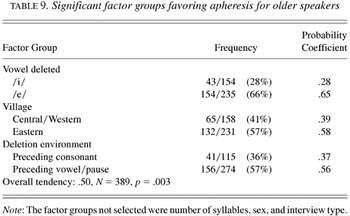
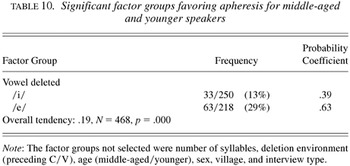
To test Hypothesis 2, separate goldvarb runs were performed for older speakers, on one hand, and younger and middle-aged speakers, on the other. Tables 9 and 10 presents statistically significant factor groups for older speakers and middle-aged/young speakers, respectively. As predicted, village is a significant factor for older speakers but not for younger speakers. The data in Table 9 would seem to bear out Fraile and Fraile's observation that eastern villages favor apheresis (.58) and western villages disfavor it (.39). In contrast, Table 10 shows that village is not significant for middle-aged and younger speakers. This is precisely the pattern predicted by Hypothesis 2. However, it cannot be determined whether the pattern in Table 9 truly reflects a village distinction, largely because the interview types for the two groups of older speakers are different. Older eastern speakers were all (coincidentally) interviewed with another community member present, and older western speakers were all (coincidentally) interviewed alone. On the assumption that one-on-one rather than group discussions are likely to push speakers toward G forms, the pattern for older speakers in Table 9 may be a reflection of the interview situation rather than speech differences among villages.
Lexis
Mino/baino
The dialectological literature discusses forms of the conjunction akin to English ‘but’ as a characteristic distinguishing G from HN (Fraile & Fraile, 1996). The canonical form for the former is

(grapheme baino) and for the latter,

(grapheme mino). However, the present data also included a series of intermediate forms such as

. Alternation among these forms was analyzed here along two dimensions: (i) nasality versus nonnasality of the initial labial and (ii) height of following vowel (/i/ vs. lower vowels).
Significant factor groups favoring apheresis for older speakers

Significant factor groups favoring apheresis for middle-aged and younger speakers

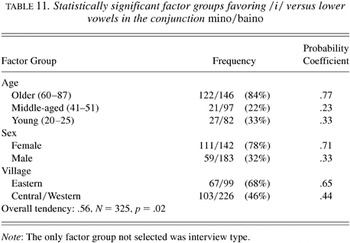
Table 11 shows statistically significant factor groups for mino/baino. As predicted by Hypothesis 1, older speakers strongly favor the use of /i/ forms (.77), whereas younger and middle-aged speakers favor lower vowels. However, contrary to expectations, middle-aged speakers favor lower vowels even more strongly than younger speakers (.23 vs. .33, respectively). Here is yet another instance where the relationship between younger and middle age speakers poses a problem for the hypothesis of change in progress. Recall from the discussion of apheresis that these two groups show equal probability coefficients for apheresis (.36).
Statistically significant factor groups favoring /i/ versus lower vowels in the conjunction mino/baino

Table 11 also shows a strong gender difference. Women strongly prefer /i/ (.71), whereas men strongly prefer lower vowels. This is the exact opposite of the expected pattern. Hypothesis 3 predicted that women would tend toward prestigious G forms and that men would conserve HN forms. However, Table 11 shows that, in fact, it is women rather than men who tend to conserve the HN form, /i/.
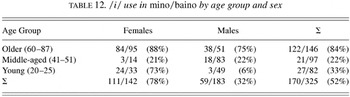
Female speakers appear to be the key group in accounting for the unexpected pattern between younger and middle-aged speakers. Table 12 breaks down /i/ use by age group and sex. In Table 12, all groups exhibit the expected patterning of a change in progress, except young females. Young females in the present data use /i/ more frequently than middle-aged speakers and nearly as frequently as the oldest age group. Male participants exhibit the expected pattern (i.e., /i/ use is directly related to age), and so it is young female speakers who account for the fact that younger speakers overall are more likely to favor /i/ than middle-aged speakers.
/i/ use in mino/baino by age group and sex

Moreover, this same group seems to account for the sex difference in Table 11. At first glance, the sex difference appears to be constant across the age groups. Among older and middle-aged speakers, women show a much higher frequency of /i/ use than men (87/109 (80%) vs. 56/134 (42%), respectively), just as in the case of younger speakers. However, the sex difference among the two older groups may instead reflect an age difference resulting from a data skew. Among older speakers, the token set is higher for women than for men (95 vs. 51, respectively), whereas among middle-aged speakers the opposite is true: the token set is much smaller for female speakers than for male speakers (14 vs. 83, respectively). Hence, the apparent sex difference among the two older groups may instead reflect the fact that middle-aged speakers show lower frequencies of /i/ use than older speakers. (When younger speakers are excluded from analysis, sex is no longer selected as a significant factor group; however, this difference may be due in part to a reduced token set: n = 243.) Hence, the only clear difference in /i/ use by sex is among younger speakers.
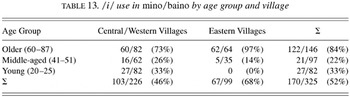
Finally, Table 11 shows a difference between eastern and western villages: the former favor /i/, whereas the latter favor lower vowels. In fact, the cross-tabulation in Table 13 shows that this difference reflects a difference among older speakers rather than among middle-aged and younger speakers. Middle-aged speakers actually show the opposite pattern, albeit weakly. Eastern middle-aged speakers show a slightly lower frequency of /i/ forms than western middle-aged speakers. (Because of the small token set, a separate multivariate analysis could not be performed for older speakers.) Again, because older eastern speakers were interviewed in circumstances different from older western speakers, it cannot be determined whether these data reflect true support for the hypothesis that village differences are the most salient for older speakers (Hypothesis 2).
/i/ use in mino/baino by age group and village

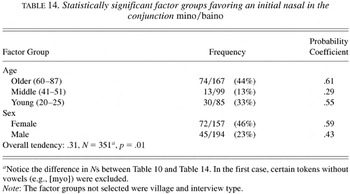
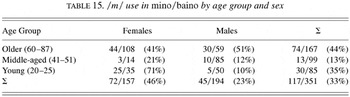
Mino/baino variation was also examined in terms of nasalization versus nonnasalization of the initial labial. Table 14 presents statistically significant factor groups for initial nasals in mino/baino. Table 14 shows the same age and sex patterning in the case of vowel height in mino/baino. Older speakers favor the HN feature, /m/, and middle-aged speakers strongly favor the G feature, /b/. This is exactly the pattern predicted in Hypothesis 1. However, younger speakers again fall in between the two older groups, and in fact younger speakers favor /m/, contrary to Hypothesis 1. Moreover, the exact opposite gender pattern emerges from that proposed in Hypothesis 3: female speakers favor the HN form, /m/, whereas male speakers favor the G form, /b/.
Statistically significant factor groups favoring an initial nasal in the conjunction mino/baino

Again, the crucial group of speakers in explaining these patterns is young female speakers. Table 15 breaks down /b/ and /m/ use by sex and age group. All groups pattern exactly as expected in the case of change in progress, except young female speakers. This group shows the highest use of /m/ of any of the groups. Again, this group singlehandedly appears to account for the two key patterns shown in Table 14. First, this finding helps explain why younger speakers (unexpectedly) favor /m/ more than middle-aged speakers. Again, because young male speakers use /m/ as they “should” (i.e., less than their elders), it is the high frequency of /m/ use among young female speakers that causes the young group to show higher frequencies of /m/ than the middle-aged group.
/m/ use in mino/baino by age group and sex

Second, young female speakers also account for the gender pattern. Again, at first glance, the gender difference seems to hold across age groups. Middle-aged and older women combined show higher frequencies of /m/ than middle-aged and older men (47/122 (39%) vs. 40/144 (28%), respectively). However, this difference may instead reflect the same data skew discussed earlier. Among older speakers, the token set is much larger for female speakers than for male speakers (108 and 59, respectively), whereas for middle-aged speakers, the token set is smaller for women than men (14 vs. 85). Hence, among older speakers, this difference may reflect an age difference rather than a gender difference. (In multivariate analysis with younger speakers excluded, sex is not selected as a significant factor group, although again this may reflect a reduced token set: n = 266.)
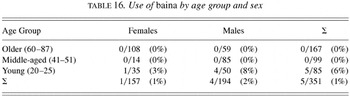
Finally, the B form of this conjunction,

(grapheme baina) differs from G and HN forms, which lets us see the influence of the standard, B, on the local vernacular. Table 16 breaks down use of this standard form by age group and gender. (Because of the low number of tokens for baina, multivariate analysis could not be performed.)
Use of baina by age group and sex

Predictably, younger speakers, who received B-medium primary and secondary instruction, are the heaviest users of baina, and in fact they are the only participants who use this form in the present data. However, their use of baina is extremely limited (6%). Note, though, that men's use of this nonlocal form is higher than that of women. This fits the pattern discussed for other aspects of baino/mino: that is, male speakers favor standard forms.
Ondo/ongi
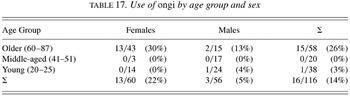
Because the available token set for ondo/ongi (adverbial ‘well’) is very small (n = 116), no multivariate analysis could be performed on these items. However, the cross-tabulations suggest that the distribution of ondo/ongi by age and gender is similar to that for apheresis and mino/baino. Older speakers and women favor the HN form, ongi, and middle-aged/younger speakers and men favor the G form, ondo (see Table 17).
Use of ongi by age group and sex

Auxiliary verbs
Overall, G forms are much less frequent in the transitive auxiliary *edun than in the intransitive auxiliary izan.19
In goldvarb runs with both auxiliaries, combined *edun strongly favors HN forms, whereas izan favors G forms.
*edun
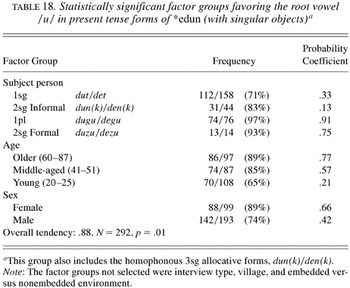
Table 18 presents significant factor groups favoring the HN root vowel, /u/, versus the G root vowel, /e/, in present tense forms of *edun. Subject persons break into two groups: 1pl and 2sg formal subjects strongly favor the HN /u/-root forms, whereas 1sg and 2sg informal subjects show somewhat lower frequencies of /u/-root forms and strongly favor /e/-root forms. These differences may reflect the general structural fact that these two groups (1sg and 2sg informal, on one hand, and 1pl and 2sg formal, on the other) pattern similarly across auxiliary paradigms (see, e.g., Tables 3 and 4). This patterning is largely a result of the historical fact that 2sg formal forms were previously 2pl forms. The contemporary 2sg informal form was, at that point, the sole 2sg form (Trask, 1997). Consequently, structural affinity between 1sg and 2sg informal forms, on one hand, and 1pl and 2sg formal forms, on the other, reflects a historical singular–plural distinction for non-third person forms. In Table 18, this same patterning reappears. This suggests that differences in auxiliary root variation by subject person are governed largely by structural analogy rather than by pragmatic factors such as a formal/informal distinction. Crucially, the nonallocutive, formal form (1sg) patterns with the informal forms (2sg informal and 3sg allocutive) rather than with the other nonallocutive, formal forms (2sg formal and 1pl).
Statistically significant factor groups favoring the root vowel /u/ in present tense forms of *edun (with singular objects)a

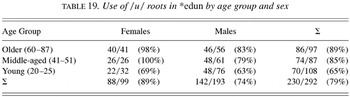
Table 18 shows the same gender difference observed in mino/baino alternation. Contrary to Hypothesis 3, female speakers strongly favor the HN form, whereas male speakers strongly favor the G form. Table 19 breaks down /u/-root use by sex and age group and shows that this sex difference is constant across the three age groups. This sex difference is also supported by a piece of real-time evidence. The twentieth-century Basque linguist Koldo Mitxelena (b. 1915) made the following observation of sex-difference in *edun forms in the neighboring town of Errenteria: “For me, the forms are dut [HN], etc. With regard to det [G], the difference is above all sex. I have never heard it from a woman” (Zuazo, 1997:418; my translation).20
Original text: “Para mí las formas son dut, etc. En cuanto a det, la diferencia es ante todo de sexo. No se lo he oído jamás a una mujer.”
Use of /u/ roots in *edun by age group and sex

Table 18 shows strong support for a change in progress (Hypothesis 1). As expected, older speakers strongly favor /u/-forms (.77), younger speakers strongly disfavor them (.21), and middle-aged speakers fall in between (.57). At first glance, these data seem to provide no evidence of any influence of B on younger speakers' use of auxiliary verbs. Recall that the B and HN forms of *edun are essentially identical in that they share a /u/-verbal root; G forms, however, have an /e/-root (see Table 5). Given the likelihood of B influencing young people's speech (and only theirs), a reversal or at least a slowing of the change toward /e/ forms might be expected. However, Table 18 shows no change in this trend: younger speakers appear to be continuing the shift toward /e/-root forms. Indeed, that the difference in probability coefficients is greater between younger and middle-aged speakers (.34) than between middle-aged and older speakers (.20) suggests that the shift toward /e/-root forms may be accelerating rather than slowing. These results, then, appear to be in keeping with the data from mino/baino/baina. Although the younger group uses the B form baina slightly more frequently than the older groups, their overall frequency is still very low, suggesting little evidence for a significant effect of B on younger people's speech.
An alternative view of the data in Table 18 is that the emergence of B has influenced local speech not by favoring /u/-root forms, but by disfavoring them.21
I thank an anonymous reviewer for suggesting this possibility and for a helpful discussion of the *edun data.
The foregoing discussion highlights an important methodological shortcoming of this study. Much more systematic data on local attitudes toward these varieties, in their historical and social context, is needed to understand the change examined here. Future research on dialect contact among these varieties might inquire into ideologies of gender and language, as these bear on specific linguistic features, as shown in the work of Echeverria (2000) and Amorrortu (2000).
izan
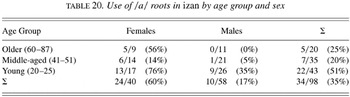
The 1pl and 2sg formal forms of izan vary by dialect (see Table 3). In western varieties the root vowel is /e/ (zera, gera) and in eastern varieties it is /a/ (zara, gara). Because the present data set for these alternations is very small (n = 98), no multivariate analysis could be performed.
Table 20 breaks down use of these forms by sex and age. Although the data are very limited, especially for older speakers,22
Younger speakers may make greater use of the impersonal you expression (common in local Spanish) than older speakers, though I am aware of no thorough study of this phenomenon.
Moreover, among younger speakers, frequencies of /a/-root forms are much higher for women than for men. This pattern suggests support for Echeverria's claim that women tend toward formal B forms more than men. However, two facts disfavor such an interpretation. First, the gender difference in these forms appears to be relatively constant across age groups. Only younger speakers have had extensive exposure to B, so it is unclear why older and middle-aged women would also favor /a/-root forms, if in fact the influence of B does account for this pattern. Second, young female speakers do not show higher frequencies than young males for other B (or B/HN) forms such as /u/-root forms of *edun or mino/baino/baina. I thank an anonymous reviewer for a helpful discussion of these facts.
Use of /a/ roots in izan by age group and sex

However, Fraile and Fraile's (1996:109) findings suggest that the direction of change may be exactly the opposite of that proposed here (i.e., a change from /e/ root forms to /a/ root forms): “Those older than 80 years old more rarely use forms like gu ga, zu za. Rather, more frequently, gu gea, zu zea.”24
Original text: “Hiztunik zaharrenengan erreparatzen bagara, beharbada asimilaziorik guttien auetxek egiten dutela ohartzen gara. 80 urtez goitikoek bakanago erabiltzen baitituzte ‘gu ga,’ ‘zu za’ … bezelako formak. Ugariago aldiz, ‘gu gea,’ ‘zu zea.’ ”
The sex difference visible in Table 19 is by now familiar. Contrary to Hypothesis 3, female speakers show higher frequencies of HN forms than male speakers.
CONCLUSION
Change in progress
Strong evidence exists that each of these elements, with the exception of /e/–/a/ root vowel alternation in izan, is undergoing change (Hypothesis 1). The data on apheresis, mino/baino, ondo/ongi, and /e/–/u/ root vowel alternations in *edun all show clear differences between older and younger speakers' uses of eastern and western forms. In the case of apheresis, an age difference only appears between the oldest speakers, on the one hand, and middle-aged and younger speakers, on the other. As discussed earlier, it remains unclear why younger speakers fail to show lower rates of apheresis than middle-aged speakers. More data are needed to determine whether this change is ongoing.
The different elements appear to be changing at different rates. The /e/-root forms of *edun seem to be entering local speech most rapidly, followed by [-high] vowels in the conjunction mino/baino and, finally, absence of apheresis. Table 18 shows a sharp difference in factor weights for older speakers (.77) and younger speakers (.21)—a difference of .56. As Table 11 shows, the age difference for /i/ use in mino/baino is slightly smaller (.77 vs. .33, respectively)—a difference of .44. And as Table 8 shows, this difference is even smaller in the case of apheresis; the factor weight is .67 for older speakers and .36 for younger speakers—a difference of .31.
Following the common assumption that rate of change is directly related to strength of motivation for change, the obvious explanation for why *edun is entering local speech most rapidly is that it carries the strongest social motivation for change. Field observations supported this hypothesis. During fieldwork, several informants referred explicitly to forms of *edun as a prestige or dialect marker. In contrast, no informant made explicit reference to apheresis or mino/baino as a prestige or dialect marker. Urla (1987:315) reported that her informants were particularly conscious of differences in auxiliary root vowels as dialect markers. This suggests that speakers are indeed more conscious of *edun as a dialect marker than other variables. It seems likely, then, that *edun has become emblematic of dialect difference.
Gender and prestige forms
None of the variables discussed here provide significant support for Hypothesis 3, which was formulated in view of Echeverria's (2000) proposal that women use prestige forms more than men. It was hypothesized that female speakers would prefer the incoming prestige forms (G) over the outgoing forms (HN). Instead, the data on mino/baino alternation and *edun provide statistically significant support for the opposite: that is, men are leading a change toward G forms and women are conserving local HN forms.25
The frequencies for apheresis and izan also suggest support for this alternative hypothesis, but these differences were not statistically significant.
The fact that sex is not selected as a significant factor group for apheresis is problematic for this alternative hypothesis. If the dialectal contrast itself has become a gender marker, then it is unclear why rates of apheresis do not differ significantly by sex. Differences in rates of change among these variables may shed light on this problem. The two elements that are changing fastest, *edun and vowel alternation in mino/baino, show the sharpest sex distinction. Absence of apheresis, which is entering local speech much more slowly, does not show a significant sex distinction. This suggests that the features with the strongest motivation for change—the most salient or strongly marked dialectal features—are also the features most likely to become gender markers. Hence, because apheresis is relatively less salient as a dialect marker, as diagnosed by its rate of change, it has not emerged as a gender marker.
One possible historical explanation for the gender difference in G and HN forms is that men and women have had differing access to G as a consequence of labor market forces. Traditional primogeniture has meant that most siblings have had to seek work away from the family farm (baserri) either in the Church, military, in industry (in recent times), or by marrying into another local baserri. In recent generations, and especially since the onset of heavy industrialization in the area in the twentieth century, men in Oiartzun have increasingly found work in locations where they would be exposed to G speakers, especially the local mines (Arditurri), the shipyards of Pasai, and the factories of Errenteria. This contact may be partly responsible for increased use of G forms among men. However, the consequences of primogeniture apply equally to women. Women have also had to find work outside the community or have held jobs where they could be expected to have had contact with G speakers. Traditional occupations for women away from the baserri include maids, waitresses, shop clerks, and other positions in the service industry (Douglass, 1976).26
In her description of industrialization in the Gipuzkoan town of Usurbil, Urla (1987:175) reported that both men and women found work in new local factories. Similarly, informants for the present study reported that some women also found work in the local mines (Arditurri). Nonfarm employment for women therefore seems not to have been limited exclusively to the service sector.
However, in describing the historical development of a gender difference in hika use, Echeverria (2000:240) suggested that the distinction between men's and women's employment patterns may explain the gendered use of G and HN forms. Echeverria proposed that, in recent generations, most nonfarm employment for men has been in the industrial sector, where they would likely have Basque speaking coworkers and be expected to use Basque. In contrast, nonfarm positions for women have typically been in the service sector where Spanish rather than Basque is more in demand. This possibility is supported by the comments of one of Echeverria's informants, who reported that girls from her town often worked as maids in the city (Donostia) where they developed inferiority complexes about speaking Basque and consequently tended to use Spanish. Hence, it may be that nonfarm employment has led to greater contact with G for men and greater contact with Spanish for women.
Hence, dialectal variation between G and HN seems to be a gender marker in its own right: that is, they have become “iconically” linked, to use Gal and Irvine's (1995) term. The younger speakers interviewed in this study are all primarily students, and none are active in the gendered labor spheres just described. Hence, it would seem that their perpetuation of the gender pattern in dialect variation is not a direct result of market forces and greater or lesser exposure to G, but is a reflection of the differential use of G and HN that has emerged as a gender marker: men tend toward G forms and women tend toward HN forms. This historical account of the gender difference in G and HN forms is admittedly speculative. More data is needed to support these hypotheses.
Dialectal variation by village
Hypothesis 2 predicted that differences among villages would be stronger for older speakers than for younger speakers. In the present data this pattern does emerge in the case of apheresis and mino/baino. Older speakers from western villages tend toward G forms and those from eastern villages tend toward HN forms. However, because the interview situation for these two groups was different, it cannot be determined whether the data reflect true intervillage differences or merely the difference in circumstances. The fact that differences in interview situation appear as a significant factor in the case of another variable, apheresis, supports skepticism in this regard.
Standardization
Relatively little evidence exists for a strong effect of the new standard variety (B) on the speech of younger speakers. Because B has been slowly introduced into the media and educational system over the past thirty years, younger speakers have had the most exposure to it. However, in the case of /e/–/u/ verbal root alternations in *edun no effect is visible. Likewise, in the case of the conjunction, mino/baino/baina young speakers show only a slight tendency toward the B form (6%).
Directions for future research
This article has described a series of dialect-based changes in progress in the Southern Basque Country. Data collected in sociolinguistic interviews with thirteen speakers from the town of Oiartzun supported the hypothesis that several western G forms are entering local speech. In addition, it was shown that men are leading this process of change. These results suggest three main directions for further research. First, a more thorough understanding is needed of speakers' attitudes toward these varieties in order to understand these processes of change and dialect contact. Second, much more research is needed into the historical context underlying the gendered distribution of G and HN forms. Finally, an examination of a broader range of linguistic features is needed to gauge the effects of standardization on the local vernacular.
References
REFERENCES
Amorrortu, Estibaliz.
(2000).
Linguistic attitudes in the Basque Country: The social acceptance
of a new variety.
Doctoral dissertation,
University of Southern California.
Artiagoitia, Xabier.
(2000).
Hatsarreak eta parametroak lantzen.
Gasteiz:
Arabako Foru Aldundia.
Basque Statistical Office.
(1996).
http://www.eustat.es
Bonaparte, Louis-Lucien.
(1863).
Carte des sept provinces basques, montrant la délimitation
actuelle del'euscara.
London.
Caro Baroja, Julio.
(1971).
Los vascos.
Madrid:
Istmo.
Douglas-Cowie, E.
(1978).
Linguistic code-switching in a Northern Irish village: Social
interaction and social ambition. In
P. Trudgill (ed.),
Sociolinguistic patterns in British English.
Baltimore:
University Park Press.
37–51.
Douglass, William A.
(1976).
Serving girls and sheepherders: Emigration and continuity in a
Spanish Basque village. In
J. B. Aceves &
W. A. Douglass (eds.),
The changing faces of rural spain.
New York:
Wiley.
45–62.
Echeverria, Begoña.
(2000).
Basque schooling: What is it good for?
Doctoral dissertation,
University of California, San Diego.
Fraile Ugalde, Idoia, &
Fraile Ugalde, Ainhoa.
(1996).
Oiartzungo hizkera.
Oiartzun:
Mugarri.
Gal, Susan.
(1979).
Language shift: Social determinants of linguistic change in
bilingual Austria.
New York:
Academic.
Gal, Susan, &
Irvine, Judith.
(1995).
The boundaries of languages and disciplines: How ideologies
construct difference.
Social Research
62:967–1001.Google Scholar
Irizar, Pedro.
(1992).
Morfología del verbo auxiliar alto navarro septentrional
(vol. 2).
Navarran Government and Basque Language Academy.
Jimeno Jurío, José María.
(1998).
Navarra, Gipuzkoa y el Euskera.
Iruñea:
Pamiela.
Labov, William.
(1972).
Sociolinguistic patterns.
Philadelphia:
University of Pennsylvania Press.
Lekuona, Manuel.
(1995).
Oiartzun. In
Enciclopedia general ilustrada del pais vasco.
Oiartzun: Sendoa.
105–156.
Olano, Mikel.
(2000).
Gipuzkoa ondoko bi hizkera nafar: Areso et Leitzako paradoxa, In
Koldo Zuazo (ed.),
Dialektologia Gaiak.
Gasteiz:
Arabako Foru Aldundia.
123–147.
Oyharçabal, Bernard.
(1983).
Verb agreement with non-arguments: On allocutive agreement. In
J. I. Hualde &
J. O. de Urbina (eds.),
Generative studies in Basque linguistics.
Amsterdam:
Benjamins.
89–114.
Rickford, John, &
McNair-Knox, Faye.
(1994).
Addressee- and topic-influence style shift: A quantitative
sociolinguistic study. In
Douglas Biber &
Edward Finegan (eds.),
Sociolinguistic perspectives on register.
New York:
Oxford University Press.
235–276.
Sankoff, David, &
Rand, David.
(1990).
goldvarb, version 2.0.
Montreal:
Centre de recherches mathématiques, Université de
Montréal.
Trask, R.L.
(1997).
The history of Basque.
London:
Routledge.
Trudgill, Peter.
(1995).
Sociolinguistics: An introduction to language and society.
London:
Penguin.
Txillardegi.
(1987)
Euskal dialektologiaren hastapenak.
Bilbo:
Udako Euskal Unibertsitatea.
Urla, Jaqueline.
(1987).
Being Basque, speaking Basque: The politics of language and
identity in the Basque Country.
Doctoral dissertation,
University of California, Berkeley.
Urla, Jaqueline.
(1993).
Contesting modernities: Language standardization and the production
of an ancient/modern Basque culture.
Critique of Anthropology
13:101–118.Google Scholar
Zuazo, Koldo.
(1997).
Oiartzungo hizkeraren kokagunea.
Fontes Linguae Vasconum.
397–425.
Zuazo, Koldo.
(1998a).
Euskalkiak, gaur.
Fontes Linguae Vasconum.
191–233.
Zuazo, Koldo.
(1998b).
Nafarroako euskal hizkerak. In
Iñaki Camino (ed.),
Nafarroako euskal dialektologoiako jardunalkietako agiriak.
Bilbo:
Udako Euskal Unibertsitatea.
1–22.
Zuazo, Koldo.
(2000).
Euskararen sendabelarrak.
Irun:
Alberdania.
Zubiri, Juan Joxe.
(2000).
Arano eta Goizuetako hizkera. In
Koldo Zuazo (ed.),
Dialektologia Gaiak.
Gasteiz:
Arabako Foru Aldundia.
85–120.
The Basque Country (adapted from Trask, 1997).
Basque dialects (adapted from Trask, 1997).
Oiartzun (adapted from Fraile & Fraile, 1996).

Employed population aged 16 and over, by branches of activity
Population by mother tongue and language spoken at home
Bonaparte's 1863 dialect boundary and Zuazo's 1997 boundary (adapted from Olano, 2000).

izan, present tense
*edun, present tense (with third person singular object agreement)
Verbs to which apheresis applies
Particpants by age and sex
Participants
Statistically significant factor groups favoring apheresis
Significant factor groups favoring apheresis for older speakers
Significant factor groups favoring apheresis for middle-aged and younger speakers
Statistically significant factor groups favoring /i/ versus lower vowels in the conjunction mino/baino
/i/ use in mino/baino by age group and sex
/i/ use in mino/baino by age group and village
Statistically significant factor groups favoring an initial nasal in the conjunction mino/baino
/m/ use in mino/baino by age group and sex
Use of baina by age group and sex
Use of ongi by age group and sex
Statistically significant factor groups favoring the root vowel /u/ in present tense forms of *edun (with singular objects)a
Use of /u/ roots in *edun by age group and sex
Use of /a/ roots in izan by age group and sex
 You have
Access
- 3
- Cited by