Implications
Due to the importance of cattle behaviour and its economic aspects, it is relevant to know the genetic background of behaviour, especially in beef cattle. Current knowledge about chromosomal regions/genes influencing behaviour in cattle is very limited. Therefore, this study is a first step in the identification of responsible regions within the genome as base for the identification of candidate genes to be included in future breeding programmes.
Introduction
In stock breeding of beef cattle the contact between human and animals is reduced and so the instinctive behaviour of the cattle is very important. An aggressive and/or nervous animal presents a danger to the stockmen, to other animals and to itself. The behaviour or temperament itself is described as the reaction of an animal to human interactions (Burrow, Reference Burrow1997), no matter whether it is beef or dairy cattle. Heritability estimates of temperament traits on the basis of behavioural tests range between 0.0 and 0.59 in German Simmental, 0.0 and 0.61 in German Angus (Gauly et al., Reference Gauly, Mathiak, Hoffmann, Kraus and Erhardt2001) and 0.03 in Hereford and Simmental (Hearnshaw and Morris, Reference Hearnshaw and Morris198), respectively.
A quantitative trait locus (QTL) for behaviour during milking in Holstein–Friesian cows was identified in a whole genome scan at BMS764 at BTA29 (Hiendleder et al., Reference Hiendleder, Thomsen, Reinsch, Bennewitz, Leyhe-Horn, Looft, Xu, Medjugorac, Russ, Kuhn, Brockmann, Blumel, Brenig, Reinhardt, Reents, Averdunk, Schwerin, Forster, Kalm and Erhardt2003). In Canadian beef cattle, QTL for behaviour, measured as movement reaction to isolation, was detected at BTA1, 5, 9, 11, 14 and 15 (Schmutz et al., Reference Schmutz, Stookey, Winkelman-Sim, Waltz, Plante and Buchanan2001). In a Holstein × Charolais cross cattle population, temperament traits were analysed in two different tests and QTL for these on 17 chromosomes including BTA29 were identified (Gutiérrez-Gil et al., Reference Gutiérrez-Gil, Ball, Burton, Haskell, Williams and Wiener2008).
The dopamine receptor D4 gene (DRD4) is involved in curiosity behaviour and novelty seeking in different mammals such as mice (Rubinstein et al., Reference Rubinstein, Phillips, Bunzow, Falzone, Dziewczapolski, Zhang, Fang, Larson, McDougall, Chester, Saez, Pugsley, Gershanik, Low and Grandy1997), dogs (Niimi et al., Reference Niimi, Inoue-Murayama, Murayama, Ito and Iwasaki1999), horses (Momozawa et al., Reference Momozawa, Takeuchi, Kusunose, Kikusui and Mori2005) and birds (Fidler et al., Reference Fidler, van Oers, Drent, Kuhn, Mueller and Kempenaers2007). In humans, DRD4 is also associated with novelty seeking, an aspect of human temperament (Keltikangas-Jarvinen et al., Reference Keltikangas-Jarvinen, Elovainio, Kivimaki, Lichtermann, Ekelund and Peltonen2003). On the basis of cattle–human comparative mapping, this gene seems to be located at BTA29 (Larkin et al., Reference Larkin, Everts-van der Wind, Rebeiz, Schweitzer, Bachman, Green, Wright, Campos, Benson, Edwards, Liu, Osoegawa, Womack, de Jong and Lewin2003). This was confirmed by radiation hybrid mapping of a partial sequence of bovine DRD4 (Haegeman et al., Reference Haegeman, Williams, Law, Van Zeveren and Peelman2003). For Bos taurus, only two partial nucleotide sequences of DRD4 are published in the GenBank (accession number AB069666 and AY263349).
The aim of this study was to analyse BTA29 and DRD4 for their effect on behaviour traits in German Angus calves and linkage mapping of DRD4.
The analysis included 545 German Angus calves of six sires, born in four consecutive years at the experimental farm, Rudlos, of the University of Giessen. DNA of all calves, mothers and sires was available. All calves were tested in three different situations – a tethering test at 3 weeks of age (modified after Boissy and Bouissou, Reference Boissy and Bouissou1988), a weighing test at 3 months of age (modified after Tulloh, Reference Tulloh1961) and a separation and restraint test at 7 to 8 months of age (Gauly et al., Reference Gauly, Mathiak, Hoffmann, Kraus and Erhardt2001). For all tests, scores were given ranging from 1 = calm to 5 = very excited and nervous. Score for tethering test is called TT. For weighing test two scores were given, one while entering the scale (ScE) and one during the weighing process (ScW). For separation and restraint test, score ST was assigned. The scores were nearly normally distributed with a left tendency.
With the primer pair DRD4-f1 (5′-tgatgggcacaggttgaata-3′) and DRD4_r1 (5′-ggcgtttcccagttctaaca-3′) a 311 bp PCR product for sequencing (ABI PRISM® 377 DNA sequencer, Applied Biosystems, Darmstadt, Germany) was amplified. A G/T substitution was detected in intron 1 and typified by a PCR-RFLP analysis with primer pair, DRD4_bovin_f3 (5′-gagccgcagcaacagtagt-3′) and DRD4_bovin_r2 (5′-cggctcctctgttattcagc-3′) and enzyme, Alw26I (MBI Fermentas, St. Leon-Roth, Germany). In the case of allele T, the 113 bp PCR fragment was digested into a 90 bp and a 23 bp fragment and the genotyping was done on a 2.5% agarose gel. The amplified sequence of DRD4 was submitted to GenBank (EF157845). The variance analysis of DRD4 was done within the SAS in a linear model with DRD4 genotype, gender and year of test as fixed effects, sire and residual as random effect and age at test as covariate. Within DRD4 the frequency of allele G is 0.65 and 0.35 for T. The population is in the Hardy–Weinberg equilibrium. DRD4 genotype shows a significant effect (P = 0.0376) on score ST. This is in agreement with the physiological functions of DRD4 and its role in the regulation of curiosity, as described before. Assuming that the curiosity of an animal is the predominant motivation to move in the separation and restraint test, this could be confirmed within the study. The effect of the DRD4 genotype on the other three scores was not significant and it is supposed that in the other two behaviour tests the part of curiosity is to a lower degree.
Ten microsatellites (BMS1857, BMS764, BMS1789, ILSTS089, MNB-127, MNB-145, MNB-109, OarHH22, BMC1206, ILSTS081) distributed on BTA29 were typified at the ALFexpress (GE Healthcare Europe, Freiburg, Germany) and at the ABI PRISM® 377 DNA sequencer (Applied Biosystems). One standard sample (Giessen2000) was used and genotyping was done with AlleleLocator version 1.03 and Genotyper V3.7.
The microsatellites showed the polymorphism information content values between 0.492 (ILSTS089) and 0.777 (ILSTS081). The number of alleles ranged from 5 (MNB-127) to 14 (BMS1857). The average of informative meioses was 670 (ranged from 372 in BMC1206 to 927 in BMS764). At BMC1206 only two sires were heterozygous, at all other microsatellites three or more sires were heterozygous.
The microsatellites were used for the mapping of DRD4 with the function build of Crimap (Goldgar et al., Reference Goldgar, Green, Parry and Mulvihill1989; Green, Reference Green1992). The calculated map of BTA29 was 119 cM with DRD4 at the distal end of the chromosome, 15.3 cM distal of ILSTS081. This location of DRD4 is in agreement with the cattle–human comparative map (Larkin et al., Reference Larkin, Everts-van der Wind, Rebeiz, Schweitzer, Bachman, Green, Wright, Campos, Benson, Edwards, Liu, Osoegawa, Womack, de Jong and Lewin2003; Itoh et al., Reference Itoh, Watanabe, Ihara, Mariani, Beattie, Sugimoto and Takasuga2005). According to the GenBank, DRD4 is located at MM7 together with NAP1L4 in mice. This microsatellite is in a bovine radiation hybrid map located at BTA29 and the closest marker to DRD4 (Haegeman et al., Reference Haegeman, Williams, Law, Van Zeveren and Peelman2003). Therefore, the results of genetic mapping confirm that the position is independent of the missing bovine DRD4 sequence in the whole genome sequence (Btau_4.0).
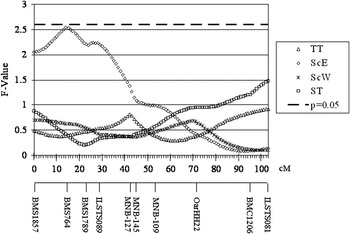
The QTL study was carried out with QTLexpress (Seaton et al., Reference Seaton, Haley, Knott, Kearsey and Visscher2002). The half-sib function and a 1QTL model with 1 cM steps and 1000 iterations were used to detect chromosome-wide threshold levels. Year of test (standing for handler) and gender were considered as fixed effects and the age at test as covariate. In the first step, the analysis was done across the families followed by an analysis within all families. QTL analysis resulted in a putative QTL for score ScE at position 14 cM (BMS764). The 5% threshold is at 2.59 and the F-value at this position achieved 2.54 as shown in Figure 1. The distal part of BTA29 also showed increasing F-values for score ST, but did not reach the 5% threshold. In spite of these findings, the study could not verify a QTL for flight distance at the distal end of BTA29 in a Holstein × Charolais population (Gutiérrez-Gil et al., Reference Gutiérrez-Gil, Ball, Burton, Haskell, Williams and Wiener2008). The putative QTL near BMS764 (14.1 cM) found for German Angus confirms earlier results of a QTL in Holstein cattle (Hiendleder et al., Reference Hiendleder, Thomsen, Reinsch, Bennewitz, Leyhe-Horn, Looft, Xu, Medjugorac, Russ, Kuhn, Brockmann, Blumel, Brenig, Reinhardt, Reents, Averdunk, Schwerin, Forster, Kalm and Erhardt2003). Therefore, this region seems to play an important role in different patterns of behaviour and across breeds and should be analysed in more detail.
F-values along the map of BTA29 for the scores of tethering test (TT), weighing test (ScE and ScW) and separation and restraint test (ST) within German Angus beef cattle.

In addition, we detected one of the sires to be a blood chimera, although the sire was born as a single offspring and not as a twin. The observed problems in parentage of this sire with DNA from blood could be clarified with DNA from semen. The most reported cytogenetic phenomena in cattle are XX/XY chimerism (Ducos et al., Reference Ducos, Revay, Kovacs, Hidas, Pinton, Bonnet-Garnier, Molteni, Slota, Switonski, Arruga, van Haeringen, Nicolae, Chaves, Guedes-Pinto, Andersson and Iannuzzi2008; Peretti et al., Reference Peretti, Ciotola, Albarella, Paciello, Dario, Barbieri and Iannuzzi2008) and the Robertsonian translocation (Ducos et al., Reference Ducos, Revay, Kovacs, Hidas, Pinton, Bonnet-Garnier, Molteni, Slota, Switonski, Arruga, van Haeringen, Nicolae, Chaves, Guedes-Pinto, Andersson and Iannuzzi2008; Iannuzzi et al., Reference Iannuzzi, Di Meo, Caputi Jambrenghi, Vonghia, Iannuzzi and Rangel-Figueiredo2008; Vozdova et al., Reference Vozdova, Kubickova, Cernohorska and Rubes2008). Therefore, blood chimersim can lead to mapping problems, especially in small populations, and therefore, exclusion and detection of chimera, at least in the sires of any research project, should be done, as it was already suggested for embryo transfer calves (Morris et al., Reference Morris, Pitchford, Cullen, Esmailizadeh, Hickey, Hyndman, Dodds, Afolayan, Crawford and Bottema2009). It should also be kept in mind that, for example, parentage testing should not only be done with DNA from blood but also with semen or tissues as the exclusion probabilities will decrease with blood DNA in the case of blood chimerism in sires.
Acknowledgements
This study was financially supported by the DFG – SFB299. We thank Holger Mathiak, Carina Urban and the staff of the experimental farm, Rudlos, for conducting behaviour tests.