Introduction
The United States recently increased military presence around the world has created a renewed public interest in the politics and process of security decisions. While pundits and politicians talk about strategic priorities and the political position of the United States, the significant decisions have already been made during the budget process. Long before the first boots hit the ground, Congress, bureaucrats, and domestic interest groups have already determined what resources would be available. However, as significant as this process is, it is one that is difficult to understand and even more difficult to teach. Undergraduate students of national security often ask three questions:
- How are national priorities translated into programs?
- How do coalitions and actors without formal roles in defense budgeting influence the outcome and with what degree of success?
- Why do fluctuations in defense and security budgets not seem to be related to threats?
Although a number of academic and popular accounts are available (Jordan, Taylor, and Mazarr 1999; Rosner 1995; Sarkesian, Williams, and Cimbala 2002; Wilson 2000), these do not help students develop answers. Passive learning leaves many students indifferent to the complex motivations that act on members of the system. By taking on the roles of actors in the decision process, students see how domestic considerations and constituencies vie with international threats in decisions of national defense and security.
In this article, I present a simulation of the budget process complete with instructions and support material. After a short discussion of the budget process and the use of simulations, the piece presents the development of and lessons from previous plays of the simulation. Although this background material may not be necessary for all teachers, it is provided to help potential users understand the rationale behind the simulation's rules and roles. Teachers who have never used simulations will find this material useful as they design their own or modify this role playing exercise. Teachers who have used simulations may decide to go directly to the appendices (available at www.apsanet.org/PS/Jan04/Kanner.pdf) for copies of the instructions and support material.
The Budget Process and Understanding National Security
Public hearings are the part of the budget process that most citizens see, but these represent the last of a long chain of events. Long before the proposal and public discussion of a president's defense and security budget, numerous documents and coordinating actions have already been published. “Developing a balanced defense program, and translating it into a defense budget acceptable to the Congress and public, is a major and demanding effort of public policy” (Jordan, Taylor, and Mazarr 1999, 197). It is also one of the most confusing and least discussed processes within the standard text on American foreign policy or national security.1
Jordan, Taylor, and Mazarr's American National Security (1999) discusses the budget process itself in depth. There is also a basic explanation at the Department of Defense Comptroller's web site (www.comptroller/icenter/budget/budgetintro.htm). Because the budget process is included in middle and senior level military education courses, instructors might also consult their local ROTC detachment for assistance.
The complexity of the system presents a problem to most students even before they attempt the simulation.
The total security budget includes more than just the Department of Defense. However, the Department of Defense's budget line dominance will be the focus for this discussion of the budget process. The Defense budget is developed through the Planning, Programming, and Budgeting System (PPBS). The system is designed to develop appropriate strategies based on recognized threats to national security. The initial document in the process is the National Security Strategy (NSS) published by the White House. From this, the Department of Defense produces the National Military Strategy (NMS) and the Defense Planning Guidance (DPG). These documents reflect the Defense Department's view on the military's role and posture and proved direction on force and resource planning that result in the Program Budget Decision (PBD). Eventually, the PBD is sent to Congress as part of the president's budget (Comptroller 2003). However, before this occurs there has already been a substantial amount of bargaining as each of the component commands (Army, Navy, Air Force) and Defense agencies makes the case for funding their own projects. They are often joined in this effort by interest groups, such as contractors, promoting specific weapons program. A change in recent years is that non-defense groups may also be involved. As an example, environmental groups have become more involved in the Army's Corps of Engineers' budget dealing with control and protection of inland waterways. Congressional allies may be brought in at this or a later stage. Negotiations do not end after the budget is developed. A recent example of this was the Marine Corps' attempt to Secretary of Defense Cheney's budget decision not to fund the Osprey aircraft (Jones 2002).
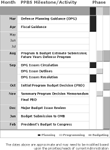
Before discussing the remainder of the process, it is instructive to discuss some problems in the PPBS. Although adopted as a means of centralizing and simplifying decision making, PPBS is recognized by observers, practitioners, and participants as a difficult system to understand (Jordan, Taylor, and Mazarr 1999). Part of the problem is that theory does not match practice. The numerous documents and review procedures vital to the system have been bureaucratically compromised over the years. First, the system is based on the assumption that there are specific objectives and clear external guidance. Because the National Security Strategy, the source of this guidance, is also a political document, it is often vague or late for the budget process (Jordan, Taylor and Mazarr 1999). Input comes from the agencies that benefit from the guidance resulting in contrasting views of the threat that may reflect bureaucratic interests and make it difficult to articulate the necessary clear guidance (O'Hanlon, 2002; Pika, Maltese, and Thomas 2002). Second, because each document requires tremendous effort to produce and review, they can no longer meet their intent. As the PPBS Dateline in Figure 1 shows, from DPG to the presentation to Congress takes one year. From presentation to passage is another six to eight months.
The result of these lags is that staffs often find themselves working on at least three budgets at once, often basing later budgets on the assumption of full or partial passage of earlier budgets (Rosner 1995; Snow 1998). Given the uncertainty of congressional reactions, the system is considered another “paperwork drill” by some of the action officers involved.2
This last is the author's observation after many years working in the system.
“The organizational details of budgeting within the Pentagon are mind-numbing to all but the most interested, and the interactions within and between the houses of Congress are often chaotic” (Snow
1998: 121). Third, it is naive to think the defense and security budgets are written in a vacuum. As the definition of security expands due to the end of the Cold War and the beginning of the War on Terrorism, competition for budget dollars includes other cabinet departments, all of which have their domestic constituencies.
Once each of the agencies has submitted their budgets, the real battle begins because the arena for negotiations is Congress. With the end of the Cold War, consensus on national security, domestic politics, and priorities increasingly became part of the decision making process (Rosner 1995; Sarkesian, Williams, Cimbala 2002). Many individuals and groups argued that maintaining a large defense structure was wasteful and resources could be better used to solve domestic problems such as education or health care (O'Hanlon 2002; Snow 1998). The end of the Cold War also saw a resurgence of congressional activity in the national security system. Congressional members no longer saw themselves obligated to agree with the Administration's assessments of either objectives or priorities. Constituent pressure about domestic economics, the budget deficit, and influx of new, more competitive congressional members changed the relationship between Congress and the Executive (Lindsay 1999; Rosner 1995; Wilson 2000).
Although the September 11th 2001 attacks put the United States on a ‘war footing,’ it did not return a consensus over budget priorities. The intermestic nature of fighting terrorism meant that agencies and groups not traditionally involved in national security (e.g., Public Health) were now claimants to security dollars. Recent scholarship has shown that there are a number of factors affecting budget and policy decisions (Sandler and Hartley 1995). Some of these findings include the treatment of defense as a public good to be divided among coalition members (Clark 2001); public reaction to external events (Knopf 1998); class interests (Narizny 2003); and the growth of ethnic interest groups (Uslaner 2002). Establishment of the Department of Homeland Security increased the number of players in the field, confusing the responsibilities of various agencies as some functions were transferred to the new department. Since one of the most important constraints on defense spending is the institutional setting (Bolks and Stoll 2000), study of this environment becomes a clue to how all of these elements interact.
Simulations as Teaching Tools
Complex processes such as the budget lend themselves to the use of role-playing exercises or simulations. Faced with having to learn a process, students respond well to methods that permit active involvement. By calling on more than one type of input (experiential as well as passive), teachers can reinforce basic lessons, providing the basis for students' later applications of these lessons to other situations (Lantis, Kuzma, and Boehrer 2000). In courses focusing on national security and foreign policy, simulations and case studies provide an excellent means for meeting the course objective of increased understanding of decision processes. Since many of the students in these courses are looking at future careers in the military or government, simulations also provide a view to their future. Even those who are not pursuing these career paths receive insights into the workings of government. While case narratives are useful in understanding the policy process, students may not capture the dynamics or interactions involved. Finding applicable case studies is often difficult and may be perceived as just another reading requirement (Cusimano 2000). First hand accounts, such as Wilson's This War Really Matters: Inside the Fight for Defense Dollars (2000), may portray only one side of the issue and include the author's personal “ax grinding.” Role-playing games overcome these problems by engaging students in the learning process. By taking on a role and dealing with others, simulations draw students into the system and generate discussions of why and how certain events occur (Wassermann 1994).
Successful role playing requires students to immerse themselves in the motivation and objectives of the individual they are portraying. Therefore, lessons learned tend to be more vivid and concrete. Students find that having participated in a simulation, they have a greater understanding of the material and make connections that reading and lecture do not provide (Cusimano 2000). A side benefit is that simulations require students to develop and use social skills that are not usually the focus of classes. Because the instructor serves as a resource and not a moderator, students must come to agreements that are perceived as mutually supporting in order to be enforced. Knowledge and goals must be shared if any student is to be successful.
“Collaboration is, in fact, an absolute necessity in a community of learners and is found on the idea that expertise does not rest with a single individual (such as the teacher), rather, it is spread throughout the classroom. Mastery of the subject/topic is the responsibility of all members of the community” (Brown and King 2000: 246).
The result is that students learn that pursuit of personal agendas may be secondary to a common group agenda. Those students who see the world only from their perspective soon find themselves shut out of the simulation.
Simulation Design
Design Concerns
In designing a simulation, it is important that the focus be on the key ideas being studied (Lantis, Kuzma, and Boehrer 2000; Wassermann 1994). While a perfect match is not always possible, the establishment of these targets reduces the tendency to add extraneous influences. This simulation was designed to support two specific learning objectives listed at the beginning of the course on national security.
- Be able to explain the roles of the president, Congress, bureaucracy, interest groups and other actors on national security and policy formation. After an introduction focusing on the historical and cultural elements that influence security policy, the class studies the formal and informal institutions by which policy is made. Formal institutions, such as the bureaucracy, are seen as made up of a number of subordinate groups, such as the Defense and State Departments, as well as individuals (e.g., chairman of the joint chiefs) with their own agenda. Informal institutions, such as interest groups, are seen as influential although the degree of influence of individual groups is not specified. Since each of these institutions is treated separately (and in the case of interest groups, often poorly) by the text, students often do not fully understand the relationships and how interest groups and informal coalitions affect policy.
- Be able to apply the concepts of the class to previous and current national security questions. Throughout the course, students are asked what the implications of particular concepts are on the way in which the government meets its security obligations. Readings prior to the simulation included the text book and current work by think tanks. Each student is required to explore an issue of their choosing and provide a policy recommendation as if they were an action officer in one of the bureaucracies. However, these tasks do not involve consideration of conflicting agendas or the difficulty in arriving at solutions within an institutional setting.
The second issue that must be addressed is how to engage the students. Previous experience using simulations has been mixed. The latest simulation run found some students to be enthusiastic about the chance to do something different, while others took it as a license to skip class. Directly associated with student's attitudes was the question of how to evaluate the work done during the simulation. Policy presentations were not used since they represented just another passive exercise, thereby defeating the purpose of creating active engagement (Cusimano 2000). I achieved a compromise between penalty and incentive by assigning points to negotiation objectives.
Failure to engage at a minimum level penalized the student's course grade. I awarded outstanding efforts additional points that would improve the student's grade (see Appendix A). Although some students were critical of this system in the original play, others saw it as an incentive to participate. Because there were 100 points available in the course, the net effect for most students was negligible.
Preparing the Students
Many students found role playing to be a new experience and had to be trained on how to approach these learning situations (Wassermann, 1994). In this case, preparation took two paths—substantive and procedural.
Substantive preparation began the first week. If class coincided with the congressional review of the budget the students were able to observe the events they were replicating. Students with access to C-SPAN were required to observe congressional hearings to get the feel of the presentation and questioning process. Those who did not have access were referred to transcripts of the previous year's hearings. Updates of key events were reported in class on a weekly basis. For semesters in which the budget was not a subject of congressional hearings, students review transcripts, defense periodicals and accounts about budget fights such as Wilson's This War Really Matters (2000). Once assigned roles, further substantive preparation was necessary. Students were only given the material presented in the Appendices. Any additional information required to back an argument or to prepare testimony had to be located by the student. Most quickly found that the more research they did, the better prepared they were to negotiate and the better they did in meeting their objectives. In validating their arguments, students looked at position papers, press releases, and for one ambitious student, questioning their counterpart by email. Students then posted their own versions on the course web site.3
Fortunately, the course was able to use the discussion board that is a part of Web CT®. If computer posting is not available, students may also print and circulate hard copies of their papers. Some students choose to do both, thinking that computer postings may be ignored.
These posts helped present the actor's case prior to and during the hearings. They also served as approximately one half of each student's grade (these were listed as ‘quality of presentation’ or ‘testimony points’ on the role cards in Appendix A). Representatives of the interest groups found that they did the most work since they were often composites of numerous groups. This work not only better prepared those students for the exercise, but helped einforce the lesson that players often have multiple agendas and goals and have to compromise some at the expense of others.
Procedural preparation occurred by integrating role playing into the curriculum. Earlier exercises required student participation as members of the National Security Council, and as members of the cabinet. By the time of this simulation in the semester, students were familiar with the idea of taking on the persona of a decision maker or an advisor. Because this was an extended simulation, one class period was dedicated to preparation. After introducing the game, students were assigned roles by the random drawing of role cards. Students then began developing negotiation strategies and coalitions. Individuals and groups were instructed not to reveal the preferences listed on their role cards since ambiguity is often an advantage during negotiations.
Teacher Preparation
Users of the simulation also have to prepare themselves, although most of the preparation is procedural. The first step is to integrate the simulation into the syllabus. Usually, this simulation is used after discussion of institutions and before discussion of security issues. At this point, students have a background on the process and need to better understand the constraints on security issues. Students see the simulation's placement in the the middle of the semester as a nice change of routine. The second step, and one of major significance, is the mental preparation of the teacher. Because this is a free play exercise, teachers now act as resources and not leaders. Their role is limited to providing clarification of the rules and guidance on other sources. Control of the agenda and enforcement of the game's rules should be left to those students whose position (e.g., chairman of the committee) is responsible for those functions.
Simulation Design
While instructions for the simulation are inclosed in Appendix B, discussion of some of the design considerations should be useful for future practitioners.
Focus of the Simulation
The overall focus of the simulation is the passage of a security budget. However, this focus means different goals for individual players. Cabinet members and agency directors each have their own priority programs. Activists and congressional members have a number of different policy and personal agendas. This atmosphere of multiple and conflicting agendas is recognizable to any who has ever participated in or observed the budget process. One of the major teaching points is that the simulation shows the Defense bureaucracy is composed of a number of actors. Except for the chairs of the committees, members of the House and Senate are able to position themselves as activists for special constituencies, such as environmental, peace, or veteran's groups(see Appendix A–Role Cards).
Phased Play
The simulation is broken into the same phases described in the budget cycle. The length of each phase is up to the individual instructor. Phased play, however, is one of the instructor's few controls. During each phase, students are given instructions on the actions and products required for each phase (see Appendix B—Simulation Instructions). Actions describe the work that must be accomplished during that period, such as the organization of working groups or coalitions. Products describe the tangible results, such as publishing the budget guidance, and concrete deadlines.
Role Descriptions
Students had already studied the various institutions both in their introductory courses as well as in the initial portions of this course; however, much of this was general in nature. As part of the instructions (Appendix B), brief descriptions of roles are provided that describe the specific functions associated with the budget process. This is common knowledge for anyone who has worked in the system. Each description focuses on the position of a particular actor(s) as it pertains to the national security budget. Students are referred to various web sites to research the backgrounds and views of the current occupants of these positions (Appendix C).
Role Assignments
Assignment of roles is another concern since it could bias the results. Seniors and ROTC students often have additional knowledge that acts as an advantage in the game. Just as in real politics, personal characteristics and charisma influenc the success of students. Students are therefore randomly assigned their roles during the preparation phase of the game using the role cards presented in Appendix A.
Administrative Instructions
These are kept to a minimum in order to simulate some of the chaos associated with the informal mechanisms. As mentioned earlier, deadlines are assigned as part of the phasing of play, but these are only required to keep the game moving.
Feedback
A feedback session is held after the completion of the vote that ends the simulation. Each actor is asked to comment on the following points:
- What policy objectives were served by the final budget?
- Did you achieve your role's personal objective? If not, why not?
- Did your informal position in the deliberations match your formal powers?
- Who was best able to influence your decision and why?
- Were you surprised by anything that occurred in the simulation? (Surprise was defined as whether the process did not meet expectations).
- What lessons did you learn about the budget process?
Rather than just look for answers to these questions, teachers should keep notes during the sessions so they can ask specific questions.4
I have found that a stenographer's pad is helpful. These pads are small and have hard backs to let you write while walking and observing working groups. Since most also have a line down the center, one side can be used for observations while the other can be used for comments and questions.
As an example, asking “Who was best able to influence your decision and why?” is likely to elicit a one word answer. A more specific question would be, “Mr. Chairman, during the second day of hearings, why did you decide to let the environmental activists testify first?” An answer here is more likely to result in a description of who, how, and why. Students are given the opportunity to make comments in class and on an electronic bulletin board established for that purpose.
Lessons Learned
Feedback sessions serve as a good source of lessons learned by the students about the budget process and the roles played by various actors. Although the results may vary for each run, students are likely to learn these lessons during their game. While this information may help teachers integrate this exercise in their courses, it is not recommended that teachers provide this information to students in advance as it biases the play.
The Weak Presidency
Students assigned the role of the president, his chief of staff, and the budget director find their budgets quickly “highjacked.” After the initial proposal, they seemed to have little control or input as congressional delegations meet with cabinet members, agency directors, and their constituents to sort out different priorities. Despite the recognition by most scholars that security debates are dominated by the president (Campbell, Rae, and Stock 2003), final budget authority sits firmly in Congress. In that arena, the president does not have a vote. One drawback of the simulation is that presidents cannot call on ‘the bully pulpit’ to put pressure on members of Congress.
The Necessity of Coalition Building
The budget is an area where ‘ambition fighting ambition’ is very visible. Students establish issue networks as activists, bureaucrats, and congressional members realize they are best able to meet their common goals by working together. This is especially critical for groups not traditionally associated with security issues. Groups and coalitions that reframe their issue in the language of national defense are the most successful in fulfilling their goals. In one simulation play, environmental activists and their supporters in Congress were able to build a coalition with the Energy Department based on reducing dependence on foreign oil and support of regimes in the Middle East that support terrorists.5
This worked better in those simulations conducted after September 11th than in earlier games.
Budget Status Quo or Growth
Problems with reducing the budget quickly become evident as the coalitions or ‘iron triangles’ are able to press their advantage. Powerful committee chairs promote their own goals by setting agendas during hearings and making agreements with cabinet members. Pet projects, from the naming of a naval craft or the placement of an installation, are often wedged into the budget despite their initial absence in the budget proposal. This parallels cases, such as the purchase of the Osprey by the Marines (Jones 2002), discussed in the course. Few agency directors are willing to cut their budget and few members of Congress are willing to give up projects that benefit their constituencies. While some of this is a result of the artificiality of a simulation (there is not a constraint on increasing the deficit above statutory limits), it also reflects interagency power struggles (Sarkesian, Williams, Cimbala 2002).
The Necessity of the Media
Although the bulletin board in Web CT© provides a public forum, there was no independent voice in the first conduct of the simulation. During that run, postings were provided by active players and were rarely subject to unbiased review or comment. Activists tried to present their own analysis, however, many of these were rejected due to obvious biases. It was also pointed out in the discussions after the simulation, that the major media sometimes acts as a player by the way it highlights or interprets aspects of the budget, e.g., coining the term “Star Wars” for Reagan's Strategic Defense Initiative. Later runs included the media. Students in those roles got credit based on their ability to highlight ‘pork.’
Not All Players Are Equal
Students soon find that some groups (Defense) automatically had an advantage in the negotiations. They had already established coalitions and had the resources to provide incentives to members of Congress. Groups that were not normally associated with the security budget (e.g., environment, peace, domestic groups) had to work harder to build their coalitions and get their issues on the agenda for the committees. These students had to establish themselves and therefore had a more difficult time achieving their goals. While some students complained that this was unfair, it is a reflection of the truth in Washington negotiations.
Conclusion
The Planning, Programming, and Budgeting System (PPBS) is the key to understanding how security objectives are translated into programs. Unfortunately, the system is difficult even for practitioners because of the numerous documents and review procedures. Add to this the addition of new actors and a revitalized Congress, and the system often seems incomprehensible. However, even the most difficult subject can be made accessible to a student if the right technique is found. Active methods, especially simulations, are ideally suited to this task because they engage students in the learning process rather than leave them as a passive consumer. While this simulation will not make students experts, it will improve their understanding by requiring them to take on roles within the system and to develop a budget that meets their goals and objectives. Participants must prioritize and compromise in order to achieve any type of agreement. In the end, the budget is larger and more bloated than any of the players' initial estimates or individual desires. The lessons learned reflect the reality of the budget system and help explain the role of activists, interest groups, and bureaucrats in translating policy into programs.