Introduction
Sleep problems are very common among pregnant women, with 45–50% of women experiencing sleep problems during pregnancy (Abbott et al., Reference Abbott, Attarian and Zee2014; Mindell et al., Reference Mindell, Cook and Nikolovski2015; Sedov et al., Reference Sedov, Cameron, Madigan and Tomfohr-Madsen2018). Daytime sleepiness, defined as persistent sleepiness and general lack of energy even during the day, is among the most common sleep problems, with especially high prevalence rates during pregnancy (Izci et al., Reference Izci, Martin, Dundas, Liston, Calder and Douglas2005; Facco et al., Reference Facco, Kramer, Ho, Zee and Grobman2010; Signal et al., Reference Signal, Paine, Sweeney, Priston, Muller, Smith, Lee, Huthwaite, Reid and Gander2014; Mindell et al., Reference Mindell, Cook and Nikolovski2015; Paavonen et al., Reference Paavonen, Saarenpää-Heikkilä, Pölkki, Kylliäinen, Porkka-Heiskanen and Paunio2016). Daytime sleepiness can either be a symptom of other sleep disorders including insomnia, hypersomnia, narcolepsy, and difficulties in initiating and maintaining sleep (Johns, Reference Johns1991; Dickinson et al., Reference Dickinson, Wolkow, Rajaratnam and Drummond2018), or of other disorders/conditions including depression and anxiety (Dickinson et al., Reference Dickinson, Wolkow, Rajaratnam and Drummond2018), or be considered its own sleep problem condition (Paavonen et al., Reference Paavonen, Saarenpää-Heikkilä, Pölkki, Kylliäinen, Porkka-Heiskanen and Paunio2016).
Maternal antenatal sleep problems are associated with maternal obesity and depressive symptoms during and after pregnancy (D⊘rheim et al., Reference D⊘rheim, Bjorvatn and Eberhard-Gran2012; Mellor et al., Reference Mellor, Chua and Boyce2014; Palagini et al., Reference Palagini, Gemignani, Banti, Manconi, Mauri and Riemann2014; Paavonen et al., Reference Paavonen, Saarenpää-Heikkilä, Pölkki, Kylliäinen, Porkka-Heiskanen and Paunio2016; Sarberg et al., Reference Sarberg, Bladh, Svanborg and Josefsson2016) and with an increased risk of gestational diabetes (Palagini et al., Reference Palagini, Gemignani, Banti, Manconi, Mauri and Riemann2014), preterm birth and suboptimal fetal growth (Micheli et al., Reference Micheli, Komninos, Bagkeris, Roumeliotaki, Koutis, Kogevinas and Chatzi2011; Abbott et al., Reference Abbott, Attarian and Zee2014; Palagini et al., Reference Palagini, Gemignani, Banti, Manconi, Mauri and Riemann2014).
Previous studies have repeatedly shown that preterm birth, suboptimal fetal growth, and maternal obesity, gestational diabetes and depressive symptoms during and after pregnancy may each predict an increased risk of psychiatric problems and poorer neurocognition in the offspring (Van Batenburg-Eddes et al., Reference Van Batenburg-Eddes, Brion, Henrichs, Jaddoe, Hofman, Verhulst, Lawlor, Davey Smith and Tiemeier2013; Betts et al., Reference Betts, Williams, Najman and Alati2014; Reference Betts, Williams, Najman and Alati2015; Korhonen et al., Reference Korhonen, Luoma, Salmelin and Tamminen2014; O'Donnell et al., Reference O'Donnell, Glover, Barker and O'Connor2014; Tarabulsy et al., Reference Tarabulsy, Pearson, Vaillancourt-Morel, Bussières, Madigan, Lemelin, Duchesneau, Hatier and Royer2014; Walder et al., Reference Walder, Laplante, Sousa-Pires, Veru, Brunet and King2014; Sandman et al., Reference Sandman, Buss, Head and Davis2015; Xiang et al., Reference Xiang, Wang, Martinez, Walthall, Curry, Page, Buchanan, Coleman and Getahun2015; Edwards and Hans, Reference Edwards and Hans2016; Pearson et al., Reference Pearson, Bornstein, Cordero, Scerif, Mahedy, Evans, Abioye and Stein2016; Gjerde et al., Reference Gjerde, Eilertsen, Reichborn-Kjennerud, McAdams, Zachrisson, Zambrana, Røysamb, Kendler and Ystrom2017; Lahti et al., Reference Lahti, Savolainen, Tuovinen, Pesonen, Lahti, Heinonen, Hämäläinen, Laivuori, Villa, Reynolds, Kajantie and Räikkönen2017; Mina et al., Reference Mina, Lahti, Drake, Raikkonen, Minnis, Denison, Norman and Reynolds2017; Pyhälä et al., Reference Pyhälä, Wolford, Kautiainen, Andersson, Bartmann, Baumann, Brubakk, Evensen, Hovi, Kajantie, Lahti, Van Lieshout, Saigal, Schmidt, Indredavik, Wolke and Räikkönen2017; Van den Bergh et al., Reference Van den Bergh, van den Heuvel, Lahti, Braeken, de Rooij, Entringer, Hoyer, Roseboom, Räikkönen, King and Schwab2017). In turn, maternal sleep problems during pregnancy have been associated with increased sleep problems in children at a mean age of 11 years in a retrospective case-control study of 97 participants (Armstrong et al., Reference Armstrong, O'Donnell, McCallum and Dadds1998), but the effects of maternal sleep problems or particularly daytime sleepiness during pregnancy on child neurocognitive or neuropsychiatric development have, to our knowledge, not been previously studied using a longitudinal design.
We hypothesized that maternal daytime sleepiness during pregnancy predicts offspring neuropsychiatric symptoms and/or neurocognitive development in early childhood. In the current study, we tested this hypothesis in a cohort of women in whom daytime sleepiness was recorded prospectively during pregnancy and their children followed-up at a mean age of 4.3 years [range 2.6–5.7 years; standard deviation (s.d.) = 0.6 years].
Methods
The participants
Our study sample comprised participants of the Hormones and Inflammation in Parents and Young longitudinal pregnancy cohort of 357 women with very severe obesity [body mass index (BMI) ⩾ 40 kg/m2] and lean controls (BMI ⩽25 kg/m2) living in Midlothian, Scotland, UK (Mina et al., Reference Mina, Denison, Forbes, Stirrat, Norman and Reynolds2015). The participants were recruited at their first appointment during pregnancy between gestational weeks 8 and 12. We obtained ethical approval for the study from the local research ethics committee (REC: 14/WS/1046, R&D: 2014/0278). The study was conducted in the Wellcome Trust Clinical Research Facility, the Royal Hospital for Sick Children, Edinburgh.
We screened the 357 pregnancy study participants for follow-up participation eligibility. Of these, 90 (25.2%) cohort members declined participation and 57 (16.0%) were uncontactable. We also excluded mothers who had moved out of Midlothian [n = 13 (3.6%)] and mothers whose child was under a child protection register alert [n = 9 (2.5%)], families where there had been a community intervention [n = 12 (3.4%)] and mother-child dyads who were unfit for medical reasons [n = 8 (2.2%)] (Mina et al., Reference Mina, Lahti, Drake, Raikkonen, Minnis, Denison, Norman and Reynolds2017). Of the recruited 153 mother-child dyads for the childhood follow-up, 37 (24.2%) did not complete the follow-up although they had verbally agreed to complete study questionnaires at home (Mina et al., Reference Mina, Lahti, Drake, Raikkonen, Minnis, Denison, Norman and Reynolds2017). Hence, we obtained written informed consent to participate in the childhood follow-up from 116 mother-child dyads with term-born offspring. As shown previously, the 116 women who participated in the follow-up were less often severely obese in early pregnancy, and they had less often high socioeconomic deprivation, and lower depressive and anxiety symptoms during pregnancy (Mina et al., Reference Mina, Lahti, Drake, Raikkonen, Minnis, Denison, Norman and Reynolds2017), but they did not differ in daytime sleepiness during pregnancy (p = 0.38). Of the 116 mother-child dyads who participated in the follow-up, three had missing data on maternal antenatal sleepiness and two on child neuropsychiatric and neurocognitive development.
The current study sample thus comprises 111 mother-child dyads with data on maternal prenatal daytime sleepiness and child neuropsychiatric symptoms and/or neurocognitive development. Compared with the current study participants, the cohort mothers who did not participate had more depressive [mean difference (MD) = 0.36 s.d. units, 95% confidence interval (CI) 0.14–0.59, p = 0.002)] and anxiety (MD = 0.31, 95% CI 0.08–0.53, p = 0.01) symptoms across pregnancy, a significantly higher proportion of severe obesity (69.9% v. 45.0%, p < 0.001), and of high socioeconomic deprivation (58.8% v. 37.8%, p < 0.001) but did not differ in terms of maternal antenatal daytime sleepiness, age, parity, gestational diabetes, smoking status or child sex (p values ⩾0.32).
Maternal daytime sleepiness during pregnancy
The mothers rated their daytime sleepiness during pregnancy with the Epworth Sleepiness Scale (ESS). The ESS assesses the levels of daytime sleepiness in eight different everyday situations with the question How likely are you to doze off in the following situations, in contrast to feeling just tired (Johns, Reference Johns1991). The ESS shows good psychometric properties (Johns, Reference Johns1991; Baumgartel et al., Reference Baumgartel, Terhorst, Conley and Roberts2013; Jaussent et al., Reference Jaussent, Morin, Ivers and Dauvilliers2017) and has been validated among patient populations including patients with narcolepsy, hypersomnia, and snoring (Johns, Reference Johns1991; Kendzerska et al., Reference Kendzerska, Smith, Brignardello-Petersen, Leung and Tomlinson2014; Maurovich-Horvat et al., Reference Maurovich-Horvat, Keckeis, Lattová, Kemlink, Wetter, Schuld, Sonka and Pollmächer2014; Nishiyama et al., Reference Nishiyama, Mizuno, Kojima, Suzuki, Kitajima, Ando, Kuriyama and Nakayama2014), and also among pregnant women (Izci et al., Reference Izci, Martin, Dundas, Liston, Calder and Douglas2005; Baumgartel et al., Reference Baumgartel, Terhorst, Conley and Roberts2013). Acceptable internal consistency (Cronbach's α = 0.75) for the ESS has been reported among pregnant women (Baumgartel et al., Reference Baumgartel, Terhorst, Conley and Roberts2013). The mothers completed the ESS up to two times at 17 and 28 weeks of gestation. We used the mean scores of these two assessments, indicating mean levels of daytime sleepiness during pregnancy, as independent variables in our analysis.
Child neuropsychiatric symptoms
The mothers rated child neuropsychiatric symptoms with the Conner's Hyperactivity Scale (Erhart et al., Reference Erhart, Döpfner, Ravens-Sieberer and Group2008), the Children's Sleep Habits Questionnaire (CSHQ)- adopted for preschool children (Goodlin-Jones et al., Reference Goodlin-Jones, Sitnick, Tang, Liu and Anders2008), Strengths and Difficulties Questionnaire (SDQ) (Goodman, Reference Goodman1997), and Preschool Version of Child Behavior Checklist (CBCL 1½−5) (Achenbach and Rescorla, Reference Achenbach and Rescorla2000). The CBCL (Achenbach and Rescorla, Reference Achenbach and Rescorla2000), SDQ (Theunissen et al., Reference Theunissen, Vogels, de Wolff and Reijneveld2013; Croft et al., Reference Croft, Stride, Maughan and Rowe2015), Conner's Hyperactivity Scale (Erhart et al., Reference Erhart, Döpfner, Ravens-Sieberer and Group2008; Westerlund et al., Reference Westerlund, Ek, Holmberg, Näswall and Fernell2009) and CSHQ (Owens et al., Reference Owens, Spirito and McGuinn2000; Goodlin-Jones et al., Reference Goodlin-Jones, Sitnick, Tang, Liu and Anders2008) are each validated questionnaires with good psychometric properties. Higher scores on each scale indicate increased neuropsychiatric problems.
The Conner's Hyperactivity Scale includes 10 items assessing ADHD symptoms of emotional lability, hyperactivity, and inattention. While two subscales of hyperactivity and emotional lability can be derived from the Conner's scale, we use only the total Conner sum-score as a dependent variable (Westerlund et al., Reference Westerlund, Ek, Holmberg, Näswall and Fernell2009). The CSHQ contains 45 items on child sleep problems and sleep behaviour. Here we examine CSHQ sleep problems as an outcome. The CBCL1½−5 comprises 99 items and SDQ 25 items on child psychiatric problems (Goodman, Reference Goodman1997; Achenbach and Rescorla, Reference Achenbach and Rescorla2000). The SDQ yields a total difficulties scale on general psychiatric problems and four more specific symptom scales (hyperactivity, emotional, conduct, and peer problems) and one subscale on child's strengths. The CBCL/1½−5 yields scores for three main (internalizing, externalizing, and total problems), eight syndrome and five Diagnostic and Statistical Manual for Mental Disorders-oriented scales. Due to limited statistical power on their subscales, we focus here on the SDQ Total Difficulties and the three CBCL broadband scale t-scores (Achenbach and Rescorla, Reference Achenbach and Rescorla2000) as outcomes.
Previous studies have reported excellent internal consistency for the Conner's Hyperactivity scale (Cronbach's α = 0.90) (Westerlund et al., Reference Westerlund, Ek, Holmberg, Näswall and Fernell2009). Also in our study sample, the scale showed good internal consistency (α = 0.86). Previous evidence also shows good to excellent internal consistencies for the CBCL internalizing, externalizing, and total problems scales (α:s varying between = 0.89 and = 0.95) (Achenbach and Rescorla, Reference Achenbach and Rescorla2000), and acceptable internal consistencies for SDQ total difficulties (α = 0.79) (Theunissen et al., Reference Theunissen, Vogels, de Wolff and Reijneveld2013), and CSHQ sleep problems (α:s between = 0.68 and = 0.78) (Owens et al., Reference Owens, Spirito and McGuinn2000).
Child neurocognitive development
Neurocognitive development in children was assessed with mother-rated neurodevelopmental questionnaire Ages and Stages Questionnaire (ASQ) and two individually administered neuropsychological tests on executive functioning, the Head Toes Knee Shoulders (HTKS) and Marshmallow–Tests. The ASQ, HTKS, and Marshmallow are all commonly used measures of neurodevelopment with good psychometric properties (Squires et al., Reference Squires, Bricker and Potter1997; Kerstjens et al., Reference Kerstjens, Bos, ten Vergert, de Meer, Butcher and Reijneveld2009; Ponitz et al., Reference Ponitz, McClelland, Matthews and Morrison2009; Mischel et al., Reference Mischel, Ayduk, Berman, Casey, Gotlib, Jonides, Kross, Teslovich, Wilson, Zayas and Shoda2011).
The ASQ assesses the completion of neurocognitive and psychomotor developmental milestones in children (Squires et al., Reference Squires, Bricker and Potter1997). It is a series of age-specific questionnaires including 5–6 questions on communication, gross motor, fine motor, problem-solving, and personal-social development (Squires et al., Reference Squires, Bricker and Potter1997). We used a sum score of these subscales with scores from 0 to 300 as an outcome to index global neurodevelopment; higher scores indicate better neurodevelopment (Kerstjens et al., Reference Kerstjens, Bos, ten Vergert, de Meer, Butcher and Reijneveld2009). ASQ has acceptable internal consistency (α = 0.79) (Kerstjens et al., Reference Kerstjens, Bos, ten Vergert, de Meer, Butcher and Reijneveld2009).
The Marshmallow test assesses child executive function aspects of self-regulation and inhibition, specifically the ability to delay immediate self-gratification for higher rewards subsequently (Mischel et al., Reference Mischel, Ayduk, Berman, Casey, Gotlib, Jonides, Kross, Teslovich, Wilson, Zayas and Shoda2011). The child is presented with a marshmallow and told that s/he can eat it immediately or wait and receive a larger reward later. Maximum test length is 15 min. The duration of test performance was used as the outcome. A longer duration indicates better self-control.
The HTKS evaluates the child's executive functioning aspects of attention, working memory, and inhibitory control (Ponitz et al., Reference Ponitz, McClelland, Matthews and Morrison2009). In the HTKS, the children must respond the opposite way to that instructed. The HTKS has three difficulty levels each including 10 tasks. Overall scores range from 0 to 60. Higher scores indicate better executive functioning.
Covariates
The mothers rated their depressive symptoms at 17 and 28 weeks of gestation and again at the childhood follow-up with the 12-item version of the General Health Questionnaire (Goldberg and Blackwell, Reference Goldberg and Blackwell1970; Lundin et al., Reference Lundin, Hallgren, Theobald, Hellgren and Torgén2016). According to previous evidence (Lundin et al., Reference Lundin, Hallgren, Theobald, Hellgren and Torgén2016) the General Health Questionnaire shows good internal consistency (α = 0.83–0.89) and validity in detecting depressive disorders. At the same timepoints, the mothers rated their anxiety symptoms with the state version of the Spielberger State-Trait Anxiety Inventory (Spielberger, Reference Spielberger1987), a widely use anxiety scale with high internal consistency (α = 0.91) (Barnes et al., Reference Barnes, Harp and Jung2002). In our analyses, we used a mean score of the prenatal assessments to indicate antenatal depressive and anxiety symptoms and the follow-up symptom scores to indicate maternal depressive and anxiety symptoms concurrently to rating the child.
Maternal BMI was measured by midwives (Mina et al., Reference Mina, Denison, Forbes, Stirrat, Norman and Reynolds2015), and maternal age, smoking, parity, and infant sex was extracted from perinatal records. The most recent maternal postcode was used to assess socioeconomic deprivation levels of the family, which were grouped into low (score <3) and high (score ⩾4) (Mcloone, Reference Mcloone2004). The mothers reported their education level (university level v. lower) at the follow-up, and the child's age was recorded at the visit.
Statistical analysis
To achieve normal distributions, the right-skewed maternal ESS and GHQ, and child Conner's, and CBCL Internalizing, Externalizing, and Total Problems scales were square-root transformed. The right-skewed maternal STAI and child SDQ Total Difficulty, CSHQ and left-skewed ASQ scale and Marshmallow test scores were rank-normalized according to Blom's formula. HTKS test scores were normally distributed and did not require transformations. All independent and dependent variables were then standardized and are expressed in s.d. units (Mean = 0, s.d. = 1) to facilitate the comparison of effect sizes. The standardizations were done based on the means and standard deviations of the current study sample.
The associations of the covariates with child neurocognitive development and neuropsychiatric problems were examined with Pearson correlation analysis and Student's t tests. Online Supplementary Table S1 shows the associations of these covariates with maternal antenatal daytime sleepiness. Online Supplementary Table S2 shows the associations of the covariates with child neuropsychiatric problems and neurodevelopmental questionnaires and tests. For our regression analyses, we included child sex and age and covariates that had significant associations with both maternal antenatal daytime sleepiness and child neuropsychiatric problems and/or neurodevelopment in our sample. As shown in online Supplementary Tables S1 and S2, these covariates associated both with maternal antenatal daytime sleepiness and child developmental outcomes included maternal obesity in early pregnancy, maternal depressive and anxiety symptoms during pregnancy and maternal depressive symptoms at the follow-up, but not maternal age, parity, smoking status, education level, socioeconomic deprivation level nor anxiety symptoms at the follow-up.
Linear regression analyses were run using mean maternal prenatal daytime sleepiness score as the independent variable in all the regression models and children's neuropsychiatric and neurodevelopmental scores as the dependent variables. The first regression models (Model 1) were adjusted for child sex and age-at-follow-up. Model 2 also included maternal depressive symptoms concurrently to rating the child to adjust for possible rater bias and familial confounding by maternal mental health. In Model 3, we added maternal obesity status in early pregnancy. In the final Model 4, we included Model 3 covariates as well as maternal depressive and anxiety symptoms during pregnancy, to assess whether any effects of maternal daytime sleepiness were independent of other forms of psychological distress during pregnancy. Furthermore, we also examined interactions of maternal daytime sleepiness by child sex on child psychological development with linear regression analyses adjusting for child age.
From all the regression models, we present unstandardized regression coefficients (in s.d. units) and their 95% confidence intervals. From the final regression models (Model 4), we also present estimates of effect size (r 2) of the independent effects of maternal antenatal daytime sleepiness on child neuropsychiatric and neurocognitive outcomes, after adjustment for the covariates in Model 4.
Results
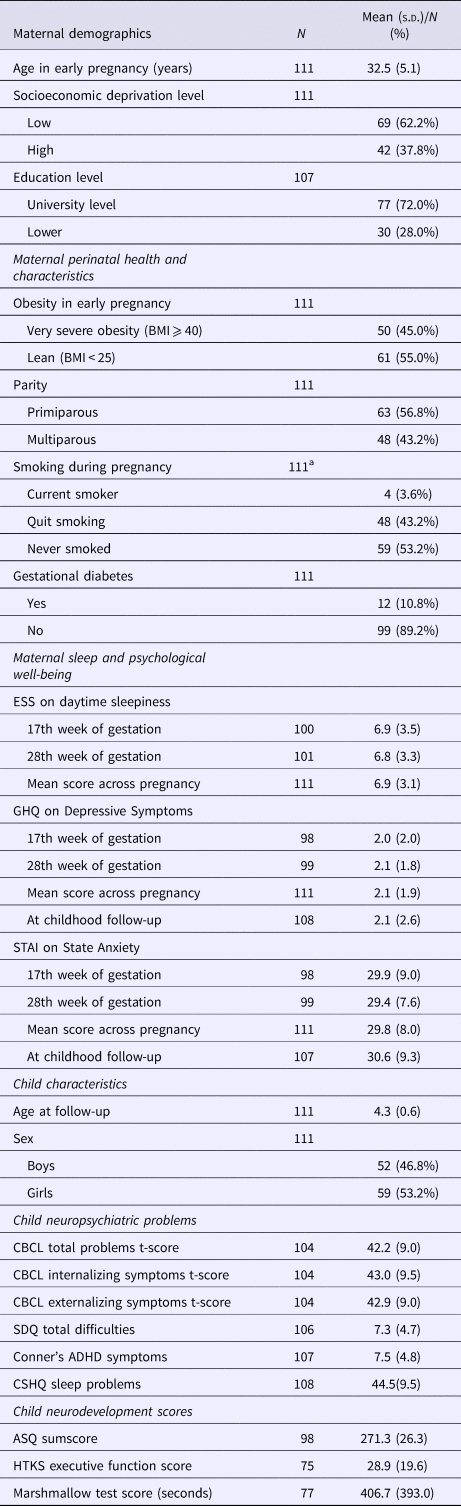
Table 1 shows the characteristics of the current study sample. Maternal daytime sleepiness at 17 and 28 weeks of gestation showed high intra-individual stability (r = 0.77, p < 0.001), and there was no within-individual change in the levels of daytime sleepiness across gestation (MD = 0.03 s.d.s, p = 0.55). Mean antenatal ESS score was 6.9 (s.d. = 3.1), and 8.1% of participating women reported excessive daytime sleepiness during pregnancy (ESS ⩾ 11).
The characteristics of the study sample

s.d., standard deviation; ESS, Epworth Sleepiness Scale; GHQ, General Health Questionnaire; STAI, State-Trait Anxiety Scale; BMI, Body Mass Index; CBCL, Child Behaviour Checklist; SDQ, Strength and Difficulties Questionnaire; ADHD, Attention Deficit Hyperactivity Disorder; CSHQ, Children's Sleep Habits Questionnaire; ASQ, Ages and Stages Questionnaire; HTKS, Head Toes Knees Shoulders Test.
a Due to the low number of participating mothers who smoked throughout pregnancy, women who quit smoking during pregnancy or who smoked throughout pregnancy were classified into the same group in all statistical analyses.
Maternal antenatal daytime sleepiness and child neuropsychiatric symptoms and seurocognitive development
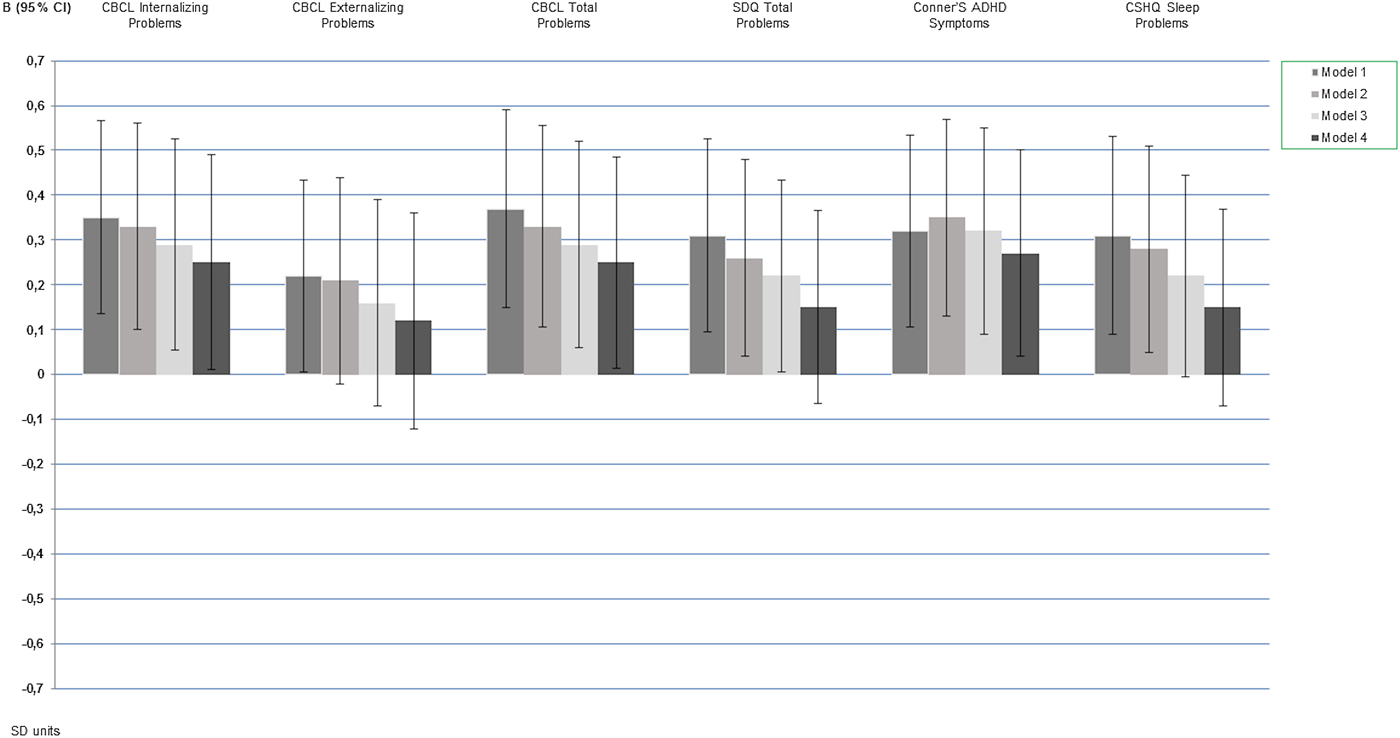
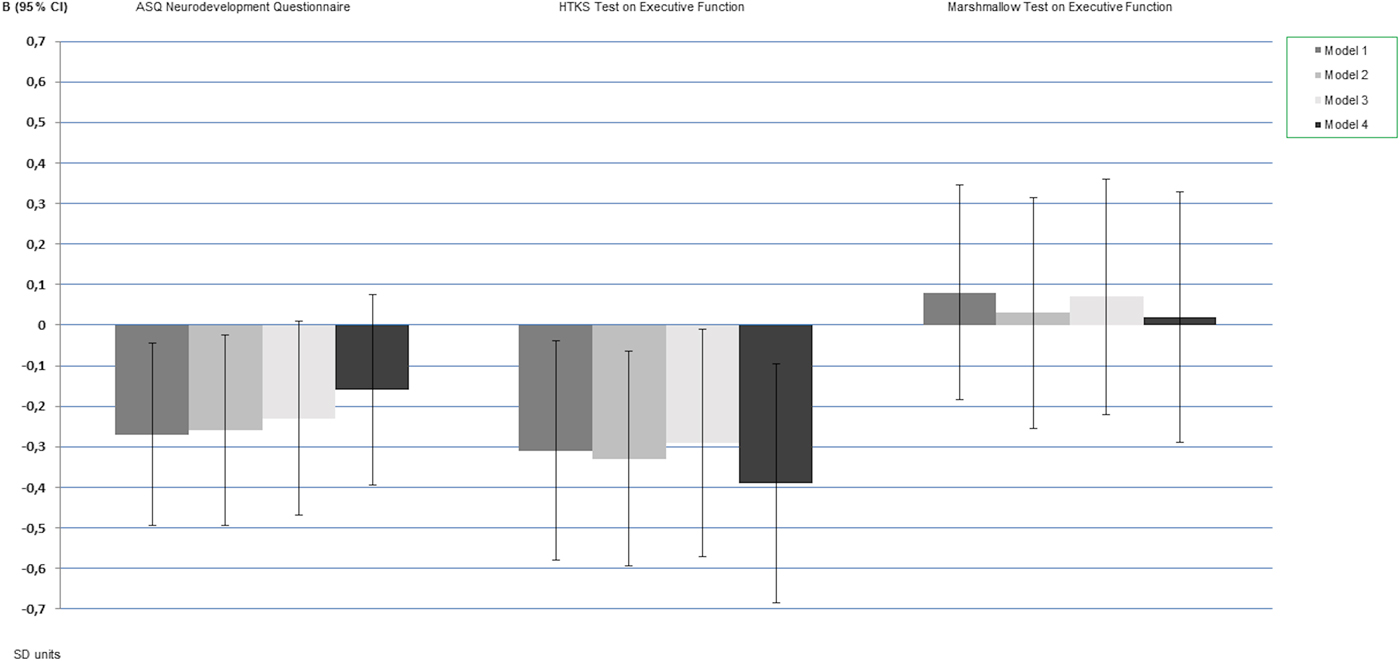
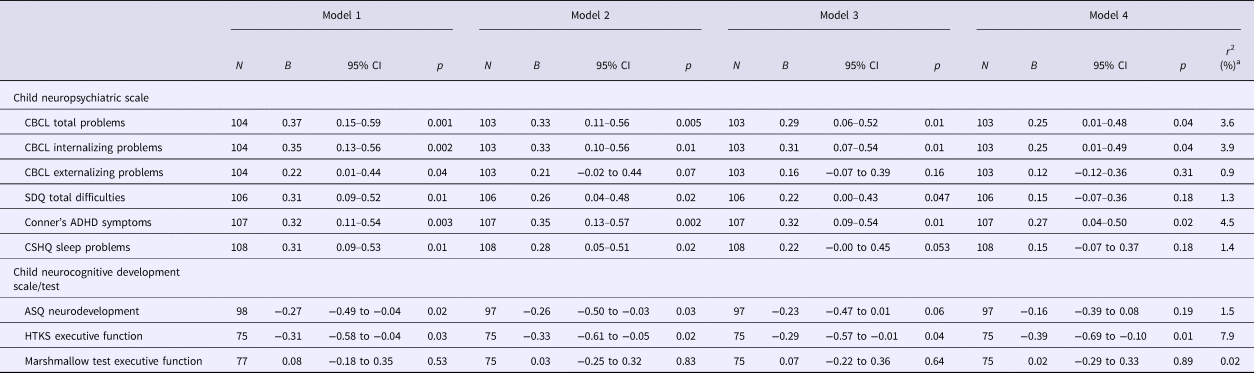
Figure 1, Fig. 2, and Table 2 show the results of the linear regression analyses of maternal daytime sleepiness during pregnancy as a predictor of child neuropsychiatric problems and neurocognitive development. In models adjusted for child sex and age, higher maternal daytime sleepiness during pregnancy was associated with significantly higher child scores on SDQ Total difficulties, CBCL Internalizing, Externalizing, and Total Problems on general psychiatric problems, Conner's Hyperactivity Scale on ADHD symptoms, and CSHQ on child sleep problems. Of the neurocognitive tests and questionnaires, maternal antenatal daytime sleepiness was also associated with significantly poorer ASQ neurodevelopment and HTKS executive function but not with Marshmallow Test scores.
Maternal antenatal daytime sleepiness and child neuropsychiatric problems. Regression coefficients (B) and their 95% confidence intervals (CI) of linear regression analyses where maternal antenatal daytime sleepiness score was used to predict child neuropsychiatric problems. All independent and dependent variables are expressed in standard deviation (s.d.) units. Model 1 is adjusted for child sex and age. Model 2 included Model 1 covariates and maternal depressive symptoms concurrently to rating the child. In Model 3, we added maternal obesity status in early pregnancy as a covariate. In Model 4, we included Model 3 covariates and maternal depressive and anxiety symptoms during pregnancy.

Maternal daytime sleepiness during pregnancy and child neurocognitive development. Regression coefficients (B) and their 95% confidence intervals (CI) from linear regression models where maternal antenatal depressive symptoms was used to predict child neurocognitive development. All independent and dependent variables are expressed in standard deviation (s.d.) units. Model 1 is adjusted for child sex and age. Model 2 also included maternal depressive symptoms concurrently to child follow-up. In Model 3, we added maternal early pregnancy obesity status as a covariate. In Model 4, we included Model 3 covariates and maternal antenatal depressive and anxiety symptoms.

Maternal daytime sleepiness during pregnancy and child neuropsychiatric symptoms and neurocognitive development

CI, confidence interval; CBCL, Child Behaviour Checklist; SDQ, Strength and Difficulties Questionnaire; ADHD, Attention Deficit Hyperactivity Disorder; CSHQ, Children's Sleep Habits Questionnaire; ASQ, Ages and Stages Questionnaire; HTKS, Head Toes Knees Shoulders Test
Model 1 is adjusted for child age and sex
Model 2 is adjusted further for maternal depressive symptoms concurrently to rating the child
Model 3 is adjusted for Model 2 covariates + maternal obesity status during pregnancy
Model 4 is adjusted for Model 3 covariates and maternal depressive and anxiety symptoms during pregnancy
a r 2 refers to the amount of variance explained independently by maternal antenatal daytime sleepiness in regression Model 4, adjusting for child age and sex, maternal depressive symptoms concurrently to child ratings, maternal obesity in pregnancy and maternal depressive and anxiety symptoms during pregnancy
Adjustment for maternal concurrent depressive symptoms in Model 2 did not markedly influence the associations; the association with CBCL Externalizing Problems was now marginal but all other previously significant associations remained significant. Furthermore, adjustment for maternal prenatal obesity in Model 3 attenuated the association with CBCL externalizing problems to non-significance, but higher maternal daytime sleepiness during pregnancy still predicted significantly higher child scores on SDQ Total Difficulties, CBCL Internalizing, and Total Problems, Conner's Hyperactivity Scale, significantly lower child HTKS executive function scores, and marginally higher child CSHQ Sleep Problems and marginally lower ASQ neurodevelopment scores.
Finally, while the associations with child SDQ Total Difficulties, CSHQ Sleep Problems, and ASQ neurodevelopment scores were non-significant in Model 4 (adjusting also for maternal antenatal anxiety and depressive symptoms), higher maternal antenatal daytime sleepiness was still independently associated with significantly higher CBCL Internalizing and Total Problems, Conner's ADHD symptoms and lower HTKS executive function test scores in children.
There were no significant interactions of maternal daytime sleepiness during pregnancy by child sex on child psychiatric problems or child neurodevelopment (p values ⩾ 0.12).
Discussion
In this prospective cohort study, maternal antenatal daytime sleepiness was associated with increased psychiatric problems and poorer neurodevelopment in young children. Maternal obesity confounded the association with child externalizing behaviour, but maternal daytime sleepiness during pregnancy predicted higher psychiatric problems among children on multiple scales and poorer child executive function even after this adjustment. While the associations were independent of maternal concurrent depressive symptoms when rating the child, many of them were attenuated to non-significance after adjustments for anxiety and depressive symptoms during pregnancy. However, maternal antenatal daytime sleepiness still predicted significantly increased internalizing and total psychiatric problems on the CBCL, increased mother-rated ADHD symptoms and poorer executive function in a neuropsychological test independently of maternal antenatal affective symptoms.
Our findings support those of previous large-scale studies where the maternal prenatal emotional state was associated with child psychiatric problems independently of all assessed covariates including maternal postnatal emotional state (Loomans et al., Reference Loomans, van Der Stelt, Van Eijsden, Gemke, Vrijkotte and den Bergh2011; Van Batenburg-Eddes et al., Reference Van Batenburg-Eddes, Brion, Henrichs, Jaddoe, Hofman, Verhulst, Lawlor, Davey Smith and Tiemeier2013; Betts et al., Reference Betts, Williams, Najman and Alati2014; Lahti et al., Reference Lahti, Savolainen, Tuovinen, Pesonen, Lahti, Heinonen, Hämäläinen, Laivuori, Villa, Reynolds, Kajantie and Räikkönen2017). Our findings also correspond with a recent animal study that showed that antenatal circadian rhythm disruption may predict anxiety- and hyperactivity-related behavioural phenotypes in adult mice (Smarr et al., Reference Smarr, Grant, Perez, Zucker and Kriegsfeld2017) and with the previous retrospective human study suggesting that maternal sleep problems during pregnancy are associated with offspring sleep problems in late childhood (Armstrong et al., Reference Armstrong, O'Donnell, McCallum and Dadds1998). In our prospective study with a relatively similar sample size and with a follow-up extending to young childhood, maternal sleep problems, particularly daytime sleepiness during pregnancy showed significant independent associations with a wide range of neuropsychiatric and neurocognitive problems in children. Our novel findings hence suggest that maternal daytime sleepiness during pregnancy may contribute to psychological development in children. We found that maternal antenatal daytime sleepiness also showed independent associations with lower scores on an objective experimental measure of executive functioning, in particular, a test measuring attention, working memory and inhibitory control. Interestingly, maternal antenatal daytime sleepiness was also independently associated with significantly increased ADHD problems in children, also suggesting deficits in executive function as a consequence of maternal antenatal sleep problems. Associations were present also with several other types of psychiatric problems, especially with child internalizing psychiatric problems. While previous evidence suggests effects of maternal antenatal psychological distress on child internalizing problems (O'Donnell et al., Reference O'Donnell, Glover, Barker and O'Connor2014; Lahti et al., Reference Lahti, Savolainen, Tuovinen, Pesonen, Lahti, Heinonen, Hämäläinen, Laivuori, Villa, Reynolds, Kajantie and Räikkönen2017; Van den Bergh et al., Reference Van den Bergh, van den Heuvel, Lahti, Braeken, de Rooij, Entringer, Hoyer, Roseboom, Räikkönen, King and Schwab2017), our findings extend these by showing that maternal antenatal daytime sleepiness also predicts child internalizing problems, independently of maternal mood during and after pregnancy.
Neurobiological mechanisms underlying the associations found may include possibly epigenetic functional changes in the neurobiological stress system, including hypothalamus-pituitary-adrenal (HPA) axis and related brain areas, maternal inflammatory milieu and autonomic nervous system, as a consequence of the maternal antenatal sleep problems. Inflammatory levels are associated with sleep disorders (Nishiyama et al., Reference Nishiyama, Mizuno, Kojima, Suzuki, Kitajima, Ando, Kuriyama and Nakayama2014) and maternal inflammation during pregnancy is associated with psychopathology risk in the offspring (Brown et al., Reference Brown, Sourander, Hinkka-Yli-Salomäki, McKeague, Sundvall and Surcel2013; Canetta et al., Reference Canetta, Sourander, Surcel, Hinkka-Yli-Salomäki, Leiviskä, Kellendonk, Ian and Brown2015; Gilman et al., Reference Gilman, Cherkerzian, Buka, Hahn, Hornig and Goldstein2016; Zerbo et al., Reference Zerbo, Traglia, Yoshida, Heuer, Ashwood, Delorenze, Hansen, Kharrazi, Van de Water, Yolken, Weiss and Croen2016; Murphy et al., Reference Murphy, Fineberg, Maxwell, Alloy, Zimmermann, Krigbaum, Cohn, Drabick and Ellman2017). Altered structure and/or functioning of HPA axis is found in sleep disorders (van Dalfsen and Markus, Reference van Dalfsen and Markus2018), and maternal HPA axis function has been associated with psychiatric problems in the offspring (Buss et al., Reference Buss, Davis, Shahbaba, Pruessner, Head and Sandman2012), and structural changes of brain areas implicated in HPA axis functioning have been shown to mediate the effects of maternal antenatal psychological distress on child psychiatric problems (Sandman et al., Reference Sandman, Buss, Head and Davis2015). Epigenetic changes in genes regulating HPA axis glucocorticoid functioning have been shown as a consequence of maternal antenatal psychological distress (Braithwaite et al., Reference Braithwaite, Kundakovic, Ramchandani, Murphy and Champagne2015; Palma-Gudiel et al., Reference Palma-Gudiel, Córdova-Palomera, Eixarch, Deuschle and Fañanás2015; Mansell et al., Reference Mansell, Vuillermin, Ponsonby, Collier, Saffery and Ryan2016), and in children with psychiatric, particularly internalizing problems (Van Der Knaap et al., Reference Van Der Knaap, Van Oort, Verhulst, Oldehinkel and Riese2015; Parade et al., Reference Parade, Ridout, Seifer, Armstrong, Marsit, McWilliams and Tyrka2016). On the other hand, although we controlled for the effects of maternal concurrent mental health, we can neither rule out genetic or shared familial postnatal environmental factors as explanations for our findings. Genetic risk for psychopathology is well-established (Smoller et al., Reference Smoller, Craddock, Kendler, Lee and Neale2013; Stein et al., Reference Stein, Pearson, Goodman, Rapa, Rahman, McCallum, Howard and Pariante2014), and some recent evidence suggests that genetic or shared postnatal environmental factors may confound or mediate the associations between maternal prenatal emotional distress and child psychiatric problems (Plant et al., Reference Plant, Pariante, Sharp and Pawlby2015; Gjerde et al., Reference Gjerde, Eilertsen, Reichborn-Kjennerud, McAdams, Zachrisson, Zambrana, Røysamb, Kendler and Ystrom2017; Kuckertz et al., Reference Kuckertz, Mitchell and Wiggins2018). These environmental factors may include child maltreatment and altered parenting practices in families with maternal psychological distress (Plant et al., Reference Plant, Pariante, Sharp and Pawlby2015; Kuckertz et al., Reference Kuckertz, Mitchell and Wiggins2018). Maternal sleep problems may also have continued postpartum, and affected parenting practices. It may be that mothers who are sleepy antenatally, continue to have high daytime sleepiness postnatally and thus the child's environment, stimulation and interaction with other humans might be adversely affected. Hence, whether the effects we found reflect prenatal programming of the developing nervous system and/or associations mediated by changes in the postnatal environments or confounded by genetics, needs to be solved in further studies.
The strengths of this study include the longitudinal design and use of multiple validated scales on child psychological development. We also had data from individually administered neuropsychological tests. The maternal daytime sleepiness measures, although self-reported, were average scores from up to two measurements, increasing the reliability of the measures. In contrast, the limitations of this study include the relatively small sample size, the relatively high attrition rates at the childhood follow-up, the use of only maternal reports of child psychiatric problems and the case-control design of the cohort in terms of maternal severe obesity in pregnancy. The case-control design meant that the mothers were more often severely obese than women in the general population. As obese pregnant women mothers have higher rates of daytime sleepiness (Amador-Licona and Guízar-Mendoza, Reference Amador-Licona and Guízar-Mendoza2012), socioeconomic disadvantage (Heslehurst et al., Reference Heslehurst, Ells, Simpson, Batterham, Wilkinson and Summerbell2007) and their children have more psychiatric problems (Mina et al., Reference Mina, Lahti, Drake, Raikkonen, Minnis, Denison, Norman and Reynolds2017), our sample can be considered a high-risk subsample with possibly limited generalizability of the findings to the general population. However, maternal obesity did not explain the effects of daytime sleepiness in our cohort. Furthermore, while having reports from both parents and/or from child's nursery caretakers would have yielded a more precise picture of the associations and eluded the risk of shared method variance inflating the associations, it is important to note the effects of maternal sleep problems were independent of maternal depressive symptoms when rating the child. Another limitation is that we did not have measurements of maternal sleep problems at child follow-up, only assessments of maternal affective symptoms. Neither did we have data on other maternal sleep problems during pregnancy than daytime sleepiness available. We do not know, for example, whether mother's sleepiness during the day was due to lack of sleep, other sleep problems, or feelings of fatigue due to other reasons such as depression or other psychological distress. We also had no data on paternal daytime sleepiness or other indices of paternal psychological well-being available. Further studies are needed to compare the effects of maternal and paternal daytime sleepiness and of different types of parental sleep problems antenatally and in childhood on child psychological development.
In conclusion, higher maternal antenatal daytime sleepiness was independently and longitudinally associated with increased neuropsychiatric problems and poorer executive function in early childhood. These effects suggest that antenatal sleep problems carry adverse consequences both for the pregnant woman and her offspring, and suggest their assessment may be an important addition to standard antenatal care.
Supplementary material
The supplementary material for this article can be found at https://doi.org/10.1017/S003329171800291X.
Acknowledgements
This work was supported by funding from Tommy's and the Medical Research Council (MR/N022556/1). We also acknowledge the support of the British Heart Foundation.
Conflict of interest
None of the authors have any personal or financial conflicts of interest.