Introduction
Peer victimization, referring to being bullied or experiencing aggressive behavior from one or more peers repeatedly, has become a worldwide concern (Arseneault, Reference Arseneault2018). The experiences of peer victimization have been demonstrated to significantly predict various psychosomatic disorders in adolescence (e.g., Moore et al., Reference Moore, Norman, Suetani, Thomas, Sly and Scott2017, for a meta-analysis). Numerous studies have been conducted on the identification of key predictors to understand the determinants of differences in adolescent peer victimization (see Zych et al., Reference Zych, Farrington and Ttofi2019). Notably, there is mounting evidence indicating that maladaptive parenting practices, such as high levels of harsh punishment and psychological control, play a prominent role in the development of youth peer victimization (e.g., Lereya et al., Reference Lereya, Samara and Wolke2013, for a meta-analysis). Adolescent peer victimization can also elicit certain parental overcontrol and punitive responses (e.g., Ma & Bellmore, Reference Ma and Bellmore2012; Zhu et al., Reference Zhu, Yu, Bao, Chen, Zhang, Jiang, Su and Zhang2019). Accordingly, the association between maladaptive parenting and adolescent peer victimization may reflect a reciprocal process of mutual influence. However, it remains unclear whether maladaptive parenting and adolescent peer victimization are longitudinally related, particularly at the within-person level. In addition, knowledge about possible mediating mechanisms that account for the longitudinal associations of maladaptive parenting and peer victimization is limited. Such knowledge is crucial for tackling interpersonal difficulties and preventing chronic problems. Therefore, in this study, we examined the within-person dynamic associations between two kinds of maladaptive parenting (i.e., harsh punishment and psychological control) and peer victimization, and the mediating roles of internalizing and externalizing problems underlying these associations with a sample of Chinese early adolescents, using random intercept cross-lagged panel modeling (RI-CLPM; Hamaker et al., Reference Hamaker, Kuiper and Grasman2015).
Harsh punishment, psychological control, and peer victimization
During early adolescence, children begin to rely more on peers as critical sources of influence on identity, self-evaluation, and personal worth, and they become more responsive to peer influence (Sumter et al., Reference Sumter, Bokhorst, Steinberg and Westenberg2009). Previous studies have found that peer victimization is more common among young people aged 11–12 years, equating approximately to the upper grades of elementary school (e.g., Ten Bokkel et al., Reference Ten Bokkel, Verschueren, Demol, van Gils and Colpin2021). Moreover, at the onset of puberty, adolescents begin to strive for autonomy and resist parental authority, and parents may adopt more controlling parenting during this stage (Fanti et al., Reference Fanti, Henrich, Brookmeyer and Kuperminc2008). Researchers have suggested the influence of parental control is especially important in the study of early adolescent peer victimization (Barber et al., Reference Barber, Xia, Olsen, McNeely and Bose2012; Frazer et al., Reference Frazer, Cooley, Fite and Poquiz2018). Thus, early adolescence may function as a unique transition period during which resources aimed at preventing youth from experiencing subsequent chronic victimization, maladaptive parenting, and related mental health problems, should be provided.
Following the work of Barber et al. (Reference Barber, Maughan and Olsen2005), Janssens et al. (Reference Janssens, Goossens, Van Den Noortgate, Colpin, Verschueren and Van Leeuwen2015) distinguished four types of parental control, including three types of behavioral control (i.e., proactive, nonphysical, and harsh punitive control) together with psychological control, each of which can result in different outcomes for youth when implemented by parents. The effects of harsh punishment and psychological control on children and adolescents have received considerable research attention, being significantly associated with various detrimental outcomes (e.g., Van Heel et al., Reference Van Heel, Bijttebier, Claes, Colpin, Goossens, Van Den Noortgate, Verschueren and Van Leeuwen2019). Harsh punishment denotes physical punishment (e.g., spanking) adopted by parents following children’s undesirable behavior, and psychological control refers to intentional, strategic parental behaviors that manipulate or dominate the child by invalidating expressed feelings, constraining verbal expression, or using love withdrawal or guilt induction techniques (Janssens et al., Reference Janssens, Goossens, Van Den Noortgate, Colpin, Verschueren and Van Leeuwen2015).
Spillover theory, which originated from ecological system theories, posits that individuals are embedded within various interdependent social systems, and experiences within one system can alter correlates, such as cognitions, emotions, and behaviors that affect social interactions in other systems (e.g., Parke & Ladd, Reference Parke and Ladd2016). The implementation of harsh punishment, characterized as impertinent and violent, has been suggested to stifle children’s development of social competence, resulting in the transference of hostility learned from violent family experiences into the peer context, which may lead to a higher level of peer victimization (Zhu et al., Reference Zhu, Yu, Bao, Chen, Zhang, Jiang, Su and Zhang2019). Moreover, it has been suggested that parental psychological control, characterized by manipulation, coercion, and intrusion, undermines children’s sense of self and limits their opportunities for developing self-efficacy, thereby impeding the development of positive interpersonal relationships with their peers (Barber et al., Reference Barber, Xia, Olsen, McNeely and Bose2012). Accordingly, researchers have stated the importance of investigating the influence of harsh punishment and parental control on peer relationships such as peer victimization (Frazer et al., Reference Frazer, Cooley, Fite and Poquiz2018; Zhu et al., Reference Zhu, Yu, Bao, Chen, Zhang, Jiang, Su and Zhang2019).
Numerous studies have supported a spillover effect from harsh punishment and psychological control on children’s and adolescents’ experiences of peer victimization (see Nocentini et al., Reference Nocentini, Fiorentini, Di Paola and Menesini2019, for a narrative review). For instance, a cross-sectional study among Spanish children identified a significant positive association between parental corporal punishment and peer victimization (Martin et al., Reference Martin, Muñoz, Braza, Ruiz-Ortiz, del Puerto-Golzarri, Pascual-Sagastizábal, Azurmendi and Carreras2021). Similar associations between parental harsh punishment and peer victimization were found in two other studies among Chinese children and adolescents (Duong et al., Reference Duong, Schwartz, Chang, Kelly and Tom2009; Li et al., Reference Li, Yu, Nie and Liu2021). Moreover, two cross-sectional studies found that psychological control had positive associations with both overt/physical and relational victimization (Li et al., Reference Li, Zhang and Wang2015; Sun et al., Reference Sun, Liang and Bian2017). A longitudinal study also showed that parental psychological control significantly predicted youth peer victimization after one year (Frazer et al., Reference Frazer, Cooley, Fite and Poquiz2018).
Spillover theory also suggests that youth’s peer relationships may be reciprocally connected with parenting behaviors in the family (e.g., Kaufman et al., Reference Kaufman, Kretschmer, Huitsing and Veenstra2020; Parke & Ladd, Reference Parke and Ladd2016). For instance, a 14-day diary study of 578 adolescents from Mexico, China, and European nations revealed that family conflict spilled over into peer conflict after 1-to-2 days, while peer conflict reversely predicted family conflict during the following day (Chung et al., Reference Chung, Flook and Fuligni2011). A 5-wave longitudinal study of 9,770 Dutch children showed that higher parental rejection and lower parental warmth predicted increases in peer victimization over time and vice versa, thus supporting bidirectional cross-domain spillover effects (Kaufman et al., Reference Kaufman, Kretschmer, Huitsing and Veenstra2020). More relevant to the current study, a 3-year longitudinal study of 342 Chinese adolescents indicated that corporal punishment significantly predicted relational victimization one year later, and relational victimization also significantly predicted parents’ corporal punishment one year later (Zhu et al., Reference Zhu, Yu, Bao, Chen, Zhang, Jiang, Su and Zhang2019). These findings suggest that youth may become trapped in a vicious cycle involving family and peer contexts. Thus, it can be expected that harsh punishment and psychological control would show reciprocal relations with peer victimization over time.
Although these findings above provided inferences for the bidirectional spillover between maladaptive parenting and peer victimization, important limitations remain. First, although these processes have been theoretically hypothesized to occur at the within-person level, empirical support for the longitudinal associations between maladaptive parenting and peer victimization is confined mostly to cross-lagged panel modeling (CLPM) (see Nocentini et al., Reference Nocentini, Fiorentini, Di Paola and Menesini2019, for a review). CLPM is used to test for the prospective effect of individual differences in one construct on changes in individual differences in another construct (and vice versa), given that the effects control for the autoregressive effects in the constructs (e.g., Orth et al., Reference Orth, Clark, Donnellan and Robins2021). Thus, CLPM can be used to test the question regarding the transactional processes between parental harsh punishment or psychological control and peer victimization at the between-person level, with the following hypothesis: Compared to youth who experience less harsh punishment or psychological control, youth who experience more harsh punishment or psychological control from parents will display a subsequent rank-order increase in peer victimization (and vice versa) (see Orth et al., Reference Orth, Clark, Donnellan and Robins2021). As such, CLPM has been criticized for failing to examine within-person effects that derive conclusions about processes occurring within individuals (e.g., Hamaker et al., Reference Hamaker, Kuiper and Grasman2015). In light of such methodological concerns, the current study was conducted using random intercept cross-lagged panel models (RI-CLPM). The RI-CLPM is an extension of CLPM into a multilevel framework (Hamaker et al., Reference Hamaker, Kuiper and Grasman2015). The inclusion of random intercepts in the RI-CLPM enables the explicit modeling of the stable, trait-like between-person differences for each of the constructs. By partialing out the between-person variance, the estimated lagged associations between constructs in the RI-CLPM refer exclusively to within-person fluctuations across time (Hamaker et al., Reference Hamaker, Kuiper and Grasman2015). Thus, the RI-CLPM can evaluate within-person processes to determine when a youth experiences an increase in parental harsh punishment or psychological control, this specific youth will experience a subsequent increase in peer victimization (and vice versa).
Second, research addressing the reciprocal relations between maladaptive parenting and peer victimization is still rare in Chinese culture. Researchers have acknowledged that cultural contexts may provide different values, practices, and norms for parenting (e.g., Tamm et al., Reference Tamm, Kasearu, Tulviste and Trommsdorff2018). Western societies encourage individuality and autonomy, high parental control (e.g., harsh punishment) may therefore be considered illegitimate (Simons et al., Reference Simons, Wu, Lin, Gordon and Conger2000). In contrast, in traditional Chinese societies, increased levels of control are always socially approved by parents, given that both Chinese parents and children tend to perceive harsh discipline as an indication of parental involvement, concern, and love (e.g., Wang & Liu, Reference Wang and Liu2014). In addition, according to the Chinese traditional Confucian culture, people are expected to benefit from a more collective and interpersonal mode of functioning, even as early as in adolescence (e.g., Uchida & Kitayama, Reference Uchida and Kitayama2009). These collectivistic features of Chinese culture may provide a powerful socializing context regarding peer victimization. Within such a context, peer victimization can be more harmful to Chinese victims, given the importance of interpersonal interdependency (Chen et al., Reference Chen, Zhang, Ji and Deater-Deckard2019). Given the unique Chinese social and cultural approaches to parenting and peer relationships, more longitudinal research is needed to capture the long-term associations between maladaptive parenting (i.e., harsh punishment, psychological control) and peer victimization among Chinese adolescents.
Third, there are limits to existing knowledge about the mediating mechanisms that account for the potential dynamic process between maladaptive parenting and peer victimization. Understanding the precise mediating mechanisms should provide a comprehensive understanding of the likely complex processes involved in the cross-domain spillover between family and peer domains, resulting in more effective interventions to prevent youth from being locked in a vicious cycle of negative relationships. In this study, we considered internalizing and externalizing problems as two plausible mediating variables to explain the longitudinal associations between maladaptive parenting and peer victimization, which are discussed in the following section.
The mediating roles of internalizing and externalizing problems
According to spillover theory, the bidirectional influences between family and peer systems may operate through indirect pathways in which an individual’s internalizing and externalizing problems drive bidirectional effects (Parke & Ladd, Reference Parke and Ladd2016). Youth who grow up in an adverse family environment characterized by hostile and harsh parenting are more likely to display internalizing and externalizing problems; in turn, such behaviors might be carried over into their peer relationships in terms of becoming the target of exclusion and bullying by peers. Meta-analyses of longitudinal studies including children and adolescents have indicated that harsh punishment and psychological control predict changes in internalizing problems (Pinquart, Reference Pinquart2017a) and externalizing problems (Pinquart, Reference Pinquart2017b) over time. Furthermore, previous studies have shown that children who display internalizing problems are more likely to be victimized; this is because they often make little effort to defend themselves or counterattack the behavior of the bully and receive little assistance from others (see Christina et al., Reference Christina, Magson, Kakar and Rapee2021, for a meta-analysis). Children with externalizing problems are also often rejected and victimized as other children retaliate (see Reijntjes et al., Reference Reijntjes, Kamphuis, Prinzie, Boelen, Van der Schoot and Telch2011, for a meta-analysis). As such, internalizing and externalizing problems may be proximal process mechanisms in the associations between parental harsh punishment and psychological control and peer victimization.
Internalizing and externalizing problems can also explain the links between peer victimization and maladaptive parenting behaviors. Studies have shown that adolescents’ peer victimization experiences play a substantial role in the development of internalizing (Christina et al., Reference Christina, Magson, Kakar and Rapee2021, for a meta-analysis) and externalizing problems (Reijntjes et al., Reference Reijntjes, Kamphuis, Prinzie, Boelen, Van der Schoot and Telch2011, for a meta-analysis). Furthermore, there is substantial evidence that adolescent internalizing and externalizing problems significantly increase the frequency of harsh control and psychological control behaviors by parents (Pinquart, Reference Pinquart2017a, Reference Pinquart2017b; for meta-analyses). A recent longitudinal study also found that spillover from parent–child relationships to peer victimization was mediated separately by children’s internalizing and externalizing problems, and spillover from peer victimization to parent–child rejection and warmth was also separately mediated by children’s internalizing and externalizing problems (Kaufman et al., Reference Kaufman, Kretschmer, Huitsing and Veenstra2020). Thus, we expected internalizing and externalizing problems to function as mediators in parent–peer/peer–parent spillover, respectively.
Theories and empirical studies also illustrate the longitudinal relations between internalizing and externalizing problems. Reciprocal models assume that internalizing and externalizing problems may bidirectionally predict each other; that is, changes in one are often associated with changes in the other (e.g., Measelle et al., Reference Measelle, Stice and Hogansen2006). Some studies that use CLPM approaches have supported the view that the associations between internalizing and externalizing problems are bidirectional over time (e.g., Panayiotou & Humphrey, Reference Panayiotou and Humphrey2018), whereas other studies found that internalizing problems emerged as sequelae of externalizing problems (e.g., Wertz et al., Reference Wertz, Zavos, Matthews, Harvey, Hunt, Pariante and Arseneault2015). An 8-wave longitudinal study investigated the associations between externalizing and internalizing problems among youth aged 7–15 using autoregressive latent trajectory models with structured residuals; the findings revealed evidence that externalizing to internalizing problems cascade at the within-person level (Murray et al., Reference Murray, Eisner and Ribeaud2019). In this study, the bidirectional relations between internalizing and externalizing problems were also examined. As such, we expected that internalizing and externalizing problems may also play chain mediating roles in parent–peer/peer–parent spillover. For instance, we examined whether paths existed by which either psychological control or harsh punishment could facilitate peer victimization via internalizing problems and externalizing problems successively, or vice versa. Such knowledge should provide a more complete understanding of the likely complex chain of processes involved in the development of maladaptive parenting and peer victimization among adolescents.
The roles of sex, SES and age
Extant literature suggests that sex may be an important factor requiring consideration when testing the associations between parenting, internalizing and externalizing problems, and peer victimization. For instance, several studies consistently found that internalizing problems are more prevalent among girls and externalizing problems are more prevalent among boys (e.g., Gutman & McMaster, Reference Gutman and McMaster2020). Moreover, some empirical studies have found that parenting has stronger effects on internalizing problems and weaker effects on externalizing behaviors among girls than boys (e.g., Möller et al., Reference Möller, Nikolić, Majdandžić and Bögels2016). However, no moderating effect of child sex was observed in meta-analyses on the relations between maladaptive parenting and internalizing (Pinquart, Reference Pinquart2017a) or externalizing behaviors (Pinquart, Reference Pinquart2017b). Studies examining sex differences in the relations between peer victimization and internalizing and externalizing problems also yielded inconsistent findings. For example, one study found depression to be predictive of peer victimization, although this effect only held for adolescent girls (Lester et al., Reference Lester, Dooley, Cross and Shaw2012), whereas in another study this effect only held for adolescent boys (Sweeting et al., Reference Sweeting, Young, West and Der2006). However, a meta-analysis reported no sex differences in associations between peer victimization and internalizing problems (Christina et al., Reference Christina, Magson, Kakar and Rapee2021). Some empirical studies have reported that peer victimization was more strongly related to externalizing behaviors among boys than among girls (e.g., Sullivan et al., Reference Sullivan, Farrell and Kliewer2006), whereas no sex differences in the relations between peer victimization and externalizing problems were found in a meta-analysis (Reijntjes et al., Reference Reijntjes, Kamphuis, Prinzie, Boelen, Van der Schoot and Telch2011). Given the inconsistencies among previous studies, the possibility of sex differences in the relations among maladaptive parenting, peer victimization, and internalizing and externalizing problems was therefore evaluated in this study. However, no specific hypothesis was formulated; thus, the evaluation was exploratory rather than confirmatory in nature.
Previous research has also suggested low socioeconomic status (SES) is related to higher levels of internalizing and externalizing problems (e.g., Lansford et al., Reference Lansford, Malone, Stevens, Dodge, Bates and Pettit2006), peer victimization (e.g., Jansen et al., Reference Jansen, Verlinden, Dommisse-van Berkel, Mieloo, van der Ende, Veenstra, Verhulst, Jansen and Tiemeier2012), and maladaptive parenting practices (e.g., Roubinov & Boyce, Reference Roubinov and Boyce2017). Moreover, previous studies have demonstrated that younger children report more victimization than older children (Hanish & Guerra, Reference Hanish and Guerra2002). Previous studies have also reported significant mean level decreases for both externalizing and internalizing problems with advancing age (Shi et al., Reference Shi, Ettekal, Deutz and Woltering2020). Therefore, we controlled for SES and age in the current study.
The current study
Theoretically expected reciprocal relations between maladaptive parenting and adolescent peer victimization exist. However, knowledge of how maladaptive parenting and adolescent peer victimization are longitudinally related and the potential mediating mechanisms underlying this interaction remains limited at the within-person level. Accordingly, this study addressed three major hypotheses. First, guided by spillover theory and the existing empirical evidence at the between-person level, the first hypothesis states that harsh punishment and psychological control would be reciprocally associated with peer victimization over time at the within-person level.
Second, spillover theory posits that internalizing and externalizing behaviors may be key mechanisms in the reciprocal relations between maladaptive parenting and peer victimization. Previous studies have also found significant associations between internalizing and externalizing problems and harsh punishment, psychological control, and peer victimization. Thus, the second hypothesis states that internalizing and externalizing problems would function as mediators in the bidirectional relations, respectively, between harsh punishment or psychological control and peer victimization at the within-person level. Moreover, bidirectional relations between internalizing and externalizing problems may also exist. Thus, internalizing and externalizing problems will also play chain mediating roles in the longitudinal associations between either harsh punishment or psychological control and peer victimization. Specifically, the following chain indirect paths may be present: “parenting → internalizing problems → externalizing problems → peer victimization,” “parenting → externalizing problems → internalizing problems → peer victimization,” “peer victimization → internalizing problems → externalizing problems → parenting” and “peer victimization → externalizing problems → internalizing problems → parenting.”
Finally, given the significant sex differences in the associations between parenting, internalizing and externalizing problems, and peer victimization, we hypothesized that these pathways underlying the longitudinal associations would differ for boys and girls. However, given the inconsistencies among previous studies and the limited evidence, our hypothesis about the nature of sex differences was exploratory rather than confirmatory.
Method
Participants
Participants were recruited from eight public elementary schools in a mid-size city located in the Northwest of China. With the assistance of local education authorities, eight schools were randomly invited to participate in this study, and all schools agreed to participate. All students and their parents in Grades 4 and 5 were invited to participate and an overall participation rate of 98% was achieved across the schools. A total of 111 classes took part, with the number of students ranging from 37 to 54 in each regular classroom (the average number of students per class = 43). The participants were assessed four times every six months over a period of 1.5 years. At the Time 1 (T1) assessment, participants comprised 4,731 students aged 10–13 years old (44.9% girls; Mean age = 10.91 years, SD = 0.72). Almost all the participants were from middle-income families (based on parent-reported information). Furthermore, 92.5% of fathers and 81.6% of mothers reported that they had at least a middle school degree, and 28.1% of families reported having one child. The employment history of participants’ parents showed that 80.9% of fathers and 67.9% of mothers held stable jobs during the year previous to the study taking place.
There were 4,450 students included at Time 2 (T2), 4,306 students at Time 3 (T3), and 4,441 students at Time 4 (T4). Attrition was due mainly to students transferring to other schools or being absent from school on the assessment date. A total of 4,171 students completed the questionnaires on each of the four assessment occasions. The average absence rate among participants at each of the assessment periods were as follows: 5.93% at T2, 9.0% at T3, and 6.1% at T4. The percentage of missing data for the main variable ranged from 6.02% to 11.84%. Differences in demographic variables (i.e., SES, age, sex) and main study variables were examined between students who provided data at all four time points (Group 1) and students with missing data (Group 2). Although there were statistically significant differences between Group 1 and Group 2 in most cases, the effect sizes were very small (η2s < 0.02), indicating that the incomplete data exerted minimal impact on the study variables. More results of attrition analysis are presented in Section 1 in the online supplemental materials. Full information maximum likelihood was used in subsequent analyses, producing unbiased estimates of non-normality for indicator variables under the missing at random assumption (Little & Rubin, Reference Little and Rubin2002).
Procedure
The study was approved by the Human Research Ethics Committee and the relevant education authorities, school boards, and teachers. Prior to data collection, written consent was obtained from all of the children and their parents through the school. The study measures were administered to the students in their regular classroom setting by a trained graduate assistant. All students received identical verbal and written instructions from the assistant. They were encouraged to take as much time as needed to complete the measures, and they could stop anytime they wanted. The parents completed demographic (i.e., SES) questionnaires online, with instructions from the headteachers in each class. Participants were assured of the strict confidentiality of the collected data, and only research personnel had access to the completed questionnaires.
Measures
Parental harsh punishment and psychological control
The Harsh Punishment and Psychological Control Subscales of the Parenting Behavior Scale (Janssens et al., Reference Janssens, Goossens, Van Den Noortgate, Colpin, Verschueren and Van Leeuwen2015) were used to measure parental harsh punishment and psychological control behaviors, respectively. The Harsh Punishment subscale comprises four items, such as “My parents slap me when I have done something wrong.” The Psychological Control Subscale included eight items, such as “My parents are always trying to change how I feel or think about things.” Response options were provided on a 5-point Likert scale ranging from 0 (never) to 4 (always). Mean scores were calculated with higher scores reflecting higher levels of harsh punishment and psychological control. In this study, the Cronbach’s coefficient alpha for the Harsh Punishment Subscale ranged from 0.68 to 0.70 across the four time points (T1–T4). The Cronbach’s coefficient alpha for the Psychological Control Subscale ranged from 0.78 to 0.81 (T1–T4).
Peer victimization
The Multidimensional Peer Victimization Scale (MPVS; Mynard & Joseph, Reference Mynard and Joseph2000) was used to measure peer victimization experiences. The MPVS comprises 10 items, three that assess physical victimization, such as “In this semester, other kids hurt me physically in some way,” and seven that assess relational victimization, such as “In this semester, someone made other kids not to talk to me.” Responses were provided using a 4-point scale ranging from 0 (never) to 3 (a lot). Mean scores were calculated with higher scores reflecting higher frequencies of peer victimization. In this study, the Cronbach’s coefficient alpha for the MPVS ranged from 0.91 to 0.94 (T1–T4).
Internalizing problems and externalizing problems
Internalizing and externalizing problems were assessed using the Youth Self-Report form of the Child Behavior Checklist (YSR-CBCL; Achenbach, Reference Achenbach1991). The scale for internalizing problems includes 17 items assessing depressive and anxiety symptoms, such as “unhappy, sad, depressed” and “nervous, tense.” The scale for externalizing problems includes 12 items assessing aggressive and delinquent behaviors, such as “cruelty, bullying, or meanness to others” and “I steal things from places other than home.” Responses ranged from 0 (not true) to 2 (very true or often true). Mean scores were calculated with higher scores indicating higher levels of internalizing and externalizing problems. In this study, the Cronbach’s coefficient alpha for the YSR-CBCL for internalizing problems ranged from 0.92 to 0.94 (T1–T4) while the Cronbach’s coefficient alpha for the YSR-CBCL for externalizing problems ranged from 0.92 to 0.94 (T1–T4).
Covariates
Students’ age, sex (0 = male, 1 = female) and SES data were collected as covariates. Parent education levels and monthly family income were reported by either fathers or mothers using an online questionnaire. The education levels were recorded on a scale from 0 (never attended school) to 7 (doctoral degree), and monthly family income was recorded as 1 (<1,000 RMB) to 9 (>80,000 RMB). Fathers’ and mothers’ education level scores and annual family income scores were standardized by transforming them into z-scores, and the average was calculated based on the three standardized variables to index SES (e.g., Zhang et al., Reference Zhang, Ying Hu, Ren and Zhang2019).
Analytic strategy
Preliminary analyses
Descriptive statistics and bivariate correlations for all study variables were calculated in Mplus Version 8.3 using the full sample after missing data were estimated by full information maximum likelihood. Then, the intraclass correlations were calculated for harsh punishment, psychological control, peer victimization, and internalizing and externalizing problems across the four waves to obtain a preliminary understanding of how much variance stems from between-person differences versus within-person fluctuations.
Random intercept cross-lagged panel models (RI-CLPMs)
First, we examined the RI-CLPMs with only harsh punishment and peer victimization, and psychological control and peer victimization. Subsequently, the RI-CLPMs with harsh punishment, peer victimization, and internalizing and externalizing problems, and the RI-CLPMs with psychological control, peer victimization, and internalizing and externalizing problems were tested. RI-CLPMs were conducted following the procedures of Hamaker et al. (Reference Hamaker, Kuiper and Grasman2015). First, each observed score was regressed on its own latent factor; factor loadings were constrained to 1. Then, the random intercepts, one for each construct, were added by regressing the constructs at each time point with factor loadings constrained to 1, while the remaining variation in the constructs represented the within-person processes, which are of main interest when testing reciprocal influences over time. To capture the variation in the observed scores measured by the within-person and between-person factor structures in full, the variances of the observed scores were constrained to 0. Students’ sex, age, and SES were entered into RI-CLPMs as time-invariant covariates, and were then regressed on all observed variables at T1 as the random intercepts of each variable.
For reasons of parsimony and given that there were no specific hypotheses regarding non-stationarity of the underlying within-person processes in this study, autoregressive paths and/or cross-lagged paths were constrained to be equal over time in a stepwise manner and compared with unconstrained baseline models (Orth et al., Reference Orth, Clark, Donnellan and Robins2021). Four models were compared. First, an unconstrained model was tested in which all cross-lagged paths, autoregressive paths, and occasional covariance were freely estimated (Model a). Second, a constrained model was tested using cross-wave equality constraints on autoregressive effects (Model b). Third, a constrained model was tested using cross-wave equality constraints on cross-lagged effects (Model c). Fourth, a constrained model was tested using cross-wave equality constraints on both autoregressive and cross-lagged effects (Model d).
The maximum likelihood with robust standard errors estimator was employed to obtain the most accurate parameter estimates. The model fit was considered acceptable when the comparative fit index (CFI) and the Tucker-Lewis Index were above 0.90, and when the Root Mean Square Error of Approximation (RMSEA) and the Standardized Root Mean Square Residual (SRMR) were below 0.08 (Kline, Reference Kline2010). For model comparisons (and because χ2 is greatly affected by the sample size), no significant difference was deemed to exist if the fit indices of ΔCFI were less than 0.01, ΔRMSEA was less than 0.015, and ΔSRMR was less than 0.030 (Chen, Reference Chen2007). When models with fixed paths do not fit significantly worse than the freely estimated models, the fixed models would be preferred as they are more parsimonious. Employing 5,000 samples, percentile bootstrapping was used to test the significance of the indirect effects and to produce percentile confidence intervals.
Sex differences
Sex differences were evaluated using multi-group modeling analysis to examine whether the structural coefficients (i.e., autoregressive and cross-lagged effects) in the RI-CLPMs differed as a function of sex. The GROUPING option was used to identify sex membership, and age and SES were still included as control variables. In the RI-CLPMs, four models were compared in a stepwise manner. The first model allowed all structural coefficients to vary across sex; the second model constrained autoregressive coefficients across sex to be equal; the third model constrained cross-lagged coefficients across sex to be equal; and the fourth model constrained both autoregressive and cross-lagged coefficients across sex to be equal.
Results
Preliminary analysis
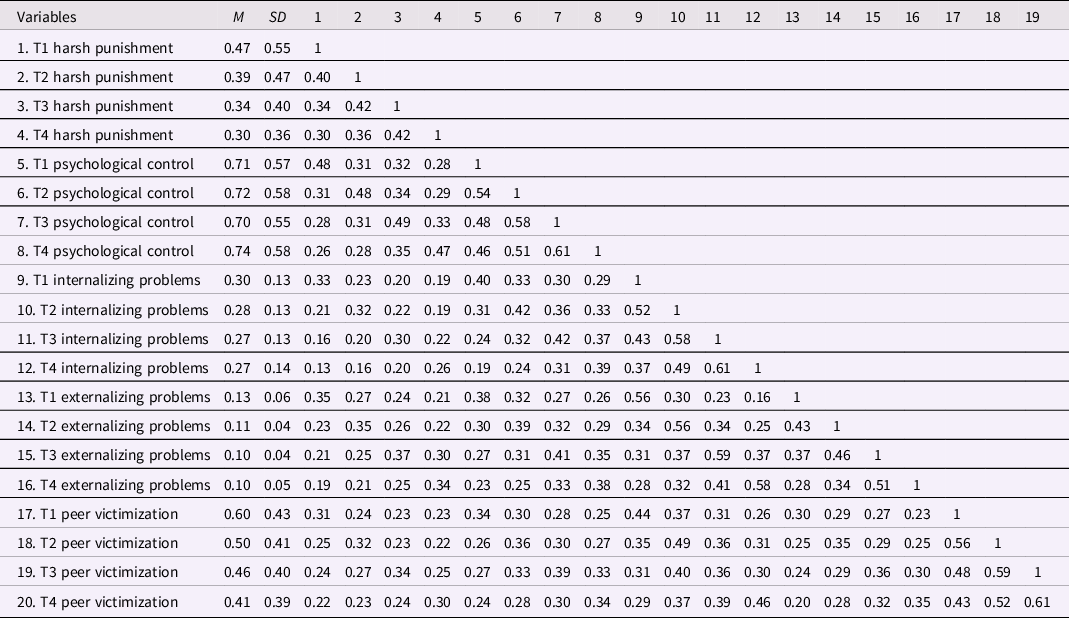
Descriptive statistics and correlations of study variables at each time point are reported in Table 1. The intraclass correlations were 0.36 for harsh punishment, 0.50 for psychological control, 0.52 for peer victimization, 0.50 for internalizing problems, and 0.40 for externalizing problems. This indicates that 36%–52% of the variances in the main study variables were explained by differences between persons, and thus the remaining 48%–64% of the variances in these variables were explained by fluctuations within persons. These results suggest sufficient within-person variance to use RI-CLPMs to investigate within-person changes over time.
Descriptive statistics and correlations of study variables

All correlation coefficients were significant at p < 0.001.
Random intercept cross-lagged panel models (RI-CLPMs)
RI-CLPM for harsh punishment and peer victimization
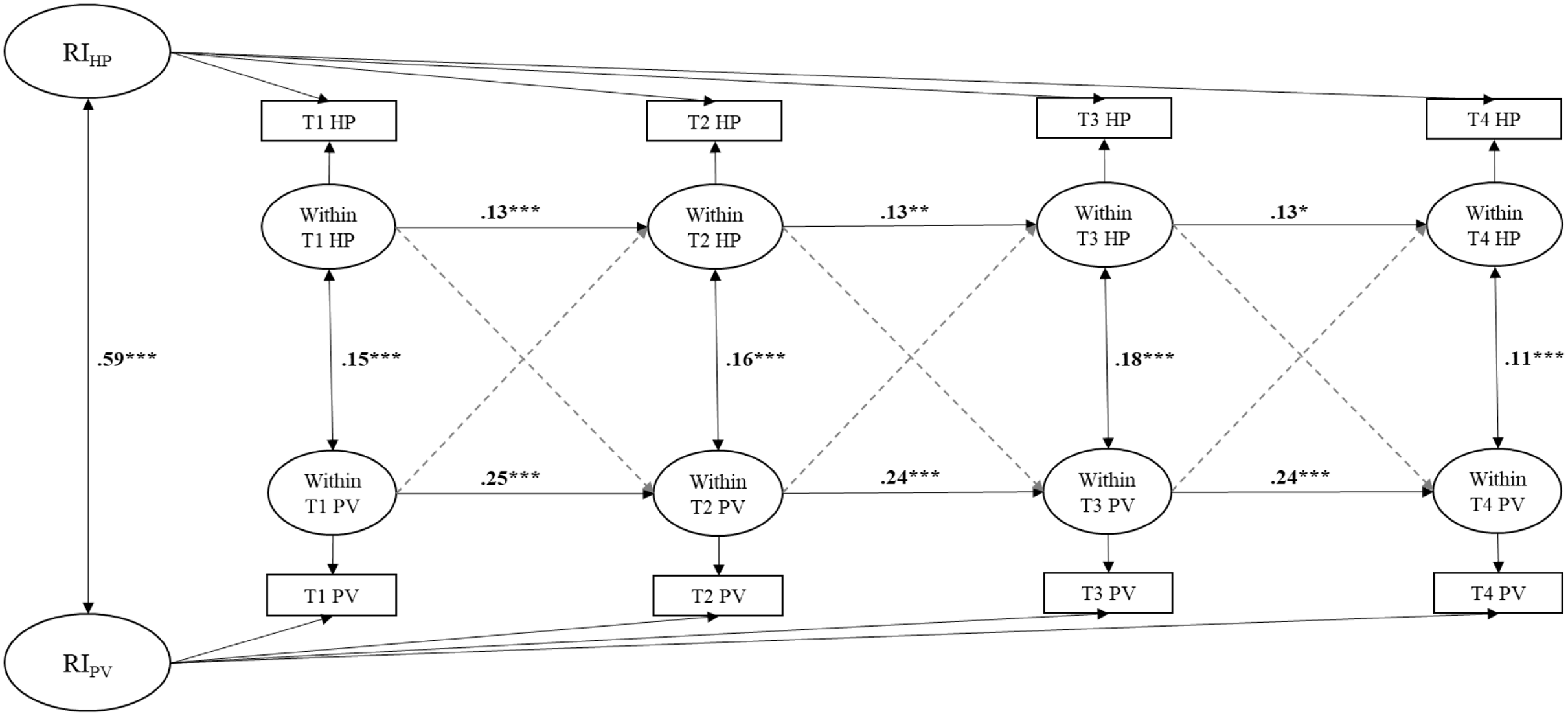
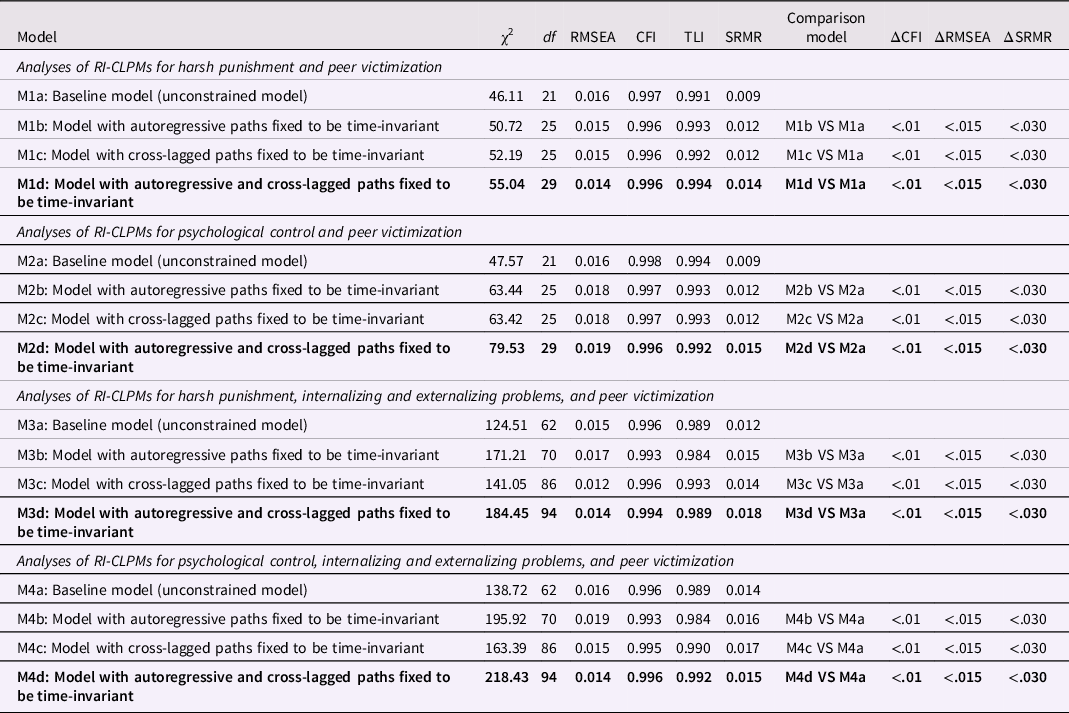
The fit and model comparison results are presented in Table 2. Model 1d was chosen as the final RI-CLPM for harsh punishment and peer victimization due to its adequate fit and satisfying parsimony. The results are summarized in Figure 1. The within-person cross-lagged effects between harsh punishment and peer victimization were not statistically significant. The random intercepts for harsh punishment and peer victimization were significantly and positively correlated (r = 0.59; p < 0.001).
Standardized path coefficients of the final RI-CLPM for harsh punishment and peer victimization. Dotted lines represent nonsignificant paths; solid lines represent significant paths. For simplicity, control variables are not presented in the figure. RI Random intercept, HP Harsh punishment, PV Peer victimization. *p < 0.05; **p < 0.01; ***p < 0.001.

Fit statistics and model comparisons for RI-CLPMs

Bold indicates final selected model.
RI-CLPM for psychological control and peer victimization
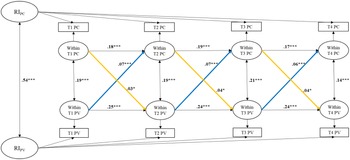
The fit and model comparison results are presented in Table 2. Model 2d was chosen as the final RI-CLPM for psychological control and peer victimization due to its adequate fit and satisfying parsimony. The results are summarized in Figure 2. The within-person effects of psychological control at time T on peer victimization at time T + 1 were all statistically significant (βs = 0.03–0.04, ps < 0.001) and vice versa (βs = 0.06–0.07, ps < 0.001). The random intercepts for psychological control and peer victimization were significantly and positively correlated (r = 0.54; p < 0.001).
Standardized path coefficients of the final RI-CLPM for psychological control and peer victimization. For simplicity, control variables are not presented in the figure. RI Random intercept, PC Psychological control, PV Peer victimization. *p < 0.05; ***p < 0.001.

RI-CLPM for harsh punishment, internalizing and externalizing problems, and peer victimization
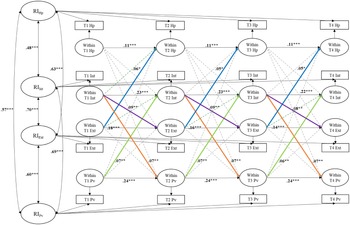
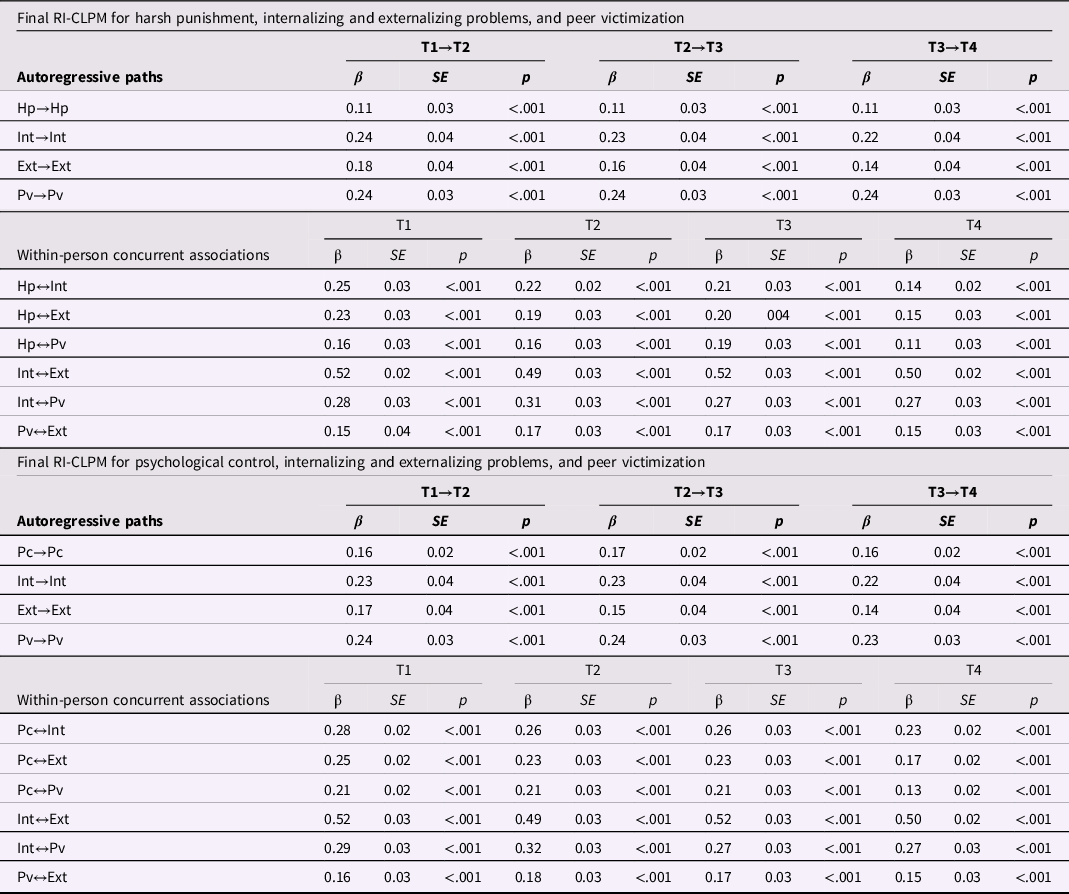
The fit and model comparison results are presented in Table 2. The results of model comparisons show that setting the autoregressive and cross-lagged paths (i.e., Model 3d) to be equal over time did not significantly decrease the fit of the unconstrained model. Thus, Model 3d was chosen as the final RI-CLPM for harsh punishment, internalizing and externalizing problems, and peer victimization. Standardized cross-lagged paths and random intercept associations of this model are summarized in Figure 3. Neither the within-person cross-lagged effects between harsh punishment and peer victimization nor the within-person cross-lagged effects between harsh punishment and internalizing problems were statistically significant. The within-person effects from externalizing problems at time T to harsh punishment at time T + 1 were statistically significant (βs = 0.06, ps < 0.05) but not vice versa. The within-person effects from peer victimization at time T to internalizing problems at time T + 1 were statistically significant (βs = 0.06–0.07, ps < 0.01) and vice versa (βs = 0.07, ps < 0.01). The within-person cross-lagged effects between peer victimization and externalizing problems were not statistically significant, while the within-person effects from internalizing problems at time T to externalizing problems at time T + 1 were statistically significant (βs = 0.09, ps < 0.01) but not vice versa. The random intercepts for all variables were significantly and positively correlated (rs = 0.45–0.76; ps < 0.001). The standardized within-person concurrent associations and autoregressive paths are provided in Table 3. The effects of the control variables in the final RI-CLPM for harsh punishment are presented in Table S2 in the online supplemental materials.
Standardized path coefficients of the final RI-CLPM for harsh punishment, internalizing and externalizing problems, and peer victimization. Dotted lines represent nonsignificant paths; solid lines represent significant paths. For simplicity, control variables and within-person concurrent associations are not presented in the figure. RI Random intercept, HP Harsh punishment, INT Internalizing problems, EXT Externalizing problems, PV Peer victimization. *p < 0.05; **p < 0.01; ***p < 0.001.

Standardized autoregressive and within-person concurrent associations coefficients for final RI-CLPMs

Hp = Harsh punishment; Pc = Psychological control; Int = Internalizing problems; Ext = Externalizing problems; Pv = Peer victimization.
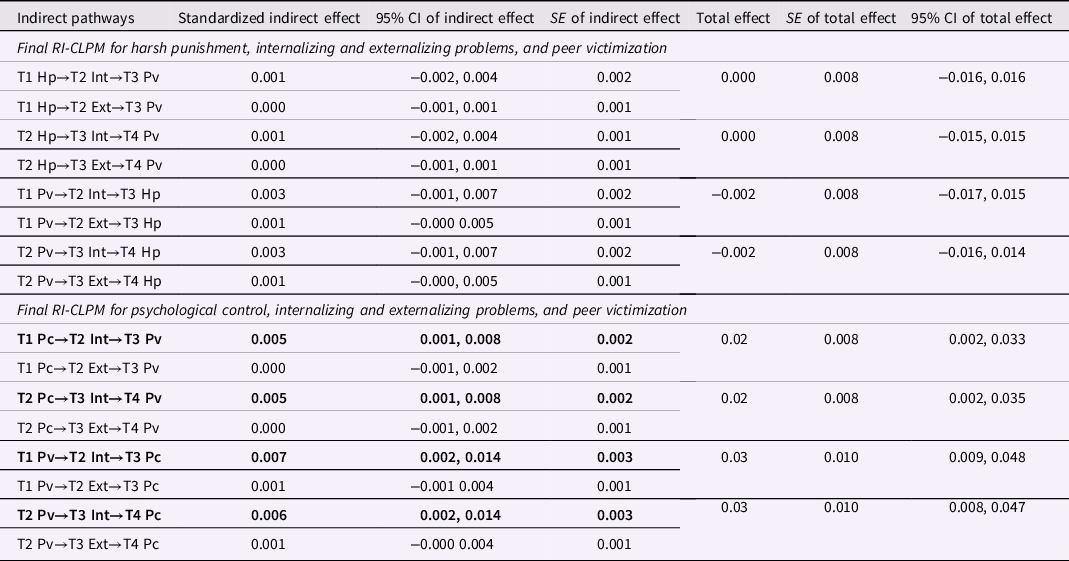
Unsurprisingly, percentile bootstrapping analysis (see Table 4) showed that the indirect pathway involving internalizing and externalizing problems at T + 1 was nonsignificant from harsh punishment at T to peer victimization at T + 2, and vice versa.
Percentile bootstrapping analysis of the magnitude and statistical significance of indirect effects for RI-CLPMs

Hp = Harsh punishment; Pc = Psychological control; Int = Internalizing problems; Ext = Externalizing problems; Pv = Peer victimization.
Bold indicates statistically significant indirect effects.
RI-CLPM for psychological control, internalizing and externalizing problems, and peer victimization
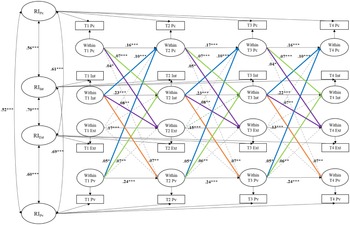
The fit and model comparison results are presented in Table 2. The results of model comparisons show that setting the autoregressive paths and cross-lagged paths (i.e., Model 4d) to be equal over time did not significantly decrease the fit of the unconstrained model. Thus, Model 4d was chosen as the final RI-CLPM for psychological control, internalizing and externalizing problems, and peer victimization (see Table 2). Standardized cross-lagged paths and random intercepts associations of this model are summarized in Figure 4. The within-person effects from peer victimization at time T to psychological control at time T + 1 were statistically significant (βs = 0.05, ps < 0.05), but not vice versa. The within-person effects from psychological control at time T to internalizing problems at time T + 1 were statistically significant (βs = 0.07, ps < 0.001) and vice versa (βs = 0.10–0.11, ps < 0.001). The within-person effects from psychological control at time T to externalizing problems at time T + 1 were statistically significant (βs = 0.04–0.05, ps < 0.05) but not vice versa. The within-person effects from peer victimization at time T to internalizing problems at time T + 1 were all statistically significant (βs = 0.06, ps < 0.01) and vice versa (βs = 0.07, ps < 0.01). The within-person cross-lagged effects between peer victimization and externalizing problems were not statistically significant. The within-person effects from internalizing problems at time T to externalizing problems at time T + 1 were all statistically significant (βs = 0.08–0.09, ps < 0.01) but not vice versa. The random intercepts for all variables were significantly and positively correlated (rs = 0.54–0.68; ps <0 .001). The standardized within-person concurrent associations and autoregressive paths are provided in Table 3. The effects of the control variables in the final RI-CLPM for psychological control are presented in Table S2 in the online supplemental materials.
Standardized path coefficients of the final RI-CLPM for psychological control, internalizing and externalizing problems, and peer victimization. Dotted lines represent nonsignificant paths; solid lines represent significant paths. For simplicity, control variables and within-person concurrent associations are not presented in the figure. RI Random intercept, PC Psychological control, INT Internalizing problems, EXT Externalizing problems, PV Peer victimization. *p < 0.05; **p < 0.01; ***p < 0.001.

Percentile bootstrapping analysis (see Table 4) showed that the indirect pathway from psychological control at T1 to peer victimization at T3 via internalizing problems at T2 was significant (β = 0.005, p < 0.05, 95% CI [0.001, 0.008]), and the indirect pathway from psychological control at T2 to peer victimization at T4 via internalizing problems at T3 was significant (β = 0.005, p < 0.05, 95% CI [0.001, 0.008]). In addition, the indirect pathway from peer victimization at T1 to psychological control at T3 via internalizing problems at T2 was significant (β = 0.007, p < 0.05, 95% CI [0.002, 0.014]), while the indirect pathway from peer victimization at T2 to psychological control at T4 via internalizing problems at T3 was also significant (β = 0.007, p < 0.05, 95% CI [0.002, 0.014]). Finally, the indirect pathway involving externalizing problems at T + 1 was nonsignificant from psychological control at T to peer victimization at T + 2, and vice versa.
Sex differences
The results of multi-group modeling analysis showed that constraining the structural coefficients (i.e., autoregressive paths or cross-lagged paths, or both of them) in the final RI-CLPMs (i.e., Model 3d, Model 4d) to be equal across sex did not significantly decrease the fit of the unconstrained model (see Table S3 in the online supplemental materials). These results indicate that sex differences were not observed in the final RI-CLPMs.
Alternate model analysis
In addition to the main RI-CLPMs, two separate CLPMs for harsh punishment and psychological control were constructed to compare the direction and magnitude of structural coefficients with the RI-CLPM. CLPMs showed reciprocal influences between harsh punishment and peer victimization, and psychological control and peer victimization at the between-person level. Moreover, externalizing (but not internalizing) problems mediated the links from harsh punishment to peer victimization and from peer victimization to harsh punishment at the between-person level. Internalizing and externalizing problems simultaneously mediated the links from psychological control to peer victimization and from peer victimization to psychological control at the between-person level. For more details about the analysis and results of CLPM, please see Section 3 in the online supplemental materials.
Alternate models for physical victimization and relational victimization were conducted separately to test the robustness of the results. Four RI-CLPMs were conducted: RI-CLPMs of harsh punishment, internalizing and externalizing problems, and physical victimization/relational victimization (M_S1 and M_S2) and RI-CLPMs of psychological control, internalizing and externalizing problems, and physical victimization/relational victimization (M_S3 and M_S4). The results demonstrate some differences between M_S1 and M_S2, as well as between M_S3 and M_S4. Specifically, the effect of internalizing problems on physical victimization was significantly greater than the effect of internalizing problems on relational victimization in M_S1 and M_S2 (Wald = 10.11, df = 1, p < 0.01); there was no significant difference between the effects of physical victimization and relational victimization on internalizing problems in M_S1 and M_S2 (Wald = 0.75, df = 1, p > 0.05). In addition, in M_S1 and M_S2, the within-person effects from physical victimization (rather than relational victimization) at time T to externalizing problems at time T + 1 were statistically significant. Moreover, in M_S3 and M_S4, the within-person effects from psychological control at time T to physical victimization (rather than relational victimization) at time T + 1 were statistically significant. Other corresponding paths of physical victimization and relational victimization did not show significant differences between M_S1 and M_S2, or between M_S3 and M_S4. For more details about the analysis and the results of M_S1 to M_S4, please see Section 4 in the online supplemental materials.
Discussion
Family and peer contexts play a critical role in youth socialization. Exposure to maladaptive parenting practices and peer victimization can lead to various maladjustment problems (e.g., Moore et al., Reference Moore, Norman, Suetani, Thomas, Sly and Scott2017; Van Heel et al., Reference Van Heel, Bijttebier, Claes, Colpin, Goossens, Van Den Noortgate, Verschueren and Van Leeuwen2019). Nevertheless, the precise nature of the relations between peer victimization and maladaptive parenting, as well as the specific mechanisms that account for links between them, remain to be elaborated. Using a longitudinal design, we examined whether parental harsh punishment/psychological control and peer victimization have a reciprocal influence at the within-person level among Chinese early adolescents. We also examined the mediating roles of internalizing and externalizing problems between harsh punishment/psychological control and peer victimization. The findings of RI-CLPM suggested that harsh punishment and peer victimization were not reciprocally related, whereas psychological control directly predicted peer victimization and peer victimization directly predicted psychological control. Neither internalizing nor externalizing problems mediated the bidirectional links between harsh punishment and peer victimization. Internalizing (but not externalizing) problems mediated both the links between psychological control and subsequent peer victimization and between peer victimization and subsequent psychological control.
Relations between harsh punishment, psychological control, and peer victimization
The findings did not support bidirectional relations between harsh punishment and peer victimization after disaggregating the between-person differences from the within-person differences. This result suggested that, during early adolescence, harsh punishment and peer victimization are not related in a transactional and dynamic manner at a within-person level (i.e., state-like associations). On the one hand, due to the possibility of inflicting physical injuries on children when using harsh punishment techniques, and due to increasing intolerance toward domestic violence in contemporary Chinese society, Chinese parents do not actively employ harsh punishment techniques in daily parenting, especially when their children have not exhibited serious misbehavior; rather, they use harsh punishment as a reactive way to punish and control youth who display some serious misbehaviors, such as bullying and stealing (Wang & Liu, Reference Wang and Liu2018). In such cases, harsh punishment may be considered reasonable and acceptable by both youth and their parents alike; thus, harsh punishment within a family may not be associated with an increase in adolescent peer victimization in that particular family. On the other hand, when a victimized youth returns home, parents are less likely to use physical punishment and more likely to use supportive behaviors, such as contacting the school to help deal with peer problems, or ignoring behaviors, such as not contacting the school and only talking to their child about the peer problems (Lindstrom Johnson et al., Reference Lindstrom Johnson, Waasdorp, Gaias and Bradshaw2019). Thus, adolescent peer victimization may not elicit an increase in harsh punishment among Chinese families in particular.
The findings showed that psychological control positively predicts later peer victimization and vice versa at the within-person level among Chinese adolescents. These results were inconsistent with previous studies. For example, a 2-wave longitudinal study of 831 US adolescents using CLPM indicated that higher levels of physical peer victimization were related to subsequent higher levels of mothers’ psychological control, but not vice versa (Ma & Bellmore, Reference Ma and Bellmore2012). Such a difference implies potential cultural differences in the nature of the relations between parent–child interactions and peer relationships (Tamm et al., Reference Tamm, Kasearu, Tulviste and Trommsdorff2018). The development of peer relationships among Western adolescents may not be associated with these parenting techniques, given that youth’s autonomy is highly valued (Huh et al., Reference Huh, Tristan, Wade and Stice2006), and the power structure within families shifts from one of unilateral authority to a more egalitarian parent–adolescent relationship during the period of adolescence (Ma & Bellmore, Reference Ma and Bellmore2012). Compared to the authoritative parenting styles characteristic of more individualistic nations, Chinese traditional culture emphasizes the authority of parents who typically employ more controlling and authoritarian techniques (e.g., Liu & Guo, Reference Liu and Guo2010). When a parent frequently uses psychological control to manage a child’s development, the exercise of such control is likely to be associated with greater restrictions on the adolescent’s behavior and activities and diminished opportunities for the adolescent to develop social competence and constructive coping strategies to deal with challenging situations, such as peer relational difficulties (e.g., Nelemans et al., Reference Nelemans, Keijsers, Colpin, van Leeuwen, Bijttebier, Verschueren and Goossens2020). Thus, parental psychological control within a particular Chinese family is likely to be associated with an increase in the likelihood that adolescents will suffering peer victimization.
In terms of the reverse direction of effects, victimized adolescents considered by their parents to be relatively weak or powerless in social interactions may directly prompt parents to exercise greater intrusion into their adolescent child’s activities. Parents may also exert psychological control over their children by making them feel guilty about their own victimization experiences; for instance, by blaming existing peer problems on the victimized youth themselves (Ma & Bellmore, Reference Ma and Bellmore2012). Thus, an increase in peer victimization may also be associated with an increase in parental psychological control within a particular family.
Relations between harsh punishment, internalizing and externalizing problems, and peer victimization
The results demonstrated that harsh punishment failed to predict either internalizing or externalizing problems at the within-person level. The effects of harsh discipline on children’s adjustment may depend on cultural customs and values (e.g., Lansford & Dodge, Reference Lansford and Dodge2008). As previously mentioned, parental harsh punishment is a reactive disciplining behavior in response to youth’s externalizing behaviors. Therefore, misbehaving youth may perceive their parents’ use of harsh discipline as an indication of tough love and care, which may not yield more internalizing and externalizing behaviors at the within-person level. Moreover, the results showed that internalizing (but not externalizing) problems significantly predict peer victimization at the within-person level. Youth with internalizing difficulties are often regarded by their peers to be less socially competent, less likable, and less powerful within the peer group, and consequently more prone to being viewed as an “easy target” by peer aggressors (e.g., Christina et al., Reference Christina, Magson, Kakar and Rapee2021). However, youth exhibiting a high frequency of externalizing behaviors may escape peer victimization by demonstrating their power and status within their peer group (Choi & Park, Reference Choi and Park2018).
The results further showed that peer victimization predicts internalizing (but not externalizing) problems at the within-person level. This finding suggested that, for a particular victimized youth, they may have a lower peer status and may also be powerless to engage in externalizing behaviors (e.g., bullying peers); thus, the experience of being victimized directly influences the development of more internalizing problems, such as depression and anxiety. Finally, consistent with previous studies (e.g., Wang & Liu, Reference Wang and Liu2018), the results showed that externalizing problems significantly predicts harsh punishment at the within-person level, confirming that harsh punishment might be a reactive control behavior. Chinese youth’s externalizing behaviors, such as bullying and stealing, may be more likely to elicit harsh discipline within an individual family.
Relations among psychological control, internalizing and externalizing problems, and peer victimization
The findings revealed that only internalizing problems mediate the bidirectional relations between psychological control and peer victimization. Although psychological control significantly predicted both internalizing and externalizing problems, only internalizing problems predicted peer victimization at the within-person level. This result indicated that Chinese parents’ use of psychological control is an important factor contributing to an increase in youth’s internalizing and externalizing problems. Chinese parents’ psychological control often involves both guilt induction, possessiveness or overprotectiveness, and criticism and rejection, through explicit expressions of disappointment and the use of conditional approval and love withdrawal (e.g., Romm & Metzger, Reference Romm and Metzger2018). It has been proposed that this type of parenting can stifle children’s psychological development by derogating their sense of self and limiting their opportunities for developing self-efficacy (Barber et al., Reference Barber, Xia, Olsen, McNeely and Bose2012). For example, self-determination theory suggests that parental psychological control negatively impacts children’s autonomy, competence, and relatedness needs satisfaction, not only within the family but also outside of it; in turn, the frustration of psychological needs can significantly contribute to problems with youth’s psychosocial functioning (e.g., Ryan & Deci, Reference Ryan and Deci2017). In Chinese culture, parents are expected to take primary responsibility for their children; thus, parents often manifest this authority by using psychological control to support their children’s adjustment (e.g., Cheng et al., Reference Cheng, Shu, Zhou, Lam, King and Bernardo2016). Nevertheless, such parenting methods may inadvertently yield an increase in internalizing and externalizing problems among youth. In turn, as previously discussed, internalizing (but not externalizing) problems appear to result in an increased vulnerability to increased peer victimization for the young person.
Within-person effects from peer victimization to psychological control via internalizing problems were also observed in the present study. Adolescents who experienced more peer victimization than usual may display increased internalizing problems and experience more psychological control from their parents. With regard to the importance of peer relationships for adolescents, when youth experience more bullying victimization than usual, they suffer an increase in internalizing problems (e.g., Troop-Gordon, Reference Troop-Gordon2017). Subsequently, these adolescents may act in ways that generate increased stress and conflict with parents or caregivers, such as seeking excessive feedback and reassurance, which then elicits increased negative responses, such as withdrawal of affection or outright rejection (e.g., Loukas, Reference Loukas2009). Furthermore, parents may respond to apathetic, distant, or uninvolved behavior with more intrusive parenting to deter their children from engaging in such behavior, and may engage in psychologically controlling behaviors with good faith in the belief that these behaviors will have positive effects (Albrecht et al., Reference Albrecht, Galambos and Jansson2007). The results of the current study thus suggest that internalizing problems act as crucial gateways in the longitudinal bidirectional links between psychological control and peer victimization at the within-person level, thus highlighting the determinative role of internalizing problems in spillover effects between the family and peer domains. Taken together, the findings of this study contribute to an advanced understanding of the longitudinal relations and mediating mechanisms between two types of maladaptive parenting and youth’s peer relationships within Chinese culture by conducting rigorous examinations using RI-CLPMs. From a practical perspective, the findings could inform effective psychological interventions to prevent youth from becoming locked in a vicious cycle of negative relationships, either directly or indirectly, via internalizing problems.
In addition, the results did not reveal any chain mediating paths of internalizing and externalizing problems in parent–peer or peer–parent spillover. Nevertheless, the results showed that internalizing problems significantly predict subsequent externalizing problems at the within-person level, which was inconsistent with previous Western research supporting the predictive role of externalizing problems on internalizing problems at the within-person level (Murray et al., Reference Murray, Eisner and Ribeaud2019; Oh et al., Reference Oh, Greenberg and Willoughby2020). One likely reason is that Confucian teachings emphasize the morality of benevolence, righteousness, and propriety, which holds harsher attitudes toward externalizing problems (Yang et al., Reference Yang, Jiang, Pan, Xu, Liang, Li, Mu, Na, Lv, An, Yu, Fu, Li, Yu, Tong and Pan2014). Thus, Chinese youth are less likely to have externalizing problems in daily life, which might explain why the predictive role of externalizing problems on internalizing problems was not supported in this study. However, adolescents who have high internalizing problems tend to express their depressive or anxious feelings through minor acting-out behaviors, which increases conflicts with family and peers and thus contributes to an increase in the risk of externalizing problems over time (e.g., Glaser, Reference Glaser1967). Thus, sustained internalizing symptoms (such as anxiety and distress) may diminish youth’s inhibitory control capacity that further leads to externalizing problems (Granic, Reference Granic2014).
Strengths, limitations, and further research
Compared to prior research, the current study demonstrates several major strengths. First, this study comprehensively examined the cross-domain spillover effect between two typical maladaptive parenting practices (i.e., harsh punishment and psychological control) and peer victimization, and whether internalizing and externalizing problems functioned as mediators among a large sample of Chinese early adolescents. Second, its longitudinal and multi-wave design enabled examination of the temporal relations between negative parenting, internalizing and externalizing behaviors, and peer victimization. Compared to previous relevant studies based on cross-sectional designs or shorter-term longitudinal studies, this study provides longitudinal evidence of the bidirectional associations over a more extended period, providing a greater opportunity to shed light on the dynamic processes involved in cross-domain spillover between family and peer systems. Third, the application of RI-CLPM, an innovative statistical approach for analyzing longitudinal data, enabled differentiation of within-person effects from between-person effects. The within-person effects provide further insight into how maladaptive parenting, internalizing and externalizing behaviors, and peer victimization influence each other at the level of an individual adolescent. Fourth, this study was able to compare findings from RI-CLPM to findings from traditional CLPM to shed light on the validity of inferences that can be drawn from findings from past longitudinal research on the direction of effects concerning maladaptive parenting, internalizing and externalizing problems, and adolescent peer victimization using CLPM.
Beyond the strengths, this study should also be considered in light of its limitations. First, data were derived from self-reported measures. Although the use of self-reporting was necessary to reflect a “child-focused” approach to parenting (Proctor & Dubowitz, Reference Proctor and Dubowitz2014), youth’s perceptions of their parents’ behaviors may differ from the parents’ perceptions of their own parenting. Importantly, this discrepancy between parents’ and adolescents’ perceptions could yield meaningful information in and of itself in the context of informant discrepancies and agreement (De Los Reyes et al., Reference De Los Reyes, Ohannessian and Racz2019). It would be interesting to examine associations between parenting and adolescent psychosocial functioning in future research from the perspective of different informants, the potential causes or consequences of informant discrepancies in these associations, and the processes underlying discrepant views between parents and adolescents concerning parenting. Moreover, students’ self-reported data could yield a threat to internal validity. Gathering data from multiple sources, including youth, caregivers, teachers, and peers, should be useful in future research for increasing confidence in the measurements by reducing the effects of common method bias and social desirability responding effects. For instance, peer victimization can be measured by peer nomination, and internalizing and externalizing problems can be reported by teachers or parents. Second, this study only focused on “deficit measures” of both parenting practices as well as problem measures of the peer domain – being victimized. This omits potentially positive effects of parenting or peer context on each other or on measures of internalizing as well as externalizing behaviors. Future studies could include positive relationship measures, such as parental support, to examine the protective factors of parenting in the examined relations to gain a greater understanding of parenting, peer relations, and internalizing and externalizing problems. Third, this study measured only two types of peer victimization: physical and relational victimization. Additional types of peer victimization, such as verbal victimization, property damage, and cyber victimization, may also be included in future studies to obtain a more comprehensive understanding. Fourth, the samples were all drawn from elementary schools in China, thus readers should be cautious when generalizing the results to other contexts. Future studies are required to replicate and extend these findings to other countries. Finally, in this study, the effect sizes at the within-student level (i.e., in the RI-CLPM) were small. However, because most of these psychological constructs show relatively strong stability over time, the degree of change in levels of the outcomes will be small and controlling for stability effects often removes a large portion of the variance in the outcome that is shared with other predictors (Adachi & Willoughby, Reference Adachi and Willoughby2015). As such, ruling out the between-person variance in the RI-CLPM can also remove a portion of the variance in the outcome. Thus, given that the previously mentioned confounders were controlled, even small effect sizes are likely to be meaningful. Thus, our findings should be of practical significance through the identification of potential targets for optimizing interventions.
Implications
This study provides important practical implications. Given the longitudinal reciprocal and adverse links between psychological control and peer victimization, school professionals and parents should pay close attention to the vicious cycle that exists between them. Adolescents’ family and peer contexts should be considered as an integrated system when tackling problems in each domain. Recognizing that parenting practices not only precede but also follow from peer victimization implies that effective prevention and intervention strategies for peer victimization should focus not only on the school environments of the victims and their peers but also on family interactions. For example, anti-bullying programs that consider the interactions between family and peer systems’ transactions should provide the most promising and efficient intervention practices (Van Niejenhuis et al., Reference Van Niejenhuis, Huitsing and Veenstra2020). Moreover, Chinese parents, in particular, may need guidance on how to reduce overcontrolling parenting and how to respond to youth’s experience of peer victimization. Chinese parents need to reevaluate the Confucian ideology of parenting; for example, the notion that youth should conform to norms and show respect for their parents and elders in all situations. Furthermore, Chinese parents should consider displaying more outward affection and verbal expressions of love and place more emphasis on autonomy, rather than endorsing higher levels of psychological control and harsh discipline (Zhang et al., Reference Zhang, Wei, Ji, Chen and Deater-Deckard2017). Providing formal parenting skills training (e.g., parent–child communication) for parents and children in schools and other community settings may improve parental support and warmth, while reducing parental hostile, low-affectionate parenting, especially when youth have experienced victimization.
The mediating effects of internalizing problems on cross-domain spillover between psychological control and peer victimization indicate that internalizing problems play a crucial role in the vicious cycle of parental negative parenting and youth’s peer problems. Thus, evidence-based interventions that target internalizing problems and promote more adaptive coping skills among adolescents who have previously been exposed to parental psychological control and peer victimization may break the vicious cycle. School professionals could devote special attention to boosting positive appraisals, emotion management, and social problem-coping skills among victimized adolescents, as well as creating positive school and peer climates at the school level. Intervention programs could also focus particularly on parents’ responses to children’s maladaptive behaviors resulting from peer problems (such as victimization), enabling parents to provide more social support (rather than psychological control) to minimize the destructive effects of internalizing behaviors.
Conclusion
The main findings of this study were that psychological control and peer victimization reciprocally influenced each other, and internalizing problems mediated the effects of psychological control on peer victimization and the reverse pathway (i.e., from peer victimization to psychological control) at the within-person level. The results suggested that parental psychological control is an important predictor of peer victimization, and that in turn, peer victimization leads to an increase in parental psychological control, thus forming a vicious cycle. The results further suggested that addressing the internalizing problems of adolescents who have been exposed to family and peer adversity could be one of the keys to breaking this vicious cycle. In addition, at the within-person level, harsh punishment did not predict Chinese adolescent peer victimization or internalizing and externalizing problems, implying that Chinese parents’ use of corporal punishment is more likely to be a reactive parenting style, given that an increase in the frequency of externalizing behaviors among youth was followed by increased use of harsh punishment strategies by parents. Overall, the understanding of family–peer linkages was advanced by the within-person approach because it examined changes in parent–peer interactions within individuals over time, providing more support for causal inferences regarding the variables of interest. Furthermore, adolescents’ interactions with their parents as well as with peers shaped each other in part through internalizing behaviors. The findings thus suggest that interventions are needed that address both family and peer contexts to prevent or break a self-sustaining cycle of maladaptive parenting and peer victimization.
Supplementary material
The supplementary material for this article can be found at https://doi.org/10.1017/S0954579422000682
Acknowledgements
The authors greatly appreciate the schools, students and teachers who took part in this study.
Funding statement
This work was supported by Funds for the Ministry of Education Key Projects of Philosophy and Social Sciences Research (No. 17JZD043) and by Funds for Young Doctoral of Institutions of Higher Learning in Gansu Province awarded for Jianhua Zhou.
Conflicts of interest
None.
Ethical standards
The present study was approved by School of Psychology Research Ethics Committee, South China Normal University. All procedures performed in this study involving human participants were in accordance with the ethical standards of the institutional and/or national research committee and with the 1964 Helsinki declaration and its later amendments or comparable ethical standards.