TBI is a major public health concern, being the leading cause of death and disability among young people (AIHW, 2007; Helps, Henley, & Harrison, Reference Helps, Henley and Harrison2008; WHO, 2006). Despite the prevalence of TBI and the worldwide efforts focused on providing effective rehabilitation services, international research shows that there continues to be limited knowledge within the general public of its sequelae and the recovery process (Ralph & Derbyshire, Reference Ralph and Derbyshire2013). In addition, research has shown inaccurate beliefs about aspects of recovery from TBI are held by many affected individuals, as well as their family members, friends, employers, service providers and other professionals (Block et al., Reference Block, Fabrizio, Bagley, Hannah, Camp, Mindingall and Lokken2014; McClure, Buchanan, McDowall, & Wade, Reference McClure, Buchanan, McDowall and Wade2008; Ruff & Jamora, Reference Ruff and Jamora2009; Swift & Wilson, Reference Swift and Wilson2001; Yuhasz, Reference Yuhasz2013).
In addition to finding a surprisingly high prevalence of misunderstanding about the effects of TBI, research has also shown the public hold various negative perceptions of people with TBI. For example, a study by McLellan, Bishop and McKinlay (Reference McLellan, Bishop and McKinlay2010) examined the attitudes of 103 members of the public towards people with physical injuries vs. TBI. The results showed this sample held significant negative biases against people with TBI across a range of personal attributes including maturity, intelligence, friendliness, flexibility and employability (McLellan et al., Reference McLellan, Bishop and McKinlay2010). Other research by Linden and Boylan (Reference Linden and Boylan2010) explored the perceptions members of the general public held about people with TBI. Despite finding increased awareness of the challenges faced by people with TBI, the study concluded that perceptions of aggressiveness, dependence and unhappiness were still evident (Linden & Boylan, Reference Linden and Boylan2010). International and local research has shown that these negative attitudes undermine the quality of life of people living with disability, including TBI, across important domains including education, employment, health, housing and social networks (e.g., Thompson, Fisher, Purcal, Deeming, & Sawrikar, Reference Thompson, Fisher, Purcal, Deeming and Sawrikar2012).
Various attempts to improve the accuracy of knowledge held within the community about disability have been shown to be of benefit (Thompson et al., Reference Thompson, Fisher, Purcal, Deeming and Sawrikar2012). For example, a study by Campbell, Gilmore and Cuskelli (Reference Campbell, Gilmore and Cuskelly2003) showed strong positive change in student teachers’ attributions towards children with Down syndrome, as a result of in-class instruction and field placement experience. The study also noted that after the training programme, student teachers were more comfortable when they interacted with children with a range of disabilities (Campbell et al., Reference Campbell, Gilmore and Cuskelly2003). In another study, positive changes in attitudes of students without an intellectual disability towards others with an intellectual disability were noted in high school students (Rillotta & Nettelbeck, Reference Rillotta and Nettelbeck2007). In short, these efforts form one component in a potential suite of important strategies which appear to positively influence attitudes and promote life opportunities for people with intellectual disability. It seems likely similar strategies may be useful with regard to influencing attitudes towards people with TBI.
It is highly desirable that community education initiatives are able to be evaluated and progressively developed. A fundamental step towards enabling meaningful evaluation is establishment of appropriate measures of head injury knowledge. Conceivably, information about any differences in perceptions about TBI held by identified subgroups of the community could further assist in focusing community education efforts and perhaps increase the efficient use of relevant resources. To date, surprisingly little work has been done to develop and evaluate effective measures of knowledge about TBI and little is known about whether there are subgroups within the community with differences in knowledge about TBI.
Summary of the Research into Community Knowledge of TBI
A key early study focused on examining misconceptions about TBI was conducted by Gouvier, Prestholdt and Warner (Reference Gouvier, Prestholdt and Warner1988). This research developed a 25 item survey, which was administered as a 10 minute interview to 221 adults in Louisiana, USA. Findings of this initial study indicated substantial misconceptions about the nature of unconsciousness, amnesia and recovery, from TBI. Fewer misconceptions were identified about the use of seatbelts and the effects of TBI. Some of the main areas of misconception were in areas relating to recovery from unconsciousness, amnesia and longer term recovery. For example, over 70% of those surveyed believed the speed of recovery depended mainly upon the effort the patient invested in rehabilitation. There was also misunderstanding about the nature of amnesia, with large proportions of the sample indicating they thought people with brain injury can forget who they are and not recognise others, but be normal in every other way. Other misconceptions were that sometimes a second blow to the head can assist a person to remember things that were forgotten following the previous injury and a failure to recognise that people with TBI have most trouble remembering things that occurred after the brain injury than remembering things that happened before TBI. Participants indicated a main source of information about TBI had been through public media, such as television talk shows, news programmes and newspapers (Gouvier et al., Reference Gouvier, Prestholdt and Warner1988).
This study highlighted the gross lack of accurate information held about TBI by the public in many key areas and pointed to the ongoing need for education to prevent problems of unrealistic expectations and various other secondary problems. A number of studies have since replicated and extended these initial findings within general population samples in the USA, UK and South Africa. For example, Willer, Johnson, Rempel and Linn (Reference Willer, Johnson, Rempel and Linn1993) found similar types and levels of misconceptions about a range of issues including the nature of cognitive functioning and the long term consequences of TBI, in a sample of 245 adults living in Western New York and Southern Ontario, Canada. A survey of 179 adults in Rhode Island found a lack of knowledge about moderate and severe TBI that was consistent with the results of previous research (Guilmette & Paglia, Reference Guilmette and Paglia2004). Similar results were reported by Hux, Schram and Goeken (Reference Hux, Schram and Goeken2006) with a sample of 318 in regional USA, and by Chapman and Hudson (Reference Chapman and Hudson2010) in a general community sample of 322 adults in the UK. Misconceptions have also been found in those who have known and worked with people with TBI.
Surveys of family members and close friends of people with TBI, as well as service providers and professionals who have contact with people with TBI show similar levels of misconceptions about the sequelae of TBI as those found in the general public. For example, Springer, Parmer and Bouman (Reference Springer, Parmer and Bouman1997) surveyed family members and close friends of 51 people with TBI at a trauma centre in Cincinnati, Ohio and found that they rated misconceptions of unconsciousness, amnesia and recovery in similar ways to the general public. While they demonstrated a better understanding of the significance of injury and its effect on cognition, family and close friends reported greater misconceptions about long term outcome and the vulnerabilities of people with TBI. Studies of teachers and college students in the USA, UK and South Africa have shown similar results (Hooper, Reference Hooper2006; Linden, Braiden, & Miller, Reference Linden, Braiden and Miller2013; O’Jile et al., Reference O’Jile, Ryan, Parks-Levy, Gouvier, Betz, Haptonstahl and Coon1997; Pretorius & Broodryk, Reference Pretorius and Broodryk2013). The items and format of the survey instrument has been developed through these studies.
Originally developed as a 25 item instrument by Gouvier et al. (Reference Gouvier, Prestholdt and Warner1988), the survey items used in these studies were developed and refined to become the Brain Injury Misconceptions Scale (BIMS, e.g., Hux et al., Reference Hux, Schram and Goeken2006; Ono et al., Reference Ono, Ownsworth and Walters2011), and a longer version (40 items) was developed from the original survey items by Springer et al. (Reference Springer, Parmer and Bouman1997) named the Common Misconceptions about Brain Injury Questionnaire (CM-TBI, e.g., Linden et al., Reference Linden, Braiden and Miller2013; Pappadis, Sander, Struchen, Leung, & Smith, Reference Pappadis, Sander, Struchen, Leung and Smith2011; Springer et al., Reference Springer, Parmer and Bouman1997). These instruments have provided an important foundational step in establishing some relevant types of misconceptions across a range of areas. However, research has shown they have poor measurement properties.
Examination of the psychometric properties of the BIMS and CM-TBI instruments highlight some problems. For example, the internal consistency of the BIMS 17 item version (after Hux et al., Reference Hux, Schram and Goeken2006) reported by Ono et al. (Reference Ono, Ownsworth and Walters2011) was very poor, α = .14. This was expected, given the items tap a range of different constructs and is supported by their finding of very weak inter-item correlation, r = .01 (Ono et al., Reference Ono, Ownsworth and Walters2011). Linden et al. (Reference Linden, Braiden and Miller2013) discarded 20 of the 40 items of the CM-TBI as a result of principal components analysis. Whilst the remaining 20 items were found to have satisfactory internal consistency, α = .77, there has been no research examining the factor structure of these items (Linden et al., Reference Linden, Braiden and Miller2013). It is conceivable that further work could be done to develop the CM-TBI as a measure of misconceptions. However at present, these surveys seem limited to an item-based exploratory and descriptive role, rather than as measures of misconceptions. As such, new approaches were needed to develop measures of head injury knowledge.
One fresh approach to conceptualising and measuring individuals’ knowledge of head injury was presented by Ono et al. (Reference Ono, Ownsworth and Walters2011). This approach conceptualised knowledge about TBI from an over-generalisation or minimisation perspective (Ono et al., Reference Ono, Ownsworth and Walters2011). Over-generalisation involves those in the community holding overly negative perceptions of the effects of TBI, which may serve to falsely limit the sense of a person with TBI's real capabilities and may restrict opportunities for work and relationships. It may also serve to reinforce a damaged and incapable sense of self in the TBI survivor, poor self-esteem and depression (Anson & Ponsford, Reference Anson and Ponsford2006). Alternatively, when friends, family and employers minimise or underestimate the effects of TBI, they may not recognise and allow for the needs of individuals with TBI. This can result in repeated failure experiences, leading to social isolation through loss of friendships, social support and employment opportunities (Ono et al., Reference Ono, Ownsworth and Walters2011). This conceptualisation was operationalised into scales that measure over-generalisation and minimisation.
The Head Injury Knowledge Scale (HIKS)
Following their conceptualisation of head injury knowledge, Ono et al. (Reference Ono, Ownsworth and Walters2011) introduced the HIKS as a new measure of misconceptions and expectations about the effects of TBI. The HIKS items were arranged conceptually within two sub-scales, measuring the tendency to over-generalise (eight items) and minimise (six items) the effects of TBI, via true/false responses. In their initial conceptualisation, the HIKS items were considered either unlikely effects or commonly preserved skills following TBI. The HIKS items focus on the functional consequences of TBI across physical, cognitive, emotional and behavioural domains, rather than broader knowledge domains related to TBI, such as injury prevention, causes of injury, coma, treatment and recovery. The items were developed from the results of a pilot study, with a small sample of people with TBI. The basic psychometric properties of the scale were promising.
Ono et al. (Reference Ono, Ownsworth and Walters2011) reported some psychometric properties of the HIKS in their pilot study, with a sample of 99 uninjured volunteers. The internal consistency of the scales was acknowledged to be marginally adequate, with α = .65 for over-generalisation and α = .68 for minimisation. There was a moderate, negative correlation between the HIKS Over-generalisation and Minimisation subscales, r = −.41, providing evidence supporting the construct validity of the measure. The magnitude of this relationship indicated the subscales were likely to be measuring similar but sufficiently separate constructs and the inverse relationship was consistent with expectations.
The validity of the HIKS was also examined in relation to the 17-item version of Gouvier et al.'s (Reference Gouvier, Prestholdt and Warner1988) BIMS. The correlations between each subscale of the HIKS and this version of the BIMS were weak, r < .20, but approached significance, p = .05–.06. This was not surprising, considering the internal consistency of the BIMS was found to be very poor, α = .14 (Ono et al. Reference Ono, Ownsworth and Walters2011). In a more recent study, weak but significant correlations were found between the HIKS and the Brain Injury and Schizophrenia Awareness Scale (BISAS) total score. The correlations were both significant at p < .01, with HIKS Over-generalisation, r = −.25 and HIKS Minimisation, r = .31 (McKendry, Ownsworth, & Bettens, Reference McKendry, Ownsworth and Bettens2014). Overall, these results indicated further work to understand the construct validity of the HIKS was warranted. Further research could also examine the relationships between knowledge of TBI and the characteristics of community members.
Relationships between Characteristics of Community Members and TBI Knowledge
One approach to efficiently utilising scarce education resources may be to develop an understanding of particular misconceptions held by subgroups within the community and tailor education strategies specifically for those groups. Research using the BIMS items has identified some relationships between basic demographic variables and misconceptions of TBI. Although not the focus of their research, Ono et al.'s (Reference Ono, Ownsworth and Walters2011) pilot study also reported the relationships of the HIKS subscales with their respondents’ demographic characteristics, including Gender, Age, Years of education and Experience with TBI. In summary they reported:
-
Gender: A significant difference was found in that females scored higher on the HIKS Over-generalisation scale than males, but no differences were found for gender on the HIKS Minimisation scale. This appeared generally consistent with the findings of other research, which reported that females held a greater number of misconceptions than males on the BIMS (Gouvier et al., Reference Gouvier, Prestholdt and Warner1988; Hux et al., Reference Hux, Schram and Goeken2006).
In looking further at the female group (n = 45), Ono et al. (Reference Ono, Ownsworth and Walters2011) found greater age and more years of education were associated with higher HIKS Over-generalisation scores. Also within the female group, personal and social experience with TBI was related to lower levels of misconceptions on the HIKS Over-generalisation subscale.
-
Age: No significant differences were found overall on either HIKS scale for age. However, some differences in levels of particular misconceptions were reported by other researchers across age groups (Chapman & Hudson, Reference Chapman and Hudson2010; Hux et al., Reference Hux, Schram and Goeken2006).
-
Years of education: No significant differences were found overall on either HIKS scale for years of education. Again however, previous studies have indicated those with greater education tended to hold fewer misconceptions about TBI (Chapman & Hudson, Reference Chapman and Hudson2010; Hux et al., Reference Hux, Schram and Goeken2006).
-
Experience with TBI: People with experience of TBI reported fewer misconceptions on the HIKS Over-generalisation scale. No differences were found on HIKS Minimisation responses between those with personal or social experience of TBI and those without these experiences. The findings of other studies however, appeared somewhat contradictory. In college and veterans samples, levels of misconceptions appeared unrelated to experience with TBI (Block et al., Reference Block, Fabrizio, Bagley, Hannah, Camp, Mindingall and Lokken2014; O’Jile et al., Reference O’Jile, Ryan, Parks-Levy, Gouvier, Betz, Haptonstahl and Coon1997). However in a study of educators, Linden et al. (Reference Linden, Braiden and Miller2013) reported teachers with experience of working with children with TBI demonstrated greater knowledge in areas of prevention, brain damage, sequelae of TBI, amnesia, recovery and rehabilitation.
In summary, Ono et al. (Reference Ono, Ownsworth and Walters2011) have introduced the HIKS and shown it may be a useful measure of misconceptions about TBI. Further research to understand its construct validity and scale properties is clearly necessary. A next step in assessing the utility of the HIKS in measuring misconceptions would be to re-examine the relationships of the scales with demographic characteristics within a larger sample. Using a cross sectional design, the aims of the present study were to examine the factor structure of the HIKS and the relationship of its factors with demographic characteristics, as well as experience of TBI, within an Australian sample.
Method
Participants
A convenience sample of adult participants was recruited via invitations displayed on relevant websites. The study sought to recruit participants both with and without social and personal experience of TBI.
Measures
Head Injury Knowledge Scale (HIKS, Ono et al. Reference Ono, Ownsworth and Walters2011). A description of this scale and its psychometric properties has already been presented. In its original format, participants provided dichotomous (true/false) responses. HIKS Over-generalisation scale items described unlikely effects of TBI on aspects of functioning and behaviour. Accurate responses would be rated as false. If “true” is endorsed on the HIKS Over-generalisation items, this is interpreted as an over-generalisation of the effects of TBI. Likewise, HIKS Minimisation items contained descriptions of problems with cognition and behaviour which were not specifically associated with TBI. Accurate responses to the HIKS Minimisation items were therefore rated as true. If “false” is endorsed on the HIKS Minimisation items, this is interpreted as minimisation of the effects of TBI (see Ono et al., Reference Ono, Ownsworth and Walters2011, p. 241).
In the present study, the item response format was modified to a four point scale, where 1 = Never, 2 = Rarely, 3 = Often, and 4 = Most of the time. This modification was to allow participants to indicate the strength of their opinion regarding the given response, to facilitate factor analyses and also in an attempt to increase the internal consistency of the scales (Comrey, Reference Comrey1988). Responses to HIKS Over-generalisation scale items which indicated greater over-generalisation were “Often” and “Most of the time”, whilst “Never” and “Rarely”, responses to HIKS Minimisation scale items indicated greater minimisation of the effects of TBI.
Procedure and Analyses
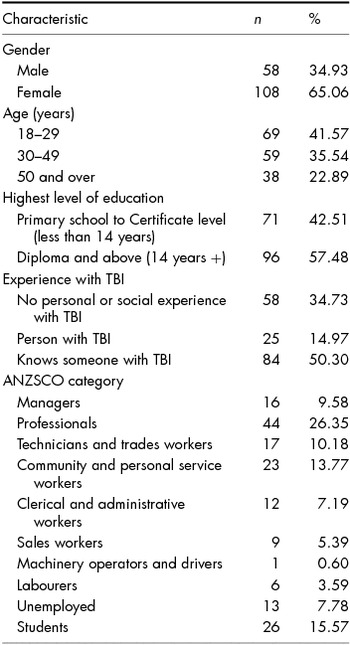
Approval for this project was obtained from the School of Psychology, Charles Sturt University Human Research Ethics Committee. Participants were recruited through an invitation to return an electronic survey. As the study required participants both with and without social and personal experience of TBI, invitations were displayed on websites that were known to be used by University students and users of the Australian Brain Injury Association social networking sites. On accessing the link to the study, participants were directed to an information statement providing an overview of the study and the requirements of participation. The information statement indicated that participation in the survey signified informed consent. Those choosing to participate responded to the HIKS items, and provided information including their age, gender, highest level of education, occupation and experience with TBI. Participants’ occupations were categorised according to the Australian and New Zealand Standard Classification of Occupations (ANZCO) taxonomy (see Table 1).
Characteristics of Participants (N = 167)

Note. One value was missing for Gender and Age.
Following an assessment of the distribution of the HIKS items, the structure proposed by Ono et al. (Reference Ono, Ownsworth and Walters2011) was examined using structural equation modelling with AMOS v.6.0. Further details of the analyses will be provided in the Results section alongside the findings.
The HIKS Over-generalisation items were positively keyed and the HIKS Minimisation scale items were negatively keyed. In the current study, the scores for the HIKS Minimisation subscale were reversed, to allow scores on all HIKS items to reflect common levels of the attributes being measured. This also permitted direct comparison of the distributions of all HIKS items and was required prior to further analyses. The formula y = −1x + 5 (where y is the new score and x is the old score), was used to recode the HIKS Minimisation item scores.
Unit-weighted composite scores were created for each of the subscales and the distributions of these were checked (Tabachnick & Fidell, Reference Tabachnick and Fidell2001; Thompson, Reference Thompson2004). Skew within the distribution of these factor scores indicated use of non-parametric analyses to examine the relationships between scores on the HIKS and demographic variables age, gender, education and experience with TBI. Mann–Whitney and Kruskal–Wallis analyses were used to investigate these relationships, using SPSS v.20.
Results
Demographic Characteristics of the Participants
A sample of 167 adult participants provided complete responses to the online survey. The distributions of relevant demographic characteristics of the sample are provided in Table 1.
Table 1 shows the sample was comprised of a higher proportion of females than males. A higher proportion of respondents were in the younger age groups than in the older age groups. Additionally, there were a higher proportion of people with personal or social experience of TBI than those without personal or social experience of TBI.
The Factor Structure of the HIKS
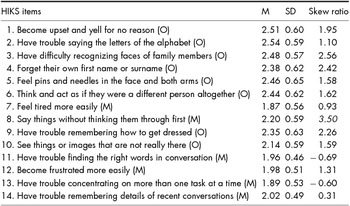
Prior to undertaking factor analysis with structural equation modelling, it was important to check the items met assumptions of normality. The distributions of the HIKS items are reported in Table 2.
Distributions of the HIKS Items (N = 167)

Note. Skew ratio = Skew/Std. error of skew. O = HIKS Over-generalisation scale, M = HIKS Minimisation scale.
Table 2 shows means and standard deviations for each of the HIKS items. Item skew was generally within acceptable limits, ranging from −.68 to 3.47 (Tabachnick & Fidell, Reference Tabachnick and Fidell2007). Only one item was observed to have a Skew Ratio (z = Skew/Standard error of skew) greater than 3.00. This was Item 8 –“Say things without thinking them through first”. As such, the items were considered to generally meet the assumption of normality for structural equation modelling, using maximum likelihood methodology.
Confirmatory factor analysis (CFA) using structural equation modelling with AMOS v.6 was undertaken to test the fit of the data to the factor model proposed by Ono et al. (Reference Ono, Ownsworth and Walters2011). The proposed factor model was first tested using likelihood-ratio chi-square analysis. The results of the chi-square analysis were significant, p < .001. Whilst significance can indicate poor model fit, differences between sample and estimated population covariance matrices can give inaccurate results (Ullman, Reference Ullman, Tabachnick and Fidell2001). The chi-square statistic is also known to be very sensitive to departures from multi-normality and increases with sample size. As such, use of a range of Goodness of Fit Indices has been suggested. Multiple goodness of fit tests included the minimum discrepancy divided by degrees of freedom (CMIN/DF, Ullman, Reference Ullman, Tabachnick and Fidell2001), the Comparative Fit Index (CFI, Bentler, Reference Bentler1988), the Root Mean Squared Error of Approximation (RMSEA, Browne & Cudeck, Reference Browne and Cudeck1993) and Standardised Root Mean Square Residual (SRMR, Hu & Bentler, Reference Hu and Bentler1999). The results of analyses to produce these goodness of fit indices for the HIKS two factor model proposed by Ono et al. (Reference Ono, Ownsworth and Walters2011) are presented in Table 3.
Goodness of Fit Test Indices for the HIKS Two Factor Model

Note: Fit to data indicates thresholds for adequate model fit for each test (acceptable fit/excellent fit). Normal Chi-square (CMIN/DF), Comparative Fit Index (CFI), Root Mean Squared Error Approximation (RMSEA 90% confidence interval (lo-hi score), and Standardised Root Mean Square Residual (SRMR).
Table 3 shows the data fitted the two factor model well across each of the fit indices. The RMSEA results included calculation of a 90% confidence interval and showed the higher score was below the threshold for acceptable fit. The internal consistency of each of the two factors was examined using Cronbach's alpha. The results of these analyses showed good internal consistencies, with Over-generalisation α = .84 and Minimisation α = .81. The two factors were found to co-vary to a moderate degree, β = −.64. The HIKS model is presented in standardised form in Figure 1.
The two-factor model of the HIKS.

Figure 1 shows each HIKS item loaded adequately onto the HIKS factors, with standardised loadings ranging between .45 and .73. Overall, the results of the CFA indicated the data was a good fit to the model proposed by Ono et al. (Reference Ono, Ownsworth and Walters2011). The current study relied on this model to calculate scores for the two HIKS factors and examined relationships between the HIKS Over-generalisation and Minimisation scores and participant characteristics.
Relationships between HIKS Factor Scores and Participant Characteristics
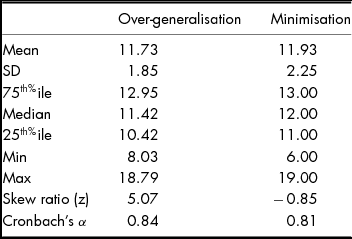
The HIKS factor scores were calculated by summing the item scores on the factor and dividing by the number of items on that scale, producing unit-weighted composite scores (Tabachnick & Fidell, Reference Tabachnick and Fidell2001; Thompson, Reference Thompson2004). Prior to the investigation of relationships of the HIKS factor scores with demographic characteristics, the distributions of normality of the factor scores were examined and are presented in Table 4.
Distributions of the HIKS Factors

Table 4 shows the mean and median scores for each of the two factor scores were similar. The HIKS Over-generalisation scale was found to be significantly positively skewed. As such, non-parametric analyses were utilised to examine the relationships between participants’ demographic characteristics and the HIKS factor scores. The results of these analyses are presented below:
-
Gender – A Mann–Whitney U test showed no significant difference between gender groups for scores on the Minimisation subscale, U = 3182.00, z = −.60, p = .15 However there was a significant difference found for the Over-generalisation subscale, U = 2365.50, z = −2.60, p < .01, where females demonstrated a greater tendency to over-generalise than males.
-
Age – The results of an Independent Samples Kruskal–Wallis Test showed no significant difference between the young, middle and older adult age groups for scores on either the Over-generalisation, H(2) = 1.06, p = .59, or Minimisation subscales, H(2) = .39, p = .82.
-
Highest level of education – A Mann–Whitney test showed no significant differences between education groups for scores on the Minimisation subscale, U = 3182.00, z = −.60, p = .55. However, there was a significant difference found for the Over-generalisation subscale, in which those with less than 14 years of education scored higher on Over-generalised items than those with greater numbers of years of education, U = 2690.50, z = −2.19, p < .05.
-
Experience with TBI – Respondents were asked to indicate whether they either had sustained a TBI themselves (personal experience of TBI), or if they knew someone with TBI (social experience of TBI). Table 1 provides the proportions of participants in these groups and also shows that 42.51% of the sample indicated they had no personal or social experience of TBI. Investigation of differences in HIKS scores between these three groups showed there were no significant differences in HIKS Minimisation scores. However, people with TBI provided significantly lower and more accurate scores on the HIKS Over-generalisation scale, than those with no personal experience of TBI, U = 524.60, z = −2.52, p < .05. No significant differences were noted on HIKS Over-generalisation scores between those who had sustained a TBI and those who knew someone with TBI. There was also no statistical difference observed between those who had no personal or social experience of TBI and those who knew someone with TBI on the HIKS Over-generalisation scale.
Differences observed between males and females in both the current study and the study reported by Ono et al. (Reference Ono, Ownsworth and Walters2011) prompted further examination of the patterns of responses within the gender groups. Within the female group (n = 108), those with less than 14 years of education scored higher on the HIKS Over-generalisation scale, U = 1349.50, z = −2.40, p < .05. Likewise, the only difference found within the male group on either HIKS scale was that those with 14 years or more of education scored significantly lower on over-generalisation, U = 308.50, z = −2.01, p < .05. Within the female group, those with TBI, scored significantly lower on the HIKS Over-generalisation scale than others who had no experience of TBI, U = 164.50, z = −2.91, p < .01. No significant differences were found on either HIKS scale between age groups and there were no statistically significant differences found in similar analyses of the HIKS Minimisation scale within either gender group.
Discussion
The aims of this study were to examine the factor structure of the HIKS and the relationship of its factors with demographic characteristics, as well as experience of TBI, within an Australian sample of community-dwelling adults. This study provided a further preliminary step towards validation of the HIKS, as a measure of head injury knowledge in the community. Overall, the results showed the factor structure of the HIKS was robust and that there appeared to be some differences in head injury knowledge held between some subgroups of the sample.
The results of CFA showed the data was a good fit to the HIKS model proposed by Ono et al. (Reference Ono, Ownsworth and Walters2011). The two factors were found to co-vary to a moderate degree, β = −.64, which was similar in direction and generally similar in magnitude to results presented by Ono et al. (Reference Ono, Ownsworth and Walters2011), r = –.41. The magnitude of this relationship in the current study indicates that whilst the two factors appeared to measure the same types of attributes, their independence was also adequate.
The internal consistency of the HIKS scales was good with over-generalisation, α = .84 and minimisation, α = .81. These results appeared better than those reported by Ono et al. (Reference Ono, Ownsworth and Walters2011), over-generalisation, α = .64 and minimisation, α = .68. Use of a four point rating scale instead of a dichotomous scale (True/False) may have helped improve the internal consistency of these scales (Comrey, Reference Comrey1988). The results of this confirmatory methodology support the construct validity of the HIKS and suggest its structure may be used with confidence.
Analyses were conducted to examine the relationship of the HIKS factors with demographic characteristics, as well as experience of TBI. Key results were that on the Over-generalisation scale, females scored higher than males, and those participants with less than 14 years of education scored higher than those with fewer years of education. Given that a larger proportion of the sample in the current study was female, it may be that some sample-related bias contributed to this finding. However, the findings of the current study were consistent with Ono et al.'s (Reference Ono, Ownsworth and Walters2011) results and those of other research, which showed males were generally more accurate with knowledge of TBI (Hux et al., Reference Hux, Schram and Goeken2006). It remains difficult to explain the reasons underlying the significant difference in the accuracy of females’ knowledge of TBI, compared with that of males (Hux et al., Reference Hux, Schram and Goeken2006). Further research in more representative community samples seems a necessary next step to better understand these relationships.
Further exploration of these relationships within the female and male groups seemed warranted. Females with greater education scored lower on the HIKS Over-generalisation scale, as did those with personal experience of TBI. This showed these groups held more accurate knowledge of TBI. These results appeared consistent with Ono et al.'s (Reference Ono, Ownsworth and Walters2011) findings. The only significant relationship observed within the male group was for education, with a similar pattern as that observed in the female group. The results of the current study showed there were no differences on either HIKS scale for age within the gender groups. This appeared inconsistent with the findings of Ono et al. (Reference Ono, Ownsworth and Walters2011), who reported a weak correlation between higher age and over-generalisation scores in their female sample. It may be that use of categorical variables in the present study resulted in some loss of ability to detect this relationship. Overall, these results point to the need for further research to more comprehensively identify and explore the differences in head injury knowledge held by various groups within the community.
Whilst the current study identified a significant relationship between years of education and the HIKS scales, this was not consistent with the results of Ono et al. (Reference Ono, Ownsworth and Walters2011), who found no significant relationships with education in their study. However, the results of the current study appeared consistent with other research that showed those with more years of education held fewer of misconceptions about TBI (Chapman & Hudson, Reference Chapman and Hudson2010; Hux et al., Reference Hux, Schram and Goeken2006). It seems conceivable that those with higher levels of education may have had exposure to a greater range of relevant experiences, which may enable them to be more capable of correctly discerning TBI attributes. Regrettably, further exploration of the precise level of education required to affect this difference was not able to proceed, due to the limitation of the categorical data collected in the current study. This is likely to be an interesting focus of larger-scale research.
No significant differences in HIKS factor scores were found for age. This finding was consistent with the results of Ono et al.'s (Reference Ono, Ownsworth and Walters2011) study. These replicated findings seem to point to education strategies being necessary for community members throughout the lifespan, rather than to particular age groups holding misconceptions compared with other age groups. It should be acknowledged that the collection of age data in three groups, rather than as a continuous variable may have limited the ability of the analyses to detect significant differences. Given other research has shown some relationships between age and misconceptions of TBI (Chapman & Hudson, Reference Chapman and Hudson2010; Hux et al., Reference Hux, Schram and Goeken2006), future research could use an approach which allows more precise examination of the relationships between the HIKS factors and age of participants.
The current study found that people with TBI were less likely to over-generalise than those with social experience of TBI (i.e., knew someone with TBI) or those with no experience of TBI. No differences were observed between these latter two groups, nor between any of these groups on the HIKS Minimisation scale. The results of the present study seemed generally consistent with the findings reported by Ono et al. (Reference Ono, Ownsworth and Walters2011), who found fewer people with experience of TBI, including personal and social experience of TBI held over-generalisations. It was noted that sample sizes in both studies were small. Ono et al.'s (Reference Ono, Ownsworth and Walters2011) sample of participants with experience of brain injury was n = 21, and the number of people with experience of TBI who responded to the current study was n = 25. Future research could seek to thoroughly examine the head injury knowledge of larger numbers of people with TBI, their families and carers, their friends and others to better establish the normative distributions of each of these groups on the HIKS scales and explore the differences in knowledge between groups. This research might assist in clarifying the education needs of those with varying levels of experience of TBI.
Limitations and Directions for Future Research
The present study utilised a convenience sample, which was generally adequate for these statistical methods focused on testing the construct validity of the HIKS scales. The results have shown support for the construct validity and internal consistency of the HIKS. However, the representativeness of the sample obtained was limited in that there were a higher proportion of females than males than the general population and a large proportion of the sample indicated they had either personal experience of TBI, or knew someone with TBI. As already discussed, this study intentionally recruited participants with experience of TBI, in order to examine any potential differences between people with experience of TBI and those without on the HIKS scales. As such, this sample was not representative of the general population, and caution should be exercised in generalising the results. As the psychometric properties of the HIKS appear good, future research utilising a population-based sample appears warranted.
Another limitation of the current study was that the sample characteristics were not collected as continuous variables. Rather, the data was requested from participants in group or ordinal formats. This may have resulted in some loss of information in the examination of the relationships between the HIKS and sample characteristics. Future research could collect data in continuous formats on demographic variables and explore differences in response patterns in greater detail. Results of this type of research might provide a useful map of the knowledge held by various groups about TBI and inform community education approaches and policy development (Thompson et al., Reference Thompson, Fisher, Purcal, Deeming and Sawrikar2012).
In conclusion, the results of the present study have shown the factor structure of the HIKS seems robust and that there appear to be some differences in head injury knowledge held between some subgroups. These results add confidence that the HIKS is likely to be a useful measure of head injury knowledge for use in larger scale research. Future research could lead to mapping of the knowledge held about TBI within relevant subgroups of the community and include the HIKS in evaluating education strategies about TBI.
Declaration of Interest
None.
Acknowledgements
This research received no specific grant from any funding agency, commercial or not-for-profit sectors.