Introduction
Natural and manmade disasters affect several million people around the world each year.1 Though in the last decade, more health care workers and nongovernmental organizations (NGOs) have been active in disaster areas, registration of patients with their respective signs, symptoms, complaints, and therapies is considered very basic.Reference Brennan and Nandy2 Literature review reveals that available data for disaster medical response are limited and confirms the need for more detailed studies.Reference Moss, Ramakrishnan, Storms, Henderson Siegle, Weiss and Lejnev3 Only a few descriptive studies exist reporting the variety of complaints one would encounter after disaster.Reference Noji4, Reference Bartels and Van Rooyen5
When developing countries are affected by disaster events, people often are relocated to internally displaced person (IDP) camps.Reference Toya and Skidmore6, Reference Noy7 Demographic data on IDP camps are available through the United Nations Refugee Agency (UNHCR) and the United Nations Children's Fund, and the prevalence of infectious diseases and other pathologies has been studied.Reference Brennan and Nandy2, 8 With this knowledge, the question rises whether health care workers and NGOs leaving for a developing country after a disaster event should be equipped to manage chronic problems common to a temporary settlement (poor water supplies, inadequate sanitation, overcrowding, malnutrition, disruption of public health programs, and limited access to basic health care) rather than prepared to take care of event-related injuries.
On March 4, 2012 between 8:00 am local time (7:00 am UTC) and 1:00 pm local time, a series of explosions took place in an ammunition depot in Brazzaville. At least 250 people were immediately killed in the explosion, over 2,500 injured, and homes of 13,800 were destroyed. Approximately 5,000 people, of which 2,500 were children, were relocated to a newly constructed IDP camp near the Sacré Coeur Cathedral in the center of Brazzaville.
At 8:00 pm local time (7:00 pm UTC) the Belgian First Aid and Support Team (B-FAST) assembled an assessment team consisting of a nurse and a doctor to evaluate the situation and the needs of the effected Congolese population. The team departed on March 5 at 7:00 am local time and arrived in Brazzaville on March 6 at 6:00 am local time. In the meantime, a second medical team was assembled, consisting of four physicians (two surgeons, one pediatrician, and one internal medicine physician), six nurses (registered for emergency and intensive care), one trained logistic aid, and one team leader. This second team left Belgium on March 6 at 5:15 pm local time, taking along 3.5 metric tons of cargo, including two Interagency Emergency Health Kit 2006s (IEHK),9, 10 three large surgery kits, several extra kits for small surgeries, and extra wound dressing sets. They arrived in Brazzaville on March 7 at 5:00 am local time and assisted in a local hospital during the first three days.
On the afternoon of March 10th, a part of the team was relocated to the IDP camp near the Sacré Coeur Cathedral. The camp was run by a small congregation of local nuns and only very basic medical care was present. Two sisters provided basic general medical care, which was sometimes with the assistance of a local physician. One sister took care of pregnant women. No medication was dispensed.
The Belgian team set up a triage post with two triage-experienced nurses, a small pharmacy, and two treatment posts with a nurse and a physician each. The sisters were asked to lead children in need of medical assistance to the medical post. Within three hours, 42 patients had received basic medical care.
The next day, an extra treatment post with a physician and a nurse was added to the team. They worked continuously from 9:00 am to 3:00 pm, and during six hours, 200 patients received basic medical care. Children were given priority, but by the end of the day, all patients were seen.
The aim of this study was to describe the different pathologies one would encounter in the above circumstances.
Report
All patients (N = 245) treated by the B-FAST team during the out of hospital mission in the IDP camp on March 10 and 11, 2012 were registered on standard World Health Organization (WHO) forms. In the triage setting, two nurses recorded a unique patient number, age (in months up to the age of three years old, in years for children age three and up and for adults), gender, and an inventory of complaints for each patient. A local health worker provided translational assistance when the patients were unable to speak or understand French.
When applicable, measured axillary temperature and weight were taken at triage. After triage, patients were sent to a second waiting zone to be seen by one of the treatment teams. In triage, all patients were given a tag with their unique number to avoid mixing up patients. The treatment teams examined the patients, completed the list of complaints, and provided treatment when necessary (and when available). Out of 245 patients, only three files were not available for this study.
Data Analysis
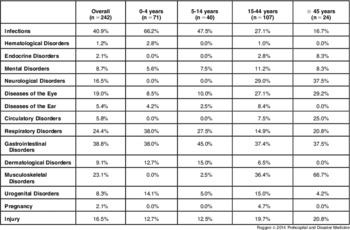
All data were entered into an Excel (Microsoft Corp., Redmond, Washington USA) file and every patient was filed under a unique sequence number (the tag number). Age, gender, weight, and body temperature (if taken) were entered into separate columns. All complaints were categorized by organ system as currently proposed in the International Classification of Diseases 11th Revision (ICD11) beta code11 and entered into separate columns, in the exact way they were noted down on the files. All complaints found in the camp in Brazzaville are illustrated in Table 1. Separate complaints also were summed to count the number of complaints per patient.
Complaints Recorded in Brazzaville, Republic of Congo, March 2012

Statistical Analysis
Statistical analysis was performed using MedCalc version 12.2.1 (MedCalc Software bvba, Mariakerke, Belgium). D'Agostino-Pearson k-squared test was used for assessing normality of data. All data are presented as mean (standard deviation) when normally distributed. When not normally distributed, data are presented as median (range).
Ethical Considerations
This study was granted post hoc approval by the Ethical Committee of the Universitair Ziekenhuis Brussel on April 19, 2012.
Clinical Data
Of 242 patients, 122 (50.4%) were minors (<18 years old, according to the United Nations Convention on the Rights of the Child).12 Their ages ranged from 0-17 years old (median age three years old) and male/female ratio was 61/61. The age range of the adults (n = 120) was 18-68 years (median age 32 years) and male/female ratio was 34/86.
Of 122 children, 102 (84%) were weighed. Weight-for-age standard deviation score (SDS) for the children was calculated according the WHO growth reference charts.13
Median weight-for-age SDS was −1.0 (−8.5 to 1.9). Girls had a lower median SDS (−1.07 vs −0.61), but the difference compared to the boys was not significant. Twenty-three out of 102 (11/54 boys and 12/48 girls) had a weight SDS below −2, meaning they were underweight.14
Health Complaints
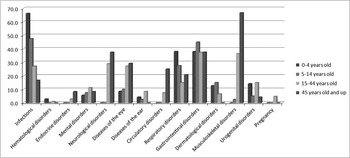
To assess health complaints, the patients were divided into standard age groups as used by Médecins Sans Frontières and the WHO in the Global Burden of Disease study results (<5 years, 5-14 years, 15-45 years, and ≥45 years).15, 16 Results are presented in Table 2 and Figure 1. Symptoms of infectious or parasitic diseases were present in all age groups, but peaked in children, with 66.2% of all children below the age of five and 47.5% of all children between 5-14 years old showing at least one sign of infectious or parasitic disease. Signs of diseases of the digestive system were present throughout all age groups, with 38.8% of all patients showing at least one gastrointestinal complaint. Respiratory problems prevailed in all age groups, with the highest incidence in younger children (38%). Diseases of the nervous system, eye problems, and musculoskeletal complaints showed a rise in incidence with the age of the patient. Problems related to mental health were prevalent in all patients, with the lowest incidence in children below the age of five years old (5.6%) and the highest in patients 15-44 years of age (11.2%). Injuries directly related to the event were present in a little more than 12.5% of the children and 20% of the adults.
Prevalence of Complaints in Standard Age Groups

Prevalence of Complaints in Standard Age Groups

Discussion
The data show that complaints generally attributed to the event (trauma such as burns, wounds, and fractures) were present in less than one in five of the patients presenting for treatment. On the other hand, signs of infection were present in 40% of all patients, with up to two out of three children below the age of five demonstrating at least one symptom of infectious disease; almost one in two patients had gastrointestinal complaints and two out of five suffered from respiratory problems. Preliminary results from van Berlaer et al17 gathered after the Haiti earthquake in 2010 and from Varela-Lopez et al18 gathered after the Pakistan floods in 2010 revealed that, respectively, 59% and 82% of all children and 52% and 48% of all adults treated by their team had complaints related to infectious diseases. Though all three countries are in different continents, and one country was hit by an earthquake, one was scourged by floods, and the third one by an explosion, victims suffered from similar health conditions. This advocates for the hypothesis that shortly after a disaster, the largest part of pathology is due to the circumstances in IDP camps.
As developing countries more rapidly request disaster relief,Reference Toya and Skidmore6, Reference Noy7, 19 and with the knowledge that people in these countries will most likely already be relocated to IDP camps, one should be aware of the universal pitfalls of a temporary settlement: poor water supplies, inadequate sanitation, overcrowding, malnutrition, disruption of public health programs, and limited access to basic health care.Reference Brennan and Nandy2 As a result of these poor circumstances, infectious diseases rapidly spread, with resulting diarrheal diseases, acute respiratory tract infections, measles, and malaria associated with the largest morbidity and mortality.Reference Brennan and Nandy2, Reference Gessner20 According to UNHCR, 50% of the people in IDP camps worldwide are children.8 The demographic results in the current report are very similar to figures worldwide, with one in two inhabitants of the camp being children. Malnutrition is present in children in IDP camps around the world.Reference Brennan and Nandy2, Reference Guerrier, Zounoun and Delarosa21, Reference Grandesso, Sanderson, Kruijt, Koene and Brown22 It is known that infectious diseases are an aggravating factor for worsening morbidity and mortality in IDP camps.Reference Schaible and Kaufmann23 Twenty-three percent of all children in the IDP camp in the Congo were malnourished.
Limitations
Limitations of this study are the cross-sectional design of the study, the limited number of patients included, and the lack of baseline data. Also, the data were collected at a single IDP camp and may not have external validity for other nonsimilar camps or circumstances.
Conclusion
Belgian First Aid and Support Team was one of the first medical teams on site after disaster struck in the Congo, as described in this report. Data from the mission showed that less than one in five people in the IDP camp presented with injuries (wounds and fractures) directly related to the disaster. One to two weeks after the disaster, and after people were relocated to IDP camps, infectious diseases (mainly gastrointestinal and respiratory problems) surfaced. Demographic data demonstrated that approximately 50% of people in the IDP camp presenting for medical care were children. Nearly half of the children were under the age of five years old. Data for this study also revealed a high amount (23%) of malnourished children.