Introduction
Sphingosine 1-phosphate is a bioactive phospholipid which is released from immune cells (including activated platelets, mast cells, macrophages and dendritic cells) and which is present at micromolar quantities in normal serum.Reference Goetzl, Wang, McGiffert, Huang and Graler1–Reference Takuwa, Takuwa and Sugimoto3 Sphingosine 1-phosphate exerts its effects mainly via the G protein-coupled receptor family comprising sphingosine 1-phosphate1, sphingosine 1-phosphate2, sphingosine 1-phosphate3, sphingosine 1-phosphate4 and sphingosine 1-phosphate5; these receptors couple to a variety of different intracellular signalling pathways.Reference Goetzl, Wang, McGiffert, Huang and Graler1–Reference Takuwa, Takuwa and Sugimoto3
Recent work demonstrates an essential role for sphingosine 1-phosphate and its sphingosine 1-phosphate1 receptor in lymphocyte migration to and recirculation from lymph nodes.Reference Allende, Sasaki, Kawai, Olivera, Mi and Van Echten-Deckert4–Reference Cyster8 There are also strong indications that sphingosine 1-phosphate may play an important role in allergic inflammation.Reference Rosen and Goetzl2, Reference Jolly, Bektas, Olivera, Gonzalez-Espinosa, Proia and Rivera9, Reference Ammit, Hastie, Edsall, Hoffman, Amrani and Krymskaya10 Sphingosine 1-phosphate is secreted from activated mast cells and induces mast cell degranulation and migration; it has also been shown to act via sphingosine 1-phosphate1 to increase the ratio of Th2 to Th1 cells.Reference Rosen and Goetzl2, Reference Jolly, Bektas, Olivera, Gonzalez-Espinosa, Proia and Rivera9 A study by Ammit et al. reported a doubling in sphingosine 1-phosphate levels in the bronchoalveolar lavage fluid of asthmatic patients 24 hours following segmental allergen challenge, but not in healthy control individuals.Reference Ammit, Hastie, Edsall, Hoffman, Amrani and Krymskaya10 As eosinophils play a central role in the pathophysiology of both asthma and allergic rhinitis, we hypothesised that eosinophils would express sphingosine 1-phosphate receptors, that their level of expression would be altered by allergen challenge, and that sphingosine 1-phosphate would thereby influence eosinophil migration in allergic rhinitis.
Materials and methods
Subjects
Thirty-three allergic rhinitis patients were recruited from Beaumont Hospital, Dublin, Ireland, by poster advertisement and direct contact at the ENT clinic. Matched healthy control subjects with no history of seasonal or perennial allergies were recruited from the laboratory and hospital community. Subjects were aged between 18 and 55 years and were non-smokers. Volunteers were questioned regarding their symptoms and categorised into intermittent or persistent allergic rhinitis, according to the Allergic Rhinitis and Its Impact on Asthma study group criteria.Reference Bousquet, Van Cauwenberge, Bachert, Canonica, Demoly and Durham11
Atopy was defined as a positive skin prick test of greater than 3 mm, compared with a control, after 15–30 minutes exposure to one or more common allergens, including: dust mite antigen; dog, cat and horse epithelium; grass mix; tree mix (birch, beech, oak and plane); hen feather; and Aspergillus fumigatus. Saline solution was used as a negative control and histamine solution as a positive control.
We excluded the following patients: those who had used topical nasal steroids or systemic steroid therapy within one month of the study; those with a history of respiratory tract infection within one month of the study; those who had used short-acting anti-histamines within one week of the study; and those with significant concomitant illness such as malignancy.
The first arm of the study established patients' sphingosine 1-phosphate receptor expression profiles. Peripheral blood was taken from healthy control subjects (n = 15) and allergic rhinitis patients (n = 16). Eosinophils were purified, and polymerase chain reaction analysis established the ribonucleic acid (RNA) profile of sphingosine 1-phosphate receptor expression. Protein expression profiles were determined by Western blotting (for eight control subjects and eight allergic rhinitis patients) and by flow cytometry analysis (for four controls and four allergic rhinitis patients).
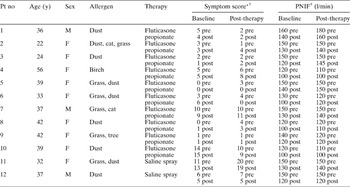
The second arm of the study determined the effect of allergen challenge on sphingosine 1-phosphate receptor expression before and after steroid treatment. Immediately after blood sampling, a cohort of 12 allergic rhinitis patients underwent a nasal allergen challenge (Table I shows patient characteristics). The allergens used for nasal provocation were Dermato pteronyssinus, grass mix or tree mix (mid-blossoming), depending on the sensitivity demonstrated by skin-prick testing.
Characteristics of allergic rhinitis patients receiving steroid or saline

* Meltzer method. †Pre- and post-allergen. Pt no = patient number; y = years; PNIF = peak nasal inspiratory flow rate; M = male; F = female; pre = before allergen challenge; post = after allergen challenge
All patients filled out a symptom questionnaire during their initial visit. Each symptom was scored, according to the Meltzer method,Reference Meltzer12 between zero and three, where zero = absent, one = mild, two = moderate and three = severe. The peak nasal inspiratory flow (PNIF) rate was assessed using the In-check nasal flow meter (Clement Clarke, Harlow, Essex, UK). At least three measurements were taken (excluding the first one) and a mean value calculated. Consistent with the first part of the study, patients underwent blood sampling, from which eosinophils were prepared and sphingosine 1-phosphate receptors1, 3, 4 and 5 were detected by flow cytometry.
All patients underwent nasal allergen challenge following blood sampling on the initial day. Twenty-four hours later, patients returned to the clinic and again filled out the symptom questionnaire, and underwent serial PNIF measurements and blood sampling for sphingosine 1-phosphate receptor profile expression analysis. Patients were then divided, in a non-blinded manner, to receive either topical nasal steroid therapy or saline spray therapy. The steroid group used a once-daily dose of 200 µg fluticasone propionate.
Patients were requested to return to the clinic two weeks after commencing their intra-nasal spray. Once again, they underwent the same procedures as before (i.e. symptom questionnaire, PNIF measurements and blood sampling).
The third arm of the study involved 10 patients, five healthy control and five allergic rhinitis patients with allergic rhinitis. Following initial blood sampling and eosinophil purification, eosinophils were subjected to chemotaxis using increasing doses of sphingosine 1-phosphate. The allergic rhinitis group of patients were given a nasal allergen challenge following the initial blood sampling, and 24 hours later blood was again taken for eosinophil purification and chemotaxis.
Eosinophil isolation
Eosinophils were prepared from 45 ml of peripheral venous blood. Fifteen millilitres of this blood was added to 25 ml phosphate-buffered saline plus 100 units of heparin. Thirty millilitres of this mixture was then layered over 23 ml Ficoll-Plaque PLUS was purchased from Amersham Pharmacia Biotech (Little Chalfont, UK) (1.077 ± 0.001 g/ml) and centrifuged at 720 g for 20 minutes at room temperature. The upper layer of serum and mononuclear cells was discarded and the pellet containing granulocytes and erythrocytes was subjected to hypotonic lysis. The granulocytes were then resuspended in MACS which is a registered trademark of Miltenyi Biotec GmbH (Bergisch Gladbach, Germany) buffer (phosphate-buffered saline with 2 mM ethylene diamine triacetic acid and 0.5 per cent bovine serum albumin) with anti-CD16 immunomagnetic beads and passed through a VarioMACS which is a trademark of Miltenyi Biotec GmbH (Bergisch Gladbach, Germany) magnetic separation column. The eluted eosinophils were collected. Cells were resuspended in serum-free DMEM (Dulbecco's Modified Eagle's Medium) plus Glutamax (Gibco BRL, Paisley, UK) and their viability and purity were determined by Trypan blue (Sigma Aldrich, Poole, UK); Speedy-Diff (trade name) (Clin-Tech Limited, Guildford, UK) staining. Only eosinophil preparations which were more than 98 per cent pure and 95 per cent viable were used in further experiments.
Ribonucleic acid extraction and reverse transcription polymerase chain reaction
Eosinophils were harvested and washed in ice-cold phosphate-buffered saline. Cells were then lysed at room temperature in Tri-Reagent (Sigma-Aldrich, Poole, UK) and RNA and protein extracted according to the manufacturer's guidelines.
One microgram of RNA was reverse-transcribed with Avian Myeloblastosis Virus (AMV) reverse transcriptase and oligo-dT primers using a first strand complementary deoxyribonucleic acid (DNA) synthesis kit (Roche Diagnostics, Burgess Hill, West Sussex, England). Reverse transcription polymerase chain reaction analysis of complementary DNA preparations was carried out in 50 µl reactions with Taq-DNA polymerase and the primer sets specific to each individual receptor (sequences reported by Rahaman et al.).Reference Rahaman, Costello, Belmonte, Gendy and Walsh13 Polymerase chain reaction products were separated by 1.5 per cent agarose gel electrophoresis and photographed under ultraviolet illumination. Band intensities were quantified by laser densitometry scanning. The results were expressed as a ratio of the band intensity relative to the corresponding β-actin band obtained by amplification of the same template complementary DNA. Polymerase chain reaction conditions were: 94°C, 4 minutes (one cycle); 94°C, 1.5 minutes; 54°C, 1.5 minutes; 72°C, 2 minutes (25–40 cycles); and 72°C, 10 minutes (one cycle). Results are presented for 30 cycles of polymerase chain reaction for sphingosine 1-phosphate1, 2, 3 and 5, 27 cycles for sphingosine 1-phosphate4, and 25 cycles for β-actin. Up to 40 polymerase chain reaction cycles were carried out to verify the absence of sphingosine 1-phosphate2.
Western blotting
Total eosinophil protein concentration was determined by the Bradford methodReference Bradford14 and Western blotting. Band intensities were quantified by laser densitometry scanning. Results were expressed as a ratio of the band intensity relative to the corresponding β-actin band from the same re-probed blot.
Flow cytometric detection of eosinophil sphingosine 1-phosphate receptors
Cells were fixed, permeabilised and washed using the Santa Cruz flow cytometry (FCM) buffer system, according to the manufacturer's instructions, in order to enable binding of sphingosine 1-phosphate receptor antibodies whose epitopes were receptor C-terminal tail-specific. Permeabilised cells were incubated with goat anti-human primary sphingosine 1-phosphate antibody for each respective receptor, and subsequently with (FITC) fluorescein isothiocyanate labelled donkey anti-goat secondary antibody. Negative control cells were incubated with FITC labelled normal goat immunoglobulin G. The cells were subsequently analysed by flow cytometry (Coulter Epics XL; Beckman Coulter, High Wycombe, UK). Data from 10 000 events were collected in logarithmic mode. Receptor levels were quantified by analysis of FITC labelling.
Chemotaxis of eosinophils
Chemotaxis of eosinophils was carried out on an AA96 chemotaxis chamber and 5 μm pore size framed filters were purchased from Neuro Probe Inc. (Gaithersburg, MD, USA). Putative chemoattractants were resuspended in phosphate-buffered saline plus 0.1 per cent bovine serum albumin at appropriate concentrations and loaded into the wells of the lower compartment of the chemotaxis chamber. In each experiment, phosphate-buffered saline plus 0.1 per cent bovine serum albumin alone was used as a ‘no chemoattractant’ control. Chemokinesis controls were included with the same concentration of chemoattractant in the top and bottom wells. Eosinophils for chemotaxis were resuspended in serum-free DMEM plus Glutamax at a concentration of 0.64 × 10⁶ cells/ml, and a total of 2.5 × 10⁵ cells was loaded into each experimental well of the upper compartment of the chamber. Chemotaxis was allowed to proceed for 2.5 hours at 37°C with 5 per cent CO2, after which the upper compartment was removed. Fifty microlitres was removed from the respective experimental wells in the bottom compartment, added to 400 µl phosphate-buffered saline and subjected to counting by flow cytometry (Beckman Coulter Epics XL-MCL) for 30 seconds, in order to quantify the number of cells which had migrated into the bottom well. Filters were also fixed and stained with Speedy-Diff stain after removal of cells from the top side of the filter and viewed under a light microscope; the number of cells migrating to the lower side of the filter was counted in five random fields, in order to confirm the consistency of the more readily quantifiable flow cytometry method. Cell migration to sphingosine 1-phosphate or eotaxin was assessed as a percentage of migration in the absence of any chemoattractant.
Statistical analysis
Values were expressed as mean ± standard error of the mean. The statistical significance of differences between patients and control subjects, between allergic patients before and after allergen challenge, and between treated and untreated samples was evaluated by analysis of variance, followed by Tukey–Kramer pair-wise multiple comparison or by Student's t-test as appropriate, using the Graphpad Instat software program (Graphpad Software Inc, San Diego, USA). A p value of 0.05 or less was taken as significant.
Results
Part one
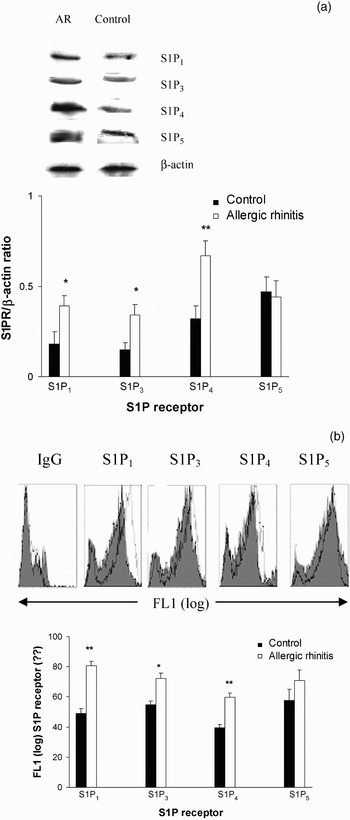
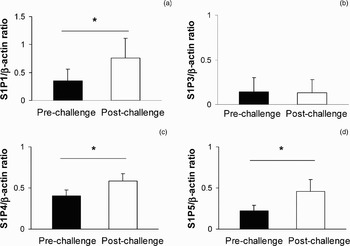
Messenger RNA for sphingosine 1-phosphate receptors1, 3, 4 and 5, as detected by reverse transcription polymerase chain reaction, was expressed by the peripheral blood eosinophils of both healthy subjects (n = 15) and allergic rhinitis patients (n = 16) (Figure 1a). Although a low level of sphingosine 1-phosphate2 expression was observed on the eosinophils of two control subjects (Figure 1b), this receptor was not expressed in any allergic rhinitis subject. Protein for sphingosine 1-phosphate receptors1, 3, 4 and 5 was also detected on the eosinophils of both controls and allergic rhinitis patients by Western blotting and flow cytometry. However, expression of sphingosine 1-phosphate1, 3 and 4 was significantly greater on eosinophils from allergic rhinitis patients compared with controls (Figure 2). Within the allergic rhinitis patient group, increased sphingosine 1-phosphate receptor expression on eosinophils was demonstrated 24 hours after allergen challenge at both the messenger RNA level (sphingosine 1-phosphate1, 4 and 5 ) (Figure 3) and the protein level (sphingosine 1-phosphate1, 3, 4 and 5) (Figure 4).
(a) Sphingosine 1-phosphate (S1P) receptor (S1PR) messenger ribonucleic acid profiles for healthy control subject and allergic rhinitis patient, prepared by reverse transcription polymerase chain reaction; lower strip shows negative control (no complementary deoxyribonucleic acid (cDNA) (b) Percentage of subjects (15 healthy controls and 16 allergic rhinitis patients) expressing sphingosine 1-phosphate receptors1, 2, 3, 4 and 5.

Expression of sphingosine 1-phosphate1 (S1P1), sphingosine 1-phosphate3 (S1P3) and sphingosine 1-phosphate4 (S1P4) protein is increased in eosinophils from allergic rhinitis (AR) patients compared with those from healthy control subjects, as shown by (a) Western blotting and (b) flow cytometry.

Messenger ribonucleic acid levels for (a) sphingosine 1-phosphate1 (S1P1), (c) sphingosine 1-phosphate4 (S1P4) and (d) sphingosine 1-phosphate5 (S1P5) are significantly increased after allergen challenge; however, those for (b) sphingosine 1-phosphate3 (S1P3) are not. Values (mean ± standard error of the mean) before vs after allergen challenge (n = 5) were compared using Student's t-test, with p < 0.05 considered significant. *p < 0.05.

(a) Flow cytometry histograms demonstrating that protein expression for eosinophil sphingosine 1-phosphate (S1P)1, 3, 4 and 5 receptors (S1P1, S1P3, S1P4 and S1P5) is increased in allergic rhinitis patients following allergen challenge. The x axis represents fluorescence due to FITC-labelled antibody binding to cells (FL1 log); therefore, a rightwards shift indicates increased antibody binding and hence increased receptor expression. (b) Fold increase in the various sphingosine 1-phosphate receptor proteins (mean ± standard error of the mean; n = 10). *p < 0.05, **p < 0.005, ***p < 0.001; before vs after allergen challenge.

Part two
Allergic rhinitis patients were allocated to receive either fluticasone propionate (n = 10) or topical nasal saline (n = 2) for two weeks, and were then subjected to allergen challenge.
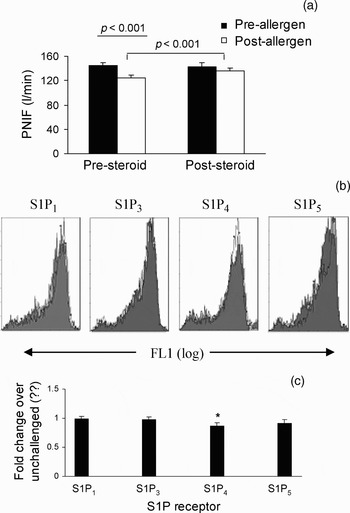
Prior to commencing treatment, there was no significant difference in symptom scoring following nasal allergen challenge, comparing the two treatment groups; however, objective measurements of peak nasal inspiratory flow (PNIF) dropped significantly following allergen challenge (Figure 5a). After two weeks' topical nasal steroid treatment, this PNIF drop following nasal allergen challenge significantly diminished.
Results for allergic rhinitis patients treated with steroids. (a) Peak nasal inspiratory flow (PNIF; l/min) measurements (mean ± standard error of the mean (SEM); n = 10), before and 24 hours after allergen challenge, before and after steroid treatment. (b) Flow cytometry histograms demonstrating Sphingosine 1-phosphate receptor expression. The x axis represents fluorescence due to FITC-labelled antibody binding to cells (FL1 log); therefore, a rightwards shift indicates increased antibody binding and hence increased receptor expression. (c) Fold change in the various sphingosine 1-phosphate (S1P) receptor proteins (S1P1, S1P3, S1P4 and S1P5; mean ± SEM; n = 10). *p < 0.05, before vs after allergen challenge.

Prior to steroid treatment, the allergic rhinitis patients showed an increase in sphingosine 1-phosphate receptor expression after allergen challenge. However, following two weeks' steroid treatment, the same patient cohort showed no increase in the expression of any sphingosine 1-phosphate receptor protein after allergen challenge (Figures 5b and 5c); indeed, sphingosine 1-phosphate4 protein expression was slightly but significantly decreased (Figure 5c).
The allergic rhinitis patients treated with topical nasal saline spray showed a similar decrease in PNIF and an increase in sphingosine 1-phosphate receptor protein expression, following allergen challenge, both before and after treatment.
Part three
Part three of the study sought to determine whether alterations in eosinophil sphingosine 1-phosphate receptor levels, following allergen challenge, had any functional correlate. Eosinophils from healthy control subjects and from allergic rhinitis patients (n = 5), both before and 24 hours after allergen challenge, were subjected to chemotaxis to sphingosine 1-phosphate or (as a positive control) eotaxin (Figure 6a). Sphingosine 1-phosphate exerted significantly greater chemoattraction on eosinophils from allergic rhinitis subjects compared with results in the same patients before allergen challenge, following allergen challenge; this response followed a bell-shaped dose–response curve with increasing test doses of sphingosine 1-phosphate (Figure 6b). Chemotaxis levels for sphingosine 1-phosphate chemotaxis were comparable to those for eotaxin, one of the most widely known eosinophil chemoattractant agents.
Sphingosine 1-phosphate (S1P) induced chemotaxis of eosinophils from allergic rhinitis (AR) patients is increased following allergen challenge. (a) Control eosinophils - S1P dose response curve graph; (b) S1P-induced chemotaxis of AR patient eosinophils is increased following allergen challenge. *p < 0.05, **p < 0.005; before vs after allergen challenge.

Discussion
It is now well established that sphingosine 1-phosphate is the natural ligand for specific G-protein coupled receptors family known as the sphingosine 1-phosphate receptors (sphingosine 1-phosphate1–5), and that sphingosine 1-phosphate influences diverse biological processes, depending on the relative cell- and tissue-specific expression of sphingosine 1-phosphate1–5 and of G proteins. Research into the biological role of the sphingosine 1-phosphate receptors is in its infancy, although many recent studies have advanced our knowledge of sphingosine 1-phosphate receptor expression and function.
In this study, up-regulation of sphingosine 1-phosphate receptors1, 3, 4 and 5 on the eosinophils of allergic rhinitis patients was demonstrated 24 hours after allergen challenge, implying a role for sphingosine 1-phosphate in the mechanism of allergic rhinitis. In allergic rhinitis patients following nasal allergen challenge, the levels of sphingosine 1-phosphate1, 3, 4 and 5 protein expression were increased; however, levels of messenger RNA expression were only significantly increased for sphingosine 1-phosphate1, 4 and 5 (not sphingosine 1-phosphate3). The fact that allergen challenge prompted up-regulation of sphingosine 1-phosphate3 protein expression but no up-regulation of sphingosine 1-phosphate3 messenger RNA expression indicates that this discrepancy is probably due to post-transcriptional mechanisms.
In order to study the effects of topical nasal steroid therapy (the most commonly used pharmacological treatment for allergic rhinitis) on the expression of sphingosine 1-phosphate receptors, 10 allergic rhinitis patients underwent a short, two-week course of this treatment. As in the initial study group, up-regulation of sphingosine 1-phosphate receptor expression was observed after allergen challenge prior to steroid treatment; however, after completion of topical steroid treatment, no post-allergen increase in sphingosine 1-phosphate receptor expression was demonstrated. Indeed, sphingosine 1-phosphate4 receptor expression was moderately down-regulated.
Significantly, this post-treatment loss of sphingosine 1-phosphate receptor up-regulation following allergen challenge correlated clinically with peak nasal inspiratory flow (PNIF) measurements. Before steroid therapy, patients' PNIF measurements were statistically significantly diminished 24 hours after nasal allergen challenge, consistent with the increased nasal mucosal oedema known to occur following nasal allergen exposure. However, following steroid therapy, the post-allergen decrease in PNIF measurements was minimal and not statistically significant. Although this study found no alteration in subjective symptom scores, comparing pre- and post-treatment values, poor correlation has often been demonstrated between reported subjective symptoms and objective measures of nasal obstruction.Reference Kim, Moon, Jung and Min15–Reference Jones, Willatt and Durham18 This poor correlation is due in part to the subjective nature of symptom questionnaires, which leads to patient bias, and also to the fact that other factors besides nasal resistance contribute to the sensation of nasal congestion.Reference Hilberg19, Reference Hardcastle, White and Prescott20 For example, menthol may relieve the subjective symptom of nasal congestion without altering nasal resistance.Reference Eccles, Jawad and Morris21
The fact that topical nasal steroid therapy prevents the up-regulation of sphingosine 1-phosphate receptor expression after allergen challenge, coupled with the fact that treatment prevents significant decreases in objective PNIF measurements, supports the hypothesis that the increase in receptor expression is an important clinical feature of allergic rhinitis, with potential consequences for eosinophil migration and survival.
Sphingosine 1-phosphate receptors have previously been shown to play a part in cell migration. For example, up-regulation of sphingosine 1-phosphate3 in pneumonia has a positive effect on migration of neutrophils, promoting chemotaxis towards sphingosine 1-phosphate.Reference Rahaman, Costello, Belmonte, Gendy and Walsh13 It has been demonstrated that sphingosine 1-phosphate4 enhances migration of transfected cells via Rho family small Guanosine triphosphatases (GTPases).Reference Kohno, Matsuyuki, Inagaki and Igarashi22, Reference Graler, Grosse, Kusch, Kremmer, Gudermann and Lipp23 The up-regulation of sphingosine 1-phosphate1, 3 and 4 seen in this study after allergen challenge may therefore facilitate eosinophil chemotaxis. Thus, allergen challenge, with associated eosinophil priming, results in increased eosinophil expression of an array of sphingosine 1-phosphate receptors, potentially facilitating eosinophil migration. Consistent with this, we found that increases in sphingosine 1-phosphate receptor expression following allergen challenge coincided with significant increases in sphingosine 1-phosphate induced chemotaxis of eosinophils. Although the observed chemotactic effect was modest in pre-allergen subjects, the chemotactic effect was significantly increased 24 hours after nasal allergen challenge, coinciding with increased levels of sphingosine 1-phosphate receptor expression.
• Sphingosine 1-phosphate is a phospholipid with multiple cellular effects exerted via sphingosine 1-phosphate receptors1–5
• Sphingosine 1-phosphate receptors1, 3, 4 and 5 were widely expressed on the peripheral blood eosinophils of both healthy subjects and allergic rhinitis patients. Up-regulation of protein expression for these same sphingosine 1-phosphate receptors on the eosinophils of allergic rhinitis patients was demonstrated 24 hours after allergen challenge
• A short course of topical nasal steroid spray abolished this up-regulation
• These observations support the theory that this increase in sphingosine 1-phosphate receptor expression is clinically relevant in allergic rhinitis, with potential consequences for eosinophil migration and survival
It has been suggested that venous blood concentrations of sphingosine 1-phosphate of between 10 and 100 nM are optimal for enhancing chemotaxis of lymphocytes to chemokines and some cytokines,Reference Matloubian, Lo, Cinamon, Lesneski, Xu and Brinkmann5, Reference Graeler and Goetzl24 while concentrations of between 100 and 1000 nM inhibit chemokine-induced T cell migration. We investigated the effect of different concentrations of sphingosine 1-phosphate on the chemotaxis of allergic rhinitis eosinophils, and we demonstrated that the eosinophil migration response after allergen challenge follows a bell-shaped dose–response curve, with highest migration observed at 1 µM sphingosine 1-phosphate, in contrast to the proposed optimal conditions for lymphocyte migration.Reference Rosen and Goetzl2 Indeed, chemotaxis levels for sphingosine 1-phosphate were comparable to those for eotaxin, one of the most widely known eosinophil chemoattractant agents. It is uncertain whether individual sphingosine 1-phosphate receptors1, 3, 4 or 5 or a combination of receptors is responsible for the post-allergen sphingosine 1-phosphate chemotactic effect demonstrated. Determination of the role of individual receptors would require access to specific blocking antibodies and/or inhibitors, which are not currently available.
Conclusion
We observed up-regulation of sphingosine 1-phosphate receptors1, 3, 4 and 5 protein expression in the eosinophils of allergic rhinitis patients 24 hours after allergen challenge. This up-regulation was prevented by steroid therapy. The increase was coincident with enhanced eosinophil migration. Our results suggest that, in allergic rhinitis patients, sphingosine 1-phosphate influences recruitment of primed eosinophils, and that eosinophil sphingosine 1-phosphate receptors may be a potential therapeutic target in allergic illness.
Acknowledgements
This work was supported by grants from the Health Research Board, Ireland, the Wellcome Trust and the Royal College of Surgeons in Ireland.