In the past few decades, numerous investigations on sentence processing suggest that adults exhibit incrementality in parsing (e.g., Ferreira, Reference Ferreira2003; Ferreira & Clifton, Reference Ferreira and Clifton1986; Ferreira & Lowder, Reference Ferreira and Lowder2016; Frazier, Reference Frazier1979, Reference Frazier and Coltheart1987, Reference Frazier and Marslen-Wilson1989; Trueswell, Tanenhaus, & Garnsey, Reference Trueswell, Tanenhaus and Garnsey1994). They do not postpone their parsing decisions in order to gain substantial information for accurate analysis, but rather they are actively engaged in incorporating the processed linguistic information to form a single dynamic representation, on the basis of which they then make predictions about the upcoming information.
(1) The horse raced past the barn fell.
However, such parsing strategy may lead to misinterpretations when temporary ambiguity is encountered in a sentence, and thus to correctly understand such a sentence requires later revision or reanalysis. These types of sentences are often referred to as garden-path constructions. One well-known example is given in (1). Before the parser encounters the last word, fell, there are two possible interpretations for the phrase raced past the barn: it can be either the predicate of the sentence or the postnominal modifier of the subject the horse. Upon the disambiguation point, that is, the verb fell, the predicate analysis collapses, thereby leaving the modifier analysis as the only plausible option, and the temporary ambiguity is then resolved. However, it has been reported that readers tend to adopt the predicate analysis as their initial interpretation even though both interpretations are available to them, and they revise the initial interpretation as the modifier analysis when later encountering the disambiguation word (Frazier, Reference Frazier1979; Frazier & Rayner, Reference Frazier and Rayner1982).
To explain the parser’s initial preference and subsequent revision, several accounts have been proposed. For instance, the garden-path theory (e.g., Ferreira & Clifton, Reference Ferreira and Clifton1986; Frazier, Reference Frazier1979, Reference Frazier and Coltheart1987, Reference Frazier and Marslen-Wilson1989; Frazier & Rayner, Reference Frazier and Rayner1982) hypothesizes that the parser analyzes sentences according to their syntactic structure, and syntactic analysis can proceed without reference to other nonsyntactic sources of information. The garden-path theory is fundamentally syntax driven. However, it should be noted that the theory does not claim that other nonsyntactic sources of information are not important in processing. Rather, it argues for the separation of syntactic information from other information at some stage during sentence processing (e.g., Frazier & Rayner, Reference Frazier and Rayner1982; Traxler, Reference Traxler2002, Reference Traxler2005; van Gompel & Pickering, Reference van Gompel, Pickering and Gaskell2007). In contrast, other accounts, such as the constraint-based theory (e.g., Boland, Tanenhaus, & Garnsey, Reference Boland, Tanenhaus and Garnsey1990; MacDonald, Reference MacDonald1994; Taraban & McClelland, Reference Taraban and McClelland1988; Trueswell et al., Reference Trueswell, Tanenhaus and Garnsey1994), the referential theory (Crain & Steedman, Reference Crain, Steedman, Dowty, Karttunen and Zwicky1985), and the good-enough approach (e.g., Ferreira, Reference Ferreira2003; Ferreira & Lowder, Reference Ferreira and Lowder2016), propose that the parser’s initial commitment incorporates several sources of information, such as structural, verb subcategorization, and referential/contextual information. These various types of information interact to determine the analysis of a sentence. Empirical evidence in favor of the constraint-based theory and the referential theory was reported by Tanenhaus, Spivey-Knowlton, Eberhard, and Sedivy (Reference Tanenhaus, Spivey-Knowlton, Eberhard and Sedivy1995), in which English-speaking adults were found to misinterpret the first prepositional phrase (PP) on the towel in (2) as the destination of the verb put significantly less often when contextual information supporting the correct modifier analysis was provided than when no relevant contextual information was provided.
(2) Put the apple on the towel in the box.
Overall, prior research on adult sentence processing has shown that when interpreting a sentence, the parser incrementally computes the structural representation and possible meanings of the sentence while drawing on different sources of linguistic and nonlinguistic information (e.g., Altmann & Kamide, Reference Altmann and Kamide1999; Reference Altmann and Kamide2007; Kamide, Altmann, & Haywood, Reference Kamide, Altmann and Haywood2003; Omaki, Reference Omaki2010; Pickering, Traxler, & Crocker, Reference Pickering, Traxler and Crocker2000; Staub & Clifton, Reference Staub and Clifton2006; Tanenhaus et al., Reference Tanenhaus, Spivey-Knowlton, Eberhard and Sedivy1995; van Berkum, Brown, Zwitserhood, Kooijman, & Hagoort, Reference van Berkum, Brown, Zwitserlood, Kooijman and Hagoort2005; Zhan, Reference Zhan2018).
Recent studies on child sentence processing seem to suggest that when listening to a sentence, children also incrementally compute the structural representation and possible meanings of the sentence (Andreu, Sanz-Torrent, & Trueswell, Reference Andreu, Sanz-Torrent and Trueswell2013; Choi & Trueswell, Reference Choi and Trueswell2010; Fernald, Zangl, Portillo, & Marchman, Reference Fernald, Zangl, Portillo, Marchman, Sekerina, Fernández and Clahsen2008; Lew-Williams & Fernald, Reference Lew-Williams and Fernald2007; Nation, Marshall, & Altmann, Reference Nation, Marshall and Altmann2003; Omaki, Reference Omaki2010; Özge, Küntay, & Snedeker, Reference Özge, Küntay and Snedeker2019; Özge, Marinis, & Zeyrek, Reference Özge, Marinis and Zeyrek2015; Sekerina & Trueswell, Reference Sekerina and Trueswell2012; Trueswell, Sekerina, Hill, & Logrip, Reference Trueswell, Sekerina, Hill and Logrip1999; van Heugten & Shi, Reference van Heugten and Shi2009; Zhou, Crain, & Zhan, Reference Zhou, Crain and Zhan2014; Zhou, Ma, Zhan, & Ma, Reference Zhou, Ma, Zhan and Ma2018). However, it has also been shown that although children process sentences incrementally, they fail to incorporate the referential information provided by the contexts into their initial interpretation (e.g., Choi & Trueswell, Reference Choi and Trueswell2010; Kidd & Bavin, Reference Kidd and Bavin2005, Reference Kidd and Bavin2007; Kidd, Stewart, & Serratrice, Reference Kidd, Stewart and Serratrice2011; Lassotta, Omaki, & Franck, Reference Lassotta, Omaki and Franck2016; Omaki, Davidson White, Goro, Lidz, & Phillips, Reference Omaki, Davidson White, Goro, Lidz and Phillips2014; Snedeker & Trueswell, Reference Snedeker and Trueswell2004; Trueswell et al., Reference Trueswell, Sekerina, Hill and Logrip1999; Weighall, Reference Weighall2008; but cf., Meroni & Crain, Reference Meroni and Crain2003). In addition, compared with adults, children are more likely to fail to revise their initial interpretation when later encountering the disambiguating linguistic information, dubbed as the kindergarten-path effect by Trueswell et al. (Reference Trueswell, Sekerina, Hill and Logrip1999). For example, Trueswell et al. (Reference Trueswell, Sekerina, Hill and Logrip1999) adopted the test materials as in (3), similar to the ones used by Tanenhaus et al. (Reference Tanenhaus, Spivey-Knowlton, Eberhard and Sedivy1995), to investigate whether 5-year-old English-speaking children could use the referential information provided in the acted-out scene to correctly interpret garden-path constructions. Both online eye movement data and offline action data were collected. The results showed that, in both the 1-referent scene (e.g., there was only one frog) and the 2-referent scene (e.g., there were two frogs, one on the napkin and one on a towel), children tended to misinterpret the first PP on the napkin as the destination of the verb put and failed to revise it when later hearing the correct destination in the box, as shown by both the frequent eye movements at the incorrect destination and the offline actions involving incorrect destination. The findings have been interpreted as evidence attesting to children’s inability to use the referential information and to reanalyze their initial interpretation. In another study, Kidd et al. (Reference Kidd, Stewart and Serratrice2011) investigated whether 5-year-old English-speaking children could successfully revise their initial interpretation and reanalyze a sentence using the semantic information of the noun phrase (NP) at the end of the sentence. For instance, in sentence (4) the verb cut exhibits a strong bias to select the NP after the preposition with as its instrument, leading the readers to initially use the with-phrase to modify the verb. The semantic implausibility of the NP the candle as the instrument should then serve as the trigger to reanalyze the with-phrase as the modifier of the NP the cake rather than the modifier of the verb cut. Kidd et al. found that when presented with sentences as in (4), 5-year-old English-speaking children failed to recover from their initial misinterpretation caused by the verb selectional bias by using the disambiguating semantic plausibility information indicated by the NP.
(3) Put the frog on the napkin in the box.
(4) Cut the cake with the candle.
In addition to studies on English-speaking children, Choi and Trueswell (Reference Choi and Trueswell2010) explored whether 4- and 5-year-old Korean-speaking children could use the thematic role assignment information by the verb at the end of the sentence, as in (5), to recover from the initial misinterpretation. Korean is a subject–object–verb language, and the case marker –ey can be used either as a locative marker indicating the destination of the verb or as a genitive marker indicating that the marked noun is the modifier of the following NP. However, verbs like cipu “pick up” cannot assign a destination role to the initial PP, so when encountering such verbs, the parser abandons the destination analysis, leaving the modifier analysis as the only plausible interpretation. The findings were that although both children and adults initially preferred the locative interpretation of the word naypkhin “napkin,” adults could take advantage of the thematic role assignment information by the verb at the end of the sentence to reanalyze naypkhin “napkin” as the modifier, whereas children could not use the information to revise their initial interpretation.
(5)


One potential cognitive factor that has been proposed to account for the kindergarten-path effect exhibited by young children is their immature inhibitory control ability (e.g., Choi & Trueswell, Reference Choi and Trueswell2010; Kidd et al., Reference Kidd, Stewart and Serratrice2011; Mazuka, Jincho, & Onishi, Reference Mazuka, Jincho and Onishi2009; Novick, Trueswell, & Thompson-Schrill, Reference Novick, Trueswell and Thompson-Schill2005; Omaki et al., Reference Omaki, Davidson White, Goro, Lidz and Phillips2014; Trueswell et al., Reference Trueswell, Sekerina, Hill and Logrip1999; Weighall, Reference Weighall2008; Woodard, Pozzan, & Trueswell, Reference Woodard, Pozzan and Trueswell2016; but cf., Huang & Hollister, Reference Huang and Hollister2019). For instance, Novick et al. (Reference Novick, Trueswell and Thompson-Schill2005) argued that reanalysis is closely associated with the ability of inhibitory control. Due to young children’s immature inhibitory control, when they incrementally process a sentence and establish provisional representations of the sentence, they have difficulties in inhibiting their initial provisional interpretation using the later encountered linguistic information. Woodard et al. (Reference Woodard, Pozzan and Trueswell2016) directly investigated the relation between 4- and 5-year-old English-speaking children’s ability of inhibitory control and their ability to reanalyze garden-path constructions as in (3), and found that children’s reanalysis ability was positively correlated with their inhibitory control ability, thus providing some evidence attesting to the relation between the two.
Another cognitive factor that might contribute to children’s difficulty with reanalysis is their limited working memory capacity (e.g., Choi & Trueswell, Reference Choi and Trueswell2010; Kidd et al., Reference Kidd, Stewart and Serratrice2011; Trueswell et al., Reference Trueswell, Sekerina, Hill and Logrip1999; Weighall, Reference Weighall2008; but cf. Woodard et al., Reference Woodard, Pozzan and Trueswell2016). There are theoretical models discussing how working memory capacity is related to reanalysis ability (e.g., Just & Carpenter, Reference Just and Carpenter1992; Lewis & Vasishth, Reference Lewis and Vasishth2005; Lewis, Vasishth, & van Dyke, Reference Lewis, Vasishth and van Dyke2006). For instance, Just and Carpenter (Reference Just and Carpenter1992) proposed that two components in working memory are involved in reanalysis, storage, and processing, and the two components share the same resources pool. When encountering the ambiguous word, the parser initial stores its multiple interpretations in working memory, which costs additional working memory resources. As parsing continues, the less preferred alternative interpretation might have to be abandoned, if the remaining working memory resources are not sufficient for the processing of ensuing elements. If the alternative interpretation, which needs to be retrieved for reanalysis, is abandoned before the disambiguation point, then it would cause processing difficulties for reanalysis. Lewis and colleagues proposed a theory called the activation-based model (Lewis & Vasishth, Reference Lewis and Vasishth2005; Lewis et al., Reference Lewis, Vasishth and van Dyke2006). On this parallel processing model, when the parser initially encounters the ambiguous word, it activates one of its interpretations and the alternative interpretation starts to decay. Reanalysis is costly for working memory resources, because when encountering the disambiguating linguistic information, the parser needs to deactivate the initial preferred misinterpretation and simultaneously reactivate the correct alternative interpretation that has started to decay after the ambiguous word.
Overall, both theories assume that individuals with lower working memory capacity exhibit more difficulties with reanalysis. In addition, both theories posit that the linear distance between the ambiguous word and the disambiguation point positively correlates with the level of difficulties in reanalyzing garden-path constructions. When the ambiguous word is adjacent to the disambiguation point, that is, when the linear distance between the two is minimized, so are the difficulties associated with reanalysis. According to the theory by Just and Carpenter (Reference Just and Carpenter1992), as the linear distance between the ambiguous word and the disambiguation point becomes greater, the processing load is also increasing. Because storage and processing share the same resources pool, the increase of processing load will automatically take up more resources available for the storage of less preferred alternative interpretation. Therefore, it is more likely for the parser to abandon the less preferred interpretation before the disambiguation point in working memory, and thus reanalysis becomes more difficult. By contrast, if the ambiguous word is adjacent to the disambiguation point, reanalysis occurs shortly after the parser stores the two interpretations in working memory, and therefore the processing load due to the storage of the less preferred interpretation is reduced to minimum. In this case, the less preferred interpretation might still be stored in working memory when reanalysis occurs, thereby alleviating the difficulties in reanalysis that requires the retrieval of the less preferred interpretation in working memory.
Similarly, in the activation-based model by Lewis et al. (Reference Lewis, Vasishth and van Dyke2006), longer linear distance between the ambiguous word and the disambiguation point leads to longer decaying time of the correct alternative interpretation. Therefore, more memory resources are required to reactivate the decayed interpretation when later encountering the disambiguation point, resulting in reanalysis difficulties. In contrast, if the ambiguous word is adjacent to the disambiguation point, the decaying time of the correct alternative interpretation becomes much shorter, and thus to reactivate the decayed interpretation requires much fewer memory resources, thereby reducing the difficulties in reanalysis. The correlation between linear distance and reanalysis of garden-path constructions has been investigated and confirmed by experimental studies on adult sentence processing (e.g., Tabor & Hutchins, Reference Tabor and Hutchins2004; van Dyke & Lewis, Reference van Dyke and Lewis2003).
Although the two theories have not been directly tested using data from children’s processing of garden-path constructions, the predictions should be fairly straightforward: young children are more likely to exhibit difficulties in reanalyzing garden-path constructions than adults, because they have more limited working memory capacity as compared to adults (e.g., Case, Kurland, & Goldberg, Reference Case, Kurland and Goldberg1982; Gathercole, Pickering, Ambridge, & Wearing, Reference Gathercole, Pickering, Ambridge and Wearing2004). In addition, the adjacency between the ambiguous word and the disambiguation point should presumably reduce the difficulties in reanalysis, because the working memory burden due to the linear distance between the two is reduced to minimum. On the basis of the two working memory models, the present study aims to investigate whether young children are able to revise their initial interpretation of garden-path constructions in which the ambiguous word is adjacent to the disambiguation point.
Prior research on children’s reanalysis of garden-path constructions mainly focused on the nature of the lexical elements that are causing the ambiguity (Choi & Trueswell, Reference Choi and Trueswell2010; Kidd et al., Reference Kidd, Stewart and Serratrice2011; Trueswell et al., Reference Trueswell, Sekerina, Hill and Logrip1999), that is, the initial interpretation is either due to the verb argument structures, including the thematic role assignment by the verb (e.g., the verb put typically requires an object NP as its theme and a PP as its location) and the bias of the verb in the selection of its arguments (e.g., the verb cut exhibits a strong bias in selecting a with-phrase as its instrument), or due to the bias of the case marker (e.g., the case marker –ey in Korean is favored as a locative marker over a genitive marker). Much less is known about whether children could revise their initial interpretation when the ambiguous word is adjacent to the disambiguation point. In addition, most prior research focused on the kindergarten-path effect of English-speaking children, with only a few studies investigating this effect in other languages (see Choi & Trueswell, Reference Choi and Trueswell2010, for Korean-speaking children, and Özge et al., Reference Özge, Marinis and Zeyrek2015, for Turkish-speaking children). The cross-linguistic perspective has proven helpful and illuminating in revealing whether the kindergarten-path effect observed in English-speaking children holds for children across languages.
The present study offers a cross-linguistic perspective by looking at how preschool Mandarin-speaking children process garden-path constructions in real time. Mandarin is ideally suited for exploring this issue, which we discuss below.
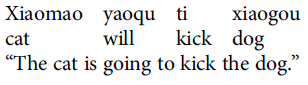
Garden-path constructions in Mandarin are mostly associated with the grammatical morpheme DE (Lee, Reference Lee, Ho, Cheung, Pan and Wu2006).Footnote 1 Consider the Mandarin example in (6). It has the structure: “NP1 + Modal + Verb + NP2 + DE + NP3.” The morpheme DE is a possessive marker, so NP2 + DE + NP3 indicates a possessive relation where NP2 is the animate possessor (e.g., xiaogou “dog”) and NP3 is the inanimate possessee (e.g., piqiu “ball”). The verb ti “kick” is the verb that causes the initial misinterpretation, as it could take either an animate or inanimate entity as its plausible complement, so in (6) NP2 xiaogou “dog” could be a perfect complement for the verb. If the parser incrementally computes the structural representation and possible meanings of the sentence, it might initially analyze the structure “NP1 + Modal + Verb + NP2” as a complete sentence, as in (7), after hearing the verb ti “kick” and before encountering the marker DE. In other words, when processing (6), the parser might initially analyze NP2 xiaogou “dog” as the object NP of the verb ti “kick,” rather than the modifier of the actual object NP xiaogou DE piqiu “dog’s ball.” The possessive marker DE, which is adjacent to the ambiguous NP2 xiaogou “dog,” is the disambiguation point (trigger for reanalysis). Upon encountering the marker DE, the parser will need to revise its initial analysis of NP2 (xiaogou “dog”) and reanalyze it as the modifier of the object NP (xiaogou DE piqiu “dog’s ball”).
(6)
(7)

Note that English also has possessive markers like ’s, as in John’s apple. However, compared with its English counterpart, the Mandarin possessive marker DE is more suitable for experimentally investigating garden-path effects. First, although both DE and ’s are subject to coarticulation of its preceding morpheme, DE can be pronounced fully and independently from its surrounding morphemes. In other words, Mandarin-speakers can opt out of co-articulating DE and the naturalness of the sentence will not be affected. By contrast, ’s has to be coarticulated with its preceding morpheme (i.e., ’s is pronounced as /s/ after voiceless nonsibilant consonants, and /z/ after voiced nonsibilant consonants). This feature of DE is particularly helpful when dividing time windows for analysis in a visual world eye-tracking study.
Second, it has been suggested that grammatical morphemes like –ed and ’s are particularly vulnerable for young English-speaking children, because these morphemes are shorter in duration and phonologically weaker than adjacent morphemes, and thus the perception of these weak morphemes exhausts the processing resources available to young children (Leonard, Reference Leonard2014; Leonard, Caselli, Bortolini, McGegor, & Sabbadini, Reference Leonard, Caselli, Bortolini, McGregor and Sabbadini1992; Leonard, Eyer, Bedore, & Grela, Reference Leonard, Eyer, Bedore and Grela1997). By contrast, the perception of the Mandarin morpheme DE should presumably be less challenging for young Mandarin-speaking children, due to its acoustic and phonological features discussed above. Previous research has shown that Mandarin-speaking children start to use DE as a possessive marker at 2 years of age (Kong, Zhou, & Li, Reference Kong, Zhou and Li1990; Li, Reference Li2004) and by 4 years of age they have acquired the syntactic and semantic features of the possessive DE construction (Shi & Zhou, Reference Shi and Zhou2018).
The present study took advantage of the property of Mandarin DE to investigate children’s processing of garden-path constructions. In particular, we were interested to investigate whether young children are able to reanalyze garden-path constructions when the ambiguous word is adjacent to the disambiguation point.
Note that in previous research the ambiguous word and the disambiguation point are nonadjacent elements, and thus the linear distance between the two is relatively long. For example, in the garden-path constructions used by Trueswell et al. (Reference Trueswell, Sekerina, Hill and Logrip1999; see example [3]), there were two words between the ambiguous word on and the disambiguation point in. Similarly, two elements intervened between the ambiguous case marker –ey and the disambiguation verb in the Korean garden-path constructions used by Choi and Trueswell (Reference Choi and Trueswell2010; see example [5]). The relatively long linear distance might have posed difficulties for young children, due to their limited working memory capacity.
To minimize children’s difficulties with reanalysis associated with working memory load, the present study used garden-path structures as in (6), where the disambiguation point, the marker DE, is adjacent to the ambiguous word xiaogou “dog,” and therefore the linear distance between the two elements is kept to minimum. By reducing the linear distance, this maneuver might presumably reduce the computational burden posed on working memory, according to Just and Carpenter (Reference Just and Carpenter1992) and Lewis et al. (Reference Lewis, Vasishth and van Dyke2006).
More specifically, in the present study we were interested to find out whether 4- to 5-year-old Mandarin-speaking children are already able to process Mandarin garden-path constructions in an adultlike manner, by maximizing their chances to revise and reanalyze their initial interpretation due to the features of the Mandarin construction discussed above. To our knowledge, this is the first experimental study to investigate Mandarin-speaking children’s real-time processing of garden-path constructions.
The present study
Participants
Twenty-five Mandarin-speaking 4-year-olds (age range 4;1-4;11; mean 4;6) and 25 Mandarin-speaking 5-year-olds (age range 5;1–5;10; mean 5;6) participated in the study. They were recruited from the Beijing Taolifangyuan Kindergarten, and had no reported history of speech, hearing, or language disorders. In addition, 30 Mandarin-speaking adults (age range 18–24, mean 20) were tested as controls. They were all undergraduate students at Tsinghua University in Beijing, and had no self-reported speech, hearing, or language disorders. Four of the 25 4-year-olds did not complete the actual test, because they became distressed during the task, and refused to continue. Four of the 25 5-year-olds and 3 of the 30 adults did not proceed to the actual test, because we were unable to calibrate them on the eye tracker. The other participants successfully completed the task and were included in the final analyses.
The study was approved by the ethics committee of the School of Medicine, Tsinghua University, 20170018. Written informed consent has been obtained from each child participant’s parents and each adult participant.
Materials and design
A total of 8 target items were created, each containing a visual image and a spoken sentence.Footnote 2 All the target spoken sentences had the same structure: “NP1 + Modal + Verb + NP2 + DE + NP3” as in (6), repeated here as (8). The modal word remained the same across trials, that is, the Mandarin yaoqu “will,” denoting a future event. The verb was always monosyllabic in Mandarin and could take either an animate or inanimate entity as its plausible complement (e.g., ti “kick”). The morpheme DE was a possessive marker, so “NP2 + DE + NP3” indicated a possessive relation in which NP2 (e.g., xiaogou “dog”) was the animate possessor and NP3 (e.g., piqiu “ball”) was the inanimate possessee. All the NPs, including NP1, NP2, and NP3, were disyllabic in Mandarin. Each visual image consisted of five entities, including one animal corresponding to NP1 of the spoken sentence (e.g., the cat in Figure 1), and two possessor-possessee pairs, one was the target possessor–possessee pair and one was the contrast possessor–possessee pair. The target possessor–possessee pair (e.g., the two entities in the left panel of Figure 1) corresponded to NP2 (e.g., xiaogou “dog”) and NP2 + DE + NP3 (e.g., xiaogou DE piqiu “the dog’s ball”), where NP2 functioned as the modifier of the object NP2 + DE + NP3 in the target sentence. We refer to the two areas as the target modifier area (e.g., the area containing the dog) and the target object area (e.g., the area containing the dog’s ball). The contrast possessor–possessee pair also indicated a modification relation between a possessor and a possessee (e.g., the rooster and the rooster’s ball in the right panel of Figure 1). We refer to the two areas as the contrast modifier area (e.g., the area containing the rooster) and the contrast object area (e.g., the area containing the rooster’s ball).
An example of a target visual image in the study.

In the visual image, the possessive relation was established by drawing an icon of the possessor (e.g., the dog) on the possessee (e.g., the dog’s ball). The animal character corresponding to NP1 always occurred at the center of the visual image, whereas the positions of the other four entities corresponding to the target and contrast possessor–possessee pairs were counterbalanced across the visual images.
(8)

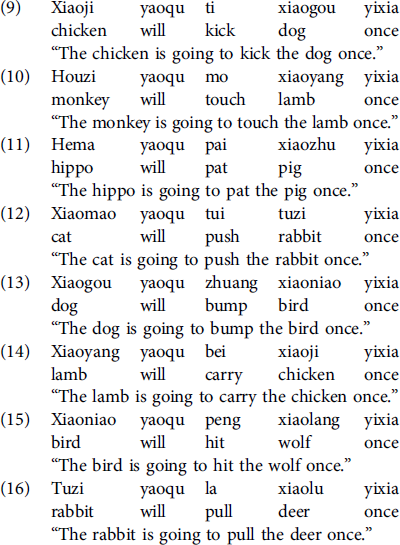
In addition, 8 control and 8 filler trials were constructed, each containing a visual image and a spoken sentence. The visual images of the control and filler trials were similar to those on the target trials. The control sentences had the following structure: NP1 + Modal + Verb + NP2 + Adverb. In the control sentences, all the NPs were disyllabic in Mandarin like in the target sentences, the modal verb was always yaoqu “will,” and the adverb was always yixia “once,” as in (9). In this sentence, xiaogou “the dog” was the object of the verb ti “kick,” so no reanalysis was involved. Control sentences such as (9) were used as a baseline condition, because the structure of the control sentences followed the structure of the target sentences up until the point of disambiguation, but crucially did not involve a garden path, thus serving a good baseline for how likely the participants were to look away from a particular image by chance or visual preference. The filler sentences had the following structure: NP1 + Modal + Verb + NP2 + HE + NP3, where the Mandarin conjunction word he “and” was used between NP2 and NP3, as in (10). With a conjunctive phrase xiaoyang he yizi “the goat and the chair,” the sentence means that the deer is going to kick the goat and the chair. The target, control, and filler trials were presented to the participants in random order. A full list of target, control, and filler sentences can be found in Appendix A.
(9)
(10)


To ensure that NP3 (e.g., piqiu “ball”) was not more plausible than NP2 (e.g., xiaogou “dog”) as the object of the verb (e.g., ti “kick”) in the target sentences, we did a survey on 20 Mandarin-speaking adults (9 males and 11 females; age range 19–27; mean 23) where they were asked to rate the plausibility of the two verb–object pairs, “verb + NP2” (e.g., ti xiaogou “kick the dog”) and “verb +NP3” (e.g., ti piqiu “kick the ball”) in all the target sentences using a 5-point Likert scale, with 5 representing the most plausible and 1 representing the least plausible. The mean plausibility score for the “Verb + NP2” pair was 4.08 (SD = 1.08), and the mean plausibility score for the “Verb + NP3” pair was 3.89 (SD = 1.33). No significant difference was found between the mean scores of the two pairs (p = .09). In addition, the median scores for the two pairs were both 4. To further examine the distribution of the plausibility scores, we divided the scores into two clusters, the low score cluster and high score cluster. The low score cluster includes three scores, 1, 2, and 3, while the high score group includes two scores, 4 and 5. The proportion of low scores for the “Verb + NP2” pair was 28% (45 out of 160 responses), and the proportion of low scores for the “Verb + NP3” pair was 31% (50 out of 160 responses). All these comparisons showed that the scores for “Verb + NP3” pair were statistically similar to the scores for the “Verb + NP2” pair, indicating that NP3 was not more plausible than NP2 as the object of the verb.
Production of the test stimuli
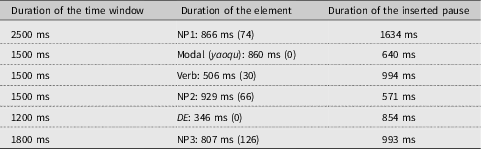
All the spoken sentences were produced by a female native speaker of Beijing Mandarin. She was asked to produce these sentences word by word in a child-directed manner. The recording took place in a sound-attenuated recording booth at Tsinghua University. To ensure the consistency of prosodic features (i.e., duration and prosody) of each element across the spoken sentences, the original recorded sentences were later edited in Praat: for each element, only one sample in the recording was selected and then used for all the relevant sentences that contained the element. For instance, all the spoken sentences (including the target, control, and filler sentences) used the same sample of the modal verb yaoqu “will,” all the target sentences used the same sample of the morpheme DE, all the control sentences used the same sample of the adverb yixia “once,” and so on. This maneuver was also used to control for the effect of prosodic cues on sentence comprehension. In addition, to create clear time windows for each element in the sentences, we added pauses between each element such that each element had the time window of the same length across sentences: NP1 (2500 ms), the modal (1500 ms), the verb (1500 ms), NP2 (1500 ms), DE (1200 ms), HE (1200 ms), NP3 (1800 ms), and the adverb (3000 ms). In other words, each time window consisted of the element of the sentence and an inserted pause. Table 1 provides a duration analysis of each time window in the target sentences. Note that in order to keep consistent the prosodic patterns across the target, control, and filler sentences, pauses were also inserted between each element in the control and filler sentences. The only difference was that the morpheme DE only occurred in the target sentences; the adverb yixia “once” only occurred in the control sentences, and conjunction word HE only occurred in the filler sentences. All the spoken sentences were 10 s long.
Duration analysis of the target sentences used in the study (standard deviation in parentheses)

Note: Each time window consisted of the element of the sentence and an inserted pause. The same recorded sample of the modal verb yaoqu “will” and the same recorded sample of the morpheme DE were used across the target sentences.
To ensure the naturalness of the edited target and control sentences, we did a survey on 20 Mandarin-speaking adults (8 males and 12 females; age range 19–27; mean 23). In the survey, they were asked to judge the naturalness of the target and control sentences using a 5-point Likert scale, with 5 representing the most natural and 1 representing the least natural. The mean naturalness score for the target sentences containing DE was 4.24 (SD = 0.90), and the mean naturalness score for the control sentences was 4.36 (SD = 0.85). No significant difference was observed in the naturalness ratings of the target and control sentences (p = .10), indicating that these edited target and control sentences sounded natural and intelligible.
Procedure
Both children and adults were tested using the visual-world paradigm (Cooper, Reference Cooper1974; Tanenhaus et al., Reference Tanenhaus, Spivey-Knowlton, Eberhard and Sedivy1995). They were presented with a spoken sentence while viewing a visual image. They were instructed that they were going to see some pictures and the puppet (the little kitten), was going to tell them what would happen in these pictures. The participants’ eye movements were recorded by an EyeLink 1000 eye tracker (by SR Research Ltd., Mississauga, Ontario, Canada) interfaced with a PC computer. The eye tracker allows remote eye tracking without a head support. It provides information about the participant’s point of gaze at a sampling rate of 500 Hz and has an accuracy of 0.5 degrees of visual angle. The visual images were displayed on the PC monitor, and the spoken sentences were presented to the participants through two external speakers connected to the computer. The distance between the participants’ eye and the monitor was about 60 cm.
Before the actual experiment, we had an introduction session where the participants were familiarized with task and the objects shown in the visual images. The participants were also instructed that if there was an icon of an animal on the object, then the animal owned the object. After the introduction session, the experimental session began. Before each trial, a black dot was shown at the center of the PC monitor, which anchored the beginning of the trial, and also served to capture the participants’ attention.
The spoken sentences started 500 ms after the appearance of the visual stimulus. The participants’ eye movements were recorded for 10 s from the onset of the sentence until the sentence was completed.
Predictions
If the participants incrementally computed the structural representation and possible meanings of the spoken sentences, when presented with the target sentences as in (8) they might initially analyze “NP1 + Modal + Verb + NP2” as a complete sentence, meaning “The cat is going to kick the dog,” after hearing the verb ti “kick” and before encountering the marker DE. In other words, when processing (8), the participants might initially analyze NP2 xiaogou “dog” as the object NP of the verb ti “kick,” rather than the modifier of the actual object NP xiaogou DE piqiu “dog’s ball.” This interpretation process would lead the participants to initially look more at the dog in Figure 1 (the target modifier area), after hearing the verb ti “kick” and before hearing the possessive marker DE. The possessive marker DE is the disambiguation point (trigger for reanalysis). Upon encountering the possessive marker DE, the participants would need to revise their initial analysis of NP2 (xiaogou “dog”) and reanalyze it as the modifier of the object NP (xiaogou DE piqiu “dog’s ball”). This reanalysis process would lead the participants to switch their eye movements from the dog to the dog’s ball in Figure 1 (the target object area), so a significant increase of fixations in the target object area and a significant decrease of fixations in the target modifier area should be expected after the onset of DE. As discussed, to provide a baseline measure of how likely participants were to look away from a particular image by chance or visual preference, sentences like (9) were used as a baseline control condition.Footnote 3 If the participants were able to revise and reanalyze their initial interpretation, and then successfully recovered from the garden path in the target sentences, then they should be expected to exhibit more looks to the target object area (e.g., the dog’s ball in Figure 1) when hearing DE in the target sentences than when hearing the adverb yixia “once” in the control sentences; by contrast, an opposite pattern should be observed in the target modifier area (e.g., the dog in Figure 1): hearing DE in the target sentences should trigger fewer looks to this area than hearing yixia “once” in the control sentences.
Results
To analyze the eye movement data, we first defined five equal-sized areas of interest in the visual image: the Agent area (corresponding to NP1 in the spoken sentence), the target modifier area (Target_Mod, corresponding to NP2 in the sentence), the target object area (Target_Obj, corresponding to NP2 + DE + NP3), the contrast modifier area (Contrast_Mod), and the contrast object area (Contrast_Obj). The contrast modifier and the contrast object areas corresponded to the other possessor–possessee pairs depicted in the visual image. As discussed in the Materials and Design section, on the example target trial the five areas of interest referred, respectively, to the cat (Agent), the dog (Target_Mod), the dog’s ball (Target_Obj), the rooster (Contrast_Mod), and the rooster’s ball (Contrast_Obj).
In preparing the eye movement data, we deleted the samples where the participants’ eye movements were not detected, for example, when they blinked their eyes. This process affected approximately 10% of the recorded data. To reduce the number of statistical tests carried out, we then down-sampled the data into a series of time bins, each with a duration of 50 ms. After that we computed the proportion of fixations for each area of interest under each temporal bin, for each participant and each trial. The proportion of fixations for a particular area of interest in a specific temporal bin was treated as the dependent variable. For example, if 5 fixation points in a temporal bin were recorded, with 2 fixation points located in that specific area of interest, then the proportion of fixations on that area was 2/5.
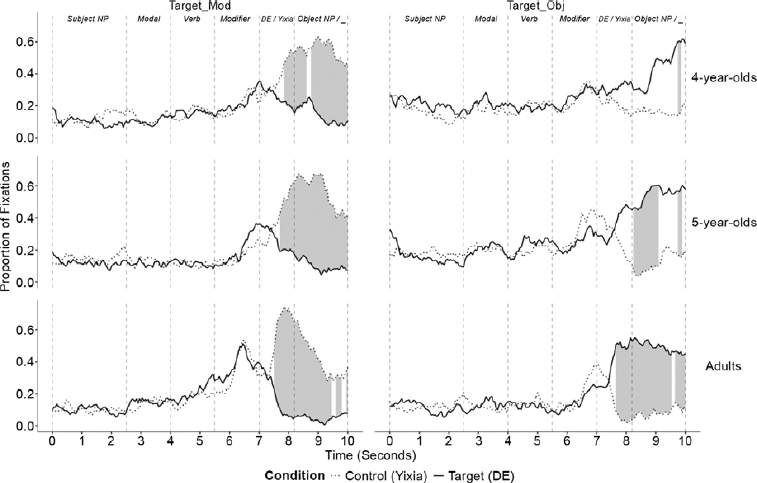
To visually present the data, we first averaged the coded data for all the trials and participants in each sample point under each condition and each age group. The results are summarized in Figure 2, where the target (i.e., Target [DE]) and control sentences (i.e., Control [Yixia]) are represented using solid and dotted lines, respectively, and the average fixation proportions in the two areas of interest, Target_Mod and Target_Obj, are presented in the left and right columns respectively. As indicated in the left column of Figure 2, hearing the possessive marker DE in the target sentences triggered fewer fixations on the Target_Mod area than hearing the adverb yixia in the control sentences for all the three age groups. In contrast, an opposite pattern was observed in the Target_Obj area, as shown in the right column of Figure 2. All the three age groups exhibited more looks to this area when hearing DE in the target sentences than when hearing yixia in the control sentences. As predicted, for all the three age groups, hearing the possessive marker DE switched the participants’ eye movements from the Target_Mod area to the Target_Obj area, indicating that the 4-year-olds and the 5-year-olds, like the adults, were able to revise and reanalyze their initial interpretation using the information encoded in the possessive marker DE, and thus successfully recovering from the garden path in the target sentences.
Average fixation proportions in the Target_Mod area (left column) and in the Target_Obj area (right column) by the 4-year-olds (upper panel), the 5-year-olds (middle panel), and the adults (lower panel). For illustration purposes, the y-axis gives the original mean proportions of fixations, instead of the transformed ones. The gray areas indicate significant differences between the target and control baseline conditions on the basis of the adjusted p values (p < .05).
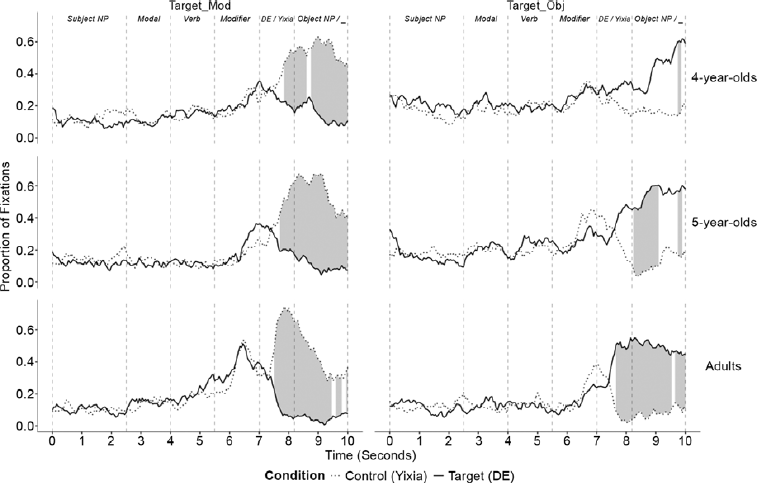
To statistically examine the observed effects, we first transformed the fixation proportions using the empirical logit formula (Barr, Reference Barr2008): probability = ln([y+0.5]/[n–y+0.5]), where y is the number of samples in which the participants’ fixation was located in a specific area of interest during a particular temporal bin; n is the total number of samples where the participants’ eye fixations were recorded. To compare the target and control conditions, we then fitted a linear mixed-effects model (LMM) to the transformed data, under each temporal bin, each area of interest, and each age group. The LMM model contained only one fixed term, condition, and two random terms, participant and trial. The model is the maximum one as suggested by Barr, Levy, Scheepers, and Tily (Reference Barr, Levy, Scheepers and Tily2013): Transformed-Proportion ~ 1 + condition + (1 + condition | participant) + (1 + condition | trial). The fitting process was conducted via the MixedModels package (Bates et al., Reference Bates, Calderón, Noack, Kleinschmidt, Kelman, Bouchet-Valat and Baldassari2019) in Julia language (Bezanson, Edelman, Karpinski, & Shah, Reference Bezanson, Edelman, Karpinski and Shah2017). The obtained p values were then Bonferroni adjusted, that is, the obtained p value times the number of comparisons in a specific area of interest and a specific age group. The model results are also summarized in Figure 2, where the gray areas indicate significant differences between the two conditions on the basis of the adjusted p values. The model results confirmed the observed eye gaze patterns. Note that for illustration purposes, the y-axis of Figure 2 displays the original mean proportions of fixations, instead of the transformed ones.
To statistically analyze the latencies of the obtained effects between different age groups, we first identified the latency for each participant and each area of interest by applying the LMM model, Transformed-Proportion ~ 1 + condition + (1 | trial), to each temporal bin for each participant and each area of interest. We then compared the obtained latencies for each participant by applying the LMM model, Latency ~ 1 + age_group + (1 | participant), to each area of interest. Using the 5-year-olds as the baseline, we found that the observed effects in the Target_Obj area occurred significantly earlier in the 5-year-olds than in the 4-year-olds (8.25 s vs. 9.65 s, b = 14.78, z = 3.13, p < .01), but compared with adults, the observed effects in the 5-year-olds occurred significantly later (7.65 s vs. 8.25 s, b = –10.59, z = –2.92, p < .01). The results indicated that it took longer time for the younger children than the older children and for the older children than the adults to revise and reanalyze their initial misinterpretation.
Discussion
The present study sought to investigate whether 4- and 5-year-old Mandarin-speaking children are able to process Mandarin garden-path constructions associated with the grammatical morpheme DE. The obtained eye gaze patterns show that the 4- and 5-year-olds, like the adults, committed to an initial misinterpretation and later successfully revised their initial interpretation when encountering the morpheme DE. This is the first experimental study that investigated Mandarin-speaking children’s real-time processing of garden-path constructions and observed that preschool Mandarin-speaking children successfully recovered from the garden path in the relevant constructions. In addition, the findings are consistent with previous research observing 5- to 8-year-old children’ successful recovery from their initial misinterpretation using later-encountered linguistic information, when processing filler-gap sentences involving local ambiguity (e.g., Özge et al., Reference Özge, Marinis and Zeyrek2015).
One possible explanation for children’s successful recovery is the minimized linear distance between the ambiguous word and the disambiguation point in the sentence. As discussed in the two working memory models, the linear distance between the ambiguous word and the disambiguation point positively correlates with the level of difficulties in reanalyzing garden-path constructions. When the ambiguous word is adjacent to the disambiguation point, that is, when the linear distance between the two is minimized, the difficulties in reanalysis are also reduced to minimum. In most previous research, the ambiguous word and the disambiguation point are nonadjacent elements, and thus the linear distance between the two is relatively long. For instance, there were two words between the ambiguous word and the disambiguation point in the garden-path constructions used by Trueswell et al. (Reference Trueswell, Sekerina, Hill and Logrip1999; see example [3]), and two elements intervened between the ambiguous case marker and the disambiguation verb in the Korean garden-path constructions used by Choi and Trueswell (Reference Choi and Trueswell2010; see example [5]). The relatively long linear distance might have posed difficulties for young children, because young children have limited working memory capacity and thus are more likely to abandon the correct interpretation before the disambiguation point (on the account by Just & Carpenter, Reference Just and Carpenter1992) or they might exhibit more difficulties in reactivating the correct interpretation due to longer decaying time (on the account by Lewis et al., Reference Lewis, Vasishth and van Dyke2006).
Unlike previous research, the present study took advantage of the Mandarin garden-path construction, where the disambiguation point, the possessive marker DE, is adjacent to the ambiguous word, and thus the linear distance between the two elements is kept to minimum. By reducing the linear distance, this maneuver might presumably reduce the computational burden posed on working memory, because shorter linear distance might significantly increase the chance for young children to hold the correct interpretation in working memory (according to Just & Carpenter, Reference Just and Carpenter1992), or might reduce the decaying time of the correct interpretation so that it becomes easier for young children to reactivate (according to Lewis et al., Reference Lewis, Vasishth and van Dyke2006).
Alternatively, the reduction of children’s working memory burden in reanalysis might also be linked to the syntactic structure of the sentences in the current study, in addition to the adjacency between the ambiguous word and the disambiguation point. According to the processing model by Pritchett (Reference Pritchett1988, Reference Pritchett1992), difficulties in reanalysis are related to the number of syntactic nodes involved in the reanalysis process: more syntactic nodes involved in reanalysis pose more difficulties in reanalysis. More specifically, when encountering the ambiguous word, the parser assigns an initial position to it in the syntactic structure. As the parsing continues, the parser has to reanalyze the syntactic structure of the sentence when encountering the disambiguation point, whereby the ambiguous word has to be removed from its initial syntactic position and be relocated to the revised syntactic position. If the initial syntactic position and the revised syntactic position reside under the same syntactic node (e.g., both are under the same NP node), then reanalysis poses relatively lower burden on working memory, because it only involves the processing of one syntactic node. By contrast, if the initial syntactic position and the revised syntactic position do not reside in the same syntactic node (e.g., the initial syntactic position is under an NP node, and the revised position under a verb phrase node), then reanalysis poses relatively higher burden on working memory, because it engages the processing of different syntactic nodes.
Compared with the classic garden-path structures such as (1) and the structures used in prior research, the Mandarin garden-path constructions in the current study might be structurally simpler, and thus are relatively easier to be processed. In the English garden-path constructions in Trueswell et al. (Reference Trueswell, Sekerina, Hill and Logrip1999), the ambiguous phrase on the napkin was first analyzed as the destination of the verb under the verb phrase node, and later reanalyzed as the modifier of the noun under the NP node when encountering the disambiguation point. As the initial syntactic position and the revised syntactic position do not reside in the same syntactic node, the reanalysis process would probably induce high working memory burden. By contrast, in the current study, the ambiguous word (e.g., xiaogou “dog”) was initially analyzed as the object noun under the object NP node. Encountering the disambiguation word DE led the parser to reanalyze it as the modifier of the object noun under the same object NP node. As the initial and the revised syntactic positions are under the same object NP node, reanalysis involved only one syntactic node and thus induced relatively lower working memory burden.
Nonetheless, we wish to note that although the features of the Mandarin garden-path construction facilitated children’s real-time comprehension of the construction, the younger children exhibited more difficulties than the older children and the adults in revising their initial misinterpretation using the later-encountered linguistic information, as evidenced by the finding that the effect of fixating more on the Target_Obj area (indicating the correct interpretation) occurred significantly later in the 4-year-olds than in the 5-year-olds and the adults. Our findings suggest that although the 4-year-olds successfully recovered from the garden-path in the target constructions, they were not as effective as the older children and the adults in revising and reanalyzing the initial misinterpretation even when the working memory burden was kept to minimum, indicating that in addition to working memory, other cognitive factors, such as children’s immature cognitive control ability, also play a role in children’s processing of garden-path constructions (Choi & Trueswell, Reference Choi and Trueswell2010; Kidd et al., Reference Kidd, Stewart and Serratrice2011; Mazuka et al., Reference Mazuka, Jincho and Onishi2009; Novick et al., Reference Novick, Trueswell and Thompson-Schill2005; Omaki et al., Reference Omaki, Davidson White, Goro, Lidz and Phillips2014; Trueswell et al., Reference Trueswell, Sekerina, Hill and Logrip1999; Weighall, Reference Weighall2008; Woodard et al., Reference Woodard, Pozzan and Trueswell2016).
The findings of the current study open up new questions for building a fine-grained model of child sentence processing. To the best of our knowledge, most previous research attributed the kindergarten-path effect to children’s immature cognitive abilities like limited working memory capacity or immature cognitive control ability, without specifying how exactly each cognitive component relates to children’s difficulties with reanalysis. To better understand the kindergarten-path effect, a fine-grained child sentence processing model is required in which the respective roles of working memory and cognitive control are spelled out in detail. The present study is an attempt in this direction by investigating whether children could revise their initial interpretation when the working memory burden is reduced to minimum, regardless of linear distance or structural reasons. To confirm the role of linear distance and structural property in children’s processing of garden-path constructions, future research is required to tease apart these two factors by investigating how each of these two factors contributes to the reduction of working memory burden in reanalysis.
We also wish to acknowledge a few limitations of the current study. The current study did not measure the participants’ working memory capacity, because we assume that young children and adults differ in their working memory capacity on the basis of the general consensus in previous research that young children have more limited working memory capacity as compared to adults (e.g., Case et al., Reference Case, Kurland and Goldberg1982; Gathercole, Reference Gathercole, Pickering, Ambridge and Wearing2004). Future research is required to directly investigate the relation between distance effect and working memory capacity. In addition, our study only focused on the working memory burden, without considering in detail the nature of the ambiguous word/the disambiguation point (e.g., whether the frequent occurrence of the morpheme DE in the adult input helped children’s reanalysis). Again, further research is needed to examine how the nature of the ambiguous word/the disambiguation point relates to children’s processing of garden-path constructions. Finally, we wish to note that the observed effects in the data analysis may not have come out if a different p value adjustment method was used or a more conservative hypothesis was adopted for the Bonferroni correction (e.g., without adopting the assumption that data from different areas of interest are independent). Future studies using the visual-world paradigm might consider using a more appropriate adjustment method when dealing with the auto-correction problem between the time bins.
Overall, the present study advances our understanding of children’s difficulty with reanalysis in processing garden-path constructions by showing that 4-year-old children can already successfully revise their initial misinterpretation and then arrive at the correct interpretation using the later-encountered linguistic information, when the working memory burden is kept to minimum as compared to previous research.
Acknowledgments
This work was supported by National Social Science Foundation of China Grant number 16BYY076 (to Peng Zhou). The authors would like to thank the children, the parents, and the teachers at the Taolifangyuan Kindergarten, Beijing, China, for their assistance and support in running the study.
Appendix A
Target, control and filler sentences in the study (8 target, 8 control, and 8 filler sentences)
Target sentences

Control sentences
Filler sentences

Appendix B
This appendix contains the original analysis that used the comparison of looks to the Target_Mod/Target_Obj areas in the interest period before the verb as the baseline. We have decided to keep the original analysis by following an anonymous reviewer’s suggestion to have more than one baseline to help place the current results. Overall, the current analysis in the main text and this original analysis gave consistent results, though using different baseline conditions, confirming the reliability of our findings and the interpretation of the findings.
Analysis
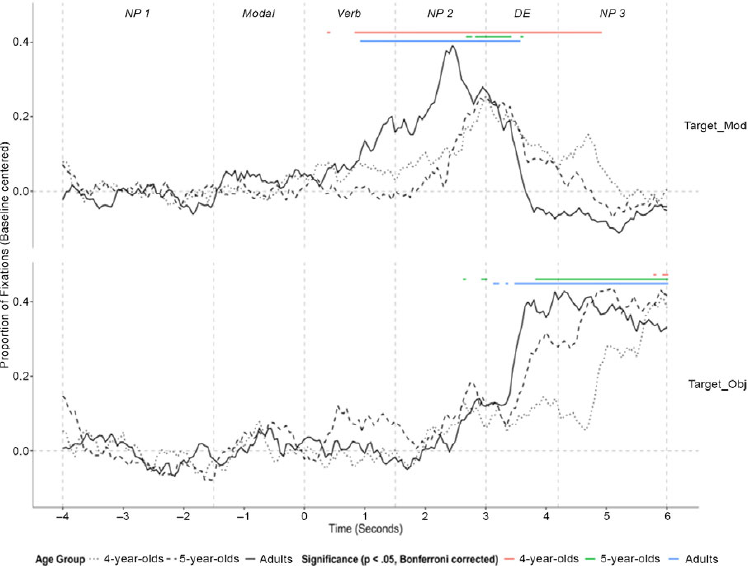
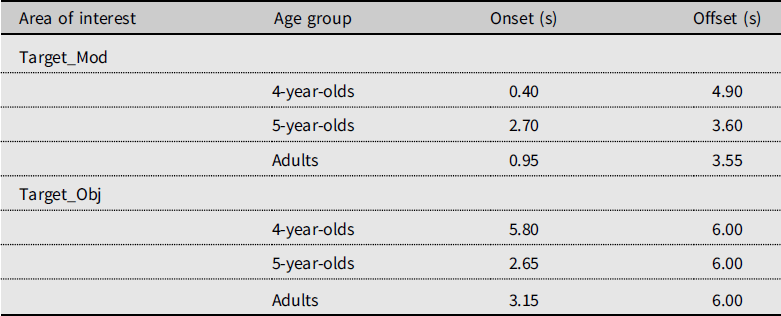
To examine the effect of the verb and the possessive marker DE, we baseline-centered the transformed proportions, that is, for each trial and each participant we subtracted the mean of transformed proportions prior to the onset of the verb from each obtained value after the onset of the verb. We then fitted a LMM to the baseline-centered data, for each temporal bin, each area of interest, and each age group. The LMM model contained only one fixed term, intercept, and two random terms, participant and trial. Since the empirical logit function is monotonic increasing, an intercept that is significantly bigger than zero means that the current proportion is significantly bigger than that of the baseline. The model fitting process was conducted via the lmer function from the lme4 package (Bates, Mächler, BolKer, &Walker, Reference Bates, Mächler, Bolker and Walker2015) under the R environment (R Core Team, 2019). The model formula used in R is Transform-and-Centered-Proportion ~ 1 + (1|Participant) + (1|Trial). The p values were then obtained using Wald z tests, that is, the statistics is hypothesized to have a normal distribution with the parameter as its mean, and the standard error as its standard deviation. The obtained p values were then Bonferroni adjusted, that is, multiplying the obtained p values by 200 (the number of comparisons in each area of interest). The adjusted results are represented using colored horizontal lines in the Appendix Figure A.1, where the red line represents the 4-year-olds, the green line the 5-year-olds, and the blue line the adults. A temporal period that has a colored horizontal line indicates that for the relevant age group, there was a significantly higher fixation proportion than the baseline (i.e., the fixation proportion prior to the onset of the verb) in this area of interest during this temporal bin. The onset and offset of the observed effects are summarized in the Appendix Table A.1.
Average fixation proportions in the Target_Mod area (upper panel) and in the Target_Obj area (lower panel) by the 4-year-olds (dotted line), the 5-year-olds (dashed line), and the adults (solid line). The illustrated proportions are baseline centered, that is, the mean fixation proportion in that area of interest prior to the onset of the verb is subtracted from the original proportions. The colored horizontal lines of each panel indicate that for the relevant age group, there was a significantly higher fixation proportion than the baseline in this area of interest during this temporal bin; the red line represents the 4-year-olds, the green line the 5-year-olds, and the blue line the adults.

The onset and offset of the significant effects represented by the colored horizontal lines in Figure A.1 for each group in each area of interest (seconds from the onset of the verb)

The model results (see both Figure A.1 and Table A.1) show that the trend to look more at the Target_Mod area appeared relatively earlier in the 4-year-olds (0.40 s) and the adults (0.95 s) than in the 5-year-olds (2.70 s), and it disappeared relatively later in the 4-year-olds (4.90 s) than in the adults (3.55 s) and the 5-year-olds (3.60 s), indicating that it took longer time for the younger children to revise and reanalyze their initial misinterpretation. The effects in the Target_Obj area further confirmed this processing difficulty exhibited by the younger children. The 4-year-olds started to fixate more on the Target_Obj area (5.80 s) relatively later than the adults (3.15 s) and the 5-year-olds (2.65 s).