Introduction
The repeated failures of pharmacological clinical trials to cure or even slow down Alzheimer's disease have raised interest for alternative non-drug interventions, in particular cognition-oriented therapies. Among them, cognitive training and reminiscence therapy are very popular. Cognitive training is the first established non-drug intervention that focused on improvement of cognition in dementia (Breuil et al., Reference Breuil1994). This approach generally consists of a structured practice on a set of standard tasks designed to involve various cognitive functions such as memory, attention, or language. Reminiscence therapy is probably the second most common non-drug therapy for patients with dementia. Even though it has been initially designed to improve mood, self-esteem and quality of life, it also involves a cognitive rationale. Indeed, with people with dementia often able to recall events from their youth or childhood, but not from earlier on the same day, reminiscence therapy, historically linked to Butler's work on “life review process” (Butler, Reference Butler1963), offers the opportunity to tap into the apparently preserved store of remote memories. Both cognitive training and reminiscence therapies are typically conducted in groups of patients to enhance social functioning. Although less frequently applied given its higher cost, cognitive rehabilitation, developed mainly through work with younger brain-injured people, is increasingly discussed in relation to dementia. Cognitive rehabilitation relies on an individualized approach where personally relevant goals are identified, and the therapist works with the patient and his/her caregiver to devise strategies to address these goals. The emphasis is put on improving performance in everyday life situations, rather than on cognitive performance per se, building on the person's strengths and developing ways of compensating for impairment (Clare and Woods Reference Clare and Woods2004).
The efficacy of cognition-oriented interventions has often been discussed but rarely demonstrated. Two Cochrane reviews examining cognitive training have been published. The first one (Clare et al., Reference Clare, Woods, Moniz Cook, Orrell and Spector2003) including six randomized controlled trials (RCTs) could not evidence any benefit on cognition, activities of daily living, or quality of life. The second and third ones provided limited evidence for cognitive training and both concluded for the urgent need of well-designed studies to draw definitive conclusions (Woods et al., Reference Woods, Aguirre, Spector and Orrell2012a; Bahar-Fuchs et al., Reference Bahar-Fuchs, Clare and Woods2013).
Two Cochrane studies have also been published for reminiscence therapy. The first one (Spector et al., Reference Spector, Orrell, Davies and Woods2000) yielded to inconclusive results while the second one (Woods et al., Reference Woods, Spector, Jones, Orrell and Davies2005) on four RCTs reported significant results in cognition, mood, general behavioral function, caregivers strain, and staff knowledge of patients. However, recently, the REMCARE trial (Woods et al., Reference Woods2012b), a quite large multicenter RCT in 488 participants provided challenging results showing no differences between the intervention and control conditions on self-reported quality of life or autobiographical memory, activities of daily living, mood, and service use and costs. Unexpectedly, caregivers of participants allocated to the reminiscence intervention reported a significant increase in anxiety at the ten-month end-point.
Regarding individualized cognitive rehabilitation, most of the reports are issued from single case experimental designs showing that individuals with early-stage dementia can to some extent, learn or re-learn important and personally-relevant information, maintain this learning over time, and apply it in the everyday context (Camp et al., Reference Camp, Bird, Cherry, Hill, Bäckman and Stigsdotter2000; Anderson et al., Reference Anderson, Arens, Johnson and Coppens2001; Clare et al., Reference Clare, Wilson, Carter, Hodges and Adams2001; Reference Clare, Wilson, Carter, Roth and Hodges2002) and that they can develop compensatory strategies using for instance memory aids (Clare et al., Reference Clare, Wilson, Carter, Gosses, Breen and Hodges2000). To date, no large RCT on individualized cognitive rehabilitation has been conducted.
Therefore, RCTs aiming at reliably assessing the impact of cognitive interventions are too scarce. Those existing report limited or negative impact. No large scale interventional study involving a comprehensive approach of both patients and caregivers, a long-term treatment, and several cognitive-oriented approaches has been carried out to date. We report the results of the ETNA3 study, a large RCT funded by the French Ministry of Health comparing the effect of cognitive training, reminiscence therapy, and an individualized cognitive rehabilitation program to usual care in Alzheimer's disease.
Methods
Study design
ETNA3 is a multicenter, stratified (by clinical site), parallel-group trial, with balanced randomization (1:1:1:1), enrolling patients with Alzheimer's disease followed at 3, 6, 12, 18, and 24 months after the initiation of the non-drug therapy. The study complied with the declaration of Helsinki regarding investigation in humans and was approved by the ethics committee of Bordeaux Hospital.
Study population
Between April 2008 and December 2009, 655 patients diagnosed with Alzheimer's disease according to criteria of the NINCDS-ADRDA (McKhann et al., Reference McKhann, Drachman, Folstein, Katzman, Price and Stadlan1984) were enrolled in 40 centers across France. Two patients were excluded: one for misdiagnosis and another one who withdrew consent. Enrollment was restricted to patients aged 50 years and over, in the mild to moderate stage of the disease as established by Mini-Mental State Examination (Folstein et al., Reference Folstein, Folstein and McHugh1975) (MMSE) (i.e. 16 to 26) and Global Deterioration Scale (Reisberg et al., Reference Reisberg, Ferris, de Leon and Crook1988) (GDS) score (i.e. 2 to 5), non-institutionalized and with an identified family caregiver. Clinical sites were Memory centers or geriatric day-care units involving a multidisciplinary medical team with neurologists, geriatricians, or psychiatrists and psychologists trained for cognitive and behavioral care.
Randomization and masking
The list of randomization was prepared by a statistician using permuted blocks, stratified by site. Each clinical site proposed two of the three interventions in addition to the usual care strategy. Interventions were randomly assigned in order to have an equal number across the four groups. Block size was randomly assigned to 10 or 11 with a ratio 2:4:4 or 3:4:4 (usual care: 1st intervention: 2nd intervention). Following completion of baseline assessments and consent, participants were randomized through an independent and remote telephone randomization service provided by the clinical trial unit. Participants and clinical staff were aware of the trial arm to which the study participants were allocated but all assessment interviews were done by physicians and psychologists blinded to allocation status.
Interventions
Each therapy program was developed according to current scientific data, standardized by a leader known to have scientific and clinical expertise in the field (JDR, PHR, HA) and ultimately validated by the working group of the ETNA3 trial, a multidisciplinary group of neurologists, geriatricians, psychiatrists, psychologists, biostatisticians, and researchers. To guarantee homogeneity in the way interventions were applied, a standardized procedure was followed: the therapists were psychologists with at least three years of experience in the field of dementia. All therapists received a three-day training session where the therapy programs were thoroughly presented. A manual detailing the guidelines of each intervention was provided. The therapists were informed that, in case of any question regarding a particular aspect of the program, the experts who designed the programs could be consulted. A phone number was given to them for this purpose. Once the patients were included in a clinical site, a Psychologist-Clinical Research Assistant from the coordinating center visited in situ the therapists to ensure that interventions were applied in accordance with the protocol. Each intervention program consisted of weekly sessions (duration: 1 h 30 min) during the first three months and maintenance sessions held every six weeks for the next 21 months.
The cognitive training therapy consisted of a structured program of a set of standard tasks designed to involve various cognitive functions such as memory, attention, language, or executive function. Each task involved two levels of difficulty to suit the patients’ level of ability. For each session, a set of standard tasks was designed to tap on a particular activity of daily life (e.g. calculation exercises and money counting to train domestic finances handling). Groups involved five to eight patients. Separate sessions were arranged in parallel with the caregivers. During these sessions, information upon disease, symptoms, progression, and treatment were delivered by psychologists and medical staff. As for the patients, the caregivers support groups sessions were held once a week during the first three months and every six weeks afterwards.
Each session of reminiscence therapy focused on a different personal theme (e.g. schooldays, birthday, wedding, working life, holidays. . .). The groups involved five to eight patients. Caregivers were encouraged to contribute with materials (e.g. pictures. . .) brought from home. As for the cognitive training therapy, the caregivers support groups sessions were held once a week during the first three months and every six weeks afterwards.
The individualized cognitive rehabilitation therapy consisted of a made-to-measure program conducted through individual sessions. The first two sessions were exclusively dedicated to select meaningful activities (activities of daily living or leisure activities) with the person suffering from dementia and his/her caregiver. The activities to be trained had to be selected according to personally relevant goals for the patients. The psychologist had to adapt the program according to patients’ cognitive abilities in order to anticipate and avoid as much as possible failures. When appropriate, the psychologist could rely on “errorless learning procedure” to train a particular activity. At each session, the psychologist had to value the relevance of pursuing the selected activity and if appropriate could change the trained activity at any time during the program. During the first three months, the caregiver received a weekly telephone contact where he/she could express a particular difficulty or ask any question. Afterwards, telephone contacts were held every six weeks.
Finally in the reference group, the patients received usual medical care excluding non-drug therapy. Caregivers were offered the opportunity to participate in caregivers support groups sessions. The aim and calendar of sessions arranged for caregivers of patients allocated to the control condition was similar to that of caregivers of patients allocated to cognitive training and reminiscence arms.
Efficacy outcomes
The primary outcome was the rate of patients alive and without moderately severe to severe dementia at two years. Moderately severe to severe dementia was measured according to current guidelines (Vellas et al., Reference Vellas2005) (MMSE lower than 15 or stages 5 to 6 of the GDS). The secondary outcomes measured at 3 and 24 months included: institutionalization, cognitive deterioration (ADAS-cog) (Rosen et al., Reference Rosen, Mohs and Davis1984), behavioral symptoms (Neuropsychiatric Inventory; NPI) (Cummings et al., Reference Cummings, Mega, Gray, Rosenberg-Thompson, Carusi and Gornbein1994), functional abilities (Disablement Assessment for Dementia; DAD (Gélinas et al., Reference Gélinas, Gauthier, McIntyre and Gauthier1999) and Grille d’Autonomie Gérontologique-Groupes Iso-Ressources, a standardized scale providing an indicator of dependency used in French legislation; AGGIR), apathy (Apathy Inventory; AI) (Robert et al., Reference Robert2002), depressive symptoms (Montgomery-Asberg Depression Rating Scale; MADRS) (Montgomery and Åsberg, Reference Montgomery and Åsberg1979), quality of life (Quality of Life - Alzheimer's Disease scale; QoL-AD) (Logsdon et al., Reference Logsdon, Gibbons, McCurry and Teri1999), caregiver's burden (Zarit Burden Interview) (Zarit et al., Reference Zarit, Todd and Zarit1986), and resource utilization (RUD Lite) (Wimo and Winblad, Reference Wimo and Winblad2003). Each measure was calculated in each group and compared to that observed in the reference group at 3 and 24 months.
Sample size
The main hypothesis was a higher survival without moderately severe to severe dementia at two years for patients undergoing non-drug interventions compared to patients receiving the usual medical care estimated at 70% according to REAL.FR study, a clinical cohort study involving similar patients from French memory centers (Vellas, Reference Vellas2003). An effect size at 15% was considered to be a significant benefit. With a type-I error (Cronbach's α) adjusted to 0.0182 (to preserve an overall risk of 0.05) and 85% power to demonstrate a 15% difference in survival without moderately severe to severe dementia at two years between each intervention tested and the reference group, we planned to include 178 patients per arm.
Statistical analysis
Categorical variables were described in terms of numbers, proportions, and confidence intervals (95%) by the exact binomial method. Continuous variables were described in terms of mean, standard deviation, median, interquartile range (IQR), and range. All outcome analyses were done first according to intention-to-treat principle replacing missing data by the most pejorative value (hereinafter referred to as “Missing Equal Failure” [MEF] analysis) and secondly on available data. Comparisons to the reference strategy were performed with Cronbach's α = 0.0182 in order to take into account the multiplicity of tests. Logistic regressions were used for the analysis of primary end-point. Non-parametric tests (Kruskal–Wallis test), Cox models, or logistic regression models were used for the analysis of secondary end-points as appropriate. All comparisons were adjusted for the clinical site, except when a non-parametric test was used and for analyses on available data. Analyses were performed with the use of SAS® software (version no. 9.2).
Results
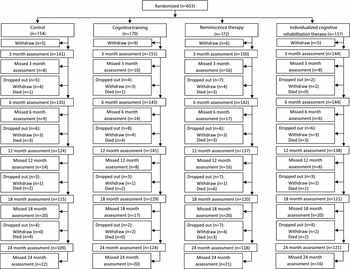
Of the 653 patient, 170 were randomized in the cognitive training group, 172 in the reminiscence group, 157 in the individualized cognitive rehabilitation group, and 154 in the control group (Figure 1). Five hundred eighty-six (89.7%) were followed-up at the three-month visit and 472 (72.3%) at 24 months.
Flow chart of participants, ETNA3 study.

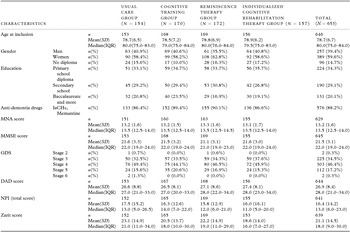
Table 1 shows participants’ baseline characteristics. Mean age was 78.7, 389 (59.6%) were women and 321 (49.1%) had a diploma higher than primary level certificate. Mean MMSE was 21.6 and most patients rated 3 (34.5%) or 4 (46.4%) on the GDS scale. A majority (88.2%) were being prescribed anti-dementia drugs.
Baseline characteristics. ETNA3 study

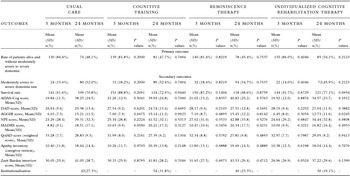
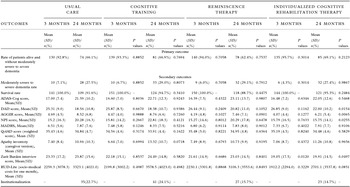
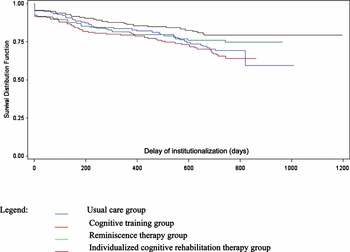
Tables 2 and 3 present the efficacy outcome scores at 3 and 24 months by trial arm. Using the MEF analysis (Table 2) or available data analysis (Table 3), none of the interventions showed superiority to the usual care reference group for the primary outcome, i.e. survival without moderately severe to severe dementia. In the cognitive training or reminiscence therapy groups, none of the secondary efficacy outcomes differed significantly from that measured in the usual care group. The patients who received the individualized cognitive rehabilitation therapy exhibited a lower functional decline at 24 months as measured by the two scales assessing functional abilities: DAD scale (available data analysis, p = 0.01) and AGGIR scale (available data analysis, p = 0.007; MEF analysis, p = 0.02). There was also a trend in favor of this intervention for the NPI score both on the available data (p = 0.03) and MEF analysis (p = 0.08) at 24 months. The score on the Burden Zarit scale rated by caregivers at three months was lower than that of the caregivers involved in the control group (available data, p = 0.01; MEF analysis, p = 0.05). There was still a statistical trend on the available data analysis (p = 0.05) at 24 months. Socio-medical costs related to disease management were compared in the available data only. Although not significant at p = 0.0182, a statistical trend of lower costs (a difference of approximately 600 euros per month with the control group) in the individualized cognitive rehabilitation therapy group compared to control group (p = 0.08) can be seen. At 24 months, the rate of institutionalized patients was lower in the individualized cognitive rehabilitation therapy group than in the control group (27.3% vs. 19.1% respectively in the MEF analysis). Figure 2 displays the Kaplan–Meier curves of institutionalization. As may be seen, the probability of being non-institutionalized was higher in the individualized cognitive rehabilitation therapy group than in the other groups, at any time of follow-up. In addition, Cox regression model showed a significant difference in the delay of institutionalization (MEF analysis, p = 0.01). Compared to the control group, patients having received individualized cognitive rehabilitation entered institution about six months later.
Results of assessments in the three therapy groups during follow-up (3 and 24 months). Missing equals failure analysis (linear or logistic regression models). ETNA3 study

Results of assessments in the three therapy groups during follow-up (3 and 24 months). Analysis on available data (linear or logistic regression models). ETNA3 study

Delay of institutionalization in the four therapy groups (Kaplan–Meier curves).

Discussion
Three main conclusions may be drawn. First, none of the three non-drug interventions applied during a 24-month period delayed the progression to the severe stages of Alzheimer's disease. Second, cognitive training and reminiscence therapy had no impact on secondary efficacy outcomes as compared to usual care. Therefore, even though we cannot rule out the possibility that cognitive training or reminiscence have impact on other clinical measures than that considered in this study, our findings do not provide support for the effectiveness of these two interventions on cognition, functional abilities in daily life activities, behavioral disturbance, quality of life, depression, or caregiver's burden. Third, the greater clinical improvement was seen with the individualized cognitive rehabilitation intervention. The patients showed lower functional decline at the 24-month visit than the other groups, as reflected by the two scales assessing functional abilities. Marginal favorable effects on behavioral disturbance, caregivers’ burden and resource utilization were also observed. In addition, a significant impact on rates of institutionalization was found. With impaired functional abilities (Heyman et al., Reference Heyman, Peterson, Fillenbaum and Pieper1997; Hebert et al., Reference Hebert, Dubois, Wolfson, Chambers and Cohen2001; Wattmo et al., Reference Wattmo, Wallin, Londos and Minthon2011; Gaugler et al., Reference Gaugler, Kane, Kane, Clay and Newcomer2003), psycho-behavioral disorders (Heyman et al., Reference Heyman, Peterson, Fillenbaum and Pieper1997; Hebert et al., Reference Hebert, Dubois, Wolfson, Chambers and Cohen2001; Yaffe et al., Reference Yaffe2002; Gaugler et al., Reference Gaugler, Kane, Kane, Clay and Newcomer2003; Wattmo et al., Reference Wattmo, Wallin, Londos and Minthon2011), and caregivers’ burden (Hebert et al., Reference Hebert, Dubois, Wolfson, Chambers and Cohen2001; Gaugler et al., Reference Gaugler, Kane, Kane, Clay and Newcomer2003) being major predictors of institutionalization, the joint effects observed in these three critical dimensions of the disease may explain the delayed institutionalization of patients who received individualized cognitive rehabilitation intervention of approximately six months.
These results are consistent with those reported by a previous study which involved an individualized approach close to that conducted in the present study (Graff et al., Reference Graff, Vernooj-Dassen, Thijssen, Dekker, Hoefnagels and Rikert2006). The intervention focused on meaningful activities patients and caregivers wanted to improve and consisted of training patients and caregivers in the use of aids to compensate for cognitive difficulties. The results showed improved patients’ daily functioning and reduced caregivers’ burden. However, this study was a monocentric trial on 135 patients only, with an intervention limited to five weeks.
The ETNA3 study has several strengths. It relies on the largest sample (653 patients) with the longest follow-up (two years) to date in the evaluation of non-drug interventions in dementia. The study population is broadly representative of Alzheimer's disease patients followed-up in memory centers and daycare centers. The non-drug therapies relied on semi-structured cognitive-oriented programs administered to patients and caregivers in a multicenter trial with centralized training and monitoring of adherence to the protocol. The assignment of the therapies was randomized per clinical site and per patient and all efficacy outcomes were blindly assessed. The proportion of drop-outs was limited.
Some limitations must be also underlined. In particular, the sample size was slightly lower than that initially targeted which could have contributed to weaken the statistical power of the study. The sample size per condition was too limited to conduct sub-groups analysis in order to identify responders. In addition, the number of sessions attended by the patients was not systematically collected. Finally, regarding the benefits of the individualized cognitive rehabilitation program evidenced in our study, it is difficult to determine whether such benefits are due to the individual format of intervention or the content of intervention itself. The amount of therapist attention received is much greater in a one-on-one intervention than in a group intervention which could be a key point of individualized cognitive rehabilitation programs.
In conclusion, these findings challenge current management practices of Alzheimer's disease patients. While cognitive-oriented group interventions have become very popular, our trial did not evidence improved outcomes in the patients. On the contrary, the individualized cognitive rehabilitation therapy provided modest but clinically significant improvement; in particular, lower functional disability and delayed institutionalization. Therefore, this latter intervention should be considered to delay institutionalization of patients with mild to moderate Alzheimer's disease.
Conflict of interest
None.
Descrpition of authors’ roles
Pr Amieva, Pr Chêne and Pr Dartigues have full access to all the data in the study and take the responsibility for integrity of the data and the accuracy of the data analysis.
Study concept and design: Amieva, Robert, De Rotrou, Andrieu, Berr, Desgranges, Dubois, Girtanner, Joel, Lavallart, Nourashemi, Pasquier, Rainfray, Touchon, Chêne, Dartigues
Analysis and interpretation of data: Amieva, Chêne, Dartigues, Robert
Drafting the manuscript: Amieva
Critical revisions of the manuscript: Robert, Grandoulier, Meillon, De Rotrou, Andrieu, Berr, Desgranges, Dubois, Girtanner, Joel, Lavallart, Nourashemi, Pasquier, Rainfray, Touchon, Chêne, Dartigues
Statistical analysis: Grandoulier, Chêne
Technical and material support: Meillon
Obtained funding: Amieva, Dartigues
Acknowledgments
Funding sources: This study was supported by the French Ministry of Health, Caisse Nationale d’Assurance des Travailleurs Salariés (CNAMTS), Programme Hospitalier de Recherche Clinique (PHRC), Caisse Nationale de Solidarité pour l’Autonomie (CNSA), Fondation Mederic Alzheimer. This work has received no funding from NIH, Welcome Trust, or Howard Hughes Medical Institute.
Role of the sponsors: The sponsors had no role in the study.
Clinical investigators: We thank the following clinical investigators for their help in data collection: Marie-Françoise AHSOUNE, Valéry ANTOINE, Eric ASSEMAT, Frédéric BLANC, François BONNEVAY, Déborah CHEVALIER, Thierry DANTOINE, Jean-François DARTIGUES, François DE LA FOURNIERE, Vincent DE LA SAYETTE, Frédéric DELMAZO, Agnès DEVENDEVILLE, Alain DYAN, Chantal GIRTANNER, Pierre HAOND, Sandrine HARSTON, Claude JEANDEL, Pierre JOUANNY, Jean-Paul LEMBELEMBE, Frédérique LOUIS, Marie-Dominique LUSSIER, Véronique MAILLAND, Bernard-François MICHEL, Jean-Marc MICHEL, Olivier MOREAUD, Claudine NEDELEC-CICERI, Fatemeh NOURHASHEMI, Marie-Pierre PANCRAZI, Brigitte PERRAULT, Maïté RABUS, Anne-Sophie RIGAUD, Alain SAGNIER, Marie SARAZIN, Géraldine SOULIE, François TIBERGHIEN, Jacques TOUCHON, Martine VERCELLETTO, Lisette VOLPE-GILLOT, Luc VOGT.
Supplementary data
Available as supplementary material attached to the electronic version of this paper at www.journals.cambridge.org/10.1017/S1041610215001830.