Introduction
Plesiosauria de Blainville, 1835 is a clade of reptiles that acquired a series of adaptations to the marine environment. Its biochron spans from the Late Triassic to the end of the Cretaceous, and its distribution is cosmopolitan, being recorded from all continents, including Antarctica (Welles Reference Welles1952, Reference Welles1962, del Valle et al. Reference Del Valle, Medina and Gasparini1977, Brown Reference Brown1981, Carpenter Reference Carpenter1999, Kear Reference Kear2003, O'Keefe Reference O'Keefe2004, Sato & Wu Reference Sato and Wu2006, Gasparini et al. Reference Gasparini, Salgado and Parras2007, Ketchum & Benson Reference Ketchum and Benson2010).
In South America, Late Cretaceous plesiosaurs have been known since the mid-nineteenth century, recording both Elasmosauridae (including Aristonectes parvidens Cabrera, Reference Cabrera1941) and Polycotylidae (Gay Reference Gay1848, Gasparini et al. Reference Gasparini, Salgado and Casadío2003a, Reference Gasparini, Bardet, Martin and Fernández2003b, Reference Gasparini, Salgado and Parras2007, Salgado et al. Reference Salgado, Parras and Gasparini2007, Otero et al. Reference Otero, Soto-Acuña and Rubilar-Rogers2010). In turn, members of both families, including A. parvidens (Reference O'GormanO'Gorman in press and bibliography cited therein), have been recorded in the Upper Cretaceous of the Antarctic Peninsula.
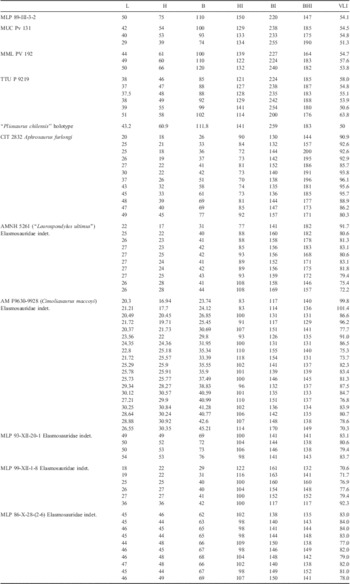
The phylogenetic relationships of A. parvidens are still debated (Gasparini et al. Reference Gasparini, Bardet, Martin and Fernández2003b, O'Keefe & Street Reference O'Keefe and Street2009, Ketchum & Benson Reference Ketchum and Benson2010). In some analyses, A. parvidens is placed within the “Aristonectidae”, separated from the Elasmosauridae (O'Keefe & Street Reference O'Keefe and Street2009), whereas others authors find Aristonectes nested within the Elasmosauridae (Gasparini et al. Reference Gasparini, Bardet, Martin and Fernández2003b, Ketchum & Benson Reference Ketchum and Benson2010). This instability of phylogenetic position is probably due to the particular combination of characters exhibited by A. parvidens and the insufficient knowledge about its postcranial anatomy. Here we follow the systematic relationships hypothesized by Ketchum & Benson (Reference Ketchum and Benson2010) as theirs is the most comprehensive analysis, however, the revision of the systematic relationships of A. parvidens is not the aim of this work. The Upper Cretaceous record of Patagonian and Antarctic plesiosaurs is dominated by postcranial material, specifically isolated vertebrae (Gasparini et al. Reference Gasparini, Bardet, Martin and Fernández2003b, Salgado et al. Reference Salgado, Parras and Gasparini2007, O'Gorman et al. Reference O'Gorman, Salgado and Gasparini2011). Among the vertebral cervical morphologies recorded in the Upper Cretaceous of South America, there is one characterized by the absence of neuro-central closure and extremely short vertebral centrum, a morphology that has been traditionally associated with the juvenile stage (Brown Reference Brown1981, O'Keefe & Hiller Reference O'Keefe and Hiller2006). In some cases, the articular faces of this type of vertebrae are “dumbbell-shaped”, suggesting a relationship with the Elasmosauridae. In spite of the suggested similarity of this type of cervical vertebra with those of juvenile specimens of some elasmosaurs, their large size is remarkable (Table I, first five specimens). Likewise, the ratio between centrum breadth and length (B/L) is unusual because the ratio is high compared with that observed in juvenile elasmosaurs (Gay Reference Gay1848, Gasparini et al. Reference Gasparini, Salgado and Casadío2003a, Reference Gasparini, Salgado and Parras2007). Although this type of vertebra is relatively common in the upper Campanian–Maastrichtian plesiosaur records of southern South America (Argentina and Chile) and the Antarctic Peninsula, its systematic identity is not clear, mostly because such vertebrae are generally found as isolated elements. Moreover, the juvenile condition prevents their comparison with adult specimens because the morphological ontogenetic variation is not well known, making it difficult to determine their affinities (Gasparini et al. Reference Gasparini, Salgado and Casadío2003a, Reference Gasparini, Salgado and Parras2007). However, a similar morphology (large cervical centra relatively short with dumbbell-shaped articular faces and B/L ratio extremely high) is recorded in the cervical centra of a juvenile specimen that preserves cranial material (TTU P 9219, see institutional abbreviations below), currently referred to A. parvidens (Chatterjee & Small Reference Chatterjee and Small1989, Gasparini et al. Reference Gasparini, Bardet, Martin and Fernández2003b). Chatterjee & Small (Reference Chatterjee and Small1989) proposed that a high B/L ratio (> 2), as in TTU P 9219, has systematic value. This probably is related to the short cervical vertebrae (average vertebral length index (VLI) = 80) recorded in the holotype of A. parvidens (MLP 40-XI-14-6), an adult specimen, and, therefore, could be a feature of systematic value even in juveniles specimens. However, the hypothesis of Chatterjee & Small (Reference Chatterjee and Small1989) has not been tested. Indeed, it is necessary to determine whether the proportions observed in this type of cervical vertebrae have in fact a systematic value, or whether they are merely related to the juvenile condition of the specimens. In support of the last option, the cervical centra of juvenile plesiosauroids are usually shorter than in adults (and therefore the ratio B/L (breadth/length) and H/L (height/length) of juveniles is higher than in adults) (Brown Reference Brown1981, O'Keefe & Hiller Reference O'Keefe and Hiller2006). The description of MLP 89-III-3-2 (see institutional abbreviations below), a juvenile specimen with the referred cervical morphology, provides an opportunity to test the above-mentioned hypothesis. In addition, MLP 89-III-3-2 provides new information about the anatomy of Aristonectes, because it preserves other postcranial elements associated with the cervical vertebrae and, obviously, the description of a juvenile specimen provides information about the ontogenetic variation.
Measurements of vertebral centra of the specimens described in this paper and those used in the analysis (in mm). L = length, H = height, B = breadth, HI = 100*H/L, BI = 100*B/L, BHI = 100*B/H, VLI = 100*L/(0.5*(H+B)) (Data taken from Gay 1848, Brown Reference Brown1913, Welles Reference Welles1943, Reference Welles1962, Persson Reference Persson1960, O'Gorman personal observation).

The goals of this paper are: a) to describe the specimen MLP 89-III-3-2, a juvenile of A. cf. parvidens collected in the 1989 Antarctic fieldtrip by B. Zinsmeister (Purdue University, USA), M. Reguero and A. Carlini (Museo de La Plata, Argentina), b) to redescribe two juvenile specimens from Patagonia, Argentina, previously described by Gasparini et al. (Reference Gasparini, Salgado and Casadío2003a), and c) to compare their cervical morphology with those of juvenile specimens of A. parvidens and other Elasmosauridae, and therefore, to determine if juvenile specimens of Aristonectes can be identified only on the basis of the proportions of their cervical vertebrae. The systematics and historical implications of referring MLP 89-III-3-2, MUC Pv 131, MML PV 192 (see institutional abbreviations below) to A. cf. parvidens are also discussed.
Geological setting
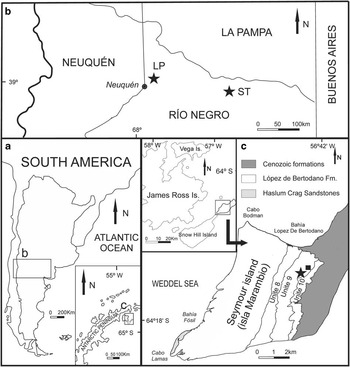
Two major Cretaceous units are recorded in the James Ross Basin, Antarctic Peninsula (Fig. 1a & c): the Gustav Group (Barremian–upper Coniacian), and the Marambio Group (upper Coniacian–Danian (Macellari Reference Macellari1988, Crame et al. Reference Crame, Francis, Cantrill and Pirrie2004) or Santonian–Danian (Olivero & Medina Reference Olivero and Medina2000)). Following Olivero (Reference Olivero2012), the Marambio Group is formed by the Santa Marta, Rabot, Snow Hill Island, Haslum Crag, and López de Bertodano formations.
Localities where Aristonectes cf. parvidens specimens were collected. a. General location. b. North Patagonia, LP = Lago Pellegrini, ST = Salina de Trapalcó. c. Archipelago James Ross, Isla Marambio. ★= MLP 89-III-3-2, MUC Pv 131 and MML PV 192, ▪ = TTU P 9219 (Aristonectes parvidens) (modified from Chatterjee & Small Reference Chatterjee and Small1989, Gasparini et al. Reference Gasparini, Salgado and Parras2007).

The López de Bertodano Formation consists of 1190 m of sandy shales and sandstones with interbedded fine concretions and subordinate carbonate facies (Macellari Reference Macellari1988). It has been divided into two informal units of approximately equal thickness. The lower unit (“rotularia units”) was deposited in a shallow marine environment near an estuary (Macellari Reference Macellari1988, Olivero Reference Olivero2012), whereas the upper unit (“molluscan units”) was deposited in a mid- to outer platform setting (Macellari Reference Macellari1988). The López de Bertodano Formation was deposited during the late Maastrichtian–Danian interval (Macellari Reference Macellari1988, Olivero & Medina Reference Olivero and Medina2000, Crame et al. Reference Crame, Francis, Cantrill and Pirrie2004). The Maastrichtian-Danian boundary lies approximately between the informal units “klb 9” (where the MLP 89-III-3-1 was collected), and “klb10” (top of the “molluscan units”) (Olivero Reference Olivero2012).
The Allen Formation, where MUC Pv 131 was collected, crops out in the north of Patagonia (Fig. 1a & b) (Río Negro, La Pampa and Neuquén provinces). This formation is a thick succession of sandstones and shales with interbedded carbonate and evaporite rocks in its upper section (Andreis et al. Reference Andreis, Iñiguez Rodríguez, Lluch and Sabio1974). The Allen Formation was deposited in a marginal marine environment (Barrio Reference Barrio1990). Based on foraminifera and magnetostratigraphy, the Allen Formation is late Campanian–early Maastrichtian in age (Ballent Reference Ballent1980, Dingus et al. Reference Dingus, Clarke, Scott, Swisher, Chiappe and Coria2000).
The Jagüel Formation crops out in the north of Patagonia (Fig. 1a & b) (Río Negro, La Pampa and Neuquén provinces). It is a thick sequence of mudstones interbedded with carbonates deposited in an inner to middle platform. The levels that crop out in the area of Salina de Trapalcó, where the MML PV 192 was collected, were deposited during the late Maastrichtian (Gasparini et al. Reference Gasparini, Salgado and Parras2007).
Methods
The material was prepared using Micro Jack and ME 9100 jackhammers. Linear measurements were taken using an electronic caliper. The indices used in the description are those proposed by Welles (Reference Welles1952), which take into account the proportions of the vertebral centrum, specifically the height length ratio (HI = 100*H/L) and the breadth length ratio (BI = 100*B/L). Here the breadth/height ratio (BHI = 100*B/H) is also considered. Both width and height were measured on the posterior articular face. Also, the rate of vertebral elongation, VLI (VLI = 100*L/(0.5*(H + B)), was used (Brown Reference Brown1981).
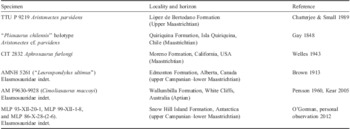
Bivariate graphics which allow making comparisons of the vertebral proportions independently from the position in the sequence were used. The ontogenetic categories proposed by Brown (Reference Brown1981), which are based on the fusion of the neural arch to the vertebral centrum, were also considered. Locality and horizon of the specimens used as comparative materials are given in Table II.
Specimens considered in the analysis (for Antarctic stratigraphy see Olivero Reference Olivero2012).

Institutional abbreviations
AM = Australian Museum, Sydney, Australia; AMNH =American Museum Natural History, New York, USA; CIT = California Institute of Technology, California, USA; MLP = Museo de La Plata, Buenos Aires Province, Argentina; MML = Museo Municipal de Lamarque, Río Negro province, Argentina; MUC = Museo de la Universidad del Comahue, Neuquén Province, Argentina; TTU = Museum of Texas Tech University, Texas, USA.
Anatomical abbreviations
ap = anterior process, cf = coracoid facet, cfe = cordiform fenestra, cv = cervical vertebra, dc = distal carpal, dv = dorsal vertebra, fo = foramen, gf = glenoid facet, in = intermedium, lc = left coracoid, mvp = mid ventral process, na = neural arch, ns = neural spine, pa = parapophyses, pf = pedicelar facet, pv = pectoral vertebra, r = radio, rc = right coracoid, ra = radial, ri = rib, sc = scapula, sf = scapular facet, u = ulna, ue = ulnare, vf = ventral foramen, vn = ventral notch.
Systematic palaeontology
SAUROPTERYGIA Owen, 1860
PLESIOSAURIA de Blainville, 1835
PLESIOSAUROIDEA Welles, Reference Welles1943
ELASMOSAURIDAE Cope, 1869 (sensu Ketchum & Benson Reference Ketchum and Benson2010)
Aristonectes Cabrera, Reference Cabrera1941
Type and only species. Aristonectes parvidens Cabrera, Reference Cabrera1941
Aristonectes cf. parvidens
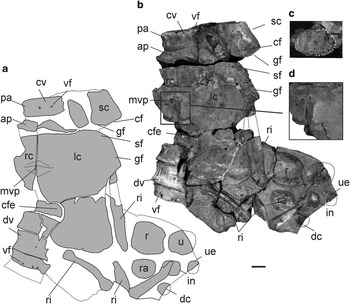
Aristonectes cf. parvidens, MLP 89-III-3-2. Partial postcranial skeleton in ventral view. a. Interpretative drawing, b. photograph, c. first pre-pectoral vertebra in anterior view, and d. detail of the mid-ventral process. Scale bar equals 40 mm.

Referred material: MLP 89-III-3-2, first pre-pectoral vertebra, three pectoral vertebrae, four dorsal vertebrae, left and right coracoid, proximal portion of the left scapula, radius, ulna, radiale, intermedium, ulnare, distal carpal I, ribs. MUC Pv 131, four cervical vertebrae, two dorsal vertebrae, a fragment of scapula?, tarsal or carpal element and four phalanges. MML PV 192, three cervical vertebrae.
Locality and horizon: MLP 89-III-3-2, Isla Marambio (64°13′26.4′′S, 56°43′18.3′′W). López de Bertodano Formation (“molluscan units”), unit “klb 9”. Pachydiscus ultimus Biozone, upper Maastrichtian (Macellari Reference Macellari1988, Olivero & Medina Reference Olivero and Medina2000) (Fig. 1c).
MUC Pv 131, Contralmirante Cordero (38°46′42′′S, 68°04′85′′W), Río Negro province, Argentina. Middle Member of the Allen Formation, upper Campanian–lower Maastrichtian (Ballent Reference Ballent1980, Dingus et al. Reference Dingus, Clarke, Scott, Swisher, Chiappe and Coria2000) (Fig. 1b).
MML PV 192, Salinas de Trapalcó, Río Negro province, Argentina. The precise stratigraphical level is unknown, however, in the area where MML PV 192 was collected, only the Allen (upper Campanian–lower Maastrichtian) and Jagüel (upper Maastrichtian–Danian) formations are exposed (Ballent Reference Ballent1980, Dingus et al. Reference Dingus, Clarke, Scott, Swisher, Chiappe and Coria2000, Gasparini et al. Reference Gasparini, Salgado and Parras2007) (Fig. 1b).
Ontogenetic stage: The specimens MLP 89-III-3-2, MUC Pv 131 and MML PV 192 show characters traditionally associated with the juvenile stage (Brown Reference Brown1981, Carpenter Reference Carpenter1999), such as the absence of neuro-central closure in all preserved vertebrae, poor differentiation of the scapular and glenoid facets of the coracoids, and coracoid and glenoid facets of the scapula, as well as the lack of differentiation of articular faces of radius, ulna and carpal elements (Figs 2–4).
Description of MLP 89-III-3-2 (Figs 2 & 3)
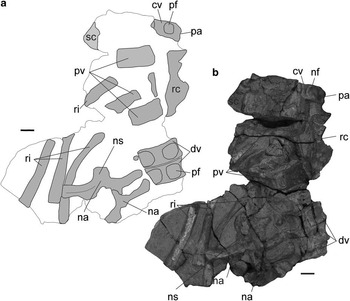
Axial skeleton: The specimen MLP 89-III-3-2 was articulated, with its ventral side up (Fig. 2). Only one cervical vertebra is preserved and because of its morphology and position in the vertebral sequence, is identified as the first pre-pectoral vertebra (Figs 2 & 3). The centrum of this vertebra is higher than long and broader than high (Table I). The pedicelar facets are elliptical, large and slightly depressed. The articular faces are subelliptical with a dorsal notch associated with the neural canal, but without a ventral notch (Fig. 2c). The parapophyses are subelliptical with their major axes posteroventrally directed. This is the typical morphology of the posterior cervical rib facet, where the parapophysis progressively is located more to the lateral side of the vertebral centrum (Welles Reference Welles1943, Reference Welles1952). On the ventral surface there are two foramina separated by a broad blunt keel (31 mm transverse length) (Fig. 2a & b).
The pectoral vertebrae are poorly preserved, and therefore a description would not add relevant information (Fig. 3). Two possibly pectoral neural arches are preserved, but they are displaced from their original position. The neural arches have very robust pedicels, and the diapophyses are subcircular in cross-section and slightly curved dorsally (Fig. 3). The prezygapophyses are paired (Fig. 3).
Four dorsal vertebrae are preserved. The vertebral centra are higher than long and broader than high. The articular faces are elliptical and the pedicelar facets are large, somewhat displaced anteriorly and slightly depressed (Fig. 3). The lateral surfaces of the vertebral centrum are weakly concave anteroposteriorly (Fig. 2). Although the ventral surface is not well preserved, more than two (up to six) foramina can be seen (Fig. 2). The dorsal ribs are robust and circular in cross-section.
Aristonectes cf. parvidens, MLP 89-III-3-2. Partial postcranial skeleton in dorsal view. a. Interpretative drawing, and b. photograph. Scale bar equals 40 mm.

Pectoral girdle: Both coracoids are preserved in articulation (Fig. 2), with the ventral surface totally exposed. The coracoid has a posterior ramus that limits the cordiform fenestra (Fig. 2), which is a typical character of elasmosaurids (Welles Reference Welles1943, Reference Welles1952, Reference Welles1962, Carpenter Reference Carpenter1999, Hiller et al. Reference Hiller, Mannering, Jones and Cruickshank2005). The anterior margin of the coracoid is concave and medially has a short, blunt anterior process (Fig. 2). The scapular and glenoid facets are not well differentiated but, nevertheless, the zone of the scapular facet has well marked mounds and depressions, so presumably it was covered by a thick cartilage. The lateral margin of the posterior process is concave (Fig. 2). Posteriorly, the distal end is laterally and medially expanded, with a larger medial expansion (Fig. 2). The medial margin is strongly concave and limits the cordiform fenestra, which is small and typically heart-shaped (Fig. 2). The inter-coracoid articulation is about half of the coracoid total length (Fig. 2). On the ventral surface of the coracoids, a mid-ventral process is located in the medial margin (Fig. 2d).
Forelimbs: The preserved limb is interpreted as a forearm because of its relative position among the skeletal remains (Fig. 2). The radius and ulna lack well-defined articular faces. They differ in size, with the larger element identified as the radius (Fig. 2). Furthermore, both elements are slightly wider than long and form an epipodial foramen that is little longer than wide (Fig. 2). The preserved proximal elements do not have defined articular faces (Fig. 2). The only preserved distal element is poorly preserved, so its shape cannot be determined.
Description of MUC Pv 131 (Fig. 4)
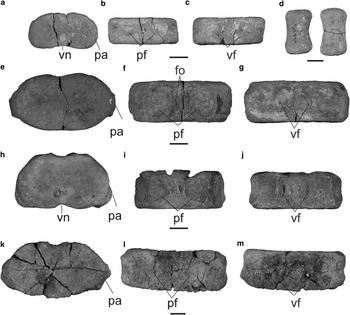
Axial skeleton: Three of the four preserved cervical centra were previously described as caudals (Gasparini et al. Reference Gasparini, Salgado and Parras2007), but, by comparison with the MLP 89-III-3-2, they are here considered as posterior cervicals. The four cervical centra are higher than long and broader than high. The pedicelar facets are large and subcircular (Fig. 4b & f). The floor of the neural canal is wide and has two foramina (Fig. 4f). The articular faces are slightly depressed and dumbbell-shaped in the two smaller centra, and elliptical in the other two centra (Fig. 4a & e). The parapophyses are subcircular and posteroventraly directed. On the ventral surface there are two foramina in the three smaller centra (Fig. 4c & g), and four foramina (two main and two accessory) in the larger one.
The two dorsal centra are higher than long and broader than high. The pedicelar facets are subtriangular, possibly related with the position of the vertebrae in the dorsal sequence. The lateral surfaces are slightly concave anteroposteriorly. Ventrally there are four foramina (two main and two accessories) in the centrum of one vertebra and seven in the other centrum.
Appendicular skeleton: One preserved element may be the glenoid ramus of the scapula, but its state of preservation does not allow a better description. The carpal/tarsal element is square with rounded edges (47 x 44 mm). Four phalanges are preserved, two larger (52 mm and 55 mm), more robust and quadrangular in cross-section, while the other two are smaller (52 mm and 48 mm), more slender and subcircular in cross-section (Fig. 4d).
Description of MML PV 192 (Fig. 4)
Axial skeleton: The three cervical vertebrae preserved, two small and one large, were described by Gasparini et al. (Reference Gasparini, Salgado and Parras2007) and referred as Plesiosauria indet. All the centra are higher than long and broader than high. The pedicelar facets are elliptical and depressed. In the floor of the neural canal there are two foramina (Fig. 4i). The articular faces are slightly concave. The two smaller centra are dumbbell-shaped while the larger centrum has elliptical articular faces (Fig. 4h & k). The parapophyses are ventrolateral in the smaller centra but lateral in the largest one (Fig. 4h & k). On the ventral surface there are two foramina (Fig. 4j & m).
Discussion and conclusions
The ontogenetic variation reported in plesiosaurs (Brown Reference Brown1981, Carpenter Reference Carpenter1999) makes the systematic identification of juvenile specimens difficult. Therefore, several characters shared by the cervical vertebrae (such as height BI index values and large and depressed pedicelar facets) could either be related to their juvenile condition or they could be of systematic significance. In order to resolve this point, first the family to which this vertebral morphology can be referred is determined, and second the systematic value of the features described herein are tested in comparison with juvenile specimens of other members of the same family.
The cervical morphology of MLP 89-III-3-2, MUC Pv 131, and MML PV 192 is not consistent with the morphology recorded in polycotylids, because the cervical vertebrae have slightly concave subelliptical or dumbbell-shaped articular faces (Fig. 2c, Fig. 4a, e, h & k) unlike polycotylids, in which the articular faces are subcircular and strongly concave (Salgado et al. Reference Salgado, Parras and Gasparini2007 and bibliography cited therein). In addition, the coracoid of MLP 89-III-3-2 has a well developed cordiform fenestra (Fig. 2), unlike the plate-like coracoid recorded in polycotylids (O'Keefe Reference O'Keefe2004).
Aristonectes cf. parvidens cervical vertebrae. a.–g. MUC Pv 131. a.–c. Anterior cervical vertebra in a. anterior, b. dorsal, and c. ventral views; d. falanges; e.–g. posterior vertebra in e. anterior, f. dorsal, and g. ventral views. h.–m. MML PV 192. h.–j. Anterior cervical vertebra in h. anterior, i. dorsal, and j. ventral views; k.–m. posterior cervical vertebra in k. anterior, i. dorsal, and m. ventral views. Scale bars equal 20 mm.

MLP 89-III-3-2, MUC Pv 131, and MML PV 192 share with the elasmosaurids dumbbell-shaped articular faces. This raises the possibility of referring the studied specimens to Elasmosauridae indet. or to A. parvidens, an Elasmosauridae with distinctively short cervical vertebrae. However, because the specimens here described are juveniles, their vertebral proportions cannot be compared directly with those of adult specimens, in view of the variation that characterizes the plesiosaur ontogeny (Brown Reference Brown1981, O'Keefe & Hiller Reference O'Keefe and Hiller2006). Consequently, the proportions of the cervical vertebrae of MLP 89-III-3-2, MUC Pv 131, and MML PV 192 are compared to those of juvenile specimens of elasmosaurs, and with a juvenile specimen of A. parvidens. An important number of juvenile elasmosaurs have been recorded from the Upper Cretaceous of North America (Welles Reference Welles1943, Reference Welles1952, Sato & Wu Reference Sato and Wu2006), several of which have been described and the measurements of the cervical vertebrae are available in the literature (Tables I & II). They were used for comparative purposes as well as three juvenile specimens of elasmosaurs from Antarctica recently prepared (MLP 93-XII-20-1, MLP 99-XII-1-5, and MLP 86-X-28-(2-6)), and a juvenile specimen of Aristonectes (TTU P 9219) collected in the upper Maastrichtian López de Bertodano Formation, which has the cranium and part of the cervical region preserved (Chatterjee & Small Reference Chatterjee and Small1989, Gasparini et al. Reference Gasparini, Bardet, Martin and Fernández2003b). For comparison of the vertebral proportions, bivariate graphs HI-BI, VLI-BI and B-BI were used.
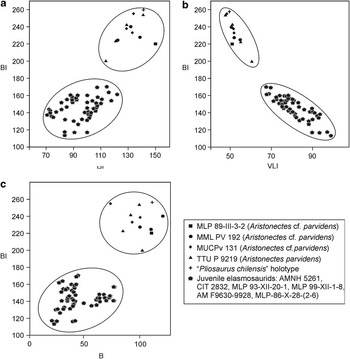
In the HI-BI graph (Fig. 5a), the cervical vertebrae of MLP 89-III-3-2, MUC Pv 131, and MML PV 192 are grouped with those of the TTU P 9219, referred to A. parvidens, and are separated from those of other juvenile elasmosaurs. In the BI-VLI graph (Fig. 5b), a similar clustering is observed, and the VLI of the cervical vertebrae of MLP 89-III-3-2, MUC Pv 131, and MML PV 192 are lower than the VLI of the juvenile elasmosaurs. Finally, the BI-B graph (Fig. 5c) is also consistent with the clusters, and also shows that the cervical vertebrae of MLP 89-III-3-2, MUC Pv 131, and MML PV 192 are broader in absolute terms than those of juvenile elasmosaurs.
Bivariate diagrams of cervical centrum values of juveniles of Aristonectes cf. parvidens and other elasmosaurs. a. HI-BI, b. VLI-BI, and c. B-BI.

In summary, the cervical centra of MLP 89-III-3-2, MUC Pv 131 and MML-PV 192 have HI, BI and VLI values more similar to those recorded in the juveniles of A. parvidens than those recorded in juvenile specimens of other elasmosaurs. The TTU 9219 P cervical vertebrae have dumbbell-shaped articular faces, while some vertebrae described in this paper have subelliptical articular faces. This difference could be explained by the position in the cervical series because the vertebrae with elliptical articular faces could belong to the posterior part of the cervical region, where in some elasmosaurs, the ventral notch of the articular face is absent (Welles Reference Welles1943, Reference Welles1952). Both in MML PV 192 and MUC Pv 131 the cervical centra with dumbbell-shaped articular faces are the smallest of each specimen, and therefore they are more anterior than the other centra. In MLP 89-III-3-2, the only cervical vertebra preserved is the posteriormost and, consistent with the above-mentioned, the articular faces are not dumbbell-shaped. Thus, the shape of the articular faces is not inconsistent with the reference of MLP 89-III-3-2, MUC Pv 131, and MML PV 192 to A. cf. parvidens. The specimen TTU P 9219 has five cervical centra preserved. The four anteriormost have a blunt lateral ridge which is absent in the posteriormost one. Therefore, the absence of lateral ridge in the specimens MLP 89-III-3-2, MUC Pv 131, and MML PV 192, referred to A. cf. parvidens, is not inconsistent with this assignment. The reference of MLP 89-III-3-2, MUC Pv 131 and MML PV 192 to A. cf. parvidens is also consistent with the morphology of the adult cervical vertebrae of the same genus because, as was said in the introduction, the holotype of A. parvidens (MLP 40-XI-14-6, adult specimen) has relatively short cervical vertebrae compared with other elasmosaurs, and therefore, they have a low average VLI (80), but higher than that of the cervical vertebrae of TTU P 9219, MLP 89-III-3-2, MUC Pv 131 and MML PV 192 (Chatterjee & Small Reference Chatterjee and Small1989, Gasparini et al. Reference Gasparini, Bardet, Martin and Fernández2003b). However, this difference could be explained by ontogenetic changes of the centrum proportions (Brown Reference Brown1981, O'Keefe & Hiller Reference O'Keefe and Hiller2006).
The dorsal vertebrae of MLP 89-III-3-2 and MUC Pv 131 are similar to each other, however, they cannot be compared with specimens previously referred to A. parvidens because neither the holotype of A. parvidens nor the specimen TTU P 9219 preserved dorsal vertebrae.
The presence of broad and depressed pedicelar facets with a smooth surface is shared by the specimens described here and TTU P 9219, but it is also present in AMNH 5261, an Elasmosauridae indet. (Sato & Wu Reference Sato and Wu2006), therefore, this character is probably related to a juvenile stage, or at least, it is not useful to differentiate juvenile specimens referred to A. cf. parvidens from other elasmosaurids.
Reference of the specimens MLP 89-III-3-2, MUC Pv 131, and MML PV 192 to A. cf. parvidens improves our knowledge of the postcranial anatomy of this plesiosaur because the coracoid morphology of Aristonectes is here described for the first time. The presence of a coracoid with a cordiform fenestra is considered a synapomorphy of the Elasmosauridae (Ketchum & Benson Reference Ketchum and Benson2010, Ch 149 state 1). Thus, the new information about the morphology of the pectoral girdle of Aristonectes supports the inclusion of this genus in the Elasmosauridae, as was recovered in the phylogenetic analyses of Gasparini et al. (Reference Gasparini, Bardet, Martin and Fernández2003b) and Ketchum & Benson (Reference Ketchum and Benson2010). The presence of a short posterior process relative to the total coracoid length may be related to the juvenile stage (Carpenter Reference Carpenter1999), and is not necessarily significant from a systematic point of view. The coracoid morphology referred in this paper to Aristonectes cannot be compared with that of the “Aristonectidae” (sensu O'Keefe & Street Reference O'Keefe and Street2009), because it is unknown. Even in Tatenectes laramiensis Knight, 1900 (Oxfordian) (an “Aristonectidae” sensu O'Keefe & Street Reference O'Keefe and Street2009), which has the coracoid present, the posterior end is not well preserved. The coracoid of T. laramiensis does not have a mid ventral process, as is observed in MLP 89-III-3-2, but it has a strong convexity on the ventral surface in a similar position (O'Keefe & Street Reference O'Keefe and Street2009).
Another consequence of referring the specimen MUC Pv 131 to A. cf. parvidens relates to its previous systematic identification. This specimen had been referred to Tuarangisaurus? sp. (Gasparini et al. Reference Gasparini, Salgado and Casadío2003a) because it shares features with the holotype of Tuarangisaurus? cabazai Gasparini, Salgado & Casadío, 2003. The new results highlight the need to review Tuarangisaurus? cabazai.
The cervical vertebral morphology referred in this paper to A. cf. parvidens has been recorded in Chilean plesiosaurs since the mid-nineteenth century. The first record of plesiosaurs from Chile, described by Gay (Reference Gay1848), comes from the Quiriquina Formation. Based on these materials Gay (Reference Gay1848) erected Plesiosaurus chilensis, (after Pliosaurus chilensis) currently considered a nomen vanum (Welles Reference Welles1962). Among the material figured by Gay (Reference Gay1848 Lam I, 1–3) there is a cervical centrum with a morphology and proportions the same as those referred in this paper to A. cf. parvidens (Fig. 5a–c). Therefore, the first record of plesiosaurs in South America is now referable to A. cf. parvidens.
Interestingly, the new record of Aristonectes comes from the same levels as TTU P 9219, so it is the second juvenile referred to Aristonectes collected in this level. Finally, it is noteworthy that the new results increase to nine the number of records of Aristonectes: three from Patagonia Argentina (Cabrera Reference Cabrera1941, this work), three from Chile (Gay Reference Gay1848, Casamiquela Reference Casamiquela1969, Suárez & Fritis Reference Suárez and Fritis2002), and three from Antarctica (Chatterjee & Small Reference Chatterjee and Small1989, this work, O'Gorman personal observation). Therefore, Aristonectes is the most recorded plesiosaur genus from the Upper Cretaceous of South America and Antarctica, and among the most frequently encountered genera from the Southern Hemisphere together with Mauisaurus, an Elasmosauridae from New Zealand, Antarctica and Chile (Hiller et al. Reference Hiller, Mannering, Jones and Cruickshank2005, Otero et al. Reference Otero, Soto-Acuña and Rubilar-Rogers2010).
Acknowledgements
This research was supported by projects PICT 2008-0261 and PICT 0365/2007. The authors thank E. Olivero (CADIC, IAA), M. Reguero, J. Moly (La Plata Museum) and B. Zinsmeister (Purdue University) for the Antarctic fieldwork. This contribution would have not been possible without the logistic support from the Instituto Antártico Argentino (Buenos Aires), as well as from the Fuerza Aérea Argentina. The authors thank the curator that allowed the revision of the materials used for comparison, M. Reguero (Museo de La Plata), D. Rubilar (Museo Nacional de Historia Natural de Chile), D. Cabaza (Museo Municipal de Lamarque), N. Cerda (Museo de Cinco Saltos). Thanks to L. Acosta Burllaile for the preparation of some elements, Bruno Pianzola for taking the photographs, and C. Deschamps and Y. Herrera, from the Museo de La Plata for improving the English version. The authors are grateful too for the comments of the reviewers, N. Hilller (University of Canterbury) and J. Case (Eastern Washington University), and the editor (A. Vaughan), which have improved this manuscript.