Introduction
Delirium is a syndrome manifesting as sudden and acute change in mental status characterized by disturbances in consciousness, attention, and cognition. It develops over a short period of time with the characteristic of fluctuating symptomatology (American Psychiatric Association, 2013).
The importance of delirium in clinical settings is highlighted by its substantial prevalence, ranging from 6% to 60% in general hospital populations in medical, surgical, mixed, and general wards (Inouye, Reference Inouye1998; Fried et al., Reference Fried, Walston and Hazzard2003; Cole et al., Reference Cole, McCusker and Ciampi2008; Meagher et al., Reference Meagher, Leonard and Donnelly2012; Inouye et al., Reference Inouye, Westendorp and Saczynski2014). Furthermore, prevalence rates have been shown to reach 50% in elderly patients (Inouye et al., Reference Inouye, Westendorp and Saczynski2014) and up to 87% in patients managed in intensive care units (ICUs; Pisani et al., Reference Pisani, McNicoll and Inouye2003; Inouye et al., Reference Inouye, Westendorp and Saczynski2014). Delirium in elderly people has been associated with poor outcome, an increased risk of morbidity, and followed by individual loss of independence and additional healthcare costs (Leentjens and van der Mast, Reference Leentjens and van der Mast2005), independently of relevant confounders such as age, comorbid illness, and baseline dementia (Witlox et al., Reference Witlox, Eurelings and de Jonghe2010), reflecting individual vulnerability, comorbidities, different etiologies, and medical treatments (Gupta et al., Reference Gupta, de Jonghe and Schieveld2008).
A Swiss University Hospital-based multi-professional project (DelirPath) was initiated to develop and implement standardized management guidelines as well as to evaluate monitoring systems for delirium incident rates (Schubert et al., Reference Schubert, Schurch and Boettger2018). Part of this initiative was the electronic Patient Assessment — Acute Care (ePA-AC) (Hunstein et al., Reference Hunstein, Sippel and Rode2012), a multi-axial routine examination of somatic and functional parameters including relevant delirium risk factors performed in all patients. The items included in this assessment have the potential for screening delirium in all patients irrespective of the managing service, medical, surgical, or intensive care.
This prospective case–control study following the assessment of the functional parameters (Bode et al., Reference Bode, Isler and Fuchs2020) investigates the potential use of the ePA-AC as the routine assessment to identify delirium risk factors and possible delirium risk constellations. The integration of validated continuous delirium assessment tools into clinical practice may improve patient care in the critically ill.
Methods
Patients and procedures
In this prospective cohort study in a 12-bed ICU, serving primarily cardiovascular–surgical patients, assessments were conducted at the University Hospital Zurich between May 1st, 2013 and April 30th, 2015. Inclusion criteria were age >18 years and staying for more than 18 h on the ICU. Exclusion criteria were alcohol, drug, or medication-use disorders. All patients gave informed consent. On behalf of those subjects who were unable to provide written consent at the time of the assessment, proxy assent from the next relative or a responsible caregiver was obtained and then retrospectively confirmed by the patient. Those who refused to participate — including refusal after the assessment — were excluded. The study was approved by the ethics committee of the Canton Zurich, Switzerland (KEK-ZH-Nr: 2012-0263).
In total, 277 patients were included, of which 118 were delirious and 159 were non-delirious. The patients were assessed by interview in terms of sociodemographic, medical, and psychiatric variables. A diagnosis of delirium was made by experienced psychiatrists according to at that time valid DSM-IV-TR criteria (American Psychiatric Association, 2000). All available sources were used to retrieve information, including information from nursing and medical–surgical staff, the electronic medical record system (Klinikinformationssystem, KISIM, CisTec AG, Zurich), and family/caregivers.
Measurements
The DSM-IV-TR (American Psychiatric Association, 2000) was the standard for diagnosing delirium at the time based on the following criteria: (A) disturbance of consciousness, with reduced ability to focus, sustain, or shift attention; (B) altered cognition (memory, orientation, and language disturbance) or the development of a perceptual disturbance (delusion or hallucination or illusion) that is not better accounted for by pre-existing dementia; (C) the disturbance develops over hours or days and tends to fluctuate during the course of the day; and (D) evidence of an etiological cause.
The electronic Patient Assessment – Acute Care
The electronic Patient Assessment- Acute Care (ePA-AC) (Hunstein et al., Reference Hunstein, Sippel and Rode2012) is a nursing instrument used on a daily basis measuring patient's abilities and impairments. This instrument includes 49 items grouped across 10 specific domains.
The domains describe (2) activity, (3) grooming and dressing, (4) nutrition, (5) elimination, (6) cognition and consciousness, (7) communication and interaction, (8) sleep, (9) respiration, (10) pain, and (11) wounds. Items are either rated on binary scales (from either 0 — absent to 1 — present), or on numeric scales (from 1 to 4, most commonly representing 1 — no ability, 2 — substantial impairment, 3 — mild impairment, and 4 — full ability, or for consciousness: 1 — comatose, 2 — soporose, 3 — somnolent, and 4 — awake and alert, or for orientation: 1 — no quality, 2 — single quality, 3 — two qualities, and 4 — fully oriented). For most items, the inability to assess is coded as 9.
Statistical methods
The statistical procedures were previously described in a paper evaluating the functional domains of the ePA-AC (Bode et al., Reference Bode, Isler and Fuchs2020) using the Statistical Package for Social Sciences (SPSS) version 25. Sociodemographic and clinical variables are described with means and standard deviations or medians and interquartile ranges, depending on parametric properties, as well as percentages for categorical variables. For categorical variables, intergroup comparisons between delirious and non-delirious patients were determined with Pearson's χ2 or Fisher's exact test depending on the sample size. Subsequently, simple logistic regressions were computed to determine effect sizes expressed as the respective odd ratio (OR) with 95% confidence interval (CI).
All tests were two-tailed and the significance level was set at 0.05.
Results
Consciousness and cognition
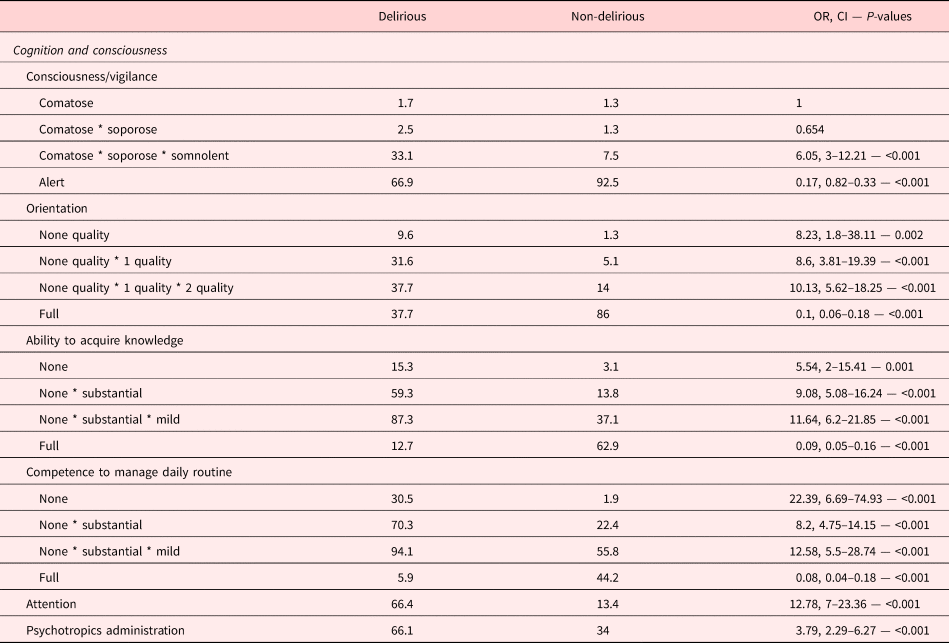
This domain comprises consciousness or vigilance, orientation, the ability to acquire knowledge, the competence to manage daily routine, attention in general, and the administration of psychotropic substances. Except for two disturbances in consciousness, coma and sopor, all other areas were affected by delirium (Tables 1 and 2). Concerning consciousness, the delirious patients were more often somnolent (OR 6) and less often awake and alert (OR 0.17).
Cognitive domains of the ePA-AC in delirious intensive care patients

OR, odds ratio; CI, confidence interval.
P Pearson's χ2 or Fisher's exact test.
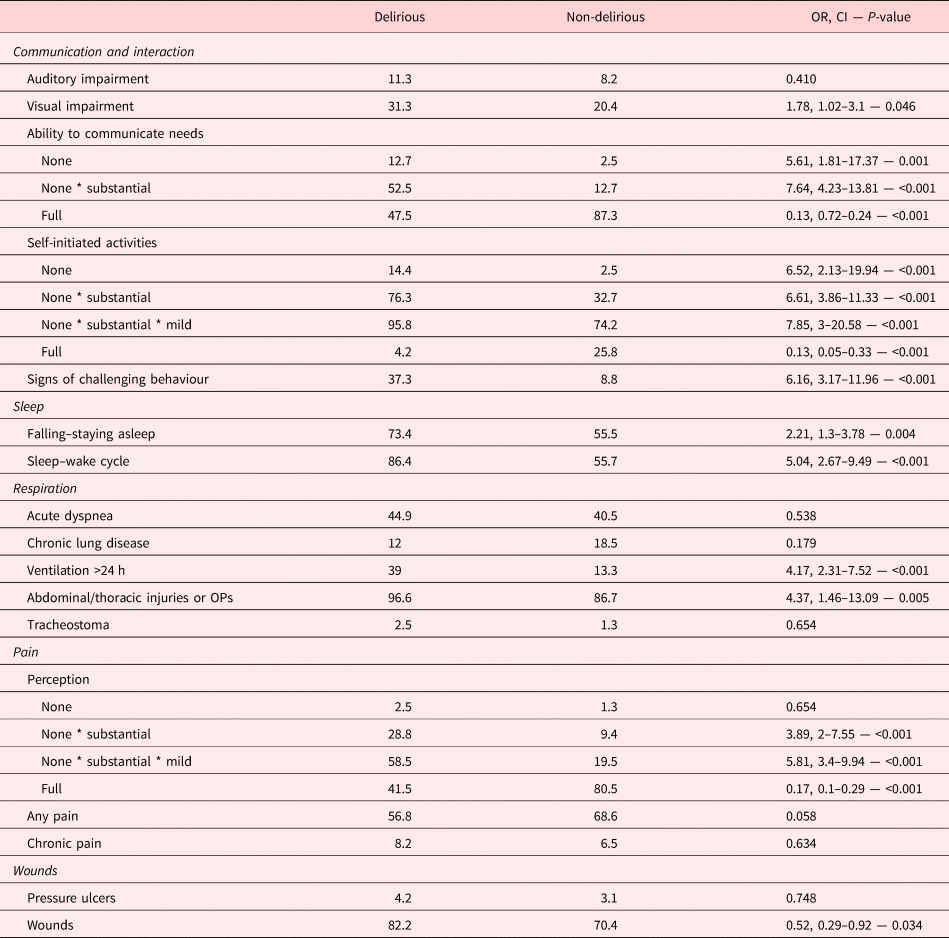
Cognitive and associated domains of the ePA-AC in delirious intensive care patients

OR, odds ratio; CI, confidence interval.
P, Pearson's χ2 or Fisher's exact test.
Orientation was substantially diminished in delirious patients; they had either a loss of orientation to all qualities (OR 8.2), one quality (OR 8.6), or two qualities (OR 10.1). Conversely, only few delirious patients stayed completely orientated (OR 0.1). Furthermore, delirium was associated with a loss of the ability to acquire knowledge (OR 5.5– 11.6) such as finding the way inside the patient's room or on the ward, understanding the treatment program, or abiding by agreements. Concerning the overall ability to acquire knowledge, the majority of delirious patients were mildly impaired (OR 11.6), they were mostly affected concerning more complicated cognitive challenges, but maintained an ability to keep in mind more simple things. Also, substantial impairment (OR 9.1) and the total loss of the ability to acquire knowledge (OR 5.5) occurred, and delirium was negatively associated with maintaining the full ability to acquire knowledge (OR 0.1).
The loss of competence to manage daily routine occurred more frequently in delirious patients (8.2–22.4). This domain includes recognizing objects and utilities to fulfill daily activities as well as identifying potentially dangerous situations and perceive basic needs. The total loss of competence to manage daily routine occurred much more often in delirious patients (OR 22.4), but also strong (OR 8.2) and mild impairments (OR 12.6) were recognized to be affected, whereas the full competence to manage daily routine occurred less frequent (OR 0.1).
Attention in delirious patients was relevantly compromised (OR 12.8), and delirious patients were more often administered psychotropic drugs (OR 3.8).
Communication and interaction
This domain included auditory and visual impairment as well as the ability to communicate needs, self-initiated activities, and signs of challenging behavior.
Auditory impairment did not occur more often in delirious patients, whereas visual impairment did (OR 1.8). The ability to communicate needs was impaired when delirium was apparent; both the lack of communication of needs was more common (OR 5.6), as well as a substantial impairment (OR 7.6) and the full ability to communicate needs were less common (OR 0.1).
The domain self-initiated activities was impaired in similar ways as communication was. Delirious patients showed a relevant impairment concerning self-initiated activities compared with non-delirious patients. This includes self-initiated activities to improve the patient's well-being and their situation. Delirious patients more often showed no self-initiated activities at all (OR 6.5); furthermore, a substantial impairment in this domain (OR 6.6) and a mild impairment (OR 7.9) were more obvious. Full self-initiated activities were less likely to be existing (OR 0.1). Additionally, challenging behavior was more typical in delirious patients (OR 6.2).
Sleep
Delirious patients had, compared with non-delirious patients, more disturbances concerning falling and staying asleep (OR 2.2). Besides, it was evident that delirious patients had more disturbed sleep–wake cycles (OR 5).
Respiration, pain, and wounds
This domain describes respirational constraints such as acute dyspnea, chronic lung disease, ventilation >24 h, abdominal/thoracic injuries or operations, and tracheostoma.
Whereas the delirious patients were less inflicted by acute dyspnea or tracheostoma or chronic lung disease, they were inflicted by mechanical ventilation >24 h (OR 4.2) as well as with abdominal/thoracic injuries or operations (OR 4.4).
Delirious patients suffered more often from substantially diminished sensory perception (including inadequate verbal expression of pain, using crying, restlessness, and groaning to express pain) (OR 3.9) and from mild sensory impairment (only partly inadequate verbal expression of pain) (OR 5.8). In contrast, full perception was significantly less frequent in delirious patients (OR 0.2), and no intergroup existed concerning absent perception.
Furthermore, delirium did not affect pain in general as well as chronic pain and was not associated with pressure ulcers; however, wounds in general were more common (OR 1.9).
Discussion
Summary of main findings
Delirium caused substantial impairment throughout the cognitive and associated domains, consciousness and cognition, communication and interaction, in addition to respiration, pain, and wounds of the ePA-AC. The most affected domains including the competence to manage daily routine and relevant impairments concerning attention, orientation, the ability to acquire knowledge, the ability to communicate needs, self-initiated activity, and the perception of pain were noted. The general pattern was a loss of competence in the mentioned areas, mostly leading to impairment rather than to full loss of competence, except for the competence to manage daily routine with complete loss being most evident.
The domain of consciousness was expectedly impaired, and delirium manifested in somnolence.
Visual impairment contributed to delirium, in contrast to auditory impairment. In addition, sleep–wake cycle disturbances occurred, the delirious patients had difficulties to fall and stay asleep. Last, mechanical ventilation >24 h contributed to delirium, as well as abdominal/thoracic injuries or operations.
Comparison to the existing literature
To date, few studies explored consciousness and cognition, communication and interaction, in addition to respiration, pain, and wounds in the intensive care setting.
A disturbance of consciousness and/or inattention are the leading diagnostic criterion for the diagnosis of delirium (American Psychiatric Association, 2013). In addition, the loss of orientation is congruent with the existing literature (Balas et al., Reference Balas, Rice and Chaperon2012; Marcantonio, Reference Marcantonio2017). Furthermore, the impaired ability to communicate needs is supported by acute brain failure: delirium affects speech, including speech content, the production of spontaneous speech, language fluency, and word count, even in comparison with dementia (Balas et al., Reference Balas, Rice and Chaperon2012; Green et al., Reference Green, Reivonen and Rutter2018). Not differentiating the ability to communicate needs from dementia, the impairment was substantial. And last, the inability to acquire knowledge: delirium can cause reduced language comprehension (Green et al., Reference Green, Reivonen and Rutter2018) and affects memory (Brown and Boyle, Reference Brown and Boyle2002; Marcantonio, Reference Marcantonio2017).
There are only few studies examining the relationship between delirium and chronic lung disease. It is likely that severe hypoxemia leads to cognitive dysfunction including delirium, but there is no clear evidence for chronic or acute lung disease to cause delirium (Grant et al., Reference Grant, Heaton and McSweeney1980). Even though there was no difference in oxygenation between delirious and non-delirious patients, delirium occurs more often after mechanical ventilation (Von Rueden et al., Reference Von Rueden, Wallizer and Thurman2017) but was not associated with chronic lung disease (Takeuchi et al., Reference Takeuchi, Matsushima and Moriya2005). The relationship between abdominal/thoracic injuries or operations and the occurrence of delirium in our patients has already been reported (Koster et al., Reference Koster, Oosterveld and Hensens2008).
The most extensive study to date evaluating the effectiveness of nursing assessment for delirium prediction (Sola-Miravete et al., Reference Sola-Miravete, Lopez and Martinez-Segura2018) was performed on regular surgical and medical floors, and thus, the results may not be completely comparable to our ICU patients, but still showed some similarities. Delirium was associated with an loss of competence in self-care (Sola-Miravete et al., Reference Sola-Miravete, Lopez and Martinez-Segura2018). Concordant to these findings, an impairment or loss in self-initiated activities and in the competence to manage daily routine was noted. Taken into consideration that generally patients on ICUs are sicker than patients on regular wards and that the used items are not uniform across studies. The chance for total inability in self-care was high in delirious patients in the aforementioned study (OR 8.5) (Sola-Miravete et al., Reference Sola-Miravete, Lopez and Martinez-Segura2018); in this study, the loss of self-initiated activities (OR 6.5) and the loss of competence to manage daily routine (OR 22) indicated similar results. Thus, it is safe to assume that delirium caused the loss of self-initiated activities and the competence to manage daily routine; notwithstanding, the severity of illness was not considered in these studies.
Visual impairment contributed to delirium, as shown in many other studies (George et al., Reference George, Bleasdale and Singleton1997; Brown and Boyle, Reference Brown and Boyle2002; Marcantonio, Reference Marcantonio2017) with the exception of the study on regular floors closest to the design presented in this study (Sola-Miravete et al., Reference Sola-Miravete, Lopez and Martinez-Segura2018). In contrast to current knowledge — based on former studies (George et al., Reference George, Bleasdale and Singleton1997; Brown and Boyle, Reference Brown and Boyle2002; Sola-Miravete et al., Reference Sola-Miravete, Lopez and Martinez-Segura2018) — auditory impairment did not contribute to delirium. This might be due to the small number of patients with auditory impairment in this study, leading to underestimation of the importance. Furthermore, it might be possible that the evaluation of auditory impairment and the use of hearing aids were less vigorous on an ICU than on regular floors on which auditory impairment was proved to contribute to delirium (George et al., Reference George, Bleasdale and Singleton1997; Brown and Boyle, Reference Brown and Boyle2002; Sola-Miravete et al., Reference Sola-Miravete, Lopez and Martinez-Segura2018).
Sleep disturbances of patients with delirium in terms of difficulties falling and staying asleep are consistent with the literature (Devlin et al., Reference Elliott, McKinley and Cistulli2018), also reporting that the extent and duration of rapid eye movement (REM) sleep are decreased suggesting an association between REM sleep quality and delirium (Trompeo et al., Reference Trompeo, Vidi and Locane2011). Potential mechanisms of sleep disturbance in delirium include: abnormalities of neurotransmitters, tissue ischemia, inflammation, and exposure to sedatives (Watson et al., Reference Watson, Ceriana and Fanfulla2012). The impaired sleep–wake cycle in the delirious is in consensus with one study showing an association between delirium and greater circadian sleep cycle disruption evidenced by an increased amount of daytime sleep (Roche et al., Reference Roche, Drouot and Thille2010).
Additional iatrogenic and hospital-related risk factors require consideration: (1) Administration of sedatives causes a decrease in slow-wave sleep and stage (REM) sleep. This interferes with restorative properties of natural sleep (Watson et al., Reference Watson, Ceriana and Fanfulla2012), although the interrelationship of sedation and pain, delirium, and sleep has not been fully elucidated (Devlin et al., Reference Elliott, McKinley and Cistulli2018). (2) In addition, mechanical ventilation may be an important cause of sleep disruption in ICU patients because of the endotracheal tube discomfort and as a result of ineffective respiratory efforts (Watson et al., Reference Watson, Ceriana and Fanfulla2012). Albeit sleep disturbances occur in delirious patients, increased sleep fragmentation has also been reported in critically ill adults (Trompeo et al., Reference Trompeo, Vidi and Locane2011; Elliott et al., Reference Devlin, Skrobik and Gelinas2013; Devlin et al., Reference Elliott, McKinley and Cistulli2018). Generally, elderly people are prone to sleep disturbances and these represent a higher risk for developing postoperative delirium (Todd et al., Reference Todd, Gelrich and MacLullich2017). Therefore, sleep deprivation represents a modifiable risk factor for the prevention and development of delirium with important implications for the acute and long-term care and outcome of critically ill patients (Weinhouse et al., Reference Weinhouse, Schwab and Watson2009).
Uncontrolled pain has been shown to contribute to delirium (Lynch et al., Reference Lynch, Lazor and Gellis1998; Vaurio et al., Reference Vaurio, Sands and Wang2006), although this was not the case in our ICU patients, which is a novel finding. A possible explanation could be sufficient analgesia in the setting of an ICU. However, the sensory pain perception was diminished in these delirious patients, particularly, the adequate verbal expression of pain. Noteworthy, delirious patients express pain more often through non-verbal signs (Decker, Reference Decker2009).
This study complements the previously reported usefulness of the functional domains of the ePA-AC (Bode et al., Reference Bode, Isler and Fuchs2020) by the missing and equally useful domains related to cognition and consciousness, communication and interaction, sleep, respiration, pain, and wounds.
Based on these findings, one may propose the implementation of the ePA-AC as a potential screening instrument in daily routine of a busy nursing setting with the aim to better and earlier detect delirium.
Although this instrument might not be ideal for the intensive care setting, this study sought to assess an instrument applied to all hospitalized patients in this very specific setting. A validation of this instrument as a delirium screening tool and an evaluation of this instrument on general floors are on the way. Based on current findings, an inclusion of all parameters might aid the identification of delirium most.
Concerning the overlap of sedation and hypoactive delirium — sedation is a core concept of managing post-operative surgical patients — patients have only been mildly sedated and drowsiness has been confirmed to be subthreshold for delirium (Boettger et al., Reference Boettger, Nunez and Meyer2017).
Strengths and limitations
This study has numerous strengths, including the comprehensive daily nursing assessment with the ePA-AC, delirium determined with the gold standard, at that time DSM-IV-TR, by psychiatrists and the inclusion of a sizable patient sample, but also notable limitations.
Both delirium and severe illness cause functional impairment, but it was not possible to separate these effects. Although patients were screened daily for eligibility, consecutive enrollment was not possible, but depended rather on patients’ ability to participate in both the psychiatric assessment and the study as a whole. Thus, a potential selection bias towards those able to engage in the interview must be considered, excluding those with diminished communication abilities, i.e., the more delirious, and potentially over-representing the less- and non-delirious.
The design did not allow for the assessment of premorbid cognitive impairment, which consequently was only screened for by chart review. This initial evaluation of the potential of the ePA-AC was cross-sectional and a longitudinal design capturing changes due to delirium would have been favorable. This study was limited to cardiovascular surgery patients known to be at high risk of developing delirium. Although these findings might extend to other post-surgical intensive care settings, the generalizability to other intensive care settings requires confirmation. Furthermore, the design was cross-sectional; thus, it is necessary to replicate these findings in a longitudinal study.
Conclusion
Following the previous evaluation of the functional domains of the ePA-AC, this study assessed the more specific domains for delirium and was able to show substantial impairment throughout the domains cognition and consciousness, communication and interaction, and sleep, in addition to respiration pain, and wounds. With these results, it will be possible to develop algorithms based on the ePA-AC able to detect delirium on a daily basis and thus to benefit patients, their caregivers, and the healthcare system altogether.
Conflict of interest
There are no conflicts of interest.