Introduction
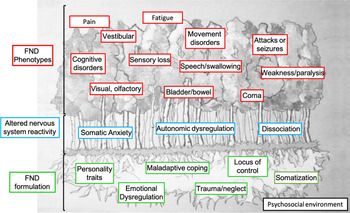
Functional neurological disorder (FND) is a complex neuropsychiatric syndrome with multiple presentations (Figure 1). In a given individual, various functional symptoms may arise independently or simultaneously as a result of a common underlying neuropsychiatric engine that drives the disorder.Reference Kranick, Ekanayake, Martinez, Ameli, Hallett and Voon 1 , Reference Scamvougeras and Howard 2 The scope of this problem in clinical practice is considerable as FND represents ~30% of patients seen in general neurology clinics.Reference Stone, Carson, Duncan, Coleman, Roberts and Warlow 3
Seeing the whole picture. Functional neurological disorder (FND) can be conceptualized as a forest of trees sharing a common root system. The surface neurological symptoms (red boxes) can be thought of as the visible “leaves,” the underlying neuropsychiatric engine is the shared root system (green boxes), emphasizing that the surface manifestations are linked by a common underlying pathology. This neuropsychological vulnerability occurs in a particular psychosocial environmental context, that is, the soil (brown box). The intermediate conduit between the root system and the phenotypic/symptom expression is alterations in nervous system reactivity (blue boxes), that is, elevated autonomic tone or dissociation, which is embedded within the system and may or may not carry physiological correlates (eg, brisk reflexes, reduced heart rate variability). Many surface phenotypes of FND exist as do many underlying engines unique to each individual, only some of which are shown here. Importantly, these drivers of FND range from simple to complex, and require a biopsychosocial framework to characterize with predisposing, precipitating, and perpetuating factors, and cannot be explained solely on the basis of the DSM-5.

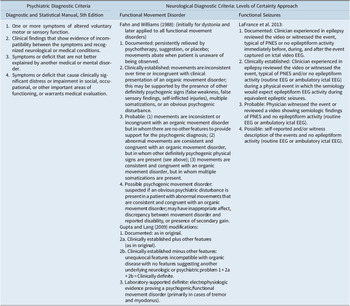
The identification of FND most often rests with the neurologist due to the physical nature of the presenting features, including in patients already followed by mental health professionals who develop new neurological symptoms. Different sets of diagnostic criteria are found in both the psychiatric and neurologic literature (Table 1). What they have in common is the presence of positive clinical findings supportive of internal inconsistency (eg, Hoover’s sign for paralysis or a tremor that stops or entrains during contralateral cued rhythmic movement). An obvious shortcoming, however, is that both fields are working from separate diagnostic criteria. The neurologic criteria are only useful for a subset of FND patients, and allude to outdated psychiatric concepts, which are problematic in that, this (1) makes the assumption that psychological factors are etiologies of FND (directly in opposition with Diagnostic and Statistical Manual-5 criteria) and (2) vague, and not within the traditional scope of practice for a neurologist to define in any meaningful way.Reference Gupta and Lang 4 , Reference Fahn and Williams 8 Furthermore, the requirement “improves with psychotherapy” is not specific to FND,Reference Fahn and Williams 8 as many other neurologic signs improve with reductions in, for instance, depression and anxiety. In contrast, the DSM 5 criteria emphasize “clinical findings that show evidence of incompatibility between the symptoms and recognized neurological or medical conditions” that are not within the traditional scope of expertise of a mental health professional, as this requires knowledge of the differential diagnoses of all neurological presentations.
Current Psychiatric and Neurological Diagnostic Criteria for Functional Neurological Disorder. 4–7. (EEG, electroencephalogram; PNES, psychogenic non-epileptic seizures)

The diagnosis of FND is further challenged by the prominent heterogeneity of its presentations, as well as neurologists continuing to adopt a “diagnosis of exclusion” approach. An outcome of the apparent dichotomy of neurologic and psychiatric aspects of the disorder has led to confusion regarding who should be responsible for following such patients, leading to abdication of treatment and patient feelings of invalidation and abandonment when seeking care.Reference Lidstone, MacGillivray and Lang 9 The emphasis on the positive neurological signs risks an inattention to potentially relevant psychosocial factors. Although the psychological vulnerabilities and risk factors are not part of these diagnostic criteria for FND, they are well recognized and have significant prognostic and therapeutic implications. We would argue that the true or complete diagnosis should not rest in simply establishing that the neurological features are not “organically” based. A broader view is required.
Diagnostic Triad of FND
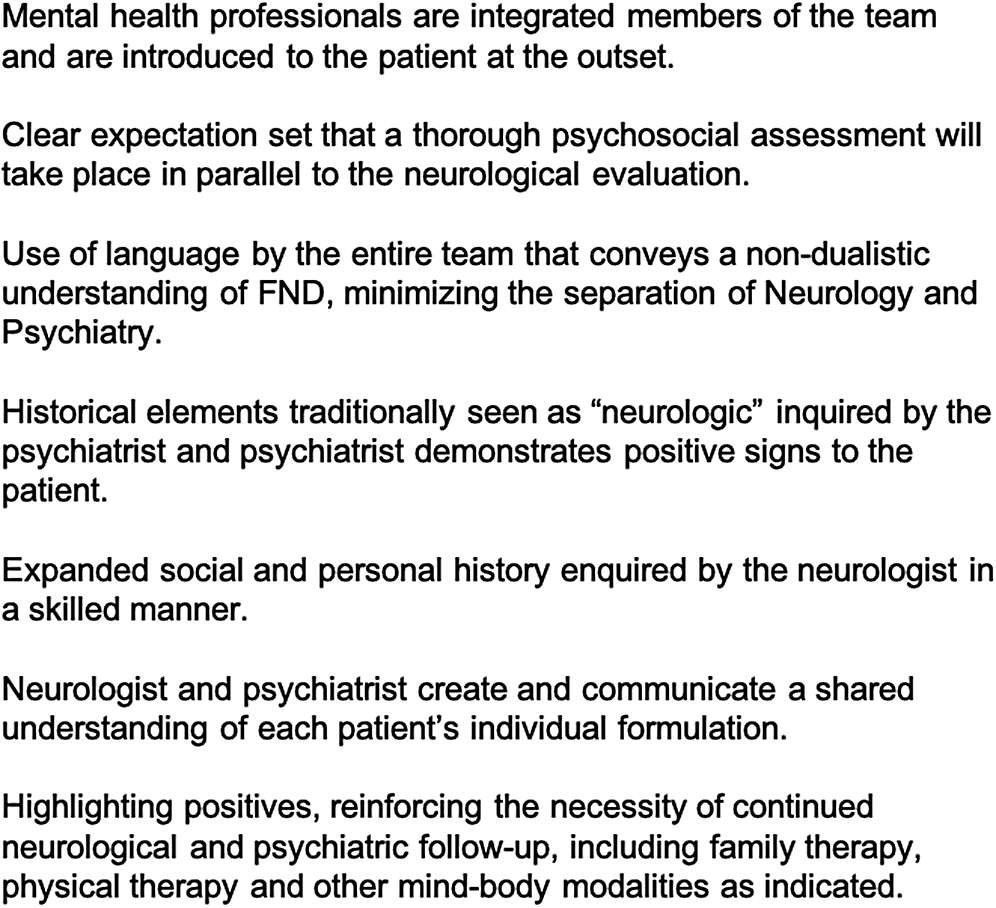
We propose that the diagnosis of FND should reflect our current understanding of FND as a complex neuropsychiatric disorder with both neurological and psychiatric/psychological elements. The diagnostic criteria should, therefore, encompass positive signs and a simultaneous recognition or contextualization of the psychiatric/psychological processes that may be driving or maintaining the disorder, if present. It follows that this approach is a diagnostic process, requiring a partnership between neurologists and psychiatrists, as well as other mental health professionals (Box 1). Importantly, advancing the field requires a departure from the status quo of each discipline and movement into a new, shared framework for assessment and diagnosis. This goes beyond the existing parallel, standard evaluations.
Options for models of integration between Neurology and Psychiatry in the diagnosis and management of functional neurological disorder.

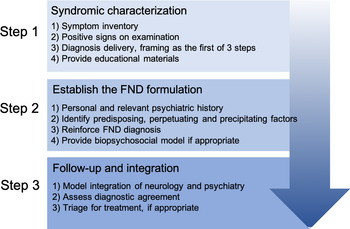
To that end, we propose that the diagnosis of FND should be a process that comprises three inextricably linked steps (Figure 2). The first step is to characterize the FND syndrome through symptom inventory and positive signs; the second step is to establish the FND formulation; the third step is integration and follow-up, as well as the initiation of a treatment plan if appropriate. Each of these steps will be described in more detail below.
Proposed diagnostic triad of functional neurological disorder (FND). These steps should be done sequentially and can be achieved through different care models so long as the partnership between neurology and psychiatry is preserved at each step and they are working from a shared understanding and disease model. With experience, this approach can also be carried out by a single individual with sufficient exposure to the neurological and psychiatric aspects of FND; or by a neurologist or psychiatrist/mental health professional with expertise in FND.

STEP 1: Characterizing the FND Syndrome
The first step of the FND diagnostic triad is syndromic characterization. This step is not equivalent to simply diagnosing a patient with a functional symptom based on positive signs alone. Instead, ideally, it involves an approach to the consultation that elicits more historical information, and possible physical examination findings, that are suggestive of and relevant to the syndrome of FND, while also assessing for features that are consistent with other neurological disease that may be comorbid or the main concern.Reference Carson, Hallett, Stone, Hallett, Stone and Carson 10 FND is a neurological condition with recognizable historical and examination findings. The ability to identify functional features, for the most part, is a clinical exercise based on establishing the presence of particular characteristic symptoms by history and signs by examination. The syndromic characterization of FND should be made by a clinician who is experienced in the diagnosis of the clinical features. For example, a patient who presents with a functional tremor would be best diagnosed by a physician, most likely a neurologist, familiar with tremor, in general, and its differential diagnosis.
There are a variety of historical features that are common across FND subtypes; none of these are specific for FND and their presence does not exclude other neurological diseases. These include: an abrupt onset, onset following physical injury, a static course, waxing and waning symptoms over time (“good and bad” days), functional impairment out of proportion to examinable deficits, paroxysmal symptoms or paroxysmal worsening of symptoms, refractory symptoms, and poor or sometimes worsening response to typical pharmacotherapy.Reference Gupta and Lang 4 Often these patients will have additional somatic features, such as pain, fatigue, and cognitive issues.Reference Aybek, Lidstone, Nielsen, MacGillivray, Bassetti and Lang 11 There may also be the presence of depression, anxiety, somatization, personality disorder, or other psychiatric history, but the frequency of these are less common than pain and fatigue.Reference Aybek, Lidstone, Nielsen, MacGillivray, Bassetti and Lang 11 An incongruous behavioral response to illness, particularly “la belle indifference,” has been emphasized in the older literature, however, this feature is found as often or more often in patients with other neurological illness.Reference Stone, Smyth, Carson and Warlow 12 Employment in an allied health profession is also commonly emphasized in the older literature, but this is uncommon and potentially misleading. While none of these features defines a disorder as functional, if present they can increase the index of suspicion for FND in combination with the positive signs found on the clinical examination.
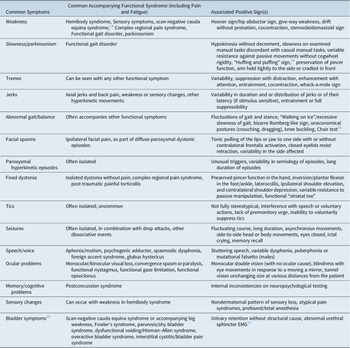
The clinical evaluation includes examination for the presence of positive signs and the presence of any comorbid structural neurological disease. Table 2 outlines some of the positive signs associated with common syndromes of functional presentations, which have been reviewed extensively elsewhere. 18–22 In difficult cases, laboratory assessments are useful, such as EEG for functional seizures and electromyography for tremor or myoclonus, and EEG assessment of the Bereitschaftspotential for jerky movements. Less often brain imaging can also be helpful, including dopamine transporter scan or assessments of the nigrostriatal dopamine system for functional Parkinsonism using positron emission tomography.Reference LaFaver and Espay 23 Thus, the syndromic characterization may require additional clinical or laboratory assessments.
Common Functional Neurological Disorder Symptoms, Syndromes, and Associated Positive Signs

Once this first step is complete, the diagnosis is shared and explained to the patient, including the demonstration and explanation of the positive signs and the potential for reversibility.Reference Stone and Edwards 24 The delivery of the diagnosis is a critical element of the therapeutic process, and lays the groundwork for the subsequent steps. 25–27 The patient should be shown that they are taken seriously. Validating the patient’s suffering is critical in engaging them in the next steps of the process, including initiating treatment. All this should lead to an understanding of what referrals are needed in order to advance to Step 2 in the diagnostic process.
STEP 2: Establishing the FND Formulation
Once the syndromic characterization has been made and the patient has been given the clinical diagnosis of FND, the next step in the diagnostic triad is to establish a working hypothesis for symptom generation and/or maintenance (ie, the “FND formulation”). This step contextualizes the physical symptoms into a broader neuropsychiatric framework—which may be simple or highly complex depending on the individual—which completes the picture. The purpose of this step is to develop a fuller understanding of the patient and to identify potential therapeutic targets, or, conversely, poor prognostic signs. This evaluation can be accomplished by any number of mental health and other professionals with experience in the field and is not limited to psychiatrists, especially since psychotropic medications are not an integral part of the management of FND.
A biopsychosocial model containing predisposing, precipitating, and perpetuating factors is the preferred approach, and the psychiatric interview should, therefore, be tailored to uncover these elements, if present.Reference Carson, Hallett, Stone, Hallett, Stone and Carson 10 , Reference Voon, Cavanna, Coburn, Sampson, Reeve and LaFrance 28 Here, we outline the common, relevant factors in FND.
Predisposing factors
Predisposing or risk factors are diverse and not fully characterized and can span aspects of physical, mental, and social health. Female gender, younger age, and low socioeconomic status are associated with FND. 29–31 Long histories of medical illness, as early as in childhood, can be present. Difficulties in interpersonal relationships can be clues to undiagnosed maladaptive personality traits or a personality disorder, such as borderline or avoidant personality disorder.Reference Bodde, Brooks, Baker, Boon, Hendriksen and Mulder 32 , Reference Reuber, Pukrop, Bauer, Derfuss and Elger 33 The psychiatric interview should include the exploration of past trauma or neglect, particularly in childhood. While the prevalence of sexual and physical abuse is higher in some subtypes of FND, it is not always present, but is important to identify if it is a potential treatment target. Modeling of symptoms, to which the patient was previously exposed (in others or in patient’s own medical history), should be screened for.Reference Stamelou, Cossu, Edwards, Murgia, Pareés and Melis 34 , Reference Pellicciari, Superbo, Gigante, Livrea and Defazio 35 Other factors conferring vulnerability to FND include genetics, as well as personality traits not fulfilling DSM 5 diagnostic criteria, such as perfectionism, avoidance, and emotional dysregulation. Taken together, while none of these predisposing factors individually result in expression of FND, they are ingredients—not an etiology—acting within a substrate that confers a vulnerability to FND.
Precipitating factors
A precipitating factor may or may not be identifiable. It is important to recognize that the index event is not the direct cause of FND but rather a trigger that may be removed temporally from the symptoms. Physical, medical, and psychological candidates should be screened for as the index event may be in the form of a medical illness, a physical injury or accident, recent surgery, exposure to substances or medications, or a psychosocial stress or loss. Physical injury or surgery is a common trigger for functional movement disorders, for example, the onset of focal ipsilateral hand dystonia following a carpal tunnel release or functional leg weakness following lumbar radiculopathy. 36–39 The search for a psychological precipitant was an integral part of DSM IV diagnostic criteria but was dropped from DSM 5 due to the paucity and inconsistency of evidence. 5 In some patients, this allows the expression or temporary resolution of other unexpressed conflicts, or needs, that “may not be ready for prime time” (eg, conscious elucidation). Functional and somatic symptoms may offer a viable (albeit maladaptive) alternative that can help absorb/funnel the negative psychological consequences of the conflict. In others, such deeper conflicts may not be found, and rather the symptoms arise following distortions in sensorimotor processing, in which erroneous health beliefs or expectations distort an often noxious, somatosensory experience.Reference Carson, Hallett, Stone, Hallett, Stone and Carson 10 , Reference Edwards, Adams, Brown, Parees and Friston 40 This process is facilitated by misdirected and overly precise attention, anxiety, and dissociation, and, in some cases, influenced further by autonomic dysregulation. Regardless of the route, if present, a triggering event plays a critical part in the patient’s explanation for the symptoms and helps the patient to “make sense” of the amorphous and often, incongruous somatic experience. The patient can be either consciously or preconsciously complicit in it. This unconscious “complicity” does not negate the diagnosis of FND and is not to be confused with malingering.
Perpetuating factors
Perpetuating factors are critical to identify as these are often drivers of symptom chronicity, barriers to treatment engagement, or may be separate treatable targets themselves. Again, these can be psychological, physical, psychosocial, or cognitive. Common perpetuating factors include ongoing medical illness, severe chronic pain, chronic fatigue, untreated comorbid anxiety or mood disorders, unrecognized personality disorder, the presence of ongoing psychosocial stress (relating to work, home life, litigation, finances, and relationships), and lack of diagnostic agreement while pursuing further explanations. Disability status and litigation have been associated with poor prognosis and complicate management. Therefore, a thorough evaluation of psychosocial factors that explore work, family, and interpersonal conflicts, as well as unexpressed needs, is relevant. Finally, there is also the influence of maladaptive behavioral responses, expectations, operant and classic learning, and central nervous system plasticity, which may all contribute to symptom chronicity.Reference Carson, Hallett, Stone, Hallett, Stone and Carson 10
The identification of comorbid psychiatric conditions in the context of the evaluation is frequent and should be addressed as such, avoiding the trap of reducing the explanation of FND to stress, anxiety, or depression. It is essential to assess the duration of the functional neurological symptoms and ascertain the presence of previous or concomitant unexplained symptoms in other organ systems. This can further aid in the appreciation of the patient’s prognosis and inform treatment recommendations. It supports the development of a case formulation—the “story”—forged by the therapist with participation from the patient into a narrative that has healing power.
STEP 3: Follow-Up and Integration
All patients should be seen in the follow-up is the third step in the diagnostic process. A follow-up visit provides validation for the patient, avoids generating feelings of abandonment, and provides an opportunity to uncover additional clinical findings and corroborate those already established from both a neurologic and psychiatric viewpoint, building on the biopsychosocial perspective. A united front between specialties may enhance patient agreement with the diagnosis and therapeutic plan, if appropriate. The key elements of this visit are to model the integration of neurology and psychiatry (or brain, mind, and body), assess diagnostic agreement, and triage for appropriate treatment. Such an integration can occur if the patients are seen through the framework of a multidisciplinary clinic or through a consulting affiliation. Communication between specialists is critical prior to this visit so that both disciplines inform each other, and, as a result, are working from a shared understanding of the patient’s individual formulation and treatment targets.
A review of treatment avenues for FND is covered elsewhere in this issue, however, it is important to mention that not all patients will respond to FND therapy.Reference Lidstone, MacGillivray and Lang 9 , Reference Aybek, Lidstone, Nielsen, MacGillivray, Bassetti and Lang 11 Shorter duration of symptoms, lack of long-standing unexplained comorbidities, recent and clearly identifiable psychosocial conflict, or need, which can be addressed concretely, all support a more favorable prognosis. Patients with non-FND syndromes, such as dominant chronic pain or fatigue, require referral to appropriate services.Reference Aybek, Lidstone, Nielsen, MacGillivray, Bassetti and Lang 11 , Reference Gilmour, Nielsen, Teodoro, Yogarajah, Coebergh and Dilley 41 Targeting mood or anxiety disorder treatments can be a useful approach to indirectly improve the FND symptoms, as these are common perpetuating factors.
The above elements should ideally be part of the diagnostic evaluation and carry a higher likelihood that patients will agree with the diagnosis and adhere to recommendations. The entire team can then collaboratively formulate a working roadmap to recovery in appropriate patients. We recognize that this model is challenging to establish in clinical practice, may not be available to all clinicians, and will likely require the establishment of local networks or dedicated specialist FND clinics.Reference Aybek, Lidstone, Nielsen, MacGillivray, Bassetti and Lang11, Reference Gilmour, Nielsen, Teodoro, Yogarajah, Coebergh and Dilley41 In settings where integrated teams are not possible, sequential intervention is the norm but must incorporate as many of the above elements as feasible to effect positive outcomes. Improved care for FND patients can begin simply with a good relationship between an interested neurologist and mental health professional, working from the same perspective, and many successful programs have begun this way.
Research Directions
In the context of this three-step process to diagnosing FND, the research agenda can also be divided into three major components.
-
1. Establishing nonmotor positive signs: The vast majority of FND syndromes can be diagnosed confidently with a thorough history and examination. However, in some FND syndromes, there is a lack of highly sensitive and specific criteria to define the neurological problem as functional. Dissociative seizures have the advantage of video EEG to help definitively characterize the syndrome. Many but not all functional movement disorders can be characterized either clinically or with additional electrophysiological testing, however, certain subsyndromes remain extremely challenging (eg, dystonia). In contrast, in the case of FND syndromes dominated by sensory, special sensory, speech, swallowing, and other features, it is sometimes far more difficult to unequivocally define the symptoms as functionally based. Thus, the first step of the proposed diagnostic triad, syndromic characterization, will require more reliable clinical, imaging, and other biomarkers to help differentiate certain syndromes from their non-FND counterparts. Establishing trans-diagnostic positive signs will play a useful role here (ie, identifying clinical and neurobiological signatures common across all functional disorders).
-
2. Understanding the engine and neuropsychiatric phenotypes : A second research priority would be the establishment, and, if possible, codification of the optimal approaches to the assessment and formulation of the “engine” underlying the FND. This would include the ability to differentiate simple triggering or aggravating factors from the more important causative and perpetuating features that require therapeutic targeting for optimal outcomes. In addition, the recognition of neuropsychiatric phenotypes that transcend physical presenting symptoms, for example, a better understanding of the impact of trauma on the developing nervous system and the role of the autonomic nervous system in symptom generation.
-
3. Treatment triaging : Finally, research studies will be required to determine the extent to which various aspects of the syndromic characterization and the etiologic formulation steps of the diagnostic process are required both to direct the choice of therapeutic approaches and to optimize the therapeutic outcomes.
Conclusion
We have argued that the diagnosis of FND requires an integrated approach reflecting the complexity of the disorder that falls within the scope of practice of both neurologists and mental health professionals. The neurologist’s job is not complete once they have established that the clinical features fulfill specified criteria; without an understanding that this is only the first step in a process, this risks a return to an outmoded neurologic era of “diagnose and adios.” Thus, the diagnosis needs to include the formulation step, which relies on a close interaction between the neurologist and the psychiatrist. Without the critical formulation component, the final steps of initiation of therapy and follow-up are incomplete. Likewise, the psychiatrist, or mental health professional, must appreciate that their job is not simply comprised of establishing that there are no comorbid DSM 5 diagnoses; instead, what is required is a broader ability to recognize the relevant predisposing, precipitating, and perpetuating factors for FND—many of which may lie outside of the realm of the psychological—and place them into an individualized, neuropsychiatric framework of symptom genesis and maintenance while also identifying possible treatment targets. Seeing the whole picture is critical to furthering our understanding and treatment of this neglected patient population.
Funding
This study was funded by The Sartain Lanier Family Foundation (SAF).
Disclosure
The authors have nothing to disclose.