Introduction
Transnationality, when discussed in the context of popular music, faces the theoretical binary of industry production vs. mass reception. Popular music scholarship on transnationality has either examined the global flows of music at the level of formalised institutions such as the multinational music industry (Garofalo Reference Garofalo1993; Khiun Reference Khiun2003; Jung Reference Jung2010), or critiqued the relationship in ‘world music’ between musical transnationality and the artists' privileged industry position (Feld Reference Feld2000; Taylor Reference Taylor, Lysloff and Gay2003). A different but related subset of transnational popular music scholarship comments on the mobilisation of media and technology related to the formation of translocal identities (Lum Reference Lum1996; Yang Reference Yang, Inda and Rosaldo2002) and communities (Wong Reference Wong2004; Pinard and Jacobs Reference Pinard, Jacobs and Ayers2006).
Given the constraints of these scholarly approaches, I would ask: How is transnationality experienced at the non-corporate, independent level? How do unsigned, independent musicians negotiate their positions and relative invisibility in a transnational world? How do independent musicians create music and discourses related to transnationality in their musical and social lives? Independent music exists in a liminal space within the institutional structure of the industry. And indie musicians are neither ‘producers’, because they do not enjoy the privileges of industry-dependent wide distribution; nor are they are mere ‘listeners’, because they create cultural content and distribute it via DIY (do-it-yourself) social networks. My work responds to this gap in existing scholarship by locating the transnational within the lively world of independent music production. This approach represents a new direction by highlighting the performative and ethnographic in the transnational popular music literature. Methodologically, I follow ethnographic approaches to transnational performance events with the emphasis on micro socio-musical processes that cannot be explicated by the forces of the music industry (Stokes Reference Stokes and Stokes1997; Schoel Reference Schoel, Gottlieb and McLelland2003). The focus on micro social processes and events, instead of the macro, mega events, sheds light on the role of the quotidian in articulations concerning identity and community. Taking the ethnographic approach enables me to look closely at the impact of fleeting moments in performances, which arguably lead to formalised discourse about ethnicity and identity.
This paper foregrounds live and mediated musical activities in Taiwanese America, a socio-cultural entity that by definition exemplifies the in-between social and political space of transnationality. It documents the story of Taiwanese American Jack Hsu and his North Jersey-based independent erhu-rock band The Hsu-nami, and examines their experiences of performing in various transnational situations fraught by the geopolitics of China, Taiwan and the United States. This framework resonates with Bandana Purkayastha's model that ‘envision[s] ethnicity as expressing a state of balance between constraints and opportunities arising out of multiple nations’ (Purkayastha Reference Purkayastha2005, p. 14). Similarly, connecting expressions of ethnicity to the processes of racialisation (Purkayastha Reference Purkayastha2005, pp. 9–10), my analysis also brings into relief the impact of racial politics upon Jack and his band's play on ethnicity.
This paper sets out to problematise the existing cultural geographies and ideologies tied to rock music discourse. The focus on Taiwanese America questions the geographical biases for the United States and the United Kingdom in rock music discourse. Challenging rock music scholarship to go beyond the single-nation framework, this work builds on the emerging transnational approach to the study of rock music (Hernandez et al. Reference Hernandez, L'Hoeste and Zolov2004; Kun Reference Kun2005). By insisting upon the scholarly importance of a rock band fronted by a Taiwanese American performer, well received among Taiwanese and other Asian Americans, this project deliberately carves out a previously silenced Asian minority space within a music culture typically marked by a white, Anglo-American dominance (Mahon Reference Mahon2004). A close sonic examination of a rock band that features the erhu, a Chinese two-stringed spike fiddle, questions the aesthetic boundaries of rock music and particularly the genre-defined centrality of the guitar. Recontextualising the discussion of rock music beyond the historical black and white racial binary in the US, this paper explores the identities and ideologies related to ethnicity, race, gender and aesthetics that emerge within and beyond overseas Taiwanese communities.
In the following pages I will discuss how Jack Hsu, alongside his white American bandmates, leverage and disrupt the binary between ‘Chinese’ and ‘Taiwanese’, and between ‘Asian’ and ‘American’. The close readings will examine how the band harnesses creative strategies and adapts to the changing politicised environment of Taiwanese America and mainstream America. The analysis begins by highlighting key moments of a performance event in which The Hsu-nami encountered Taiwanese nationalism through sharing a bill on a concert with Chthonic, an extreme metal band touring from Taiwan. This event entangled the band in a politicising discourse that concerns Taiwan's status relative to the United Nations. An analysis of Jack's ambivalence toward the sentiments of ethnic nationalism of the Taiwanese American community follows. Next, I will focus on The Hsu-nami's racialised position in the mainstream American press. This section is followed by an examination of how Jack counters racialisation and adapts rock music ideologies, gestures and technologies in order to create a unique erhu-rock style. This analysis traces the changing ethnic, racial and gender meanings associated with the erhu, an unusual instrument within the genre of rock music. Lastly, the paper addresses how Jack and his bandmates navigate themselves in the midst of politics of ethnonationalism and racialisation, and engage with the politically safe, multiculturalist metaphor of cultural diplomacy.
Encountering Taiwanese ethnonationalism
At Highline Ballroom, one of New York City's high-profile music venues, multi-coloured stage lights shifted in formation according to the high-energy performance of the progressive erhu-rock band, The Hsu-nami. Jack Hsu exchanged solos with lead guitarist Brent Bergholm, while shredding on his amplified erhu. Clipped onto his waist, Jack's erhu looked like an electric guitar. Jack and Brent moved towards each other to lean back-to-back, and finished the song by playing the chorus melody in unison. Brent announced, ‘we're going to take this song to the people of Taiwan’. The crowd cheered and applauded. Jack and Brent told me they had been surprised to see that some of the older Taiwanese in the audience had tears in their eyes while Jack played his erhu solo.
The Hsu-nami's set warmed up the audience for the evening's headliner, Chthonic, an extreme metal band from Taiwan. On stage, the lead vocalist Freddy Lim of Chthonic alternated his guttural screams with his bandmate's sombre erhu solos. Only the young white metal fans in the audience, many of whom had followed the band up and down the East Coast, knew that Freddy's virtuosic but unintelligible vocalisations were narrating stories inspired by Taiwanese mythologies. The young metal fans banged their heads in synch to the machinegun-like guitar riffs and the rapid firing on the double-bass drums and bass guitar. Wincing to the assaulting sounds, the older Taiwanese, some with improvised tissue-paper earplugs, stood in the crowd with stiff limbs and torsos, attempting to show support for the band.
An unusual performance: middle-aged Taiwanese men and women don't tend to go to rock music shows and socialise with young, black-t-shirt wearing, white American metal-heads. For The Hsu-nami and particularly Jack, who is Taiwanese American, this performance was the beginning of their unexpected entanglement in the complex transnational politics among Taiwan, the People's Republic of China (PRC, or colloquially referred to as ‘China’) and the United States. Unwittingly, Jack and his bandmates found themselves thrown into the mix of a Taiwanese nationalist protest spearheaded by the event organisers and Chthonic. For Chthonic and its bandleader Freddy, this high-profile event offered an opportunity to propagate a politics-laden brand of Taiwanese identity to a North American and global audience. Despite these differences, both bands share affiliations with the island of Taiwan, however differently these links may have been forged.
The performance at Highline Ballroom was organised by the Committee for Admission of Taiwan to the United Nations, abbreviated to CATUN. According to CATUN's website, the organisation was ‘established through Taiwanese American Council of Greater New York representing more than ten Taiwanese American organisations in the area’. Since its inception in 1992, CATUN has organised an annual mass rally during the assembly of the UN every September, protesting its exclusion of Taiwan. A brief summary of the recent history of Taiwan and its fraught relations with the PRC and the USA can help contextualise the politics surrounding the event.
When the Communist Party took Mainland China in 1949, the oppositional Chinese Nationalist Party known as the Kuomintang (or KMT) fled to Taiwan. Under the military rule of KMT leader Chiang Kai-Shek, Taiwan was considered a sovereign nation and a part of the UN until 1978. After 1978, the US and the UN sought to rebuild relations with the PRC by adhering to the ‘One China’ policy enforced by the Chinese government. In the late 1980s, Taiwan formed a two-party democracy, split between those wanting reconciliation with China and those supporting Taiwanese independence. The KMT has maintained its position of supporting reconciliation with the PRC, whereas the newly formed oppositional party, the Democratic Progressive Party (DPP), has mobilised for a pro-Taiwanese independence movement. Since then, polarising issues regarding a ‘Taiwanese’ identity have shaped the island's cultural and political landscape at home and abroad (Hsu and Sargent Reference Hsu and Sargent2008, pp. 39–40).
The Taiwanese American political group CATUN organised this performance event as an after-party following the 2007 protest rally against the UN. This event served to introduce the Taiwanese band Chthonic on its North American tour to the Taiwanese American community in the greater New York metropolitan area. The organisers of CATUN invited The Hsu-nami to perform as a local supporting act, hoping to draw a young local audience. To The Hsu-nami, this performance meant an exposure of its music outside the band's fan-base which usually consists of 20-something year-old Ramapo College graduates, Taiwanese students studying abroad in the New York metropolitan area, as well as friends and families of the band members.Footnote 1
According to Jack, The Hsu-nami was particularly excited about sharing the stage with a band from Taiwan. Jack hoped that The Hsu-nami would eventually tour Taiwan through this performance connection. But the performance panned out differently to how the band had hoped. It ushered The Hsu-nami into the overseas Taiwanese community in the metropolitan area of New York. Members of this community, including the organisers of the event, began to associate The Hsu-nami with the rally against the UN, perceiving the band's participation as support for Taiwanese independence. This misreading, I argue, is largely shaped by Chthonic's overt expressions of Taiwanese nationalism and identity.
Chthonic's explicit support for Taiwanese independence facilitated the political aims of CATUN. On stage, Freddy shouted into the microphone, ‘Fuck China, fuck UN!’ Chthonic's metal-head fans, who seemed to know the script, responded by screaming back exactly the same phrases. Freddy even managed to get the middle-aged Taiwanese rally-goers in the audience to shout out these political slogans with a metal-inspired vengeance.Footnote 2 Freddy said to the crowd: ‘The UN considers themselves to represent all nations of the world. But Taiwan is limited [of] its membership, so Taiwan represents the underworld, like you guys!’ Resonating with the word ‘underworld’, the crowd cheered. Drawing on the Greek term ‘chthonic’, meaning deities or spirits of the underworld, Freddy analogises the dark, pagan-inspired black-metal imagery with the invisible status of Taiwan in the eyes of the UN. A few months prior to the event, on the band website, Chthonic announced the purpose of naming their North American and European tour the ‘Unlimited’ tour: ‘We want to emphasise the “Unlimited” potential of Taiwan and the Taiwanese people. We also want to highlight “UN Limited Taiwan”, an endeavour to strongly protest how the UN limits Taiwan's full participation as an independent country’ (Chthonic 2007). Chthonic has personal and financial ties to DPP, the pro-Taiwan independence and anti-China political party. In fact, the DDP-leaning administration led by Taiwan's president at the time, Chen Shui-Bian, provided partial financial support for Chthonic's tour of North America and Europe (Frazier Reference Frazier2007).Footnote 3
At the CATUN event, the pro-independence, anti-UN rally-goers were not interested in drawing the distinction between the political position (or lack thereof) of The Hsu-nami vs. that of Chthonic. To many members of the Taiwanese American community, The Hsu-nami's ethnic makeup – a Taiwanese American erhu player fronting an all-white-American band – speaks to the imagined union between Taiwan and the US. At the concert, one of the Taiwanese audience members expressed what the multi-ethnic composition of the band meant to him. Seeing The Hsu-nami's bassist Derril Sellers, a tall young man with a neatly trimmed blonde goatee and a friendly smile, this Taiwanese man said: ‘I love that he's wearing an “I love Taiwan” T-shirt. This, to me, means friendship.’ Jack told me that Derril wore the shirt only because he knew that the event had ‘something’ to do with Taiwan. But that ‘something’ had nothing to do with the complex transnational geopolitics among Taiwan, the PRC and the USA. Derril's representation of Taiwan meant to him a friendly alliance with the Taiwanese American community in New York, but he had no idea what kind of political assumption might have been taken from his friendly gesture.
CATUN's intended articulation of a politicised ‘Taiwanese’ identity has had a ripple effect on shaping the public reception of The Hsu-nami. Media coverage of the event exposed The Hsu-nami to the overseas Taiwanese community who readily associated the band with pro-Taiwanese independence politics. This misreading continues, however complicated its social and historical roots are. And its impact, a subsequent ethnicisation, affects only Jack and further distinguishes him from the rest of his band.
Deflecting ethnonationalism and transnational geopolitics
After the band's performance at a Taiwanese cultural festival in New York City, a grandmother-aged woman clung to him. With a great big smile, she seemed really proud of him. She said in the Taiwanese dialect, ‘It's great that you're Taiwanese’.
Not knowing what she said exactly, Jack replied, ‘yea’.
Then the elderly woman carried on the conversation in Taiwanese. When she realised that Jack couldn't understand her, she asked, ‘Are you from China?’ She couldn't fathom how Jack could be from Taiwan but not understand Taiwanese. (Hsu Reference Hsu2009a)
As the only Taiwanese American member in the group, Jack bears the burden of explicating the political position of his band. Jack's encounter with the elderly woman brings into relief the fraught distinction of being ‘from Taiwan or China’. This interaction exemplifies the ideology of ethnic nationalism, on the part of the elderly woman. She assumes that if Jack does not speak Taiwanese, a sociolinguistic trait that has been associated with the Taiwanese national identity, then Jack must be of Chinese national origin.
Ethnic nationalism or ethnonationalism is an ideology that defines a nation based on its ethnicity. When imposed upon individuals, it calls for an allegiance to a nation-state based on that person's presumed ethnicity. Conflating ethnicity, national origin, and nationality, ethnic nationalist thinking allows no room for ethnic multiplicity within a nation or an individual's heritage and culture. In the situation related to the politics across the Taiwan Strait, one could only be from either Taiwan or China. No individuals could possibly identify with both Taiwan and China, not to mention the possibility of an added identification with a third culture, such as the US. This kind of ethnic nationalism is prevalent among the attitudes of the members of this overseas Taiwanese community.
In this section, I will discuss how attitudes marked by ethnic nationalism pose a dissonance against Jack's transnational upbringing and the multicultural contexts of his musical training. Fuelled by the Cross-Strait politics, ethnic nationalist ideas shape the experiences of many individuals within the overseas Taiwanese community, particularly those who are active and have the power to organise within the community. I ask: How do these organisations within the Taiwanese American community discipline and flatten the identification of Jack and his band? I examine how they ‘sift’ through Jack's discourse about his band ‘in order to develop ethnic repertoires that are likely to promote certain kinds of belonging’ (Purkayastha Reference Purkayastha2005, p. 146); and, just as importantly, how Jack navigates himself in the midst of a discursive field charged by ethnic nationalism.
Jack moved to New Jersey from Taiwan with his parents at age 12. To ensure that he did not ‘forget his roots’, for a summer when he was 14, Jack's parents sent him to Nanjing, China, the old home of his grandfather. He was sent explicitly to study the erhu. At the time, Jack had already mastered the Western classical violin. He thought he could easily pick up the erhu because it resembles the violin. Then in college back in the US, he dabbled in rock guitar. He eventually developed his distinct musical identity by playing erhu in a rock band that he started with his musician friends at Ramapo College in New Jersey.
In an online chat over a winter holiday, Jack revealed to me his frustration with the imposition of having to define the ethnic orientation of his band. TaiwaneseAmerican.org, a blog with the mission of ‘highlighting many of the interesting people, events and organisations that make up Taiwanese America’, had approached Jack for an interview via email. Knowing the blog's affiliation with many pro-Taiwan independence organisations, Jack confided to me that he was stumped by some of the questions asked in the interview email. Seeing this interview as an opportunity to promote his band to the Taiwanese American community, Jack floundered at conjuring ways to capture his personal sense of ‘ethnic’ belonging. Jack told me how he danced around terms such as Taiwanese, Chinese, and Asian in order to avoid the risk of alienating individuals with opposing political views. He felt pressured to react to the sentiments relating to Taiwanese ethnic nationalism and to align himself either to the pro-independence or to the pro-reconciliation side. Jack said, ‘if I say, “Chinese”, Taiwanese people would be mad since usually Taiwanese don't see themselves as Chinese’ (Hsu Reference Hsu2008). The pressure to side with either ‘China’ or ‘Taiwan’ conveniently flattens Jack's transnational experiences – his birthplace in Taiwan, his musical training in Taiwan, the PRC and the US, and his long-time permanent residence in the US. This discursive tension also elides the centrality of his interracial friendship and collaboration with his white American bandmates and singles him out as an ethnicised individual. The discursive dominance shaped by Taiwanese ethnic nationalism also allows no space for a reconciliatory or, rather, a non-antagonistic attitude toward Mainland China and individuals of PRC nationality or national origin. He said that he does not want to ‘diss’ his Chinese friends. Jack worried about the prospect of becoming entangled in the inflammatory partisan politics across the Taiwan Strait, about which he knows very little, since Jack has spent most of his life in the US.
The dialog below illustrates Jack's predicament of ethnic ambivalence. My own handle name is ‘imtenis’ and Jack's screen name is “正杰 jacki”, the combination of his name in Mandarin Chinese and in English.
Imtenis: It's not like you're playing into the either-green-or-blue political system in Taiwan – am I right to say that, or no?
正杰 Jacki: No, I don't know that much about it.
Imtenis: I see. I think there are a lot of us who are in a similar situation.
正杰 Jacki: Yea, it's just the Taiwan pride I've got.
Imtenis: But still feeling kind of out of touch?
正杰 Jacki: Yup.
Imtenis: And you wish that your ‘Taiwan pride’ doesn't have to feed into the politics between US, China and Taiwan, right?
正杰 Jacki: Yea, too complicated.
A reflective moment for both Jack and me – this conversation touched not only on political issues such as Taiwan–US relations and the Cross-Strait conflicts. Even more deeply perhaps, Jack and I discovered that we share a conundrum as individuals of Taiwanese descent or, more precisely, as 1.5-generation Taiwanese Americans, with respect to these issues. I moved to the USA with my family at the age of 12. Over the course of my long-term residence in the US, I have become out of touch with the domestic and international politics relating to Taiwan. My families have splintered into two groups based on their attitude toward the politics across the Taiwan Strait. I have always felt trapped between the two sides and wished for a peaceful union.
As a performer, I too could relate to Jack's frustration. I brought my Virginia-based, multi-ethnic band Dzian! to perform in front of a mixed audience consisting of Taiwanese immigrants and their children, as well as non-Taiwanese passers-by at a Taiwan-themed cultural festival in New York. A Taiwanese politician, a DPP member, who at the time was visiting New York from Taiwan, interrupted our performance mid-set and made a speech, with a political undertone, about the glory of and his pride for Taiwan. This interception infuriated my family in the audience, who happened to be the KMT-supporting contingent of my family.
As I listened to Jack's grievances, my own ambivalence toward the Cross-Strait geopolitics and ethnic nationalism surrounding an island known as Taiwan came to the foreground. Feeling like a big sister, I guided the discussion of our shared ambivalence. This predicament led to our feeling of entrapment between now-politicised terms such as ‘Taiwanese’ and ‘Chinese’.
Imtenis: What I'm sensing is that you're embracing different parts of your Taiwanese heritage and some of that has to do with its Chinese culture: the culture that both Taiwanese and mainland people share. It's ok, I think, because you're not actually in Taiwan now. You're here in the US and the distinction between Taiwan and China is up to you to define as an individual. You don't have to buy into the green-blue party system if you don't want to.
正杰 Jacki: Interesting. We're working on our next album and thinking of the concept for it at the moment. And it can be simply the love of two cultures coming together.
Imtenis: Oh yea? Nice. I like the positive language. The world needs more of that.
正杰 Jacki: Yea, definitely.
Imtenis: Taiwaneseamerican.org is obviously an org with a certain political agenda, but you don't have to appeal to their politics. You don't even have to be political as they are. And you can still get your points and music across, I think.
正杰 Jacki: I see. Yea, we're just thinking of a way to publicise the band.
Imtenis: They're more interested in the conflict between Taiwan and China, but it seems like to me that you're not quite as into that … more into the love and peace between countries, especially Taiwan and US.
正杰 Jacki: We don't really have to support anything.
Imtenis: Right, of course. I think you can simply say that your music is about two cultures coming together.
正杰 Jacki: Yea, it's better that way so at least our music means something.
Imtenis: This is neutral, in terms of politics. Two cultures coming together – with love and peace.
正杰 Jacki: Umm, so good. Yea that's it.
In this chat session, Jack came to identify The Hsu-nami's mission as a cultural collaboration or, in his own words, ‘the love of two cultures coming together’. By deliberately leaving the ‘two cultures’ unnamed, Jack deploys a strategic ambiguity as a way to avoid potential conflicts defined by differences of culture, ethnicity, and nationality. In this instance, ethnic ambiguity facilitates The Hsu-nami's achieving of its peaceful and conflict-free image. It also circumvents the disciplinary rhetoric governed by the logic of Taiwanese ethnonationalism.
The band conveys the ambiguity of this intra-cultural collaboration in its official band biography. The Chinese version of the band biography expresses the fusion aesthetic of erhu-rock as ‘a cultural exchange between Taiwan and the United States’ (my translation).Footnote 4 To the Chinese-speaking readers, The Hsu-nami identifies specifically with both Taiwan and the US, but only through culture. The emphasis on ‘culture’ as a safe, non-partisan antithesis of politics resists potential misreadings that may be related to the politics between Taiwan and the PRC. Jack's culturally determined position conveniently transcends the binary rhetoric surrounding the Taiwan Strait and implies a conflict-free, peaceful union. The statement of a conflict-free ideology, however, does not anticipate any racialised discourse about the Asian affiliations of the band.
Negotiating race in Asian America
The Hsu-nami's claim to international fame is its musical presence at the Reference Hsu-nami2008 Olympics in Beijing, China. The band's song, ‘Rising of the Sun’ was selected to represent the PRC's men's basketball team. This event brought the band's ethnic ambiguity into a contentious foreground. Various press outlets, within and beyond the overseas Taiwanese community, latched onto the story with the intention of spinning the story according to their political agenda. In this section, I concentrate my analytical efforts on the non-Taiwanese, mainstream media portrayal of The Hsu-nami for its airplay at the Olympics. In particular, I will tease out some of the racially infused language in the press surrounding the Hsu-nami's claim to fame. This analysis focuses on The Hsu-nami's affiliation with Asian America, an ethno-racial entity that represents those of Asian descent living as minority individuals in the USA.
The Associated Press picked up the story and distributed it regionally and nationally through NBC Sports, USA Today, International Herald Tribune (the global edition of the New York Times), and others. These news stories centred on Jack's experiences and ethnicity, while neglecting the distinction between Taiwan and China. Columnist Jim Beckerman of NorthJersey.com wrote, ‘No doubt Fort Lee's Jack Hsu, originally from Taiwan, will be cheering on his countrymen in the basketball competition at the 2008 Summer Olympics this month’ (Beckerman Reference Beckerman2008). This statement not only overlooks the ethnic, national and political distinctions between Taiwan and China, it also equates Jack's Taiwanese national origin with an allegiance to China. Beckerman's assumption of Jack's ‘home country’ as China erroneously overlooks the fact that Jack is in fact a US citizen. A writer on NJ.com calls Jack ‘a native of Taiwan who plays a traditional two-stringed Chinese instrument called an erhu’ (McHugh Reference McHugh2008). Labelling Jack as ‘a native of Taiwan’ precludes Jack's long-term residence in New Jersey and his legal status as a US citizen. Juxtaposing Jack's Taiwanese national origin with the erhu's ‘Chinese’ roots, while using ethnic descriptors such as ‘native’ and ‘traditional’, overemphasises the ethnic otherness of both Jack and his instrument. The rhetorical effect, from a Euro-American perspective, reduces Jack's multifaceted Taiwanese-American identification to a prototypical image of an alien resident. In both news articles, Jack's overgeneralised ethnicity makes him seem foreign, or categorically ‘not American’. This feeds into the stereotype of the Perpetual Foreigner as experienced by many Asian minorities living in the US (Wu Reference Wu2003).Footnote 5
The overgeneralisation of Jack and his band's ethnic affiliations happens, unfortunately, as frequently in independent media as in mainstream press. Jack and his bandmates' efforts toward explicating Jack's national origin have not always successfully avoided the pitfalls of discursive exoticisation from press commentators, particularly from rock journalists. A blogger from Lucid Culture, a New-York-based music and politics electronic zine, wrote a concert review on the band. In the post, the blogger describes The Hsu-nami as ‘like Chinese hot sauce – no matter how intense it gets, you still keep wanting more and more’ (Lucid Culture 2009). The association of the sound of The Hsu-nami with ‘Chinese hot sauce’ can be linked to the cultural cliché of the ‘exotic’ Chinese and other Asian food culture in the USA (Lee Reference Lee1999, pp. 38–9; Moon Reference Moon2005, pp. 47–8).
During my fieldwork, I also encountered multiple instances in which The Hsu-nami's performance was met with racialising responses from the audience. At Desmond's Tavern, an Irish Pub in midtown Manhattan, I overheard revealing banter among a standing group of three or four white men perched at the back of the performance space. One of them asked, ‘What instrument is that guy playing?’, referring to the erhu. Another man replied, ‘Oh, I know what it is. It's called “very F.O.B.”’. Everyone in the group laughed at the joke. Another person chimed in and said, ‘No, man. He's awesome. THIS is awesome, man.’ The other men in the group echoed this remark to reinforce their fraternal bonds. The derogatory term ‘F.O.B.’, meaning ‘fresh off the boat’, is linked to the racialisation of newly arrived immigrants who have not assimilated into the social, linguistic, and behavioural norms of the host country. The racialised label ‘F.O.B.’, when used in casual conversation, stigmatises signifiers of foreignness. That the conversation ended upon a consensual remark on Jack's ‘awesome’ erhu playing is interesting. This technical ‘awesomeness’, outlined in the next section, is exactly how Jack reclaims the foreignness of his instrument.
Universalising the foreign through erhu-rock
Back in New York's Highline Ballroom, towards the end of The Hsu-nami's set, the band got quiet unexpectedly. The stage darkened. Stage lights focused on Jack while he played a fast tremolo, bowing and whipping his erhu strings. ‘Horse Race’ (in Mandarin Chinese, ‘Sai Ma’) was the name of the tune. This tune resonated among the Taiwanese audience members as they zealously clapped along to the steady eighth-note beat on the bass drum. As Jack's erhu solo ascended tonally, reaching the climax of the song, the audience's participatory clapping grew more present and joined the drummer's heavy strikes on the floor tom drum. It felt like an amplified Chinese music ensemble inside a rock music venue. The synchronised sounds rang thunderously through the hall. The audience's clapping united those on stage with those in the audience. Most certainly, the clapping united the Taiwanese rally-goers and the young white metal-heads.Footnote 6
Jack's version of this mid-20th century Chinese erhu standard exemplifies his self-invented ‘erhu-rock’ style. Ethnomusicologist Jonathan Stock groups this composition with mid-20th century works that evoke extra-musical imagery of the ethnic minority groups in China such as ‘Mongols and others from the grasslands of the north and west’ (Stock Reference Stock1992, p. 62). Jack learned ‘Horse Race’ during his intensive summer training in Nanjing, China. However, the composition's historical context and its ethnic qualities are not a point of interest in Jack's world. I argue that Jack takes a rock-ist approach to playing to his instrument, in spite of the ethnic terrains that his playing and choice of instrument tread on. Jack ‘rock-ifies’ his instrument and adopts rock performance styles, technologies, and ideologies related to American individualism, masculinity, and sexuality.
Without having any previous knowledge of the historical context of the composition and his instrument, Jack translates rock guitar virtuosity – with emphasis on speed and strength – into his playing of a two-string spike fiddle. At an extremely fast tempo, Jack's fingering races through the tune in less than two minutes. He subdivides his finger-picking into a stream of plucked eighth-note patterns. This rhythmic subdivision expedites the flow of the melody. Conventionally, ‘Horse Race’ ends with a coda that calls for the technique of ‘linked, pausing bow’ – a combination of ‘simultaneous tremolo bowing of both strings with a trill and glissando’ (Stock Reference Stock1992, p. 74) – to imitate horse neighs. Jack transforms this novel, almost comedic programmatic musical moment into a virtuosic erhu-rock shredding solo. ‘For the thrill of it’, according to Jack, he accelerates the trills while exerting pressure onto the strings, turning the jagged sound of a horse neigh into a loud, continuous scream. Contrary to most other performances of ‘Horse Race,’Footnote 7 Jack's version crashes and burns while riding on excessive tempo fluctuations. With an almost uncontrollable intensity, the song finishes in the style of a climactic rock-star ending.
I asked Jack about his or the band's motivation behind playing this song. He replied, ‘It's all about the crowd’. At first I thought that he was referring to the ethnic composition of the audience. When I pressed him further, Jack explained that he uses this solo tune to excite the crowd. Jack expressed his view that the tune is not particularly ‘ethnic’ to him. Jack is uninterested in considering this tune in relation to its Chinese Mongolian origins. In his personalised erhu-rock version, Jack infuses influences from his favourite rock virtuosos, such as Swedish guitarist Yngwie Malmsteen, into the Chinese erhu composition (Hsu 2009). To Jack, ‘Horse Race’ serves the function of displaying his technical capability on the erhu, showcasing his branded erhu-rock virtuosity.Footnote 8
Adapting rock guitar virtuosity, Jack employs his unique erhu-rock techniques to introduce the perceptibly foreign erhu to a US audience that is presumably familiar with rock music performances. In doing so, he popularises the instrument by infusing it with identifiable rock gestures and attitudes. Jack's self-invented style, I argue, strips away the instrument's seemingly foreign ethnic affiliations so that it fits into Anglo-American rock music contexts. In this process of adaptation, unwittingly, Jack subscribes to the values of individualism and populism endorsed and celebrated in rock music discourse (Keightley Reference Keightley, Frith, Straw and Street2001). This ideological underpinning reinforces the US value of liberalism, leaving Jack and his instrument out of the question of ‘American’ cultural authenticity. Jack's populist approach to playing seems culturally normative because he is simply doing what his peers are doing, just on a different instrument. Jack is interested in neither exoticising nor particularising his instrument as an ethnic object. This strategy to popularise or universalise the erhu exempts Jack from being an object of the Orientalist gaze.
To adapt his erhu into the rock context, Jack made a number of technological amendments to it in order to mimic electric guitar playing. Through trial and error and a DIY approach, Jack tested several methods of amplification using various combinations of microphones and amplifiers. He attached a microphone pick-up to the vibrating membrane of the instrument. Electrifying the erhu enables Jack to expand the timbral possibilities of his instrument and to mimic the rich palette of rock guitar tone colours. He bought an amplifier that he saw a country fiddle player using in Nashville. The amplifier's built-in equaliser allows Jack to project the desirable ‘beefy sounds’ in low- and mid-ranged frequencies of his erhu sound (Hsu Reference Hsu2010). In performance and on recordings, the erhu sound is always mixed in the foreground, taking up the space conventionally reserved for the lead vocal or instrumental track. Commenting on the technique of adding reverb effects to a live amplified sound, Jack insists on the importance of adding only a small amount of reverb so as not to drown out the original sound source from the erhu. With this, he intends for the subtle reverb effect to bring out the ‘presence’ of his instrument. He said: ‘For me, I want more presence. Not really airy [sound]. Like in chthonic, [with] the erhu they put a shit load of reverb … [I] feel like [it's] background music for them. But the erhu I want is an in-your-face kinda thing, since it replaces the vocals’ (Hsu Reference Hsu2010). Jack's words such as ‘beefy’ and ‘in-your-face’ connote a degree of assertion or even aggression, engendering a masculine expressive mode.
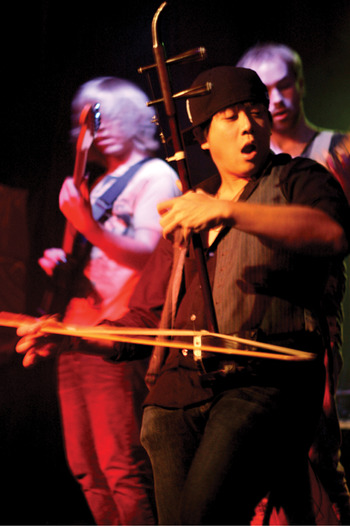
Jack's erhu-rock modifications, however masculinised, are most visible in the position of his instrument during performances. Conventionally, the erhu is played on the performer's lap in the seated position; Jack clips the fragile wooden fiddle onto his waist while he wields his bow (see Figure 1). With brute but highly controlled force, Jack plays in an upright style similar to his favourite rock guitar virtuosos such as Slash, former lead guitarist of Guns N' Roses. The comparison with Slash is notable from a gender perspective: Slash slings his guitar low so that it sits in front of his groin. The guitar's proximity to his genitals is coupled with the fast shredding movement in the high register on the fingerboard of the guitar. This combination engenders signifiers of ‘cock rock’ and suggests male sexual prowess as articulated by the phallic displays on the guitar (Tringali Reference Tringali2005).
Jack Hsu, Taiwanese Welcome Party, Don Hill's Club, New York City, 26 September 2008. Photograph by the author.

The Hsu-nami's friends and fans often comment on the sexualised aspects of the erhu-rock performance. At the end of a show, a young (white) man in his twenties, who appeared to be friends with the band, yelled, ‘I want your Pimp-Stick’ – referring to the erhu. The stick-like shape of the instrument and its erected performance position bring the phallic symbolism into relief. The reference to pimping connotes a control over female sexuality. In that light, Jack's wielding of his Pimp-Stick realises the ‘rock'n’roll' dream of playing music while ‘getting girls’. Not only that, his Pimp-stick creates opportunities for him to fit comfortably into the male-dominated, heterosexual norms within rock music culture (Coates Reference Coates and Whiteley1997; Nguyen Reference Nguyen, Nelson and Tu2001), in spite of his status as a racial minority. Aligning with the gender and sexual norms in rock music enables Jack to achieve his goal of creating a universal appeal for himself and his instrument.
Leveraging a transnational musical diplomacy
In face of the splintering and pigeonholing politics, Jack Hsu has come to embrace his transnational, intra-ethnic limbo associated with his erhu fusion rock project. Not only that, in an attempt to sidestep political positioning, he has found himself slipping into the expected role of a cultural diplomat to facilitate the understanding of ethnic, generational, and racial differences within and beyond Taiwanese America. The rhetoric of cultural diplomacy has offered Jack and his band the privilege of curating cultural content to represent Taiwanese America. It also provides them with opportunities to interface with commercial entities interested in the ‘Asian’ market. I argue that Jack and his band's cultural diplomacy project exemplifies the multiculturalist logic: a co-existence of cultural differences, ethnically and racially defined. In this last section, I will discuss how Jack and his band have established for themselves a role as cultural diplomats, musically and institutionally; how this diplomacy project mobilises multiculturalist thinking to undermine ethnic nationalist practices; and how diplomacy slips into a capital-driven consumerist multiculturalism, an ideological mode that conveniently boosts the commercial viability of the band.
Led by Jack's vision, The Hsu-nami's mission of diplomacy has manifested itself in its more recent musical endeavours. On their second album (The Hsu-nami, 2009), the song ‘Passport to Taiwan’ demonstrates the band's culture-based diplomatic approach to musical syncretism. In this song, The Hsu-nami adapted the melodies of three Taiwanese folk and early popular songs and arranged them into an erhu-rock medley. Quite literally, the arrangement of the medley figures Jack as a cultural ambassador, introducing Taiwanese tunes to his bandmates. During the first song of the three-song medley, ‘Dark Sky’ (天黑黑), with striking lyricism, Jack introduces the minor pentatonic melody of the verse section on his erhu over power chords on the guitar. In the chorus section, guitarist Brent joins Jack's erhu, doubling the melody. After the second chorus, now occupying the sonic centre-stage, Brent plays a guitar solo that makes a departure from the original pentatonic melody. He takes the original tune's tonal centre away from the pentatonic minor sound around A and G to hover around E and C. After playing a cluster of notes in the C major scale and then hitting a high C, Brent's solo descends and lands on A, bringing back the chorus melody in the original A pentatonic minor mode. Jack and Brent repeat the erhu-and-guitar union in the last chorus to end the first song in the medley. This song embodies the band's cultural work of representing ‘Taiwan’ through integrating Taiwanese ‘folk tunes into the sonic fabric of rock music.’Footnote 9 This song counters the notions of ethnic purism and essentialism by blurring the aesthetic boundaries that define the folk music of Taiwan and of rock music, with roots in the US. On stage, Jack and Brent, usually wearing a ‘Say Yes to Taiwan’ T-shirt, stand side by side while playing the melody together (Figure 2). Their musical and kinaesthetic performance indicates an unequivocal union across the cultural and national rift between Taiwan and the US, between Asia and America.
Jack Hsu and Brent Bergholm, Taiwanese Welcome Party, Don Hill's Club, New York City, 26 September 2008. Photograph by the author.

The Hsu-nami named this song ‘Passport to Taiwan’ after the annual cultural festival organised by the Taiwanese American Association of New York (TAA-NY). Jack and his bandmate Brent have expressed their ultimate dream of touring Taiwan; positioning the song as a cultural visa, they hope that ‘Passport to Taiwan’ will help them gain entry into the country.Footnote 10 According to Jack, covering Taiwanese songs served to ‘thank the festival. [I] chose the most famous ones that I knew since I was little’ (Hsu Reference Hsu2009b). The Passport to Taiwan festival emerged in 2002 after the United States Congress designated the second week of May as ‘Taiwanese American Heritage Week to recognise the contributions of Taiwanese Americans’. Spearheading the initiative to ‘introduce Taiwan and Taiwanese Americans’, Passport to Taiwan has since become the largest, most iconic outdoor Taiwanese event in the country. The Hsu-nami have performed at Passport to Taiwan every year since 2006, ultimately taking on the role of festival headliners. The metaphor of diplomacy concretised when the organisers, joined by the Taipei Economic and Cultural Office in New York (a unit of the Ministry of Foreign Affairs of Taiwan), appointed Jack as the event programmer for Passport to Taiwan 2010. Jack gladly accepted this (unpaid) position.
Echoing his fusion rock sensibility, Jack set out to make the festival less ‘traditional’, even claiming to create a ‘hip’ Taiwanese America. Over various chat sessions, Jack consulted with me, looking for recommendations of bands with a Taiwanese American contingent. After serious consideration, Jack created a music programme featuring Taiwanese folk performances and five rock-oriented groups to fit the ‘Taiwanese-American Bands Rock Passport to Taiwan 2010’ bill. The event flyer displays images of loudspeakers and denim as a background to appeal to the young Taiwanese Americans and the non-Taiwanese American passers-by. Along with his efforts to subvert the traditions at past events, Jack enlisted DJ Hatfield, an Anglo-American anthropologist fluent in Mandarin and Taiwanese, as the emcee of the event. When I asked Jack to explain his emcee choice, he said that it would be ‘cool’ to let a Mandarin-speaking ‘white guy’, an unlikely ethno-linguistic combination, to be the face of the event. Jack's work as a festival organiser destabilises the notions of ethnic essentialism routinised at most cultural festivals. The event's emphasis on the ‘hip’ and its departure from the default traditionalist focus on folk arts draws a mixed audience of Taiwanese immigrants, second- or later generation immigrants, and individuals of non-Taiwanese descent. This mixed-bag approach to programming creates an aesthetically and racially multiplistic Taiwanese America, beyond what is imagined by Taiwanese ethnonationalists and mainstream America.Footnote 11
Undeniably, The Hsu-nami's visible position as cultural diplomats has led to a series of product sponsorships. These partnerships position the band as an icon to draw an international, multi-ethnic clientele with ambiguously ‘Asian’ interests. Both Jack and his bandmates get free t-shirts from Akufuncture, an independently owned t-shirt company that ‘brings together Chinese culture and street wear’. A few band members enjoy their hi-top sneakers provided by Taiwanese-owned shoe company Jump. With a sponsorship from the Tokyo-based beer company Asahi, the band members receive free beverages at performances. Asahi has sponsored a number of performance events featuring the band, including the Chinese Night, a CMJ (College Music Journal) performance showcasing The Hsu-nami, along with three bands from Beijing, China. What does it mean to be playing at a concert that features bands from the PRC while wearing ‘urban-inspired’ shoes manufactured by a Taiwanese company and overtly drinking Japanese beer? I assume that Asahi is uninterested in making national or ethnic distinctions between these signifiers. These companies have identified The Hsu-nami as an iconic influencer to reach a market ambiguously labelled as ‘Asian’, lumping together identifiers of ‘Japanese’, ‘Chinese’, ‘Taiwanese’, and ‘American’, all at once.
Contrary to Jack's mixed-bag programming at the cultural festival, through these partnerships The Hsu-nami's multiplistic affiliations fall into a rather uncritical mode of multiculturalism. Scholars have couched US multiculturalism within two opposing political contexts: a critical practice that destabilises notions of ethnic and racial essentialism and contests the material inequalities that structure the mode of representation (Palumbo-Liu Reference Palumbo-Liu1995, Reference Palumbo-Liu2002); or an uncritical, neoliberal, consumerist formation that celebrates ethnicity without questioning racial inequalities and histories (Prashad Reference Prashad2001). I argue that Jack and his band's deployment of cultural diplomacy exists somewhere between these two ideological poles. Jack and his band's involvement at Taiwanese cultural events counters ethnic and racial essentialism; but their orientation toward commercial sponsorship reinforces the capitalist impulse to sell culture and ethnicity.
Ultimately, Jack and The Hsu-nami's version of cultural diplomacy exemplifies a kind of pragmatic multiculturalism that reflects the experiences of many individuals of Taiwanese descent and Asian racial status in the US. Pragmatic multiculturalism, as a concept, allows the social agent to fluctuate between being critical and uncritical. It foregrounds the marginal position of the Asian American minority that moves back and forth between voicing its minority status and harvesting the benefits of being a transnationally situated agent. The Hsu-nami's depoliticisation and gravitation toward commercial success hardly make the band an outlier, even within rock music narratives. Keir Keightley articulates the tension between rock music's ostensibly political and counter-cultural front and its commercial foundation: ‘Rock may wear subcultural clothes, identify with marginalised minorities, promote countercultural political positions, and upset genteel notions of propriety, but from its inception it has been a large-scale, industrially organised, mass-mediated, mainstream phenomenon operating at the very centre of society’ (Keightley Reference Keightley, Frith, Straw and Street2001, pp. 126–7). When presented with an opportunity to gain visibility through commercial means, most independent musicians, including The Hsu-nami, simply cannot resist. Because, after all, Jack and his bandmates are pursuing their rock-star dreams.
Conclusion
On the surface, the musical, performative, and discursive details of a single band fronted by a Taiwanese American erhu player could hardly seem deserving of scholarly attention. Yet, as I have outlined above, the unique position of Jack Hsu and his band The Hsu-nami illuminates the overlapping social and political contexts previously uncovered in scholarship. These contexts include ethnic nationalism within the overseas Taiwanese community; the race-based ideologies surround a presumably foreign instrument such as the erhu in rock music discourse and, by extension, mainstream racial discourse in the US. The ethnographic account teases out a Taiwanese American response of ambivalence to the geopolitics surrounding Taiwan, and various creative strategies to address its unique discursive position.
While the experiences of Taiwanese Americans are sometimes dismissed in Taiwanese studies, it is my hope that this paper has argued for the importance of understanding Taiwan and its culture in a transnational setting. The members of Taiwanese American communities have actively participated in the cultural and political landscape of Taiwan. Commercially successful Mandopop singer-songwriter Wang Leehom, along with Mandopop icon David Tao and members of the rap group LA Boyz, are either American-born or have spent a significant amount of their childhood and adolescence in the US. These recording artists have undeniably shaped the sounds and styles of music made in Taiwan. At the independent music level, the contact between Taiwan and Taiwanese America is all the more complex and interesting. On 6 August 2009 Typhoon Morakot struck the island of Taiwan. The typhoon triggered mudslides, severe flooding and the loss of many lives and homes throughout southern Taiwan. In the wake of the typhoon and its aftermath The Hsu-nami, double-billed with Kou Chou Ching, a hip-hop group touring from Taiwan, raised substantial funds and brought media attention in the US to the disasters in Taiwan. In addition, Susan and Emily Hsu of indie pop band Exit Clov made a fundraiser video of themselves playing and singing a classic Taiwanese pop song. Their YouTube video was circulated in Taiwan and celebrity figures made a mock performance based on the Hsu sisters' video on a game show.Footnote 12 The tremendous support for the typhoon victims inspired me to organise a fundraiser in central Virginia. This event instigated the formation of my own band Dzian!.
This paper is the first of potentially many on transnational popular musics about Taiwanese and Asian America. The mode of production and reception of popular music and its scholarship can sometimes be territorial. By highlighting the experiences of Taiwanese America, I look forward to joining the emerging scholarly conversation that expands our definition of ‘Asia’ beyond the geographical landmass. With a new lens on a transnational Asia, we can systemically look at the rich musical projects that have redrawn the aesthetic, ethnic, national, geographical, and racial boundaries of Asian pop.
Acknowledgements
The author thanks the guest editors Hyunjoon Shin, Tunghung Ho and Yoshitaka Mori, and the anonymous reviewers for their comments. She is also grateful to Jack Hsu and the rest of The Hsu-nami for their friendship and patience.