1. Introduction
Current research in the field of bilingual language development identifies Age of Onset of Acquisition (AOA) and the quantity and quality of input as main factors in the search for understanding the route and rate of bilingual acquisition of different target structures (Tsimpli, Reference Tsimpli2014; Unsworth, Argyri, Cornips, Hulk, Sorace & Tsimpli, Reference Unsworth, Argyri, Cornips, Hulk, Sorace and Tsimpli2014). In this cross-linguistic research agenda, gender is one of the most frequently studied linguistic features.
Several earlier studies have suggested, somewhat simplified, that gender assignment and gender concord in a gendered language such as French are just as easy for the young monolingual child (L1) or the simultaneous bilingual child (2L1) as they are difficult for the adult L2 learner (cf. on (2)L1 studies by Carroll, Reference Carroll1989; Clark, Reference Clark and Slobin1985; Granfeldt, Reference Granfeldt2003, Reference Granfeldt and Dewaele2005; Karmiloff-Smith, Reference Karmiloff-Smith1979; Müller, Reference Müller and Meisel1994; cf. on adult L2 studies by Bartning, Reference Bartning2000; Carroll, Reference Carroll1989, Reference Carroll1999; Dewaele & Véronique, Reference Dewaele and Véronique2001; Granfeldt, Reference Granfeldt2003, Reference Granfeldt and Dewaele2005; Harley, Reference Harley1979; Hawkins & Franceschina, Reference Hawkins, Franceschina, Prévost and Paradis2004). Depending on the authors, the proposed accounts for explaining this L1–L2 difference have been couched within L1 transfer and the impossibility of acquiring functional features anew in adult L2 acquisition (Hawkins & Franceschina, Reference Hawkins, Franceschina, Prévost and Paradis2004), within maturational accounts (Meisel, Reference Meisel, Haznedar and Gavruseva2008; Möhring, Reference Möhring, Foster-Cohen and Nizegorodcew2001) or within different processing accounts, either of the input (e.g., adult L2-ignorance of some relevant properties in the input as in Carroll, Reference Carroll1999) or of the output (e.g., adult L2-impossibility of producing surface level morphology as in Grüter, Lew-Williams & Fernald, Reference Grüter, Lew-Williams and Fernald2012). Even though these accounts differ in their theoretical approaches and the proposed exact locus of the L1–adult L2 difference, they share a reference to AOA effects in some way or another.
An AOA effect is perhaps most clearly argued for in the maturational account of Meisel (Reference Meisel, Haznedar and Gavruseva2008). Meisel argued on the basis of both behavioural and neurophysiological data for a cut-off point for L1 acquisition between ages 3 and 4 years. If AOA occurs before age 4, the language will develop as in simultaneous bilinguals (2L1) and be virtually indistinguishable from L1 monolingual development. If AOA occurs after 4 years but before 8 years we will be dealing with an instance of child L2 acquisition with some features (bound morphology) developing as in adult L2 acquisition and others (syntax) as in L1 acquisition.
More recent studies on gender marking have generally confirmed previous empirical findings for adult L2 learners of French (Lindström, Reference Lindström2013), whereas results in particular from 2L1 acquisition of gender point to differences between gender assignment and gender concord (or agreement) (Kupisch, Akpinar & Stöhr, Reference Kupisch, Akpinar and Stöhr2013). Importantly, some of these recent studies have pointed out that gender systems (and grammatical features in general) are not equally difficult to acquire, some systems and features being more transparent and others more opaque (Ågren, Granfeldt & Thomas, Reference Ågren, Granfeldt and Thomas2014; Rodina & Westergaard, Reference Rodina and Westergaard2013; Unsworth, Argyri, Cornips, Hulk, Sorace & Tsimpli, Reference Unsworth, Argyri, Cornips, Hulk, Sorace, Tsimpli, Danis, Mesh and Sung2011). In turn these findings have opened up for a discussion of the influence of quantity and quality of input on the development of gender (Nicoladis & Marchak, Reference Nicoladis and Marchak2011; Unsworth, Reference Unsworth2013, among others), which has emerged as a competing explanation to AOA and transfer accounts in order to explain gender difficulties in bilingual development. By now there is an emerging consensus in this field of research that the quantity and quality of input is particularly important in bilingual acquisition of ‘late’, ‘harder’ or ‘more opaque’ grammatical structures (Gathercole, Reference Gathercole2007; Chondrogianni & Marinis, Reference Chondrogianni and Marinis2011; Unsworth et al., Reference Unsworth, Argyri, Cornips, Hulk, Sorace and Tsimpli2014), structures typically involving interface relationships of some kind (e.g., lexicon–syntax, syntax–semantics, syntax–pragmatics) (Sorace, Reference Sorace, Cornips and Corrigan2005, Tsimpli, Reference Tsimpli2014). In a language like French, the development of gender will simultaneously have effects on different linguistic levels, including an abstract system level, the lexical level and the syntactic level. This makes gender a particularly interesting structure to study in bilingual development since, with previous research in mind, different aspects of gender can be predicted to be more or less sensitive to, for example, input effects.
Therefore, I examine in this study the development of three aspects of gender in French (see below) in a longitudinal multiple case study including successive (L2) Swedish–French bilingual children (n = 4), simultaneous (2L1) Swedish–French bilingual children (n = 4) and monolingual French children (n = 4). The age span covered in the study ranges from 3;5 to 10 years, but no child was followed for more than three years. Two of the L2 children have an AOA below 4 years and two of them have an AOA above 4 years (cf. Meisel, Reference Meisel, Haznedar and Gavruseva2008). All children attend the same French-speaking school, Lycée français St Louis de Stockholm, in Sweden.
There are comparatively few longitudinal studies in the recent literature on gender marking, especially on L2 children with different AOAs, and one of the specific contributions of the present study is the longitudinal study of a small set of children in different modes of acquisition over a long period of time. Moreover, the linguistic development of other structures has been studied in the same children (e.g., Ågren et al., Reference Ågren, Granfeldt and Thomas2014; Granfeldt, Reference Granfeldt2012) allowing for comparisons between gender development and other morphosyntactic features in French. Another important feature of the present study is the operationalization of the input factor. In many studies input is either only roughly estimated or defined as the equivalent to Length of Exposure (see Unsworth, Reference Unsworth2013 for criticism). In this study input conditions within school were similar for all included children since they all attended one and the same French-speaking school. Moreover, input outside school was measured for each bilingual child individually through the establishment of a detailed input profile (see details below and in Ågren et al., Reference Ågren, Granfeldt and Thomas2014).
The paper is organised in the following way: section 2 presents three aspects of gender in French and Swedish. Section 3 then contains an overview of previous research on the acquisition of gender marking, with an emphasis on French. Section 4 presents the method and the establishment of input profiles. The results are presented in section 5 and discussed in section 6. The conclusion is presented in section 7.
2. GENDER, attribution and concord – three facets of a single feature
Following previous research (Carroll, Reference Carroll1989), I will assume that gender in French is present at three different linguistic levels: a) as an abstract gender property of French nouns, b) as a binary feature [+/– masculine] in lexical entries for individual French nouns, and c) at the level of syntax as an agreement feature resulting in gender concord within the DP which is morphologically marked on some adjectives.Footnote 1 The abstract gender feature can be thought of as a ‘macroparameter’ (cf. Tsimpli, Reference Tsimpli2014), a system-internal abstract and global feature.
In all learning contexts, the attribution of a particular gender [MASC] or [FEM] to a particular noun is of course learned by exposure to input. Since gender in French is only predictable in part of the inventory of nouns (cf. Corbett, Reference Corbett1991 and below), this selection must be more inductive (i.e., more local) than the activation or selection of the abstract gender feature itself. In terms of input strings the difference is easily understood. All strings involving any gender marking are potentially relevant to the child and the L2 learner when activating or selecting the gender feature itself, but only strings involving relevant properties for a particular noun, say maison, are useful for acquiring the knowledge that maison is [- masc]. Previous research has found that in both (2)L1 and L2 acquisition a word like maison can be assigned gender both ‘locally’ from determiner-noun pairings and through inductive generalisation to a subclass of nouns, triggered in particular by formal morpho-phonological properties of the noun class (Carroll, Reference Carroll1989; Karmiloff-Smith, Reference Karmiloff-Smith1979; Kupisch et al., Reference Kupisch, Akpinar and Stöhr2013; Müller, Reference Müller and Meisel1994).
Features of lexical entries project and depend on syntactic Functional Categories (FCs) for checking, deletion and ultimately for interpretation (Chomsky, Reference Chomsky1995). For gender concord a specific proposal was put forward by Carstens (Reference Carstens2000) within this general framework.Footnote 2
In summary, gender is present at three different levels in French: first as an abstract gender eature (Carroll, Reference Carroll1989) with the characteristics of a ‘macroparameter’ as in Tsimpli (Reference Tsimpli2014), second as a binary lexical feature of nouns and third, in syntax, as a grammatical feature triggering concord between constituents.
2.1 Gender in French and Swedish
Both Swedish and French have binary grammatical gender systems. Modern-day Swedish distinguishes common from neuter gender (1a and 1b), whereas French has a feminine vs. masculine distinction (2a and 2b).Footnote 3
(1)

(2)


In both languages, the two genders are unequally distributed in the lexicon. About 60% of all French nouns are masculine (Tucker, Lambert & Rigault, Reference Tucker, Lambert and Rigault1977) and approximately 70–75% of all Swedish nouns have common gender (Andersson, Reference Andersson1992). These biased distributions will probably produce an overlap of masculine French nouns and common Swedish nouns, but apart from this frequency effect there seem to be no simple correspondences between the two lexicons, although such a correlation cannot be excluded.
French has an intricate gender system which is considered to be opaque (Corbett, Reference Corbett1991) or even arbitrary (Riegel, Pellat & Rioul, Reference Riegel, Pellat and Rioul1994). Whereas the semantic gender system is straightforward and contains few exceptions, the grammatical gender system is highly complex. Probabilistic formal and semantic gender rules with varying degrees of coverage have been put forward (Tucker et al., Reference Tucker, Lambert and Rigault1977; Lyster, Reference Lyster2006). In particular some of the phonological tendencies have been found to be reliable cues for children acquiring French (Karmiloff-Smith, Reference Karmiloff-Smith1979), but successfully acquiring French gender assignment is determined, at least initially, on having repeatedly encountered a particular noun in the input together with an adjacent determiner and/or an adjective displaying gender. This is particularly true for monosyllabic French nouns (Carroll, Reference Carroll1989).
As the above examples show, the gender feature produces an overt agreement effect on both the article and the adjective in both languages, but in Swedish the morphological gender distinction on the adjectives is lost when the DP is definite. In spoken French, only a third of all adjectives are gender-marked overtly (Riegel et al., Reference Riegel, Pellat and Rioul1994), but the distinction is made on more than half of the adjectives in the register referred to as “Français fondamental” (Surridge, Reference Surridge1993). In both languages, the overt gender agreement is lost in the plural, on articles in both languages and in Swedish also on adjectives. In French, gender information is lost on articles in the singular if the following noun is vowel-initial (e.g., élision as in l'école).
3. Previous research on the development of gender with an emphasis on French
A common finding for L1 monolingual acquisition of gender in French is that it develops during the first three years of life, often with low error rates for gender assignment and with comparatively small individual differences (Carroll, Reference Carroll1989; Clark, Reference Clark and Slobin1985).
By and large findings on gender development in French are the same for L1 and 2L1 children, at least up to 3 years and in the stronger language (Granfeldt, Reference Granfeldt2003; Hulk, Reference Hulk, Prévost and Paradis2004; Müller, Reference Müller and Meisel1994). Granfeldt (Reference Granfeldt2003, Reference Granfeldt and Dewaele2005) studied the development of gender in three Swedish–French 2L1 children who were mostly balanced bilinguals and found very few gender mistakes altogether, both in assignment and concord (cf. also Müller, Reference Müller and Meisel1994). However, the fact that error rates are low does not necessarily mean that concord is acquired and sometimes it can be hard to establish in spontaneous production because of a lack of data. Hulk (Reference Hulk, Prévost and Paradis2004) observed that the bilingual child Anouk started out by producing the ‘default’ masculine form of adjectives and it was only at 2;7 that the feminine forms of adjective appeared in the data (cf. Granfeldt, Reference Granfeldt2003 for the same finding).
Studies on somewhat older simultaneous bilinguals (3–6 years) have shown that if French is clearly the weaker language error rates can be higher (Granfeldt, Schlyter & Kihlstedt, Reference Granfeldt, Schlyter, Kilhstedt and Granfeldt2007; Kupisch, Müller & Cantone, Reference Kupisch, Müller and Cantone2002). Higher error rates in both gender assignment and gender concord in 2L1 French compared to age-matched L1 French data were also found by Nicoladis and Marchak (Reference Nicoladis and Marchak2011) on French–English simultaneous bilinguals aged 3 to 5 years. The authors argued that the higher error rates in the 2L1 children, compared to, for example, those in Granfeldt (Reference Granfeldt2003, Reference Granfeldt and Dewaele2005), could be a task effect. Nicoladis and Marchak used a picture-naming task while other studies have relied on spontaneous data. The feminine forms of adjectives turned out to be particularly difficult in this study. When looking at agreement between the determiner and the adjective, Nicoladis and Marchak found that adjectival agreement was particularly difficult (in both L1 and 2L1) after a feminine determiner which could be interpreted as an overuse of masculine forms of adjectives (cf. Hulk, Reference Hulk, Prévost and Paradis2004). Nicoladis and Marchak argued that reduced input and less experience with French in the bilinguals could explain the differences between the 2L1 and L1 data. Interestingly, Unsworth (Reference Unsworth2013) found that differences in the amount and quality of input could explain the development of gender assignment in Dutch bilingual children, but when assignment was controlled for and the focus was on gender concord, the effect of input disappeared. One possible conclusion is that it is, in particular, the lexical aspect of gender marking, assignment, which is affected by input properties, while the question of the role of input for gender concord, at least in children, seems to be more open.
Studies on child L2 acquisition are scarcer. Meisel (Reference Meisel, Haznedar and Gavruseva2008) found that some of the German–French L2 children with an AOA of around 4 years displayed similarities with adult L2 acquisition with respect to gender in French, others not. The evidence was both quantitative (error rates) and qualitative (gender mistakes with nouns whose endings clearly predict gender). Meisel explained the findings within a maturational account, where neurophysiological changes take place around the fourth year of life, resulting in a different developmental route compared to (2)L1 acquisition (see also Möhring, Reference Möhring, Foster-Cohen and Nizegorodcew2001).
Unsurprisingly, one typically finds high error rates at beginner and intermediate stages of adult L2 French both in assignment and concord (Granfeldt, Reference Granfeldt2003, Reference Granfeldt and Dewaele2005; Hawkins & Franceschina, Reference Hawkins, Franceschina, Prévost and Paradis2004; Lindström, Reference Lindström2013). In Bartning and Schlyter's (Reference Bartning and Schlyter2004) model of morphosyntactic development of adult French L2, gender assignment reaches 90% correctness only at the very last stage, stage 6, which describes the highly advanced L2 learner of French. Several studies have shown that gender concord is more difficult than gender assignment at low and intermediate stages of adult L2 French (Bartning, Reference Bartning2000; Dewaele & Véronique, Reference Dewaele and Véronique2001; Granfeldt, Reference Granfeldt2003, Reference Granfeldt and Dewaele2005).Footnote 4 However, studies focusing on end-state L2 learners find that gender concord is easier than gender assignment and that adult L2 learners can reach native-like levels of gender concord at this stage (Bianchi, Reference Bianchi2013, Kupisch et al., Reference Kupisch, Akpinar and Stöhr2013). Error patterns in assignment and concord in adult L2 French are revealing. Both Hawkins and Franscheschina (Reference Hawkins, Franceschina, Prévost and Paradis2004) and Granfeldt (Reference Granfeldt2003, Reference Granfeldt and Dewaele2005) have argued that gender errors in L2 are at least in part a result of the overuse of a particular form of a determiner or of an adjective and not the overgeneralization of a default masculine gender. Granfeldt (Reference Granfeldt and Dewaele2005) showed that while some adult L2 learners overused le and une as determiners, others overused la and un. In a similar way, Granfeldt (Reference Granfeldt2003) found that adult L2 learners at beginner and intermediate stages might overgeneralize feminine forms of adjectives together with masculine determiners (e.g., le petite chien, 'the.MASC. small.FEM. dog.MASC). This type of error seems to be a typical L2 error with respect to gender concord.
3.1 Research question and general predictions
The main research question in this study is:
What is the effect of Age of Onset of Acquisition and quality and quantity of input on the development of the three different aspects of French gender in simultaneous and successive bilingual acquisition of French where the other language is Swedish?
If the development of some aspects of gender is primarily influenced by input conditions, we expect to see developmental differences, in terms of delay and/or variability, between all three major groups L1, 2L1 and cL2 and possibly individual differences, in particular in the two latter groups, 2L1 and cL2, where input profiles vary (see below). On the other hand, if the development of gender is primarily influenced by AOA, we expect to see no or few differences between the L1 and the 2L1 children, but more pronounced differences between the (2)L1 and cL2 children, possibly with additional intra-group differences depending on the AOA of the L2 children (below or above 4 years) following the proposal by Meisel (Reference Meisel, Haznedar and Gavruseva2008).
4. Method
4.1 Children and corpus
The children in this study all attend a French school in Sweden which falls under the jurisdiction of the Agence pour l'Enseignement Français à l’Étranger (AEFE) and ultimately under the French Ministry of Education (Ministère de l’Éducation Nationale Français). The school is primarily French-speaking and accepts children with various linguistic backgrounds. In this study, 12 children from the following groups at the school will be included:
(i) Monolingual French-speaking children with two French-speaking parents (L1, n=4)
(ii) Bilingual Swedish–French children with one French-speaking parent (2L1, n=4)
(iii) Swedish-speaking children with two Swedish-speaking parents (cL2, n=4)
The school has a French monolingual orientation but also explicitly states on its website and in official documents that the aim is for L2 children to be proficient bilinguals when entering high school.
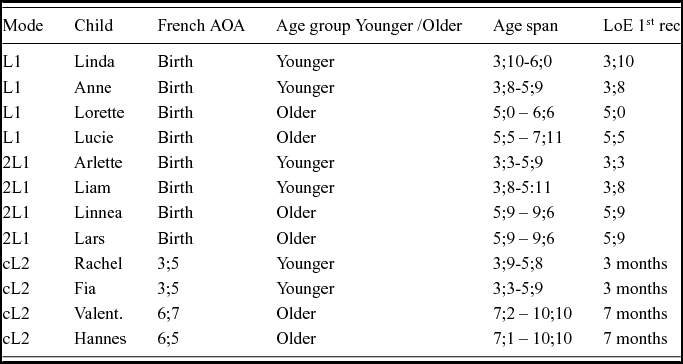
Biographical data of the twelve children included in the study are presented in Table 1. There are four children in each mode of acquisition. These are further divided into a younger and an older age group. The L2 children in the younger age group started in primary school (resulting in an AOA = 3;5) whereas the older L2 children started school directly without any prior exposure to French (resulting in an AOA = 6;5). They all spend the entire day at school and are almost exclusively exposed to French by the teachers and their French-speaking peers. However, none of the L2 children speak French at home. When comparing the children studied at a group level, Table 1 demonstrates an overlap between AOA and Length of Exposure (LoE) in the L1 and the 2L1 children. The L2 children, in contrast, have a higher AOA, 3;5 and 6;5 respectively, and a considerably shorter LoE than the other two groups.
Biographical data on the children in the study.

NB: The LoE for the cL2s is based on 10 months of exposure per year. If they were exposed to French during their summer holidays we added that time.
4.2 The individual input profilesFootnote 5
All children in the present study attend one and the same French-speaking school (see above). This means that at school the children are exposed to a very similar amount (six hours) and type input in French during an ordinary school day. The input addressed to the children from the many native French-speaking teachers is high-quality input, thus referring to both the variety of French native teachers that the children meet at school and to the experience these teachers have of teaching French to children with varied linguistic backgrounds. Furthermore, we define the input from the children's peers to be of mixed quality overall. The majority of children at the school are bilingual, which in terms of input could be thought of resulting in language mixing and more language errors than compared to a monolingual situation.
Since input at school is overall the same, the individual input profile thus focuses on the main characteristics of each child's input situation outside school and aims to operationalise differences in the quality and quantity of input in French that the children are exposed after school has finished, during weekends and during holidays. We developed this measure in a previous publication (Ågren et al., Reference Ågren, Granfeldt and Thomas2014) and the results from this procedure are reused in this study but some new children have been analyzed and added to the database. The input profile score of each child (see below) was established on the basis of interviews with the parents. For the interviews we used a detailed questionnaire about the children's and the families’ French-language use and access to authentic materials in French. As a complement, we also interviewed the teachers about the language situation at the school and talked to the children themselves about French-speaking friends and activities outside school. In the interviews the following quality and quantity-oriented input variables were investigated:
• Mode of acquisition of French of each parent (L1, L2, no French)
• Proportion of French spoken at home
• Number of weeks spent in French-speaking countries per year
• Contact with other French-speaking persons
• Access to French television
• Reading habits in French
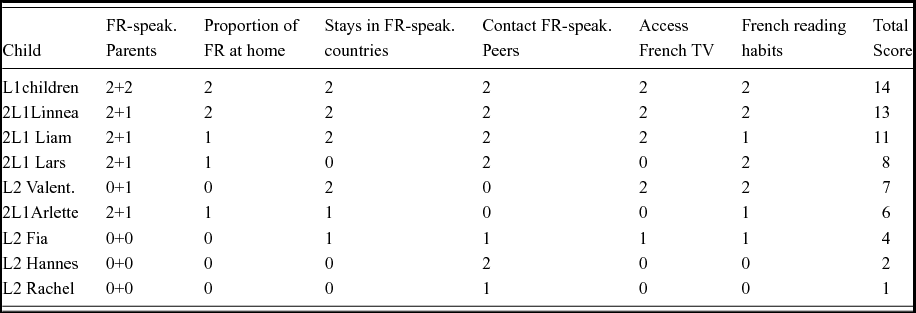
It is difficult to distinguish between variables tapping into input quantity and input quality respectively. Therefore, Paradis (Reference Paradis2011) talks about quantity and quality-oriented variables. The input profile presented here should be viewed as a whole reflecting both aspects. In the input profile each factor was quantified (scores 0, 1 or 2) in order to obtain a global score of the quantity and quality of input for each individual child outside school. For more details of the scoring procedure and the reasoning behind it, I refer to Ågren et al. (Reference Ågren, Granfeldt and Thomas2014).
Table 2 presents the results of the investigation of the input factors in the 12 children studied. The individual input profiles are presented in decreasing order, from the children with the strongest to the child with the weakest input profile.
Individual input profile scores for the children in the study.

From Ågren et al. (Reference Ågren, Granfeldt and Thomas2014), table 5.
We estimate that the L1 children have access to the maximal amount of input, which translates into a score of 14 points. Even though variations in input situations can also be found among L1 children (De Houwer, Reference De Houwer2009), the L1 children studied here have a very similar parental SES (socioeconomic status) and they are rather homogeneous as to the input variables focused on in this study. The L1 children typically lead a ‘French-speaking life’ in Sweden and they are exposed to very little Swedish even outside school. This is mainly due to the establishment of a French-speaking community in Stockholm in which francophone families from the Lycée St Louis have an important role. Consequently the L1 children develop very little knowledge of Swedish during their stay in the country.
When considering the other two groups of children, 2L1 and L2, we find almost a complete overlap between 2L1 acquisition and higher input profile scores. With the sole exception of the 2L1 child Arlette, all the 2L1 children have a higher input score than the L2 children. This is mainly due to the fact that the 2L1 children speak French at home with at least one of their parents. More importantly for the present study, we can also observe differences in input profiles within a group of children. There is not necessarily a great difference in input profile between the L1 children (14 p.) and the 2L1 child Linnea (13 p.), but there is a considerable difference between 2L1 Linnea (13 p.) and 2L1 Lars (8 p.) or 2L1 Arlette (6 p.). Similarly, the L2 child Valentine (7 p.) receives much more French input outside school than Rachel (1 p.) who is exposed to virtually no French outside school.
4.3 Data collection procedures, transcriptions and analysis
Recordings were made in Swedish and in French on a regular basis, approximately every 3 to 5 months. They took place at school, in a separate room, with a native French speaker and a native Swedish speaker as principal interviewer in the respective settings. Only the French data will be used in this study.
Each recording session lasted for about 30 minutes and included two types of procedures:
• Free conversations about the past, the present and the future
• Different elicitation procedures, narratives as well as specific tests (but not focusing on gender)
The transcriptions of the recordings were carried out and checked by students or members of the research team. The CLAN editor was used and the transcriptions follow the mid-CHAT transcription conventions (MacWhinney, Reference MacWhinney2000).
Data for gender assignment and gender concord in French were pooled from all transcripts, across different procedures. This resulted in a total of 3,978 noun tokens which could be subjected to further analysis.
Recall the objective of this paper, which is to study three aspects of gender in French, gender as an abstract feature of the language, gender as a lexical feature (gender assignment) and gender as a syntactic feature triggering concord. For each of these three levels a specific empirical analysis was carried out:
(1) The development of gender as an abstract feature was assessed on the basis of a varied used of indefinite (un vs. une) and definite articles (le vs. la), the argument being that if children have discovered that French has gender, the first context where this will be evident is in the article system. Note that only a varied use of different articles with different nouns within the respective domains of definiteness was assessed, not the target-like use of these articles.
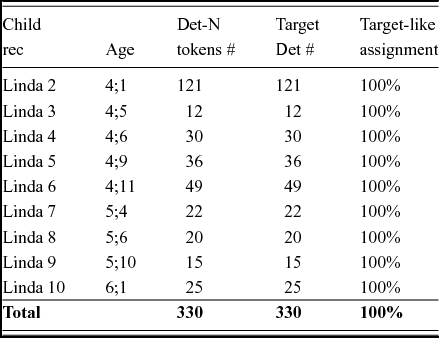
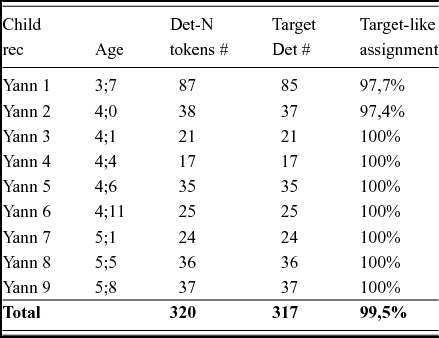
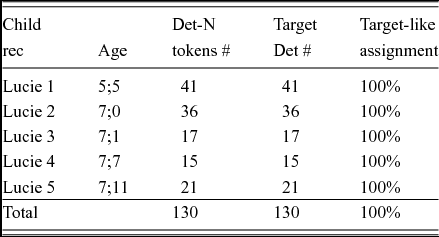
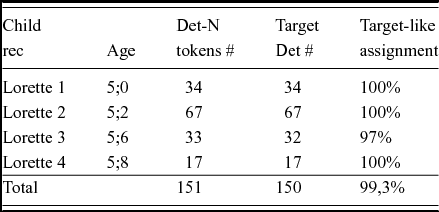
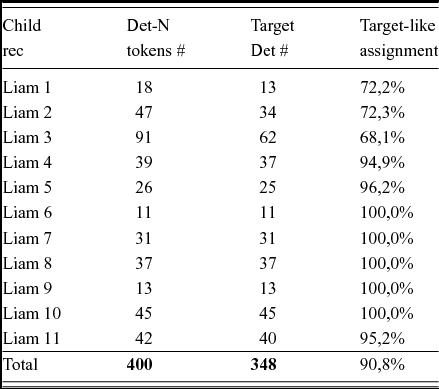
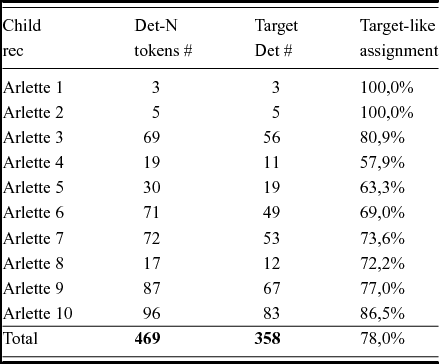
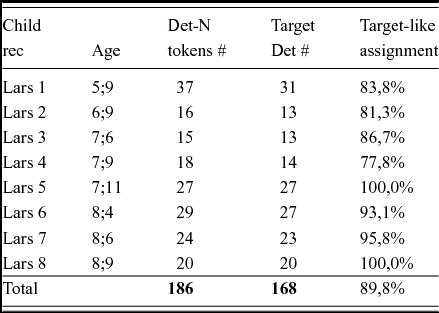
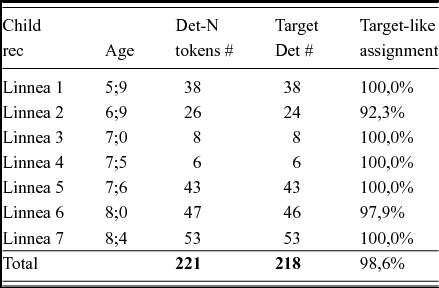
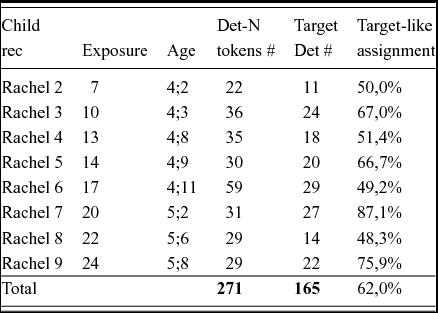
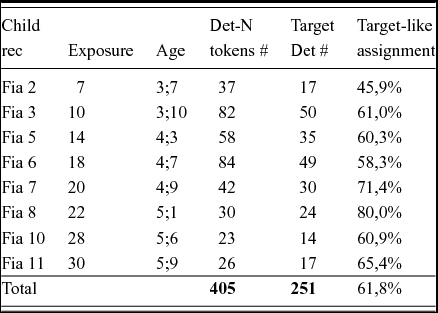
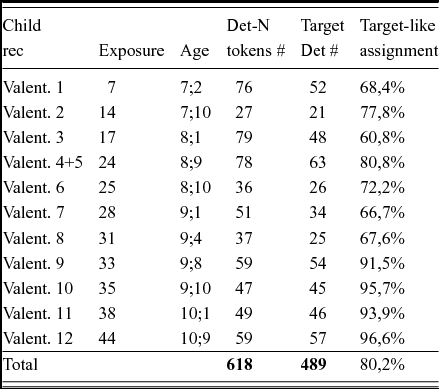
(2) Following, among others, Dewaele and Véronique (Reference Dewaele and Véronique2001) and Kupisch et al. (Reference Kupisch, Akpinar and Stöhr2013), the development of gender assignment was assessed on the basis of target-like use of determiner + noun combination, including articles, possessive pronouns (mon, ma, etc), demonstratives (ce, cette) and some indefinite pronouns (certain, certaine).Footnote 6 Gender assignment was studied longitudinally and I report results as percentages of target-like assignments, at both a group and an individual level. Raw numbers of occurrences for each child and each recording are provided in Tables 7–18 in Appendix 1. In addition to this, I also carried out an error analysis in order to identify what types of gender assignment that are made in the different groups.
(3) Again following Dewaele and Véronique (Reference Dewaele and Véronique2001) and Kupisch et al. (Reference Kupisch, Akpinar and Stöhr2013), gender concord was assessed on the basis of concord between a noun and an attributive or predicative adjective. A well-known difficulty with gender analysis in spontaneous production data is the possible confusion between assignment and concord (Glahn, Håkansson, Hammarberg & Holmen, Reference Glahn, Håkansson, Hammarberg and Holmen2001; Granfeldt, Reference Granfeldt and Dewaele2005). Consider a DP like *le petit maison (the.MASC small.MASC house.FEM). Two types of analysis are possible here. If we only consider the adjective we might conclude that there is no concord in this case, since maison is [–MASC] and petit is [+MASC]. But if we make the additional hypothesis that maison has incorrectly been assigned [–MASC] in the learner's mental lexicon (cf. Figure 1) in this case and that the determiner is showing this erroneous assignment, then we might say that there is concord between the adjective and the noun. In order to avoid underrepresenting the children's knowledge of gender concord, I opted for the second type of analysis in this study. For this analysis, then, gender assignment of the head noun was decided on the basis of the co-occurring determiner and the adjective was considered the target for marking concord.
Gender assignment in L1, 2L1 and cL2 groups - all data points collapsed.

However, relevant data on adjectives with an audible difference between masculine and feminine forms were relatively scarce in the corpora (n = 200 tokens in all groups). Therefore only group level analyses of gender concord are presented here. Raw numbers of occurrences for each group are provided in Table 19 in Appendix 1. In addition to these analyses I also performed error analyses on the non-concord patterns in order to reveal potential similarities or differences between the groups.
Statistical analyses were performed where it was deemed appropriate and the data allowed for it. Non-parametric statistics were used throughout since the data was not normally distributed.
5. Results
5.1 Development of gender
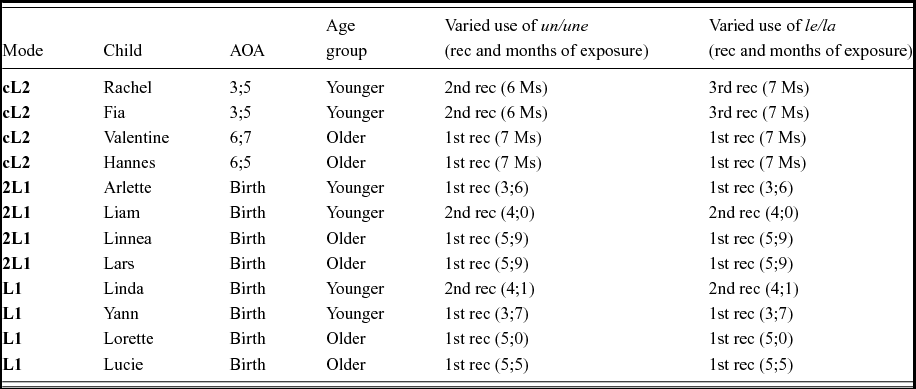
The focus of this analysis is on the cL2 learners, since both the L1 and the 2L1 children were past the stage where gender is discovered when data collection started.Footnote 7 Table 3 shows that both the younger and the older cL2 learners have discovered gender after some 7 months of exposure.Footnote 8
Time of varied first use of articles with different gender in French.

The younger cL2 children (AOA = 3;5) first start using gendered forms of the indefinite article (un/une) and somewhat later the definite article (le/la). This development is in line with previous studies on the development of the article in 2L1 and L1 children (Müller, Reference Müller and Meisel1994; Granfeldt, Reference Granfeldt2003). The results also suggest that the amount and quality of input outside school, i.e., the input profile score, does not seem to affect the rate with which the cL2 learners discover the gender feature. The two children with the lowest input profile scores, Hannes (2 p.) and Rachel (1 p.) start using different gender forms of articles equally fast as their respective age-matched peers with higher scores (Valentine, 7 p., and Fia, 4 p., but see footnote vii).
5.2 Development of gender assignment
I will start by presenting the data on a group-level for the whole data collection period, then I will present the developmental data for each child. Figure 1 shows group-level means of accuracy on target-like and non-target-like gender assignment for the whole data collection period. Since the cL2s have had much less exposure to French I do not expect them to perform at the same level as the L1 and 2L1 children, but it is important to establish their respective proficiency levels with respect to gender assignment.
The L1 children are at ceiling with 99.6% target-like assignment, whereas the 2L1 children reach a mean of 91.0% target-like assignment when all data points are considered together. The difference between L1 and 2L1 is significant according to an independent samples Mann Whitney-U test U =213, p = .000. Unsurprisingly, the cL2 children do not reach the same levels of accuracy but are still clearly above chance level with 75.3% as an overall mean. As could be expected, the difference between the cL2s and the L1s is significant U =18, p = .000, as is the difference between the cL2s and the 2L1s U =317, p = .000. The results in Figure 1 are all expected under the hypothesis that input conditions is the single most important factor for development of gender assignment in French.
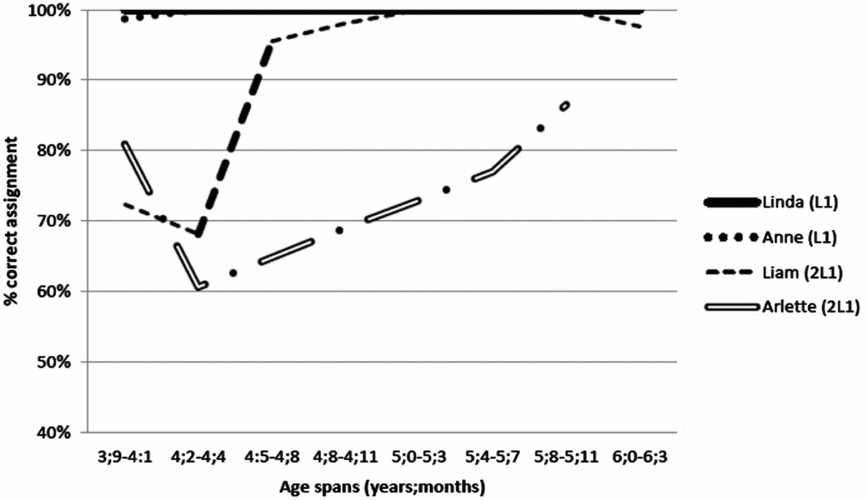
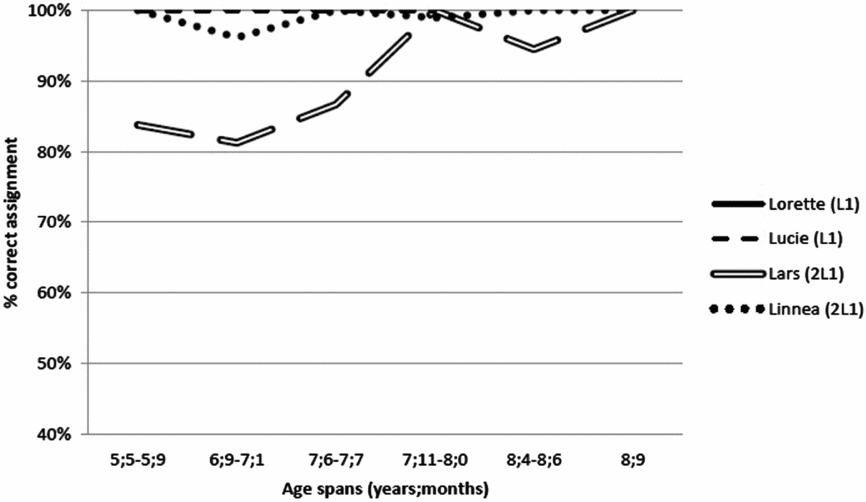
Figures 2 and 3 below show the development of gender assignment in the L1 and 2L1 children. Figure 2 presents age-matched results for the younger group (3–5 years) and Figure 3 presents the same results for the older children (5–9 years).
Development of gender assignment in L1 and 2L1 group - Younger children. The data on Arlette from Günes (Reference Günes2014).

Development of gender assignment in L1 and 2L1 group - Older children.

Figures 2 and 3 show that both the younger and the older L1 children are at ceiling with respect to gender assignment as evidenced by the choice of an adjacent determiner. More importantly, the figures also show that the 2L1 children in both the younger and the older group develop towards the French target system during the data collection period. This is especially true for the two 2L1 children in the younger group (cf. Figure 2), Liam and Arlette, but also for the older 2L1 child Lars (cf. Figure 3).
If we look at the effect of quality and quantity of input as measured by the individual input profile scores we see fairly strong positive correlations with target-like gender assignment, both when the individual data points are considered separately (rate of development) and when the whole data collection period is considered together. If we begin by looking at rate of development, we see in Figure 2 that the 2L1 child Liam clearly develops faster than the 2L1 child Arlette. This difference in the rate of development correlates with their respective input profiles. Recall that Arlette is the 2L1 child with the weakest input profile (6 p. out of 14). Liam, on the other hand, has a more average input profile score for 2L1 children (11 p.) according to my analysis. Differences in input profile scores can also explain the rate difference in the older 2L1 group (cf. Figure 3). Lars, another 2L1 child with a comparatively weak input profile (8 p.), develops much more slowly than the 2L1 child Linnea (13 p.).
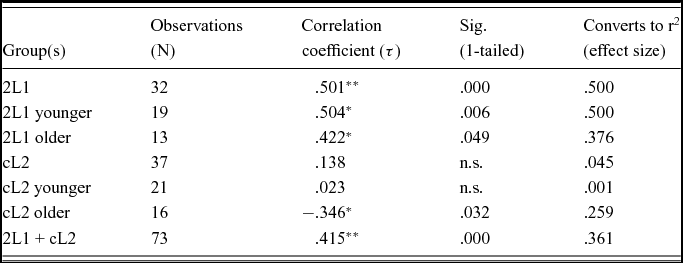
Table 4 below presents group-level correlations between input profile scores and means of target-like gender assignment in percentages when the whole data collection period is considered together.
Correlations between input profile scores and target-like gender assignment - all data points collapse.

NB! Following Gilpin (Reference Gilpin1993) I used a conversion table to convert the tau coefficient to an r2 score.
From Table 4 we can see that there is a significant positive correlation between input profile scores and target-like gender assignment in the 2L1 children. This is true both for the group as whole and when the younger and older 2L1 children are considered separately. The effect sizes range between .376 and .500, which should be considered medium to strong. The results for the cL2 learners will be commented after the presentation of the developmental data in Figure 4.
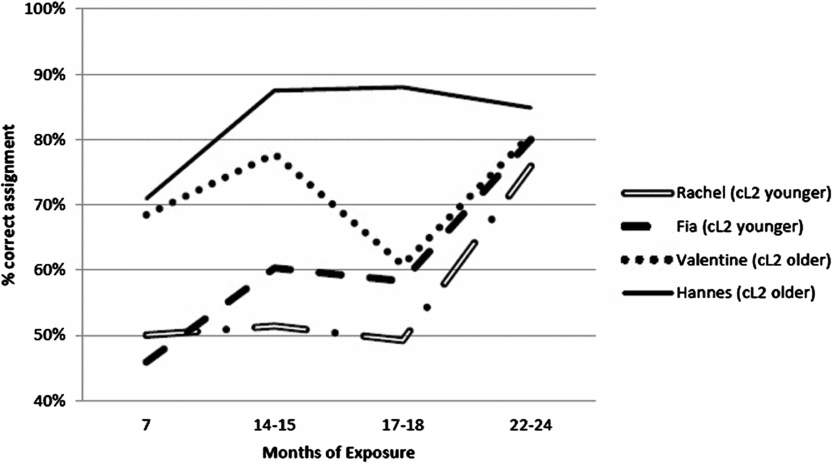
Development of gender assignment in cL2 group - Younger and older children.

Figure 4 shows several interesting results. To begin with, it can be observed that the older cL2 learners (with an AOA of 6;5) develop faster initially. At 7 months of exposure they choose the right gender form of determiners about 70% of the time, whereas the younger cL2 learners (with an AOA of approximately 3;5) are at chance level after the same length of exposure.
At the same time it is difficult to find any clear correlation between input profile scores and rate of development of gender assignment. In fact, the cL2 learner Hannes with the second lowest input profile score (2 p.) outperforms the cL2 learner Valentine with the highest input profile score of all cL2 learners (7 p.). In the younger group there is no difference between Rachel, the child with the lowest input profile score (1 p.), and Fia, with a higher input profile score (4 p.).
When returning to Table 4 above we see that even if the whole data collection period is considered and a group-level analysis is performed there is no positive significant correlation between quantity and quality of input as measured by the input profile score and gender assignment. The finding that input profile scores correlate better with the rate of linguistic development in 2L1 than in cL2 was also found in a previous study on these children (Ågren et al., Reference Ågren, Granfeldt and Thomas2014). I return to this observation in the discussion below.
5.2.1 Error analysis of gender assignment
In the next step I will look at where gender assignment errors occur. Since gender assignment errors are extremely rare in the L1 children's data, this analysis is restricted to the data from the 2L1 and cL2 groups.Footnote 9 A first question is if assignment is equally difficult in both genders for the children. Figure 5 below presents the results.
Proportion of gender assignment errors with masculine and feminine nouns.

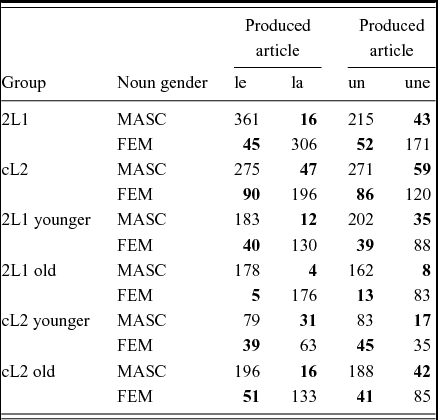
Figure 5 shows that errors with feminine nouns are more frequent than errors with masculine nouns. The difference between masculine and feminine errors is significant according to a related samples Wilcoxon Signed Rank Test in 2L1 Z =88,5, p = .000, in 2L1 younger Z =29,5, p = .004 and in 2L1 older Z =18,0, p = .008. The difference is also significant within the cL2 group as a whole Z =141, p = .036 but not when cL2 younger and older are considered separately (cL2 younger Z =24, p = .423 and cL2 older Z =53,5, p = .054). Another way of putting it is to say that Figure 5 seems to show that masculine gender is overgeneralized by all children, as a default, irrespectively of mode of acquisition. However, it is not clear from Figure 5 if it is masculine gender per se that is being overgeneralized or if it is the case that certain forms of determiners are overgeneralized. Recall that previous studies on adult L2 acquisition have found that adult L2 learners of French overgeneralize individual forms of articles (Granfeldt, Reference Granfeldt2003, Reference Granfeldt and Dewaele2005; Hawkins & Franscheschina, Reference Hawkins, Franceschina, Prévost and Paradis2004). In order to distinguish between these two possibilities Table 5 presents a confusion matrix, in raw occurrences, showing how often a particular form of an article (definite or indefinite) was produced and what the expected target form was in each case (based on the target gender of the noun). This analysis allows us to see if a particular form of a definite or indefinite article more frequently replaces another form than vice versa. Incorrect uses of an article are signalled by bold face in the table. With this information we can compute a degree of overgeneralization for individual articles by dividing the total number of incorrect uses of a particular article with the total number of contexts for the article (Figure 6).
The use of articles in 2L1 and cL2 - all data points collapsed.

Legend: Produced articles and gender of accompanying nouns. Figures in bold face are errors.
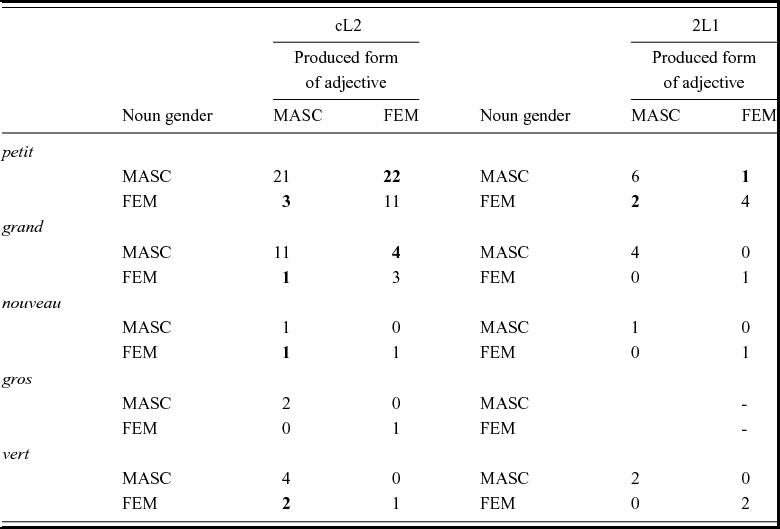
The use of five adjectives in 2L1 and cL2 - all data points collapsed.

Legend: Produced forms of adjectives and gender of accompanying nouns. Figures in bold face are errors.
Degree of overgeneralization of different articles in 2L1 and cL2.

From Table 5 and Figure 6 we can observe that the article le is incorrectly replacing the article la more often than vice versa. This is true in both 2L1 and cL2 and in-line with the idea that MASC is overgeneralized, but when the indefinite articles are considered it becomes clear that masculine gender per se is not being overgeneralized. The indefinite article un is not more often incorrectly replacing une than vice versa. In the 2L1 group the two forms of indefinite articles are overgeneralized to an equal extent while in the cL2 group it is the article une which is more often used incorrectly (cf. Figure 6). When we compare the proportion of overgeneralization of the two articles (definite and indefinite) within MASC and FEM, we see from Figure 6 that the article une is clearly more overgeneralized compared to la than un compared to le. This is true for both 2L1 and cL2. One possible interpretation is that both the 2L1s and the cL2s are avoiding the nasal vowel in un and replacing it with une perhaps for phonological reasons but this needs to be investigated further. This conclusion is supported by the fact that la is the article which is the least overgeneralized if 2L1 and cL2 are considered separately. It is not the case then that assignment of feminine nouns is particularly difficult to acquire.
5.3 Gender concord
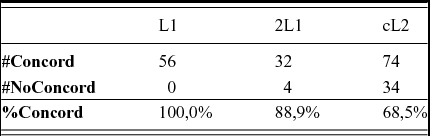
Gender concord was assessed on the basis of concord between a noun and an attributive or predicative adjective (200 occurrences in total). For this analysis the gender feature of the noun was decided on the accompanying determiner, not according to the target language. Since there were comparatively few occurrences to analyse for gender concord in the 2L1 and the cL2 data, only group-level results will be presented here. Figure 7 shows the main results for gender concord in the three modes of acquisition.
Gender concord in L1, 2L1 and cL2 groups - all data points collapsed. In L1 only the younger children are included in the analysis.

The results indicate that the L1 children are again at ceiling with respect to gender concord (even though only the younger L1 children are included here) whereas the 2L1 children reach 88.9% of correct concord. According to a Mann Whitney-U test, the difference between the L1s and the 2L1s is not significant U =.950, p = .400. Recall that the same comparison between the L1s and the 2L1s with respect to gender assignment (cf. Figure 1) showed a significant difference. The overall mean for gender concord in the cL2 group is 65.4% correct concord and the difference between the 2L1s and the cL2s is significant U =.834, p = .029.
The cL2 learners are clearly doing better on gender assignment than on gender concord (75.3% vs 65.4%). The difference is significant according to a one-sample t-test, t(3)=12.023, p=0.001. Three out of four cL2 learners show this pattern in their individual data. This suggests that gender concord is hard for the cL2 learners, a result in line with several previous studies on beginner and intermediate adult L2 acquisition of French (Bartning, Reference Bartning2000; Dewaele & Véronique, Reference Dewaele and Véronique2001; Granfeldt, Reference Granfeldt and Dewaele2005). The 2L1 children perform at the same level as the L1s on gender concord but are less good with gender assignment.
5.3.1 Error analysis of gender concord
Figure 8 shows how often MASC forms are incorrectly replacing FEM forms of adjectives and vice versa.Footnote 10 The analysis suggests that when there is an error in gender concord in the 2L1 data it is because a MASC form of an adjective (e.g., *la petit maison) was produced instead of a FEM form of the adjective, in line with what Nicoladis and Marchak (Reference Nicoladis and Marchak2011) found for English–French 2L1s. In the cL2 we find the opposite pattern where a FEM form of the adjective (e.g., le petite chien) was produced instead of the MASC form, which is a result previously found only with adult L2 learners at low and intermediate stages (Granfeldt, Reference Granfeldt2003). Recall that in this analysis, gender of the head noun was decided on the determiner which means that gender assignment was factored out and that the observed context is the one between the determiner and the adjective.
Frequency of overgeneralization of different forms of adjectives in 2L1 and cL2.

Finally, Table 6 shows that the tendency in cL2 to overgeneralize feminine forms of adjectives in combination with masculine determiners is particularly strong with the most frequent adjectives. The single most frequent adjective with an unambiguous feminine form is petit (small). For this particular adjective, it is about 7 times more frequent in the cL2 data that the feminine form incorrectly replaces the masculine form than vice versa.
6. Summary and discussion
In this study the development of three aspects of gender in French were studied in three groups of children acquiring French, monolinguals (L1, n=4), simultaneous bilinguals (2L1, n=4) and successive bilinguals (cL2, n=4). The cL2 learners either had an AOA below 4 years (n=2) or above 4 years (n=2). All in all 12 children from the same French school in Sweden were followed longitudinally over a period of nearly 3 years for some of the children. For each bilingual child, an individual input profile measuring input in French outside school was established on the basis of parental interviews. The research question was to what degree AOA and/or input quality and quantity influenced the development of the three aspects of gender, 1) discovery of the abstract GENDER feature, 2) gender assignment and 3) gender concord in the two groups of bilinguals.
With respect to the first aspect the results showed that both the younger (AOA < 4 years) and the older cL2 learners (AOA > 4 years) had discovered that French is a gendered language after 7 months of exposure. There was no clear evidence for an effect of input scores on the rate with which the cL2 learners discovered the GENDER feature.
There are at least three circumstances working together that can be invoked as an explanation for these findings. First the abstract GENDER feature resembles a ‘macroparameter’ (cf. Tsimpli, Reference Tsimpli2014), a system-internal abstract and global feature with only limited semantic effects (e.g., grammatical gender). Features of this type are typically acquired early in L1 acquisition and insensitive to individual input differences (Tsimpli, Reference Tsimpli2014). Second there is massive evidence for GENDER in the French language to the extent that also children with a low input profile score will probably receive more than sufficient exposure to this feature in order to discover it early. Finally, since Swedish also has gendered determiners and these develop before age 3 years in L1 Swedish, it is reasonable to assume that initial determiners in cL2 French contain a gender feature.
The second facet of gender in French that was studied was the lexical gender feature, i.e., the choice of [+/– MASCULINE] for a particular noun (assignment). Overall means and the rate of development were significantly correlated with the 2L1 children's respective input profile. Children with a higher score on their input profile developed faster and vice versa. No such correlation between input profile scores and rate of development of gender assignment was found in the cL2 learners. The results showed instead an initial AOA advantage in the cL2 learners in favour of the older cL2 learners (cf. Muñoz, Reference Muñoz2014). The older children with an AOA of 6;5 showed higher levels of correctness in gender assignment after 7 months of exposure than the younger children with an AOA of 3;5 after the same length of exposure. After 2 years of exposure, however, the younger cL2 learners had caught up completely with the older cL2 learners.
The finding that the rate of development of gender assignment in 2L1 French correlates significantly with input profile scores is expected and in line with previous studies on gender assignment in different languages by bilingual children and bilingual adult speakers (Bianchi, Reference Bianchi2013; Kupisch et al., Reference Kupisch, Akpinar and Stöhr2013; Nicoladis & Marchak, Reference Nicoladis and Marchak2011; Rodina & Westergaard, Reference Rodina and Westergaard2013; Unsworth et al., Reference Unsworth, Argyri, Cornips, Hulk, Sorace and Tsimpli2014 among others). More surprisingly, the input profile scores did not correlate significantly with overall means of correct gender assignment or with the rate of development of gender assignment in the cL2 group. The exact same result was found in a previous study on finiteness, object clitics and S-V agreement in the same children as studied here (see Ågren et al., Reference Ågren, Granfeldt and Thomas2014 and below). Under the assumption that the input profile scores are tapping into relevant properties of input conditions, Ågren et al. (Reference Ågren, Granfeldt and Thomas2014) argued that it is in sense logical that the quality and quantity of input have different effects in 2L1 compared to cL2. If we hypothesise that input conditions such as the ones included in the input profile are relatively constant over time, we would expect to see a cumulative effect of input differences between children (cf. Unsworth, Reference Unsworth2013). As a consequence, the magnitude of momentary input differences between children will increase over time. Therefore, it is in a sense natural that the effect of input is best seen in groups of children with a longer exposure time, such as the 2L1 group. It may be that the individual input differences in the cL2 group will become apparent at later stages, when these daily differences will have had time to play out more.
The error analysis of gender assignment suggested that both 2L1 and cL2 children made more errors with feminine nouns than with masculine nouns which could point to an overgeneralization of masculine gender. This finding could be due to a frequency effect since the French lexicon is unevenly distributed with approximately 60% masculine nouns. However, a closer analysis of individual articles revealed that it is not masculine gender per se which is being overgeneralized but rather individual articles. Interestingly enough, le is preferred over la but un is not preferred over une and this is true for both 2L1 and cL2. The form une is particularly favoured in the cL2 data with 33% overuse (cf. Figure 6). In this respect, there was no difference between the younger cL2s with an AOA below 4 years and the older cL2s with an AOA above 4 years (cf. Table 5). This finding echoes previous studies on adult L2 acquisition of French in which it has been argued both for Anglophone learners and for Swedish-speaking learners that individual forms of articles are overgeneralized (Granfeldt, Reference Granfeldt2003, Reference Granfeldt and Dewaele2005; Hawkins & Franscheschina, Reference Hawkins, Franceschina, Prévost and Paradis2004). The fact that Swedish–French 2L1 learners, child and adult L2 learners with a gendered L1 (Swedish) and L2 learners with an, in principle, non-gendered L1 (English) display similar patterns also casts doubt on any crucial effect of the L1 with respect to the development of gender assignment. Rather it points to a general learning problem where learners pick an individual form of an article to express in/definiteness with nouns for which they haven't yet acquired the gender. Importantly for the present study, 2L1 and cL2 seem to pattern more or less alike in this respect, with the possible exception of the cL2s preferring the form une as a default to a greater extent. However, the 2L1s and the cL2s are not directly comparable due to differences in exposure time.
The last facet of gender in French studied here was gender concord. Due to a lack of adjectives, this analysis was only performed at the group level and for the entire data set, so interpretations with respect to individual differences and development over time should be avoided. As was the case with gender assignment, the group results on gender concord showed that the L1 children performed at ceiling for this aspect too, but that the 2L1 children did not differ significantly from the L1s with respect to gender concord. It was not the case, then, that gender concord was ‘harder’ than assignment for the 2L1 children. By contrast, in the cL2 group the group-level performance for gender concord was significantly below the level for gender assignment in the same children (75.3% for assignment vs 65.4% for concord). There was no difference between the younger cL2 learners with an AOA below 4 years and the older cL2 learners with an AOA above 4 years. The finding that concord is harder than assignment is parallel to many studies on adult L2 acquisition of gender (Bartning, Reference Bartning2000; Dewaele & Véronique, Reference Dewaele and Véronique2001; Granfeldt, Reference Granfeldt2003, Reference Granfeldt and Dewaele2005; Lindström, Reference Lindström2013, but see Bianchi, Reference Bianchi2013; Kupisch et al., Reference Kupisch, Akpinar and Stöhr2013 for different results).
Interestingly enough, error patterns for gender concord differed in 2L1 and cL2. As in at least one previous study on 2L1 children (Nicoladis & Marchak, Reference Nicoladis and Marchak2011, but see also Hulk, Reference Hulk, Prévost and Paradis2004), the 2L1 children had a clear tendency to overuse masculine forms of adjectives in combination with feminine articles. The cL2 learners displayed the opposite pattern and overused feminine forms of adjectives with masculine determiners, something that has not been documented, to my knowledge, in 2L1 acquisition of French. Again, the two groups are not directly comparable since input conditions and total amount of exposure differ, but the finding is still interesting and might say something about qualitative differences in the development of gender concord in 2L1 and cL2 acquisition. There were no differences between the younger cL2 learners (AOA < 4 years) and the older cL2 learners (AOA > 4 years) in this respect.
So why then should there be a difference between gender assignment and gender concord in cL2 acquisition? I would like to focus here on the importance of the developmental timetable in the L1. Rather than posing an across-the-board sensitive period for language acquisition, the available results suggest a more complex picture. A combination of the order of acquisition in the L1, the linguistic properties of the particular structure and input conditions seems to be at play when the L2 child is developing a particular structure of the target language. In order to show this, I will in the following section draw on results from two previously published studies on the development of two other comparable morphosyntactic structures, subject-verb agreement and finiteness, in partly the same children as the ones studied here.
6.1 Development of gender in the light of other morphosyntactic structures in the same children
In Ågren et al. (Reference Ågren, Granfeldt and Thomas2014) we looked at subject-verb agreement in 3rd person plural (together with two other structures) in partly the same children that were studied here. Overt subject-verb number agreement in spoken French can be described as partial, heterogeneous, and lexically-conditioned in the sense that it is not audible in all verbs and not in all persons. In fact, according to Marty (Reference Marty2001) only 9.6% of all verb types in French display an audible difference between 3rd person singular and 3rd person plural. A verb like prendre ('to take') is thus an exception with the following forms: 3sg (e.g., prend /pʀã/, ‘takes’) from 3pl (e.g., prennent /pʀɛn/, ‘take’). In L1 acquisition of French S-V agreement in 3rd person plural develops very late. Errors are frequent up until 7 years according to Prévost (Reference Prévost2009) and involve replacing the 3rd person plural with a default form. In Ågren et al. (Reference Ågren, Granfeldt and Thomas2014) we found that all three groups of learners, L1, 2L1 and cL2, had difficulties in acquiring agreement in 3rd person plural and that the rate of development was highly correlated with the input profiles scores. One can argue that overt 3rd person S-V agreement in spoken French is not syntactically governed but rather lexically restricted. In this respect this feature resembles gender assignment and it should come as no surprise, then, that the development of both of these structures, despite being very different, largely depends on input conditions.
Now, compare 3rd person S-V agreement to finiteness. Schlyter and Thomas (Reference Schlyter, Thomas, Watorek, Benazzo and Hickmann2012) studied the development of finiteness, measured as the distribution of long and short verb forms, in some of the children included in the present study. We know from the literature that finiteness is acquired very early in L1 French (Meisel, Reference Meisel and Meisel1994) and L1 Swedish (Platzack, Reference Platzack and Meisel1992). In both languages the acquisition can be considered to be completed before 2;5 years. We also know that finiteness develops according to different sequences in (2)L1 and adult L2 French (Schlyter, Reference Schlyter, Dimroth and Starren2003). A diagnostic structure for identifying adult L2 learners at initial stages is the combination of subject clitic + non-finite verb form, e.g., *il parler. With respect to the L2 children Schlyter and Thomas (Reference Schlyter, Thomas, Watorek, Benazzo and Hickmann2012) found that both the children with an AOA below 4 years and the L2 children with an AOA above 4 years produced, initially and to varying degrees, the typical adult L2 structure. Consider the following example from Schlyter and Thomas (Reference Schlyter, Thomas, Watorek, Benazzo and Hickmann2012) from one of the children in the cL2 younger group (AOA < 4 years), Rachel:
(3)

In this example Rachel produces combinations of subject clitics and non-finite verb forms (il regardE and il lire) which are diagnostic of an L2 developmental sequence of finiteness in French. If we compare this to the findings of the present study on gender concord in the cL2 learners, a plausible conclusion is that the development of gender concord patterns more with finiteness than with 3rd person S-V agreement. The data here are a bit scarce but the cL2 learners with an AOA before age 4 were equally good (or bad) on gender concord as the cL2 learners with an AOA of 6 years. Moreover, the error patterns were the same in both cL2 groups also with very frequent adjectives like petit and, most importantly, different from the error pattern found in the 2L1 data, but comparable to what have been found in previous studies on adult L2 acquisition of gender concord (Granfeldt, Reference Granfeldt2003). We know from the literature that gender concord develops early in both L1 Swedish and L1 French, and gender concord is well-established before the AOA of the younger cL2s studied here. The data presented here suggest that one consequence is a developmental sequence for gender concord which is closer to what is known for adult L2 learners than to (2)L1 acquisition, even for cL2 learners with an AOA as low as 3;5.
7. Conclusion
This study investigates three aspects of a single feature in French, gender, and asks the question if the development of each of these is more or less dependent on AOA or input conditions. The results show that cL2 learners discover the macro-parameter GENDER equally fast independently of AOA and input conditions. It is also quite clear from the results that cL2 learners, independently of AOA, and 2L1 learners pattern mostly alike with respect to the development of gender assignment. The route and the rate of development of this lexical aspect of gender are to a high degree dependent on input conditions. Lastly, the results for development of gender concord, the syntactic aspect of gender, show that the cL2 learners might take a different route of development than the 2L1 children. This leads to the conclusion that a combination of AOA, the L1 acquisitional timetable for a particular structure, linguistic properties of the target structure and input conditions are all crucial aspects for a complete understanding of linguistic development in bilingual children.
Appendix 1 - Individual data
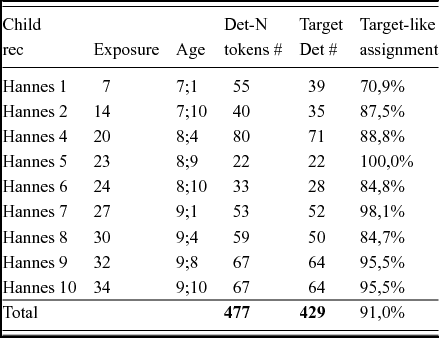
Gender assignment in the child Linda (L1).

Gender assignment in the child Yann (L1).

Gender assignment in the child Lucie (L1).

Gender assignment in the child Lorette (L1).

Gender assignment in the child Liam (2L1).

Gender assignment in the child Arlette (2L1).

Gender assignment in the child Lars (2L1).

Gender assignment in the child Linnea (2L1).

Gender assignment in the child Rachel (cL2) Exposure in months.

Gender assignment in the child Fia (cL2). Exposure in months.

Gender assignment in the child Valentine (cL2). Exposure in months.

Gender assignment in the child Hannes (cL2). Exposure in months.

Gender concord in L1, 2L1 and cL2*.