Implications
Oxidation of lipids and microbial spoilage are processes occurring in meat biological systems leading to an excessive deterioration of meat quality that limits meat acceptability and economic value. The inclusion of essential oils in livestock diets is becoming a common practice for improving meat shelf life as an alternative to postmortem addition of synthetic antioxidants into the product. Although, cinnamon essential oil dietary supplementation appears an interesting procedure to enhance sheep meat tissue antioxidant and antimicrobial efficacy, no significant effects on the examined meat properties (quality characteristics, oxidative stability and microbial counts) were observed in the present study.
Introduction
Oxidation by free radicals is one of the primary mechanisms for quality deterioration in food and especially meat products (Kanner, Reference Kanner1994). It is initiated in the highly unsaturated fatty acid fraction of membrane phospholipids, leading to the production of hydroperoxides, which are susceptible to further oxidation or decomposition to secondary reaction products such as short-chain aldehydes, ketones and other oxygenated compounds that may adversely affect lipids, pigments, proteins, carbohydrates, vitamins and the overall quality of products due to losses in flavour, colour and nutritive value limiting thus product shelf life (Kanner, Reference Kanner1994). The shelf life of meat and meat products is also influenced by the growth of spoilage bacteria. The degree of spoilage is defined by a maximum bacterial safety limit and the shelf life depends on the types and counts of microorganisms, that are initially present and their subsequent growth (Borch et al., Reference Borch, Kant-Muermans and Blixt1996).
In the past, synthetic agents were used to retard lipid oxidation and to control microbial growth of meat and meat products. However, in the last decade, considerable interest has arisen in the use of natural products that would serve as alternatives to synthetic compounds aiming to improve meat quality, without leaving residues in the product or the environment (Yanishlieva – Maslarova, Reference Yanishlieva-Maslarova2001). The use of natural antioxidants can prolong the shelf life and increase the acceptability of meat and its economic value in the marketplace. Moreover, nutritional approaches (endogenous treatments) are often more effective than exogenous addition of the antioxidant and/or antimicrobial agents to the muscle foods since the compound is preferably deposited where it is most required (Govaris et al., Reference Govaris, Botsoglou, Papageorgiou, Botsoglou and Ambrosiadis2004). Dietary supplementation of essential oils could increase tissue endogenous content and allow uniform incorporation of their compounds into the subcellular membranes where they can effectively inhibit the oxidative reactions and the microbial growth (Yanishlieva – Maslarova, Reference Yanishlieva-Maslarova2001; Burt, Reference Burt2004).
The use of essential oils in livestock diets is becoming a common practice, whereas several studies have provided evidence for the efficacy of direct addition of essential oils for improving meat shelf life (Zhang et al., Reference Zhang, Xiao, Samaraweera, Lee and Ahn2010). Inclusion of distilled rosemary leaves (Nieto et al., Reference Nieto, Diaz, Banon and Garrido2010a) or thyme leaves (Nieto et al., Reference Nieto, Diaz, Banon and Garrido2010b) in pregnant ewes’ and then in lambs’ diets reduced the rancid odour observed in lamb meat after 21 days under display in comparison to meat from lambs not receiving the above supplements. Dietary phenolic compounds have also been reported to strongly reduce meat lipid oxidation during display and storage. Zhong et al. (Reference Zhong, Tan, Han, Tang, Tan and Zeng2009) indicated higher stability in meat from goats receiving supplemental tea catechins in the diet compared with meat from animals in the control group. Moreover, Simitzis et al. (Reference Simitzis, Deligeorgis, Bizelis, Dardamani, Theodosiou and Fegeros2008) found that feeding lambs a diet supplemented with 1 ml/kg of oregano (Origanum vulgare hirtum) essential oil strongly reduced meat lipid oxidation during refrigerated and frozen storage.
Cinnamomum zeylanicum Blume (Lauracae) is a tropical tree that grows wild mainly in Sri Lanka, but also in Madagascar, India and Indochina (Bakkali et al., Reference Bakkali, Averbeck and Averbeck2008). The major compounds in the essential oil of C. zeylanicum are cinnamaldehyde, benzaldehyde, limonene, linalool and eugenol (Baratta et al., Reference Baratta, Dorman, Deans, Figueiredo, Barroso and Ruberto1998). It possesses intense antimicrobial (Unlu et al., Reference Unlu, Ergana, Unlu, Zeytinoglou and Vural2010) and antioxidant (Prasad et al., Reference Prasad, Yang, Dong, Jiang, Zhang, Xie and Jiang2009) properties. Cinnamomum zeylanicum action is mainly attributed to cinnamaldehyde and eugenol, substances that react with lipid and hydroxyl radicals converting them into stable products through their hydrogen-donating ability (Jayaprakasha et al., Reference Jayaprakasha, Negi, Jena and Jaganmohan Rao2007) and inhibit production of essential enzymes by the bacteria due to the presence of a carbonyl group that binds and inactivates them and/or cause damage to the cell wall of the bacteria (Di Pasqua et al., Reference Di Pasqua, Betts, Hoskins, Edwards, Ercolini and Mauriello2007). Both Gram positive and Gram negative bacteria have been reported to be sensitive to cinnamon oil and cinnamaldehyde in in vitro experiments (Quattara et al., Reference Quattara, Simard, Holley, GJ-P and Begin1997). Although cinnamaldehyde is the main active component of cinnamon oil, other components, such as eugenol, present at low concentrations may interact with cinnamaldehyde, which may explain the more pronounced antimicrobial activity of cinnamon essential oil compared with cinnamaldehyde (Burt, Reference Burt2004).
Cinnamon constituents also possess intense antioxidant action and may prove beneficial against free radical damage to cell membranes (Dragland et al., Reference Dragland, Senoo, Wake, Holte and Blomhoff2003). It appears that the radical scavenging activity of cinnamon extracts stem from their hydrogen-donating ability. In detail, components of cinnamon essential oil are believed to intercept the free radical chain of oxidation and donate hydrogen from the phenolic hydroxyl groups, thereby forming a stable end-product which does not initiate or propagate further oxidation of lipid (Jayaprakasha et al., Reference Jayaprakasha, Jaganmohan Rao and Sakariah2004).
The objective of the present study was the evaluation of the effects of cinnamon (C. zeylanicum) essential oil dietary supplementation on lamb growth performance, carcass and meat quality characteristics.
Material and methods
Animals and diets
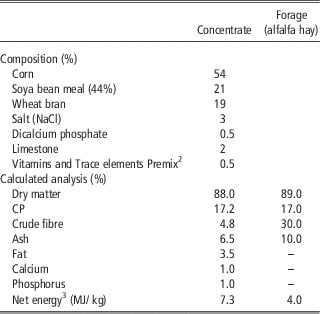
Sixteen male weaned 45 day-old lambs of the Karagouniki breed were weighed and randomly assigned into two equal groups. One of the groups served as a control and was given a commercial basal diet, whereas the other group was given the same diet further supplemented with cinnamon essential oil at 1 ml/kg of feed. Table 1 presents the ingredients and the composition of the control diet. The methods used in the present experiment were in accordance with the national legislation and the guidelines of the Research Ethics Committee of the Agricultural University of Athens.
Composition and calculated analysis of the basal (concentrates and alfalfa hay) dietFootnote 1

1 Lambs were fed ad libitum; control group was fed on the basal diet, and the cinnamon supplemented group was fed on the basal diet supplemented with cinnamon essential oil (1 ml/kg concentrated feed).
2 Premix contained per kg: 10 g Mn, 8 g Fe, 0.2 g Cu, 8 g Zn, 7 mg Se, 200 mg Co, 200 mg I, 60 mg Se, 200 mg Mo, 2000 kIU vitamin A, 400 kIU vitamin D3, 3 g vitamin E (kIU: 1000 International Units).
3 According to Agricultural and Food Research Council (AFRC) (1993).
Cinnamon essential oil used in the present study was purchased from Benforado David S.A. (Athens, Greece). It was extracted from the leaves of C. zeylanicum and was stored in a stainless sealed container, appropriate for volatile compounds (1l). It had a clear yellow colour and a warm, spicy musky odour, characteristic of cinnamon. Cinnamon essential oil main components were (%): eugenol (76.70), benzaldehyde (9.90), limonene (4.40) and cinnamaldehyde (1.30) (according to R.C. Treatt Ltd, Suffolk, UK). The level of cinnamon essential oil dietary supplementation (1 ml/kg concentrated feed) was selected, because according to preliminary studies conducted in our department no negative effects on lamb feed palatability were observed at this concentration (unpublished data). Taking into consideration that the cinnamon essential oil incorporated in lamb diet contained ~80% cinnamaldehyde and that the lamb average daily feed intake was 500 g, the daily level of cinnamaldehyde ingestion was ~0.4 ml per lamb, a quantity that was in accordance to the recent literature (400 p.p.m.) (Chaves et al., Reference Chaves, Dugan, Stanford, Gibson, Bystrom, McAllister, Van Herk and Benchaar2011).
Diet composed of the concentrated feed (70%) and alfalfa hay (30%) (Table 1), was provided ad libitum twice daily at 0800 and 1500 h. After feeding the concentrated feed, alfalfa hay was provided to all lambs together. Water was also available ad libitum. Lambs were individually fed in identical pens, placed with the same direction and orientation, the same covered area (2 m2/lamb) and equipped with similar troughs for feeding. Feed intake was daily recorded and lambs were individually weighed every week for estimation of BW gain.
The preparation of cinnamon supplemented diet was carried out every 5 days, throughout the experimental period. In detail, a quantity of concentrated feed (25 kg) was placed in a black-coloured container and it was gradually sprayed with cinnamon essential oil (1 ml/kg). Feed was continuously mixed during spraying, with the intention to obtain a uniform distribution of the essential oil. After the addition of the essential oil, the container was firmly sealed in order to minimize essential oil degradation due to exposure to air and light. The size of container was 0.125 m3 (length×width×height: 0.5×0.5×0.5 m) and it was stored at room temperature (20°C). The prepared quantity of concentrated feed was based on the estimated feed intake of the cinnamon group of lambs for 5 days. At the end of the 5th day, after the consumption of the cinnamon supplemented feed, the container was cleaned of feed remains and the procedure of feed preparation was repeated.
Evaluation of the growth performance parameters was based on the feed intake and live weight measurements recorded during the feeding trial. At day 80 of age (experimental period of 35 days), lambs were fasted for 18 h (water was allowed), weighed and slaughtered. After refrigerated storage for 24 h at 4°C, carcasses were weighed and sectioned longitudinally into two symmetric halves. Each carcass consisted of the following joints: legs, chumps, loins, anterior loins, ribs, anterior ribs, shoulders, breast and neck. The longissimus dorsi muscle thoracic region (6th to 13th rib) was then excised and used for measurements of pH, colour, water-holding capacity, intramuscular fat content and tenderness. Determination of lipid oxidation was performed on days 0, 3, 6 and 9 after refrigerated storage (4°C). Moreover, samples of longissimus thoracis muscle were inoculated either with Listeria monocytogenes 21 412 or Salmonella enteritidis PT4. Pathogen growth was monitored under domestic refrigeration conditions on 0, 1, 3 and 6 days post inoculation. All measurements were performed in duplicate.
Meat quality measurements
pH24 and colour
pH was measured using a pHM210 Meterlab pH System (Copenhagen, Denmark) model, with the electrode inserted into the longissimus thoracis muscle 24 h after slaughter. The pH meter was calibrated at ambient temperature in buffers at pH 4.0 and 7.0 (Merck, Darmstadt, Germany). The part of longissimus thoracis muscle between 12th and 13th ribs was sliced across the fibers, left exposed to the air at room temperature for 30 min to allow colour blooming and following that, muscle colour was measured (three measurements per sample) using a Miniscan XE (HunterLab, Reston, VA, USA) chromameter set on the L*, a*, b* system (Commission International de l’ Eclairage, 1976). A white and a black tile were used for calibration.
Cooking loss and shear force
Samples (80±2 g) of longissimus thoracis muscle were individually placed in plastic bag and cooked in a water bath at 75°C for 20 min. After removal from the water bath, the bags were placed under running water for 15 min and then left at room temperature. Samples were weighed again in order to estimate the percentage of cooking loss (%) (Geesink et al., Reference Geesink, Mareko, Morton and Bickerstaffe2001). Three sub samples with a cross section of 1 cm2 were then cut parallel to the muscle fibers and shear force value of the longissimus thoracis muscle was measured using a Warner Bratzler shear blade fitted to a Zwick Testing Machine Model Z2.5/TN1S (Zwick GmbH & Co, Ulm, Germany). Shear force was expressed in Newton values (N/cm2).
Water-holding capacity
Water-holding capacity was measured according to the method of Sierra (Reference Sierra1973). Muscle samples (5 g) (P1) were placed between two pieces of filter paper, and pressed for 5 min, using a weight of 2.25 kg. The muscle samples were then removed and re-weighed (P2). The percentage of water-holding capacity was calculated as (P1−P2)/P1×100.
Intramuscular fat content and lipid oxidation
The chemical fat content of longissimus thoracis muscle was determined according to the method first described by Folch et al. (Reference Folch, Lees and Stanley1957). Tissue samples were homogenized with a 20-fold volume of chloroform-methanol (2 : 1, v/v). The crude extract was mixed with 20% of its volume with water and it was separated into two phases. The lower phase contained the tissue lipids. The total fat content was gravimetrically determined.
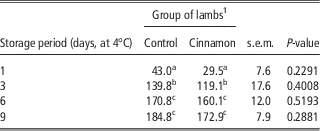
Lipid oxidation was assessed on the basis of the malondialdehyde (MDA), a secondary lipid oxidation product formed during storage. In the present study, MDA concentration in longissimus thoracis muscle samples stored in individual transparent plastic bags was determined 1, 3, 6 and 9 days after storage at 4°C by using a selective third-order derivative spectrophotometric method, previously developed by Botsoglou et al. (Reference Botsoglou, Fletouris, Papageorgiou, Vassilopoulos, Mantis and Trakatellis1994). Derivative versus conventional spectrophotometry was adopted because it offers improved sensitivity, specificity and reliability of the measurements, since it eliminates potential interferences from other reactive compounds.
In brief, 2 g of each sample (two samples per lamb) were homogenized (Edmund Buehler 7400; Tuebingen/H04, Germany) in the presence of 8 ml aqueous trichloroacetic acid (50 g/l) and 5 ml butylated hydroxytoluene in hexane (8 g/l), and the mixture was centrifuged for 3 min at 3000×g. The top hexane layer was discarded and a 2.5 ml aliquot from the bottom layer was mixed with 1.5 ml aqueous 2-thiobarbituric acid (8 g/l) and placed in a water bath at 70°C for 30 min. Following incubation, the mixture was cooled under tap water and submitted to third-order derivative spectrophotometry (Hitachi U3010 Spectrophotometer, Hitachi High-Technologies Corporation, Tokyo, Japan) in the range of 500 to 550 nm. The concentration of MDA (ng/g wet tissue) was calculated on the basis of the height of the third-order derivative peak at 521.5 nm by referring to slope and intercept data of the computed least-squares fit of a standard calibration curve prepared using 1,1,3,3-tetraethoxypropane, the MDA precursor.
Antimicrobial properties
Frozen samples of longissimus thoracis muscle were thawed and individually minced. Subsequently, each minced sample was divided in two portions of 10 g, each allocated in a separate sterile Petri dish and inoculated either with L. monocytogenes 21 412 or S. enteritidis PT4. The bacterial inocula had been grown aerobically for 18 h, in Tryptone Soy Broth (Oxoid, Basingstoke, UK) at 30°C and Brain Heart Infusion broth at 37°C, respectively, washed, re-suspended in sterile PBS buffer (0.1 M; pH 7.2) and diluted according to yield 105 CFU/g minced meat. Pathogenic strains were kindly supplied from the Laboratory of Food Microbiology and Biotechnology of AUA. The growth of the pathogens in all minced meat samples was monitored under domestic refrigeration conditions (4°C) on 0, 1, 3 and 6 days post-inoculation, using standard serial dilutions in half strength peptone water (Oxoid, Basingstoke, UK). Given the homogeneity and ease of mixing of the minced meat samples, 1 g portions were considered appropriate for the required repeated sampling procedure. Listeria monocytogenes 21 412 was enumerated on PALCAM agar with Listeria supplement at 30°C for 48 h and S. enteritidis PT4 on Xylose Lysine Deoxycholate agar at 37°C for 24 h. Results were expressed as log CFU/g meat.
Statistical analysis
Body weights, carcass yield and meat quality characteristics, such as pH24, colour parameters (L*, a*, b*), intramuscular fat content (%), cooking loss (%), water-holding capacity (%) and shear force value (N/cm2) measurements for the longissimus thoracis muscle were analysed using a mixed model procedure which contained the fixed effect of nutritional treatment. Data referring to the average weekly feed intake (g), MDA concentration and microbial growth counts were analysed using a mixed model procedure appropriate for repeated measurements per subject, which included nutritional treatment as fixed effect (unstructured covariance structure). The effect of BW was examined but was not significant and was therefore excluded from the above models. All model analyses were performed with SAS/STAT (2005).
Results and discussion
Feed intake, growth performance and carcass characteristics
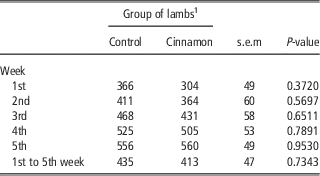
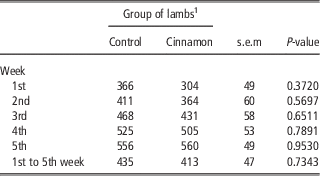
Feed intake was not influenced by the dietary cinnamon essential oil supplementation (P>0.05) (Table 2). Similarly, lambs fed on a diet supplemented with cinnamaldehyde at a concentration of 0.2 g/kg (Chaves et al., Reference Chaves, Stanford, Gibson, McAllister and Benchaar2008a, Reference Chaves, Stanford, Dugan, Gibson, McAllister, Van Herk and Benchaar2008b and Reference Chaves, Dugan, Stanford, Gibson, Bystrom, McAllister, Van Herk and Benchaar2011) did not eat less feed compared with controls. No significant differences in daily feed intake were observed in beef cattle supplemented with cinnamaldehyde (Yang et al., Reference Yang, Ametaj, Benchaar, He and Beauchemin2010a) or eugenol (Yang et al., Reference Yang, Benchaar, Ametaj and Beauchemin2010b) at the concentrations of 0.4, 0.8 and 1.6 mg per steer per day, respectively.
Effect of the dietary cinnamon essential oil supplementation on lamb average daily concentrate feed intake (g) (LS means±s.e.m.)
1 Lambs were fed ad libitum; control group was fed on the basal diet, and the cinnamon supplemented group was fed on the basal diet supplemented with cinnamon essential oil (1 ml/kg concentrated feed).
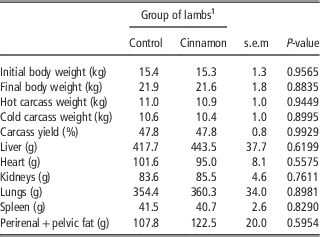
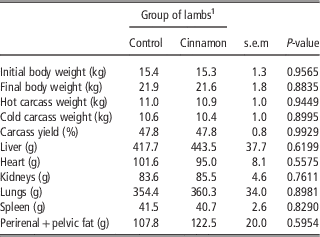
Final boby, carcass and perirenal+pelvic fat weights did not significantly differ between the two lamb groups (P>0.05) (Table 3). Previous studies similarly demonstrated no effect of dietary cinnamaldehyde supplementation on growth performance and carcass characteristics in lambs (Chaves et al., Reference Chaves, Stanford, Gibson, McAllister and Benchaar2008a, Reference Chaves, Stanford, Dugan, Gibson, McAllister, Van Herk and Benchaar2008b and Reference Chaves, Dugan, Stanford, Gibson, Bystrom, McAllister, Van Herk and Benchaar2011). No significant differences in carcass weight were also observed after cinnamaldehyde (Yang et al., Reference Yang, Ametaj, Benchaar, He and Beauchemin2010a) or eugenol (Yang et al., Reference Yang, Benchaar, Ametaj and Beauchemin2010b) supplementation in beef cattle.
Effect of the dietary cinnamon essential oil supplementation on lamb body weight, hot – cold carcass weight, carcass yield and internal organs’ weight (LS means±s.e.m.)
1 Lambs were fed ad libitum; control group was fed on the basal diet, and the cinnamon supplemented group was fed on the basal diet supplemented with cinnamon essential oil (1 ml/kg concentrated feed).
Dietary supplementation with cinnamon essential oil did not significantly affect the weights of the internal organs (P>0.05) (Table 3). However, in a previous study, lambs fed on a diet supplemented with cinnamaldehyde at a concentration of 0.2 g/kg tended to have heavier livers than those fed with the control diet (Chaves et al., Reference Chaves, Stanford, Gibson, McAllister and Benchaar2008a). On the other hand, in a recent study of the same authors, no effect of cinnamaldehyde dietary supplementation (0.2 to 0.4 g/kg) on lamb liver weight was observed (Chaves et al., Reference Chaves, Dugan, Stanford, Gibson, Bystrom, McAllister, Van Herk and Benchaar2011).
Meat quality characteristics (pH24, colour, shear force value, cooking loss and water-holding capacity)
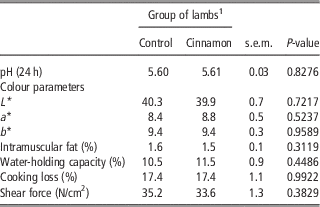
Longissimus thoracis muscle quality characteristics (pH24, colour parameters, shear force value, cooking loss and water-holding capacity) were not significantly influenced by the dietary treatment (P>0.05) (Table 4). In similar experiments conducted in lambs fed on diets supplemented with cinnamaldehyde, sensory evaluation showed no changes in meat juiciness, tenderness and overall palatability as well as flavour intensity or desirability (Chaves et al., Reference Chaves, Stanford, Gibson, McAllister and Benchaar2008a and Reference Chaves, Dugan, Stanford, Gibson, Bystrom, McAllister, Van Herk and Benchaar2011). Moreover, incorporation of cinnamaldehyde in feedlot cattle diets did not influence meat sensory characteristics and quality grade (Yang et al., Reference Yang, Ametaj, Benchaar, He and Beauchemin2010a).
Effect of the dietary cinnamon essential oil supplementation on lamb longissimus thoracis muscle quality characteristics (LS means±s.e.m.)

1 Lambs were fed ad libitum; control group was fed on the basal diet, and the cinnamon supplemented group was fed on the basal diet supplemented with cinnamon essential oil (1 ml/kg concentrated feed).
Meat colour parameters were not significantly influenced by the dietary cinnamon oil supplementation (P>0.05). Instrumental colour values did not show either dark or light meat colour or meat of excessive redness (a*) or yellowness (b*) (Table 4) and were within the normal range (Nieto et al., Reference Nieto, Diaz, Banon and Garrido2010a; Reference Nieto, Diaz, Banon and Garrido2010b; Smeti et al., Reference Smeti, Atti, Mahouachi and Munoz2013). Cinnamon essential oil supplementation did not affect meat shear force and cooking loss values (P>0.05) (Table 4), findings that are in accordance with the existing literature. Furthermore, there is no published data of nutritional approaches that have a direct effect on meat tenderness (Hopkins et al., Reference Hopkins, Hall, Channon and Holsy2001).
Lipid content and lipid oxidation
No significant effects of dietary cinnamon essential oil supplementation on total lipid content (intramuscular fat) of longissimus thoracis muscle were found (P=0.3119) (Table 4). Moreover, the extent of lipid oxidation in raw longissimus thoracis muscle stored at 4°C for 9 days varied within the same treatment as the storage period was extended (P<0.05) but there were no differences between treatments for the same storage period (P=0.2068) (Table 5). Refrigerated storage increased the levels of MDA. Results indicated that incorporation of cinnamon essential oil into the lambs’ diets at the level of 1 ml/kg did not significantly affect lipid oxidation in the refrigerated longissimus thoracis muscle samples (Table 5).
Effect of the dietary cinnamon essential oil supplementation and the storage duration on the lipid oxidation values (MDA, ng/g) in the raw lamb longissimus thoracis muscle (LS means±s.e.m.)

abcMean values with different superscripts within a column differ (P<0.05). Time effect was significant but the interaction of time with treatment was not significant (P=0.2068).
1 Lambs were fed ad libitum; control group was fed on the basal diet, and the cinnamon supplemented group was fed on the basal diet supplemented with cinnamon essential oil (1 ml/kg concentrated feed).
Dietary supplementation has been proved to be a simple and convenient strategy to uniformly introduce a natural antioxidant into the phospholipid membranes where it may effectively inhibit the oxidative reactions at their localized sites (Lauridsen et al., Reference Lauridsen, Buckley and Morrissey1997). Although, cinnamon constituents exhibit intense antioxidant in vitro action and have been proved beneficial against free radical damage to cell membranes (Dragland et al., Reference Dragland, Senoo, Wake, Holte and Blomhoff2003), no effects of cinnamon essential oil dietary supplementation (in vivo) on lipid oxidation rate were observed in the present study. In a previous experiment, rosemary essential oil dietary supplementation (0.6 ml/kg feed) had also no significant effect on lipid oxidation values across the storage period of 9 days at 4°C (Smeti et al., Reference Smeti, Atti, Mahouachi and Munoz2013). On the other hand, oregano essential oil dietary supplementation (1 ml/kg concentrated feed) reduced lamb meat lipid oxidation values during refrigerated and frozen storage (Simitzis et al., Reference Simitzis, Deligeorgis, Bizelis, Dardamani, Theodosiou and Fegeros2008). The controversy within the literature may arise from differences in the size of previous trials (number of animals) and variation in supplements used (chemical composition, constituents, dose) and weight, genetics or management of animals in the various reported studies. Especially for meat samples, it is possible that these variations also caused by the levels of microorganisms present, since bacteria appear to decompose MDA and possibly other dicarbonyl compounds (Moerk and Ball, Reference Moerck and Ball1974).
Meat antimicrobial properties
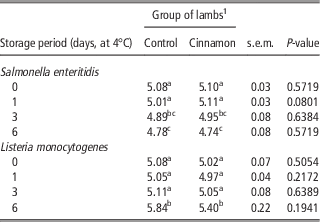
The effect of cinnamon essential oil dietary supplementation on the antimicrobial properties of the meat produced was assessed by monitoring the post inoculation counts of S. enteritidis and L. monocytogenes in meat samples during refrigerated storage for 6 days (Table 6). The levels of S. enteritidis decreased, especially after the 3rd day of refrigerated storage, irrespective of the treatment (P<0.05). On the other hand, the levels of L. monocytogenes tended to increase the last (6th) day of storage (P<0.05) (Table 6). In general, no significant effects of cinnamon dietary supplementation on the post-inoculation populations of the two examined pathogens throughout refrigerated storage were found (P=0.670 and 0.340 for the S. enteritidis and L. monocytogenes, respectively). These results do not confirm the in vitro reported intense antimicrobial activity of cinnamon essential oil against several microorganisms (Unlu et al., Reference Unlu, Ergana, Unlu, Zeytinoglou and Vural2010). Cinnamaldehyde and eugenol have been shown to inhibit production of the essential enzymes and cause damage to the cell wall of the bacteria in experiments implemented in vitro (Di Pasqua et al., Reference Di Pasqua, Betts, Hoskins, Edwards, Ercolini and Mauriello2007). In general, it has been found that a greater concentration of essential oils is needed to achieve the same effects in foods compared to the in vitro experiments (Smid and Gorris, Reference Smid and Gorris1999). The greater availability of nutrients in foods than in the laboratory nutrient cultivation may enable bacteria to repair damaged cells faster (Gill et al., Reference Gill, Delaquis, Russo and Holley2002) and the antibacterial effects of essential oils are therefore not so profound.
Effect of the dietary cinnamon essential oil supplementation and the storage duration on the levels of Salmonella enteritidis and Listeria monocytogenes (log CFU/g meat) in minced samples of raw lamb longissimus thoracis muscle (LS means±s.e.m.)

abcMean values with different superscripts within a microbe and column differ (P<0.05). Time effect was significant but the interaction of time with treatment was not significant (P=0.670 and 0.340 for the Salmonella enteritidis and Listeria monocytogenes, respectively).
1 Lambs were fed ad libitum; control group was fed on the basal diet, and the cinnamon supplemented group was fed on the basal diet supplemented with cinnamon essential oil (1 ml/kg concentrated feed).
Conclusion
In this experiment, the dietary administration of cinnamon essential oil (1 ml/kg of feed) during a period of 35 days did not exert significant effect on lamb growth performance, meat quality, antioxidative and antimicrobial properties. The results of the present study suggest that cinnamon essential oil may not have the potential to improve growth performance and meat characteristics in lambs, although further experimentation is needed to elucidate its exact action.