INTRODUCTION
Stand-level species richness of tropical rain forests is commonly high (Gentry Reference GENTRY1988, Richards Reference RICHARDS1952, Whitmore Reference WHITMORE1998, Wright Reference WRIGHT2002), but this is not always the case, and even species-rich forests may have an upper canopy dominated by one or a few related species (Connell & Lowman Reference CONNELL and LOWMAN1989, Hart Reference HART1990, Torti et al. Reference TORTI, COLEY and KURSAR2001). In some cases, monodominance appears due to superior tolerance of severe growing conditions (Hart Reference HART1990). It is more difficult to explain monodominant forests in relatively benign conditions (Peh et al. Reference PEH, LEWIS and LLOYD2011a, Torti et al. Reference TORTI, COLEY and KURSAR2001), including where they adjoin mixed rain forests without apparent difference in environment (Hart Reference HART1990, Martijena Reference MARTIJENA1998, Peh et al. Reference PEH, SONKÉ, LLOYD, QUESADA and LEWIS2011b, Read et al. Reference READ, JAFFRÉ, FERRIS, MCCOY and HOPE2006).
One potential explanation of monodominance adjacent to mixed-canopy forest is that the forest types are different successional stages (Connell & Lowman Reference CONNELL and LOWMAN1989, Hart et al. Reference HART, HART and MURPHY1989). Monodominance might occur early in succession by a species whose juveniles grow rapidly in exposed conditions, or late in succession by a slow-growing shade-tolerant species (Connell & Lowman Reference CONNELL and LOWMAN1989, Hart Reference HART1990, Hart et al. Reference HART, HART and MURPHY1989). In the latter case, monodominance should persist, with a multi-aged population of the dominant tree. Early-successional monodominance is unlikely to persist, given probable trade-offs between the rapid-growth-light-demanding strategy and tolerance of heavy shade below a closed canopy (Kunstler et al. Reference KUNSTLER, COOMES and CANHAM2009, Wright Reference WRIGHT2002), particularly in species-rich forests comprising a range of life histories. Studies of spatial variables, particularly soil variables, have produced little evidence that they explain boundaries between monodominant and mixed rain forest (Martijena Reference MARTIJENA1998, Nascimento & Proctor Reference NASCIMENTO and PROCTOR1997a, Peh et al. Reference PEH, SONKÉ, LLOYD, QUESADA and LEWIS2011b, Read et al. Reference READ, JAFFRÉ, FERRIS, MCCOY and HOPE2006), and recent attention has focused more on the plant traits that promote persistent monodominance (Henkel et al. Reference HENKEL, MAYOR and WOOLLEY2005, McGuire Reference MCGUIRE2007a, Reference MCGUIRE2007b; Peh et al. Reference PEH, LEWIS and LLOYD2011a, Torti et al. Reference TORTI, COLEY and KURSAR2001). However, there have been relatively few quantitative studies of regeneration dynamics that allow the temporal hypothesis to be evaluated (Hart Reference HART1995, Nascimento & Proctor Reference NASCIMENTO and PROCTOR1997b, Nascimento et al. Reference NASCIMENTO, BARBOSA, VILLELA and PROCTOR2007, Newbery et al. Reference NEWBERY, VAN DER BURGT and MORAVIE2004, Woolley et al. Reference WOOLLEY, HENKEL and SILLETT2008).
In New Caledonia, a global diversity hotspot (Myers et al. Reference MYERS, MITTERMEIER, MITTERMEIER, FONSECA and KENT2000) with a unique rich and threatened flora (Morat et al. Reference MORAT, JAFFRÉ, TRONCHET, MUNZINGER, PILLON, VEILLON and CHALOPIN2012), individual Nothofagus species (Nothofagaceae) dominate the upper canopy of some evergreen rain forests next to mixed rain forests. There is no evidence that soil variables explain the boundaries of these forests (Read et al. Reference READ, JAFFRÉ, FERRIS, MCCOY and HOPE2006). Nothofagus forests, however, appear to be more common on interfluves than in gullies, and when occurring at the foot of slopes they are often adjacent to maquis (shrub-dominated vegetation), i.e. environments exposed to strong winds and to fire (Enright et al. Reference ENRIGHT, RIGG and JAFFRÉ2001, Jaffré Reference JAFFRÉ1980, Jaffré et al. Reference JAFFRÉ, RIGAULT and DAGOSTINI1998, McCoy et al. Reference MCCOY, JAFFRÉ, RIGAULT and ASH1999, Perry & Enright Reference PERRY and ENRIGHT2002). In addition, some population data suggest the Nothofagus forests are an early-successional stage (Read et al. Reference READ, HALLAM and CHERRIER1995), contrasting with the persistence commonly reported in tropical monodominant rain forests (Peh et al. Reference PEH, LEWIS and LLOYD2011a, Torti et al. Reference TORTI, COLEY and KURSAR2001). However, few data are available regarding the population dynamics of Nothofagus and co-occurring canopy species in either the monodominant or adjacent mixed rain forests to assess successional status and persistence. Here, we use analysis of population size structure to assess the regeneration status of the canopy species of both forest types. The results are used to address the hypothesis that monodominant Nothofagus forest is an early successional stage that will develop into mixed rain forest, and to predict long-term change in canopy dominance in these forests.
METHODS
Study sites
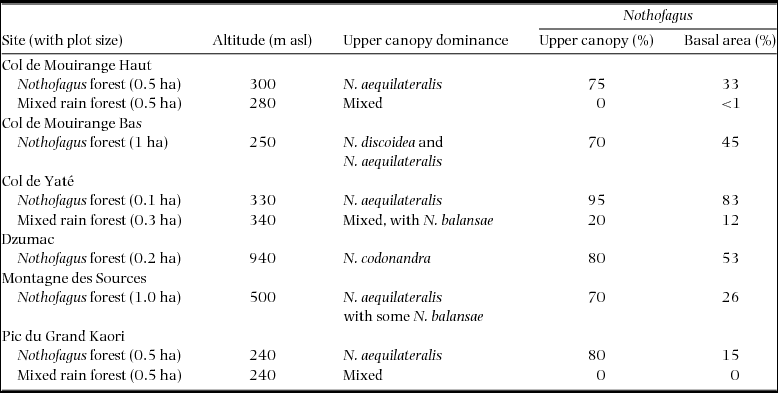
Nothofagus usually occurs on ultramafic substrates in New Caledonia, and the study was undertaken on the southern massif of the main island of New Caledonia where these substrates predominate (Jaffré Reference JAFFRÉ1980). Six study sites were selected to include Nothofagus forests across a variety of locations, altitudes, topographies, forest structures, degrees of dominance by Nothofagus, and four of the five New Caledonian Nothofagus species (Table 1) (Read et al. Reference READ, JAFFRÉ, GODRIE, HOPE and VEILLON2000). The Nothofagus sites vary in tree diversity: in some stands the canopy has a low richness; in others richness is high but with Nothofagus dominating the upper canopy, although not always the basal area (Table 1). Three low-altitude sites (Col de Yaté, Col de Mouirange Haut and Pic du Grand Kaori; Table 1) are adjacent or close to mixed rain forest, allowing comparison of population dynamics in similar environments. The composition of these mixed rain forests is similar to that of the Nothofagus forests, except in abundance of Nothofagus (Read et al. Reference READ, JAFFRÉ, GODRIE, HOPE and VEILLON2000). Several study sites are small forest fragments – Dzumac and the Col de Yaté sites are less than 1 ha – and others are near the margins of larger fragments (≥ 10 ha, with the Nothofagus stands usually being a smaller component). Forests on the southern massif tend to be fragmented, due largely to fires that increased in frequency after European settlement, as well as disturbances associated with mining and logging (Jaffré Reference JAFFRÉ1980, Jaffré et al. Reference JAFFRÉ, MUNZINGER and LOWRY2010, McCoy et al. Reference MCCOY, JAFFRÉ, RIGAULT and ASH1999).
Summary of the Nothofagus-dominated and mixed rain-forest study sites in New Caledonia (modified from Read et al. Reference READ, JAFFRÉ, GODRIE, HOPE and VEILLON2000). The proportion of Nothofagus foliage in the upper canopy was estimated by recording the tree in the uppermost canopy closest to each of 20–30 random points located on the ground by random number tables. Percentage of the stand basal area is calculated from trees ≥ 20 cm dbh. Limited selective logging (e.g. Agathis lanceolata) occurred prior to the 1950s at the latest at Col de Mouirange Bas, Montagne des Sources and Pic du Grand Kaori, with cut stumps forming no more than 1–3% of canopy trees (Read et al. Reference READ, JAFFRÉ, GODRIE, HOPE and VEILLON2000), usually near plot edges. On plots with two Nothofagus species, the species generally occur in different areas with little intermixing.

The sites experience mean annual rainfall of c. 1800 mm (Col de Mouirange) to c. 3500 mm (other sites), with a dry season in September–November of variable severity and length (Jaffré Reference JAFFRÉ1993). Mean annual temperatures at the nearest lowland stations are 22–24 °C (Cherrier Reference CHERRIER1984), but closer to c. 17 °C at Dzumac (Read et al. Reference READ, HOPE and HILL2005). The soils are ferrallitic of the ferritic type (deficient in aluminium clays), developed over peridotite, but are influenced by gabbro at Col de Mouirange (Read et al. Reference READ, JAFFRÉ, FERRIS, MCCOY and HOPE2006). Soil depth, profile and physicochemical characteristics vary, but all have very low levels of P, K and Ca, and low Ca:Mg (Read et al. Reference READ, JAFFRÉ, FERRIS, MCCOY and HOPE2006), as is usual in these soils (Jaffré et al. Reference JAFFRÉ, VEILLON, PINTAUD, Jaffré, Reeves and Becquer1997, McCoy et al. Reference MCCOY, JAFFRÉ, RIGAULT and ASH1999).
Survey methods
Population size structures were derived from trunk diameters at each site and used to infer regeneration dynamics (‘time-specific analysis’: Hett & Loucks Reference HETT and LOUCKS1976), since ages could not be determined for most species examined. Nothofagus populations were predicted to have the unimodal (mound-shaped) size structure typical of episodically regenerating populations, rather than the reverse-J (steeply descending) and negative exponential curves of continuously regenerating populations of shade-tolerant species (Hett & Loucks Reference HETT and LOUCKS1976, Lorimer & Krug Reference LORIMER and KRUG1983). We note that size structures must be interpreted cautiously for several reasons, including interactions of size-specific survival, growth and fecundity (Condit et al Reference CONDIT, SUKUMAR, HUBBELL and FOSTER1998, Doak & Morris Reference DOAK and MORRIS1999, Hett & Loucks Reference HETT and LOUCKS1976, Feeley et al. Reference FEELEY, DAVIES, NOOR, KASSIM and TAN2007).
A permanent plot was established at each site in 1991–1996 (Read et al. Reference READ, JAFFRÉ, GODRIE, HOPE and VEILLON2000). All trees of ≥ 20 cm dbh (diameter at breast height, 1.3 m above ground) were tagged, identified and dbh measured (1579 trees across all sites). A small number appear to be short trees, reaching only half the height of the main canopy, e.g. Zygogynum baillonii. Due to insufficient information being available for potential tree height for some species, we have included all tree species with dbh ≥ 20 cm. All woody plants ≥ 1.3 m high were identified, tagged and dbh measured in a grid of 4 × 10-m quadrats (10–35% of the total plot area, with 11374 plants ≥ 1.3 m high and < 20 cm dbh). Seedlings (plants < 1.3 m high) were recorded in a 2 × 4-m quadrat in the centre of each larger quadrat. In 2011, size structures of Nothofagus spp. were re-measured at the two Col de Mouirange (CM) Nothofagus forests, where substantial deaths had occurred over 20 y, with subsequent canopy opening. Plant nomenclature follows Morat et al. (Reference MORAT, JAFFRÉ, TRONCHET, MUNZINGER, PILLON, VEILLON and CHALOPIN2012).
Tree dating
Annual ring production was checked in Nothofagus aequilateralis, using callus tissue generated by cambial wounds in two trees tagged in 1992 at CM Haut as a time-stamp (Kuroda & Shimaji Reference KURODA and SHIMAJI1984, Mariaux Reference MARIAUX1969). Cores were then extracted from 73 Nothofagus trees with a 40-cm Suunto (Vantaa, Finland) tree borer (5 mm diameter) to investigate tree ages and assist interpretation of size structures. At CM Haut and both Col de Yaté forests, at least 12 trees of N. aequilateralis and N. balansae were cored. Cores were also collected from two to four of the largest Nothofagus trees on each site except Dzumac to estimate stand age. Cores were collected from several small Nothofagus trees on some sites to assess whether they were similar in age to large trees. Two to four trees of Agathis species (Araucariaceae) were cored where present, since they can produce clearer annual rings, and one to five trees of 13 other canopy species occurring with N. aequilateralis at CM Haut (Read et al. Reference READ, EVANS, SANSON, KERR and JAFFRÉ2011). In each case, one to two cores were collected per tree, at 1.0–1.3 m above ground, the second core taken perpendicular to, and c. 2 cm above, the first core. Trees were selected semi-randomly, avoiding damaged trees or unusual growth conditions. Cores were mounted in supports, sanded and then digitally scanned at 4800 dpi. Images were imported into WinDENDRO™ Version 6.4a (Regent Instruments Inc., Quebec, Canada) and growth rings were counted and measured. Cross-dating was not possible, so estimates are based on raw ring counts, with estimation of missing rings where necessary. Cores were discarded if a significant number of rings were missing due to rot or failure to reach the centre of the tree.
Data analysis
The Weibull probability density function allows quantification and hypothesis testing of the shape of population size structures (Bailey & Dell Reference BAILEY and DELL1973). It was fitted by maximum likelihood estimation to diameter distributions of tree species represented by at least 60 individuals ha−1 ≥ 1.3 m high, including at least two individuals ≥ 20 cm dbh. For species with coppice growth, only the largest live stem per tree was included. The parameter c provides a shape index: 0 < c < 3.6 indicates a positive skew; at c ≅ 3.6 the curve is similar to a normal distribution; c > 3.6 indicates a negative skew (Bailey & Dell Reference BAILEY and DELL1973). A strong positive skew (c ≤ 1) is predicted for continuously regenerating populations (c = 1 indicates a negative exponential distribution, c < 1 indicates a reverse-J curve: Bailey & Dell Reference BAILEY and DELL1973), so confidence intervals were calculated for c following Thoman et al. (Reference THOMAN, BAIN and ANTLE1969) to allow hypothesis testing (1-tailed t-test). Values of c ≤ 1 can also arise in disjunct distributions (Baker et al. Reference BAKER, BUNYAVEJCHEWIN, OLIVER and ASHTON2005) that suggest several establishment episodes or episodes of size-dependent mortality rather than continuous regeneration. Therefore, c ≤ 1 size structures were recorded as disjunct if stems were absent from two or more adjacent size classes, i.e. ≥ 10 cm size gap, below 40 cm dbh, or if there was a marked hump in the curve. Spearman correlation was used to test associations between dbh and age. SYSTAT v. 13 was used for analyses, with a critical level of α = 0.05 for hypothesis testing.
RESULTS
Population size structures and inferred regeneration status
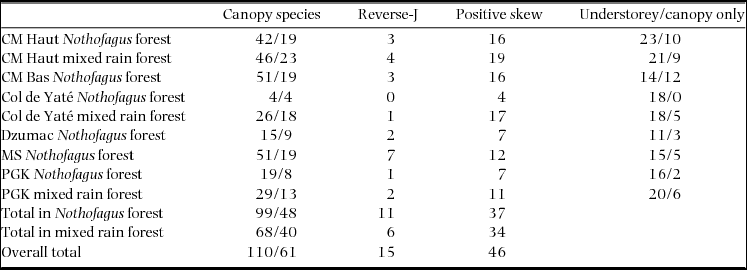
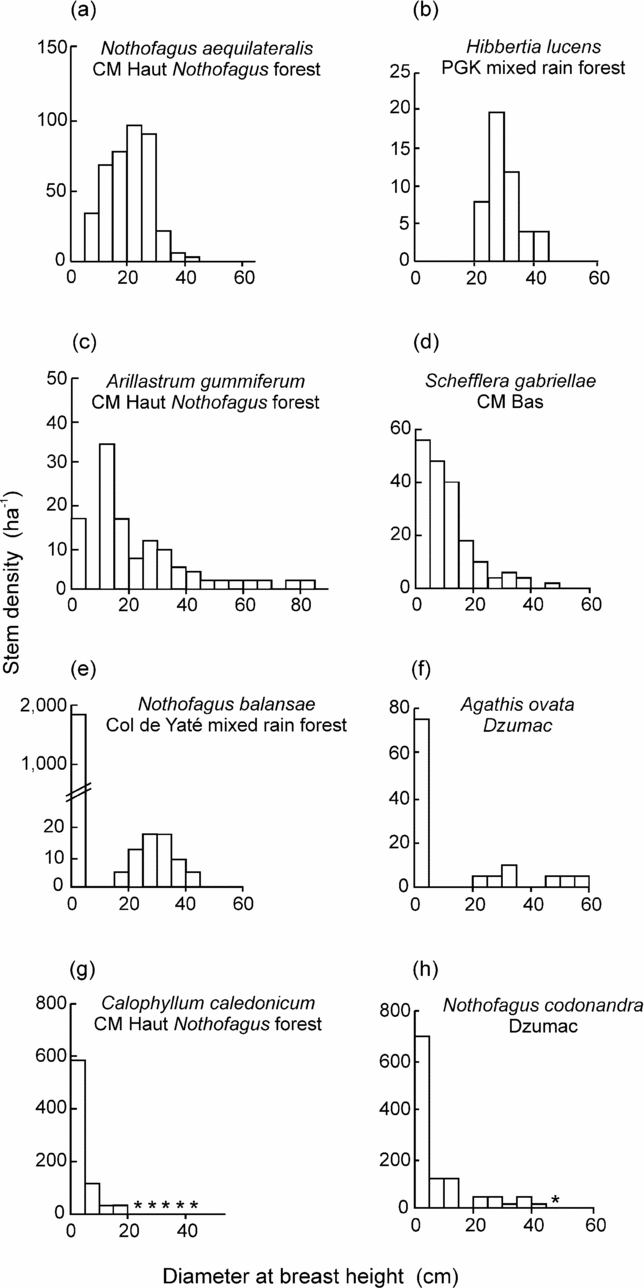
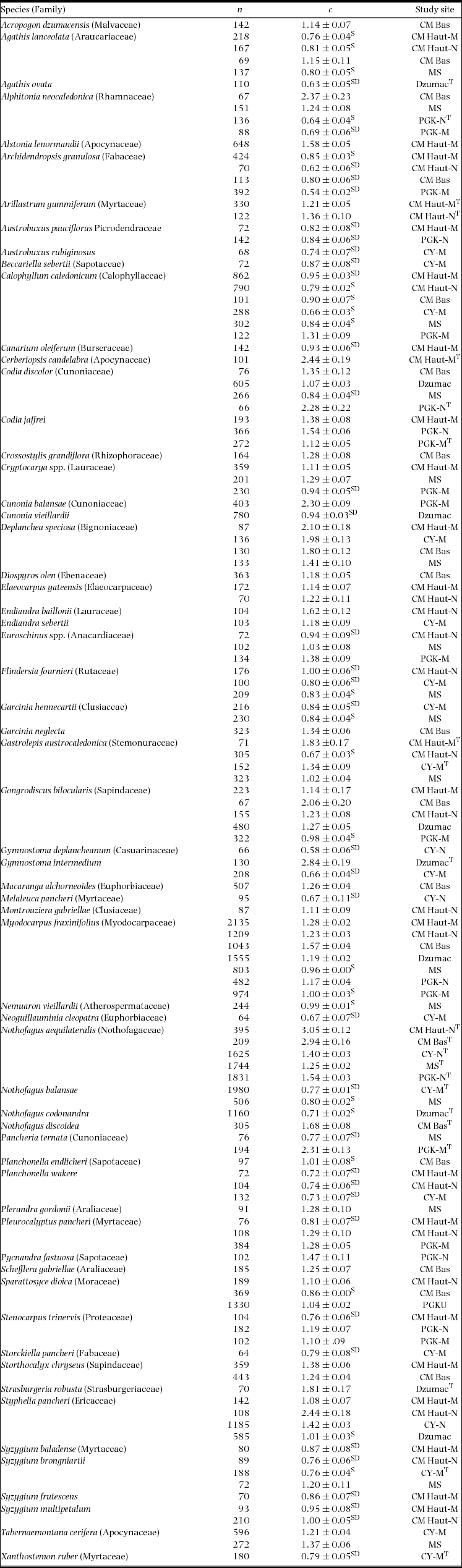
A total of 110 species from 40 families was recorded with trunk dbh ≥ 20 cm, with 61 species meeting criteria for size structure analysis (Table 2). All of these showed positive skewing, i.e. c-values < 3.6 (the highest was 3.05), usually < 2.0 (Figure 1; Table 2). However, size structures varied considerably among sites in some species. For example, c-values ranged from 1.25 to 3.05 across five sites for N. aequilateralis, and from 0.64 to 2.37 across four sites in Alphitonia neocaledonica (Appendix 1). Some species were more consistent, e.g. c-values of 0.66 to 0.95 across five sites for Calophyllum caledonicum (Appendix 1). The small number of high c-values reflects insufficient stems rather than rarity of unimodal or negatively skewed distributions. For example, some species had abundant large trees, but few or no smaller stems, and so insufficient stems for analysis on some sites. The latter group includes some common canopy species, such as Alphitonia neocaledonica, Hibbertia lucens (Figure 1b) and Gymnostoma spp.
The number of canopy species in Nothofagus forest and mixed rain forest study sites in New Caledonia. Canopy species are judged as those reaching ≥20 cm dbh on any study site (possibly an underestimate of the potential canopy species). The first data column gives the total number of canopy species, with the number of species for which size structures were analysed. The second column gives the number of species showing reverse-J curves (c ≤ 1, without major disjunctions). The third column gives the number with c ≤ 1 but with disjunct distribution, plus the number showing weaker positive skew (1 < c < 3.6). The fourth column gives the number of canopy species occurring only in the understorey (< 20 cm dbh), with the number of species recorded in the canopy but not in the understorey. CM, Col de Mouirange; MS, Montagne des Sources; PGK, Pic du Grand Kaori.
Examples of population size structures in Nothofagus-dominated and mixed rain forests in New Caledonia. Unimodal mound-shaped curves (Hibbertia lucens has insufficient stems for Weibull analysis) (a, b); positive skews, but c >1 (c, d); disjunct curves with c ≤ 1 (e, f); reverse-J curves, c ≤ 1 (g, h). Data include all individuals at least 1.3 m high. Asterisks indicate where trees are present in a size class, but not visible due to the axis scale used. CM, Col de Mouirange; PGK, Pic du Grand Kaori.
In both Nothofagus forests and mixed rain forests, the most abundant canopy species tended to have c-values > 1, thereby without evidence of regeneration sufficient to maintain abundance levels, or had c-values ≤ 1 but a disjunct distribution (Appendix 1). Overall, 85% of species analysed in mixed rain forests, and 77% of species analysed in Nothofagus forests showed no evidence of continuous regeneration (Table 2). In particular, Nothofagus species showed no evidence of continuous regeneration, except at the high-altitude Dzumac site (Figure 1h). At three sites (both sites at Col de Yaté, and Montagne des Sources), abundant small Nothofagus stems were recorded, but were localized near a forest edge. Nothofagus size structures at most sites were truncated at the upper size classes (Figures 1a, e), without the tail of large trees expected in an old forest. All study sites, including Dzumac, showed evidence of one or more substantial disturbances, inferred from unimodal size structures in some species (Appendix 1, Figure 1a, b), and the reverse-J curve of N. codonandra (Figure 1h) might comprise multiple establishment episodes.
Fifteen canopy species showed reverse-J curves (here taken as c ≤ 1 without disjunction) typical of continuous regeneration (Figure 1g, h, Table 2). However, only C. caledonicum, Agathis lanceolata and Myodocarpus fraxinifolius showed this pattern on more than one site, and only C. caledonicum had c-values ≤ 1 on most sites where it occurred (Appendix 1). Furthermore, there were generally few canopy species per site with reverse-J curves (Table 2). However, canopy species with no individuals ≥ 20 cm dbh were represented in the understorey on some sites (Table 2), suggesting that they may contribute to the future canopy, e.g. Sparattosyce dioica, Diospyros spp. and Cryptocarya spp.
Interpretation of tree age from tree size
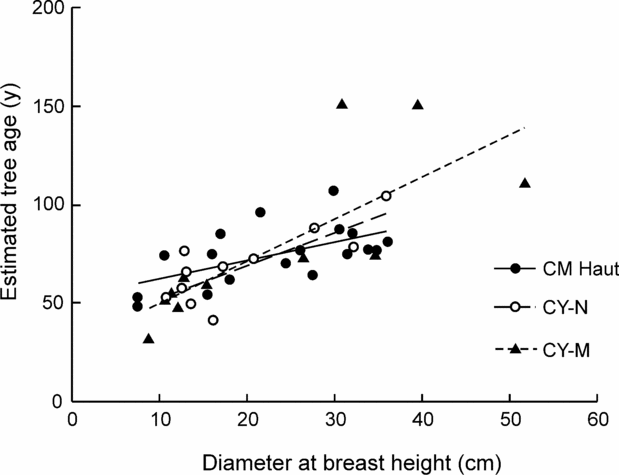
Radiocarbon dating of A. lanceolata cores at Col de Mouirange showed rings were annual (J. Read & Q. Hua, ANSTO, unpubl. data), and ring counts from time-stamped N. aequilateralis at CM Haut (10–11 rings identified in 10–12 y) suggested that identifiable rings were produced annually. However, no cores with clear rings were found in other species, and cross-dating was not possible in any species. Hence tree rings could not be used for precise dating of establishment or testing size-age relationships in common species other than Nothofagus. For Nothofagus, cores were successfully analysed from 61 trees, with differences of nil to five rings between cores from the same tree. Estimated age and dbh were positively correlated in N. aequilateralis at Col de Yaté (11 trees: R P = 0.80, P = 0.003) and CM Haut (18 trees: R P = 0.58, P = 0.011) and N. balansae at Col de Yaté (11 trees: R P = 0.77, P = 0.005) (Figure 2), supporting cautious use of these size analyses to infer dynamics.
The relationship between tree size (trunk dbh) and tree age as estimated by ring counts for Nothofagus species at study sites in New Caledonia. No adjustment has been made in these data for time to reach the height at which cores were taken. CM, Col de Mouirange; CY-N, Col de Yaté Nothofagus forest; CY-M, Col de Yaté mixed rain forest. N. aequilateralis, circles; N. balansae, triangles. Trend lines were fitted to each species at each site by OLS regression.
Estimation of stand age and recent history
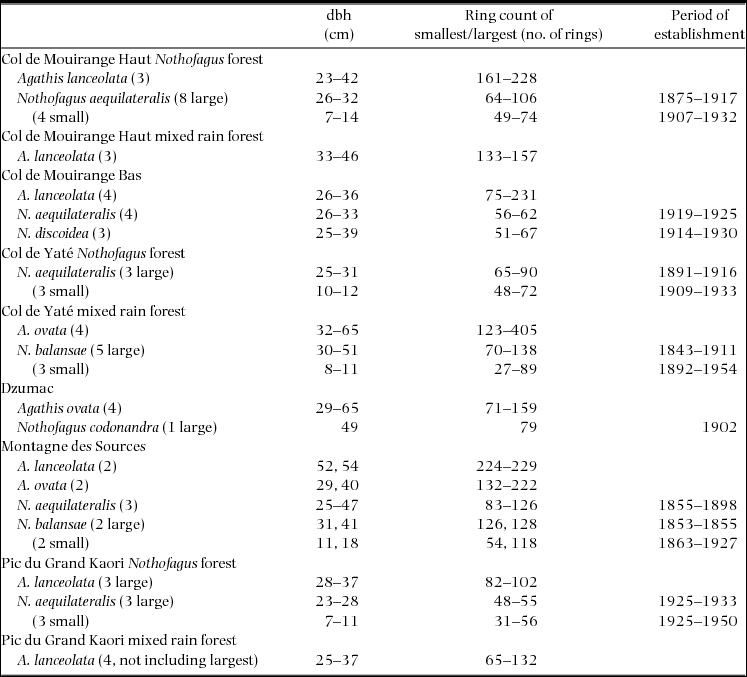
Most living trees of Nothofagus ≥ 7 cm dbh appear to have established at these sites from c. 1850–1933, with the main cohorts probably dating from the late 1800s at the earliest (Table 3). One large tree of N. balansae c. 80 cm dbh at Montagne des Sources was not dated and probably established earlier. In most Nothofagus stands there are remnants of a pre-disturbance forest. Agathis lanceolata appears to reach substantially greater ages than the largest Nothofagus trees in the same stands (Table 3). In addition, at Col de Mouirange and Montagne des Sources Nothofagus forests and Col de Yaté mixed rain forest there is a small number of very large trees of other species (e.g. Arillastrum gummiferum and Neoguillauminia cleopatra) that may be older than most co-occurring Nothofagus. Few large trees occur in the Pic du Grand Kaori Nothofagus forest, but linear mounds on the forest floor suggest earlier forest.
Dating of Nothofagus and Agathis in Nothofagus-dominated and mixed rain forests in New Caledonia. The number of trees cored is given in parentheses. Tree diameters and ring counts are given for trees in 1991 cored at c. 1.0–1.3 m above ground. Estimated period of establishment is given for Nothofagus trees, with adjustments of 10 y (based on seedling growth rates in canopy gaps) to reach coring height.
There is little evidence of the type of disturbance that initiated episodes of establishment of Nothofagus and other canopy species. Some Nothofagus trees at Col de Mouirange appear to have snapped or been uprooted following cyclones. Charcoal was found in the soil of the Col de Yaté Nothofagus forest at a depth of 10–40 cm, but may have been transported from upslope maquis. Charcoal and fire-scarred trees occur near forest margins at other sites and nearby vegetation commonly shows evidence of fire, but there is no evidence of fire inside most plots.
Changes in size structure after 20 y
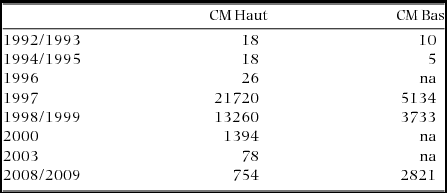
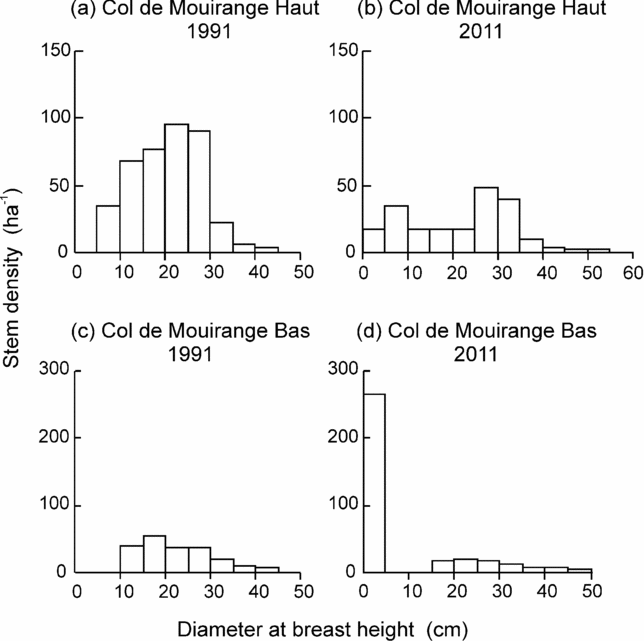
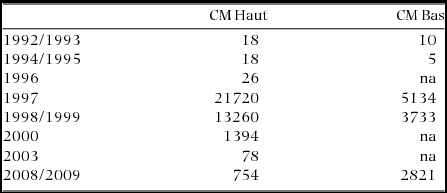
Some Nothofagus deaths at Col de Mouirange appear linked to major cyclones in 1996 and 2003. Observations at CM Bas in 2007–2011 indicated additional recent deaths in standing Nothofagus trees, i.e. not killed by wind damage, near the epicentre of death. Overall, 49% of N. aequilateralis trees and 34% of total trees ≥ 20 cm dbh died at CM Haut Nothofagus forest, and 52% of N. aequilateralis and 23% of total trees ≥ 20 cm dbh died at CM Bas in 1991–2011. Consistent with the disturbed canopy, plus the first Nothofagus mast seeding event (1996–1997) during this period, there was a large increase in seedling abundance (Table 4). At CM Haut, seedling abundance then declined substantially, with little recruitment into the sapling category (≥ 1.3 m high), but at CM Bas there was greater recruitment from the 1996 and later seedling cohorts (Table 4; Figure 3).
Densities of Nothofagus seedlings (ha−1) from 1992 to 2009 at Col de Mouirange, New Caledonia. Seedling plots at Col de Mouirange Haut Nothofagus forest were generally measured only in even years and at Col de Mouirange Bas were measured only in odd years. Seedlings included in this table range from cotyledonary seedlings to < 1.3 m high, and at Col de Mouirange Bas include both N. discoidea and N. aequilateralis since they can be difficult to distinguish as juveniles. The first mast seeding event observed was in late 1996–early 1997. na, no data available.
Comparison of Nothofagus aequilateralis population size structures over 20 years at Col de Mouirange, New Caledonia. Col de Mouirange Haut Nothofagus forest in 1991 (a) and 2011 (b); Col de Mouirange Bas forest in 1991 (c) and 2011 (d).
DISCUSSION
Regeneration dynamics of Nothofagus
All Nothofagus populations appear to have a major cohort that established after one or more large disturbances, with recruitment insufficient to maintain dominance except at Dzumac. Vegetative sprouting has not been observed in these Nothofagus species, unlike some persistent monodominants, e.g. Spirotropis longifolia (Fonty et al. Reference FONTY, MOLINO, PRÉVOST and SABATIER2011) and Dicymbe corymbosa (Woolley et al. Reference WOOLLEY, HENKEL and SILLETT2008) in the Guiana Shield, and in contrast to some New Guinea Nothofagus species (Ash Reference ASH and Gressit1982, Reference ASH1988; Read et al. Reference READ, HOPE and HILL1990). In most Nothofagus-dominated stands there was strong evidence of previous forest. Hence, Nothofagus appears able to regenerate sufficiently in massively disturbed forest to achieve dominance. Indeed, the size structures suggest that Nothofagus at low to mid-altitude requires such disturbance to maintain dominance. Ages of c. 160 y have been estimated in Nothofagus (Table 3), so it is likely that populations would experience large-scale disturbances within their lifetime, given the regional cyclone regime. Similarly, some Nothofagus stands in New Guinea show regeneration failure, with likely progression to mixed rain forests in the absence of large-scale disturbance (Ash Reference ASH and Gressit1982, Reference ASH1988; Read et al. Reference READ, HOPE and HILL1990). Disturbance is also implicated in Nothofagus dominance of some temperate forests in South America and New Zealand that contain shade-tolerant canopy or understorey species, but where the disturbance is usually tectonic activity or avalanches (Haase Reference HAASE1999, Ogden et al. Reference OGDEN, STEWART, ALLEN, Veblen, Hill and Read1996, Veblen et al. Reference VEBLEN, DONOSO, KITZBERGER, REBERTUS, Veblen, Hill and Read1996).
Cyclones and wildfires are the likely sources of disturbance initiating damage and regeneration in our study sites. Cyclones may lead to mosaics of death and establishment (Franklin et al. Reference FRANKLIN, DRAKE, MCCONKEY, TONGA and SMITH2004, Hjerpe et al. Reference HJERPE, HEDENAS and ELMQVIST2001, Lugo Reference LUGO2008, Webb et al. Reference WEBB, SEAMON and FA'AUMU2011) and may best explain survival of trees, including Nothofagus, from earlier cohorts. Some Nothofagus stand age estimates are consistent with known cyclones, particularly a devastating cyclone in 1880 (Valette Reference VALETTE2006), and others in 1910 and 1933 (http://www.meteo.nc/cyclone/cyclones-passes?view=cyclones). These cyclones may have caused substantial damage and subsequent regeneration of forests in the region, with effects on structure and composition continuing to the present. The southern massif has also experienced destructive fires and disturbance associated with prospecting, mining and logging since the 1870s (McCoy et al. Reference MCCOY, JAFFRÉ, RIGAULT and ASH1999, Stevenson & Hope Reference STEVENSON and HOPE2005, Valette Reference VALETTE2006). Some fires, when not degrading the forest to maquis (McCoy et al. Reference MCCOY, JAFFRÉ, RIGAULT and ASH1999), may have contributed to establishment of secondary forests. There is little evidence of earlier generations of forest in the Col de Yaté and Pic du Grand Kaori Nothofagus forests, suggesting establishment after an intense fire. Fire has a long history in this region (Ibanez et al. Reference IBANEZ, BORGNIET, MANGEAS, GAUCHEREL, GÉRAUX and HÉLY2013), even in the Pleistocene (Stevenson & Hope Reference STEVENSON and HOPE2005), and with cyclones (Keppel et al. Reference KEPPEL, BUCKLEY and POSSINGHAM2010, Lugo Reference LUGO2008, Webb et al. Reference WEBB, SEAMON and FA'AUMU2011), including additive and synergistic effects (Elmqvist et al. Reference ELMQVIST, RAINEY, PIERSON and COX1994), may have played a significant role in shaping long-term vegetation dynamics. Some forests in the region were subjected to selective logging (especially Agathis, Arillastrum and Montrouziera) in c. 1875–1910. In particular, logging in the late 1800s to 1910 and a wildfire in 1902 (Valette Reference VALETTE2006) may have impacted the Pic du Grand Kaori forests, but pre-date the Nothofagus population by decades.
There is limited evidence that Nothofagus dominance persists without large-scale disturbance. Significant recruitment is occurring in smaller size classes of Nothofagus in montane forest at Dzumac, without evidence of recent disturbance. In contrast, recruitment into the sapling size class has been infrequent over the last c. 20 y at CM Haut Nothofagus forest, despite abundant seedlings and death of canopy trees. However, at CM Bas there has been substantial recruitment into the sapling class in the patches where canopy trees have died over an extended period following a cyclone, with the enhanced recruitment possibly reflecting the concentration of tree deaths to create larger light gaps. Hence disturbance does not need to be massive for regeneration of Nothofagus in some species-rich forests, and possibly even for persistence of dominance. However, deaths of individual large trees appear insufficient for maintenance of dominance at low to mid-altitudes.
Regeneration dynamics of other canopy species of Nothofagus and mixed rain forests
Arillastrum gummiferum (Jaffré Reference JAFFRÉ1980), and to a lesser extent Cerberiopsis candelabra (Read et al. Reference READ, SANSON, BURD and JAFFRÉ2008), commonly dominate the canopies of stands on the southern massif. These species also generally showed skewed unimodal distributions in this study, suggesting that, like Nothofagus, they achieved dominance following large-scale disturbances, with little or no recent regeneration. Hence, in southern New Caledonia in the current environment, monodominance appears to be due to superior responsiveness to large-scale forest disturbance by light-demanding, long-lived (> 100 y) secondary-forest species.
Many other common canopy species associated with Nothofagus in monodominant forests, and in adjacent mixed rain forests, showed either episodic regeneration or positively skewed size structures with insufficient juveniles to maintain current abundance of adults. Overall, 75% of species appear likely to decline in abundance in the absence of large-scale disturbance, although some might regenerate in gaps created as Nothofagus trees die. Few species showed size structures typical of continuous regeneration on multiple sites, the most consistent being Calophyllum caledonicum. More species may be shade-tolerant, but with low density at some sites preventing detection of continuous regeneration, e.g. S. dioica, and some Sapotaceae, Lauraceae, Diospyros and Syzygium species. Regeneration of shade-tolerant species (often with large fleshy fruits, e.g. Montrouziera, Pycnandra, Planchonella, Elaeocarpus and Syzygium) depends on mature trees from which fruits or seeds are dispersed. The relative youth of these stands (since the last major disturbance), the decline of the main disperser of large fleshy fruits, Ducula goliath (the notou or giant pigeon) (Carpenter et al. Reference CARPENTER, READ and JAFFRÉ2003), and the fragmented nature of the forests may impact the diversity of shade-tolerant canopy species (Benitez-Malvido Reference BENITEZ-MALVIDO1998, Laurance et al. Reference LAURANCE, NASCIMENTO, LAURANCE, ANDRADE, FEARNSIDE, RIBEIRO and CAPRETZ2006). By comparison, shade-tolerant species are more diverse and abundant in the canopy of some more extensive (less fragmented) forests in the region (J. Munzinger pers. comm.).
Unlike the persistent monodominant forests reported elsewhere (Hart Reference HART and Sudarshana2012, Nascimento et al. Reference NASCIMENTO, BARBOSA, VILLELA and PROCTOR2007, Torti et al. Reference TORTI, COLEY and KURSAR2001), there are no known examples of individual shade-tolerant tree species dominating forest stands in this region of New Caledonia, although some can be abundant, especially C. caledonicum (Jaffré & Veillon Reference JAFFRÉ and VEILLON1990, Reference JAFFRÉ and VEILLON1995). The large, long-lived A. lanceolata can dominate small stands, and larger stands may have been lost to logging (Manauté et al. Reference MANAUTÉ, JAFFRÉ, VEILLON, KRANITZ, Bieleski and Wilcox2009), but unlike our study sites, is not always present as juveniles (J. Munzinger pers. comm.).
Predictions of change and future dominance in Nothofagus forests
Population size structures do not necessarily provide good predictive power of future population trends (Condit et al. Reference CONDIT, SUKUMAR, HUBBELL and FOSTER1998, Wright et al. Reference WRIGHT, MULLER-LANDAU, CONDIT and HUBBELL2003). However, some population changes predicted by size structures have already been recorded in these forests. For example, by 2011, abundance of both N. aequilateralis and C. candelabra had declined in the canopy at CM Haut, with little recruitment in small size classes, as predicted from their skewed unimodal size structure in 1991.
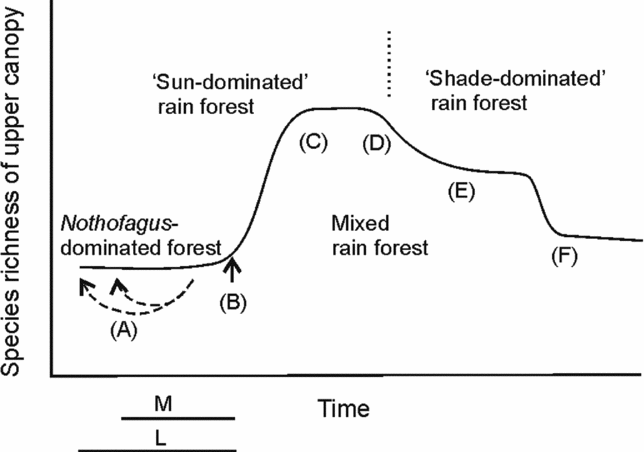
The size structures suggest that large-scale disturbance during the reproductive life span of Nothofagus should allow dominance to be maintained (Figure 4: A). Small-scale exogenous disturbance (e.g. weaker cyclones) may initiate or maintain recruitment in larger than usual gaps (Newbery et al. Reference NEWBERY, VAN DER BURGT and MORAVIE2004, Reference NEWBERY, PRAZ, VAN DER BURGT, NORGHAUER and CHUYONG2010; Webb et al. Reference WEBB, SEAMON and FA'AUMU2011), but may be insufficient for dominance to persist, depending on the forest structure and synchronicity of disturbance and mortality. In the absence of large-scale disturbance, the canopy will increase in richness as Nothofagus trees die without replacement (Figure 4: B). At high altitudes, Nothofagus dominance might persist without exogenous disturbance.
A simple predictive model of the canopy dynamics of Nothofagus-dominated forest at low to mid-altitudes in New Caledonia, modified after Read et al. (Reference READ, HALLAM and CHERRIER1995). L, duration of Nothofagus lifespan; M, duration of its reproductive life. Dashed line, impact of large-scale disturbance. Note that differing disturbance regimes within the reproductive lifespan of Nothofagus will lead to differing effects on the structure and composition of the forest, but it is likely to remain dominated by Nothofagus (A); the transition to mixed-canopy rain forest may occur rapidly, or slowly, depending on the degree of synchronicity of death among Nothofagus canopy trees, and the capacity for replacement in endogenous gaps (B); the mixed rain forest is likely to be quite dynamic in composition as long-lived shade-intolerant species die without recruitment, replaced by species of greater shade tolerance (C–E).
Many other canopy species do not show continuous regeneration, in both Nothofagus-dominated and mixed rain forest. The timing of senescence in other shade-intolerant tree species and the rate of recruitment of shade-tolerant species will affect the diversity of the ensuing canopy (Figure 4: C). Some species such as A. neocaledonica have a short life span (c. 60–80 y), dying with or earlier than Nothofagus. Others survive longer, with lower mortality rates than Nothofagus, and possibly with greater recruitment, or vegetative persistence, e.g. stem sprouting in Cunoniaceae spp. In the longer term without large-scale disturbance, the canopy of mixed rain forest is likely to decrease in richness (Figure 4: D), unless (1) species of intermediate shade tolerance are maintained by small-scale endogenous disturbances, i.e. gap dynamics (Wright et al. Reference WRIGHT, MULLER-LANDAU, CONDIT and HUBBELL2003), or (2) the number of shade-tolerant canopy species increases through immigration or enhanced establishment success. ‘Shade-dominated’ rain forest may have a mixed canopy (Figure 4: E), although possibly less rich than ‘sun-dominated’ mixed rain forest, or may eventually be dominated by a small number of persistent highly shade-tolerant species (Figure 4: F). Large-scale disturbance of any post-Nothofagus stage is unlikely to lead to re-establishment of Nothofagus in the short-term, since there will be no Nothofagus seedlings in the understorey, and fruits are poorly wind-dispersed (Read & Hope Reference READ, HOPE, Veblen, Hill and Read1996).
The relationship between Nothofagus forests and adjacent mixed rain forests
While it is likely that lowland forests with a Nothofagus-dominated canopy will become more species-rich in the hypothetical absence of disturbance, there is no evidence that the converse is true, i.e. that adjacent mixed rain forests have developed from an earlier Nothofagus-dominated stage. Furthermore, many canopy trees of these mixed rain forests have size structures indicating episodic regeneration. Hence these forests are best interpreted as secondary forests, in contrast to mixed rain forests in more protected areas that have a stronger component of shade-tolerant species in the canopy (J. Munzinger pers. comm.). Therefore, it appears that multiple types of secondary forests occur within a local area, some of which have a monodominant canopy while others have a more species-rich canopy. The determinants are not yet clear: small differences in edaphic factors and topography may contribute to this variation, as well as site history, including the disturbance regime. It is likely, as has been suggested in other tropical forests (Baker et al. Reference BAKER, BUNYAVEJCHEWIN, OLIVER and ASHTON2005), that disturbances occurring at multiple temporal and spatial scales and intensities contribute to complex forest structure and dynamics, over both space and time. Therefore, although temporal factors (e.g. time since disturbance and frequency of disturbance) play an important role in explaining Nothofagus monodominance, their contribution to the contiguity of monodominant and mixed-canopy forest will be more difficult to elucidate.
CONCLUSIONS
Unlike many tropical monodominant rain forests, the New Caledonian Nothofagus forests are secondary forests that appear to be successional to mixed rain forests, at least at low to mid-altitudes. However, dominance might persist in the long term due to tree longevity combined with the frequency of large-scale disturbance in the region, as is common in Nothofagus elsewhere in both tropical and temperate regions. Small exogenous disturbances may allow regeneration of Nothofagus, but might not allow dominance to persist. It is uncertain whether the predicted late-successional shade-dominated rain forests would be mixed or simple in canopy composition. Given the fragmented and exposed nature of these forests and the frequency of disturbance, progression to this stage is likely to be rare. This may, in the medium and long term, endanger the diversity of shade-tolerant species. While temporal factors associated with disturbance regimes play a key role in determining monodominance by Nothofagus, their role in explaining contiguity of monodominant and mixed-canopy forest is more complex, since the latter may also be secondary forest. It is likely that spatially and temporally heterogeneous disturbance regimes contribute to these patterns of composition and dynamics.
ACKNOWLEDGEMENTS
We gratefully acknowledge early collaboration with J.-F. Cherrier (dec.) and establishment of the plots with CIRAD Forȇt, and the assistance of M. Boulet (formerly of Province Sud, Noumea). We thank G. Hope, E. Goudrie, S. McCoy, F. Clissold, J. Ferris, A. Jordan, S. Ball, R. Boyle, M. Kohout, C. Ashburner, M. Wardle, P. Wardle, S. Kerr, and particularly P. Peeters, G. Sanson and R. Carpenter, for assistance in the field, and S. Kerr and K. Allen for tree core analyses. We thank P. Baker and R. Simken for advice on ring counts, the Herbarium of the Centre IRD Noumea (NOU) for access to herbarium specimens to assist identifications, J.-M. Veillon, J. Munzinger, G. Dagostini, S. McCoy and B. Suprin for assistance with identifications, G. Hope, R. Carpenter, P. Peeters and G. Sanson for discussion and insightful comments on the manuscript, and the Jaffré and McCoy families for their hospitality. Financial support was provided by the Australian Research Council, Ministère des Affaires Etrangères (France), IRD, Monash University, and Air Calin. We gratefully acknowledge permission of Province Sud to undertake this research.
Size structure analysis of canopy species in Nothofagus-dominated and mixed rain forests in New Caledonia. Weibull c-values are given, with standard deviations. S indicates size structures with c ≤ 1 (1-tailed t-test), i.e. with the strong positive skew predicted for continuously regenerating populations. D indicates those with a disjunct distribution of individuals. T indicates species that contributed ≥ 10% total stand basal area. CM = Col de Mouirange; CY = Col de Yaté; MS = Montagne des Sources; PGK = Pic du Grand Kaori; M = mixed rain forest; N = Nothofagus forest. Observations are combined for two species of Cryptocarya (C. transversa and C. guillauminii) and two species of Euroschinus (E. rubromarginatus and E. verrucosus) that could not always be distinguished.