Introduction
In 2012, 8.2 million people died of cancer, making it a leading cause of death worldwide (Ferlay et al., Reference Ferlay, Soerjomataram and Dikshit2015). Adults with advanced-stage cancer often struggle with losing their precancer identity (Gillies & Johnston, Reference Gillies and Johnston2004), sense of meaning and purpose in life (Kissane, Reference Kissane2012), and sense of dignity (Chochinov et al., Reference Chochinov, Hack and McClement2002; Gillies & Johnston, Reference Gillies and Johnston2004)—characteristics frequently associated with depression and desire for hastened death (Arrieta et al., Reference Arrieta, Angulo and Núñez-Valencia2013; Chochinov et al., Reference Chochinov, Hack and McClement2002). In fact, patients often report these concerns contribute more to their desire for hastened death than the physical effects of cancer and cancer treatment (Chochinov et al., Reference Chochinov, Hack and Hassard2005).
Dignity therapy (DT) is a brief individual psychotherapeutic approach designed to support the dignity of terminally ill patients and reduce their suffering (Chochinov, Reference Chochinov2012). In DT, patients are invited to answer a series of reflective open-ended questions in an audio-recorded conversation with a trained clinician. Patients are encouraged to talk about the most important aspects of their lives and what they want loved ones to know and remember about them (Hack et al., Reference Hack, McClement and Chochinov2010). The recording is transcribed and edited into a legacy document that the patient can share with loved ones (Chochinov, Reference Chochinov2012). Review of these documents often reveals patients’ core values (Hack et al., Reference Hack, McClement and Chochinov2010). Notably, patients have reported that DT is significantly more helpful than both standard palliative care and client-centered care, bringing greater improvement in their quality of life and sense of dignity (Chochinov et al., Reference Chochinov, Kristjanson and Breitbart2011). Most patients who participate in DT report an increased sense of meaning, purpose, and dignity (Chochinov et al., Reference Chochinov, Hack and Hassard2005, Reference Chochinov, Kristjanson and Breitbart2011; Fitchett et al., Reference Fitchett, Emanuel and Handzo2015). Most families report that DT made life more meaningful for their loved ones and that the document was a continuing source of comfort during their grief (Chochinov et al., Reference Chochinov, Hack and Hassard2005, Reference Chochinov, Kristjanson and Breitbart2011; Goddard et al., Reference Goddard, Speck and Martin2013; McClement et al., Reference McClement, Chochinov and Hack2007). A systematic review of 28 DT studies reports decreased patient anxiety, improved existential and psychosocial outcomes, and improved end-of-life experience (Martínez et al., Reference Martínez, Arantzamendi and Belar2016).
Despite encouraging outcomes, several barriers limit wider implementation of DT in clinical practice. DT requires a clinician trained in the intervention, and such training opportunities are relatively rare and costly. The time needed to deliver DT varies and can be prohibitive. In a phase 3 randomized controlled trial of DT in terminally ill adults, DT was delivered in three sessions per patient, with approximately 2 hours of clinician time across the sessions, in addition to time required to transcribe session recordings and edit each transcript before returning to the patient (Chochinov et al., Reference Chochinov, Kristjanson and Breitbart2011). In two other studies that reported total time to deliver the intervention, DT took two to seven sessions to complete (Hall et al., Reference Hall, Goddard and Opio2012; Montross et al., Reference Montross, Winters and Irwin2011), with the clinician spending an average of 6.3 hours (range = 3.6–10) per patient in one study (Montross et al., Reference Montross, Winters and Irwin2011) and 15.04 hours (SD = 7.13), including an average of 4.05 hours (SD = 1.92) of transcriptionist time, in the other (Hall et al., Reference Hall, Goddard and Opio2012). DT also requires an audio recorder and transcription of sessions, which can be costly (Aoun et al., Reference Aoun, Chochinov and Kristjanson2015; Johns, Reference Johns2013). Further, previous DT participants have commented that they would like to be able to modify or add to their legacy project independently based on their changing needs as end of life approaches (Johns, Reference Johns2013), which is not possible in traditional DT (Bernat et al., Reference Bernat, Helft and Wilhelm2015).
To address both the barriers to implementation and participants’ feedback, we developed and evaluated an abbreviated version of DT, designed to be less resource-intensive and more patient-involved while remaining true to the fundamentals of traditional DT. The objective of this paper is to evaluate benefits, barriers, and recommendations related to abbreviated DT by qualitatively analyzing (1) postintervention interviews with participants and legacy recipients and (2) the core values expressed in patients’ legacy projects. Quantitative results from the study are reported elsewhere (Bernat et al., Reference Bernat, Helft and Wilhelm2015).
Methods
Recruitment and eligibility
The Scientific Review Committee of the National Cancer Institute–designated Indiana University Simon Cancer Center and the Indiana University Institutional Review Board approved the study protocol. Study recruiters identified eligible patients in the outpatient oncology clinic of Indiana University Simon Cancer Center. Eligible patients (1) were aged 21 years or older; (2) were diagnosed with incurable and advanced-stage solid malignancies as assessed by the patient's oncologist; (3) were rated by their oncologist as having <50% chance of 1-year survival; (4) had impaired existential well-being determined by a score of ≤25 on the Functional Assessment of Chronic Illness Therapy – Spiritual Well-being Meaning and Peace subscale (Peterman et al., Reference Peterman, Fitchett, Brady, Hernandez and Cella2002); (5) were literate in English; and (6) self-reported as using the internet and checking e-mail at least once a week. The protocol was later amended to eliminate the impaired existential well-being criterion to improve recruitment. All participants provided written informed consent.
Procedures
After consenting, participants completed a demographic questionnaire and measures of existential well-being and dignity-related distress at baseline (Bernat et al., Reference Bernat, Helft and Wilhelm2015). Participants then scheduled a 90-minute session with a DT-trained study interventionist at each participant's preferred location—typically the participant's home. During these audio-recorded face-to-face sessions, abbreviated DT participants worked with the interventionist to discuss three of the nine core questions of the traditional DT protocol developed by Chochinov and colleagues (Reference Chochinov, Hack and McClement2002). These three selected core questions (noted in Table 1) were found to be most likely to yield sensitive emotional content in previous research (Johns, Reference Johns2013). Having the interventionist administer these three questions gave the patients an opportunity to work with a therapist as they reflected on these deeply introspective questions while also making the most of the interventionist's dedicated, yet limited time. After the session, participants completed an orientation to a legacy-building web portal.
Dignity therapy questions

* Questions asked in the face-to-face abbreviated dignity therapy session.
The audio-recorded responses from the face-to-face session were transcribed and electronically delivered to the participant within 1 week of the session, along with the remaining six questions of the DT protocol. Participants then made additional edits and typed responses to the remaining six DT questions at home and either uploaded weekly progress to their legacy-building web portal or e-mailed their projects to their study interventionist. Each participant received weekly supportive phone calls from the interventionist lasting 5–10 minutes for 3 weeks. When checking in, the interventionist verbally recognized progress made on the legacy project, addressing questions about navigating the web portal, assisting with writing goals for the following week, and acknowledging the emotional experience of writing the legacy project. Upon completing their legacy projects, participants and recipients of the projects participated in individual postintervention interviews by phone with a research assistant. These interviews explored the benefits and weaknesses of the intervention and invited recommendations for future participants. Interviews were audio-recorded and transcribed verbatim. Participants and their legacy recipients each received a $25 gift card upon completing the interviews.
Data collection and analysis
Postintervention interviewers solicited feedback on (1) satisfaction with abbreviated DT, (2) benefits and barriers to the effectiveness of abbreviated DT, and (3) recommendations for project improvement and for future participants. Using a semistructured guide, interviewers asked a number of open-ended questions, including: “What was it like for you to create your legacy project?”; “If any difficult emotions arose while creating your legacy, how did you handle these?”; and “If others like yourself were considering creating an online legacy project, what would you recommend to them?” An interview analysis team consisting of one qualitative researcher (A.H.C.) and two research assistants analyzed 10 participant and seven recipient postintervention interview transcripts using rapid qualitative analysis methods (Beebe, Reference Beebe2001). A data template was developed to capture key interview responses in a succinct, bulleted format, categorizing based on the three feedback areas mentioned previously. The team analyzed a set of three randomly selected interview transcripts and used these initial results to refine the template and develop consensus on interview content relevant to each category. The team then divided the remaining 14 transcripts, and two independent reviewers recorded information relevant to each category along with illustrative quotes. Afterwards, the team met to discuss data gathered for each broad category and come to consensus.
A legacy project analysis team—including two psychologists, one communications researcher, one nurse, and one physician—evaluated the 11 completed legacy projects to identify core values expressed within each project using the DT Coding Framework developed by Hack and colleagues (Reference Hack, McClement and Chochinov2010). In a double-review process, two reviewers read through the legacy projects and recorded core values described by each participant in each paragraph of their project. Team members met to discuss values coded and come to consensus.
Results
Demographics
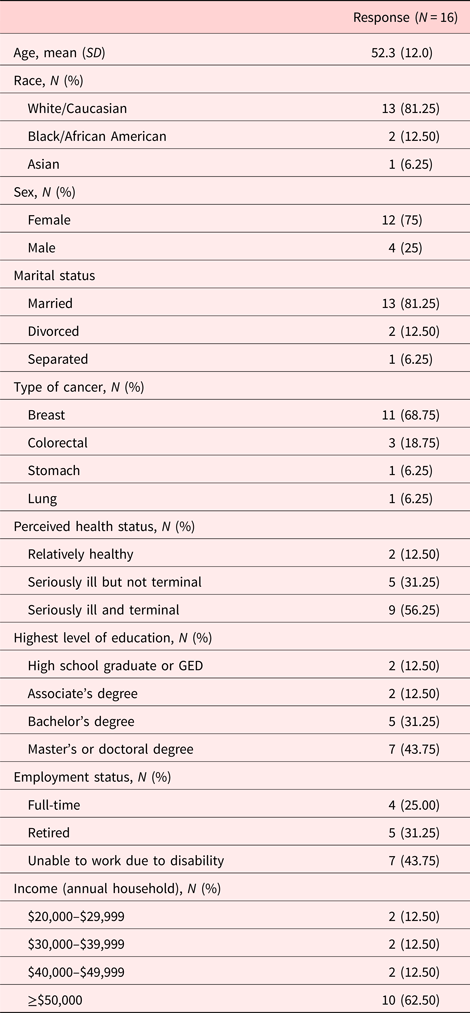
In 6 months of active recruitment, 58 potentially eligible participants were identified by recruiters through in-clinic eligibility screens. Of these 58 patients, 16 enrolled in the study. As shown in Table 2, the enrolled patient sample was mostly female, white, married, and college-educated, with a mean age of 52.3 years (SD = 12.0). The majority of participants had breast cancer and the remainder had either gastrointestinal or lung cancer. During the study, two participants died and three dropped out because the intervention did not work out with their schedules. Eleven participants completed the intervention and developed legacy projects and 10 completed a qualitative interview. At study enrollment, each participant named one family member as the primary recipient; seven of these legacy project recipients (three spouses, two siblings, one parent, and one cousin [mean age = 51.9; SD = 15.5]) also completed qualitative interviews.
Participant demographic and medical characteristics

Benefits
Analysis of postintervention interview transcripts identified the following four themes focused on benefits of abbreviated DT: (1) self-expression, (2) connection with loved ones, (3) sense of purpose, and (4) feeling of continuity.
Self-expression
“I guess I just wanted to say things that maybe I didn't say or don't always say… I was able to put it in this written format to say how much I love them” (018).
Participants appreciated the chance to write the legacy document themselves, reporting that they often found it easier to write than talk and that writing helped them express thoughts and feelings they found difficult to convey otherwise. Recipients agreed, mentioning that their loved one enjoyed writing and creating the document. Further, both participants and recipients noted that the project was an excellent way to compile the participants’ writings and journals in a structured and accessible way. One participant noted that she chose to include a sensitive topic in her project and found that the opportunity to write and rewrite over the course of several weeks helped her determine how to include the event in a way she felt was diplomatic, but honest. One dyad revealed that the participant was “not a talker” (018A) and felt uncomfortable expressing her thoughts and feelings verbally, even with close family. She reported that abbreviated DT was a helpful format that enabled her to express herself openly in writing. Only one participant found it easier to use the transcriptions of conversations with the interventionist in her project than writing herself; however, she still found the process of creating the project useful.
“I really enjoyed going over my pictures…, collecting them and making little stories about what happened to me as a kid… There's a lot of stuff…that other family members don't really know about” (007).
Participants appreciated having autonomy in the abbreviated DT process, including the ability to add pictures to their projects. One participant was especially excited to add pictures because she kept a photo-journal of her life events. She particularly enjoyed exploring her mother's photograph collection when creating the legacy project, stating it “gave [her] a glimpse” of her mother's life (007); her completed project used more than 70 pictures. The recipient of a different project that included photos remarked that they complemented the written document and illustrated the participant's experiences and relationships.
Connection with loved ones
“It really makes me feel good that I have it down so that they know some serious things. Because usually when we're together it's laughter and fun lightheartedness and not-so-seriousness” (019).
Participants and recipients felt that the project enabled them to say things they might never have discussed with their loved ones. Participants said there was “never a good time” to talk about serious issues, but completing and sharing the document allowed them to initiate difficult conversations about emotional topics, such as dying (017). Creating and sharing the legacy project also gave participants and recipients a way to openly grieve and cope with strong emotions together in a supportive environment. Participants felt that showing love for family in a tactful way was more important than complete honesty, but others urged future participants to “go for it” (008) and hold nothing back in their projects.
Recipients of legacy projects reported that editing the participant's project was an unanticipated benefit of abbreviated DT. In traditional DT, the interventionist fills this role; however, some study participants asked their recipients to help with this task. These recipients said that editing their loved one's project was an emotionally difficult but highly rewarding experience—one recipient stating, “I felt it was an honor to be a part of it with him” (013A). Another recipient observed that working together on the legacy project strengthened their relationship and enabled them to attain a “much healthier emotional state” (015A). Projects often sparked deep conversations, giving recipients an opportunity to comfort their loved one and talk about what each of them was feeling, allowing both to process their grief and reaffirm their love for one another. Many recipients expressed that they were deeply moved that their loved one entrusted them to help with their legacy project.
Sense of purpose
“I think for the patients it's good because it helps them focus on something other than their disease. Sometimes I think people get focused on their disease and if that happens, they don't focus on things that can actually be good” (014A).
Participants noted that they were excited to work on the legacy project and felt a sense of happiness in completing it. One participant commented that having an ongoing self-directed project motivated her to organize her day and even make plans for the coming year—something she had done in the past that gave her joy. Another felt so compelled to work on the project that she wrote parts of it in the middle of the night. Participants enjoyed having autonomy to continually modify and add to the document. Some participants carried a tape recorder with them for several weeks to record ideas to add to their project later. Another participant regularly wrote project ideas on her smartphone when she was away from her computer. Recipients observed that the continuing project gave participants a goal and a renewed sense of purpose and accomplishment. One participant cited that it would be an “ongoing project” (014) even after completing the study. Participants and recipients both felt that abbreviated DT helped participants evaluate their accomplishments and realize all they had done throughout their lives. Both also commented that creating the project together helped participants feel more positively about life and reframe their outlook.
Continuity of self
“It was extremely fulfilling to me to look back and see…what has been important in my life…and it…gives me not only a sense of accomplishment, but peace in that I have something that I can give my children, and grandchildren and husband to look over and see into who I really am. And then remember me in that way” (019).
Participants most frequently reported that they wanted their family (including upcoming generations) to know who they really were and what their life was like. Participants found the idea of their thoughts being “put down on paper” (014) comforting, bestowing a sense of permanence. Some expressed concerns that younger family members would only remember them as an aunt or a mom, for example, without knowing the other facets of their life that make them who they are and noted that the project helped them develop a record of their complex individuality. Participants were glad they could pass on wishes, expectations, and deep love for their family and friends. Recipients noted that they learned more about the full identity of the participant. Recipients also felt that the legacy project would preserve the essence of their loved one and agreed that the project would help teach younger generations about the participant.
Barriers
The majority of participants felt that carving out time to create the project presented challenges, and one cited that time was a major obstacle. Managing time was challenging because participants had other responsibilities and oftentimes did not feel well enough to work. Participants managed this by setting goals and carefully planning time, which some commented was a helpful exercise for them. Despite sometimes struggling to make time for the project, participants tended to like that the project had study-imposed time constraints because it pushed them to work on it when they might otherwise have put it off.
Participants and recipients reported emotional pain associated with creating the project as both a barrier and a benefit, commenting that initially, directly confronting their mortality and evaluating their lives was an emotionally charged experience.
“The first part we got through and it was a bit difficult because it made me bring to the surface things that I had been feeling and to me, that was the greater aspect of it, was because these things had to come to the surface” (013).
To cope with this, many participants found support in their families or the study interventionist or by stepping away from the project until they felt ready to face their inevitable emotions. Religious participants also found comfort in prayer and faith. After the initial confrontation, participants found that facing their emotions was an important part of the dying process, and they were glad to be able to work through them in a structured way. Even so, recipients often found it hard to start reading the finished document.
Finally, participants struggled with physical pain and fatigue from their cancers and treatments while developing their projects. If unable to control the pain with medication, participants often waited until symptoms passed before returning to the project. Participants mentioned they did not feel pressure from the interventionist to finish the project while they were not feeling well.
Recommendations
Participants who completed the intervention overwhelmingly reported they would recommend abbreviated DT, saying it was “valuable” (013A) and “extremely fulfilling” (019). Recipients unanimously reported they would recommend abbreviated DT to others and that abbreviated DT was helpful for them and the participant's family. The majority of participants and recipients said DT helped participants cope more adaptively with cancer. Although few interviewees said they would change anything about the project, one recipient suggested more questions to guide the participants’ responses, whereas a few participants said there should be fewer legacy questions.
Legacy project core values
“Family” was the most common and universal core value expressed in the legacy projects, followed by “spirituality,” “caring,” “sense of accomplishment,” and “autonomy.” The least universally significant value was “spirituality,” with several projects mentioning it multiple times and other projects not mentioning it at all. This was to be expected as some participants were more religious than others. The other core values were fairly evenly distributed across patients.
Discussion
Findings from studies of traditional DT demonstrate that it can foster important life-affirming perspectives in participants—including a sense of meaning, pride, and hopefulness—as they explore personal histories, life lessons, accomplishments, and love (Hall et al., Reference Peterman, Fitchett, Brady, Hernandez and Cella2013; Montross et al., Reference Montross, Winters and Irwin2011). Research has shown that traditional DT can also benefit family members (Goddard et al., Reference Goddard, Speck and Martin2013). The qualitative data from this study seem to suggest that abbreviated DT may foster similar benefits to traditional DT, including sense of purpose and continuity of self. Participants reported that creating the project was instrumental in remembering their accomplishments and appreciating their life's worth. All recipients interviewed said abbreviated DT was helpful for their loved ones and recommended that others participate in this activity. Overall, the participants reported that abbreviated DT was an instrumental therapy for themselves and their families.
Participants and recipients reported some additional benefits to abbreviated DT. Self-expression was identified as an important benefit of abbreviated DT, which uses a model of participants independently writing responses to most of the questions in the DT protocol. For participants who feel uncomfortable disclosing all of their personal and emotional life events to an unfamiliar clinician, traditional DT may result in important, sensitive topics being left out. However, the limited, one-time session with the interventionist in abbreviated DT was foundational for participants’ projects; through the therapist's skillful probes and acknowledgement, participants learned how to reflect and respond to deeply introspective prompts, which may have aided them in writing their legacy projects independently thereafter. Abbreviated DT allows participants to complete the project in a mostly private environment, in which they can reflect and consider how they want to include sensitive content and capture their lives over several weeks, rather than the limited span of traditional DT.
Between the 90-minute face-to-face session and three weekly 5- to 10-minute phone calls, we estimate total interventionist time to range from 105 to 120 minutes per participant. Because only one-third of the nine DT questions needed to be transcribed for abbreviated DT, transcription costs were also reduced compared to traditional DT, making abbreviated DT a potentially viable option for institutions lacking the resources required for traditional DT. However, a cost-effectiveness analysis between abbreviated and traditional DT is needed before one intervention can be recommended over another.
Abbreviated DT does, however, require significantly more participant time, which may limit the patient population for whom this variation would be appropriate. For example, very sick patients may find traditional DT more appropriate because less participant time and energy is required. Future studies investigating abbreviated DT should ask participants to compare their experience of answering questions with the interventionist with the experience of writing responses to questions on their own to capture which method might be better-suited for one patient over another.
Traditional DT has been found to promote exploration and rediscovery of self as well as reflection on what is most meaningful in life for participants (Hack et al., Reference Hack, McClement and Chochinov2010). In this study, participants and recipients alike reported that abbreviated DT enabled participants to similarly consider their personal identity, legacy, and core values; however, the primary focus for most participants was their families. This may indicate the large role that family plays in patients’ senses of identity. Values involving the self were used infrequently.
The importance participants placed on “autonomy” and its emergence as one of the top five core values in abbreviated DT is also a notable finding, because the physical decline brought on by cancer and treatment often robs patients of autonomy. Interestingly, “autonomy” is not among the top six values in the study conducted by Hack and colleagues (Reference Hack, McClement and Chochinov2010). Perhaps the freedom given to abbreviated DT participants to develop their legacy projects in the comfort of their home led these patients to feel more autonomous in the creation process than traditional DT participants, whose legacy projects typically contain only transcribed spoken content recorded during time-constrained interviews with clinicians. Because abbreviated DT participants had the freedom to revisit and edit their documents repeatedly, the processes of reflection and revision continued to deepen understanding of their life narrative and changing needs approaching death. Participants praised this feature of abbreviated DT—many included their legacy project as part of their daily routine. Overall, the top core values expressed in legacy projects reflect the most frequent desires of dying patients, and as such, care teams should foster situations that honor those values to comfort persons with advanced-stage cancers.
Limitations
Although this study offers rich information about patients’ experiences with abbreviated DT, it has some limitations. The pilot study included a small sample size with an overrepresentation of high socioeconomic status—largely white, female, college-educated participants. All participants had an e-mail account, were regular users of the Internet, and had computers at home. Also, at least two of the 11 completers had already done a fair bit of previous journaling, which could indicate a sample bias. The small sample, lack of diversity, and regular computer use may inhibit generalizability of the study's emergent themes.
Conclusion
Implementing abbreviated DT may allow for decreased interventionist time and cost while still providing meaningful benefits to patients and families. Participants and recipients reported positive experiences with the abbreviated DT protocol and the majority found it a personally meaningful, life-enhancing activity. Although additional research is needed to confirm these effects, abbreviated DT may be a promising variation of the original DT intervention.
Acknowledgments
This project was funded by the Indiana University-Purdue University Indianapolis Research in Palliative and End-of-Life Communication and Training (RESPECT) Signature Center; the National Cancer Institute's R25 CA117865 to J.K.B.; an Indiana Clinical and Translational Sciences Institute career development award to S.A.J. (funded in part by the National Institutes of Health, National Center for Advancing Translational Sciences Clinical and Translational Sciences Award TR000163); and a Walther Cancer Foundation Faculty Development Award (0175.01) to S.A.J. Mentoring support was provided by Dr. Victoria Champion through the National Cancer Institute of the National Institutes of Health (#K05CA175048). The content is solely the responsibility of the authors and does not necessarily represent the official views of the National Institutes of Health or the Walther Cancer Foundation. This study would not be possible without the work of Dr. Harvey M. Chochinov and colleagues, developers of DT. The authors thank Holly Martin for her assistance with qualitative analysis. The authors are deeply grateful to the courageous patients who enrolled in this study and their compassionate legacy recipients, each of whom taught us to be mindful of the preciousness of life.