A wise person does at once, what a fool does at last. Both do the same thing; only at different times.
—Lord Acton
In the majority of the world's democracies election dates are not fixed. Governments, especially those in parliamentary democracies, often can and do call elections before the mandatory end of their term, with consequences for domestic politics and economics. A well-timed election, such as one that coincides with an expanding economy, can boost an incumbent government's reelection prospects as well as diminish the political demand for politically motivated macroeconomic intervention. Yet despite the importance and prevalence of endogenous, politically determined election timing, we know surprisingly little about the circumstances and institutions that yield opportunistic early elections. When should elections optimally be called? What institutional arrangements favor or inhibit opportunistic elections and economic manipulation? To what degree, if any, does the possibility of opportunistic timing temper the incentives for stimulating the economy before elections?
Scholars and the public alike have long believed that governments, where able, time elections (“surf”) and manipulate their economies (“manipulate”) for political advantage.1
This usage of the term “surfing,” to the best of my knowledge, was coined by Takashi Inoguchi (1979).
Political histories and press accounts abound with depictions of parliamentary governments consumed with the timing of elections (e.g., Butler and Kavanagh, multiple years, and Crossman
1979); statistically grounded research has found governments to be more (Palmer and Whitten
2000; Roper and Andrews
2002) or less (Smith
2003) opportunistic. Interest in economic manipulation has been no less pervasive. Belief in the political business cycle is sufficiently widespread that one scholar (Suzuki
1992) has found that the public systematically raises welfare expectations prior to elections; academics match this interest with a steady flow of political business cycle models—initially with adaptive expectations, later with rational expectations—and empirical tests (cf. Alesina, Roubini, and Cohen
1997 and Drazen
2000, chap. 7). It is incontrovertible that the public and many academics believe that governments gain electoral advantage from both activities, surfing and manipulation. Yet despite the obvious possibilities for surfing and manipulation to influence each other, ever since Nordhaus (
1975) first formalized the political business cycle and assumed fixed election timing, researchers have analyzed them in isolation from each other.
Beginning with Ito and Park's (1988) seminal paper, a wave of studies began to bridge this separation by showing preelection economic manipulation to be considerably muted in several countries that permit endogenous election calling (e.g., Cargill and Hutchinson 1991, Chowdhury 1993, and Ito 1990).2
One notable exception to the empirical orientation of this research area was Chappell and Peel's (1979) early model of the political business cycle with endogenous elections. This model, however, provides no uncertainty in the election calling decision.
This predominantly empirical literature offered a new, but not the only, explanation for the puzzling absence of political business cycles around the world (cf. Alesina, Roubini, and Cohen
1997). Why should governments engage in distortionary and unreliable macroeconomic manipulation when the simpler and nondistortionary act of election calling can achieve the same electoral end? Other observers of the surprising absence of political business cycles focused on other explanations such as the difficulty of triggering macroeconomic booms prior to elections (e.g., Lewis-Beck [
1988]
1990) or the rational expectations of voters (e.g., Cukierman and Meltzer
1986, Person and Tabellini
1990, Rogoff
1990, and Rogoff and Sibert
1988).
3 Indeed, macroeconomic manipulation not only may be ineffective but also may backfire as rational voters, behaving as “fiscal conservatives,” recognize politically engineered election year booms and punish incumbents for expected postelection economic distortions (Peltzman 1992).
,
4 Clark and Hallerberg (2000) offer an additional explanation: Given capital mobility, fixed and flexible exchange rate regimes constrain monetary policy and fiscal policy, respectively.
Researchers, left with a strong incentive for governments to manipulate the economy—voters, after all, punish governments for poor economic performance—but scant evidence of cycles in macroeconomic aggregates, turned their attention to a finer-grained instrument: cycles in fiscal balances. The intuition is simple: It is easier for governments to manipulate fiscal components to target electorally important constituencies and signal competence to rational voters (Rogoff
1990) than to engineer timely improvements in output or other macroeconomic aggregates. Yet again, however, empirics raised a new puzzle: “Political
budget cycles” are rarely found in developed countries (Alesina, Cohen, and Roubini
1992), emerging instead primarily in the developing world. This may be attributable to weaker institutions and stronger governments (Schuknecht
1996) or to lower audience costs of manipulation (Gonzalez
1999) in less developed countries. I argue that it is also attributable to the preponderance of endogenous election timing in developed countries, specifically the OECD. Of the 24 OECD member countries in 1990, only Norway, Switzerland, and the United States fully preclude early elections.
5 However, the constraints on opportunistic election calling vary considerably among endogenous timing countries.
Opportunistic election timing matters for explaining the absence of political–economic cycles, regardless of whether they are in fiscal balances or macroeconomic aggregates. Surprisingly, however, after the initial burst of interest in the moderating influence of surfing on manipulation, the field stalled.6
With the notable exception of articles by Heckelman and Berument (1998) and Reid (1998).
A combination of diminishing marginal returns from demonstrating the same effect in additional countries and the absence of testable theories of how institutions affect surfing and manipulation dampened interest. I seek here to redress this problem by developing an explicit model with empirically testable predictions. To be precise, I embed a career concerns model of government policy choice within a dynamic optimal stopping framework to predict the degree of surfing and manipulation under alternate institutional, governmental, and constituency features. Among other results, I find that the likelihood of early elections rises with the variance of exogenous shocks to voters' welfare,
7 As I explain later, voters in this framework cannot directly observe government competence; they infer it from their welfare. Consistent with empirical literature, they do not distinguish between welfare shocks that are beyond the control of their elected representatives and those that are more credibly attributable to government.
with longer constitutional interelection periods (CIEP), and with uncertainty about the future but diminishes with the value of office-holding; manipulation decreases in the variance of welfare shocks but increases with the CIEP and with the value of office-holding; and as surfing is increasing in welfare shocks but manipulation decreasing, surfing effectively substitutes for manipulation.
These results are strongly prescriptive for institutional engineering and suggest possible unintended consequences for certain political and constitutional arrangements. Consider, for example, how increasing international economic integration might have notably different effects on politics in endogenous timing and fixed-timing countries. As both monetary and fiscal intervention in the economy become increasingly constrained by economic and political integration, governments able to time their elections strategically should enjoy an electoral advantage relative to their fixed-timing peers. Those governments with the fewest institutional and political barriers to opportunistic election timing, the smallest, most volatile economies, and the longest CIEPs should enjoy the greatest advantage in their reelection campaigns. Where manipulation is least constrained and economic performance most volatile—primarily in the less economically integrated developing world—it is the electorate that may gain the most from opportunistic election timing. Those states that least impede the strategic timing of elections, primarily parliamentary democracies with long maximum terms, should experience less preelection manipulation and concomitantly less distortion in the postelection economy.
The second goal of this paper is to improve the understanding of opportunistic election timing itself by replicating for majority governments what Diermeier and Stevenson's (2000) Lupia and Strom's (1995) coalition bargaining models have done for the study of government termination under coalition governments. By making coalition bargaining explicit, they make dissolution and elections—whether opportunistic or involuntary—a consequence of the strategic interaction of coalition members rather than the vaguely epidemiological process that dominated earlier government duration literature.8
See Grofman and Roozendaal's (1997) review article for a history of the coalition stability and duration literature.
After all, as Grofman and Roozendaal (
1994) once commented, it is the choices of actors within circumstances created by exogenous shocks that bring cabinets down. Election timing by single-party governments is considerably simpler than dynamic coalition bargaining but much can still be gained from an explicit consideration of the actors' choices within circumstances created by exogenous shocks. Single-party governments, for example, maximize both the duration of the current term and the probability of reelection, not, as the traditional government duration literature assumes, just time in office. I model this trade-off between extending the current term and winning another as a dynamic optimization problem. This is not the first model of strategic election timing—signaling games by Smith (
1996) and Terrones (
1989) find equilibria on no early elections and early elections, respectively,
9 Early elections in Terrones' model signal high competence because a low-competence government, knowing it would stand little chance of reelection, should simply maximize its time in office by postponing elections to the last possible moment. Early elections in Smith's model signal low competence because high competence governments have greater confidence in their ability to perform well in the future. Later empirical work by Smith (2003) confirms the spirit, if not the equilibrium, of his signaling model. British governments call early elections but, because early elections signal government foreknowledge of imminent downturns, voters penalize them for doing so. The penalty, however, is not sufficient to preclude opportunistic election calling. The stochastic model presented here predicts that governments call elections during exceptionally large expansions unlikely to recur in the same term. This is often, but not always, observationally equivalent to calling elections before downturns.
and dynamic programming models by Balke (
1990) and Ito (
1990) yield numerical predictions of election timing—but this model, in addition to explicit consideration of manipulation, offers the first analytic predictions of when elections should be called and under which institutions they should be most prevalent.
The remainder of this paper develops, extends, and discusses the importance of a dynamic stochastic model of opportunistic election timing and economic manipulation. I begin with a parsimonious election timing model illustrating how governments form a finite-horizon optimal strategy for calling elections to maximize their reelection probability. Governments in this initial setup only decide between calling and not calling an election in each period of their term; they only care about reelection; and they increase their reelection probability by coordinating elections with favorable, exogenously determined states of the world. A subsequent section then builds on the initial model by considering utility from office-holding, not just reelection. Early elections cost governments the remainder of their current term, a trade-off that matters if office-holding itself is desired. I next constrain the stochastic state variable to economic shocks and make the voters' decision calculus explicit. Other noneconomic events certainly matter for election timing, but parsimony, as well as the upcoming exploration of how timing substitutes for economic manipulation, demands a ceteris paribus focus on macroeconomic management. Voters in this third section of the model now infer competence from the government's provision of public goods, a government activity that is constrained by the exogenous performance of the economy. The final extension of the model, after a brief digression on the intuition of the election timing model, allows governments to circumvent this budget constraint by increasing current-period spending via a distortionary tax on the postelection future. Comparative statics then suggest, among other results, that surfing does substitute for manipulation, that countries with more volatile economies surf more (and manipulate less), that longer maximum-term lengths (CIEPs) increase both the likelihood of opportunistic elections and political intervention in the economy, and that the value of office holding decreases surfing but increases manipulation.
As a majority of parliamentary democracies allow for endogenous election timing, the implications of this research are neither obscure nor trivial. A clearer understanding of why and when elections are called promises broadly applicable insights into electoral politics and the political business cycle.
THE BASIC MODEL
Election timing is quintessentially a problem of optimization under uncertainty. The incumbent government assesses electoral conditions in each period of its term and decides whether to call an election or to proceed to the next period, not knowing what that period holds. Opportune timing can increase both the probability of electoral victory and legislative efficacy through greater seat share but also effectively stops (i.e., resets) the game. Thus, election timing is fundamentally a finite-horizon optimal stopping problem. The government has a fixed number of periods in which to call an election before one is imposed and therefore times the election to coincide with the most electorally advantageous circumstances.
Recognizing election timing as an optimal stopping problem allows one to model a government's dynamic decision process explicitly. Dynamic programming techniques, as explained below, permit current-period options to be repeatedly compared to the expected value of future opportunities. Although the unknown values of several parameters prevent us from predicting the magnitude of different variables' effects on the probability of elections in this model, it is nevertheless possible to predict the sign of that effect.10
Estimating discrete choice dynamic programming parameters is often possible, however, and has received considerable attention from some econometricians and labor economists. Eckstein and Wolpin (1989) offer a survey of several approaches and newer techniques (e.g., Keane and Wolpin 1994) continue to emerge. In the case of this paper, one possibility might be to employ polling data in place of the current stochastic economic shocks.
Imagine for now the simplest possible arrangement: Voters have no memory of previous periods; the government's reelection probability, p, in each period t∈ {1,2,3,…,τ}, is strictly increasing in the random state variable, μ, distributed, for simplicity, uniformly with density ζ; each draw of μt is independent of others; the value of office-holding is constant over time; and governments simply maximize their chance of reelection, by timing elections to coincide with the highest μt that they believe will occur in their term.
Given that the government cannot see future states, how does it determine that the current state is the best that they will likely see before their term expires? The government knows the distribution from which μ is drawn and, as in any stationary Markov decision problem, plays a strategy to maximize its payoff: Call an election only if the current state exceeds the best expected future state. Assuming optimizing behavior in each future period allows us to calculate the government's expected future state via backward induction. Thus, for example, in the penultimate period, τ−1, the government's expected state in the subsequent and final period, Eτ−1(μτ), is simply the expected value of the random variable
, i.e., one. In this penultimate period the government will call an election if the current state of the country, μτ−1, is greater than the expected future state, Eτ−1(μτ) = 1 . This logic is then extended to the preceding period, τ−2 . The expected state continuing from τ−2 to τ−1 is simply the value of playing an optimal strategy at τ−1, i.e., the average expected state from τ−1's two possible outcomes over all possible values of μ: (1) continuing to the final period if μτ−1<Eτ−1(μτ) [payoff=1] and (2) calling an election if μτ−1>Eτ−1(μτ) [payoff
].
Expressed more succinctly, the government's decision at each t solves the program
which implies that the value of playing an optimal strategy at t is
or, more explicitly,11
Keep in mind the distinction between E(μ) and E(μt): The former is simply the expected value of a single draw from the state variable (μ) distribution, whereas the latter is the expected utility of playing an optimal strategy at t.
Thus the expected state from playing an optimal strategy can be calculated at any period and the expected value of continuing is just the value of an optimal strategy in the subsequent period.12
Equations (1) and (2) depend on the Bellman optimality equation. See Sundaram ([1996] 1999, 274) for an explanation of how a decision rule constitutes an optimal strategy in finite horizon dynamic programming. See Kreps (1990, Appendix 2.2) for a mathematically similar optimal stopping example.
Since
E(μ
t+1), the expected utility of continuing in office, is a monotonically decreasing function of time, converging to
E(μ), i.e., unity, in the penultimate period, it is least likely that current-period circumstances will exceed the expected future circumstances at the beginning of a term. As remaining tenure wanes, however, the expected future state steadily declines, thereby increasing the probability that a current period random draw of μ will exceed it and trigger an election.
13 The expected utility of continuing declines with time because the number of future draws decreases with time. This process, to borrow from the extensive optimal search and stopping applications in labor economics, is akin to that faced by a job seeker with a fixed number of sequential job offers with salaries drawn from the same distribution. At the final offer the job seeker will have to accepted the expected value of a single draw from the distribution, i.e., its mean. The penultimate offer will therefore only be accepted if it exceeds the expected value of the final offer, and so on, backward to the first offer.
OFFICE-HOLDING
Governments, however, derive utility from many time-dependent actions in office, not just from reelection per se. In this context, election to office becomes only a necessary condition: Governments maximize their reelection probabilities in order to extend their time in office but must trade off a probability-weighted new term against the remainder of their current term. Calling an election too soon costs the government the utility from the remainder of the current term; waiting too long reduces the chances of another favorable period occurring before mandatory dissolution. Thus a rational incumbent attempts to call elections in the last best period possible.
When utility comes from office-holding, the incumbent's decision becomes
Each period in office the government gains one unit of utility—consider this an ego rent, R—and receives new information about the current state of the country. The rational office-seeking incumbent continues in office until the expected utility of calling an election exceeds the expected utility of continuing in office, knowing that future elections may arrive under less fortunate circumstances. I represent λ, the value of continuing, as
The second term in the equation, (τ−t)R, captures the remaining utility in the current term in office and shrinks as the term progresses, providing a diminishing incentive to forgo favorable election opportunities. τ is the maximum term length in periods and t represents the current period.
The first term in Eq. (4) represents the other important element in determining election timing: the expected value of calling an election in the future. When incumbents expect favorable circumstances for an election in the future, it is easier to forgo current opportunities. More precisely, the expected value of a future election is the product of the reelection probability generated by the expected future state p[E(μt+1)] and the utility of a new term in office, τR, appropriately time discounted. Against this expected value of continuing, politicians must weigh the utility of calling elections. In its most basic form the expected utility of elections in any period is
simply the maximum length of another term weighted by the current-period reelection probability, p(μt).
VOTERS
Until now, the government's reelection probably has simply been defined as a function of the state variable without explicit consideration of how voters form their preferences. I now make the voters' preference mechanism explicit with respect to economic welfare. I redefine the state variable μ as a stochastic shock to the economy to generate a tractable model with budget constraints that can later trade off economic manipulation and election timing. This is not to claim that noneconomic events do not affect election timing—they do—but simply to restrict this model to ceteris paribus effects of the economy.
Adopting a career concerns framework (Dewatripont, Jewitt, and Tirole 1999a,b; Holström 1982; Persson and Tabellini 2000) positing asymmetric information, I can now make the voters' selection process—and hence the government's reelection probability calculation—explicit. Voters hold governments accountable for economic performance but, unable to observe government competence directly, infer it from the provision of public goods. More explicitly, suppose that government provision of public goods, gt, is constrained by gt=zt(Ty+st), where T represents the tax rate,14
The tax rate, T, remains fixed in this model in the interest of simplicity. Transforming T into a choice variable would mandate a full welfare function for voters and unnecessary complexity. With T fixed, governments may only choose between surfing and manipulation.
, income;
zt, aggregate two-period economic shocks; and
st, a hidden and distorting tax that shifts resources from the future to the present, improving current period welfare at the cost of the equivalent amount plus negative economic distortions,
V(
s), in the subsequent period. Knowing that more competent governments provide more public goods, but impotent to influence μ, governments are tempted to create the appearance of greater competence by increasing
s. While voters can immediately observe
g,
T, and
y, both
z′
t and
s′
t remain at least partially unobservable (primes indicate inferred variables). Voters therefore infer overall government competence as
z′
t=
gt/(
Ty+
s′
t). Past aggregate competence,
zt−1, is both observable and related to present competence but the current period's competence cannot be observed directly. Imagine aggregate competence,
zt, as the sum of the random and serially uncorrelated economic shock variable μ over the present and immediately preceding period,
zt=μ
t−1+μ
t, where μ
t−1 is observed by government and voters alike but knowledge of μ
t is reserved for the government. Given that the random variable μ is distributed uniformly with mean one and density
, voters choose the government if its inferred current competence
is greater than the opposition's expected competence, E(μ0) = 1.15
Unity is chosen simply to simplify later algebra and has no substantive effect on the model's comparative statics. Objections that government competence increases welfare beyond the government's resources are easily met by reducing E(μ) to one-half or less.
,
16 Note that variables not directly observed by the electorate are denoted by prime.
Thus, the government's reelection probability is
simply the probability that its inferred current competence exceeds the opposition's expected competence. More explicitly,
or, reexpressing gt and rearranging,
Keen observers will notice the possibility of bounded rationality. Voters base their assessments of government competence—and hence election preferences—on economic performance, yet governments have little direct influence over the short-term performance of the macroeconomy.17
See the debates over monetary policy ineffectiveness in the real business cycle literature launched by Kydland and Prescott (1980, 1982) following the rational expectations contributions of Lucas (1972) and others. Note that the standard assumption in the real business cycle literature is that the cyclical real effects of monetary policy are very small or nonexistent. Empirical support for the policy ineffectiveness assumption is provided, among others, by Litterman and Weiss (1989).
Assuming some price stickiness, as some recent real business cycle models attempt (cf. McCallum
1999), builds in a lag on inflation that then resembles the model offered here: Governments can provide real short-term stimulus but only at the cost of future distortions. In the absence of such price stickiness, governments would be constrained—as in political budget cycle models—to fiscal manipulation, which obviously also generates an intertemporal transfer. Thus, I continue to assume that manipulation is only possible in combination with costly transfers from the future but that, consistent with empirical political science, voters nevertheless reward and punish governments on the basis of economic performance (Lewis-Beck and Stegmaier
2000).
Voters, therefore, may be fully rational or boundedly rational, depending on the cost to them of the government influencing the economic variable from which they infer competence. In this model the government can only signal competence by increasing public goods provision, g, either though opportune timing (hence a higher z) or by increasing s, a hidden and distortionary tax on the future. Although exogenous to the model, if the value to the voters of the competence signal inferred from g exceeds the time-discounted future distortionary effects of s, then the voters are fully rational in much the same way they are in rational political budget cycle models (e.g., Rogoff 1990). Alternatively, if the value of the competence signal does not exceed that of the discounted future distortions, voters are boundedly rational. Empirically, there are numerous examples of voters holding politicians accountable for acts of God that they can at best mitigate but cannot prevent.18
The recent paper by Achen and Bartels (2002) showing how New Jersey voters punished local politicians for shark attacks (among other examples) is an amusing illustration of this. Susan Hansen (1999) shows that even competent state governors are often punished by voters for national economic trends such as unemployment over which they have little influence.
This behavior may even induce governments to engage in costly acts of signaling that reduce future welfare. The framework developed here is sufficiently general to accommodate either assumption about voter behavior.
Finally, consistent with this discussion, note that reelection probabilities are increasing in μt and st in Eq. (7), providing governments with an incentive to manipulate the economy in election periods for electoral advantage. To provide more realism (and an interior solution), I explore the derivation of optimal manipulation, s*, below; but first let us consider the model's broader intuition.
THE INTUITION
Thus far I have established a framework for how governments calculate reelection prospects and how voters assess government competence. In brief, governments' expected future election-period competence diminishes as the remaining time (and hence election-calling opportunities) wanes; voters infer competence and select candidates based on their own welfare; and governments repeatedly compare current and expected future utility in deciding when to call an election. Temporarily disallowing economic manipulation and adapting the government's election-calling decision to a fully dynamic setting in which future periods within the present term are discounted relative to more immediate periods now allows us to strengthen the model's intuition by simulating an incumbent's period-by-period election-calling decision.
A period-by-period decision process requires us to calculate the present value of each term's ego rent “revenue stream” at the time of each election calling decision, i.e., at each t. Not only do governments view future terms as less valuable than the present term, but within a given term, a distant period is less valuable than the current period. Hence, the government's election-calling decision should be expressed as
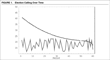
This decision is best presented graphically. Figure 1 simulates the calling (solid line) and continuing (dotted line) decision over time, assuming ζ = 3, δ = .02, and τ = 60. Obviously, when calling exceeds continuing, an election is called. Toward the beginning of a term, the time remaining in the current term, τ−t, together with high expected future popularity, E(pt+1), ensures that the value of continuing in office exceeds the value of calling elections. As time in office progresses, however, both τ−t and E(pt+1) diminish, lowering the value of waiting to the range where an exogenous stochastic event may make a snap election the more appealing option. From the government's perspective, when λ exceeds n, circumstances are better than expected and likely only to deteriorate in the future.
Election Calling Over Time
What if voters' affections are not so fickle? Although extraneous to the model at hand, it is not difficult to simulate voters who recall previous events and update their assessment of government competence more slowly. Constructing p as a linear combination in which past reelection standing is combined with new events in proportion to the strength of voter memory does not change the model's fundamentals. Suppose that
where m, m ∈ [0,1], captures the strength of the previous period's influence on current reelection prospects and pit represents the current period instantaneous reelection probability, i.e., the government's chance of reelection if voters base their decision on only the current period's events. At higher levels of m, new developments affect reelection prospects less and, obversely, lower levels of m weight present events more.
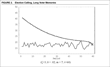
Voter memory reduces the volatility of government reelection probabilities and consequently may lower the likelihood of early elections. Figure 2 (ζ = 3, δ =.02, m=.7, and τ = 60) illustrates this: n, the value of calling at each t, is visibly less volatile than in Figure 1. A broad definition of collective voter memory, such as one that includes education levels and the independence and quality of the press in addition to innate human memory, would imply that societies with higher (lower) levels of education and a better (worse) press may be more (less) resistant to opportunistic election calling. Speculation aside, both Figure 1 and Figure 2 illustrate the model's fundamental intuition: A high initial value of continuing descends into a range where it may be exceeded by stochastic competence shocks as a government ages.
Election Calling, Long Voter Memories
OPTIMAL MANIPULATION
As the model is currently constituted, reelection-minded governments should simply increase economic manipulation until their probability of reelection approaches unity, engendering an economically destructive vicious cycle as expectations also adjust upward. As voters do not witness the distortionary effects of s until after the election, governments should consistently inflate the economy beyond expectations to ensure victory.
However, a government that cares about voter welfare, or, more cynically, its own reputation and future reelection bids, will avoid this corner solution by trading off reelection probability and voter welfare. Preelection manipulation induces postelection penance in the form of (1) lower government revenue, (2) lower public goods provision as gt+1=zt+1(Ty−st), and (3) negative distortionary effects, V(st), such that
In short, governmental sins of the past revisit the voters' present as the distortionary effects of previous period manipulation and lower levels of public goods as the government repays election period obligations. Incumbents thus maximize a combination of reelection conditional utility and voter welfare in choosing the optimal level of economic manipulation,
or, equivalently,19
Solving expression (7) for
yields the critical value,
. pt is the area in the μ distribution where
, that is,
or, more explicitly,
. Persson and Tabellini (2000) offer an excellent explanation of similar probabilistic voting techniques. The expectations term represents expected welfare in the period following the election period. I assume that revenues, st, borrowed in the election period must be repaid, thereby reducing the provision of public services in the succeeding period, gt+1.
which, taking expectations, E(μt+1)= 1, and retaining only necessary subscripts, yields
Multiplying through by the inverse of
and setting s′=s (in equilibrium) provides the FOC:
With a little help from the implicit function theorem, one can now see that optimal manipulation is decreasing in competence:
Governments, concerned with their legacies and constituents' welfare, are not willing to induce too severe a postelection economic distortion in return for marginal increase in reelection probability. While strong incentives exist to manipulate the economy for electoral gain in election periods, the degree of such intervention is tempered by concerns about economic repercussions.
COMPARATIVE STATICS
So what does this mean for election timing? The comparative statics of this model bear strong implications for optimal election timing. Understanding the effect of τ, R, ζ, μ, and δ on p has—as I show below—direct implications for optimal timing and, consequently, institutional design. We will also see that opportunistic timing, in turn, has its own implications, especially in relation to manipulation.
A single observation, posed as a proposition below, allows for relatively simple comparative statics on election timing.
Proposition 1. Let E(telec) be the expected period in which elections are called under optimal election timing. Then E(telec) is strictly decreasing in E(pt) if e−δ (τ−t) E(pt+1)/E(pt)<1.
Given Eq. (8), any increase in E(pt), the central component in calling, yields a greater increase in E(pt+1), the primary component in continuing, in all periods prior to τ−1. The expected value of playing an optimal strategy over multiple future periods is greater than the (expected) value of the single draw in the current period, so any increase in single draw E(pt) is amplified in E(pt+1). This implies that the value of continuing increases in E(pt) at a faster rate than the value of election calling, yet as calling is immediate and continuing deferred, only the latter is time discounted. As long as a government discounts the future at a rate sufficient to offset the rate at which E(pt+1) surpasses E(pt), then
.20
The condition that
is very reasonable. For example, even near the end of a term where dE(pt+1)/dE(pt) is greatest and the exponential discounting slightest, given
and three remaining periods prior to mandatory elections, any δ greater than .02 suffices to ensure that an increase in E(p) will raise the utility of calling more than continuing. In the preceding period, τ−4, the discount threshold falls to .018, and by the first period of a 60-period term (think of monthly periods in a five-year term), any value of δ greater than .002 will ensure that
and therefore
. Thus, anything that raises E(pt) yields more opportunistic election calling and earlier elections if
and reduces opportunistic election calling and extends expected government tenure if
.
Given that
obtains, it is now possible to draw a number of conclusions about the effect of several societal and institutional features on election timing and manipulation. Proposition 1 implies that opportunistic timing increases (i.e., λ−n decreases) in
1. μt. Governments cannot influence short-term economic conditions (short of distortionary manipulation) but they are able to call elections to correspond with opportune circumstances. Timing elections to correspond to periods of better economic performance (greater μ) increases public goods provision, the electorate's estimate of government competence, and the incumbent's current period reelection probability. Opportunistic elections should therefore be more likely in periods of exceptionally strong economic performance.
2. δ. The more a government discounts the future, the more λ, the value of continuing, is reduced relative to n, calling. This suggests that minority governments or governments with narrow majorities or low party discipline—that is, any government with low expectations of staying in power for long—should be more inclined to opportunistic timing.
3. τ. Longer maximum terms postpone the expected election period, telec, but increase opportunistic election calling by decreasing λ−n. The prior occurs because the remaining term sacrificed by early elections increases; the latter occurs because longer terms raise the value of a given term, thereby invoking proposition 1. Opportunistic election calling should therefore be more common in states with longer maximum terms.
But opportunistic timing decreases in
4. R. The greater the value of office-holding, the less opportunistic the government. An increase in the value of office-holding (fewer checks on power, weaker opposition, etc.) is reduced by reelection uncertainty in the calling function common to λ and n but is unmodified in the remainder of the present term unique to λ.
5. ζ. The higher the density of μ, the lower the variance of μ, the lower the probability of a draw of μt sufficiently above E(μ) for n to exceed λ. Stated differently, the frequency of opportunistic elections is positively associated with the variance of economic performance. Opportunistic election timing should therefore be more common in countries with volatile economic performance, such as developing countries and developed countries with sectorally concentrated economies.
Similarly, Eq. (14) shows that manipulation, s*, increases in
6. R. A greater value of office-holding increases the optimum level of reelection motivated intervention in the economy. Stronger governments should therefore be expected to manipulate their economies more, not just because they can, but because they have a stronger incentive to do so.
7. τ. Longer maximum term lengths increase the value of office-holding and the level of election-motivated economic manipulation. All else equal (especially election timing), economic manipulation should be greater in states with longer maximum terms. Since states with longer term lengths are also more likely to reduce manipulation by calling opportunistic elections, empirical testing requires careful selection.
8. ζ. A higher density in the distribution of exogenous economic shocks implies more manipulation. Imagine an infinite density so that every draw of μ equals E(μ); then only manipulation would remain as a means of increasing perceived competence. Manipulation should therefore be greater in states with stable economies that, by varying little, offer few benefits from opportunistic timing.
But manipulation decreases in
9. μ. Positive exogenous economic shocks substitute for economic manipulation, lowering the need for distortionary manipulation by raising the reelection probability. Elections held in periods of exceptional economic performance should therefore be associated with less economic manipulation.
Finally, it is now possible to see that greater economic shocks increase opportunistic timing but (recalling Eq. [15]) decrease manipulation. Thus, surfing and manipulation are inversely related in μ. Opportunistic timing effectively makes μ, an exogenous random variable, a choice variable. Institutional arrangements that enable opportunistic timing enable a higher election period μ and consequently reduce manipulation.
CONCLUSION
With the exception of three elections called in the first 19 months in office by governments hoping to improve weak parliamentary positions, none of the 16 British general elections since the Second World War have been called before 40 months, two-thirds of the maximum five-year term (Butler 1995 [1989]; Keesing's). Yet only two governments (under Alec Douglas-Home in 1964 and John Major in 1997) have run their entire term. New Zealand exhibits a strikingly different pattern: There, it is extremely rare for a parliament not to run its entire three-year course, although opportunistic elections are clearly allowed. Since World War Two, only 3 of 20 New Zealand parliaments have been dissolved early (by Holland in 1951, Muldoon in 1984, and Clark in 2002). In Great Britain political business cycles in macroeconomic aggregates are largely absent; in New Zealand exceptional economic growth prior to elections has been highly apparent (cf. Alesina, Roubini, and Cohen 1997). The comparative statics derived in this paper broadly correspond to these empirical patterns. States with longer maximum terms, such as the United Kingdom, should experience more frequent opportunistic election calling than their shorter-term peers, such as New Zealand. It then follows that countries with more opportunistically timed elections, such as the United Kingdom, should also have less evident political business cycles than less opportunistic countries like New Zealand. This paper provides some tentative explanations for these observations and suggests the existence of additional regularities.
More specifically, I have found that surfing increases in exogenous economic performance, in future electoral uncertainty, in the maturity of a parliament, in the maximum length of a term and in the variance of economic performance but decreases in the value of office-holding. Manipulation increases in the value of office-holding and in the maximum length of a term but decreases in economic performance and in the variance of shocks to voter welfare. Importantly, better economic performance increases opportunistic timing but diminishes election-motivated economic manipulation, implying an inverse relationship between surfing and manipulation.
Earlier work has highlighted the endogeneity bias inherent in empirical tests for political business (and budget) cycles when opportunistic election calling is permitted but not modeled (e.g., Heckelman and Berument 1998). Yet this is the first paper to delineate the relationship between surfing and manipulation. This paper explains why, where, and to what magnitude opportunistic timing should affect manipulation. Where governments have the least influence over their domestic economy and economic performance is volatile, endogenous election timing may reduce the manipulation the most. The tempering effect of surfing on manipulation may be greatest in trade-exposed developing countries with volatile terms of trade. Mexico, for example, might have avoided its notorious cycle of preelection currency overvaluation and postelection devaluation if it permitted endogenous election timing. Canada, where some newspapers and the current opposition are calling on the federal government to follow British Columbia and Ontario's recent adoption of fixed election timing, might be wise to consider the implications for preelection macroeconomic management.
The implications for election timing per se are no less important than those for the political business cycle. The model suggests that most single-party governments should be highly opportunistic in calling elections. Governments able to coordinate elections with an expanding economy should enjoy greater incumbency advantage than their fixed-timing peers. Moreover, constraints on possible tools of monetary and fiscal manipulation—for example, the European Economic and Monetary Union, increasing capital mobility, the European Union's growth and stability pact, or simply a growing share of exports in GDP—should only increase this difference.
Finally, this paper provides a central role for strategic decision making in research on government termination. Traditional empirical research on government termination, constrained by the limits of discrete time and hazard models, has largely ignored strategic behavior (e.g., Warwick 1994). Formal work has incorporated strategic behavior but has been either numeric (e.g., Balke 1990) or not fully dynamic (e.g., Lupia and Strom 1995). The present dynamic stochastic model, together with advances in the estimation of dynamic stochastic discrete choice models (e.g., Keane and Wolpin 1994), should offer new opportunities for predicting and estimating the effects of various political, institutional, and economic arrangements on surfing and manipulation.
I would like to express my gratitude to those who provided comments on or suggestions for this paper, especially Kathleen Bawn, Eric C. C. Chang, Michael Colaresi, John Duggan, Hein Goemans, David Karol, Ronald Rogowski, Christopher Wlezien, and three anonymous referees. Additional thanks go to Subhasish Ray for remarkably diligent research assistance. Any errors, however, remain mine. A previous version of this paper was presented at the Annual Meeting of the American Political Science Association, Boston, MA, 2002.






Comments
No Comments have been published for this article.