1. Introduction
Most American households approach retirement with little or no wealth (Hanna et al., Reference Hanna, Kim, Chen and Xiao2016) and, according to a recent Gallup poll, have significant concerns about their economic wellbeing once they retire (Newport, Reference Newport2018). Lack of financial knowledge has been shown to partly explain this phenomenon, and interventions aimed at increasing financial literacy have been advocated as a way to improve retirement preparedness (Lusardi and Mitchell, Reference Lusardi and Mitchell2007a). The effectiveness of such initiatives, though, hinges crucially on individuals' awareness of their level of financial knowledge and willingness to acquire the necessary skills to improve their financial decision making.
In this paper, we contrast individuals' subjective and objective assessments of their financial knowledge and investigate whether observed discrepancies relate to cross-sectional differences in financial preparedness for retirement. We focus, in particular, on overconfident individuals – those with relatively high self-rated but low objective financial knowledge – and underconfident individuals – those with relatively low self-rated but high objective financial knowledge. For different reasons, these are two interesting segments of the population that could be more likely to lag behind when it comes to retirement readiness. On the one hand, underconfident individuals may delay planning for retirement because they do not feel adequately prepared to face the task. On the other hand, overconfident individuals may see their retirement preparation efforts hampered by their low levels of financial knowledge. Moreover, because they lack awareness of their limited knowledge, they may exhibit relatively little interest in acquiring information about financial matters and, therefore, also be less amenable to initiatives aimed at improving financial literacy. We assess the retirement preparedness of under- and overconfident individuals in comparison to that of individuals for whom subjective and objective assessments of financial knowledge align.
For this purpose, we exploit a unique microeconomic data set: the Understanding America Study (UAS) Comprehensive File (CF). The CF merges together a number of UAS surveys, providing measures of individuals' financial literacy, perception of their retirement financial knowledge, willingness to learn about retirement planning and Social Security rules. It also contains an extensive array of demographics, detailed data on household assets and liabilities, and information about individuals' participation in retirement saving plans.
Since our primary interest is on retirement preparedness, we focus on the measure of self-rated retirement financial knowledge available in the UAS. Ideally, we would classify individuals as over- or underconfident depending on how their self-rated and actual retirement financial knowledge compare. Unfortunately, UAS members are not administered a retirement-specific financial literacy questionnaire. We, therefore, rely on an overall financial literacy score to measure individuals' objective knowledge. While this is not exactly the objective counterpart of subjectively assessed retirement financial knowledge, all items evaluated by the general financial literacy quiz are likely to play a role for retirement planning. In fact, several authors have underscored the relationship between overall financial literacy and retirement preparedness (Lusardi and Mitchell, Reference Lusardi, Mitchell, Lusardi and Mitchell2011, Reference Lusardi and Mitchell2007b; Van Rooij et al., Reference Van Rooij, Lusardi and Alessie2012). Hence, we classify individuals as over- and underconfident by comparing their subjective retirement financial knowledge and objective general financial literacy. We verify the soundness of this choice with various robustness checks. Specifically, we create an alternative measure of actual knowledge using only the subset of the financial literacy quiz questions that are more relevant for retirement planning. Furthermore, since we do observe individuals' actual and assessed Social Security knowledge, we consider an alternative classification of individuals into the over- and underconfident categories based on those variables. Our findings are unchanged across alternative measurement/classification strategies.
We consider a wide range of retirement-related financial outcomes. As far as retirement preparedness is concerned, underconfident individuals appear to lag behind others with similarly high financial knowledge. They are less likely to have started planning for retirement, are less likely to participate in an employer-provided pension plan, and hold less retirement wealth in all categories considered. Overconfident individuals are more likely than others with similarly low financial knowledge to have started planning for retirement. However, those efforts do not translate into better retirement preparedness, as they are not more likely than others with low financial knowledge to have positive financial wealth, own stocks, have positive wealth in an Individual Retirement Account (IRA) or participate in an employer-sponsored pension plan. Consistent with their high subjective perception of their financial skills, they are not more interested than other individuals with low financial knowledge in receiving information from the Social Security Administration about their benefits, and are significantly less interested than any other group in learning about retirement planning.
In a recent paper, Allgood and Walstad (Reference Allgood and Walstad2016) suggest that perceived financial literacy is an important driver of credit card, investment, loan, and insurance behaviors. Our study gauges the importance of perceived knowledge for retirement preparedness. Moreover, it explores the relationship between self-assessed financial knowledge and individuals' interest in learning about financial matters, which is bound to determine the effectiveness of financial educational programs across different segments of the population.
There exists a large literature in psychology examining biases in personal beliefs. Over- and underconfidence tend to arise in the context of difficult tasks when predictability is low, and for undertakings lacking fast and clear feedback (Fischhoff et al., Reference Fischhoff, Slovic and Lichtenstein1977; Lichtenstein et al., Reference Lichtenstein, Fischhoff, Phillips, Jungermann and De Zeeuw1977). All these attributes describe the process of planning and preparing for retirement. Over- and underconfidence have also been related to gender, with men exhibiting systematically higher levels of overconfidence than women in areas such as finance (Barber and Odean, Reference Barber and Odean2001). Our results reveal that men are also more likely than women to be overconfident in reference to retirement financial knowledge. This is consistent with the findings of Bucher-Koenen et al. (Reference Bucher-Koenen, Alessie, Lusardi and van Rooij2017), who document that women are less confident in their financial competence than men. However, we find no differences in the relationship between over- or underconfidence and economic outcomes by gender.
The remainder of the paper proceeds as follows. Section 2 provides a description of the data and descriptive statistics for the main variables of interest. Section 3 presents the results of our analyses. Section 4 illustrates various robustness checks. Section 5 concludes.
2. Data and descriptive statistics
Data for this study come from the UAS CF. The CF is a collection of UAS core surveys, which are taken by all panel participants every 2 years.Footnote 1 It comprises an extensive array of demographics, as well as information on financial literacy, retirement preparedness, and knowledge of Social Security rules. Notably, the entire Health and Retirement Study (HRS) questionnaire is administered to all UAS members on a biannual basis and is part of the CF. This allows us to observe, for each individual, the complete household balance sheet, including disaggregated asset holdings and liabilities – from the value of checking accounts to credit card debt – as well as ownership of IRAs and participation in employer-sponsored pension plans.Footnote 2
Since we focus on financial preparedness for retirement, we restrict attention to individuals below the age of 62 (the Social Security early claiming age), who should be less likely to have retired or started their transition towards retirement. After excluding individuals with missing values for key variables, our analytic sample includes 3,767 respondents.
2.1 Subjective retirement financial knowledge
Subjective retirement financial knowledge is gauged through a series of questions asking individuals to use a 4-point scale, where 1 is ‘very knowledgeable’ and 4 is ‘not at all knowledgeable,’ to rate how knowledgeable they feel about the following domains: (1) how inflation affects retirement; (2) how much they will need to have saved to retire comfortably; (3) how the Social Security system works; (4) how long they might live in retirement; (5) how to invest their retirement money; and (6) how to manage spending in retirement. We construct a subjective retirement financial literacy score by aggregating self-reported ratings for all these items.Footnote 3 The score ranges from 6 to 24, with a mean equal to 14.9 and standard deviation equal to 4.4.
2.2 Objective financial knowledge
UAS members are administered a battery of 14 financial literacy questions, including those originally proposed by Lusardi and Mitchell (Reference Lusardi and Mitchell2007a, Reference Lusardi and Mitchell2007b). The questions cover the topics of compound interest rates, inflation, time discounting, functioning of the stock market, the relationship between risk and return, the relationship between interest rates and bond prices, portfolio diversification, etc.Footnote 4 A total financial literacy score is obtained by aggregating the number of correct answers over all 14 questions. Thus, it ranges from 0 to 14, with mean and standard deviation of 9.3 and 3.1, respectively.
Given our focus on retirement preparedness, a measure of actual retirement financial knowledge would be preferred to an objective measure of overall financial literacy. Unfortunately, UAS members do not undertake a specific quiz about retirement financial-knowledge. As a result, we do not have at our disposal the exact, objective counterpart to the subjective measure of retirement knowledge described above. Arguably, however, all items encompassed by the general financial literacy questionnaire (from an understanding of compound interest rates and discount factors to the knowledge of financial products) play a role in retirement planning. Indeed, several studies have documented a strong relationship between general financial literacy and retirement preparedness (Lusardi and Mitchell, Reference Lusardi, Mitchell, Lusardi and Mitchell2011, Reference Lusardi and Mitchell2007b; Van Rooij et al., Reference Van Rooij, Lusardi and Alessie2012). Hence, we compare subjective retirement financial knowledge and objective general financial literacy when classifying individuals as over- and underconfident. In Section 4, we show that our results are robust to adopting alternative measures of actual financial knowledge that are more narrowly and explicitly linked to retirement matters.
2.3 Group indicators
Combining measures of self-rated retirement financial knowledge and objective general financial literacy, we classify individuals in the following four groups (with corresponding sample proportions in parentheses):

Individuals in G2 are in the bottom half of the financial literacy distribution but exhibit relatively high confidence in their retirement financial knowledge (top quartile). Conversely, those in G3 are in the top half of the financial literacy distribution but display relatively low confidence in their grasp of retirement financial matters (bottom quartile). We refer to individuals in G2 and G3 as overconfident and underconfident, respectively.Footnote 5 In the analysis that follows, we focus on these two groups. As a reference, we compare their behavior to that of individuals in G1/G2, who have low/high financial literacy and relatively low/high confidence in their grasp of retirement-related financial matters.
2.4 Descriptive statistics
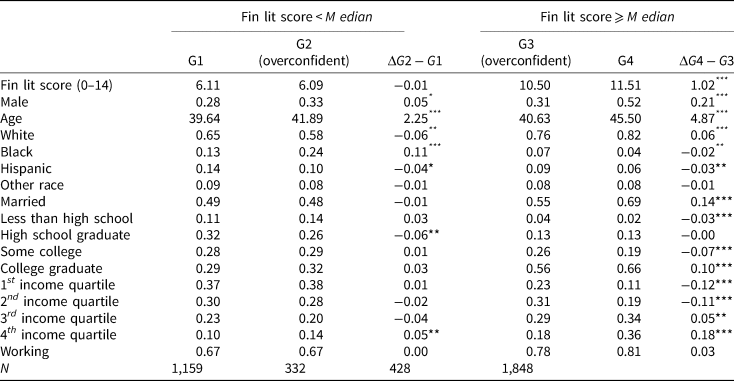
In Table 1 we compare the characteristics of respondents with different confidence in their retirement financial knowledge, but similar objective knowledge. That is, we compare G1 versus G2 (left panel) and G3 versus G4 (right panel). G1 and G2 share, on average, the same level of financial literacy. Among those with an above-median financial literacy score, individuals with high confidence in their retirement financial knowledge (G4) perform significantly better than their counterparts with low confidence (G3). Yet, the difference in scores is modest and amounts to less than a third of a standard deviation.
Demographics: descriptive statistics by group

***, **, and * indicate significance at the 1%, 5%, and 10% level, respectively.
It is apparent from Table 1 that men have higher financial literacy than women. In fact, only about 30% of those with a score below the median are men, versus 48% among those with a score above the median. In line with previous studies on overconfidence in the area of finance, male respondents are more likely to be overconfident (the proportion of males is 28% in G1 and 33% in G2, with the resulting difference significant at 10%) and much less likely to be underconfident than female respondents (the proportion of males is 31% in G3 and 52% in G4, with the difference significant at 1%).
Compared to those in G1, overconfident individuals are approximately 2 years older, less likely to be white or Hispanic and more likely to be Black. Underconfident individuals are about 5 years younger than their counterparts in G4, more likely to be Hispanic or Black, and less likely to be married. In the upper half of the financial literacy score distribution, confidence in retirement financial knowledge increases notably with education and income. For instance, the proportion of individuals with a college degree is 56% in G3 versus 66% in G4, while the proportion of those in the highest income quartile is 18% in G3 versus 36% in G4. Education and income appear less important in driving overconfidence, as differences between G1 and G2 are modest and generally not statistically significant. Neither under- nor overconfidence is related to employment status.
The descriptive statistics in Table 1 reveal that the four groups identified by the combination of high/low self-assessed and objective financial knowledge differ in important characteristics such as age, education, and income, which are bound to directly affect long-term saving and investment decisions. In what follows, we perform regression analyses accounting for a wide range of demographics in order to control for such differences.Footnote 6
2.5 Outcomes
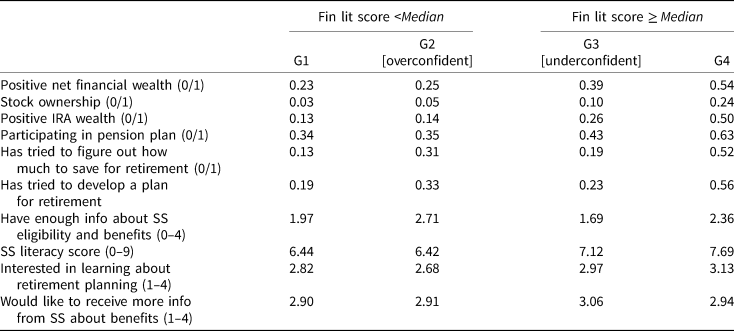
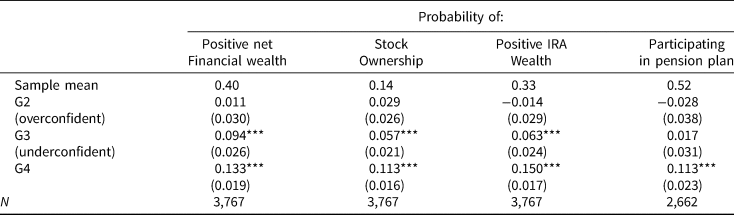
We consider four measures of retirement preparedness. The first one is an indicator for positive net financial wealth, defined as the value of stocks and mutual funds, bonds and bond funds, certificates of deposit and government bonds, checking and savings accounts, as well as other savings held by the individual outside of employer-sponsored retirement accounts and net of non-mortgage debt. We focus on a binary indicator because net financial wealth is less than or equal to zero for about 60% of the sample, and its distribution is skewed by very large values (with a mean of $44,000 versus a median of $0 for the whole sample, and a mean of $133,000 versus a median of $18,300 for the subsample with positive financial net wealth). Table 2 shows that the probability of holding positive net financial wealth is positively associated with financial literacy (23% in G1 and 25% in G2, versus 39% in G3 and 54% in G4). Nevertheless, even among individuals with above-median financial literacy scores, about half have zero or negative net financial wealth holdings.
Outcomes: descriptive statistics by group

The second measure is an indicator of stock ownership. While the presence of stocks in a portfolio is not, on its own, an indicator of adequate retirement preparedness, it is useful to consider together with the other ones, as it conveys important information about an individual's financial sophistication and understanding of the trade-off between short-term risk and long-term investment return. Moreover, stock ownership is an interesting outcome to focus on in this study because of existing work documenting the association between overconfidence and individuals' stock market participation (Bucher-Koenen et al., Reference Bucher-Koenen, Alessie, Lusardi and van Rooij2016) and trading behavior (Statman et al., Reference Statman, Thorley and Vorkink2006; Grinblatt and Keloharju, Reference Grinblatt and Keloharju2009). Table 2 indicates that the probability of owning stocks increases with financial literacy. Furthermore, overconfident individuals are slightly more likely to own stocks than those in G1, but the probability is low for both groups (5% versus 3%). Underconfident individuals are considerably less likely to own stocks than those in G4 (10% versus 24%).
To zero in on savings specifically earmarked for retirement, we consider an indicator for positive IRA wealth. Overall, about one-third of our sample has positive IRA wealth. Again, significant differences exist across groups, with this fraction being the lowest in G1 and G2 (13 and 14%, respectively), followed by G3 (26%), and reaching its peak at 50% for G4.
Finally, we merge the UAS-CF with the UAS-HRS pension module, which includes a variable indicating the type of pension plan the respondent has access to through their employer. This allows us to create an indicator for whether the respondent is actively participating in any employer-provided pension plan (both defined-benefit and defined-contribution plans are included). This measure is only available for individuals who are currently working, which represent approximately 70% of our sample. Participation in employer-sponsored pension plans is lowest for G1 and G2 (34 and 35%, respectively), followed by G3 (43%) and G4 (63%).
The CF contains two questions asking respondents whether they have ever tried to figure out how much they should save for retirement and whether they have ever tried to develop a plan for retirement. In line with previous studies and evidence from other surveys (Angrisani et al., Reference Angrisani, Kapteyn and Lusardi2016), only about one-third of UAS members under the age of 62 answer these questions affirmatively. Both measures indicate that individuals in G1 are the least likely to have started planning for retirement, followed by underconfident individuals. More than 30% of overconfident individuals and more than 50% of individuals in G4 have done so.
UAS respondents are asked to state, using a 4-point scale, how much they agree or disagree with the statement ‘I currently have enough information about my Social Security retirement eligibility and benefits.’ We construct a measure of an individual's perceived knowledge about the Social Security system by reverse coding the answers so that higher values indicate stronger agreement with the statement (i.e., 1 for ‘strongly disagree’ and 4 for ‘strongly agree’). As can be seen in Table 2, overconfident and underconfident individuals are the most and least likely to agree with the statement, respectively.
We construct a Social Security literacy score that counts the number of correct answers to a question inquiring how a workers' Social Security benefit are calculated and to the following true/false statements: (1) ‘Someone who has never worked for pay may still be able to claim benefits if one's spouse qualifies for Social Security’ (true); (2) ‘Social Security benefits are not affected by the age at which someone starts claiming’ (false); (3) ‘Social Security benefits are adjusted for inflation’ (true); (4) ‘Social Security benefits have to be claimed as soon as someone retires’ (false); (5) ‘Retired people who continue to earn income from working or investments may have to pay tax on their Social Security benefits’ (true); (6) ‘Social Security is paid for by a tax placed on both workers and employers’ (true); (7) ‘Workers who pay Social Security taxes are entitled to Social Security disability benefits if they become disabled and are no longer able to work’ (true); (8) ‘If a worker who pays Social Security taxes dies, any of his/her children under age 18 may claim Social Security survivor benefits’ (true); and (9) ‘If a worker who pays Social Security taxes dies, his/her spouse may claim Social Security survivor benefits only if they have children’ (false).Footnote 7 The resulting variable ranges from 0 to 10.Footnote 8 Not surprisingly, values for the Social Security score are correlated with respondents' level of financial literacy. On average, it is equal to 6.4 for G1 and G2, 7.1 for G3 and 7.7 for G4.
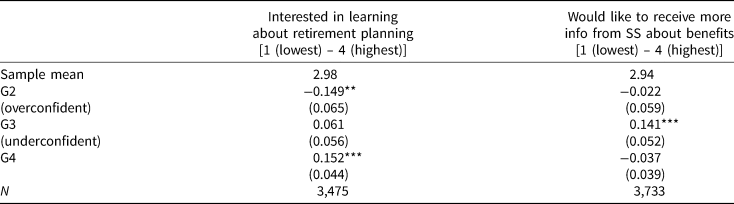
Individuals' willingness to learn about retirement is gauged via two questions asking about their interest in learning about retirement planning and in receiving more information from Social Security about their benefits and planning for their retirement. Answers to both questions are on a 4-point scale, with higher values indicating higher willingness to learn. Table 2 shows that individuals with low objective financial knowledge (G1 and G2) are, on average, less predisposed to learning than those with high objective financial knowledge (G3 and G4). Overconfident individuals are the least interested in learning according to the two measures.
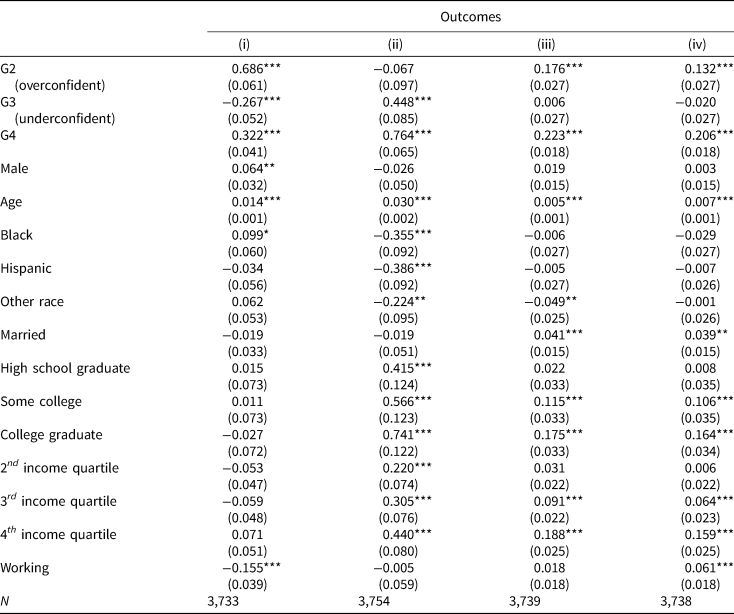
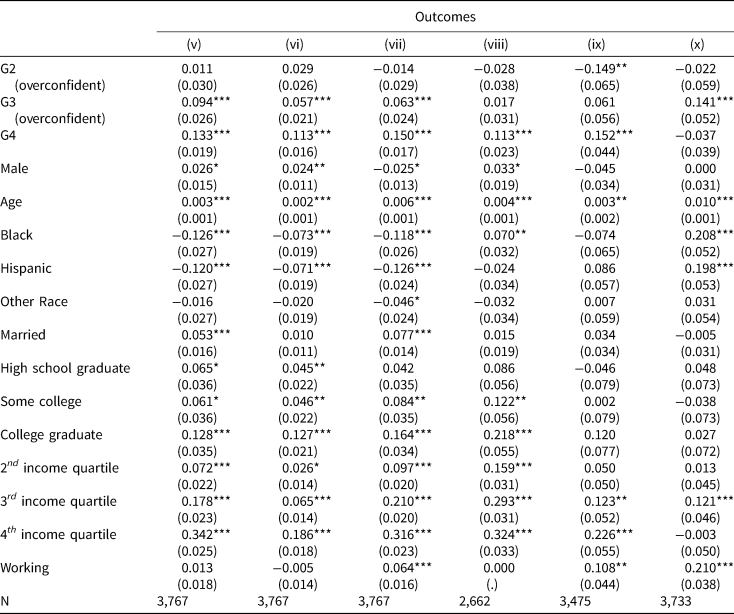
In the empirical analysis, we regress the outcomes just described on group-specific indicators (with G1 as the reference group) and demographic variables including gender, a quadratic polynomial in age, indicators of marital status (single versus married), race (White, Black, Hispanic, Other), education (less than high school, high school graduate, some college, college graduate), income quartiles, and employment status (working versus non-working).Footnote 9 In the interest of space, below we only report the estimated coefficients of group-specific indicators. The complete set of estimated regression coefficients can be found in the Appendix.
3. Analysis and results
3.1 Knowledge of social security
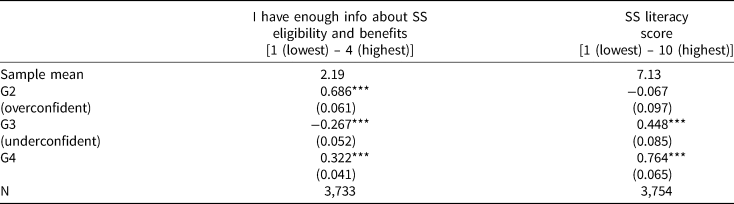
We begin by documenting that the disconnect between actual and perceived knowledge for over- and underconfident individuals is not limited to general retirement financial literacy, but extends to more specific domains, such as knowledge about the Social Security system and its rules. The first column of Table 3 shows that overconfident individuals are significantly more likely than any other group to feel that they have enough information about the Social Security rules. Specifically, their self-assessment of how much information about Social Security eligibility and benefits they possess is 0.7 points higher than that of individuals in G1, about 1 point higher than that of underconfident individuals (G3), and 0.4 points higher than that of individuals in G4. These are sizeable 31%, 44%, and 17% increases, respectively, relative to the sample average of 2.2. In contrast, underconfident individuals report having the least information about Social Security eligibility and benefits.
Perceived versus actual knowledge about social security

Robust standard errors in parentheses. Other regressors are gender, a quadratic polynomial in age, indicators for marital status, race, education, income quartiles, and working situation. The complete sets of estimated regression coefficients for these two outcomes are in columns (i) and (ii) of Table A.1 in the Appendix. ***, **, and * indicate significance at the 1%, 5%, and 10% level, respectively.
To determine the extent to which these perceptions are backed by actual knowledge of the Social Security system, we focus on the Social Security literacy score in the second column of Table 3. Despite their much higher self-reported knowledge, actual knowledge about the Social Security rules for overconfident individuals is indistinguishable from that of individuals in G1, with whom they share low levels of objective financial literacy. Underconfident individuals, on the other hand, perform much better than overconfident individuals, scoring about half a point more, and only somewhat worse than those in G4. These estimates confirm that, for groups G2 and G3, the same disconnect between perceived and actual financial knowledge exists with respect to knowledge of Social Security rules.
3.2 Retirement planning
A necessary step towards retirement preparedness is to formulate medium- and long-term financial goals and a plan to achieve them. Planning for retirement is a daunting task that many, even those on the verge of exiting the labor force, keep postponing (Lusardi and Mitchell, Reference Lusardi and Mitchell2007b). We investigate how the attitude towards retirement planning differs by group.
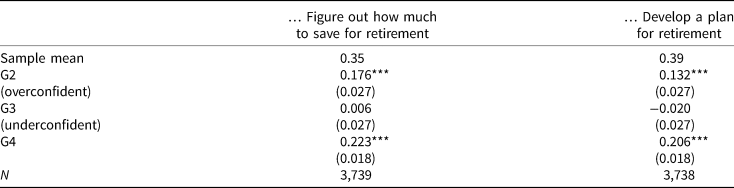
Table 4 shows Probit marginal effects for the probability that the respondent has tried to figure out how much his/her household should save for retirement (left column) and the probability that the respondent has tried to develop a plan for retirement (right column). Compared to individuals in G1, overconfident individuals are 18 percentage points more likely to have tried to figure out retirement savings and 13 percentage points more likely to have developed a plan for retirement. In both domains, they perform significantly better than underconfident individuals who, despite their relatively higher level of actual knowledge, are not more likely than those in G1 to have tried to either determine their saving needs or come up with a retirement plan. It is indeed conceivable that overconfident individuals' high confidence on their retirement knowledge stems precisely from their higher likelihood of having started thinking about their retirement financial needs. Finally, individuals in G4 are the most likely to have done some retirement planning.
Probability the respondent ever tried to…

Probit average marginal effects, with robust Delta Method standard errors in parentheses, are reported. Other regressors are gender, a quadratic polynomial in age, indicators for marital status, race, education, income quartiles, and working situation. The complete sets of estimated regression coefficients for these two outcomes are in columns (iii) and (iv) of Table A.1 in the Appendix. ***, **, and * indicate significance at the 1%, 5%, and 10% level, respectively.
3.3 Financial preparedness for retirement
We now turn to the important question of whether differences across groups in the likelihood of having planned for retirement are reflected in behavioral differences when it comes to actual retirement saving, wealth accumulation, and management.
The first column of Table 5 shows Probit marginal effects for the probability of holding positive financial wealth. Overconfident individuals fare no better than others with similarly low objective financial knowledge (G1), and significantly worse than those with better actual financial skills (both G3 and G4). Specifically, overconfident individuals are 9 and 13 percentage points less likely to hold positive financial wealth than those in G3 and G4, respectively. Underconfident individuals are only about 4 percentage points less likely to report positive financial wealth than those in G4, with whom they share a similar level of objective knowledge, and this difference is only significant at 10%.
Actual measures of retirement financial preparedness

Probit average marginal effects, with robust Delta Method standard errors in parentheses, are reported. Other regressors are gender, a quadratic polynomial in age, indicators for marital status, race, education, income quartiles, and working situation. The complete sets of estimated regression coefficients for these outcomes are shown in columns (v) to (viii) in Table A.2 in the Appendix. ***, **, and * indicate significance at the 1%, 5%, and 10% level, respectively.
In the second column of Table 5, we investigate differences across groups in stock ownership. As mentioned above, this is an important outcome not only because previous studies have found a correlation between overconfidence and the behavior of stock market participants, but also because it speaks to the degree of financial sophistication and understanding of the trade-off between short-term risk and long-term investment return. For overconfident individuals, the likelihood of owning stocks is not higher than that of individuals in G1. As was the case for overall financial wealth, stock ownership appears to be mostly driven by objective financial literacy, as both G3 and G4 are significantly more likely to own stocks than G1 and G2. Among those with relatively higher objective knowledge, confidence plays an important role in determining behavior. In fact, underconfident individuals display a likelihood of stock ownership approximately 5 percentage points lower than that of individuals in G4, with the difference being significant at 1%.
Next, we consider a more direct measure of retirement preparedness, that is, whether respondents have a positive amount of IRA wealth. The results, shown in column 3 of Table 5, replicate the patterns in the first two columns. For overconfident individuals, the probability of having positive IRA wealth is not significantly higher than for those in G1. Yet, it is about 6 percentage points lower than that of underconfident individuals, and 15 percentage points lower than that of individuals in G4 (the difference between G3 and G4 is significant at 1%).
The financial outcomes considered so far present an incomplete picture of retirement preparedness, given that many individuals keep the bulk of their retirement savings in employer-sponsored pension plans such as 401(k)s. Other workers (the minority nowadays) participate in defined-benefit plans, where regular contributions are notionally made directly by the employer. Unfortunately, the CF does not include a measure of defined-contribution (DC) or defined-benefit (DB) pension wealth. However, we do observe whether the individual is currently participating in a DB or DC plan. The results in the last column of Table 5 reveal that individuals in G4 are 11 percentage points more likely than any other group to participate in an employer-sponsored pension plan. The probabilities that overconfident and underconfident individuals participate in a pension plan are not statistically different from that of the reference group.Footnote 10
3.4 Willingness to learn
We have observed that, notwithstanding differences in the propensity to plan for retirement across groups, economic retirement preparedness is mostly driven by actual financial knowledge. This is particularly true for overconfident individuals, whose retirement preparedness is not statistically different from that of individuals in G1 for any of the outcomes considered. Underconfident individuals perform worse than individuals in G4, but still statistically better than those with below-median financial literacy scores in all outcomes except for pension plan participation. Such findings would back the advisability of campaigns aimed at improving financial literacy as a way to enhance individuals' retirement preparedness. However, a natural question arises as to whether overconfident individuals would be amenable to such campaigns, given their belief that their financial knowledge is already adequate. To address these questions, we study how interest in learning about retirement knowledge varies across groups.
The left column of Table 6 shows that overconfident individuals are the least interested in learning about retirement planning. Their score is 0.15 units lower than that of individuals in G1, 0.21 lower than that of individuals in G3 (with the different significant at 5%) and 0.30 lower than that of individuals in G4 (with the difference significant at 1%). Relative to the sample mean these effects amount to 5%, 7%, and 10% differences, respectively. The results reported in the right column of Table 6 indicate that overconfident individuals are not more interested in receiving information from the Social Security Administration about their benefits than those in G1 and G4, and significantly less interested than underconfident individuals. The lower interest in learning displayed by the overconfident relative to the underconfident is particularly noteworthy, given that, in comparison, their general financial and Social Security literacy scores are 45% and 12% lower, respectively.
Predisposition towards learning about retirement financial issues

Robust standard errors in parentheses. Other regressors are gender, a quadratic polynomial in age, indicators for marital status, race, education, income quartiles, and working situation. The complete sets of estimated regression coefficients for these two outcomes are in columns (ix) and (x) of Table A.2 in the Appendix. ***, **, and * indicate significance at the 1%, 5%, and 10% level, respectively.
4 Robustness checks
4.1 Alternative group classifications
As discussed in Section 2, the measure of self-rated retirement financial knowledge does not have an exact objective counterpart in our data. While most of the items covered by the general financial literacy quiz are relevant for retirement planning, one may still wonder to what extent the classification of individuals as under- and overconfident based on these measures truly reflects miscalibrated beliefs about individuals' retirement financial knowledge or simply captures differences in the domains the two measures are concerned with. In this section, we test the robustness of our findings for retirement preparedness and willingness to acquire knowledge about financial matters to using alternative measures to classify individuals into different groups.
RC1: Robustness Check 1
We exclude from the measure of subjective retirement financial knowledge the items that ask individuals to rate how knowledgeable they feel about how long they may live in retirement and about how to manage their retirement spending (since the first is not strictly financial and the second does not have a clear counterpart in the objective financial literacy questions). At the same time, we construct the objective score using the subset of questions that are most similar to those included in the subjective score – namely those covering inflation, purchasing power, interest rates, compound interest, how the stock market works, how mutual funds work, diversification, the relative risk of stocks versus bonds, and the relative returns to different assets.
RC2: Robustness Check 2
We amend both scores in RC1 with a measure of Social Security knowledge. Specifically, we add to the subjective score in RC1 individuals' subjective rating of their knowledge of how the Social Security system works, and we add to the objective score in RC1 an indicator equal to one if the individual's Social Security literacy score (described in Section 2) is in the top 20%.
RC3: Robustness Check 3
We focus on Social Security knowledge only. We use the 4-point index rating respondents' agreement with the sentence ‘I currently have enough information about my Social Security retirement eligibility and benefits’ as the subjective retirement knowledge measure, and we use the Social Security literacy score (0–10) as its objective counterpart. Because Social Security benefits are just one of several components of a worker's retirement planning, the measures of under- and overconfidence obtained in this specification cannot be interpreted as indicators of under- and overconfidence in overall retirement knowledge. This robustness check is useful, however, because it is based on measures of objective and subjective knowledge that fully overlap.
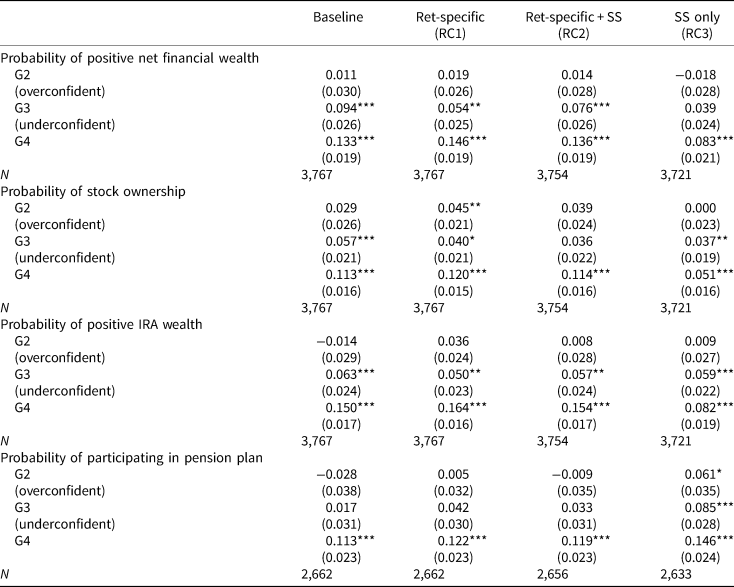
Table 7 shows the results from the analysis of retirement preparedness presented in Table 5 in the first column (‘Baseline’), and those obtained using alternative measures of subjective and objective knowledge to construct groups in the remaining three columns. The main findings are unchanged: overconfident individuals do not fare differently from those in G1 for most of the outcomes considered, while they generally fare worse than those in G3 and G4. At the same time, underconfident individuals tend to be better prepared for retirement than those with lower objective financial knowledge, but worse than those in G4.
Results with alternative measures of subjective/objective knowledge (I)

Probit average marginal effects, with robust Delta Method standard errors in parentheses, are reported. Other regressors are gender, a quadratic polynomial in age, indicators for marital status, race, education, income quartiles, and working situation. ***, **, and * indicate significance at the 1%, 5%, and 10% level, respectively.
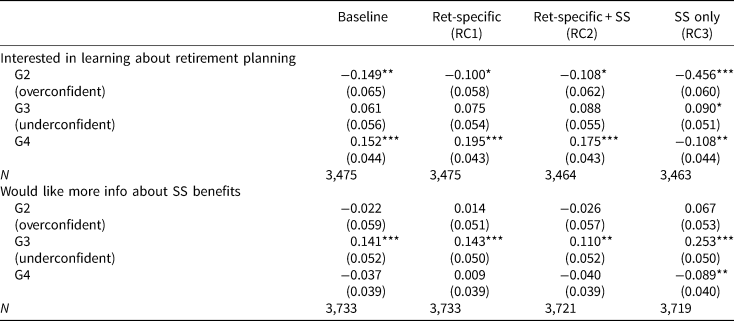
In terms of individuals' predisposition towards learning, Table 8 reveals that, no matter which measure of objective and subjective knowledge is used, overconfident individuals are the least likely to be interested in learning about retirement planning, and they are not more interested than those in G1 in obtaining more information about Social Security benefits. This is the case even when their objective knowledge is proxied using only questions regarding the Social Security system in the last column. Underconfident individuals are generally not more likely than those in G1 or G2 to want to learn about retirement planning but are more interested than any other group in receiving information about Social Security benefits. The latter association is strongest when their subjective knowledge refers only to the Social Security system in the last column.
Results with alternative measures of subjective/objective knowledge (II)

Robust standard errors in parentheses. Other regressors are gender, a quadratic polynomial in age, indicators for marital status, race, education, income quartiles, and working situation. ***, **, and * indicate significance at the 1%, 5%, and 10% level, respectively.
4.2 Gender differences
The results presented in Table 1 show that women are more likely than men to be classified as underconfident, and less likely to be classified as overconfident. To investigate whether the relationship between under- or overconfidence and the retirement preparedness outcomes varies by gender, we run the regressions in Tables 3–6 separately for men and women. We find no statistically significant differences in the estimates for any of the group-specific coefficients.
5. Conclusions
In this paper, we examine differences in retirement preparedness across groups characterized by different levels of subjective and objective retirement financial knowledge. For this purpose, we exploit a unique data set, the UAS CF, which provides an extensive array of demographics, financial literacy scores, self-assessment of retirement preparedness, and knowledge of Social Security rules, as well as a complete household balance sheet for each sampled individual. We focus on two interesting segments of the population, namely overconfident individuals – those with relatively high self-rated but low objective financial knowledge – and underconfident individuals – those with relatively low self-rated but high objective financial knowledge.
We find that the disconnect between perceived and actual financial knowledge for over- and underconfident individuals extends to specific domains, including an understanding of Social Security rules. Moreover, our analysis highlights significant differences between these two groups. Overconfident individuals report higher likelihoods of having done some retirement planning but, when it comes to actual retirement preparedness, they are no more likely than other with similarly low levels of financial literacy to hold positive net financial wealth, own stocks, have IRA wealth or actively participate in an employer-sponsored pension plan. Importantly, overconfident individuals show relatively little interest in learning more about retirement-related financial issues. Underconfident individuals are less likely to state that they have developed a retirement plan. In terms of objective retirement preparedness, they generally fare better than overconfident individuals but worse than the group with a similarly high level of financial literacy. In contrast with overconfident individuals, they appear to be the most eager to receive more information about retirement planning.
Our results are relevant for financial educational policy, suggesting that campaigns aimed at improving financial literacy may not be equally effective at promoting better financial decisions across different segments of the population. Overconfident individuals, in particular, would likely be less amenable to such campaigns than others with similarly low financial literacy because consistent with their high subjective perception of their financial skills, they are the least interested in learning more about retirement planning.
A large literature in psychology has pointed at task difficulty and lack of feedback as two important reasons why individuals exhibit under- and overconfidence biases in certain domains. Retirement planning is a daunting task where such biases may arise. Accompanying educational programs with initiatives that provide feedback to increase awareness of one's actual financial knowledge represents a potentially effective step towards reducing such biases and, hence, enhancing individuals' retirement preparedness.
Appendix
Financial literacy questions
The right answer to each question in highlighted in black.
(1) Suppose you had $100 in a savings account and the interest rate was 2% per year. After 5 years, how much do you think you would have in the account if you left the money to grow? More than $102/Exactly $102/Less than $102/I don't know.
(2) Suppose you had $100 in a savings account and the interest rate was 20% per year and you never withdrew money or interest payments. After 5 years, how much would you have on this account in total? More than $200/Exactly $200/Less than $200/I don't know.
(3) Imagine that the interest rate on your savings account was 1% per year and inflation was 2% per year. After 1 year, would you be able to buy (More than today/Exactly the same as today/Less than today/I don't know) with the money in this account?
(4) Assume a friend inherits $10,000 today and his sibling inherits $10,000 but 3 years from now. Who is richer today because of the inheritance? My friend/His sibling/They are equally rich/I don't know.
(5) Suppose that in the year 2020 your income has doubled and prices of all goods have doubled too. In 2020, will you be able to buy (More/The same/Less than today/I don't know) with your income?
(6) Which of the following statements describes the main function of the stock market? It helps to predict stock earnings/It results in an increase in the price of stocks/It brings people who want to buy stocks together with those who want to sell stocks/None of the above/I don't know.
(7) Which of the following statements is correct? Once one invests in a mutual fund, one cannot withdraw money in the first year/Mutual funds can invest in several assets, for example invest in both stocks and bonds/Mutual funds pay a guaranteed rate of return which depends on their past performance/None of the above/I don't know.
(8) If the interest rates rise, what should happen to bond prices? They should rise/They should fall/They should stay the same/I don't know.
(9) Do you think the following statement is true? Buying a single company stock usually provides a safer return than a mutual fund. True/False/I don't know.
(10) Do you think that the following statement is true or false? Stocks are normally riskier than bonds. True/False/I don't know.
(11) Considering a long period (for example 10 or 20 years), what normally gives the highest return? Savings accounts/Bonds/Stocks/I don't know.
(12) Normally, which asset described below displays the highest fluctuations over time? Savings accounts/Bonds/Stocks/I don't know.
(13) When an investor spreads his or her money among different assets, does the risk of losing a lot of money (Increase/Decrease/Stay the same/I don't know)?
(14) Housing prices in the USA can never go down. True/False/I don't know.
Complete regression results (I)

Complete regression results (II)