INTRODUCTION
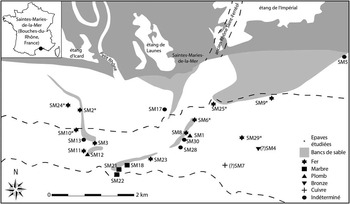
The presence of iron objects is attested in Mediterranean Gaul (the Languedoc-Roussillon and Provence-Alpes-Côte d’Azur regions in France) from the 8th century BC (Janin and Chardenon Reference Janin and Chardenon1998). Despite smithing activity recognized as dating back to the 6th century BC, it is only in the 2nd century BC that the emergence of iron smelting workshops in the south of France was seen (Pagès Reference Pagès2014). The Roman conquest of Gaul in 121 BC boosted metallurgical smelting and smithing activities with the massive production of iron products that were traded across the Roman Mediterranean. In the 1990s, the underwater discovery of 30 shipwrecks off the coast of Saintes-Maries-de-la-Mer in the Mediterranean widely attested to this iron trade (Figure 1) (Domergue Reference Domergue2004; Domergue et al. Reference Domergue, Serneels, Cauuet, Pailler and Orzechowski2006; Pagès Reference Pagès2014).
Location of Saintes-Maries-de-la-Mer shipwrecks containing ferrous bars in the Bouches-du-Rhône (south of France) (Long, Masselin, DAO: Pagès).

This exceptional finding testifies to the important activity in this zone during the Roman period when many ships were traveling between southwest France, Spain or Latium, and inner Gaul through the St Ferréol Rhône. These boats transported various cargoes such as marble blocks, lead ingots, and iron bars. Eleven of the shipwrecks contained mainly ferrous bars, equivalent to more than 500 tons of iron (Long et al. Reference Long, Rico and Domergue2002; Coustures et al. Reference Coustures, Rico, Béziat, Djaoui, Long, Domergue and Tollon2006; Pagès Reference Pagès2014). This discovery has fueled much research on the iron production network, the techniques used, and the question of the raw materials’ origins (Coustures et al. Reference Coustures, Béziat, Tollon, Domergue, Long and Rebiscoul2003; Pagès et al. Reference Pagès, Dillmann, Fluzin and Long2011).
Morphological studies based on metrological criteria led to the identification of eight bar types (Long et al. 2002, Reference Long, Djaoui and Rico2005; Coustures et al. Reference Coustures, Rico, Béziat, Djaoui, Long, Domergue and Tollon2006). This first approach of characterization was completed by extensive metallographic observations and chemical analysis of 48 bars collected in six wrecks (Pagès et al. 2008, Reference Pagès, Dillmann, Fluzin and Long2011). The results suggest that the different bar types could also have been linked to different qualities of metal recognized both by the producers of iron and the people who imported these products. The question of the origin of the bars has not yet been solved due to the various possibilities of iron ore sources in the area and the complexity of the iron production system in solid phase (Coustures et al. Reference Coustures, Béziat, Tollon, Domergue, Long and Rebiscoul2003; Pagès et al. Reference Pagès, Dillmann, Fluzin and Long2011).
The shipwreck chronology, from the 1st century BC to 1st century AD, was established from a few archaeological artifacts discovered in or on the ferrous concretions that constitute the only remains of the ships and their cargoes. It was soon considered that the shipwrecks of Saintes-Maries-de-la-Mer represented a snapshot of the Roman ferrous trade between the Mediterranean and Gaul and inferred that the ferrous cargoes were delivered to the Roman legions (Domergue et al. Reference Domergue, Benquet, Decombeix, Fabre, Gorgues, Rico and Tollon2003).
Today, the possibility to directly date iron by radiocarbon offers the opportunity to bring new chronological elements for the shipwrecks of Saintes-Maries-de-la-Mer. Using the newly developed approach based on accelerator mass spectrometry (AMS) 14C dating to directly date iron (Leroy et al. Reference Leroy, L’Héritier, Delqué-Kolic, Dumoulin, Moreau and Dillmann2015a), we analyzed a set of iron bars from the shipwrecks to test the long-standing chronological assumption that these shipwrecks happened in a short time period between the 1st century BC and 1st century AD. We thus provided the first direct dating of these bars and determined a chronological interval in which the boats likely sunk by integrating the 14C dates and archaeological data.
MATERIALS AND METHODS
The basic idea for dating ferrous alloys by 14C is that the carbon incorporated in the steel components of the ancient metal comes from the charcoal used as fuel during ore smelting. During the manufacture of the alloy, the carbon from charcoal used as fuel and from CO resulting from its combustion diffuses into the metal. The final metallographic form of the steel is a mix of ferrite (containing <0.02 wt% C) and cementite (Fe3C). The presence of carbon in the structure is therefore not relative to single fragments of charcoal but to carbon-containing compounds obtained after chemical reaction with the carbon of the initial charcoal.
However, 14C dating of iron requires special pretreatment to overcome potential contamination due to different factors. Numerous studies led by archaeometallurgists (Fluzin Reference Fluzin1983; Tylecote Reference Tylecote1987; Serneels Reference Serneels1998; Pleiner Reference Pleiner2006) provided important knowledge of the direct iron-making process used to obtain iron in antiquity, which allowed identifying the sources of contamination: the age of the wood used to produce the charcoal, the recycling of older metals, and the cementing with other materials containing carbon. Another major limitation is related to the low carbon content of the ancient iron, heterogeneously distributed within the metallic matrix. Considering these different risks of misdating, Leroy et al. (2015a, Reference Leroy, Hendrickson, Delqué-Kolic, Vega and Dillmann2015b) developed an adapted methodology for dating iron following a detailed study of the metallic matrix.
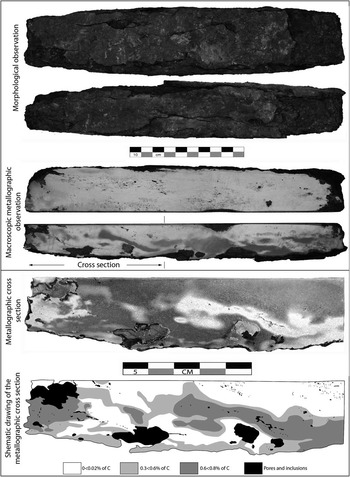
A metallographic study and microscopic observation of the matrix were performed on the iron samples to obtain information on the metal microstructure and on artifact manufacture, in particular the possible use of recycled metal, which is essential to obtain reliable 14C dates that correspond to the manufacturing date of the artifact. Cross-sections were cut in the central part of the bars, thoroughly polished with abrasive paper and softly with diamond paste (3 to 1 µm grain) to obtain a mirror-like surface. A 3% Nital etching was then applied to visualize the possible welding lines. The next step consisted in the elemental analysis of the slag inclusions (SI) entrapped in the metallic matrix (Dillmann and L’Héritier Reference Dillmann and L’Héritier2007; Leroy et al. Reference Leroy, Hendrickson, Delqué-Kolic, Vega and Dillmann2015b) to glean information on the bars’ manufacturing and, in particular, on the possible use of separate pieces, whether welded or forged together (recycling). The detailed protocol for SI analysis is not described in this article; thus, readers are referred to Dillmann and L’Héritier (Reference Dillmann and L’Héritier2007), Pagès et al. (Reference Pagès, Dillmann, Fluzin and Long2011), and Leroy et al. (2012, Reference Leroy, L’Héritier, Delqué-Kolic, Dumoulin, Moreau and Dillmann2015a). For all the cross-sections, a second 3% Nital etching was done to reveal the distribution of carbon within the metal and to allow the sampling for 14C dating in the most carburized areas. This chemical step also has the advantage of cleaning the surface of the cross-section from external contamination possibly added during cutting or polishing of the metal sample. The cross-sections were then rinsed with deionized water and ethanol and then dried at 80°C. They are finally observed under a reflected light microscope to visualize the distribution of carbon and the possible welding lines (Figure 2). The gray level of a zone is related to its carbon content: from a bright aspect for low carbon content area to dark color for eutectoid iron (0.8% of carbon). The sampling was carried out with a 3.5-mm-diameter metallic drill coated with cobalt boron (CoB). A few hundred milligrams, depending on the carbon content, are generally needed to obtain approximately 1 mg of carbon for 14C dating.
An example [sample SM6.2(5C)] of a microscopic metallographic observation on a bar after Nital etching with the corresponding schematic drawing of the carbon content and distribution (Pagès et al. Reference Pagès, Dillmann, Fluzin and Long2011).

The particles collected were then combusted at 850°C in a sealed quartz tube with an excess of CuO (MCuO=5× mass of iron sample) grains and 1 cm of silver wire. This CuO/Fe ratio is recommended by Hüls et al. (Reference Hüls, Grootes, Nadeau, Bruhn, Hasselberg and Erlenkeuser2004) to provide a sufficient excess of oxygen in the tube during combustion and ensure the extraction of over 90% of the initial carbon from the sample. The extracted CO2 gas samples were automatically graphitized at the LMC14 lab as described in other publications (Cottereau et al. Reference Cottereau, Arnold, Moreau, Baqué, Bavay, Caffy, Comby, Dumoulin, Hain, Perron, Salomon and Setti2007; Delqué-Količ et al. Reference Delqué-Količ, Comby-Zerbino, Ferkane, Moreau, Dumoulin, Caffy, Souprayen, Quilès, Bavay, Hain and Setti2013; Dumoulin et al., Reference Dumoulin, Comby-Zerbino, Delqué-Količ, Moreau, Berthier, Beck, Caffy, Hain, Mollet, Perron, Setti, Sieudat, Souprayen and Tellierforthcoming). The 14C, 13C, and 12C contents were measured in ARTEMIS, the NEC AMS facility installed in the LMC14 in Saclay (France), analyzed using the NEC’s standard data acquisition software, abc, and the dates calculated with the in-house database.
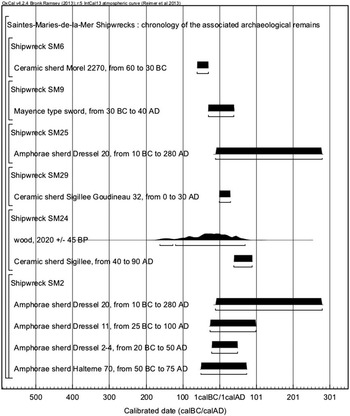
To better understand the diachronic or synchronic framework of the wrecks, it was important to date several bars from several shipwrecks. Based on the metallographic examination of 49 bars (Pagès et al. Reference Pagès, Dillmann, Fluzin and Long2011), we selected 12 cross-sections with sufficient appropriate carbon content (>0.1% C) for a 14C date. These cross-sections correspond to 12 different iron bars from seven ships among the 11 carrying ferrous alloy bars. The bars, elaborated from one or several fragmented blooms welded together, are semi-products that were not submitted to the intensive smithing process or cementation, which could have added other sources of carbon. Some of the cross-sections showed welding lines, but it was verified that the pieces of metal welded together had similar chemical signatures, which tends to drastically minimize the use of recycling, and therefore, possible older iron. Furthermore, none of the cross-sections studied by Pagès et al. (Reference Pagès, Dillmann, Fluzin and Long2011) showed carburized areas at the surface, which rules out a cementation process. The majority of the studied shipwrecks are associated with a few archaeological discoveries trapped inside the ferrous concretion with associated chronology (Figure 3). Some of them are associated with archaeological ceramic sherds whose typology allows a chronological allocation (SM6, SM24, SM25, SM29, and SM2), while ship SM9 is linked to a Mayence-type sword. Ship SM2 is the best-documented one, with four sherds of amphorae from Baetica province. For SM24, a piece of wood from the ship could be 14C dated. No chronological elements were found for SM10.
Chronological elements given by the archaeological remains associated with the studied shipwrecks

RESULTS AND DISCUSSION
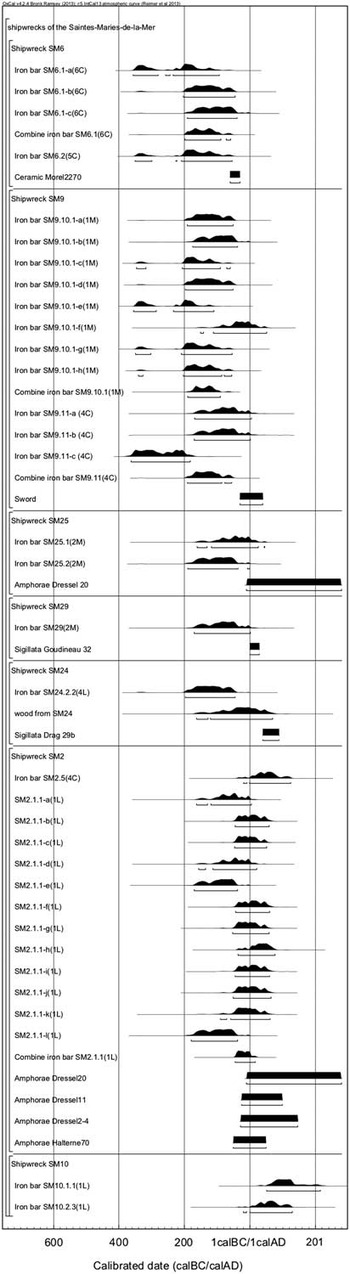
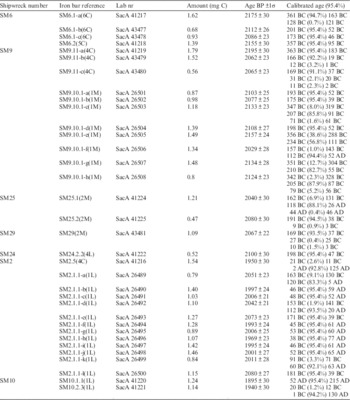
A total of 34 14C dates were obtained from the 13 iron bars selected for this study. They are shown in Table 1 and Figure 4 with their calibrated intervals calculated with the calibration curve IntCal 13 (Reimer et al. Reference Reimer, Bard, Bayliss, Beck, Blackwell, Bronk Ramsey, Buck, Cheng, Edwards, Friedrich, Grootes, Guilderson, Haflidason, Hajdas, Hatté, Heaton, Hoffmann, Hogg, Hughen, Kaiser, Kromer, Manning, Niu, Reimer, Richards, Scott, Southon, Staff, Turney and van der Plicht2013) and the OxCal v 4.2 program (Bronk Ramsey Reference Bronk Ramsey2009). The results are grouped by shipwreck with the chronological information brought by the archaeological remains. For SM6, SM9, SM25, SM2, and SM10, two different bars were dated, while only one could be analyzed for SM29 and SM24. Four bars [SM2.1.1(1L), SM6.1(6C), SM9.11(4C), and SM9.10.1(1M)] have been dated several times to test the reproducibility between several samplings done on the same cross-section. For shipwreck SM6, two iron bars were dated, giving results that overlap in the 2σ range. The three subsamples taken from bar SM6.1(6C) give chronological intervals that fit very well. The calibrated intervals are slightly older than the chronological range suggested by a ceramic sherd found in the ferrous concretion. For SM9, each bar offered several subsamples. The bar SM9.10.1(1M), with its high proportion of steel (93% of the cross-section contains 0.6 to 0.8% of carbon), provides eight dates that could be compared by using a χ2 test to evaluate the consistency of the results. Even if the test does not strictly pass at 95% confidence (T=16.1>14.1 at 95%), all the probability densities overlap, meaning that the results are consistent. For SM9.11, two of the three results are perfectly coherent, with the third one being slightly older. The fragment of sword trapped in the ferrous concretion is attributed to the period 30 BC to AD 40, which fits with two dates from SM9.11(4C) and with one from SM9.10.1(1M), the other dates on bars being earlier. For SM25, only one date could be obtained for each of the two bars that present a low carbon content (0.2–0.3%) on the larger part of the cross-sections studied. The ceramic sherds found with the ferrous concretion are attributed to amphorae present over a long time in the Roman world, including the younger part of the calibrated range obtained for the iron bars. For SM29, only one bar was available and the cross-section cut inside was mostly ferritic (%C < 0.02%), which limited the possibilities of sampling. One date was obtained that is slightly older than the ceramic sherd found with the bars. For SM24, one sample coming from a cross-section showing a poor carbon content (0.2–0.3% C) was dated. The calibrated range is earlier than the period recognized for the ceramic sherd found in the shipwreck but overlaps with the 14C interval obtained for a piece of wood remaining from the ship. For SM2, two bars were dated and several samples could be taken from a same bar. The 12 dates obtained for the bar SM2.1.1(1L) could be compared through a χ2 test: T=22.4>19.7 at 95%. As in the case of SM9, the test is not strictly passed, but the probability distributions overlap showing the consistency of the results. For SM10, no archaeological artifacts were found and the 14C dates on the two iron bars provide the first chronological elements of this shipwreck. Both dates are coherent and slightly younger than the ones obtained for the bars coming from SM6, SM9, SM25, SM29, and SM24. They are in the same range as most of the dates obtained for SM2.
Calibrated 14C dates of the iron bars and archaeological priors found with the shipwrecks of Saintes-Maries-de-la-Mer.

Radiocarbon dating results for the iron bars of the shipwrecks of Saintes-Maries-de-la-Mer. Calibration was performed with OxCal v 4.2 (Bronk Ramsey Reference Bronk Ramsey2009) and the IntCal13 calibration curve (Reimer et al. Reference Reimer, Bard, Bayliss, Beck, Blackwell, Bronk Ramsey, Buck, Cheng, Edwards, Friedrich, Grootes, Guilderson, Haflidason, Hajdas, Hatté, Heaton, Hoffmann, Hogg, Hughen, Kaiser, Kromer, Manning, Niu, Reimer, Richards, Scott, Southon, Staff, Turney and van der Plicht2013).

For all the shipwrecks, the good consistency of the 14C results coming from samples collected on the same iron bar allows us to group the dates with the R_Combine operation in the OxCal program. We also observe that the bars within a ship give chronological intervals that overlap at 1σ, except SM2 for which the overlapping is in the 2σ range. The comparison of the 14C dates obtained on iron bars with the archaeological prior available for each shipwreck showed that the archaeological artifacts found within the ships are younger than the iron bars in the case of SM9, SM29, and SM24.
The old-wood effect, which sometimes explains the aging of 14C dates of wood or charcoal, does not seem to apply in the case of the bars for several reasons. In fact, the intensification of anthropogenic pressure (intensification of agropastoral practices, ceramics, and iron production) since the Neolithic times does not support the long-term curation of heartwood for iron-making (Doyen et al. Reference Doyen, Vannière, Berger, Arnaud, Tachikawa and Bard2013). Archaeological and anthropological studies have shown that small trunks or branches are preferred to produce charcoal because they allow a better control of the charring process than big pieces of wood that are, for their part, indispensable as a building material.
Moreover, it is important to note that for 14C dating of iron, we do not measure single fragments of charcoal but bulk carbon incorporated in the metallic structure that derives from a mixing of the charcoal used as fuel during the reduction operation and through the CO gas produced by its combustion during the process. Unlike 14C dating of fragments of charcoal, this process would tend to drastically minimize the old-wood effect if indeed long-lived trees were used in the production of charcoal, by averaging the contribution of all the charcoal pieces put in the furnace. In view of these observations, we are therefore confident that the dates produced by this approach represent the smelting dates of the original iron.
For SM6, SM25, and SM2, the probability distributions of the 14C dates and of the ceramic sherds overlap. It is interesting to observe that for SM2, which is the best-documented shipwreck from a chronological point of view, the 14C results of both bars are in concordance with the numerous ceramic sherds found in the ferrous concretion. As described earlier, the archaeological remains associated with the wrecks consist of only a few ceramic fragments or a sword whose origin cannot be attributed with absolute certainty to the cargo of the shipwreck. In fact, this type of deposit can be easily disturbed by the sea currents and the shipwrecks themselves were much eroded by saltwater. The reliability of such remains to date the shipwrecks can therefore be questionable.
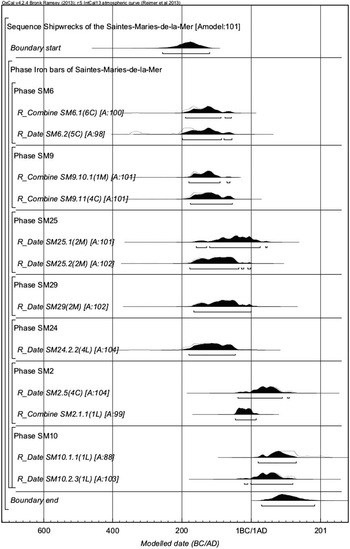
By including all the 14C dates obtained for the iron bars in the same phase and by postulating “phase boundaries,” we tested the extent of this “phase” that represents the sinking of all the ships. This modeling situates the sinking of the ships between (256, 121) cal BC to (30, 180) cal AD (Figure 5). It allows the elimination of the older part of the age density obtained for SM6.2 [351 (14.7%) 300 cal BC], which is strongly influenced by the plateau effect of the calibration curve in the period 400–200 cal BC and is difficult to envisage in the historical context of the shipwrecks. If we include the archaeological priors available for each shipwreck in the modeling, the probability distributions for the lower and upper boundaries are shortened by approximately 40 yr: (206, 105) cal BC for the beginning of the phase and (51, 150) cal AD for the end of the phase. This greater precision in the calculation of the boundaries, due to the input of new information in the model, does not change the fact that all these wrecks could have happened in an interval that includes the one considered until now, that is, from the 1st century BC to 1st century AD. However, the first wrecks could be earlier than the beginning of the 1st century BC even if, once again, we must be careful with the possible aging brought by the plateau effect in the 400–200 cal BC period, and the last ones could be later than the 1st century AD. Suggesting a period of more than 2 centuries for the circulation of these ships in the Saintes-Maries-de-la-Mer area, the direct dating of the iron bars questions the long-standing idea of a short period of time for all these shipwrecks.
Modeling of the 14C dates obtained for the iron bars of the Saintes-Maries-de-la-Mer shipwrecks.

Applying this new method of 14C iron dating to the bars of the Saintes-Maries-de-la-Mer shipwrecks involves historical reflections. Indeed, until now it was accepted that the Saintes-Maries-de-la-Mer shipwrecks represented a snapshot of the iron market between the Mediterranean and Gaul around the 1st century BC and 1st century AD. Moreover, this hypothesis leads us to think that the ferrous shipments were mainly intended to feed the Gallic Wars led by Caesar (58–52 BC) (Domergue et al. Reference Domergue, Benquet, Decombeix, Fabre, Gorgues, Rico and Tollon2003). Now, by dating cargo irons, it appears that this snapshot notion must be questioned. Most of the wrecks belong to a sequence of more than 150 yr, at the beginning of Roman rule over Gaul, between the end of the 2nd century BC or the beginning of the 1st century BC and the middle of the 1st century AD. Moreover, it appears from this study that the iron trade could have started at the beginning of the 2nd century BC and stopped in the middle of the 2nd century AD, ranging over a long period of time of 150 to 250 yr.
Without excluding a temporary relationship between iron cargoes and the Gallic Wars, it appears that the Saintes-Maries-de-la-Mer shipwrecks could reflect a more complex situation, including long-lasting commercial flows between the northeastern Mediterranean and western Europe, when the iron production sites multiplied and when the use and market of iron were growing exponentially (Domergue Reference Domergue2004; Domergue et al. Reference Domergue, Serneels, Cauuet, Pailler and Orzechowski2006; Pagès Reference Pagès2014).
Considering this new state of the art, the following new questions arise:
-
∙ Could the iron trade between the northeastern Mediterranean and western Europe have begun by the end of the 2nd century BC, directly after the beginning of the conquest of Gaul (121–118 BC) while Rome controlled the Mediterranean trade after the Punic War? Other discoveries of ships containing iron ingots in the Mediterranean corroborate this hypothesis. On the Mediterranean coast of Provence, between Hyères and Saint-Raphaël (Var, France), four wrecks loaded with the same types of iron bars are known to be from the second half of the 2nd century BC to the first half of the 1st century BC (Tchernia Reference Tchernia1969; Fiori Reference Fiori1973; Joncheray Reference Joncheray1994; Pagès Reference Pagès2010a: 199–237). In Spain, the same types of bars have also been discovered in wrecks or harbor areas dating from the 2nd to 1st century BC, from the eastern Hispanic coast, in Catalonia to Les Sorres (Llobregat) and in Ben Aféli, in the Valencia area (Ramos et al. Reference Ramos, Wagner and Fernandez1984; Izquierdo Reference Izquierdo1987; Izquierdo i Tugas Reference Izquierdo i Tugas1992).
-
∙ Did the trade of Saintes-Maries-de-la-Mer really disappear in the 1st century AD? If the answer is yes, why was this trade abandoned while iron was still marketed in the Empire under the same shape of bars until at least the 4th century AD (Pagès 2010, Reference Pagès2014)? More generally, can we sequence the volume of commercial flows by dating more wrecks loaded with iron bars? This systematic approach of iron bar dating could also be considered throughout the Roman Empire because many bars are not properly dated and the issue of commercialization under Roman rule must be understood globally.
CONCLUSION
The discovery of shipwrecks containing ferrous bars off the coast of Saintes-Maries-de-la-Mer provided archaeologists an exceptional set of samples to study the organization of the manufacture and the circulation of iron in the Mediterranean area during the early Roman period. While extensive metallographic and chemical analysis of the ferrous bars has provided important information on the production and distribution of iron, our study focused on the chronology of these shipwrecks through the direct dating of the ferrous bars. Thanks to the newly developed methodology based on 14C dating of the most carburized area of the iron samples, 34 dates were obtained on 11 bars from 7 shipwrecks. These results suggest a period of 150 to 250 yr ranging from the 2nd century BC or the beginning of the 1st century BC to the middle of the 1st century AD or 2nd century AD for the shipwrecks. These results question the long-standing idea of a short period of circulation of iron through the Mediterranean devoted solely to the supply of the Roman army during the Gallic wars. The multiplication of iron production sites in Spain first, then in the south of Gaul could have fed an early trade of ferrous semi-products across the Mediterranean that continued after the 1st century AD.
ACKNOWLEDGMENTS
We are very grateful to Luc Long, from the Département des Recherches Archéologiques Subaquatiques et Sous-Marines (DRASSM, Marseille, France) and the laboratoire Archéologie des Sociétés Méditerranéennes (UMR5140, Lattes, France), who first explored and studied the Saintes-Maries-de-la-Mer shipwrecks and gave us the points that have fuelled our reflexion. We acknowledge the LMC14 team for the preparation and 14C measurements of the iron samples. We thank our colleague Georgina Thompson for correcting the English text and the two reviewers for their constructive comments.