Migrations between rural areas in pre-industrial north-western Europe were usually of a regional or temporary nature.Footnote 2 Although it could be considered common knowledge that the population in early modern and nineteenth-century rural societies could be highly geographically mobile,Footnote 3 most rural-rural moves comprised migrations between neighbouring parishes, or at least between villages in close proximity. Population movements over long distances or across national borders were much rarer, and if they occurred, usually involved a temporary move to rural regions where additional labour was required for a limited period, for instance during harvest.Footnote 4 There are many examples of such large-scale seasonal migration systems of agricultural workers such as the migrations from the French Massif Central to the departments around Paris during the seasonal grain harvest, the movement of workers from Ireland, Wales, Scotland and different parts of England to assist in the Lincolnshire and East Anglian harvests or the gardening in the Home Counties, and the mowing of the grain in Castilia by Galician workers. The Dutch Republic, and its successor the Kingdom of the Netherlands, was also part of such seasonal migration systems. Every year, from the seventeenth until the end of the nineteenth century, tens of thousands of small subsistence farmers from German Westphalia moved to the pastures of the Dutch provinces of Holland and Friesland to mow the grass. In almost all of the above-mentioned seasonal migrations, as well as in the short-distance regional rural migrations, the move itself sustained the agricultural status of the migrant. Most of the seasonal migrants, for instance, left small subsistence farms behind, which were run by their wives during their absence. Termed the ‘work cycle’ by Jan Lucassen, this means of earning an additional income away from home was vital in maintaining the farm and the position of a non-wage labourer.Footnote 5
Prior to the nineteenth century, the permanent, long distance out-migration from rural regions in north-western Europe, in contrast to the seasonal or regional displacement of people with an agricultural background, was very often accompanied by proletarianisation, where migrants were not already wage labourers, and almost always by the loss of the agricultural status of the migrant.Footnote 6 From the seventeenth century, but increasingly in the following century, large numbers of migrants with a rural background ended up as wage labourers in the expanding cities of north-western Europe that were ever demanding new labourers, regardless of whether their background was agricultural or not.Footnote 7 The fact that rural-urban migrations were so numerous does not, however, imply that rural-rural migrations over longer distances were non-existent. On the contrary, the latter type of migrations certainly occurred, even in large numbers, but rarely within north-western Europe: it was mainly a transatlantic phenomenon. From the seventeenth century until the present, the New World has attracted farmers from Europe who chose to set up a farm thousands of kilometres from their place of birth.Footnote 8
The grounds for the success of these rural-rural migrations to the New World, if one defines success in terms of the maintenance of occupational status as farmers, are to be found in two factors in particular. First of all, agricultural land in the New World was plentiful and therefore cheap, which meant that the costs of setting up a new farm were relatively low. Furthermore, because most of the new land on the other side of the ocean was relatively unoccupied, there were no institutional barriers for newcomers to overcome. They were nobody's competitor and therefore did not have to deal with an already settled and potentially hostile agricultural community.
The two factors that explain the rural-rural transatlantic migrations also clarify why long distance rural-rural migrations were so rare in north-western Europe. In contrast to the New World, both pasture and arable land in the Old World was in relatively short supply. As a result, the capital costs of starting a farm were relatively high, and could not be easily overcome. Furthermore, while many farmers in the New World entered a virtual terra incognita, potential migrant-farmers in north-western Europe could face a plethora of institutional and informal barriers ranging from local legislation making it impossible for a newcomer to buy land, to an informal preference of local buyers for autochthonous produce.Footnote 9 Although the outcome of most rural-urban migration may have been risky, for almost all rural migrants entering an urban labour market was a much smaller and easier step than setting up a farm in a different area.Footnote 10
The eighteenth- and nineteenth-century migration from Germany to the rural parish of Watergraafsmeer near Amsterdam in the Netherlands is, however, an exception to the rule of the predominance of rural-urban long distance migration in north-western Europe. This article aims to contribute to our understanding of the phenomenon of long distance permanent rural-rural migration through the use of the Watergraafsmeer case study. Here German migrant farmers that had migrated from hundreds of kilometres away dominated the market gardening sector for over a century.Footnote 11 Where permanent long distance or international migration in north-western Europe is, as described above, usually equated with rural-urban or urban-urban migration, this case study aims to explain why a type of migration that is normally seen as an almost exclusive transatlantic phenomenon could also occur in north-western Europe.
II
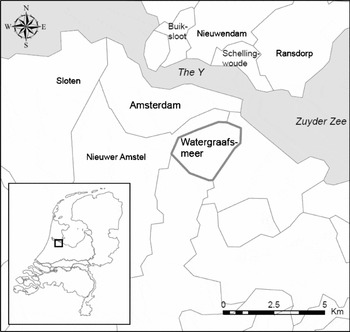
The Watergraafsmeer is a polder situated southeast of Amsterdam (see Figure 1). In 1624 the Amsterdam city council asked the States of Holland for permission to reclaim the Watergraafsmeer or De Meer (‘meer’ is the Dutch word for ‘lake’). The States of Holland agreed and in 1628 dykes were built around the lake. The process of reclamation using a series of six windmills took thirteen months: on 20th August 1629 the Watergraafsmeer was completely reclaimed, and 600 hectares of pasture and fertile arable land became available.Footnote 12 One of the earliest accounts of the ‘Meer’ is a drawing by the Dutch master Rembrandt van Rijn, depicting one of the mills that maintained the water level in the polder.
The parish of Watergraafsmeer and other parishes surrounding Amsterdam in 1840.

From the beginning the main purpose of the polder was the production of foodstuffs (vegetables but also milk, cheese and meat) for the Amsterdam market. Conveniently situated next to the river Amstel, the main waterway flowing into Amsterdam, the farmers could easily ship their produce (roughly between April and September) to the Amsterdam market just a few miles downstream.Footnote 13 The demand for agrarian products was high: where the nation's capital had 80,000 inhabitants around 1600, in 1650 the number had doubled to 160,000, as a result of the influx of foreigners.Footnote 14 The urban growth of Amsterdam illustrates the necessity for the creation of the Watergraafsmeer. Although other rural parishes around Amsterdam produced food for the Amsterdam market, in the middle of the urban explosion the Amsterdam city council took radical measures to expand the production by actively increasing the productive capacity: the Watergraafsmeer was born out of necessity.Footnote 15
While Amsterdam reached its cultural and economic peak around 1650 and was the shining centre of what has been labelled the Dutch Golden Age, disaster struck for neighbouring Watergraafsmeer. During a storm in 1651, a dyke collapsed in the eastern part of the polder and, as a result, the entire polder became inundated. Although the water was pumped relatively quickly, in 1672 the parish was hit by another set back. Because of the fear of a French invasion of Amsterdam, the States General decided to inundate the polder deliberately so that it could serve as a natural barrier against foreign armies.Footnote 16 After this second inundation the character of the Watergraafsmeer changed significantly. Although it remained important as a source of vegetables, meat and dairy products, the polder also became a popular place of leisure for the wealthy of Amsterdam. Many of the Amsterdam merchants who had become rich in the intra-European trade or the long distance trade with the West and East Indies, built large and luxurious country estates and pleasure gardens. Especially during the summer months, when the ‘grachtengordel’ of Amsterdam had to cope with the stench coming from canals which were used as open sewers, the Amsterdam high society escaped the city and settled in the Watergraafsmeer. It was during this period that the Watergraafsmeer was called the ‘pearl on Amsterdam's crown’. Some parts of the polder were still used for food production, although not on such a large scale as before.Footnote 17 The fact that, as will be shown later, the population of Amsterdam did not grow significantly and even stagnated during the eighteenth century also contributed to the change in purpose of the polder.
During the eighteenth century the situation in Amsterdam deteriorated, and this had a direct effect on the Watergraafsmeer. While in the first half of the seventeenth century Amsterdam's economic growth, like that of the Dutch Republic, seemed endless, from the 1670s the Dutch economy slowly but steadily lost momentum. The aforementioned invasion of the French, wars with the English and growing international competition resulted in the stagnation of the Dutch economy.Footnote 18 The wealthy merchant class of Amsterdam slowly began to eat into the capital they had earned in the Golden Age and for many the country estates and pleasure gardens increasingly became a financial burden.Footnote 19 The final straw came in the last quarter of the eighteenth century. The Fourth Dutch Anglo War (1780–1784) resulted in an accelerated deterioration of the economic situation in the Dutch Republic, and when, at the turn of the century, Napoleon, who treated the Dutch Batavian Republic (1795–1806) as his puppet state, decided to cut the interest rates on outstanding loans many owners got into serious liquidity problems. As a result, many of the Watergraafsmeer estates were sold, the buildings were demolished and the gardens were turned back into arable land.Footnote 20
At the start of the nineteenth century the Watergraafsmeer returned to the purpose the Amsterdam city council intended it to have when it decided to create the polder. In the second half of the nineteenth century the market gardens in Watergraafsmeer increased in scale. Eventually, Watergraafsmeer harboured a dozen large ‘meerboederijen’ (which translates as ‘lake farms’), half of them run by German farmers. During the last decades of the nineteenth century, however, Watergraafsmeer slowly but gradually lost its agricultural character. Amsterdam experienced a rapid process of urban sprawl and began to annex the surrounding polders. Watergraafsmeer managed to maintain its status as an independent municipality in 1896, when other neighbouring polders and farm lands were incorporated in the city of Amsterdam.Footnote 21 Nonetheless, the establishment of a tramline straight across the Meer opened up the polder for visitors from Amsterdam out for a stroll. After the turn of the century Watergraafsmeer rapidly turned into a popular residential area. Annexation by Amsterdam now seemed inevitable and came to effect in 1921.Footnote 22
III
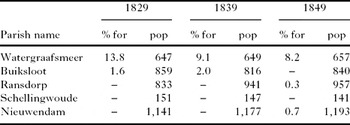
Because of the availability of population registers for a large part of the nineteenth century, it is possible to get a clear view of the size of the German population in Watergraafsmeer during the nineteenth century.Footnote 23 In Table 1 the proportion of foreigners in the population in the first half of the nineteenth century is compared to five other rural parishes around Amsterdam.Footnote 24 While in the other five rural parishes a maximum of only two per cent came from outside the Netherlands, in Watergraafsmeer in 1829, about fourteen per cent of the registered population was born abroad, and almost the entire foreign population in the parish came from Germany.Footnote 25
The share of foreigners in the population registers of six rural vegetable producing parishes near Amsterdam and their total population, 1829–1849

Source: ACA, 5008, inv. nrs. 193, 195, 334, 335, 386, 441, 443, 496.
In itself, migration to the Netherlands, and especially to its core province Holland, was not exceptional.Footnote 26 In the urban centres of Holland in particular, which were amongst Europe's most urbanised areas during the early modern period, levels of immigration were much higher than anywhere else in Europe.Footnote 27 In 1650 an estimated eighteen per cent of the population consisted of foreigners. In contrast, the influx from the rest of the Dutch Republic in the same year was only nine per cent.Footnote 28 Watergraafsmeer's neighbour, Amsterdam, witnessed an even higher relative influx of foreigners. Like most urban centres in the early modern period, Amsterdam was not able to grow through the reproduction of its inhabitants alone.Footnote 29 Up until the start of the nineteenth century, deaths exceeded births, and during the seventeenth century the natural growth deficit was especially high. Since the population of Amsterdam doubled during a time of negative natural growth, it is obvious that in-migration accounted for the growth of the city.Footnote 30 Amsterdam attracted migrants from all parts of Europe, as a result in 1650 about forty per cent of its inhabitants consisted of people born outside the Dutch Republic. The most important sources of migrants were the Southern Netherlands (present day Belgium) which supplied seventeen per cent of the migrant population, and the Scandinavian countries (especially Norway) which provided about thirty per cent. The largest proportion of migrants was from the German States, however. An estimated fifty-four per cent of the migrants in Amsterdam originated from the Holy German Empire, especially from western regions such as Westphalia, East Friesland and Oldenburg.Footnote 31 Although after the French occupation (1806–1813) the proportion of migrants declined significantly, immigration levels remained high in the urban centres of the newly found Kingdom of the Netherlands.Footnote 32
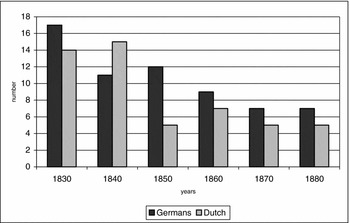
The presence of such a large number of migrants in the population registers for Watergraafsmeer (which as a rule only record migrants that actually settled in the parish) demonstrates that Watergraafsmeer had an exceptionally large proportion of foreigners for a rural parish. More striking, however, is how these permanent, or at least sedentary migrants, were able to dominate the cultivation of vegetables. In Graph 1 the number of market gardens that were German (defined as having a household head of German origin) is compared to the number of Dutch farms: apart from in the year 1840, the majority of the market gardens were run by German farmers.
Number of German and Dutch owned market gardens in the Watergraafsmeer parish, 1830–1880.

Thanks to the population registers it is relatively easy to reconstruct the level of immigration to Watergraafsmeer during the nineteenth century. For the pre-census period this is much more complicated, but by combining various sources it is possible to get at least an impression of the presence of Germans in Watergraafsmeer. To start with the early years of the polder, there is little evidence in the parish's sources of the existence of German migrants in the Watergraafsmeer in the first three decades of its existence. Undoubtedly they were active, albeit temporarily, in seasonal occupations. Furthermore, given the presence of the literally tens of thousands of Germans only a stone's throw away, one can assume that in the seventeenth century the occasional German was working in Amsterdam's neighbouring parish. The Watergraafsmeer had a small core of buildings concentrated in the north-western part of the polder close to the road leading to Amsterdam and also provided employment in non-agricultural occupations. In the polder's nineteenth century censuses some German immigrants show up as carpenters, bakers and tailors.Footnote 33
The first recorded German immigrant turns up in the parish sources at the beginning of the eighteenth century. He was a market gardener by the name of Carel Pietersz from Muensterland (the area around Muenster in the west of Germany). His case is mentioned in the parish's Criminal Records of 1710. Apparently Pietersz, accompanied by his wife, stole a cabbage from a fellow market gardener and was sentenced to banishment from the province of Holland.Footnote 34 Scattered over the century, other German immigrants show up in a wide range of records such as wills, probate inventories and the parish marriage registers.Footnote 35 Apart from the occasional market gardener, without exception immigrants in the polder state ‘gardener’ as their occupation, and almost all were working on country estates and pleasure gardens. One of them was Johann Georg Lauppert. Dictating his will on 22nd September 1736, Lauppert states that he worked in the pleasure garden named ‘Rozenburg’ situated in the middle of the polder.Footnote 36
We have indicated above that the Watergraafsmeer slowly regained its agricultural function during the eighteenth century. The relatively fertile land on which the country estates and the pleasure gardens were built was more and more used for the production of vegetables. A comparison of historical maps of the polder in the early eighteenth century and cadastral maps some hundred years later shows that on the grounds of the former estates, farms, and particularly market gardens, had emerged.Footnote 37 The increase of agricultural ground at the expense of the estates is also traceable in the minutes of the parish council. The minutes tell that as a result of the expansion of agricultural land, a steep increase in the number of market gardeners is noticeable. In 1825 the influx was high enough for the council to decide to put a halt to the settlement of new farmers in the polder. It is hard to say if this decision had any effect on the number of farmers in Watergraafsmeer, since the first reliable data concerning the number of farmers in the polder dates from 1830.Footnote 38
Although at the start of the nineteenth century the number of available sources grows exponentially, and despite the fact that the information for the eighteenth century is fragmentary to say the least, there appears to be a clear correlation between the increasing opportunities in the Watergraafsmeer and the growing influx of German migrants in the polder. There is an increase in the numbers of Germans in different types of sources. Moreover, the sources indicate that the Germans settled relatively easily in this Dutch polder. Although most of the early nineteenth-century sources cannot be used to measure the size of the migrant population in this period, they provide a clue to the position of migrants in the parish. The parish marriage register, for instance, gives an indication of the level of integration of German immigrants in the polder. In 1826 German farmhand Clamor Ivemeijer, who was born in Essen, Hanover in 1799 and employed at one of Watergraafsmeer's market gardens, married a local Watergraafsmeer girl named Anna Wakker. The registers show that Ivemeijer's case was not extraordinary: ethnic marriage exogamy was relatively common in the parish, with most of the immigrants marrying a non-German partner. The population registers show that between sixty and seventy-five per cent of the German immigrants chose a native bride or groom.Footnote 39 In this respect, the Watergraafsmeer clearly deviates from other immigrant settlements in the early modern and nineteenth-century Netherlands, where endogamy, marriage within one's own ethnic circle, was the rule and marriage exogamy an exception.Footnote 40 It is also remarkable that although the majority of the German immigrants were Lutherans (either members of the Restored Lutheran Church or Evangelical Lutheran Church) and the native population was Dutch Reformed or Roman Catholic, religion was no barrier for marriage: mixed marriages were the rule.Footnote 41 Other sources also give an indication of the participation of the German immigrants in the daily parish life and their far from marginal position in Watergraafsmeer. German immigrants for example played a role in public life, taking positions as head of the night watch or as a member of the parish council's auditing committee, or employed as a blacksmith, tailor and butcher.Footnote 42
The parish tax records and the cadastral accounts also provide a qualitative insight into the position of German immigrants in the polder. The tax registers show that in 1830 two German market gardeners belonged to the top twelve tax-payers, and about two decades later, in 1848, three out of the top twelve were of German origin.Footnote 43 Additionally, the cadastral accounts give a good overview of the landownership among the German population in the Watergraafsmeer. It shows that in 1821 a certain Coenraad Dewesen, born in Hanover in 1768, and indeed among the aforementioned twelve richest in Watergraafsmeer, owned no less than nine large plots of land in the polder. Interestingly, parts of his estate, which consisted of a number of houses, market gardens and several farms, had contained country houses and pleasure gardens in the century before. The accounts do, however, show, that only a minority of immigrants owned the ground on which they farmed. Most of the German market gardeners, like their Dutch colleagues, were leaseholders; in fact most of the land in the Watergraafsmeer was owned by a small number of large Dutch landowners.Footnote 44
As shown in Graph 1, during almost the entire nineteenth century German market gardeners outnumbered their Dutch colleagues and the parish of Watergraafsmeer attracted not only foreign market-gardeners, but also day labourers and farmhands from Germany. The tax registers of 1806 show that during harvest and seedtime thirty-five day labourers from Germany, almost all from the region around Osnabrück, worked as temporary workers. A number of market gardeners show up in the 1806 tax registers as well. At least six of them still lived in Watergraafsmeer some twenty-four years later, among them the prosperous market gardener Coenraad Dewesen.Footnote 45
All in all, the parish sources demonstrate that Watergraafsmeer harboured German migrants right from the early decades of its existence, working as gardeners on the country estates or as grass mowers and dyke workers. The large scale permanent settlement of German migrants, however, dates from the early decades of the nineteenth century, when the stock of arable land was expanded at the cost of the country estates and pleasure gardens and German market gardeners came to dominate Watergraafsmeer's agricultural sector. How the Germans came to dominance will be the subject of the next section.
IV
The lack of institutional barriers and the access to cheap land have already been identified as the main reasons why the transatlantic rural-rural migrations were so successful, and at the same time provided an explanation for the lack of rural-rural long distance migration in north-western Europe. Naturally there are important differences between the settlement migrations in the New World and the Watergraafsmeer case, not least in terms of scale and the distance migrants needed to travel. Nevertheless, it is instructive to find out whether the factors that made the transatlantic rural-rural migrations successful also apply to the Watergraafsmeer. As such, the apparent uniqueness of the Watergraafsmeer case will be discussed.
Starting with the first factor, it seems that, as in the United States and Canada, institutional barriers for foreigners to set up a business did not exist in Watergraafsmeer. Although on a national level guilds were only abolished in 1811, there were never any guilds in the parish, either for non-agricultural trades or for agricultural professions.Footnote 46 It had therefore never been difficult for newcomers to perform a profession or set up a business in Watergraafsmeer. Moreover, there were no obstacles for an immigrant to purchase or lease land. The German ownership of at least two market gardens shows that in contrast to England, for instance, foreign subjects were allowed to buy land.Footnote 47
Nevertheless, the absence of formal (institutional) barriers for newcomers does not necessarily mean that migrant settlement in Watergraafsmeer would have been without any problems. It is known that within open trades in the Netherlands informal preferences could make it virtually impossible for foreigners to practise a profession.Footnote 48 Yet the far from marginal role the German immigrants played in the Watergraafsmeer society, shown by the predominance of marriage exogamy and the participation of Germans in the local parish council, seems to imply that even on an informal level, Germans were not treated differently from Dutchmen. It is especially striking that even after imposing a numerus fixus for the number of market gardeners in the polder in 1825, German market gardens continued to outnumber their Dutch counterparts. Even in times of tension there is no sign of any anti-German sentiment,Footnote 49 the best example being the fact that there is no evidence that, as a result of the numerus fixus on market gardens, leases of German farmers were dissolved. Although it remains hypothetical, an explanation for the open-attitude may be found in the fact that Watergraafsmeer was a relatively young polder, and lacked the social cohesion of an autochthonous population. Again, a comparison with the settlements in the New World springs to mind. As a rule, everyone in the polder was a newcomer, and after the disappearance of the country estates at the end of the eighteenth century, the parish started carte blanche. Small as the polder was, it needed to be colonised again. It could have been this mentality, in which colonisation was regarded as a mutual enterprise that ensured that Germans were regarded as equal. This was, for instance, a feature of the English colonisation of North America.Footnote 50
Easy and cheap access to land was the second factor that explained why rural migrants could settle relatively easily across the Atlantic, and once more, this explanation also seems to apply to the rural migration to Watergraafsmeer. As was shown above, with the demise of the country estates in the polder, a massive amount of new arable land became available, which indeed led to a second wave of ‘colonisation’. The deeds of sale in the notarial archive of the Watergraafsmeer show that the country estates and the surrounding gardens were sold for relatively low prices. An example of how cheap land actually had become at the turn of the century is the sale history of the estate ‘Hoflust’. In 1809 the estate was sold for 1,000 guilders and demolished, although only thirty years before it had yielded 5,000 guilders. This equals, corrected for inflation, a sum of 7,024 guilders in 1809.Footnote 51 In other words, within thirty years the effective price of this estate and its land had decreased by a factor of seven. Although not every migrant purchased land, the cost of starting a new farm would have been similarly inexpensive for leaseholders, since the lease sum was linked to the value of the ground.
The price for land in Watergraafsmeer was relatively low in comparison to other vegetable producing parishes in the vicinity of Amsterdam. This was the case for at least two reasons. First, the sudden increase of supply must have caused land prices to fall. As was shown above, as a result of the financial troubles of the estate owners in the late eighteenth and early nineteenth century, large amounts of land became available in a relatively short time which must have affected the price. Second, the quality of the land gradually deteriorated, which caused prices to drop. In the 1830s the minutes of the parish council meetings mention severe problems with the water management, resulting in difficult harvests. According to the minutes, the location of the polder, about six metres under sea level, was the main reason for the drainage problems.Footnote 52 The Watergraafsmeer in fact lacked an efficient drainage system. The polder had been reclaimed through the use of six eight-sided water wheel mills. Afterwards four of them remained in use to maintain the water level in the polder. From the mid of the eighteenth century onwards, these mills were replaced by two so-called water disc mills.Footnote 53 After the turn of the century Watergraafsmeer' farmers started complaining about the mills, which were not able to maintain the water level. Moreover, the main drainage canal, the river Amstel, could only receive a fixed amount of water from the Meer. Regulation prohibited draining superfluous polder water to the Amstel on a large scale during the winter and early spring because otherwise the river level would rise too high. In fact, the Watergraafsmeer lands were only in good condition at the end of spring. Other rural parishes around Amsterdam were located on a much higher level, and had much less difficulty.Footnote 54 Hence, land prices in the Meer must have been relatively low compared to other rural areas in the vicinity of Amsterdam.
The fact that, despite the far from ideal circumstances, the Watergraafsmeer still harboured many market gardeners is mainly due to the large demand for produce in Amsterdam. For the first time in almost a century, in the first half of the nineteenth century the population of the polder's large neighbour started to grow. After remaining stagnant during the first half of the eighteenth century on a level of about 234,000, and showing a significant decrease in the following fifty years, in 1800 the city reached a level of about 204,000 people. During the next fifty years Amsterdam's population, however, rose to some 224,000 people in 1850.Footnote 55 It is highly likely that the moment of the ‘boom’ of market gardening in the Watergraafsmeer is directly correlated to the growing demand for agricultural produce from its large neighbour.
It appears that the German immigrants in the Watergraafsmeer exploited the opportunities in the polder to the maximum. In a sense they did not have a choice. The relatively easy access to land and the low costs of starting a farm did not apply to other areas around Amsterdam, and where some Dutch farmers chose to move their farm to better and much older parishes around Amsterdam,Footnote 56 the German immigrants had no alternative but to remain working in the Meer. One can, however, also turn the argument around. Since for German immigrants with a rural background the Watergraafsmeer had always been about the only option if they wanted to start or take over a market garden, they were very much aware of the possibilities there, and in the long run profited from their knowledge of the polder. In economic terms, one could say that because of the knowledge they had about this specific place, the transaction costs of setting up a new farm here were relatively low: they knew how to work the land in the Meer, were aware of the specific difficulties involved in growing crops in a polder and had access to existing transportation networks and the Amsterdam vegetable markets.Footnote 57
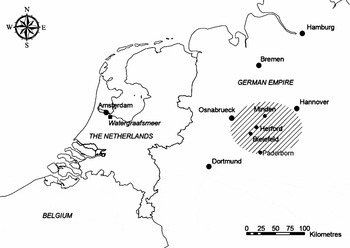
In addition, they had one major advantage over their Dutch colleagues in Watergraafsmeer in their easy access to cheap labour. Not only did market gardeners migrate from Germany, but an ever larger group of farmhands and day labourers also made the move to the Dutch polder, most of them originating from the same region. Unfortunately little is known of the exact background of most of the migrants. Many of them used generic place or regional names such as Osnabrück, or Hanover, which could either mean the town or, more likely, the region. Moreover, the ‘Dutchification’ of the German first and surnames makes record-linking with German sources an impossible task.Footnote 58 Nevertheless, what can be gathered from the data is that the majority of the migrants in the eighteenth- and nineteenth-century sources were born in rural areas in the Prince-Bishopric of Osnabrück near places such as Herford, Minden and Bielefeld (see Figure 2).Footnote 59
Region of origin of German immigrants in Watergraafsmeer during the nineteenth century.
Map showing the borders of the Kingdom of the Netherlands from 1830 onwards.

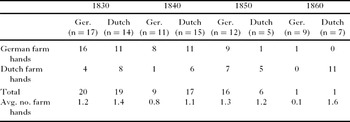
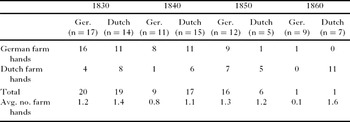
Table 2 shows that German market gardeners mainly hired German personnel, who, given the unequal wage levels between the western parts of Germany and the Netherlands,Footnote 60 would have worked for lower wages than their Dutch colleagues. An indication of the latter, given that wage data for the polder have unfortunately not survived, is the fact that in 1830 and 1840 Dutch market gardeners also hired more German than Dutch workers. Relatively speaking, however, Germans hired more ethnic labourers. The use of cheap ethnic labour by migrant entrepreneurs is a phenomenon that is known from an urban context as well. Evidence for the Dutch city of Utrecht, for instance, shows that in the second half of the nineteenth century, German shopkeepers hired cheap personnel who, as was the case in Watergraafsmeer, were also from the employers' region of origin. Because of the knowledge of foreign labour markets, immigrant entrepreneurs had easier access to cheap immigrant workers, which gave them an edge over competitors who did not.Footnote 61 In Watergraafsmeer there also appears to have been a correlation between the strong position of immigrant ‘entrepreneurs’ and availability of cheap labour originating from the region of origin, even though their Dutch colleagues also profited from the presence of relatively cheap German farm hands.
Origin of farm hands at the German and Dutch market gardens in the Watergraafsmeer, 1830–1860
Source: ACA, 5008, inv.nrs.193–195. Population Registers 1830–1860.
Chain migration is the phenomenon that describes the close ties between the region of origin of migrants and their destination. It constitutes a direct link, resulting in a ‘chain’ of different moves from one region of origin to a specific region of destination over a longer period of time. Within the European context this phenomenon is normally related to ties between migrants in an urban environment, although in research on migrant settlements in the United States it has been shown that there were also strong ties between migrants from rural regions of origin and rural destination.Footnote 62
Although the direct evidence is scarce, the migrations of Germans to Watergraafsmeer also show features of chain migration. In her influential article on chain migration between villages from German Hesse-Cassel and the United States, Simone Wegge assumes that chain migrants ‘are linked by ties in the home country and not necessarily by connections at the destination’. Wegge argues that in the case of the migrations to the United States chain migrants did not necessarily ended up living together in the adopted country.Footnote 63 In Watergraafsmeer, however, it seems that chain migration also worked the other way around; as a result of the direct link between the polder and the region of origin, potential migrants must have been aware of the specific conditions and possibilities in Watergraafsmeer. From the eighteenth century until the end of the nineteenth century, people originating from different neighbouring villages in the western part of Germany migrated to this one polder. The fact that German immigrants from this region were already present in the polder not too long after it was created meant that information about the polder must have existed in the region of origin of most of the migrants. This not only ensured that potential migrants knew exactly where to go to, which indeed explains why there was a continuous stream of migrants to Watergraafsmeer. In other words, it encouraged more migrationFootnote 64 but it also ensured that the ethnic employers had access to existing networks, and could easily recruit cheap labour from the region of origin which subsequently resulted in maintaining the information network intact.
V
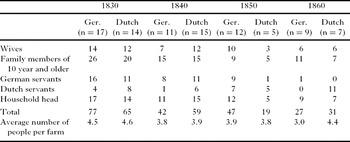
The link between Germany and Watergraafsmeer became weaker over time; Table 2 shows that the number of farmhands decreased after 1850. In 1860 the nine German market gardeners in Watergraafsmeer only had one servant employed (a German). The decline in the rate of German influx was both the result of internal (Watergraafsmeer) and external (German) factors. The fact that the number of German workers decreased is not surprising. From the second half of the nineteenth century, Germany transformed from a peripheral region in north-western Europe into an attracting core itself. The German Ruhr Area in particular industrialised rapidly, and attracted hundreds of thousands of German internal migrants.Footnote 65 Not only did this region provide more opportunities for potential migrants, but places such as Dortmund (see Figure 2) were also much closer to ‘home’ than the Netherlands. Interestingly, the migration stream even inversed and Dutch workers increasingly migrated to Germany. The running dry of the traditional source of cheap labour is also shown in Table 2. Whereas in 1830 a total of twenty-seven farmhands worked in the polder, the number had decreased to nineteen in 1840, ten in 1850 and only one in 1860. The farmers, however, could not do all the work on their own. Again, the German market gardeners made use of the situation by choosing the cheapest option: in this case the labour of the family.Footnote 66Table 3 shows the number of family members which theoretically could be employed at the farm including children of ten years and over. The table indicates that when the farmers' wives, children and other family members are taken into account, the number of people working on the German and Dutch farms hardly differed.
Average complement of Dutch and German market gardens in Watergraafsmeer, 1830–1860

Source: ACA, 5008, inv.nrs.193–195. Population Registers 1830–1860.
The overall decline in the number of people employed on the Watergraafsmeer farm lands was caused by the bad drainage conditions in the polder. In 1845 a dozen farmers, eight of them of German origin, stormed into the mayor's office, demanding an immediate solution to the polder's drainage problems, otherwise they would refuse to pay their taxes.Footnote 67 Their appeal did not fall on deaf ears. The dykes were strengthened and slowly but gradually the Meer's farm lands again started to bear a rich harvest. Nonetheless, the bad conditions in the Meer had already caused a strategic shift in the character of the agricultural sector. Watergraafsmeer turned out to be best equipped for the cultivation of coarse vegetables on a large scale, which both decreased the consequences of a bad harvest and allowed for a more labour extensive running of the farms. Whereas surrounding farm lands, not hampered by drainage problems, specialised in delicate vegetables and fruit, often cultivated on rather small-scale, labour-intensive farms, the Meer's so-called large scale ‘meerboederijen’ produced vegetables such as cabbages and cauliflower.Footnote 68
In 1884 Watergraafsmeer counted fourteen ‘meerboederijen’. Half of them were run by German immigrants, two others by Dutch-born sons of German farmers who had previously settled in Watergraafsmeer. According to the available, albeit rather scattered statistics, the Watergraafsmeer farmers employed very few permanent farm hands and relied on the efforts of their family and possibly also day labourers.Footnote 69 Soon the Watergraafsmeer farm lands were threatened by the urban sprawl of Amsterdam. Gradually, towards the turn of the nineteenth century, Watergraafsmeer lost its agricultural character and underwent a process of urbanisation. In addition, other farm lands in Holland rose to prominence, undercutting the relatively small scale farm lands in the vicinity of Amsterdam. The ‘Westland’ in the province of South-Holland developed into the centre of Dutch market gardening with its ‘city’ of large-scale greenhouses. The agrarian crisis of the 1880s further enforced the scaling up of market gardening in the Netherlands.Footnote 70
VI
One of the most striking aspects of the German migration to the Watergraafsmeer is that the factors that explain the success of this migration very much resemble those of the transatlantic settlement migration from rural areas in the Old World. In both settlement migrations, the settlement was successful because of the availability of a combination of cheap agricultural land and very few institutional settlement barriers. A second aspect that makes the Watergraafsmeer case study a relevant one is that it shows how the rural migration of Germans to the Dutch polder resembled that of their urban counterparts. This is particularly demonstrated by how the German immigrants in the polder were able to profit from what seems to have been a marginal position. A concept that is called ethnic niching can be used to illustrate this striking phenomenon. By focusing on what appears to be a marginal and far from profitable trade, the disadvantage is turned into an advantage. In the present day urban environment the best example of ethnic niching is the ethnic restaurant business: Indian, Pakistani, and Chinese restaurants, which in general are selling relatively low priced food and are at the bottom of the culinary ladder, are almost completely an ethnic affair. One of the most important factors that determines or influences the existence or the success of ethnic niching is the use of temporary, but especially cheap labour from the region of origin.Footnote 71 Indeed many or almost all Chinese restaurants in present day Europe are not only run by ethnic Chinese, but also employ personnel of Chinese origin, often from the same region. A somewhat similar situation applies to late eighteenth- and nineteenth-century Watergraafsmeer, although unlike the Chinese restaurant business, the connections between the region of origin and Watergraafsmeer had existed for several centuries. Nevertheless, through the use of century-long existing links between the Dutch polder and their region of origin in the western parts of Germany, the German market gardeners were able to recruit cheap labourers, and thus succeeded in maintaining and continuing their business against all odds.