Introduction
The role played by co-operative wineries is an important issue in the study of the world’s main wine-producing region: Mediterranean Europe. France, Italy, and Spain are the most important countries in this regard. More than six hundred co-operative wineries exist in Spain, and they control 70 percent of the Spanish wine market. Moreover, they bring together one hundred seventy thousand winegrowers, which is approximately 80 percent of the domestic total. Footnote 1 The data for Italy are similar, even though the sales of Spanish co-operatives are much smaller than that of their Italian counterparts. This fact indicates that the Italian and Spanish co-operative sectors are of similar size but have very different structures. The sector in Spain is intensely fragmented, whereas in Italy it is much more concentrated from a business point of view (Table 1). Moreover, it is much more efficient in terms of its activity than the Spanish sector.
Co-operative wineries in Spain and Italy, 2008

Source: General Committee for Agricultural Cooperation in the European Union, Agricultural cooperatives in Europe.
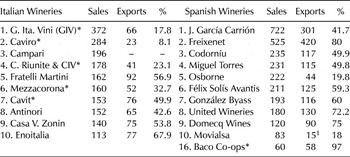
In 2012 the market share of Italian co-operative wineries was 57 percent, and five of the top ten wine companies were co-operative groups, and two held the top two positions Footnote 2 (Table 2).
Top ten wineries in Italy and Spain, by sales (millions, euro), 2012

Source: Ufficio Studi Mediobanca, Indagine sul settore vinicolo, 11; Alimarket, Informe anual de bebidas, 2012.
* Co-operative enterprise
1 2011
In contrast, the list of the largest Spanish wineries in 2012 included only one co-operative enterprise, Baco, which is actually a second-degree co-operative (i.e., a co-operative in which membership is not made up of physical persons but of other co-operatives). The business activity of this company largely relies on selling the product of nine co-operative wineries from the same region on the international market. Baco was rated sixteenth in terms of size, and it had to compete with major Spanish corporations such as J. García Carrión; Freixenet; Codorníu; and the large sherry producers Osborne, González Byass, and Domecq. The sales for the Spanish corporations were in excess of €120 million each in 2012 (see Table 2).
In Italy, it is different. Co-operative groups such as GIV and Caviro led the wine sector, along with co-operative enterprises such as Cantine Riunite/CIV, Mezzacorona, and Cavit. All of these companies sold over €150 million in 2012. Moreover, the merger of GIV and Cantine Riunite/CIV resulted in the creation of a massive group, with sales of more than €500 million. Footnote 3
These facts reflect the concentration and restructuring processes undertaken by Italian co-operative wineries in the second half of the twentieth century, which stands in sharp contrast with the situation in Spain. In the second case, the creation of a multiplicity of micro-wineries, which sometimes operate only at a local level, has resulted in a fragmented sector. Although these co-operatives included the majority of wine growers, no efforts to join forces and improve production and marketing processes were made.
Certain theoretical approaches posit that recessive economic conditions are particularly favorable to the creation of co-operatives. According to Hansmann, among others, co-operatives offer a better response to social needs and to correct market failures. Footnote 4 In expansive economic conditions, however, they are regarded as less efficient than capitalist firms. The main reasons for this are the lack of incentives for profit or maximization of value, free-riding behavior of associates, and the complexity of the decision-making processes, which can be detrimental to overall efficiency. Footnote 5
This theoretical premise has been rejected from a historical perspective because of other successful co-operative sectors, such as the Danish dairy agribusiness and the German rural credit co-operatives. The key factors to the success of this model are the roles of co-operatives as formal institutions in regions characterized by high scores in human and social capital parameters, strong social networks, and intense degrees of social cohesion. In these settings, co-operative businesses have competitive advantages in comparison to capitalist ones by being more efficient and productive. Footnote 6 Some authors also reject the classical focus from a theoretical point of view, claiming that co-operative firms can be more efficient than capitalist firms in facilitating the circulation of information as well as in reducing transaction costs. These authors argue that co-operative firms strike a sensible balance between efficiency and equity, and bring democracy to modern economics. Footnote 7
According to the data discussed above, it seems coherent to regard co-operative wineries in Italy as successful in comparison with Spain. This article undertakes a comparative analysis to study the similarities and differences in these co-operatives to understand why Spanish co-operative wineries did not embark on a similar concentration process, and it summarizes the different long-term strategies. This process made Italian co-operative wineries competitive in national and international markets, and gave them an advantage over capitalist wineries. As a result, the Italian wine sector is currently dominated by a number of major co-operative groups. Although historically the emergence of co-operative wineries in both countries was similar, the Spanish case is quite different. They both began at a disadvantage in comparison to France, and in both countries dictatorial regimes played significant roles in the development of the wineries.
In short, the main objective of this work is to answer the following question: Why did the Italian wine sector, in terms of market position, make better use of the advantages offered by the co-operative model than did the Spanish wine sector? In this article, we adhere to the theoretical framework of the business life cycle, and pay special attention to the model set forth by Cook. Footnote 8 The goals of this analysis are to determine at what stage Spanish and Italian co-operative wineries are today, and how they evolved historically.
The article is divided into sections: following the introduction, we establish the theoretical framework by providing an overview of the historical evolution. We analyze features and geographical distribution, and we compare the structure, demand, and management models of co-operative wineries in both Spain and Italy in the twentieth century. We then provide a brief comparative analysis of current differences, which are the result of distinct historical evolution. The article closes with conclusions.
Theoretical Framework: The Co-operative Business Life Cycle
We use a dynamic theoretical framework to analyze both the performance of Italian and Spanish co-operative wineries in the second half of the twentieth century and their evolution from an organizational perspective, which depends on their ability to adapt and innovate in response to the changing environment.
This approach has been used to analyze business life cycles. For instance, Scott concluded that firms entered new stages in their life cycle as a consequence of growing specialization and higher organizational complexity. Footnote 9 Greiner and other authors, in comparison, think that the relevant variables are size and time. Footnote 10
There are several approaches regarding the number of stages into which an organizational life cycle can be divided, but consensus exists about the main features of the process: the stages evolve in a sequential nature; occur in hierarchical progression; become more complex over time; and, in general, models predict that organizations will undergo a stable model of creation, growth, and maturity that is followed by decline or redevelopment. Footnote 11
Some authors who have worked on the economic theory of co-operatives have touched on the business life cycle of co-operatives. For instance, Vanek defined three phases: birth, death, and reproduction. Footnote 12 Ben-Ner tried to establish the different life cycles of co-operative business according to the environment within which these entities operate. Footnote 13 In critical economic cycles, co-operatives have some advantages over capitalist firms; they operate more efficiently and tend to increase their market share, especially in those sectors where capitalist firms suffer contractions to a greater degree and where problems of asymmetric information is more significant. Footnote 14
The cycle is completed when a new stage of economic growth begins. Under these new conditions, the creation of co-operative firms decreases and the co-operatives that already exist tend to turn into capitalist societies, which are more efficient in expansive conditions. Another reason for this is the members’ aspirations to increase their profits. These phenomena are referred to as either hybridization or demutualization processes. Footnote 15 In conditions of high productivity, co-operatives tend to hire salaried employees, which is less costly than incorporating new members who would have a share in the profits. Footnote 16 Authors such as Bonin or Miyazaki Footnote 17 agree with this pattern.
A number of authors have created models adapted to these firms in the Italian case (see e.g., Carbogni and Masiero; Fiorentini and Scarpa; Meister; Panati and Roncaccioli; Zan). Footnote 18 We suggest, however, that the perspective adopted by authors working on agricultural co-operatives is more useful. For example, Helmberger, Le Vay, and Murray agree with the begin–succeed–decline model and that the transformation of co-operatives into investor-owned firms should not be regarded as a failure (demutualization) but as a rational adaptation to increasingly competitive markets. Footnote 19 Hind stresses the importance of change in goals over time and the increasing differences in the goals of major stakeholder groups. Footnote 20 Ortmann and King highlight the co-operative firms’ potential for institutional innovation. Footnote 21
The most widely accepted framework for the analysis of agricultural co-operatives is that proposed by Cook. Footnote 22 We follow this same framework to ascertain the current stage of Spanish and Italian co-operative wineries today and to evaluate their historical evolution. The development of agricultural co-operatives in this framework follows five stages.
The first, Stage 1, is economic justification. According to Cook, there are strong incentives for creating co-operatives despite the high organizational costs. In conditions of market failures and excess supply conducive to falling prices, co-operatives protect the value of farming assets. This stage is essentially defensive in character, has a high degree of economic homogeneity, and has a simple organizational structure. After analyzing the main traditional types of U.S. agricultural co-operatives during their formative stages, Cook divided them into seven categories: Farm Credit System (rural credit co-operatives aimed at financing agricultural activities); Rural Utilities (rural electric and telephone co-operatives aimed at supplying utilities in sparsely inhabited areas); Nourse I (multipurpose local co-operatives); Nourse II (multifunctional regional co-operatives); Sapiro I (bargaining co-operatives); Sapiro II (marketing co-operatives); Sapiro III (added-value marketing co-operatives).
Stage 2 is the organization design. The institutional environment (especially legislation) sets norms and, therefore, internal costs that affect the creation and performance of co-operatives. These costs must be compensated for with the profits of co-operation.
Stage 3 is growth, glory, and consequences (heterogeneity). After their creation, co-operatives enter a process of growth in which new and heterogeneous members are incorporated into the membership. This increases internal transaction costs, especially due to the increased likelihood of free-riding and horizon problems, portfolio problems, control problems, and influence costs problems (all of which will be illustrated in our analysis of Spanish and Italian co-operative wineries). These problems are typical of interclass organizations with a heterogeneous membership, in which several groups of partners have divergent goals and pursue opposing interests. The root of the problem is a vaguely defined property right structure, which can cause a conflict of interest within the institution, especially in decision-making and control processes, and which can ultimately damage the efficiency and internal performance of the firm. The organizational conflict is emergent.
The next is Stage 4, which is crisis and recognition of conflicts (introspection). The management of increasingly compound institutions likewise becomes more complex, especially due to internal transaction costs and the competitive nature of the environment. Confronted by this challenge, and after intense debates over ownership-control rights and capital structure, co-operatives can adopt three strategic options: exit (liquidation, merger with other co-operatives or demutualization); continuity (the traditional structure is preserved with only minor or moderate changes); or shifting (a radically new model is applied in order to adapt to the new circumstances—this is the Sapiro III structure, which involves an offensive strategy and a more complex organization).
Stage 5 is restructuring time (choice). The co-operatives choose between the strategic options described in Stage 4, and a new life cycle begins.
In the next sections we analyze the historical development of these firms and use this agricultural co-operative cycle model to examine the different evolutions of Spanish and Italian co-operative wineries, from their origins up to recent years.
Stages 1 and 2: Creation and Development before World War II
During the first half of the twentieth century, Italian and Spanish co-operative wineries shared many features. In both countries, co-operative wineries began in comparatively backward conditions in comparison to France, where in 1933 there were 595 co-operatives, while in Spain and Italy there were only around 100 in each country. Footnote 23 The implementation of this business model in rural areas was limited.
The earliest Italian co-operative wineries were created in the last third of the nineteenth century in regions such as the Piedmont and Venezia-Tridentina (especially in the provinces of Bolzano and Trento). Soon the model spread throughout the northern region, as well as in some central and southern regions. This expansion was aided by the prevalent agrarian crisis, favorable legislation, and the creation of co-operative associations that promoted the creation of co-operative wineries. Footnote 24 In 1913 the number of co-operative wineries in Italy was 150. Footnote 25
As a result of the crisis of the liberal state and the rise of the fascist regime between 1922 and 1944, this expansion stagnated in the following years, along with the rest of the Italian co-operative sector. Footnote 26 By 1931 the number of co-operative wineries had fallen to 115, all of which were grouped under the Federazione Nazionale delle Cantine Sociali (the National Federation of Co-operative Wineries). Footnote 27
Co-operativism arrived in the Spanish wine sector in the early twentieth century, especially in the regions of Catalonia, Valencia, and Navarre. In the 1930s there were 100 co-operative wineries in Spain. Footnote 28 Only some, however, were involved in winemaking. These collective institutions purchased consumables, gave credit to members, and trained them in the application of new agrarian technologies. Footnote 29
The Italian sector was better structured in terms of economic performance than the Spanish sector, despite both having similar starting conditions. Both co-operative sectors started producing wine from the outset. In 1931 the 115 Italian co-operative wineries produced only 2 percent of the domestic total. Footnote 30 Together, these co-operatives included more than 12,000 winegrowers, and their productive capacity was 930,000 hectoliters. Individually, each was a small winery with, on average, fewer than 100 members, and each winery had a productive capacity of 9,490 hectoliters. Footnote 31 In both countries before World War II, co-operatives were quite elemental in terms of structure: they were small, non-integrated enterprises that operated only in local and regional markets. They were vulnerable to competition from capitalist companies and wholesalers, and their institutional design was simple and operated on the basis of a closed, direct democracy.
Therefore, both the Spanish and Italian wine co-operatives were at Stages 1 and 2 of Cook’s model. They were created as a survival-defensive strategy to confront a situation of declining prices. In the Spanish case, these conditions crystallized in the 1910s and 1920s, and especially between 1945 and 1960. As shown in the following section, these were the golden years for co-operativism in Spain. Footnote 32
These firms were also simple from an organizational point of view, and both confronted similar structural problems: financial obstacles, lack of public support, difficult access to modern technologies and distribution networks, poor marketing, and mediocre raw materials. Footnote 33 They belonged to Cook’s Nourse I type (multipurpose local co-operatives). They were created to provide services to members, achieve economies of scales, and operate mainly in local markets.
In short, the historical development of Italian and Spanish co-operative wineries was similar in the first half of the twentieth century, and both faced sharp regional differences and problems within these entities.
Stage 3: Growth in the 1950s and 1960s
Dissemination and Regional Distribution
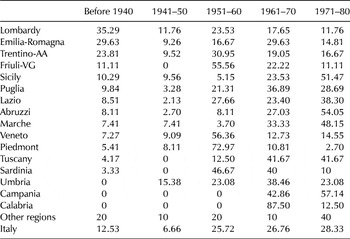
The expansion of co-operative wineries in Italy and Spain mostly took place after World War II, and especially in the 1950s and 1960s. In 1981 there were 961 co-operative wineries in Italy, of which only 12.53 percent had been created before 1940, and 6.66 percent in the period between 1941 and 1950. In the three decades that followed World War II, the sector grew at a rate of 25 percent per decade (Table 3). The entire Italian co-operative sector in general (for example, agricultural co-operatives, consumer co-operatives) underwent a similar process. Footnote 34 The promulgation of the Legge Basevi (Basevi Act) in 1947 and the role of co-operative associations were the key factors behind this process.
Geographical distribution of Italian co-operative wineries, by date of creation (%)

Source: Instituto Nazionale di Statistica, Annuario dell’agricoltura italiana.
In Spain, the Ley de Cooperación (the Law of Co-operation, in 1942) and public support played significant roles in the spread of co-operative wineries. In this case, however, co-operatives were under strict government (dictatorial) control. The period 1950 to 1965 saw the emergence of a large number of wine co-operatives. As early as 1953, they numbered 286 and had an aggregate production of just under three million hectoliters. Footnote 35 In 1964 the number of co-operative wineries soared to 600, and their share of domestic production climbed to 40 percent. According to Pan-Montojo, co-operatives brought industrialization to the Spanish wine sector. Footnote 36
From a regional point of view, the geographical distribution of co-operative wineries changed during the second half of the twentieth century. In Italy, new regions joined the phenomenon. Before 1940 the fastest-growing regions had been Lombardy, Emilia-Romagna (especially in Modena and Reggio Emilia), and Trentino-Alto Adige (Bolzano and Trento), and after the war each region saw an increase in the number of co-operatives (35.29 percent, 29.63 percent, and 28.81 percent, respectively). The limited number of co-operatives in the Italian south should be noted, for example, in Sicily or Sardinia. In later years, the co-operative movement was to grow dramatically, a process that was mirrored in Spain.
In Italy, expansion had halted immediately after the war, but it resumed between 1951 and 1960, especially in the regions just mentioned, as well as in other northern regions, for instance, Friuli Venezia-Giulia, Footnote 37 Veneto, and the Piedmont.
The number of co-operatives in central and southern regions, such as Puglia, Lazio, Sicily, and Sardinia, also grew. This trend was consolidated in the following decade, despite the slower growth rate in regions with more tradition of co-operativism. During this period the co-operative movement spread throughout Italy; and regions such as Abruzzi, Marche, Tuscany, Umbria, Campania, and Calabria (see Table 3) were incorporated.
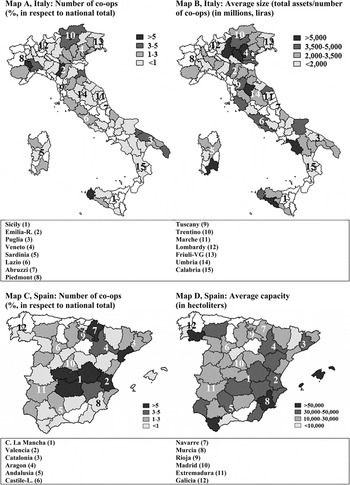
The general outcome of this historical process and the distribution of the co-operatives wineries by province at the beginning of the 1980s are shown in Figure 1. Map A clearly shows that the north of Italy remained the region with the most co-operative activity. The main difference with regard to the years that followed World War II is the greater level of implementation of this business model in the center and the south of the country.
Number of co-operative wineries and average size and capacity in Italy and Spain, by province, at the beginning of the 1980s. Source: Bollettino Ufficiale delle Societá per Azioni (Soc. Cooperative). Courtesy of Patrizia Battilani; Circular informativa no. 7/80 de la Junta Nacional de Cooperativas Vitivinícolas (Unión Nacional de Cooperativas del Campo). Authors’ own calculations.

Regarding the average size (total assets per co-operative) Map B indicates that co-operatives in the center and south, especially in Lazio, Sicily, and Sardinia, were particularly large, as were the co-operatives in some northern regions, for example, in Veneto.
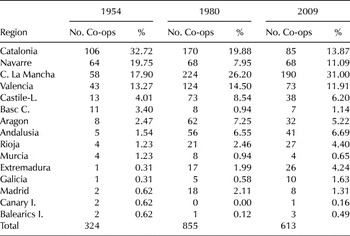
In Spain, a similar process took place. While there was no growth before the Spanish Civil War (1936 to 1939), by the end of the 1970s, the 855 existing co-operative wineries were producing more than 60 percent of Spanish wine (Table 4). The information offered by the Catastro Vitícola y Vinícola (the cadastre of vineyards and wine production), Footnote 38 which was organized by provinces and published in the late 1970s and the early 1980s, reveals the intense growth in wine sector co-operatives in several areas. Seven regions must be stressed in this regard. Three had some tradition of wine co-operativism (Catalonia, Valencia, and Navarre) but four were relatively new to this phenomenon (Castile-La Mancha, Aragon, Murcia, and Castile-Leon) (see Figure 1 [Map C] and Table 4). With respect to size, these new wineries in the emerging regions had the highest average capacity (see Map D).
Number of Spanish co-operatives and percentage of domestic total by region, (1954, 1980, 2009)

Source: La Semana Vitivinícola, 483–484, 1954; Circular informativa no. 7/80 de la Junta Nacional de Cooperativas Vitivinícolas (Unión Nacional de Cooperativas del Campo), 1980; Cooperativas Agroalimentarias, 2009.
Growth in Spain was particularly strong between 1945 and 1965; in the three regions with a previous tradition of co-operativism, new co-operatives were created, but at a slower rate than in the newly incorporated regions. This same tendency occurred in Italy. The fastest-growing region in Spain with regard to wine co-operativism throughout the Franco regime was Castile-La Mancha.
In 1954 there were 324 co-operative wineries in Spain, mainly in Catalonia (106), Navarre (64), Castile-La Mancha (58), and Valencia (43). By 1980 Castile-La Mancha had 224 (see Table 4). Thus, the relative importance of the region for the sector had grown substantially, from 17.90 percent to 26.2 percent of the total number of co-operative wineries. Conversely, pioneering regions, such as Catalonia, saw their relative importance diminish (from 32.72 percent to 19.88 percent in the same period). A similar case may be noted in Navarre. The relative importance of Valencia remained stable.
The Development of a “Productivist” Model
In the 1950s and 1960s, the number of members in Italian and Spanish co-operatives wineries grew and the firms increased in complexity, thus they entered Stage 3 of Cook’s model. In both countries, similar “productivist” and non-market-oriented business models were adopted, and co-operatives suffered from a number of problems that affected their performance. The main problem was the free-riding behavior of certain partners; the heterogeneous membership was focused more on the maximization of individual profits than on the general efficiency of the firm. This had a harmful effect on a firm’s heterogeneous social structure and created divergent goals and conflicts of interest. This issue is linked with the ideas of theorists such as Ward or Vanek, who analyzed the self-interested behavior or associated free-riding as a key to understanding the operation of inefficient co-operatives. Footnote 39 Each is also related with the horizon problem, because, from a lack of incentives, to increased capital for investment in technology, to research and development, to marketing, to advertisement, and to other intangible assets, members preferred maximum immediate returns. This explains why Spanish co-operative wineries were always undercapitalized and why the scale of their financial debt was much larger than that suffered by other firms in the wine sector. According to economic theory, funding is a major, intrinsic problem for the co-operative model, and the creation of external “support structures” is necessary to help their development. Risk aversion among partners, limited liability, poorly defined property rights, and the pursuit of profit maximization by individual members have been put forward in support of this thesis. Footnote 40
Other important factors were the portfolio problem, because opportunistic members showed a strong reluctance to assume high-risk undertakings; Footnote 41 and the control and influence cost problems, both of which were derivatives of the agency costs generated by the heterogeneity of the partners and their different interests. The main challenge for co-operatives was the adoption of an institutional design that discouraged selfish behaviors.
Most of the new wineries fell into Cook’s multifunctional regional co-operative type (Nourse II). They operated in regional markets and competed with capitalist wineries. These firms offered services to their members (especially the purchase of inputs and the collective use of agricultural machinery) and focused activities on the production and marketing of wine in the local and regional markets. Footnote 42
Spanish wine co-operatives managed to grow enormously in spite of these problems, due to favorable external conditions: the absence of a strong capitalist sector meant there was no obstacle to their dominance in the local markets; a good match existed between production and internal demand (especially favorable for commercialization in bulk); and protection afforded by the state in the form of grants, credit, and purchase of surplus product. Footnote 43 The key for the growth during these years was mainly state support and a favorable legislative framework.
In both countries, the process was led in part by emerging regions where few co-operative wineries had been before World War II. The creation of co-operative firms in these areas had strong institutional support, and one goal was to boost the industrialization of the wine sector. Footnote 44 In Italy, a third agent—co-operative associations—played a significant role in creating, developing, and structuring co-operative wineries.
Nevertheless, the roles played by co-operative associations in Italy and Spain differed greatly. In Spain, all support came from Franco’s dictatorial government, and co-operative wineries were integrated into a corporatist structure. This policy was to confront the drop in wine prices in the early 1950s. Franco’s regime imitated the politics that had been implemented by Italian fascism two decades earlier; the main goal was to control prices and production in a sector that suffered from endemic overproduction. At the same time, the majority of the winegrowers were integrated into a strong corporativist structure to prevent social conflict in rural areas.
The final outcome of the growing process in both countries was different, as demonstrated in the following sections.
The Time of Divergence (1970s–1980s)
Size and Structure
Before World War II and afterward, the wine co-operative sectors in Italy and Spain were similar in terms of numbers. However, there were differences in their eventual development.
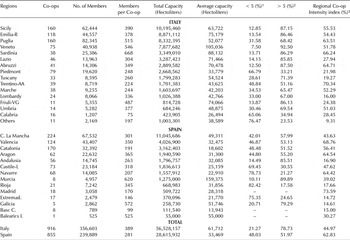
In the 1980s Italian wine co-operatives were considerably larger, with an average of 389 members per co-op, compared to 281 members in Spain (Table 5). The difference is even more significant in terms of capacity: Italian wine co-operatives’ production was almost double that of Spanish co-operatives, despite the fact that the number of co-operatives in both countries was similar. On average, Italian wineries were capable of producing 61,712 hectoliters of wine, compared to 33,469 hectoliters in Spain. In comparative terms, co-operatives wineries were regarded as major businesses in some Spanish regions; Footnote 45 however, their Italian counterparts dwarfed them.
Comparative analysis of Italian and Spanish co-operative wineries at the beginning of the 1980s, by region and total

Source: Instituto Nazionale di Statistica, Annuario dell’agricoltura italiana; Instituto Nacional de Denominaciones de Origen, Catastro Vitícola y Vinícola; Circular informativa no. 7/80 de la Junta Nacional de Cooperativas Vitivinícolas (Unión Nacional de Cooperativas del Campo); Estadística sobre cosechas de la Junta Nacional de Cooperativas Vitivinícolas (Unión Nacional de Cooperativas del Campo).
1 Percentage of total production controlled by co-operative wineries with capacity under five million hectoliters.
2 Percentage of total production controlled by co-operative wineries with capacity over five million hectoliters.
3 Percentage of the total regional production controlled by co-operatives.
In 1981, Italian co-operative wineries with capacity over five million hectoliters could produce up the 78.73 percent of the total capacity (approximately 44 million of hectoliters); in Spain, the percentage was 51.97 percent (11.3 million of hectoliters), which is indicative of greater fragmentation and atomization in the sector. This is despite the fact that Spanish co-operatives produced over 60 percent of all the wine being produced in the country; meanwhile, Italian co-operative wine made up only 45 percent of the internal market. A few significant Italian regions such as Sicily, Emilia-Romagna, Puglia, and Veneto can be compared in absolute terms, due to their large production capacity (between 8 and 10 million hectoliters), with the largest wine-producing region in the world in terms of vineyard size: Spain’s Castile-La Mancha. In relative terms, with regard to the percentage of regional production controlled by co-operative wineries, these regions go hand-in-hand with others, such as Trentino-Alto Adige, Abruzzi, and Sardinia. These variations also underline the limited degree of co-operative implementation in regions with the longest tradition of co-operativism because they were already close to saturation point; for example, Piedmont produced 21.98 percent of the productive capacity and Lombardy produced 16 percent of the region. This was due to the fact the co-operatives had a small size in these areas.
In short, while both countries’ wine sectors were of similar size in terms of the number of co-operatives—in relative terms, the Spanish co-operative wine industry was, in fact, larger—their capacities and structures were different in the 1980s. Italian wine co-operatives had a higher number of members and larger productive capacity. That is, the Italian co-operative sector was much more concentrated than in Spain, where business was much more atomized, a larger proportion of co-operatives were small or medium sized, and they only marketed their product at local or regional levels. Footnote 46
In the 1970s the Italian co-operative wineries embarked on a vertical–horizontal integration process. They specialized in producing low-quality products, but this process helped them grow in size and complexity in terms of their functional structure. This growth facilitated their access to more segmented demand, especially in international markets; this was helped by Italy’s membership in the European Economic Community (see the next section). After this process, a large proportion of the Italian wine co-operative sector, especially in the central and northern regions, entered Stages 4 and 5 of the Cook model. These co-operatives both consolidated their position in the national market and opened new avenues for international sales. In Spain, most co-operatives remained in Stage 3, and the opening up of international markets essentially occurred for capitalist firms. The key to understanding these differences lies in the different management and organization models adopted in each case and in the support structures that led the process in Italy, which were lacking in Spain.
Markets and Demand
The wine sector underwent significant transformation during the twentieth century, especially in terms of demand and consumption. Traditionally, the leading countries in terms of wine consumption and production were in southern Europe (France, Italy, Spain, and Portugal). Since the 1960s, however, wine consumption has fallen substantially worldwide in a constant and regular trend, especially in these countries, in response to social changes that also have had an effect on food consumption and lifestyle. At the same time, demand in non-producing countries has grown substantially. These new markets, mostly in central and northern Europe (e.g., the United Kingdom, the Netherlands, Scandinavian countries, Germany), demand medium- and high-quality wines. In the last few years, some developing countries, such as Russia, Brazil, and China, have also joined this trend, to form what has become a globalized wine market. Footnote 47
These new demand patterns have had a dramatic impact on supply. Wineries have had to adapt to these new circumstances to survive the shifting national and international market conditions, and this adaptation has sometimes involved deep and traumatic restructuring processes.
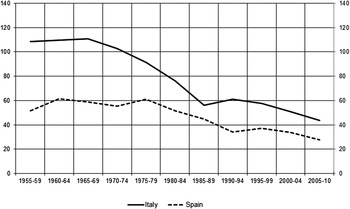
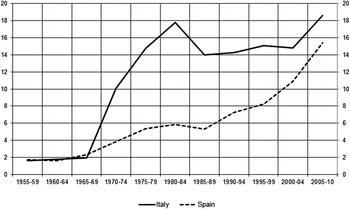
As noted, since the late 1960s in Italy, and a decade later in Spain, wine consumption has fallen sharply. In both cases, this has resulted in narrower markets and harder competition, which have been aggravated by a growth in production. In the 1960s, Italians drank over 110 liters of wine per capita every year, while Spaniards drank over 60 liters. In the last few years, per capita wine consumption is 43.6 liters and 27.8 liters, respectively; that is, less than half the average in the 1960s (see Figure 2). At the same time, production in these countries has grown through implementation of better technologies in the vineyards and wineries; one of the main effects of this has been an increase in yields per hectare. In order to solve the problem posed by overproduction, these firms started searching for new markets abroad. Footnote 48 Before the 1970s, in both Italy and Spain, less than 10 percent of the total product was exported, but this proportion has since grown; today, approximately half of Italian and Spanish wines produced are sold on the international market (Figure 3). Footnote 49
Evolution of wine consumption in Italy and Spain (liters per capita), 1955–2010, five-year averages. Source: Organisation for Economic Co-operation and Development, Food Consumption Statistics (1955–1984); International Organisation of Vine and Wine OIV Statistics (1985–2010).

Evolution of wine exports in Italy and Spain (in hundreds of thousands of tons), 1955–2010, five-year averages. Source: FAOSTAT database.

In Italy, exports grew rapidly while internal demand fell. This producer thus became the leading country in wine exports in terms of volume but not in terms of value, owing to France’s continuing leadership in the segment of premium products. The Spanish exports grew more slowly and later (see Figure 3). Both countries specialized in low- and mid-quality wines, unlike France, which specialized in high-quality products. Footnote 50 Italy was the main supplier to the major markets within the low- and mid-quality wine segment, especially to Germany and the United States. Access to the European markets was harder for Spanish wine producers, because the country did not belong to the European Economic Community (EEC), unlike Italy. For this reason, a significant proportion of the Spanish exports were sold at a low price in Africa and Eastern Europe. Footnote 51
Italian co-operative wineries adapted well to these new patterns. In 1967 they produced 9.5 million hectoliters (16.9 percent of the total national output), of which 86 percent was table wine and 14 percent was produced under an Appellation of Origin. In the early 1980s they produced around 20 million hectoliters, which was 45 percent of total production, but table wine had fallen to 60 percent due to the creation of the Indicazione Geografica Tipica (IGT), Footnote 52 a quality marker for low- and mid-quality wines. IGT co-operative wine is key to understanding the growth of Italian exports in the 1970s and 1980s. At that time, Italy specialized in the production of low- and mid-quality bottled wines at premium prices for international markets; this was especially true with the Lambrusco wines, which were at the time nicknamed “Italian Coke” because of their popularity. With this product and the support of intense marketing campaigns, the large co-operative groups of Emilia Romagna were a tremendous success in markets like the United States. Footnote 53 The co-operative groups of this region, in fact, produced 15 percent of the total co-operative output, a proportion that reached 26 percent with IGT wines. Half of the wine produced in this region was labeled IGT; nevertheless, the percentage of wine sold under Appellation of Origin barely grew in the same period. Co-operatives in other regions, such as Trentino-Alto Adige, developed another model under which they specialized in producing high-quality wines (57 percent of the product was labeled with Appellation of Origin), whereas in the south, lower-quality table wine was still the main product. Footnote 54 This explains why, even today, in terms of value, large co-operative groups such as GIV, Caviro, Cantine Riunite, CIV, Cavit, and Mezzacorona are responsible for half of the total exports of Italian wine (see Table 2). Footnote 55
Therefore, in Italy, co-operative wineries were adapted to new market patterns. This was not the case in Spain. The Spanish wine sector joined globalization at a later date, and exports grew significantly only after Spain became an EEC member in 1986. Since then, European markets—Great Britain, Portugal, France, Germany, Sweden, and Switzerland—as well as the United States and Russia have been the main destinations for Spanish wine exports, especially low- and mid-quality wines. Footnote 56
In 1975, twenty-nine wineries ranked among the 756 top-exporting Spanish firms in terms of volume. None of these were co-operatives. Ten years later the situation remained the same. None of the top fifty Spanish exporting firms in the drinks sector were co-operatives; this is shocking because fifty-six companies of the 1,666 top-exporting firms were wineries. Also in 1975, only twenty co-operatives ranked among the 223 top-selling Spanish wineries, and the first co-operative was fifty-sixth in sales. Footnote 57 In the early 2000s, 75 percent of co-operative produce still consisted of table wine sold in bulk, and only 17 percent of co-operative bottled wine was exported. Footnote 58 In conclusion, co-operatives in Spain did not lead to a growth in exports, as in Italy, and they had many more problems in adapting to the process of globalization.
Between the 1960s and the 2000s, the wine sector in both countries underwent an intense process of internationalization to confront the fall of sales in the domestic market. This process started in Spain ten years later than in Italy. Despite their similar contexts, Italian co-operative wineries integrated and concentrated more successfully and, therefore, adapted better to new demand patterns. The Spanish co-operative sector remained fragmented and focused on local and regional markets. In Spain, capitalist firms, not large co-operative groups as in Italy, led the internationalization process. Institutions, management, and organization models had much to do with this divergent evolution.
Management and Organization Models
During the expansion of wine co-operatives in the 1950s and 1960s, similar business models occurred in Italy and in Spain, with the emergence of “productivist” wineries; these were primarily concerned with processing the grapes provided by their members, not with being market-oriented.
This situation continued until the economic crisis and changes in consumer preferences hit the sector in the mid-1970s and 1980s. Spanish wine co-operatives had to borrow heavily to confront the new situation with improved technology and to adapt to new market conditions in the face of the decreasing domestic consumption: producing a bottled, higher-quality, and diversified product with more added value and greater appeal to the international markets. Footnote 59
During the early years of the second half of the twentieth century, Italian co-operatives encountered similar problems. In both countries, co-operative wineries were at Stage 3 of the Cook model. Moreover, they also had to compete with capitalist firms that did not take too kindly to the presence of co-operative wineries, which controlled an important share of the raw materials and production, especially in regions such as Emilia-Romagna. Footnote 60
The key to understanding the subsequent and divergent evolutions of Italian and Spanish wine co-operatives in the 1970s and 1980s is to acknowledge the different “external support structures” that drove the restructuring process, which firms undertook to respond to changes in market trends. The expansion of Spain’s co-operative business model from 1945 to 1965 was encouraged by the dictatorial regime, in a standardized, corporatist, and guided process. The targets were production and price control in a sector that was heavily burdened by overproduction, and the integration of the rural sector into the regime’s economic structure to avoid social unrest. Spanish co-operatives did not emerge spontaneously, and they were not adapted to their local contexts in response to rational optimization criteria. The Spanish co-operative businesses were subject to governmental decisions, and they lacked a well-defined ideological foundation and an autonomous organizational culture. This lack of independence resulted in a deficient institutional design and recurrent free-riding behaviors among members. Spanish co-operatives grew with public institutional and financial support but were deficient in adapting to changes in demand trends. The sector was fragmented and competed poorly in the growing international markets. Footnote 61
In the 1940s the Spanish regime basically copied the institutional design implemented by fascist Italy twenty years earlier. Footnote 62 During the second half of the twentieth century, however, Italian co-operatives were less dependent on state structures than were Spanish co-operatives. In Italy, a now-democratic country, the main external support structures were strong local, provincial, regional, and national co-operative associations, which channeled the restructuring process of the sector and helped to promote close co-operation with the networks of Italian consumer co-operatives.
Italian co-operatives, with much less state support, had to adopt formulas that would lead them to become the largest wine companies in the country. They not only dominated the local and the regional markets, but also the national and international markets. The Italian government financially assisted the co-operative movement, Footnote 63 and did not subject it to the suffocating corporatism previously imposed by the fascist regime.
We must address the voluntary integration of these wineries into two major umbrella organizations, the Lega Nazionale delle Cooperative Italiane (Legacoop, created in 1886 and left-leaning) and the Catholic-oriented Confederazione delle Cooperative Italiane (Confcooperative, founded in 1919). In Spain, similar umbrella organizations had existed prior to the civil war, but they were later eliminated by Franco’s regime, which integrated the entire co-operative sector into a single corporate structure. Italian co-operatives were incorporated into a general associative movement with strong ideological undertones. This movement adopted business strategies that made co-operative wineries much more competitive.
Several authors Footnote 64 have shown that these umbrella organizations outlined the general strategies the associated co-operatives were to follow, especially with regard to the adoption of modern management strategies, the professionalization of management structures, and the merging of co-operatives to create large corporate entities or consortia that had better access to markets and increased competitiveness. Footnote 65
To a great degree, Italian wineries followed the general trend set by the wider co-operative sector. Umbrella organizations led the restructuring and concentration of the Italian co-operative sector and directed processes of horizontal and vertical integration at provincial, regional, and national levels. Institutions such as the ANCA Footnote 66 or AICA, Footnote 67 both of which were created by Legacoop in 1947, were designed as support structures and offered a range of services to its members in areas such as technical and administrative assistance, the purchase of consumables, and transportation and transformation processes. Footnote 68
These umbrella institutions also created credit agencies to offer financial support in addition to that already granted by the state and the European Economic Community. Fornasari and Zamagni Footnote 69 claim that the state lacked the means to cover all the capital needs of Italian co-operatives. Fincooper, created by Legacoop in 1969, assisted member co-operatives from a financial point of view, promoted some projects for the sector, and supplemented the role of the government. Footnote 70 The existence of regional co-operative banks, for example the Banca Cooperativa dell’Emilia-Romagna, or Cooperbanca (Co-Operative Bank of Emilia Romagna), also contributed to the development of these sectors. Footnote 71 This is what Menzani and Zamagni, Footnote 72 in their analysis of the success of the Italian model, referred to as financial networks.
The strongly ideological nature of these umbrella organizations must be kept in mind. The Socialist Legacoop and the Catholic Confcooperative transmitted their ideological principles to their members. One of the main problems faced by Spanish wine co-operatives was their members’ lack of commitment: they sought to maximize their individual benefit regardless of the overall situation of the firm. This was the result of the creation of co-operatives with no ideological foundations, promoted by the state and subject to strong, state-imposed, corporatist conditions. In Italy co-operatives arose spontaneously and were guided by the principles of solidarity, mutuality and participatory democracy; members were strongly aware of the co-operative spirit and avoided indulging in opportunistic behavior. Footnote 73
When talking about Italian wine co-operatives, we speak of “organizational isomorphism,” Footnote 74 which was not achieved through coercion, like in Spain, but through the application of mimetic and normative practices: the imitation of a successful model in a favorable environment and the existence of professional associations to assist and guide the behavior of the sector. Italy’s co-operatives experienced a “sistema cooperativo di organizzazioni volontariamente federate” (co-operative system of organizations voluntarily federated), Footnote 75 while Spain’s co-operatives were forcefully integrated into Franco’s regime’s corporate system.
Menzani and Zamagni Footnote 76 reinforce this idea in their study of Italian co-operative networks over the last thirty years. Co-operatives make extensive use of these networks, which can be horizontal, vertical (a collaboration between production and consumption-oriented entities), complementary (services, infrastructure, other activities), financial, or a “networks of networks.” Footnote 77 Umbrella organizations fall within the last category and have assisted in the creation of large consortia, which has led to a concentration in production, attainment of competitive advantages, and modernization of management methods, thus significantly contributing to the success of Italian co-operatives.
Italy’s associated co-operatives created large business consortia (second- and third-degree co-operatives, the so-called consorzi di cooperative in Italian) to dominate national markets and gain significant footholds in the international scene; but the Spanish state favored the creation of small local co-operatives to control production in a sector in a permanent state of crisis due to falling or stagnating prices. State structures did not promote the professionalization of co-operatives or their merging as a way to improve marketing strategies and did not adopt modern business strategies; in the 1980s this forced a traumatic need for co-operatives to restructure themselves.
Another differentiating factor closely related to the existence of the Italian associations was the collaboration between wineries and consumer co-operatives. Footnote 78 This collaboration resulted in the emergence of networks that facilitated more efficient distribution and better access to marketing. Spanish co-operatives faced difficulties in distributing their product at a national level because of the structural shortcomings of the system; but this was overcome in Italy, which faced similar problems, through close collaboration between consumer co-operatives and umbrella organizations. Footnote 79 These agreements even had an international scope, as reflected in the deal struck by Sodecoop (the Parisian network of consumer co-operatives) and Legacoop: the former agreed to include the products of the latter in its distribution system, including a number of wine co-operatives such as CIS (Brindisi, Puglia), Civ & Civ, Cantine Riunite, and Cantine Sociali di Ronco (Forlì, Emilia-Romagna). Footnote 80
These associations created effective distribution systems that allowed Italian cantine sociali (co-operative wineries) to distribute their products at competitive prices and under favorable conditions throughout the country. In Spain, consumer associations never had the same scope, so it was always much harder for Spanish wine co-operatives to reach national markets. To do so, they had to create their own distribution system, which was virtually impossible, or had to access the market through conventional distribution channels, thus incurring high costs. Both the Italian wine co-operatives and umbrella organizations agreed on the desirability of gaining a foothold in international markets, and applied new marketing and sales strategies, for example, by making use of supermarkets. Footnote 81 This is the formula that some consumer co-operatives, especially the Coop, Footnote 82 were beginning to implement in Italy. Footnote 83
The work of Legacoop was instrumental in the creation of bottling consortia for the integration of wine co-operatives at the regional and local levels. This is paradigmatic of the process of vertical integration undergone by the Italian wine sector in the 1960s and 1970s (e.g., Cantine Riunite, Civ & Civ, Cevico, among others). In the following decades, this entity promoted the integration of these consortia at the national level (third degree) (e.g., Gruppo Coltiva, Gruppo Italiano Vini), and the creation of firms engaged in other industrial processes such as distillation (e.g., Distercoop). Simultaneously, agreements were struck with consumer co-operatives for the distribution of the products, which completed the process of vertical integration of the co-operative wine sector in the region of Emilia-Romagna.
All these differences are reflected in financial data, such as the debt and profitability ratios (Table 6). The row “Total Debt to Equity Ratio” reflects the financial debt faced by the wineries; the row “Return on Assets” (ROA) establishes the relationship between the productivity of assets and returns, and the row “Return on Equity” (ROE) illustrates the efficiency of shareholders’ equity.
Debt and profitability ratios* in Italian and Spanish co-operative wineries in the late 1970s and the early 1980s

Source: AGA, (14) 001.004, Balances de cooperativas; Bollettino Ufficiale delle Societá per Azioni (Soc. Cooperative). The data for Italian wineries provided by Patrizia Battilani. Authors’ own calculations.
1 Total liabilities/shareholders’ equity.
2 Net income/average total assets.
3 Net income/average shareholder’s equity.
* Data collected from the balance sheets of 109 co-operative wineries for the year 1981.
** Data collected from the balance sheets of 75 co-operative wineries for the early 1970s.
Recent research has shown that one of the main problems for Spanish co-operative wineries was their high degree of financial dependence, especially on public loans, during Franco’s regime. Footnote 84 Table 6 illustrates that debt was high in both Italy and Spain, and that it was actually higher in Italy than in Spain. However, Spain’s debt was not efficiently invested; ROE and ROA were higher in Italian wineries. This shows that Italian investments in fixed assets resulted in higher profitability. In the 1970s, large and second- and third-degree consortia were created in Italy, resulting in the construction of large bottling factories for the supply of foreign markets. Investments were made in new technologies and larger conglomerates were formed, which led to economies of scale and competitive advantages to compete with the capitalist sector. In addition, Italy’s organizational and management models were more coherent and rational than Spain’s.
In short, in the 1970s Italian co-operative wineries entered Stages 4 and 5 of Cook’s model, and adapted to demand and access international markets. They chose to respond to environmental conditions by merging with other co-operatives, forming large consortia and hybridizing their management models (Sapiro III). In contrast, Spanish co-operatives remained at Stage 3 because of the limitations posed by the dictatorial regime; only in a few cases did debates about future developments occur. The implications of this are reviewed in the following section.
Results: Spanish and Italian Wine Co-operatives in the Last Years
The circumstances described above allowed Italian co-operatives to reach a level of modernization that Spanish co-operatives have not reached even today; the Spanish structure of the sector remains severely atomized. According to the theory of the co-operative business life cycle, Italian co-operative consortia are at Stage 5 of Cook’s model (with a Sapiro III structure). Footnote 85 They are consolidated value-added marketing companies, well streamlined from organizational, divisional structure, and professional management points of view, and they have diversified product lines and multiple markets and distribution channels. This has removed the problems that appeared in Stage 3, especially the free-riding behaviors, although some basic essential features of the co-operative firms have been lost (hybridization).
The majority of Spanish co-operatives are now at Stage 4, according to the aforementioned information. Their production and marketing strategies were not adapted to face new market difficulties (they still have a single product line, limited market, single distribution channel, and little vertically integrated production). From an organizational point of view, their structure is still basic; very few Spanish co-operative entities have entered Stage 5 (with a Sapiro III structure).
Those co-operatives at Stage 4 have chosen to maintain traditional structures with only moderate changes. These co-operatives can cater to a more segmented market, due to diversification of distribution channels and a higher degree of vertical integration (bottling lines), and their organization is more complex and market-oriented. Those few co-operatives at Stage 5 of their business life cycle have had little relative success (e.g., Baco, Cevipe, Bocopa, Viñaoliva; see Table 2).
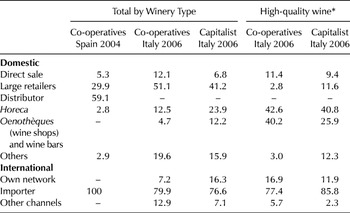
In comparison, the distribution channels used by Italian wine co-operatives are much more advanced and diversified (Table 7). While Spanish co-operatives use distributors as the main channel for commercialization of their product, Italian co-operatives sell a higher percentage of their product through direct sales, Horeca, Footnote 86 oenothèques (wine shops), and wine bars. Italian wineries depend more heavily on mass distribution channels.
Distribution channels used by major Spanish and Italian wineries, 2004 and 2006 (%)

Source: Based on Confederación de Cooperativas Agrarias de España, Estudio sobre la comercialización agroalimentaria, 85–86; Ufficio Studi Mediobanca, Indagine sul settore vinicolo.
* Retail price of 25 euro or more per bottle.
If analysis is applied to foreign markets, the trend observed is similar. While Spanish co-operatives fully rely on import brokers, Italian co-operatives distribute up to 7.2 percent of their external sales through their own networks; this indicates the more advanced state of their distribution system. However, if compared with Italian capitalist wineries, the results for the Italian co-operatives are poorer; their dependence on mass distribution channels in the domestic market and on import brokers in the international markets is more acute. Their results are also poorer with regard to direct sales, Horeca, and their own external network. However, for high-quality wines (those with a retail price of 25 euro or more per bottle), Italian wine co-operatives exhibit better results than capitalist firms, with higher percentages of direct sales, Horeca, and wine bars, and in terms of operation of their own external networks.
Ownership and management of Italian co-operative wineries are kept separate, but the principle of “solidarity” still operates. Mutuality is no longer maintained between partners, but is between management bodies; this prevents the emergence of conflicts of interest and agency costs, to which large businesses may be exposed. According to Mintzberg, Footnote 87 their solid organizational culture is based on strong ideological commitment. In contrast, most Spanish wineries are challenged by Stage 4, and some, particularly in regions such as Castile-La Mancha, are still at Stage 3.
In Italy, the co-operative system has been a model of success. Footnote 88 However, Spanish wine co-operatives were not inefficient because they were co-operatives but because they were integrated into a corporate system that did not know how to manage the potential of a sector that controlled the majority of the wine production and most of the winegrowers in the country. The Franco state promoted them and provided financial aid but could not guide them when they needed to transform and adapt to the new challenges faced by the sector.
Conclusions
When the theory of the co-operative business life cycle is applied, as in the model set forth by Cook, most of the Italian wine co-operative sector is currently in Stage 5, the most advanced stage. This involves a level of modernization that the Spanish sector has not yet arrived. Italian co-operatives are solid, soundly organized companies based on a well-constructed, divisional structure and with professional management, diversified product lines, multiple markets, and distribution channels, among other things.
The main target of this article was to examine the probable causes of the different situations in which Italian and Spanish wine co-operatives find themselves today, despite the fact that their starting point, up to World War II, was similar. To achieve this aim, we carried out a comparative analysis to shed light on the matter.
We have shown that Spanish and Italian co-operative wineries had a similar historical development during the first half of the twentieth century. In both cases, and prior to World War II, co-operativism was weak in comparison with France. There were sharp regional differences, and associations often had opposing ideological bents (socialist or Catholic). The co-operatives were forcefully inserted into the corporatist apparatus of totalitarian regimes, which gave them some momentum in the short-term but left them subjected to tight controls. Finally, co-operatives in both countries developed considerably after World War II.
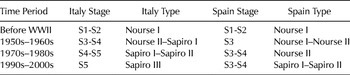
Both sectors took very different paths (Table 8). Wine co-operatives developed strongly in Italy. In Spain, however, the constant crises, which affected the sector, drove many growers to join forces in order to call for specific legislation and financial assistance from the state. Newly established wineries had similar characteristics in both countries, and their initial orientation was mostly productivist. However, there were also differences between the two. For example, in Italy, state protection was less significant. This forced the sector to become more competitive, to create strong partnerships, and to establish links of co-operation with networks of consumer co-operatives. Italy’s earlier membership into the EEC is another factor to consider.
Chronological evolution of Italian and Spanish co-operative wineries according to Cook’s model

Source: Based on Cook, “The Future of U.S. Agricultural Cooperatives.”
In Italy, co-operative associations had a strong ideological basis, which prevented opportunistic behavior among members. These associations planned development strategies and led the processes of concentrating and restructuring the sector. The creation of second- and third-degree co-operatives, the so-called consorzi di cooperative, encouraged the application of modern and professional management strategies and sound divisional structures.
In contrast, Spanish wine co-operatives were integrated into a corporate system that was part of a dictatorial government, and this regime failed to manage the potential of a sector that controlled the majority of the wine production and winegrowers in the country. Co-operatives did not arise spontaneously, but responded to the impetus given by the state, which determined their normative organizational structure. The operation did not respond to rational criteria for the optimization of resources, and the organizational culture lacked a clear ideological basis. The state promoted the Spanish wine co-operatives and provided financial aid, but it also framed them as corporations, which made them lose their autonomy. This did not facilitate the operation of the companies, and free-riding behavior ensued. Many members joined only to maximize their private benefits, regardless of the general interests of society. Furthermore, the Spanish state that encouraged their creation did not help in the 1970s when they needed to restructure to face challenges caused by the changes in national and international markets.