Implications
The study provides critical support for an effect of luminal thymol on oxyntic and gastric mucosa, inducing intense proliferative activity and expression of several genes involved in the control of digestive activity. In the present research, thymol was administered intragastrically, but similar effects might occur if thymol is provided in the feed to weaned pigs, helping them to rapidly stimulate the maturation and the functional activity of the stomach. The results also provide evidence that thymol gastric detection affects genes involved in the control of cellular storage of calcium (and other ions).
Introduction
The interest for the use of herbs and spices, and of their natural extracts, in the animal feeding is prevalently related to their potential nutraceutical properties. However, the chemical composition of these products is in general quite variable, and thus research is often oriented to the study of some of their dominant and interesting chemical components. Thymol, the principal constituent of thyme-extract oil, is a phenolic compound with antimicrobial activity. Thymol has been proposed as an animal feed supplement to positively influence gut microbiota and consequently improve animal health and growth (Lallès et al., Reference Lallès, Bosi, Janczyk, Koopmans and Torrallardona2009; Khan et al., Reference Khan, Naz, Nikousefat, Tufarelli and Laudadio2012). Research has suggested that thymol rapidly enters the bloodstream after it is ingested (Kohlert et al., Reference Kohlert, Schindler, März, Abel, Brinkhaus, Derendorf, Gräfe and Veit2002), and in pigs it is absorbed in the stomach (Michiels et al., Reference Michiels, Missotten, Dierick, Fremaut, Maene and De Smet2008). Thus, after the mouth, the gastric mucosa could be an important site of thymol action. The toxicological effects of thymol have been studied, and in general, thymol is considered safe (US Environmental Protection Agency, 2009). Nevertheless, when considering an oral supplement, potential luminal effects should be considered. Thymol has a strong odor and taste, suggesting that it can interact with the mucosae with possible local stimulatory effects. In an Ussing chamber system, anion secretion has been detected in human and rat colonic epithelia after luminal thymol applications (Kaji et al., Reference Kaji, Karaki and Kuwahara2011), potentially mediated by the sensing of thymol by olfactory receptors or transient receptor potential (TRP) channels (Kaji et al., Reference Kaji, Karaki and Kuwahara2011).
The oxyntic mucosa of the stomach has several important functions, including pH control, hydrochloric acid and endocrine secretion, intrinsic factor for vitamin B12 absorption and growth factor production (Goebel et al., Reference Goebel, Stengel, Lambrecht and Sachs2011). However, additional activities are emerging, some of which appear to involve other functional districts of the porcine stomach, such as the pyloric mucosa, including taste-sensing (Colombo et al., Reference Colombo, Trevisi, Gandolfi and Bosi2012), translation of chemosensory signals (Mazzoni et al., Reference Mazzoni, De Giorgio, Latorre, Vallorani, Bosi, Trevisi, Barbara, Stanghellini, Corinaldesi, Forni, Faussone-Pellegrini, Sternini and Clavenzani2013) and activation of the mucosa-associated lymphoid tissue (Mazzoni et al., Reference Mazzoni, Bosi, De Sordi and Giovanna Lalatta-Costerbosa2011).
Thus, we aimed to determine the effect of intragastric thymol on the differential gene expression in the oxyntic and pyloric mucosae of young pigs.
Material and methods
Animals and treatment
The procedures performed on the pigs were carried out in compliance with Italian laws regarding experimental animals and were approved by the Ethic-Scientific Committee for Experiments on Animals of the University of Bologna. Eight crossbred (Large White×Landrace) male weaned pigs (6 weeks of age and mean BW of 11.3 kg), previously individually caged and fed ad libitum a post-weaning standard diet, were randomly assigned to the thymol treatment (TH) or control (CO) group (four pigs per treatment). The pigs were healthy and were not littermates. Natural identical free thymol was a kind gift from A.W.P. s.r.l. (Reggio Emilia, Italy).
After the morning meal (restricted to 5 g/kg BW to allow a full and rapid intake), the pigs received 50 mg/kg BW of thymol or a placebo in 5 ml of sterile physiological saline, introduced directly into the stomach through intragastric gavage by medical catheter. We adopted this protocol to standardize the treatment for each pig and avoid the risk that some thymol was not consumed because of its pungent taste. A single dose of thymol was used to study the acute effects of thymol on the stomach.
Sample collection
About 12 h after the thymol administration, the pigs were slaughtered by an intracardiac injection (Tanax, 0.5 ml/kg BW; Intervet Italia, Peschiera Borromeo, Italy), after being anesthetized with sodium thiopental (10 mg/kg BW). The stomach was removed from each pig, opened along the greater curvature and washed in ice-cold phosphate buffered saline. Tissue samples from the oxyntic gland area close to the greater curvature and pyloric mucosa were collected, immediately frozen in liquid nitrogen and stored at −80 °C until further use.
RNA isolation, microarray processing and quality control
Total mRNA was isolated from the oxyntic and pyloric mucosa collected from each subject using a Qiagen RNeasy® Midi Kit, according to the manufacturer’s instructions (Qiagen, Hilden, Germany). The purity and integrity of the RNA was assessed just before the analysis using an Agilent Bioanalyzer 2100 (Agilent Technologies Inc., Santa Clara, CA, USA). The total mRNA was hybridized on Affymetrix© Porcine Gene 1.1 ST array strips, and the hybridized arrays were scanned using a GeneAtlas imaging station (Affymetrix, Santa Clara, CA, USA). The performance quality tests of the arrays including the labeling, hybridization, scanning and background signals by a Robust Multichip Analysis were conducted on the CEL files using an Affymetrix Expression ConsoleTM (Affymetrix).
Pathway analysis
The Affymetrix Transcript IDs, which were typically characterized by several exonic sequences, were associated with 13 406 human gene names from the Sus scrofa Ensemble database (release 69, www.ensembl.org). For processed gene-expression values, an exploratory functional analysis was performed using Gene Set Enrichment Analysis and the C5.BP catalog of gene sets (based on Gene Ontology) from the Molecular Signatures Database v3.1 (http://www.broadinstitute.org/gsea/msigdb/Index.jsp) to compare the expression in the TH and CO pigs. The normalized enrichment score (NES) was calculated for each gene set, and statistical significance was defined when the false discovery rate % was <25 and P-value of NES was <0.05. The enrichment score P-values were estimated using a gene set-based permutation test procedure.
Results
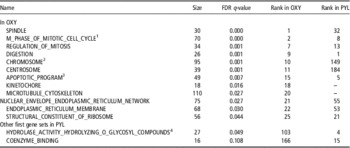
In the TH group, 72 gene sets were significantly enriched in the oxyntic mucosa and 19 sets were enriched in the pyloric mucosa compared with the control pigs (Table 1). In the oxyntic mucosa, several gene sets involved in mitosis and its regulation were among the most enriched genes. The most enriched gene set not involved in cell cycle regulation was DIGESTION. The gene encoding pancreatic lipase-related protein 2 (PNLIPRP2 – galactolipase) ranked first in the list of genes enriched in the oxyntic mucosa of the TH pigs.
First gene sets enriched in oxyntic (OXY) and pyloric (PYL) mucosa from thymol-treated pigs compared with the controls

FDR=false discovery rate.
1 MITOSIS, MITOTIC_CELL_CYCLE, M_PHASE, CELL_CYCLE_PROCESS, CELL_CYCLE_CHECKPOINT, CELL_CYCLE_PHASE and MITOTIC_CELL_CYCLE_CHECKPOINT were also significantly enriched.
2 CHROMOSOMEPERICENTRIC_REGION, CHROMOSOME_SEGREGATION and CHROMOSOMAL_PART were also significantly enriched.
3 CELLULAR_COMPONENT_DISASSEMBLY and CELL_STRUCTURE_ DISASSEMBLY_DURING_APOPTOSIS were also significantly enriched.
4 SERINE_HYDROLASE_ACTIVITY, SERINE_TYPE_ENDOPEPTIDASE_ACTIVITY and SERINE_TYPE_PEPTIDASE_ACTIVITY were also significantly enriched.
In the pyloric mucosa of the TH pigs, DIGESTION was the most enriched gene set, followed by gene sets related to serine hydrolase activity and cellular turnover. The aldo-keto reductase family 1, member C-like 1 (AKR1CL1) ranked first in the complete list of genes upregulated by TH.
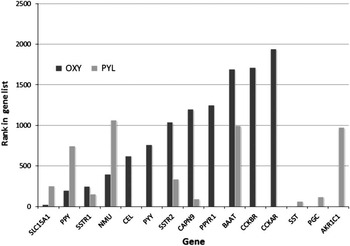
The ranking of TH-upregulated genes in the DIGESTION gene set in oxyntic and pylori mucosae is summarized in Figure 1. Peptide transporter 1 (SLC15A1), somatostatin (SST) (only in pyloric), gastricsin, also known as pepsinogen C (only in pyloric), pancreatic polypeptide, somatostatin receptors (SSTR1, SSTR2) and calpain 9 (a calpain specific for gastrointestinal tract) were the most upregulated genes.
Rank of core-enriched genes in the DIGESTION gene set, as well as the whole gene set in the oxyntic (OXY) and pyloric (PYL) mucosa of pigs intragastrically inoculated with thymol compared with controls.

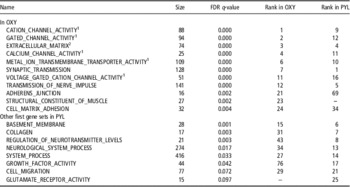
Thymol reduced the enrichment in 120 and 59 gene sets in oxyntic and pyloric mucosa, respectively (Table 2). In the oxyntic mucosa from TH, several gene sets related to ion transport channels and aqueous pores across membranes were less enriched compared with controls. In CATION_CHANNEL_ACTIVITY and GATED_CHANNEL_ACTIVITY gene sets, the first downregulated genes were short transient receptor potential channels (TRPCs) 4 and 5, ryanodine receptors (RYRs) 2 and 3, and some voltage-dependent calcium channel (CACN) genes. Other core-enriched genes in these sets in the CO pigs were potassium voltage-gated channel members (KCNA) 1 and 2 and some large-conductance calcium-activated potassium channel (KCN) genes.
First gene sets enriched in oxyntic (OXY) and pyloric (PYL) mucosa from control pigs compared with thymol-treated pigs

FDR=false discovery rate.
1 METAL_ION_TRANSPORT, CALCIUM_ION_TRANSPORT, VOLTAGE_GATED_ CHANNEL_ACTIVITY, CATION_TRANSPORT, ION_CHANNEL_ACTIVITY, DI_TRI_VALENT_INORGANIC_CATION_TRANSPORT, LIGAND_GATED_CHANNEL_ACTIVITY, CATION_TRANSMEMBRANE_TRANSPORTER_ ACTIVITY and ION_TRANSPORT were also significantly enriched.
2 PROTEINACEOUS_EXTRACELLULAR_MATRIX, EXTRACELLULAR_MATRIX_PART, BASEMENT_MEMBRANE and EXTRACELLULAR_STRUCTURE_ORGANIZATION_AND_BIOGENESIS were also significantly enriched.
The SYNAPTIC TRASMISSION gene set was the most enriched set in the pyloric mucosa of CO pigs. Of the whole gene data set, 5-hydroxytryptamine receptor 2A (HTR2A) ranked first of the enriched genes in the pylorus mucosa of the CO pigs compared with the TH pigs. However, the comparative expression observed for this gene was low (roughly <75% of the whole gene data set; data not in table).
Discussion
Here, we identify for the first time the molecular signaling pathways regulated by the direct contact of thymol with the oxyntic and pyloric mucosa of young pigs. First, we provide strong evidence that thymol activates genes involved in mitosis and mitosis regulation. Although no previous study has reported direct evidence regarding the effect of thymol on mitosis, thymol has been shown to reduce gamma radiation-induced apoptosis in V79 cells (Archana et al., Reference Archana, Nageshwar Rao and Satish Rao2011), primarily by the modulation of intracellular antioxidant levels and free radical scavenging. It is also likely that carvacrol, another monoterpenic phenol structurally similar to thymol, stimulates mitosis and liver tissue regeneration after partial hepatectomy (Uyanoglu et al., Reference Uyanoglu, Canbek, Aral and Husnu Can Baser2008).
The differential effect of thymol-induced genes involved in the digestive function of the stomach has been shown previously. Among the genes included in the DIGESTION set, SLC15A1 was the most upregulated gene in TH pigs. This gene encodes a small, selective oligopeptide transporter that is widespread in the gut and stimulated by fasting, drugs, hormones and circadian rhythm (Shimakura et al., Reference Shimakura, Terada, Saito, Katsura and Inui2006a). We inspected the possible parallel activation of peroxisome proliferator-activated receptor α and caudal-type homeobox 2, two transcription factors that specifically affect SLC15A1 gene expression (Shimakura et al., Reference Shimakura, Terada, Saito, Katsura and Inui2006a and Reference Shimakura, Terada, Shimada, Katsura and Inui2006b); however, these genes were not differentially expressed in response to thymol in the pig mucosa.
Pathogenic bacteria (Nguyen et al., Reference Nguyen, Dalmasso, Powell, Yan, Bhatt, Kalman, Sitaraman and Merlin2009) and lipopolysaccharides (Shu et al., Reference Shu, Takeda, Shinzawa, Takahashi and Kawata2002), the major components of the outer layer of Gram-negative bacteria, can also affect the expression of SLC15A1, which can transport bacterial peptides. Our trial was not designed to assess the impact of thymol on gastrointestinal microbiota because its antibacterial properties are well known, and thus we cannot speculate here on possible variations on the gastric bacteria profile. Nevertheless, it is worth mentioning that transgenic mice overexpressing SLC15A1 and infected with Citrobacter rodentium had reduced colonic colonization by this microbe, compared with that observed in infected wild-type mice (Nguyen et al., Reference Nguyen, Dalmasso, Powell, Yan, Bhatt, Kalman, Sitaraman and Merlin2009). Intriguingly, in a previous in vivo trial, we found that Citrobacter freundii, a microbe closely related to C. rodentium, was increased in the intestinal content of pigs fed thymol compared with that observed in control pigs (Jankzyk et al., Reference Janczyk, Trevisi, Souffrant and Bosi2008). Finally, the activation of SLC15A1 could be relevant for porcine ingestive behavior because it can elicit the release of cholecystokinin from enteroendocrine cells and inhibit gastric motility via vagal afferent activation (Darcel et al., Reference Darcel, Liou, Tome and Raybould2005).
The gastric lipase (PNLIPRP2) gene was also overexpressed in pigs inoculated with thymol. In humans, the encoded protein can hydrolyze up to 17.5% of dietary triglycerides (Carrière et al., Reference Carrière, Barrowman, Verger and Laugier1993). A preduodenal lipase has also been identified in pigs (Bauer et al., Reference Bauer, Jakob and Mosenthin2005). PNLIPRP2 is important for newborn and milk-fed mammals (Andersson et al., Reference Andersson, Hernell, Bläckberg, Fält and Lindquist2011). Furthermore, recently, carvacrol has been shown to inhibit murin lipase (Yamada et al., Reference Yamada, Murata, Kobayashi, Miyase and Yoshizaki2010). Thus, it can be hypothesized that thymol can also increase PNLIPRP2 expression.
As shown in this study, the genes SST and CAPN9 are only overexpressed in the pylorus in response to thymol. Both of these genes are activated by the peroxisome proliferator-activated receptor γ; however, the peroxisome proliferator-activated receptor γ gene was not differentially expressed in the pylorus in response to thymol treatment in our study. Interestingly, it has been demonstrated that both SST and CAPN9 are downregulated in human gastric cancer in two different populations (Junnila et al., Reference Junnila, Kokkola, Mizuguchi, Hirata, Karjalainen‐Lindsberg, Puolakkainen and Monni2010).
Thymol has a pungent odor and induces a warm thermal sensation when it comes in contact with the tongue. The diffuse presence of various sensors related to taste, olfactory and thermal sensation along the digestive tract may explain the activation of some of these genes by thymol. Research has shown that several different mechanisms can be involved, but in general, they are related to sensory detection and/or implicate cation regulation by direct or indirect mechanisms.
Ion fluxes along the cell membrane are gated by pore-forming proteins (channels). Among these proteins, receptors belonging to the cation channels in the TRP family also act as cellular sensors. In cell cultures, thymol activates the thermal/irritant-responsive TRPA1 (Lee et al., 2008; Kaji et al., Reference Kaji, Karaki and Kuwahara2011), the warmth-sensing TRPV3 (Xu et al., 2006) and the cold-sensing TRPM8 (Ortar et al., Reference Ortar, Morera, Moriello, Morera, Nalli, Marzo and Petrocellis2012). Activation of TRPA1 by luminal stimuli induces anion secretion in colon enterocytes (Kaji et al., Reference Kaji, Yasuoka, Karaki and Kuwahara2012). Thymol also induces anion secretion from porcine jejunal epithelium in the Ussing chambers (Boudry and Perrier, Reference Boudry and Perrier2008). Although TRPA1 was not included in the gene sets related to channel activity included in our enrichment analysis, it ranked 1072nd and 128th in the list of genes upregulated in the oxyntic and pyloric mucosa, respectively, after thymol inoculation. Thus, our data regarding TRPA1 expression in the porcine stomach are consistent with the effect of thymol on TRPA1 expression previously observed in human and rat colon cells as well as kidney cell cultures. Conversely, TRPV3 and TRPM8 gene expression was not affected by thymol in our study, presumably because in the pig stomach, its value was in general very low; this is in contrast with the effect observed in other species and tissues.
It has been shown that thymol triggers the olfactory receptors OR73 and OR1G1 in the colon epithelial cells (Kaji et al., Reference Kaji, Karaki and Kuwahara2011); however, we did not find the genes encoding these receptors in the array of porcine genes orthologous to human, and therefore we cannot make any conclusion regarding the effect of thymol on olfactory receptors. The thymol-induced downregulation of several genes related to cation channeling activity could be related to a physiological desensitization of the tissues in response to thymol, particularly for the SYNAPTIC_TRANSMISSION gene data set in both oxyntic and pyloric mucosae. Our observation is not consistent with previous physiological evidence showing an effect of thymol on calcium release from sarcoplasmic reticulum vesicles isolated from pig skeletal muscle, induced by the activation of the RYR2 channel protein (Sárközi et al., Reference Sárközi, Almássy, Lukács, Dobrosi, Nagy and Jóna2007). However, this difference could be because of the dose of thymol used and contact with the gastric tissues that give rise to an adaptive response, reducing the activation of genes sensitive to thymol. In fact, a dose-dependent desensitization of thymol of some TRP channels has been previously reported (6.25 to 25 μM thymol, Lee et al., Reference Lee, Buber, Yang, Cerne, Cortes, Sprous and Bryant2008; 50 to 100 μM thymol, Ortar et al., Reference Ortar, Morera, Moriello, Morera, Nalli, Marzo and Petrocellis2012). The desensitization can also explain the observation that weaned pigs fed a high dose of thymol (1% of the diet) for several days initially reduce their feed intake but then recover eating the same as control pigs (Trevisi et al., Reference Trevisi, Merialdi, Mazzoni, Casini, Tittarelli, De Filippi, Minieri, Lalatta-Costerbosa and Bosi2007).
TRPC4, which was the first downregulated gene in response to thymol in this study, encodes a non-selective cation channel mediating Ca2+ entry to maintain intracellular Ca2+ stores (Birnbaumer, Reference Birnbaumer2009); however, a direct effect of thymol on TRPC4 has not yet been documented. TPRC4 is normally activated by a pathway involving a G-protein-coupled membrane receptor (GCPR) and the subsequent stimulation of phospholipase C and diacylglycerol (Birnbaumer, Reference Birnbaumer2009). Among the genes encoding GCPRs, the 5HTR2a gene was downregulated by thymol in our study. Previous studies have shown that the stomach has the ability to sense chemical species using several taste receptors including those involved in detecting a bitter taste (Colombo et al., Reference Colombo, Trevisi, Gandolfi and Bosi2012) or olfactory sensing cells. It can thus be hypothesized that the sensing of thymol, presumably in the stomach by bitter taste receptors or olfactory sensing, could stimulate enterochromaffin cells to produce serotonin (5HT). Indeed, the gene encoding tryptophan hydroxylase, which is involved in 5HT production, ranked 341th and 7th in the lists of genes upregulated by thymol in oxyntic and pyloric mucosae, respectively. This could in turn result in the downregulation of the 5HTR2A gene as well as other genes regulated by this receptor, including several gated channels. It is also possible that in response to the activation of the irritant TRPA1 (and may be other TRPs) in the stomach of our pigs, the increased release of calcium elicited a compensative response in other calcium store-operating TRPs, especially TRPC4. This could explain the differentially higher gene expression of TRPC4, RYR2 and other calcium channels in control pigs compared with the TH pigs.
In conclusion, feeding thymol may contribute in activating several pathways related to the proliferation of gastric mucosae and controlling of digestion. It is reasonable to also expect the same effect when thyme herb or its extracts are fed at a dose that provides a comparable thymol supply to the pigs.
Acknowledgment
This work was financially supported by Regione Autonoma della Sardegna-Progetto di Ricerca CRP1_404 (Legge Regionale 7 agosto 2007, n. 7).