

International migration is a worldwide phenomenon of impressive dimensions. According to the World Bank, more than 247 million people lived outside their birth countries in 2013 (World Bank 2016). Moreover, between 1960 and 2000, the estimated number of international migrants experienced a marginal increase of about 80 percent (World Bank 2014). Factors such as demographic pressures, climate change, and economic disparities will continue to encourage the movement of people across borders. In addition, remittance flows to developing countries totaled about $431 billion in 2014 (World Bank 2016). Yet despite the implications of international migration and remittances for origin and destination countries, understanding their political impact for the sending communities remains widely unclear.
This article addresses the effect of international migration on home country elections and raises the general question, how does international migration affect political parties’ electoral strategies back home? Specifically, given the flow of remittances into the electorate, are political parties more likely to target remittance recipients than similar nonrecipients? This study claims that remittances help political parties decide whom to target during elections. Drawing from theories of vote targeting and those on the effects of remittances, the study addresses how political parties’ electoral strategies follow the specific characteristics of remittance recipients. It uses local networks to explain that this party machinery is necessary to identify remittance recipients, and that local brokers rely on remittances to gather useful information and design their targeting strategies.
Using data from Mexico’s 2006 presidential elections, this research analyzes two commonly used electoral practices: clientelism, or the contingent exchange of goods and favors for votes; and home visits, which plausibly range from friendly interactions to some form of intimidation. It focuses on the three main political forces in Mexico, the Partido Revolucionario Institutional (PRI), the Partido de Acción Nacional (PAN), and the Partido de la Revolución Democrática (PRD). The results show that receiving remittances has a significant impact on experiencing electoral targeting, especially by the PAN, the incumbent party at the time. This research also finds support for the theory that because of their political disengagement, remittance recipients are more likely electoral targets.
This study shows that remittances affect political parties’ strategies back home. Moreover, it brings together the literature on the effects of international migration and that on vote targeting to address how remittances affect both sides of elections: voters and political parties. Importantly, if the presence of remittance recipients helps political parties implement their electoral strategies and win elections, political contenders have incentives to keep using these practices in future electoral contests. However, conditioning the vote on personal exchanges and coercion mechanisms, as opposed to performance in office and policy programs, has widely recognized negative consequences for democratic accountability and institutional quality (e.g., Stokes Reference Waddell2005; Kitschelt et al. Reference Lazarsfeld, Berelson and Gaudet2010).
This research has also implications for development. It brings to our attention that remittances, despite providing for family needs back home, affect electoral processes and the selection of representatives. These elected politicians then make decisions on matters with high developmental impact, such as public spending allocation and taxation.
International Migration, Home Country Elections, and Electoral Targeting
This article builds on two areas of research: that which connects international migration with voting behavior back home and that which addresses how political parties’ targeting strategies follow voters’ characteristics. While the first area provides little evidence on how migration affects political parties’ strategies, the second has not considered how remittances affect voters and hence, targeting strategies.
International Migration and Home Country Elections
Existing research claims that international migration affects the decision to vote. One mechanism emphasizes social remittances (Levitt Reference Morgan, Hartlyn and Espinal1998; De la Garza and Yetim Reference Avinash and Londregan2003; Kapur and McHale Reference Lawson2005; Levitt and Lamba-Nieves Reference Nichter2011) and argues that exposure to politically active societies in destination countries leads to higher turnout among those involved in migration.Footnote 1 The other mechanism posits that the reliance on the transnational community to secure individuals’ well-being causes political disengagement and decreases the incentives to know about national politics and participate in elections (Goodman and Hiskey Reference Goodman and Hiskey2008; Bravo Reference Bravo2008, Reference Bravo2009). Despite the different reasoning, these works reach similar conclusions: migration decreases turnout (Goodman and Hiskey Reference Goodman and Hiskey2008; Bravo Reference Bravo2008, Reference Bravo2009; Dionne et al. Reference Thad and Stokes2014) but increases participation in nonelectoral activities, such as civic organizations, protests, and accountability requests (Goodman and Hiskey Reference Goodman and Hiskey2008; Pérez-Armendáriz Reference Pérez-Armendáriz2009; Pérez-Armendáriz and Crow Reference Su2010; Batista and Vicente Reference Bravo2011; Dionne et al. Reference Kim Yi, Inman and Montinola2014; Pérez-Armendáriz Reference Stokes, Dunning, Nazareno and Brusco2014; Córdova and Hiskey Reference De la Garza and Yetim2015).Footnote 2
According to other authors, international migration affects vote choices. Some focus on the economic benefits of remittances, which mean more votes for the incumbent. Germano (Reference González-Ocantos, Kiewiet de Jonge and Meseguer2010, Reference González-Ocantos, Kiewiet de Jonge and Nickerson2013) argues that remittances act as safety nets that make recipients less vulnerable to economic instability and more optimistic about the economic situation. He finds that recipients in Michoacán are less likely to have voted, or if they voted, more likely to have voted for the incumbent PAN in the 2006 Mexican presidential elections. Morgan et al. (Reference Pérez-Armendáriz and Crow2011) present a related argument for the Dominican Republic, whereas, using data from 20 Latin American countries, Bravo (Reference Brusco, Marcelo and Stokes2012) shows that remittances increase presidential approval and voting intentions for the incumbent via improvement in economic assessments.Footnote 3 Interestingly, Bravo (Reference Bravo2008) also provides an alternative explanation for why migration benefits the incumbent. This author stresses the self-selection of migrants and asserts that those leaving Mexico tend to be anti-PRI voters, which reshaped local electorates and favored the PRI during the 1990s.
Still other authors claim that international migration and remittances weaken clientelism, which means higher support for the opposition. These works mainly study Mexico and the negative effect of migration for the PRI (e.g., Díaz-Cayeros et al. Reference Jorge2003; Merino Reference Pérez-Armendáriz2005). Pfutze Reference Szwarcberg2012, for instance, finds that migration increases the probability of an opposition party’s winning a municipal election against the PRI for the first time, while Pfutze Reference Szwarcberg2014 shows that in the early 2000s, a higher proportion of remittance-receiving households meant lower turnout for the PRI in those municipalities continuously ruled by this party.Footnote 4 Adding some geographic variation, Ahmed (Reference Ahmed2011) argues that remittances decrease the incumbent’s ability to buy support, and finds that, conditional on dissatisfaction with the government, recipients are less likely to have intentions to vote for the incumbent in 18 Latin American countries.Footnote 5
Further contributions look at government programs and collective remittances. Su (2009) claims that remittances signal to the PRI who the likely swing voters are, and thus this party attempts to win those voters back with materialistic incentives (Programa de Apoyos Directos al Campo or PROCAMPO transfers). González-Acosta (Reference Hicken2009) shows that in the Dominican Republic, remittances do not exclude participation in clientelism (of 331 respondents, 77 participated in clientelism and 25 were remittance recipients). Multiple works also analyze collective remittances, particularly the Mexican 3×1 program (Aparicio and Meseguer Reference Aparicio and Covadonga2012a, b, c). This program matches the funds that hometown associations in the United States send back to Mexico with municipal, state, and federal resources to finance public projects. Yet the authors find that political interests are key determinants in the distribution process: incumbent strongholds and less competitive localities are the main beneficiaries. In other words, the incumbent party uses collective remittances to reward supporting municipalities and ensure their future votes. Similarly, Waddell (Reference Waddell2015) shows a positive connection between 3×1 investments and electoral cycles, which suggests the use of these funds to get political support.
Electoral Targeting and Voter Characteristics
The literature on electoral targeting clearly establishes that political parties follow voters’ characteristics to design their strategies (Mares and Young Reference Nichter, Palmer-Rubin, Domínguez, Greene, Lawson and Moreno2016). One such characteristic is socioeconomic status, since poor voters are more likely to be targets (e.g., Brusco et al. Reference Carling2004; Jensen and Justesen Reference Kitschelt, Hawkins, Pablo Luna, Rosas and Zechmeister2014). While existing research generally supports this finding, it has also looked into other aspects of social status. For instance, Schaffer and Baker (Reference Szwarcberg2015), using evidence from Latin America and Mexico, claim that party machines get most of their strategies by targeting “opinion-leading epicenters,” who then engage in informal conversations and persuade other voters.Footnote 6
Some authors emphasize the importance of psychological factors and democratic values. Finan and Schechter (Reference Frederico and Schechter2012), for example, show that being a reciprocal individual increases the chances of being a target in Paraguay; and, using data from Mexico, Lawson and Greene (Reference Lawson and Greene2014) rely on feelings of obligation and indebtedness (after receiving a gift or favor) among voters to produce similar results.Footnote 7 Carlin and Moseley (Reference Carlin and Mason2015) argue that party brokers target citizens who are not strong supporters of democratic values, whereas González-Ocantos et al. (Reference González-Ocantos, Kiewiet de Jonge and Nickerson2015) contend that in contexts where electoral legitimacy is questionable, political parties target loyal voters who doubt the legitimacy of the elections.
This research has also focused significantly on partisan preferences and voting intentions. In this area, the discussion has evolved around whether the core or the swing voters are the key targets (Cox and McCubbins Reference Cox and McCubbins1986; Dixit and Londregan Reference Avinash and Londregan1996; Golden and Min Reference Miriam and Min2013). While some authors claim that weakly opposed voters are subject to vote buying (Stokes Reference Waddell2005; Brusco et al. Reference Brusco, Marcelo and Stokes2004), for others, considering both political identity and tendency to abstain is essential, since turnout buying (getting supporters to vote) is crucial in electoral contexts (Nichter Reference Pfutze2008). Yet this research also emphasizes how political parties mix different tactics, not only including vote and turnout buying (Dunning and Stokes Reference Thad and Stokes2008; Stokes et al. Reference Stokes, Dunning, Nazareno and Brusco2013) but also rewarding loyalists (supporters with voting inclinations) and double persuasion (nonsupporters without voting intentions) (Nichter Reference Pfutze2008; Gans-Morse et al. Reference Jordan, Mazzuca and Nichter2014).
What Is Missing?
How international migration affects political parties’ electoral strategies back home is far from clear. Current analyses focus largely on the voter and the associated electoral outcome but provide little empirical evidence about political parties’ electoral strategies (see González-Ocantos et al. Reference González-Ocantos, Kiewiet de Jonge and Meseguer2018 for an exception). Nevertheless, capturing political parties’ behavior is necessary to knowing why family members left behind make electoral decisions that contribute to electoral outcomes. For instance, one could claim that these citizens are not electoral targets and therefore “free” to abstain or vote, but it could also be that the incumbent or opposition parties target them to win elections. Also, while analyzing collective remittances (Aparicio and Meseguer Reference Aparicio and Covadonga2012a, b, c) and government programs (Su Reference Su2009) is important, one might wonder how political parties complement these actions with other strategies as election day approaches. This omission is noteworthy, given the literature suggesting how political parties target citizens to shape individual vote choices. Moreover, given political parties’ efforts to identify and target voters with varying characteristics, capturing how remittances factor into these calculations in remittance-rich environments is paramount.
Therefore, the question of how international migration affects political parties’ electoral strategies back home can be narrowed down to whether political parties are more likely to target remittance recipients than similar nonrecipients during elections. To explore this question, we first need to explain why political parties might or might not target remittance recipients.
Explaining Electoral Targeting
I argue that international migration helps political parties decide their electoral targets. By electoral targeting, I mean commonly used strategies: clientelism and home visits. Clientelism refers to the process by which political parties, mostly through party machines and political brokers, offer particularistic goods and favors as a contingent exchange for votes (Kitschelt Reference Lawson and Greene2000; Hicken Reference Kitschelt2011). This clientelism is not limited to clientelistic vote buying (exchanging vote choices) but denotes electoral clientelism more broadly, since both inclination to vote and political preferences are part of political parties’ considerations (Nichter Reference Pfutze2014). Home visits are also essential tactics, and plausibly range from friendly interactions that spread campaign messages to some form of intimidation. The latter could fall into the category of negative strategies and coercive measures, such as physical and economic sanctions (Mares and Young Reference Mares and Young2016). Next, I explain why remittance recipients might or might not be more likely targets and what sort of useful information remittances provide to political parties and local brokers.
Remittance Recipients as Electoral Targets
Various reasons suggest that remittance recipients should be less likely electoral targets. Given the effects that remittances cause among their recipients, we might expect political parties to consider these consequences when designing their electoral strategies. One such consequence is the economic benefits associated with remittances, since recipients experience improvements in living standards and in economic stability (Kapur Reference Larreguy, Marshall and Querubin2004; Kapur and McHale Reference Kapur and McHale2005). As Kapur (Reference Kapur2004, 11) states, “households that receive remittances rapidly attain standards of living greater than those who do not have family members working abroad.” Moreover, especially in rural and smaller communities, income inequalities, better household conditions, and different consumption patterns create a distinction between recipients and nonrecipients (Mohapatra et al. Reference Mohapatra, Joseph and Ratha2012; Adams and Cuecuecha Reference Adams and Alfredo2010; Germano Reference González-Ocantos, Kiewiet de Jonge and Meseguer2010; although see McKenzie and Rapoport Reference McKenzie and Rapoport2007).Footnote 8
This effect, together with evidence showing that poor voters are more likely targets (e.g., Brusco et al. Reference Brusco, Marcelo and Stokes2004; Jensen and Justesen Reference Jensen and Justesen2014) and indicating that remittances favor the opposition because their recipients are harder to buy (e.g., Pfutze Reference Szwarcberg2012; Ahmend Reference Ahmed2011), leads us to expect recipients to be less likely targets.
Remittance recipients could also be less likely electoral targets because political parties target “opinion-leading epicenters,” who engage in informal conversations with their nonfamilial networks and create a beneficial multiplier effect for party machines (Schaffer and Baker Reference Schaffer and Baker2015). However, according to some scholars, remittance recipients would not fit into this category. Instead, international migration is associated with political disengagement and thus, lower incentives to know and talk about politics, as well as to participate in elections (e.g., Bravo Reference Bravo2009). Given this reasoning, we could expect recipients to be less likely to engage in political conversation and be opinion leaders, and hence the targets of political parties.
Furthermore, remittance recipients could be less subject to electoral targeting due to social remittances, since empirical evidence suggests that political parties target those who are not strong supporters of democratic values. Put differently, while social remittances imply the transfer of democratic values, ideas, and behaviors from destination countries (commonly better-functioning democracies) to family members left behind (Levitt Reference Morgan, Hartlyn and Espinal1998; Pérez-Armendáriz Reference Pérez-Armendáriz2014), Carlin and Mosley (Reference Carlin and Mason2015) find that party brokers avoid strong democrats but target weaker democratic supporters. Thus, if the transfer of social remittances translates into recipients’ supporting democratic practices (similar to those of the destination countries), remittance recipients should not fall into the category of weak democratic supporters. Building on this reasoning, we might expect recipients to be less receptive to vote-buying strategies and therefore less likely targets.
Nevertheless, various reasons also explain why remittance recipients should be more likely electoral targets. First, in the same way that some causal mechanisms make remittance recipients unlikely “opinion-leading epicenters,” others point in the opposite direction. In particular, social remittances are often associated with more participation in nonelectoral practices, such as civic organizations and protests (e.g., Pérez-Armendáriz and Crow Reference Pérez-Armendáriz and Crow2010), and even with higher political engagement at the local level (Córdova and Hiskey Reference Córdova and Hiskey2015). Thus, it is plausible that through participation in these community activities, recipients develop large social networks, engage in political conversations, and facilitate the intended multiplier effect that persuades voters (Shaffer and Baker Reference Schaffer and Baker2015). For this reason, recipients might be more likely targets.
Relatedly, remittance recipients could also be more likely electoral targets if their exposure to the democratic practices of other countries makes them more inclined to question the legitimacy of elections at home. According to Crow and Pérez-Armendáriz (Reference Crow and Pérez-Armendáriz2018), transnational communications with family members abroad can lead to “heightened expectations” about democratic practices and more criticism of the existing democratic system. And as González-Ocantos et al. (Reference González-Ocantos, Kiewiet de Jonge and Nickerson2015) found studying the Honduran 2009 elections, clientelistic strategies focused on supporters who had consistently voted in the past but were at risk of abstention due to doubts about electoral legitimacy. Building on both contributions, we might expect that recipients could be more likely to question the legitimacy of elections and thus more likely electoral targets.
What’s more, theories of electoral targeting emphasize the importance of partisan preferences and voting intentions (e.g., Nichter Reference Pfutze2008; Stokes et al. Reference Stokes, Dunning, Nazareno and Brusco2013). Importantly, remittances might affect recipients’ partisan preferences and voting intentions by causing political disengagement (e.g., Goodman and Hiskey Reference Goodman and Hiskey2008; Bravo Reference Bravo2009; Germano Reference González-Ocantos, Kiewiet de Jonge and Meseguer2010). That is, even if recipients favor certain political groups, economic dependence from abroad, political disaffection, and lower involvement could lead to low voting intentions and weak ideological attachments.Footnote 9 These characteristics could cause the mobilization of supporting recipients and the persuasion of nonsupporting recipients.
A main objective of political parties is to ensure that supporters vote, and to that end, parties use local networks to identify those citizens at risk of abstention (Stokes Reference Waddell2005; González-Ocantos et al. Reference González-Ocantos, Kiewiet de Jonge, Meléndez, Osorio and Nickerson2012). If remittance recipients fall into the category of potential abstainers due to their political disengagement, political groups have incentives to mobilize these supporters and make these recipients their targets. Additionally, political parties need to deal with nonsupporters in order to maximize the chances of winning (Hicken Reference Kitschelt2011; Golden and Min Reference Miriam and Min2013). Political disengagement and weak ideological inclinations could explain why, among nonsupporters, remittance recipients appear as the “easier to buy” types and hence the chosen targets.
This reasoning connects with traditional works on party switchers, according to which the least informed voters and those with certain exposure to the political campaign are the most persuadable (Lazarsfeld et al. Reference Lazarsfeld, Berelson and Gaudet1944; Converse Reference Crow and Pérez-Armendáriz1962). It also relates to recent research that finds that lower access to information makes vote buying more effective (Kramon Reference Kramon2016a). Therefore, since political disaffection decreases access to political information, lowers partisan attachments, and facilitates persuasion to change political sides, political candidates might perceive recipients as those who could easily switch parties and become effective targets. Thus, nonsupporting recipients could also be more likely targets.
Remittances and the Role of Brokers
Local brokers’ immersion in dense social networks gives them an information advantage. It allows them not only to target citizens with specific characteristics, but also to tailor electoral exchanges to individuals’ specific needs (González-Ocantos et al. Reference González-Ocantos, Kiewiet de Jonge, Meléndez, Osorio and Nickerson2012; Stokes et al. Reference Stokes, Dunning, Nazareno and Brusco2013; Nichter and Palmer-Rubin Reference Nichter2014; Larreguy et al. Reference Larreguy, Marshall and Querubin2016). Moreover, local brokers act as problem solvers for everyday concerns through the provision of goods (food, appliances) and services (childcare, counseling) (Auyero Reference Batista and Vicente2000; Szwarcberg Reference Szwarcberg2012b). This function helps them acquire valuable information on what voters need and would exchange for political support, as well as on political preferences and tendency to vote (González-Ocantos et al. Reference González-Ocantos, Kiewiet de Jonge, Meléndez, Osorio and Nickerson2012; Stokes et al. Reference Stokes, Dunning, Nazareno and Brusco2013; Szwarcberg Reference Szwarcberg2012a).
This role of local networks is highly relevant in remittance-rich environments. First, these networks can help political parties identify who the remittance recipients are. Although the distinction is typically perceivable to the community, due to, for example, economic differences between recipients and nonrecipients (Kapur Reference Larreguy, Marshall and Querubin2004; Mohapatra et al. Reference Mohapatra, Joseph and Ratha2012; Germano Reference González-Ocantos, Kiewiet de Jonge and Meseguer2010), brokers’ immersion in local communities can also be instrumental for identifying these recipients. Second, interactions with remittance recipients can help brokers gather information about these recipients’ political disengagement, democratic profiles, and political opinions. Local brokers can engage in conversations with recipients and discern, for example, their interest in politics, their attachment to political parties, and their questioning of national electoral processes.
Third, these conversations can also help party operatives offer recipients tailored goods or favors. For instance, taking as a fact that remittances provide for basic needs, brokers can appeal to these voters with other exchanges, such as business permits and administrative favors. Research shows a connection between remittances and entrepreneurial activities (Woodruff and Zenteno Reference Woodruff and Zenteno2007; Dustmann and Kirchkamp Reference Christian and Kirchkamp2002; Guarnizo Reference Kapur and McHale2003). In short, not only is the party machinery useful to identify remittance recipients, but brokers rely on remittances to gather valuable information and implement their electoral strategies.
Empirical Approach: Mexico’s 2006 Presidential Elections
Data from Mexico’s 2006 presidential election were used to test this theory on the intersection between remittances and electoral targeting. Various reasons motivate this selection. To start, and as previously mentioned, numerous studies have analyzed the impact of remittances on Mexican voters and the associated electoral outcomes (e.g., Goodman and Hiskey Reference Goodman and Hiskey2008; Bravo Reference Bravo2008; Pfutze Reference Szwarcberg2014; Germano Reference González-Ocantos, Kiewiet de Jonge and Nickerson2013). This is not surprising, given that Mexico is one of the largest migrant-sending countries in the world and that the Mexico-U.S. remittance corridor is one of the busiest (World Bank 2016).Footnote 10
Yet much remains unknown about how remittances affect Mexican political parties’ electoral strategies. This omission is remarkable not only because of the importance of remittances in Mexico, but also because of this country’s long history of electoral manipulation (Nichter and Palmer-Rubin Reference Nichter2014; Larreguy et al. Reference Larreguy, Marshall and Querubin2016). Put differently, while clientelism and other forms of electoral targeting (that adapt to individuals’ characteristics) have dominated Mexican elections and shaped vote choices for decades (Nichter and Palmer-Rubin Reference Nichter2014; Larreguy et al. Reference Larreguy, Marshall and Querubin2016), understanding how political parties are responding to this remittance-rich electorate is far from clear.
Additionally, understanding the highly contested and nearly tied Mexican 2006 presidential elections requires considering variation in the electoral campaigns of the main contenders.Footnote 11 That is, although the PAN was initially divided over who the presidential candidate should be, the party eventually united and worked on heavy canvassing and some gift distribution before election day (Shirk Reference Shirk2009; Díaz-Cayeros et al. Reference Alberto, Estévez and Magaloni2009). The incumbency also provided the PAN and Felipe Calderón an advantage over the PRI and the PRD, since controlling the presidency facilitated the funding and implementation of electoral targeting.Footnote 12 Ultimately, the electoral campaign and an improving economic situation gave the PAN another six years in office.
As for the opposition, Andrés Manuel López Obrador enjoyed a lead in the opinion polls throughout most of the campaign, due to his likable personal characteristics and respected political abilities (Lawson Reference Lawson2009). This popularity, however, contrasted with the lack of good evaluations voters expressed for the rest of the PRD and with López Obrador’s lack of incumbency advantage or a strong party structure working for him (Domínguez Reference Jorge2009). On the other hand, while the PRI had traditionally relied on strong party machinery to mobilize voters and deliver winning strategies, this capacity did not prevent a disastrous electoral performance in 2006 (Langston Reference Langston2009). This electoral outcome resulted partly because a competitive primary left the PRI internally divided and its candidate, Roberto Madrazo, without a committed machine working toward his victory (Lawson Reference Lawson2009). In sum, it is clear that differences in candidates’ popularity and electoral campaigns characterized Mexico’s 2006 elections. What is unknown, nonetheless, is the role that remittances played in shaping political parties’ targeting strategies.
Research Design
The Mexico 2006 Panel Study (Lawson et al. Reference Lawson2007) asked the same participants political and socioeconomic questions at three different times: October 2005 (wave 1), April–May 2006 (wave 2), and after the elections in July 2006 (wave 3).13 Of course, attrition happened, but a majority of the respondents remained involved: the sample started with 2,400 respondents and finished with approximately 1,600.Footnote 14 The analysis here employs information from the three waves.
Dependent Variables
Two different questions were used to create the electoral targeting variable: first, if “a political party representative knocked on your door during the last few weeks, and which party or candidate” (home visits), and second, if “in the last few weeks, a political party representative or candidate gave the respondent a gift, money, meals, groceries, or any other type of help, and which party or candidate” (clientelism). Electoral targeting happens when either of these two questions receives a positive answer. Moreover, given the panel format of this dataset, the dependent variable was created by considering those respondents who participated in all three waves and their answers to the questions about clientelism and home visits, regardless of whether the targeting occurred in the first, second, or third wave or in multiple waves. Thus, this variable takes the value of 1 when a respondent was a target and 0 otherwise.
Since these questions included the political party, different indicator variables were also created that captured the targeting party: PRI target, PAN/Incumbent target, and PRD target Footnote 15 Both electoral actions were combined in a single indicator variable, for various reasons. First, respondents tend to underreport clientelism, due to social desirability bias (González-Ocantos et al. Reference González-Ocantos, Kiewiet de Jonge, Meléndez, Osorio and Nickerson2012), and so any analysis based on this question alone would lead to doubtful results. Second, in addition to home visits’ being a strategy commonly used to get votes (through friendly or coercive measures), I expect this question to be less subject to bias (no reference to goods or favors exchanged) and to capture some unreported clientelism, since it means interaction with political parties during elections. Third, I prefer an indicator to an index across waves (sum of targets) because some respondents could be answering yes to being a target in the past instead of only within “the last few weeks,” as the question specifies for each wave, and thus leading to inaccurate numbers.
Independent Variables
Remittance recipients were captured as those who affirmed receiving money, for either themselves or the household, from someone living in the United States (asked in wave 2).Footnote 16 This variable took the value of 1 when the respondent fell into the recipient category and 0 when the response was negative. Furthermore, respondents’ political orientation was used to analyze whether political parties’ strategies were conditional on this characteristic (supporters vs. nonsupporters). First, this relied on respondents’ self-identification with a political party: Priista (PRI ID), Panista (PAN ID or Incumbent ID), or Perredista (PRD ID). Second, part of the analysis used the self-reported electoral choice for the 2000 elections (PRI/PAN/PRD last elections) (asked only in wave 1). These variables were coded as 1 when a respondent identi-fied/voted for a party and 0 when they favored or voted for another party or no party at all. These measures come from wave 1 to avoid the endogeneity concerns that emerge from electoral targeting driving party ID.Footnote 17
Control Variables
The analysis controlled for the following confounding factors: age, gender, and education (1-no education to 9-university degree or more).Footnote 18 It also included a measure of wealth (as the sum of whether the respondent had a total of eight household items), which is commonly used in research on electoral targeting (e.g., Kramon Reference Kramon2016b; Lawson and Greene Reference Lawson and Greene2014). It further accounted for the frequency of church attendance (0-never to 4-more than once a week) and of political talk (1-never to 5-daily) because they measure respondents’ social connectivity, which arguably connects with the facility to migrate, exposure to political networks, participation in political conversation, and thus the likelihood of targeting (e.g., Schaffer and Baker Reference Schaffer and Baker2015). The analysis also controlled for the size of the place (municipal population), since it could affect the workings of political networks (e.g., Stokes Reference Waddell2005) and political parties’ ability to know who the remittance recipients were.Footnote 19
Empirical Results: Who are the Electoral Targets?
Given the binary nature of these dependent variables (party target or not), logistic regressions were used to estimate the following basic model:
 $$Electoral\, Targeting = {\rm{F}} \left( {\beta _0}{\rm{ + }}{\beta _{\rm{R}}}{\mkern 1mu} Remittances + {\beta _{\rm{C}}}{\mkern 1mu} Controls + \varepsilon \right)$$
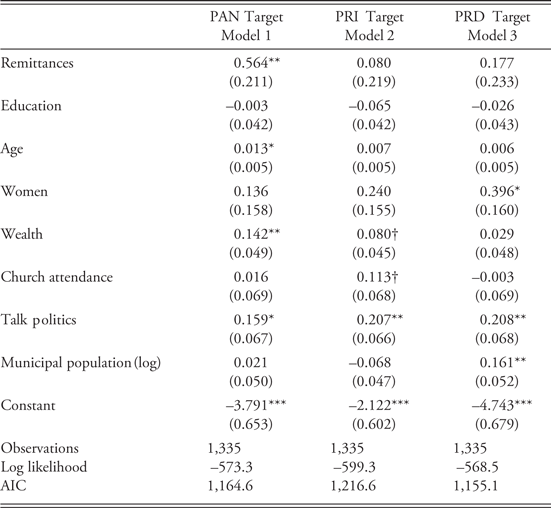
Table 1 shows the extent to which being a remittance recipient predicts electoral targeting, when controlling for other relevant factors.Footnote 21 This table indicates that being a remittance recipient reports a positive relationship with being a target by any of the political parties. However, this positive relationship is statistically significant only for the PAN/incumbent targeting. That is, remittance recipients are more likely to be PAN targets than similar nonrecipients. In terms of predicted probabilities (with 95 percent confidence intervals), those who receive remittances from the United States have a higher predicted probability of being electoral targets than similar nonrecipi-ents.Footnote 22 This holds across the different competing parties, but the difference between recipients and nonrecipients is especially substantial in the case of PAN targeting: 0.22 (0.16, 0.29) for recipients and 0.14 (0.12, 0.16) for nonrecipients.
Remittance Recipients, Nonrecipients, and Electoral Targets

*** p < 0.001, * p < 0.01, * p < 0.05, † p < 0.1
Logit regression estimates. Standard errors in parentheses.
Source: Mexico 2006 Panel Study
As for the other predictors in table 1, being older and a woman increases the chances of PAN and PRD targeting, respectively. Those who talk more frequently about politics are, as predicted, also subject to more targeting (all parties), while a similar finding is present for those living in larger municipalities (PRD targets). Higher wealth also leads to more PAN targets. Although this result is somewhat unexpected, given findings that connect poorer voters with more clientelism (Brusco et al. Reference Brusco, Marcelo and Stokes2004; Stokes Reference Waddell2005; Nichter Reference Pfutze2008), it could reflect the right-wing PAN party’s tendency to approach wealthier, conservative supporters. Also, this project analyzes both clientelism and home visits, which could be less responsive to socioeconomic status but driven by voting intentions.
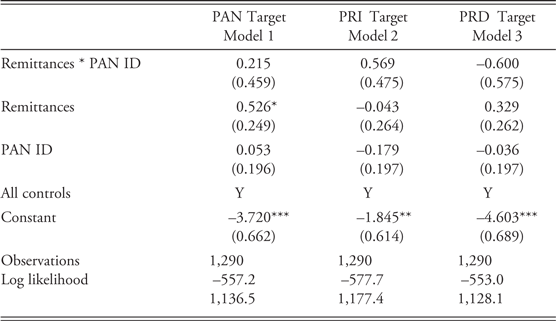
Further tested is whether electoral targeting is conditional on remittance recipients’ holding a certain political orientation. The results specify the following interactive nonlinear model (see Kam and Franzese Reference Langston2007):
 $$Electoral\,Targeting\, = \,{\rm{F(}}{{\rm{\beta }}_0}\,{\rm{ + }}\,{{\rm{\beta }}_{\rm{R}}}{\rm{ }}Remittances\, + \,{{\rm{\beta }}_{{\rm{ID}}}}\,Political\,ID\, + \,{{\rm{\beta }}_{{\rm{R}}\,{\rm{ \times }}\,{\rm{ID}}}}\,Remittances\, \times \,Political ID\, + \,{{\rm{\beta }}_{\rm{C}}}\,Controls\, + \,{\rm{\varepsilon )}}$$
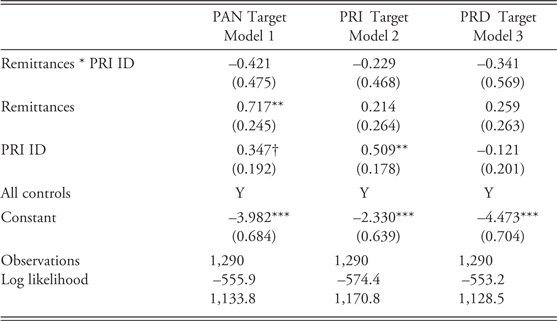
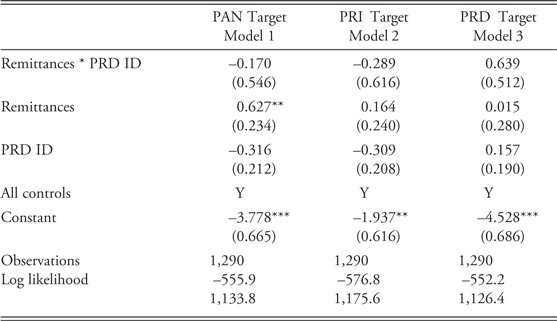
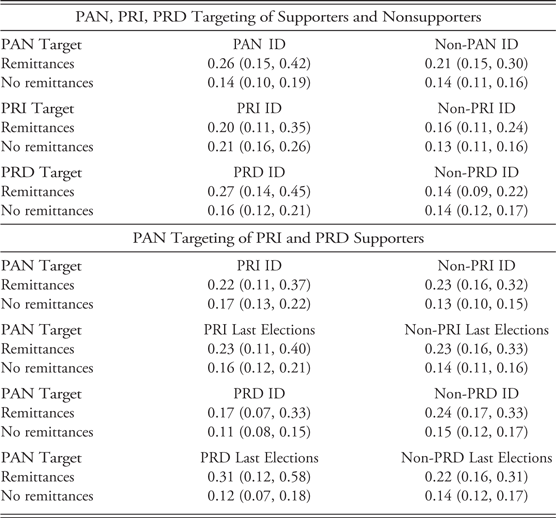
where βR is the effect for remittance recipients without a given political ID, βID is the effect of a given political ID for nonremittance recipients, and βR×ID is the effect for recipients with a given political ID. Table 2 explores respondents’ identification with the incumbent PAN, with the opposing PRI in table 3 and the opposing PRD in table 4. These results allow comparison of how being a remittance recipient or nonrecipient and a party supporter or nonsupporter affects the targeting strategies of the competing political parties. Given these results, table 5 reports predictive probabilities (with 95 percent confidence intervals), which is an intuitive way to understand the interactive effect of our two dummy variables (political ideology or not and remittance recipient or not) on targeting (Kam and Franzese Reference Langston2007).Footnote 23
Remittance Recipients and Electoral Target: PAN ID

*** p < 0.001, *p < 0.01, * p < 0.05, (†) p < 0.1
Logit regression estimates. Standard errors in parentheses.
Source: Mexico 2006 Panel Study
Remittance Recipients and Electoral Target: PRI ID

*** p < 0.001, ** p < 0.01, * p < 0.05, (†) p < 0.1
Logit regression estimates. Standard errors in parentheses.
Source: Mexico 2006 Panel Study
Remittance Recipients and Electoral Target: PRD ID

*** p < 0.001, ** p < 0.01, * p < 0.05, (†) p < 0.1
Logit regression estimates. Standard errors in parentheses.
Source: Mexico 2006 Panel Study
Predicted Probabilities

Table 5 shows that given PAN identity, the PAN targets remittance recipients (0.26) with a higher probability than similar nonrecipients (0.14), while for those without PAN identity, the PAN also targets remittance recipients (0.21) with a higher predicted probability than similar nonrecipients (0.14). Thus, the partial effect of receiving remittances on being a PAN electoral target is 0.12 for PAN supporters and 0.07 for non–PAN supporters when compared with nonrecipients, everything else equal.
How about the opposition parties? As table 5 shows, in the case of the PRI, the differences in predicted probabilities between recipients and nonrecipients when looking at PRI supporters and non–PRI supporters are minimal, which indicates that receiving remittances has no significant impact on PRI targeting. In the case of the PRD, and given PRD identity, the PRD targets recipients (0.27) with a higher predicted probability than similar nonrecipients (0.16), while there is no difference in predicted probabilities between recipients and nonrecipients without PRD identity. This means that the partial effect of receiving remittances on being a PRD electoral target is 0.11 for PRD supporters when compared with nonrecipients and with all other exogenous factors held constant.Footnote 24
Finally, given the significant impact of being a remittance recipient on PAN targeting, the analysis further explores whether the PAN targets recipients who identify with any of the key contenders. Essentially, it analyzes PAN targeting when looking at PRI (PRI ID and PRI last elections) and PRD supporters (PRD ID and PRD last elections; see online appendix) and, as before, reports predicted probabilities in table 5. As the table shows, remittance recipients report a higher predicted probability of being PAN targets than similar nonrecipients with the same party identity. However, the highest chance of being a target (highest difference between recipients and nonrecipients) is for recipients who voted for the PRD in 2000: such a recipient has a 0.31 chance of being a PAN target (0.23 for PRI voters), while a nonrecipient who voted the same way has a 0.12 chance (0.16 for PRI voters). Therefore, the partial effect of receiving remittances on being a PAN electoral target is 0.19 for those respondents who voted for the PRD in 2000 when compared with nonrecipients, everything else equal.
In sum, receiving remittances has a significant impact on experiencing PAN electoral targeting. Moreover, the PAN targets remittance recipients who are core supporters with a higher predicted probability. Among the set of non–PAN supporters, the PAN also targets recipients with a higher predicted probability, especially past PRD electoral supporters. Arguably, this targeting of recipients by the PAN could be due to this party’s incumbency advantage, which is commonly associated with political parties’ capacity to access more resources, connect with local institutions, and provide different favors (Hicken Reference Kitschelt2011; Szwarcberg Reference Szwarcberg2013a, b; Mares and Young Reference Mares and Young2016). This advantage could also be essential to using local networks that identify recipients, capture vote intentions, and deliver tailored goods. Additionally, the results suggest that the PRD targets recipients who are core supporters with a higher predicted probability than similar nonrecipients. The results with respect to the PRI do not lead to any conclusive remarks about this party’s distinction between recipients and nonrecipients, which might be due to the PRI’s lack of coordinated efforts during these elections.
Exploring the Mechanisms
Building on the theoretical section, this discussion explores whether recipients are more likely targets because they are “opinion-leading epicenters,” they question the legitimacy of the elections, or they are politically disengaged. It compares recipients and nonrecipients in terms of their nonfamilial discussions, their evaluations of whether or not Mexico is a democracy and the extent to which elections are clean and fair, and their political engagement, which is captured through the frequency of talking politics and of watching the news, interest in the campaign, political knowledge, following the presidential debate, having weak political ID, having no political ID, and self-reported abstention in the 2000 elections (see online appendix). These variables come from waves 1 and 2 to be consistent with the previous analysis and because this early information on voters should have affected the later design of electoral strategies.
A simple analysis offers support to the explanation that remittance recipients experience electoral targeting because of their political disengagement (see online appendix). First, the analysis finds no evidence that recipients have more nonfamilial discussion than nonrecipients, since the relationship between being a recipient and nonfamilial discussions is negative (not statistically significant).
Second, being a recipient is positively correlated with declaring that Mexico’s elections are fair, which goes against the idea that remittance recipients are electoral targets because they question the legitimacy of the elections. Moreover, this result also questions the social remittance mechanism and the notion that recipients, because of their exposure to the democratic practices of other countries, might be more susceptible to this type of electoral action and more inclined to report it. Put differently, one would expect that if recipients are susceptible and report this practice more, they should also be more inclined to characterize Mexico as not having clean elections and as not being a democracy. However, this simple analysis does not support this intuition.
Third, the same simple approach offers support to the political disengagement explanation, since being a recipient is negatively correlated with the frequency of political talk and of watching news, interest in the campaign, and political knowledge. Moreover, being a remittance recipient is negatively (and statistically significant) related to the frequency of political talk, political knowledge, and interest in the campaign, but positively (and statistically significant) related to declaring Mexican elections as fair when controlling for other predictors (age, gender, and wealth; see online appendix). Thus, these results offer some support to the theory that because of their political disengagement, remittance recipients are likely electoral targets.
Reverse Causality
Reverse causality occurs if targeting leads to a party ID (e.g., PAN targeting leads respondents to become PAN supporters). This problem is less of a concern here because of the panel dataset, which allows using party ID from wave 1 while targeting happened mostly closer to election day. Yet the analysis exploits respondents’ self-reported behavior, which indicates that 61 percent of respondents did not vote for the PAN in 2000. Of these, 1 percent were PAN targets in wave 1, and of this 1 percent, 76 percent still did not report PAN ID in wave 1. Although numbers are small (low targeting in wave 1), this comparison questions the effect of targeting on party ID. Similar results follow for PRI and PRD targeting.Footnote 25
We may also question whether electoral targeting causes some families to receive remittances. While ruling out this connection completely is not plausible, the literature usually highlights other reasons that people send money back home, such as improving the living conditions of those left behind, securing a place to return after migration, and financing new businesses (e.g., Lucas and Stark Reference Lucas and Stark1985; Brown Reference Carlin and Mason2006; Amuedo-Dorantes and Pozo Reference Amuedo-Dorantes and Susan2006; Carling Reference Córdova and Hiskey2008). Thus, even if some respondents receive remittances because of targeting, they would represent a marginal number, and for the most part, the relation runs from receiving remittances to experiencing targeting.
Selection Bias
One common concern to all research on migration is the selection process that leads some people to migrate. In this study, the selection bias could be present if individuals who receive remittances come from households with greater chances of experiencing targeting anyway. To address this concern, the research relied on propensity score weighting, which allows controlling for selection bias in nonexperimental studies by using weights to account for the selection into the treated and control groups (Olmos and Govindasamy Reference Olmos and Govindasamy2015) (at least observable factors). Propensity score weighting requires estimating two models: a treatment model (receiving remittances) and an outcome model (experiencing targeting). Therefore, a logistic regression was run in which receiving remittances was a function of having close relatives in the United States, socioeconomic status (benefiting from government programs, wealth, education), age, gender, church attendance, and size of the municipality. Then the outcome model was estimated as in the previous sections (same controls) but including in the observations the propensity score weights from the estimated treatment model. The results support the finding that remittance recipients are electoral targets, especially by the PAN (see online appendix).
Conclusions
This article has explained how the presence of remittance recipients in the electorate affects political parties’ electoral strategies. It has shown that receiving remittances is a significant factor in experiencing targeting, and was used especially, in the 2006 elections, by the incumbent PAN. The results have also shown that the PAN targeted, with a higher predicted probability, recipients who were supporters and nonsupporters, especially if the nonsupporters had voted in 2000 for the key contender in 2006, the PRD. These findings therefore suggest that the incumbency advantage helped the PAN access resources and work with networks that identified recipients and gathered information about these voters. Yet additional research is necessary to address the connection between incumbency advantage, access to resources, and identification of recipients’ needs.
Also, while the opposing PRD also targeted recipients who were supporters with a higher predicted probability than similar nonrecipients, this research has not found any strong relationship between the PRI’s behavior and the distinction between recipients and nonrecipients. The fact that the PRI candidate could not rely as much on the PRI machine could be one of the reasons behind this result. Importantly, this research also finds support for the theory that because of their political disengagement, which relates to lower intentions to vote and more persuadable voters, remittance recipients are more likely targets. Altogether, this article suggests that Felipe Calderón’s victory in 2006 could be partly due to the targeting of remittance recipients.
These findings have multiple implications. One is that the inflow of remittances helps political parties identify their electoral targets, which has negative effects on accountability. That is, conditioning the vote on the exchange of goods and favors and on coercion mechanisms, as opposed to performance and policy programs, has widely recognized negative consequences for the capacity of political institutions to deliver development outcomes (Stokes Reference Waddell2005; Kitschelt et al. Reference Kitschelt, Hawkins, Pablo Luna, Rosas and Zechmeister2010). This study, therefore, brings to our attention the fact that even if remittances satisfy basic needs and provide economic stability, they can also be harmful for electoral processes, democracy, and development.
Furthermore, while previous research addresses the effect of migration on turnout, political participation, and electoral choices, these findings show that remittances also affect political parties’ electoral strategies back home. Moreover, although a variety of authors contend that migration (especially remittances) makes it more costly for the incumbent to buy electoral support and citizens more independent from these practices (Díaz-Cayeros et al. Reference Díaz-Cayeros, Magaloni and Weingast2003; Merino Reference Merino2005; Pfutze Reference Szwarcberg2012, Reference Pfutze2014; Ahmed Reference Ahmed2011), this study has determined that at the individual level, recipients are the likely targets of some political parties. Put differently, the income effect of remittances might affect the total number of targeted voters in a geographic unit and the aggregate electoral outcome, but the microfoundation is the targeting of remittance recipients.
This study also offers opportunities for future research. One follow-up question is whether political parties choose certain strategies with particular types of voters; for instance, home visits over clientelism, or vice versa. Consequently, designing survey instruments that avoid social desirability bias (e.g., list experiments, as in González-Ocantos et al. Reference González-Ocantos, Kiewiet de Jonge, Meléndez, Osorio and Nickerson2012) should provide a good starting point to test if political parties choose clientelism or home visits when targeting remittance recipients and nonrecipients. A related query is where political parties decide to concentrate their electoral efforts. If remittance-rich municipalities improve their economic situation, political parties might focus their efforts on these or other localities. Finally, the results from the Mexican case also raise the question of how remittances affect electoral strategies in other countries with similar or different political party systems and migration profiles. Thus, exploring this study’s findings in other political contexts is an exciting future step.
Supporting Information
Additional supporting materials may be found with the online version of this article at the publisher’s website: Appendix.