Introduction
The importance of an active support network in reducing morbidity, delaying mortality and enhancing psychological wellbeing have been well-documented (Berkman and Syme Reference Berkman and Syme1979; Fratiglioni et al. Reference Fratiglioni, Wang, Ericsson, Maytan and Winblad2000; Seeman, Bruce and McAvay Reference Seeman, Bruce and McAvay1996; Fiori, Smith and Antonucci Reference Fiori, Smith and Antonucci2007). There are two major dimensions of social support: structural support refers to the existence of social ties and is typically measured by network characteristics, particularly network size and contact frequency; functional support refers to the availability of network members' resources to meet certain needs (e.g. instrumental and emotional needs). Whereas structural support tends to promote overall health and wellbeing, functional support buffers against the adverse impact of everyday problems (Cohen and Wills Reference Cohen and Wills1985). Not only is receiving support important, for being able to reciprocate and to provide support is equally important for older people, including those with chronic disability (Boerner and Reinhardt Reference Boerner and Reinhardt2003; Brown et al. Reference Brown, Nesse, Vinokur and Smith2003).
Research on social support has been conducted primarily with community-dwelling older adults who tend to be relatively healthy, and comparatively little is known about the social support available to those with significant functional deterioration and who have moved into residential or nursing-home care. Although relational aspects of care are often claimed to be of high priority by nursing-home managers (Kalis, van Delden and Schermer Reference Kalis, van Delden and Schermer2004; Hong Kong Social Welfare Department, no date), in reality nursing homes function more like ‘total institutions’ and emphasise routinisation, surveillance and conformity (Goffman Reference Goffman1961; McLean Reference McLean2006). Scholars have argued that such an environment results in mortification of the self and consequently social isolation and withdrawal from interaction, even among those who frequently sit next to each other (Goffman Reference Goffman1961; Shield Reference Shield1988). Homes that provide more choices and individualised care, most of which are relatively small, are likely to have residents who initiate more activities with each other, cultivate long-term relationships, and develop diverse forms of mutual support (McAllister and Silverman Reference McAllister and Silverman1999). Indeed, studies show that nursing-home residents do engage in interactions and some develop close relationships with fellow residents and staff.
In a qualitative study of four nursing and residential care homes, Hubbard, Tester and Downs (Reference Hubbard, Tester and Downs2003) noted many interactions among the residents, including everyday conversations, telling jokes, flirtations and expressions of dislike. In another study of 43 Israeli nursing-home residents, 20 per cent said that they had a friend in the same home, and 69 per cent said they had more than one friend in or beyond the home; moreover, contact frequency positively correlated with morale (Sherer Reference Sherer2001). In Bitzan and Kruzich's (Reference Bitzan and Kruzich1990) study, 57 per cent of the residents had someone on the unit with whom they felt especially close; of these, 64 per cent were fellow residents and the rest were staff. Women, and those who were ambulatory and without auditory impairment, were more likely to report having a close friend inside the home. Finally, a Taiwanese study found that perceived support from nursing staff was associated with a better quality of life among nursing-home residents (Tseng and Wang Reference Tseng and Wang2001).
Among all their visitors, those of children would probably be the most emotionally meaningful. These visits are key connections to the outside world for many who live in nursing homes. The few studies of the topic suggest that, in general, family members and relatives continue to engage with an older person admitted to a nursing home, for example by paying visits and being involved in personal care (e.g. transferring in and out of bed). Residents with more functional and cognitive impairments and those with one or more family members living close by tend to receive more visits and help (Bitzan and Kruzich Reference Bitzan and Kruzich1990; Gaugler, Zarit and Pearlin Reference Gaugler, Zarit and Pearlin2003; Greene and Monahan Reference Greene and Monahan1982; Max, Webber and Fox Reference Max, Webber and Fox1995; Port et al. Reference Port, Gruber-Baldini, Burton, Baumgarten, Hebel, Zimmerman and Magaziner2001). In Taiwan, nursing-home residents who received more frequent interactions with family members reported a relatively high quality of life (Tseng and Wang Reference Tseng and Wang2001). With the care provided by the nursing home, many family carers can refocus their attention on the emotional needs of the resident and renew the strength of their affection. Although most residents receive regular visits, a study of 300 residents in 54 United States nursing homes showed that 16 per cent received no visits by family members, that 40 per cent received none from friends, and that those with infrequent visitors had on average been resident for longer (Bitzan and Kruzich Reference Bitzan and Kruzich1990).
The cultural context of social support
Despite the small samples in most of the cited studies (which probably reflects recruitment difficulties), their findings suggest that after moving to a nursing home, older people's previous social ties are maintained and that some form new ties in the home. Lee, Woo and Mackenzie (Reference Lee, Woo and Mackenzie2002) interviewed 18 nursing-home residents in Hong Kong one week after admission and monthly thereafter for about six months. Among other things, they demonstrated that the cultural orientations of collectivism and familism limited the formation of new social ties in the nursing home, and even persuaded some residents to relinquish social ties outside the home. The residents were most concerned not to offend others in the home and not to transgress its implicit and explicit rules. In such ways, the institutional setting required residents to fit in and to put the collective interest before their own. Apart from the residents who had known each other in the past, they tended to isolate themselves from one another, or at best treated each other as distant friends. The staff members were viewed as authority figures to be heeded rather than a support resource. These findings are not at all surprising, because in many ways nursing homes in Hong Kong are run like total institutions that emphasise efficiency rather than the quality of care (see Cheng and Chan Reference Cheng and Chan2003). In my view, the consequences of institutionalisation probably transcend the cultural influence.
A surprising finding of Lee and colleagues' study, however, was that for successful emotional adjustment in the new setting, the severance of long-term ties with relatives, friends and neighbours might be required. Under the cultural notion of filial piety, elders are supposed to be taken care of by their children, especially eldest sons (Cheng and Chan Reference Cheng and Chan2006), and having to move to a residential home is perceived by many as a personal and family disgrace. To save face, some elders make efforts to ensure that their ‘absence from the family’ is not known to others. For instance, an 84-year-old woman instructed her son to tell the others that she now lived with her daughter, for ‘only then will those people shut their mouths if they know that my son has not abandoned me’ (Lee, Woo and Mackenzie Reference Lee, Woo and Mackenzie2002: 672). Hence, besides leading separate lives inside the home, the elders also detached themselves emotionally from those outside. It is therefore not surprising that a survey of nursing-home residents in Hong Kong reported an average of only 0.6 network members (Lee, Lee and Woo Reference Lee, Lee and Woo2005), which means that many had none at all.
The present study
Given such cross-cultural differences, it was believed that a more systematic study of the social network of nursing-home residents in a collectivistic society was needed. The present study aims to detail the social network of a small sample of elders with different durations of residence in nursing homes. It will examine the composition of their social network with reference to the different kinds of relationship (close family, extended relatives, friends, other residents, and staff), and the degree to which the resident felt close to each network member. The emotional and instrumental support received from and provided to the network members will also be investigated.
Methods
Participants and procedure
A convenience sample of residents was recruited from nursing homes in Hong Kong.Footnote 1 Of the 10 homes that were approached, seven agreed to participate. These homes were chosen because they were of similar size (around 120 residents) and dispersed all over Hong Kong. Smaller homes were not approached because it was unlikely that they would have provided the required number of participants, and much larger homes were not chosen because they would introduce confounding variables associated with their distinctive institutional culture (i.e. the larger the home, the more likely there are strict rules). The manager of each home was asked to identify residents who were sufficiently cognitively intact, defined as having Mini-Mental State Examination scores of at least 18 (see below), and who were dependent in basic self-care, defined as having one or more impairments in the Activities of Daily Living (see below). These criteria were chosen so that the participants would have the cognitive capacity to complete the interview competently, and to create a relatively homogeneous sample in terms of functional impairment. The latter criterion is important because the ability to interact and to maintain a social network depends partly on health (Aartsen et al. Reference Aartsen, van Tilburg, Smits and Knipscheer2004), and the findings would be difficult to interpret if the sample had included both functionally independent and dependent individuals. Altogether, 126 residents were referred and screened for cognitive and functional impairment. Only 72 who met the inclusion criteria were included in the study.Footnote 2
Measures
Cognitive impairment was assessed by the Mini-Mental State Examination (Folstein, Folstein and McHugh Reference Folstein, Folstein and McHugh1975). It has 10 items that assess different cognitive abilities (e.g. orientation, working memory, visual-motor integration), and the possible range of scores is from 0 to 30. A score of less than 18 suggests moderate cognitive impairment (Folstein et al. Reference Folstein, Anthony, Parhad, Duffy and Gruenberg1985). Functional impairment was assessed by the Barthel Index (Mahoney and Barthel Reference Mahoney and Barthel1965), which measures the person's ability to perform 10 Activities of Daily Living (ADL) (e.g. bladder and bowel control, feeding, mobility). A score below 20 indicates some degree of impairment in at least one ADL. Self-rated health was assessed by asking the respondents to rate their overall health on a five-point scale from ‘very poor’ (1) to ‘excellent’ (5).
Structural support was assessed using the Kahn and Antonucci (Reference Kahn, Antonucci, Baltes and Brim1980) questionnaire. This uses a graphical representation of the respondent's social world that has three concentric circles around the person (‘me’) at the centre. Participants are asked to place individuals into either the inner circle, which refers to people so close that it is hard to imagine life without them; or the middle circle, for people who are not as close but still very important to the person; or the outer circle, for people who had not been mentioned but nonetheless are close enough and important enough to be included in one's personal network.Footnote 3 For each identified network member, the following attributes were established: (a) gender, (b) age, (c) relationship to focal person, (d) years of the relationship, (e) whether living in Hong Kong, and (f) frequency of face-to-face contacts on a six-point scale (1 ‘occasional’, 2 ‘once a month’, 3 ‘several times a month’, 4 ‘once a week’, 5 ‘several times a week’, and 6 ‘daily’). Only face-to-face contacts were collected because nursing homes in Hong Kong typically provide no access to telephones.
Functional support received was assessed by asking if each network member provided (a) emotional support, as measured by four items (confiding, showing affection, companionship, and paying respect), and (b) instrumental support, also measured by four items (care when ill, assistance with daily activities, advice and guidance, and financial aid). Each item was rated on a five-point scale from ‘never’ (1) to ‘always’ (5). In view of the physical capacity of the participants, functional support provided by the participant to each network member was measured with three items (confiding, showing affection, and advice and guidance). The alpha reliability coefficients, across all network members, were 0.64 for received emotional support, 0.60 for received instrumental support, and 0.71 for provided support.
Results
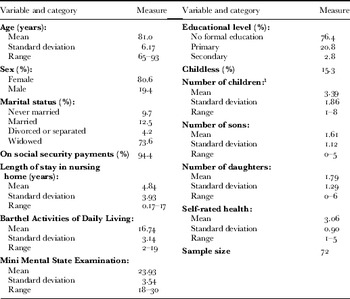
The socio-demographic characteristics of the sample are presented in Table 1. According to the respondents, the reasons for admission to the homes were invariably illnesses and disabilities that made it difficult to continue living in their own home. Rather surprisingly, the decisions to enter were mostly made by social workers (41%), followed by children (mainly daughters) (33%) and the respondents (25%).
Socio-demographic characteristics of the sample

Note: N=72. 1. For those with children only.
Structural support
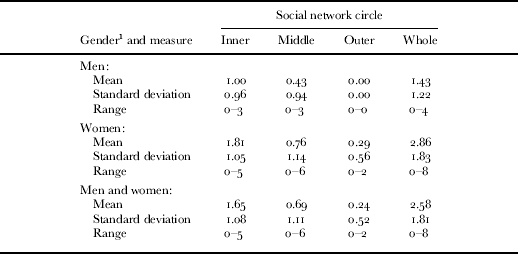
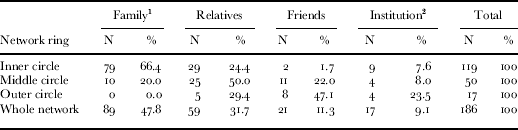
Product-moment correlation coefficients were estimated to investigate whether age and length of stay (log-transformed to correct for skewness) were associated with the size of the family, relative, friend, institution and total networks. All correlations were weak and not significant (r<0.19). For this reason, the findings are presented for the whole sample without regard to age and length of stay. The participants reported an average of 2.58 network members (Table 2). A majority (56%) of the one-in-eight (12.5%) without any network member were men (Fisher's exact p=0.07), but there was no association with marital status or age (caution is advised when interpreting these findings given the few with no network members). Table 3 presents the numbers of network members in different relationships with the participants by the three categories of closeness.
Network size by gender and social circle
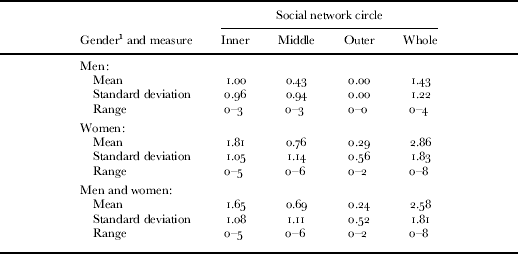
Notes: Sample size 72. 1. Men and women differed in inner circle network size (t=−2.63, df=70, p<0.01), outer circle network size (t=−3.97, df=70, p<0.001), and total network size (t=−2.78, df=70, p<0.01), but not in middle circle network size (t=−1.00, df=70, ns).
Social network composition (head count) by category of closeness
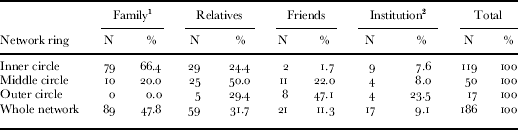
Note: Percentage figures are percentages of the row total. 1. Spouse, children or grandchildren. 2. Includes staff and residents in the nursing home.
Thirteen of the 72 participants nominated 20 grandchildren as network members, and placed 70 per cent of them in the inner circle and 30 per cent in the middle circle. Only four of the nine married participants named their spouse as a network member. Because of the traditional emphasis in Chinese societies on vertically-extended families, the spouse, children and grandchildren were grouped together (and hereafter are referred to as ‘family members’), whereas the term ‘relatives’ is used to refer to other relatives (e.g. siblings). Fourteen participants named 17 people in the nursing home as network members; all except two were staff, either social workers or personal care workers. For the analysis, the staff and the two co-residents were aggregated as ‘persons in the nursing home’. As many of the reports that follow were based on sub-samples, e.g. frequency of contact with friends has been calculated for only the 18 participants who had friends in their social networks, comparisons of different sub-samples were not subjected to statistical tests.
As Tables 2 and 3 show, the average number of network members fell steeply from 1.65 in the inner circle (the closest people) to 0.24 in the outer circle (the least close). The inner circle was dominated by family members, the middle circle by other relatives, and the outer circle by friends. There was a significant association between type of relationship and placement in the inner circle as opposed to the middle and outer circles (χ2=57.3, degrees of freedom (df)=3, p<0.001).Footnote 4 On the whole, nearly one-half of the people identified in the networks were family members, nearly one-third were other relatives, and the remaining 20 per cent were more or less equally divided between friends and those in the home (χ2=74.9, df 3, p<0.001). It is noteworthy that very few friends were placed in the inner circle (only two in the entire sample), whereas one-half (52.9%) of the nominated people in the home were placed in the inner circle. The numbers of sons and daughters of the 61 elders with children are displayed in Table 4. Altogether, the informants had 207 children but only 63 (30%) were identified as network members. Unexpectedly only eight (13%) of the 61 informants with children included all of them in their network, and on average 2.4 children were excluded from the informants' networks. Sons were significantly more likely than daughters to be excluded.
Numbers of children included in and excluded from the social networks

Notes: Tabulation for only the 61 participants who had at least one child. Sons and daughters differed in the likelihood of being excluded (χ2=4.27, df=1, p<0.05).
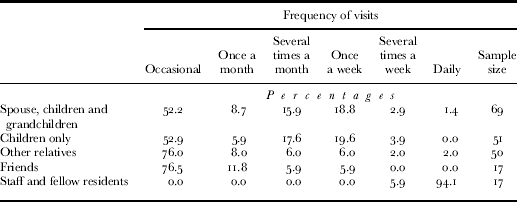
In comparison to the women informants, the men reported a significantly smaller total network size and fewer members in the inner circle, and none of the men identified a single network member in the outer circle (Table 2). The seven informants who had never been married had significantly smaller networks than others.Footnote 5 Across the whole sample, 31 network members including 14 children were living abroad, but the country of abode was not associated significantly with whether the network member was in the inner, middle or outer circles of closeness. The frequencies of the visits by the network members resident in Hong Kong are displayed in Table 5. As can be seen, network members, regardless of the nature of the relationship, paid only occasional visits to the informants. Even among the immediate family members (children, grandchildren and spouses), one-half made only occasional visits, and about one-third made weekly or almost weekly visits. For obvious reasons, the frequency of contacts with staff and residents in the home was near daily. The participants tended to receive more visits from female than from male network members.Footnote 6
Frequency of visits from network members or contacts with others in the home
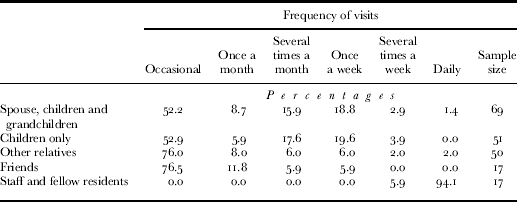
Note: Network members living abroad were excluded.
Functional support
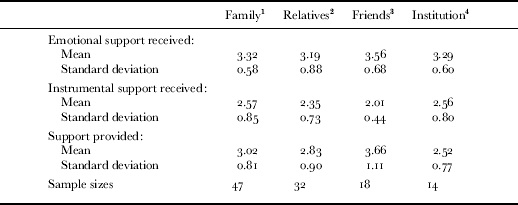
The association between type of relationship and average supportiveness was first examined. Because the number of individuals reporting one or more network members in each relationship category varied (see Table 6), four relationship-specific analyses were conducted with repeated measures analysis of variance. In each analysis, emotional support received, instrumental support received and support provided averaged across network members were included as dependent variables (i.e. a within-subject factor with three levels). The results showed significant differences in the three support variables in all relationship categories. Planned contrasts were conducted separately for the four relationship categories using ‘emotional support received’ as the reference category. The results showed that across the different types of relationship, instrumental support received from and support provided to network members were both significantly lower than the amount of emotional support received, except in the friendship network when support provided and emotional support received were not significantly different from each other.Footnote 7 Note also that the provided support items were also biased toward emotional support. The participants thus perceived more emotional support exchanges with the network members, but the level of instrumental support that these frail older persons received was considerably lower. This pattern was consistent across the four relationship categories.
Social support exchanges with network members by nature of relationship
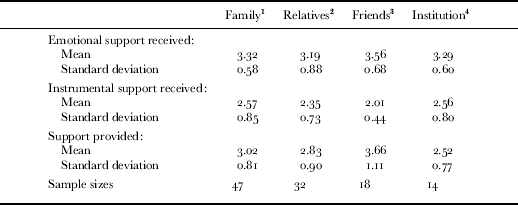
Notes: 1. F=44.03, df 2, 45; p<0.001. 2. F=27.59, df 2, 30; p<0.001. 3. F=85.61, df 2, 16; p<0.001. 4. F=44.31, df 2, 12; p<0.001.
Discussion
Limitations of the study
This study has two limitations. First, the difficulty of recruiting informants from nursing homes suggests that those who volunteered and gave consent tended to over-represent the healthier and more socially active residents. Hence, the present findings might have under-estimated the degree of social isolation of nursing-home residents. Secondly, we computed composite scores for the support variables. It is conceivable that different support behaviours are more relevant for different kinds of network members (Litwak Reference Litwak1985), such as health-care related interactions being a dedicated role of the staff, and so a slightly different picture of social support might be revealed if the support behaviours were analysed individually. Given the small sample size and the inter-correlations of the support behaviours, and to reduce the possibility of Type I error inflation, it was decided to analyse the composite variables and reduce the number of analyses. Nevertheless, the general conclusions were not changed when the support behaviours were analysed one by one.
There has been little research into the structural and functional support provided to nursing-home residents, and the limited evidence from western countries may not apply to Chinese societies. According to Lee, Woo and Mackenzie (Reference Lee, Woo and Mackenzie2002), the Chinese collectivistic orientation discourages institutional residents from seeking mutual social support and, to avoid the disgrace of having to admit the unwillingness or inability of their children to continue caring for them at home, they may even sever ties with relatives and friends. For these reasons, nursing-home residents in Chinese societies are expected to have very limited social connections. The study by Lee, Lee and Woo (Reference Lee, Lee and Woo2005) of 175 nursing-home residents in Hong Kong found that the average number of network members was just 0.6. Perhaps because of the more meticulous method of enumerating social network members in this study, a larger network size (2.6) was found.
The social networks of the residents were composed primarily of immediate family members, and it was not surprising that few friends were included. People of advanced age often disengage from peripheral relationships (Carstensen Reference Carstensen1995) and, in fact, by the time one needs to be institutionalised, many close friends might be in a similar situation or have died. Moreover, as has been discussed, the concern with saving face might lead the residents to sever ties with friends, with the result that more network members were staff and residents than friends. By comparison with family relationships, friendships tend to be based more on mutuality and reciprocity (Larson, Mannell and Zuzanek Reference Larson, Mannell and Zuzanek1986; Rook Reference Rook1987), and those maintained in the present sample were characterised by a more balanced exchange of social support (particularly emotional support). These findings must be interpreted cautiously, however, because few informants had a friendship network.
The extent to which children were excluded from the network was surprising. Although family members, mainly children, dominated the networks and particularly the inner circle, more than two-thirds of the respondents' children were absent from their networks. In effect, many of the residents no longer considered their children part of their day-to-day lives. During the first few interviews with the informants, we asked why some children were not named as network members, but the respondents broke into tears and one interview had to be terminated, so the question was dropped. Such exclusions have not been reported by studies of the social networks of community-dwelling older people (Chi and Lee Reference Chi and Lee1989). These findings deserve further attention.
By long-established custom, a Chinese older person is supposed to be taken care of by sons (especially the eldest son). Moving to a nursing home means that one's children have failed in their duty, which is considered a disgrace. We believe that the feeling of being abandoned by children might have been the primary reason why some children, especially sons, were excluded from the respondents' network. Moreover, even for those children included in the network and resident in Hong Kong, who supposedly had the primary care responsibility (see Cheng and Chan Reference Cheng and Chan2006), their visits were astoundingly infrequent. In Hong Kong, where transport from one place to another is relatively convenient and time-efficient, this infrequency of contact is hard to understand from a Chinese perspective. It may be the cumulative effect of home-placement policies and procedures, management convenience, changes in children's attitude towards care, or other cultural factors.
Home placements usually occur at a time of crisis following an acute deterioration in the person's functioning. In these situations, older people are often incapable of saying ‘no’ and the wishes of family members prevail. Negative stereotypes about nursing homes are commonplace (Lee Reference Lee1997), however, and the substantial shortage of beds in Hong Kong means that choice is limited. The waiting time for a bed in a subsidised home is almost three years (Cheng and Chan Reference Cheng and Chan2003), which encourages family members to accept a place for their relative as soon as it is offered. If the older person had been admitted to hospital, the ward managers and social workers are required to plan a prompt discharge (to release the bed), and many are to private-sector homes where vacancies are easier to find. It was therefore no wonder that 41 per cent of our respondents said the decision for placement was made by social workers. The whole process necessitates a quick transition to the nursing home in which the older person's ambivalence about placement remains unresolved. This may arouse the older person's perception of a lack of filial piety among his or her family members, and create an enduring sense of shame and disappointment (see Cheng and Chan Reference Cheng and Chan2006).
At the same time, the intensive involvement of the social worker in the placement process tends to strip the family of the care responsibility. This is reinforced after admission to a nursing home because, in Hong Kong, family members are rarely involved in the personal care of the older person. For the management's convenience, nursing homes are run like total institutions. Hence, both residents and their family members are expected to adhere to routines in the home which discourage visits and interactions; for example, the inflexible visiting hours make evening visits by working children difficult. The residents' poor access to telephones in nursing homes further separates the residents from their family members. Such practices discourage family members from frequent engagement with the lives of the residents. Furthermore, given the space limitations of Hong Kong's nursing homes (about 6.5 m2 per resident, all space uses included; Cheng and Chan Reference Cheng and Chan2003), a resident's personal space is no more than a bed and a locker. Most residents live in large, communal rooms, and bringing items of memory value into the home is generally discouraged. Together with the cultural stigma attached to living in a nursing home, it is then not surprising that the residents prefer to cut themselves off from previous social ties, including from their children and spouse.
In addition, as Lee, Woo and Mackenzie (Reference Lee, Woo and Mackenzie2002) noted, most newly admitted residents wish to fit into the homes' routines and comply with the daily regime, which reinforces the ‘total institution’ effect. Their behaviour is characterised by avoiding conflict with staff and other residents, rather than seeking social support because this would strain relationships that were already tenuous. Hence, only a minority (19.4%) of the sample reported having one or more network members in the home, and most were staff. Subjective interactions with fellow residents were exceptional, and support exchanges among residents virtually non-existent.
Lastly, an important finding was the relatively low level of perceived instrumental support, not excluding that provided by the staff. In retrospect, this is not surprising because nursing homes in Hong Kong provide only the most basic care and support. For example, the guideline on staff-ratios for care-and-attention homes is that nursing staff provide each resident with just 2.5 hours of care per week (Cheng and Chan Reference Cheng and Chan2003). The informants perceived a large discrepancy between their instrumental needs and the support received, even among those who identified a staff member as ‘close’. The situation among those without a ‘close’ staff member was even more worrying. Overall, the findings suggest that nursing-home residents, especially men, were rather socially isolated. For many, their closest relatives – children, grandchildren and spouse — visited infrequently. Many also felt isolated in the home and had not formed a relationship with another resident. Only a small minority felt close to any staff member or resident. Regardless of the nature of the relationship, they received more emotional than instrumental support from the network members.
Acknowledgements
The preparation of this manuscript was supported in part by a grant from the Research Grants Council of Hong Kong (CityU1495/05H). I am grateful to Mandy To and Alfred Chan for their assistance in data collection. Alfred Chan also provided valuable comments on an earlier version of the manuscript, for which I am most grateful.