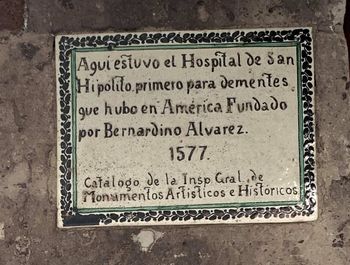
Located in the bustling downtown area of Mexico City, across from one of its busiest avenues, is an aged two-story building that, like many of the monuments, churches, and edifices that saturate the capital's central historic district, bears witness to a deeply rooted colonial past. While connected to a church that retains much of its baroque facade and to date remains in active use, this building, with its faded and crumbling red brick exterior, blackened walls, and desolate corridors, offers little to marvel at. The most dedicated of observers, however, will no doubt reap some satisfaction in taking note of its historical significance, which is quietly announced on the small tile plaque shown in Figure 1: “Here once stood the Hospital de San Hipólito, first [hospital] for the insane of the Americas, founded by Bernardino Álvarez in 1577 [sic].”Footnote 1
Plaque Near Main Entrance of the Hospital de San Hipólito
Source: Photograph by the author.

Its underwhelming physical presence notwithstanding, San Hipólito does indeed hold a bold claim to being the first hospital of the Americas to specialize in the care and confinement of the mentally disturbed.Footnote 2 In 1877, the hospital's administrator, Dr. Sebastián Labastida, proudly remarked on the institution's precocious sixteenth-century appearance, emphasizing that it predated by no insignificant stretch its much more illustrious English counterparts, London's St. Luke's Hospital and the York Retreat, while its humane approach to managing mental disorder prefigured the groundbreaking techniques of the “sage Pinel.”Footnote 3 In a much different register, the nineteenth-century novelist José Joaquín Fernández de Lizardi immortalized San Hipólito and its infamous jaulas, or cages, in his beloved work Periquillo sarniento (1819), wherein he describes the protagonist's dalliances as a newfangled Quixote and in particular his momentary descent into locura, or madness, during an ill-fated voyage at sea.Footnote 4 If Lizardi captured the hospital's mystique as the New World's “Bedlam”—a site where marginality and mayhem commingled—the colonial archive testifies to its daily operations as the largest (in spite of its modest size) and most active facility within Spain's American empire to shelter and care for a category of individuals labeled pobres dementes or mad paupers. Yet apart from a handful of studies that anachronistically characterize San Hipólito as an “insane asylum” and its founder as a “New World psychiatric pioneer,” surprisingly little is known of the institution's history, much less of the patients who occupied its facilities and of the nurses who dedicated themselves to the daily drudgery of caring for the poor and mad. While Josefina Muriel's pioneering compendium of hospital development in New Spain remains invaluable, its encyclopedic breadth comes at the expense of depth and falls short in the way of critical analysis of the hospital's colonial implications.Footnote 5
The final half-century of San Hipólito's existence saw its humid and convent-like quarters put to use in the service of psychiatry.Footnote 6 However, for most of its existence, it operated as a stunningly different type of institution, administered by a religious order and beholden to an older, distinctly colonial and Catholic tradition of extending succor to the mentally disturbed. This article brings San Hipólito's early history to light, affording us an opportunity to consider how Iberian institutions and institutional practices pertaining to madness and its management were exported to the New World, and the degree to which they adapted to their new environment and aligned with a colonizing agenda.
As the earliest “mental hospital” of the Western Hemisphere, San Hipólito was modeled on antecedents rooted in Spain, where the practice of delivering specialized medical and custodial services to the mentally disturbed under the banner of Christian charity was a time-tested tradition. Its evolution within the Americas, however, meant that both its practices and spaces, as well as its shifting institutional mission, would be tailored to local circumstances and register colonizing efforts to reproduce Iberian culture and secure Spanish hegemony in the New World. Specifically, this article contends that the hospital functioned as a limited tool of colonial governance whose utility resided less in the forceful confinement of a multiracial, recalcitrant, and vulnerable group of colonial subjects than in the reproduction of charitable practices and ideas that lent legitimacy to Catholicism and Hapsburg models of paternal rule. Reconstructing the hospital's origins and activities during the first century and a half of Spanish rule sheds light on the ways in which institutions of madness reconstituted colonial authority in the absence of the biopolitical regimes that figure prominently in scholarly accounts of colonial psychiatry.Footnote 7
In foregrounding the story of San Hipólito and its treatment of pobres dementes, this article draws on two discrete bodies of scholarship. First, it expands on a vast and robust historiography on madness and its institutions that has overlooked developments in the Spanish Atlantic world.Footnote 8 This oversight is unfortunate, given that some of the earliest facilities designed exclusively for the care and custody of the mentally incapacitated appeared on the Iberian Peninsula. The Spanish, in fact, were first among the imperial powers to deploy these institutions and their attendant ideas and practices to deal with the illness they called locura overseas. In exploring the ways in which San Hipólito was implicated in colonial processes and practices, this study provides a counterpoint to histories of colonial psychiatry that, with some exception, have privileged psychiatry's discursive engagement with modern notions of race and imperial policy.Footnote 9 In advancing this insight, I build on a second body of scholarship: namely, recent studies that have begun to consider the question of the early modern hospital as a “tool of empire,” to borrow a popular trope and apply it in earnest.Footnote 10 For colonial Peru, for instance, Gabriela Ramos has analyzed Indian hospitals, emphasizing a discrepancy between their intended use as instruments of assimilation and colonial governance, and their uneasy—indeed failed—reception among Andean natives.Footnote 11 This article contributes to this body of literature in showing how Spanish colonialism shaped the institutional management of mental illness in the era before the rise of psychiatry as a hegemonic science.
The article makes its case in three parts. The first section examines the hospital's prescient foundations, showing how its origin story resonated with a formative phase of Spanish colonization in which hospitals figured prominently as aspirational tools of empire that embodied ideals of Catholic charity, community, and Hapsburg models of paternal rule. The second section considers the history of Spanish mental hospitals in preface to considering the ways in which San Hipólito both reproduced and transgressed Old World paradigms. The final section provides an intimate sketch of hospital life that shows how Spanish colonialism was embodied and reproduced in everyday institutional, religious, and medical practices. Taken together, the history of San Hipólito and its treatment of pobres dementes reaffirms Woodrow Borah's claim that social welfare in New Spain was essentially a “history of transfer, adaptation, and experiment.”Footnote 12
Colonization and Hospitalidad
San Hipólito's early appearance in the New World can be attributed to a number of factors, most immediately the charitable impulses of a repentant conquistador named Bernardino Álvarez. Legend has it that the New World's first mental hospital was born out of spiritual awakening when Álvarez returned to the capital of New Spain after more than a decade in exile and vowed to atone for the sins of his past though selfless service to the sick and indigent. Two posthumous biographies, one of them authored by a bishop and the second by a Jesuit father writing in vocal support of Álvarez's beatification, record the events that followed.Footnote 13
Álvarez's penitential journey reportedly began at the Hospital de la Concepción de Nuestra Señora, the institution patronized by another repentant conquistador, Hernán Cortés. It was there that he observed firsthand the troubling inadequacy of the capital's extant welfare institutions, short on space and resources to accommodate the vast number of patients demanding their services. Particularly alarming was the plight of the mentally incapacitated: while the locos inocentes, or the feeble-minded, helplessly wandered the streets, the object of public scorn and humiliation, those displaying more violent tendencies, the locos furiosos, were incarcerated in public jails and treated like common criminals.Footnote 14
The official, laudatory account relates that Álvarez was so stirred to compassion by this sorry spectacle that he embarked on a charitable mission to found his own hospital. This enterprise was wholly inspired by evangelical motives: in the words of Díaz de Arce, Álvarez practiced the virtue of hospitalidad—that is, hospitality or charitable service to the sick and poor—with “complete perfection” so “his fellow Spaniards would see him, and see themselves in him, as in a mirror.” The penitent conquistador also hoped his altruistic and selfless actions would serve as a model of ideal Christian conduct for the recently converted natives, described metaphorically as “plantas nuevas,” or new plants, prime for spiritual harvesting.Footnote 15 Álvarez got to work immediately, obtaining a license to found the hospital from the archbishop Alonso de Montúfar in 1566. Although he originally intended to erect a small building in the center of the capital on the street of Celada, in 1567 he set his ambitions on a more attractive and historically propitious site on the city's outskirts, near the Tacuba causeway.Footnote 16 The new location was once the scene of the infamous noche triste (“sad night”), the Mexica uprising following the death of Moctezuma that resulted in the military retreat of Cortés and his troops from the capital at Tenochtitlán. When the Spanish forces finally subjugated the Mexica in 1521 and demolished the great city, they erected a church on the premises of the former battleground. Appropriately, the church was dedicated to Saint Hippolytus, the saint whose feast day had coincided with date of the military victory. Because of its proximity to the historic church, the Hospital of Convalescents, as Álvarez's hospital was originally called, eventually became known as the Hospital de San Hipólito.Footnote 17
While the hospital was still under construction, Álvarez took to the streets. His caridad, or charity, his biographers emphasized, possessed no limits. He collected the convalescent, the poor, the orphaned, and the old and weary. Then, he turned his philanthropic gaze to the most miserable lot: the mad. As the Jesuit father Fransisco García recounted in effusive, baroque praise: “He [Bernardino Álvarez] gathered all the mad and feeble-minded of New Spain in order to cure and sustain them. He said that these individuals were the most needy because, like reasonable creatures they need food and clothing, but cannot fend for themselves . . . and since they cannot care for themselves, it is necessary that someone else care for them. He would treat these poor individuals, whom everyone else had deprecated, with special affection, seeing in them the image of God, blessed with grace [and] lacking the taint of sin.”Footnote 18
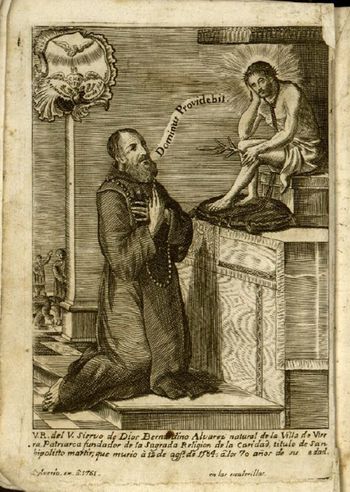
The story of San Hipólito's auspicious beginnings cannot be taken at face value. In medieval and early modern Europe, similar accounts of heroic charity circulated to describe the origins of different welfare institutions. Whether factual or mythic, the plot usually centered on the transformative experience of a benefactor who was stirred to action by the suffering of the sick and poor. These narratives served not just to extol the institution and the exemplary piety of its founder, but also to inspire others to bestow compassion and charity on the needy.Footnote 19 San Hipólito's foundational story conveyed this message, yet it did so within a colonial framework that yoked Christian beneficence to the paternalism and evangelical agenda endorsed by the Catholic Church and the Hapsburg crown to legitimize colonial expansion.Footnote 20 The illustration of Bernardino Álvarez (Figure 2) included in the 1762 edition of Juan Díaz de Arce's Libro de la vida del próximo evangélico, originally published in 1652, encapsulates the hospital's religious and colonial origins. Álvarez is represented as a humble supplicant kneeling before an altar on which sits a scourged Christ in a scene from the Passion, crowned with thorns and bound with a rope around his neck. Referred to as a “siervo de Dios” (servant of God) in the caption in the banderole beneath the altar, Álvarez clasps his hands over his heart in a gesture of devotion as he utters the Latin phrase, “Dominus providebit” (God will provide). The illustration portrays the founder of the Hospital de San Hipólito as undertaking God's work in the Americas. Álvarez's piety is in the foreground, while the beneficiaries of his charity, one of them physically crippled, reside in the distant background.
Bernardino Álvarez, Founder of the Hospital de San Hipólito
Source: Juan Díaz de Arce, Libro de la vida del próximo evangelico, el venerable padre Bernardino Álvarez (Mexico: 1762). Courtesy of the John Carter Brown Library.

If charitable impulses fueled the hospital's foundation, colonial interests too propelled it along. Although Álvarez's posthumous biographies were published a century after San Hipólito's establishment, they capture a formative phase of Spanish colonization that was marked by the proliferation of hospitals, rooted in Iberian institutional models and religious ideals but reconfigured in the New World to suit imperial designs. Recapping this period in Spanish colonial history partly explains why the New World's first mental hospital appeared precisely when and where it did, and the particular form it took. There were, to be sure, no hospitals in Mesoamerica until the arrival of Spanish colonizers. When, in the sixteenth century, the indigenous artists of the Codex Osuna famously depicted a “sick house”—in Nahuatl, cocoxcalli—they were representing a colonial institution, not a pre-Hispanic construction.Footnote 21 In Spanish America, the establishment of institutions dealing with health and healing began shortly after the initial encounter with the New World and its native inhabitants. In a letter of 1502, Queen Isabel of Castile ordered Nicolás de Ovando, Columbus's successor as governor of Hispaniola, “to build hospitals where the poor can be housed and cured, whether Christians or Indians.”Footnote 22 A century later, well over a hundred hospitals existed in New Spain alone, located in densely inhabited areas near important roads, mostly in the Valley of Mexico and the province of Michoacán.Footnote 23
The establishment of colonial health care institutions was an extension of long-standing European practices and attitudes toward poverty and poor relief.Footnote 24 Within Spain's rigidly ordered society, the wealthy and noble classes, the church, and the monarch were all obligated to extend both justice and physical relief to the poor, provided the latter remained socially subservient and politically compliant.Footnote 25 This system of social welfare had religious underpinnings: specifically, it was driven by a Christian view of the poor as Christ-like and innocent and therefore worthy of material assistance. As articulated in the Seven Works of Mercy—feeding the hungry, sheltering the homeless, dressing the naked, giving drink to the thirsty, visiting the sick, ransoming the captive, and burying the dead—the Catholic Church taught its followers that service to the needy was a fundamental part of being a good Christian and a way to salvation.Footnote 26 Beyond church and individual aid, charitable organizations such as hospitals and hospices—varyingly founded and financed by private individuals, the crown, municipal governments, and religious orders or confraternities—addressed the needs of the poor, providing them with shelter, nourishment, clothing, basic medical attention, and custodial and spiritual care.
Fueling hospital development in the New World were pragmatic and political concerns. In pragmatic terms, such facilities addressed the physical needs of the colony's multiracial inhabitants, many of whom were weakened by warfare, social and material displacement, and epidemic disease. In political terms, these institutions worked to further a colonial agenda concerned with enforcing social and political stability, reproducing Iberian culture and, in the case of hospitals for Indians, preserving a diminishing labor force and fostering evangelization.Footnote 27
Indeed, both church and state took active interest in the founding of hospitals precisely because they endorsed efforts to spiritually colonize the New World. True to their medieval roots, hospitals were foremost religious rather than medical institutions. Sixteenth-century Spaniards often referred to them as templos de piedad (“temples of piety and compassion”), underscoring their importance as symbols and reenactments of Christian caridad or charity.Footnote 28 Transplanted to a colonial setting, the hospital's religious mission came to resonate with the agenda to Christianize the natives of Mexico. As the Franciscan friar Pedro de Gante made clear in a 1532 letter to Charles V, the establishment of hospitals for the natives “helped with [their] conversion” because it was through such institutions that sick and needy Indians “came to know the charity that exists among Christians, and thus they are invited to join the faith.”Footnote 29 Prior to New World invasion and settlement, the Spanish had exploited the hospital's potential to proselytize and assimilate in their campaign to subdue the Moors following the Reconquista.Footnote 30 Drawing on these experiences, they founded hospitals in New Spain in close proximity to churches and monasteries, thus bringing patients into contact with Catholic priests and friars who served as models of piety, spiritual counselors, and bodily healers.Footnote 31
The impetus to found hospitals in the Americas was given official endorsement in a number of royal decrees. In 1541, Charles V demanded that hospitals be erected in all towns populated by Spaniards and Indians so that the “poor can be cured and Christian charity be exercised.”Footnote 32 This order was reissued in the 1573 Ordenanzas de pobladores.Footnote 33 Although the physical care of the sick, aged, and impoverished fell under the administrative purview of the Catholic Church, the Spanish crown wielded jurisdiction over social welfare projects in the Americas by virtue of the patronato real, or royal patronage, a series of papal rulings granting civil authorities control over Church affairs in the colonies. Due to this unique arrangement, all hospitals in the New World ultimately embodied the paternalistic philosophies of the Spanish crown, which cast itself as a benevolent protector of the poor and vulnerable, in particular of the miserables (wretched unfortunates) who were the main targets of charitable aid.Footnote 34 Traditionally, this category of unfortunates included the handicapped (indigent or otherwise) and poor widows and orphaned children, as well as the dementes, or mentally incapacitated. These individuals were, to varying degrees, deemed worthy of assistance and shelter, and minors and the mentally disturbed were accorded some legal protection. In the Americas, this category of unfortunates was necessarily expanded to include people of indigenous and African descent, who lived on the economic fringes.Footnote 35 In particular, Spanish jurists spilled no shortage of ink in expounding on the miserable status of the native population, who were likened to children, bereft of the spiritual tutelage to govern themselves and lead meaningful Christian lives.Footnote 36
When the Hospital de San Hipólito was conceived in 1567, it addressed a void in the colonial health care system. By the mid sixteenth century, Mexico City possessed its first general hospital, the Hospital de la Concepción de Nuestra Señora, founded by Cortés, in addition to a number of specialized institutions: San Lázaro (for lepers), Amor de Dios (for syphilitics), and the Hospital Real de los Naturales (for indigenous patients). Alongside these institutions, the Spanish crown had founded the tribunal of Protomedicato to regulate medical practice in the colony and the Royal and Pontifical University of Mexico to provide medical education.Footnote 37 This landscape broadly reflected the structure of medicine and medical charity in Europe, which by the sixteenth century had transitioned from generalized hospitality directed toward the needy to focus increasingly on medical care to different sectors of the poor.Footnote 38 Still, there was no hospital in the New World to extend succor to the mad poor until Bernardino Álvarez championed their plight.
Spanish Bedlam Travels to the New World
As the preceding paragraphs have shown, colonial hospitals were based on Spanish institutional models, but adapted to address the conditions of the New World environment and the political imperatives of the Church and crown. The history of the Hospital de San Hipólito provides a case study of this process, documenting the transfer and adaptation of a unique type of institution dedicated to locura or madness. Although early records identify San Hipólito as a convalescent hospital, from its inception the institution acquired a unique reputation for sheltering pobres dementes and adopted many of the specialized features of Spanish mental hospitals, including the use of physical restraints and Western categories for framing mental disorder and its management. However, its spaces, varied services, and practices were also shaped by local circumstances and accommodated new visions for social order informed by Spanish colonialism.
In early modern Spain, the practice of delivering specialized welfare and medical services to the mentally incapacitated was a well-established tradition. Evidence suggests that as early as the late fourteenth century, the Hospital de Colom in Barcelona began to admit mad patients, implementing restraints such as chains and shackles on those whose mental disturbances provoked physical aggression or suicidal tendencies.Footnote 39 In 1409, the Mercedarian friar, Gilaberto Jofré, founded one of the earliest mental hospitals, not merely in Christian Spain but in all of Europe, the Hospital de los Inocentes in Valencia, when he took pity on a poor madman who was suffering abuse and ridicule on the street.Footnote 40 This establishment was quite possibly modeled on similar foundations located in North Africa, where Jofré's religious order had long dedicated itself to the rescue of Christian captives. Or it may very well have been inspired by a similar hospital founded in Muslim Granada decades earlier, in 1375.Footnote 41 As a number of scholars have opined, the legacy of Islamic occupation on the Iberian Peninsula offers a compelling explanation for Spain's active and early involvement in allocating hospital resources to madness. Like their Christian counterparts, Islamic hospitals, which flourished from the ninth century on, took in the mad poor within a larger charitable framework. The inclusion of small but specialized mad wards was an early feature of these institutions, their appearance possibly stimulated by the dissemination of Arabic Galenism, which occurred contemporaneously.Footnote 42
Following the establishment of the Valencia hospital, similar facilities gradually dispersed throughout the Spanish kingdoms, loosely modeled on their Arab predecessors. By the middle of the sixteenth century, the cities of Seville, Toledo, and Valladolid each possessed a hospital exclusively designated for the mentally incapacitated, while seven general hospitals situated across the Catalan-Aragonese and Castilian territories contained mad wards.Footnote 43 Despite the scattered presence of specialized spaces for the care and confinement of the mad, one must be wary of overstating their significance. Madness during this period was largely a domestic affair, with facilities such as these typically reserved for the most desperate of individuals and scenarios: mad paupers without resources and often without family to sustain them, and the raving insane who were deemed a danger to themselves and society.
At least initially, Spain's earliest mental hospitals operated more like hospices than medical institutions. The original hospital in Valencia, for instance, demonstrated little interest in medical treatment, even though Galenic understandings of madness as a physiological imbalance had already begun to be reintroduced into Western Europe from the Islamic world. It approached madness as a condition of poverty, centering its services on the provisioning of food, shelter, and protection. As Sara T. Nalle has commented: “‘Protection’ went both ways; the ill needed to be sheltered from the abuse they received on the streets, and the city's residents needed protection from the violently insane.”Footnote 44 The use of physical restraints for patients with violent proclivities, justified as a method of last resort, was widespread and looms as a reminder of the hospital's more unsavory and coercive aspects, loosely cloaked in the veil of charity. Interest in “cure”—in the form of purging, bloodletting, emetics, and dietary adjustments to restore humoral equilibrium—came gradually and unevenly, and complemented rather than overshadowed the hospital's religious and custodial functions. By the mid sixteenth century, the Hospital Real y General de la Señora de Gracia in Zaragoza, a general hospital with a spacious ward that annually treated around 200 mentally ill patients, had acquired a unique reputation for its therapeutics. Here, patients who were not physically restrained were placed in cells, fed a special diet that prevented the mind from overheating, and kept occupied with various domestic and manual tasks.Footnote 45
As this discussion suggests, early modern Spaniards had long recognized that the mad were not demonically possessed but suffered from a distinct condition that merited specialized attention. In general terms, they referred to a mad person as either loco or demente, and to states of madness as locura and demencia. They further demarcated whether a mad person was feeble-minded and thus harmless (loco inocente, literally innocent) or uncontrollably violent and dangerous (loco furioso). According to Sebastián de Covarrubias's 1611 Spanish dictionary, Tesoro de la lengua castellana, the category of inocente denoted someone who was “without blame” and applied to both children, “who harmed no one,” and the simple-minded, who “lacked malice.” The furiosos, by comparison, were either insane or extremely “angry and choleric”; either way, he argued, their ire clouded their judgment, making it necessary to “hold them in chains or cages.”Footnote 46 The two-faced character of madness—at once innocent and threatening, arousing compassion as well as trepidation—was reproduced by the institutions designed to contain and manage it, which conflated forms of charity and coercion.
Bernardino Álvarez and his followers would have known of these institutional paradigms for managing mental illness. Tellingly, the brothers of San Hipólito, the religious order inspired by Álvarez's example and tasked with administering the hospital, occasionally referenced the renown Zaragoza hospital in their documents as a way to exalt their activities and garner official recognition.Footnote 47 Álvarez himself might have also been personally familiar with the Hospital de los Inocentes in Seville, located not too far from his native town of Utrera in southern Spain.
Nevertheless, although Spanish precedent was well in place by the time of San Hipólito's foundation, the hospital came only gradually to be considered as a casa de locos or madhouse that mirrored those across the Atlantic. The official license from the archbishop Montúfar granting Álvarez permission to found the hospital gave the institution the name Hospital de Convalecientes y Desamparados (Hospital of Convalescents and the Defenseless).Footnote 48 As the hospital's origin story related, Álvarez was inspired to found the hospital while undertaking charitable work at the Hospital de la Concepción de Nuestra Señora, where he observed an urgent need for an institution that would receive patients who were rejected or prematurely dismissed from other hospitals without a place to convalesce. San Hipólito was thus originally conceived as a general shelter for convalescents and invalids. It received the mentally ill as part of its broader mission to assist the poor, incapacitated, and defenseless, and only gradually came to concentrate its services on this marginal group exclusively. Its transformation, while clearly indebted to Old World antecedents, was also fueled by colonial processes, local demand, and the ad hoc, improvisational nature of Spanish settlement.
One poignant illustration of the hospital's colonial status resides in its symbolic location. As noted earlier, the choice of location for the hospital's construction, adjacent to the church of San Hipólito, was historically meaningful as the church commemorated the triumphal fall of the Mexica to the Spanish conquerors. One contemporary, in fact, referred to the church of San Hipólito as the “old church of conquistadors.”Footnote 49 Through its association with the church and its patron saint, the hospital partook in a vaster project of symbolic and material appropriation in which Spanish settlers erected churches, monasteries, and hospitals on former battlegrounds or sites of pagan temples. Patricia Seed has termed these gestures of appropriation “ceremonies of possession.” Although Seed's work refers specifically to ceremonial acts and processions such as speeches, the planting of banners, crosses, and coats of arms, and the making of maps, these “symbolic acts of possession” can also be extended to the founding of religious institutions such as hospitals.Footnote 50 The most infamous example of the hospital's role in sanctioning Spanish dominion was the founding of the Hospital de la Concepción de Nuestra Señora by Cortés, which occurred shortly after the military siege of Tenochtitlan and on the very site where the conquistador purportedly first encountered his ill-fated adversary, Moctezuma. Like Cortés's hospital, San Hipólito associated the conquest with the introduction of Christian caridad or charity to the New World through its foundational story and symbolic setting.
The hospital's auspicious location would also mark it as a prominent site of celebration during major holidays. While it was common practice in Iberia for mental hospitals and their patients to partake publicly in the festivities of Holy Week, in the New World religious and civic celebrations inspired a new range of meanings and contributed to the formation of a creole culture. This was especially true for the feast day of Saint Hippolytus (August 13) when the city of Mexico honored its anniversary with great pomp and fanfare. The “climax of Mexico City's festival year,” the event spanned two days and consisted of a banquet, bullfights, and roping contests, preceded by a lengthy military-style procession led by a member of the cabildo (municipal council). Beginning at the Plaza Mayor, the parade followed a route that deliberately recalled scenes of the conquest and culminated at the shrine of San Hipólito.Footnote 51 The following day, the church of San Hipólito hosted a mass, and the hospital's wards were opened so that citizens of Mexico could visit the pobres dementes and make a special contribution to the hospital. Similarly, San Hipólito was accustomed to open its wards to the public in late December on the day of the Holy Innocents, which commemorated the martyred children slaughtered by Herod.Footnote 52 Such events, central to the hospital's financial survival, indicate that the pobres dementes were not entirely shuttered from the public gaze. To the contrary, they remained a visible fixture in the capital's ceremonial life, both through their Old World associations with folly and innocence, and through the hospital's affinity with the capital's patron saint and a triumphant vision of the conquest.
Of course, San Hipolito's significance to colonial society was not just symbolic. In its earliest incarnation, it provided an expansive range of charitable and practical services, in addition to extending succor to the mentally disturbed, all of which were critical to sustaining Spanish settlement in the Americas. A 1569 document presented by the brothers of San Hipólito to the Council of the Indies outlined the hospital's multifaceted mission and its utility to the broader Spanish colonial project:
The intention of the founder was to collect the locos inocentes, and the simple-minded, and shelter them, and to sustain poor clergymen, disabled elderly people, and the sick, and to help those who had recently arrived from the [Spanish] Kingdom, who are called gachupines, and not only has [this practice] continued with punctual observance, but it has grown to great lengths, because [the brothers of San Hipólito] are not content only to receive, and shelter the mad, and simple-minded of the city, but they travel long distances to faraway provinces to gather them, and they bring them to the hospital at their own cost, so that in Mexico they can cure them . . . for which the hospital is highly regarded, like the celebrated Zaragosa [hospital], and it sustains a great number [of patients] on a daily basis [such as] ecclesiastics, and lay people [suffering from] different species of furor and madness [demencia], treating them with charity, and [is] an example to all.Footnote 53
In spite of the allusion to the celebrated Zaragoza hospital, San Hipólito resembled its Spanish counterpart only partially, at best. While both facilities allotted accommodations to the mentally disturbed and convalescent, by the sixteenth century Zaragoza had become highly specialized and medical in orientation with its expanded premises boasting multiple surgical wards, facilities for the treatment of the French disease, and special chambers for pregnant women.Footnote 54 By contrast, San Hipólito's occupants, ranging from pobres dementes to destitute clergymen, were a heterogenous lot, and its services, while no less wide-ranging, registered strategies directly aimed at addressing the challenges wrought by Spanish settlement in the New World. For instance, the passage above references the highly touted recua, an impressive system of transport devised by the brothers of San Hipólito that comprised between 70 and 100 mules. Serving as a relief convoy, the recua was used to transport weak and ill European immigrants from the port of San Juan de Ulúa to the Hospital de San Hipólito and other hospitals en route.Footnote 55 Immigrants were provided with food, clothing, and medical attention at San Hipólito, where they remained until they recovered their health and obtained a livelihood. Potential employers seeking domestic servants or overseers for their haciendas often sought employees from among San Hipólito's sheltered guests.Footnote 56 In this way, the hospital functioned as a vital site of transit, facilitating the movement of immigrant bodies throughout the Spanish American mainland.
The hospital's interior arrangement underscored these varied activities. According to García's description of the hospital's original interior, which was completed in the mid to late 1580s, the finished building contained:
many quarters and rooms for diverse sick and needy individuals; one for convalescents; another for the feeble-minded and mad, with cages [jaulas], and restraints [prisiones] to contain the violent ones [furiosos] so that they would not inflict nor receive harm; another to house those who had recently arrived from Spain, until they found their livelihood [comodidad], and extra rooms for poor priests, and people of high status [calidad] who suffer need, with the necessary offices for the service of the hospital, and enough rooms for the hospital's administrators, everything with great order, and distinction, according to what he [Álvarez] had learned in the ten years at the Hospital of the Marqués de Valle [Cortés's hospital].Footnote 57
San Hipólito's expansive charitable project and role in supporting Spanish settlement was thus mapped onto space. One of its quarters was reserved exclusively for the pobres dementes—fully equipped with cages and physical restraints (prisiones) to contain the more unruly patients—while other rooms were designated for convalescents and still others for “diverse sick and needy individuals.” Some its rooms were even converted into schoolrooms where elderly tutors and teachers sheltered within the hospital could offer free schooling to children, teaching them “the Christian doctrine, to read, write, [and] count.”Footnote 58
The hospital's finances, which combined both public and private sources, also reflected the transfer of Iberian systems of social welfare while accommodating new arrangements and relationships forged through colonialism. Unlike the Hospital Real de los Naturales (Royal Indian Hospital), San Hipólito was not under direct royal patronage, although it occasionally received limited amounts of viceregal support. Álvarez used his personal wealth, which according to various testimonies amounted to over 30,000 pesos, to found his hospital.Footnote 59 Afterward, the institution relied extensively on charitable donations. An official decree dating to 1589 granted Álvarez license to beg publicly for alms (pedir limosna), as the hospital was considered a charitable good work (obra pía) that benefited colonial society.Footnote 60 Similar concessions urging the citizens of Mexico City to donate funds to the hospital were issued well into the eighteenth century. Its account books registered a boost in charitable donations on major holidays when, as noted previously, the hospital welcomed local spectators.
Limited funds may also have come from native communities, although the evidence here is muddy. In a radical departure from traditional notions of poor relief, the crown required indigenous villages to pay tribute (known as the medio real de hospital) to the Royal Indian Hospital to sustain their own health care.Footnote 61 The presence of hospitals designated exclusively for the native population was consonant with the two-tiered model of sociopolitical organization enforced in New Spain, comprising a “republic of Spaniards” (república de españoles) and a “republic of Indians” (república de indios). However, these institutions lacked the appropriate facilities to accommodate mad patients, making San Hipólito one of the few colonial hospitals to receive a mixed patient population. By the late eighteenth century, the Bourbon government would oblige the Royal Indian Hospital to allocate funds to the mental hospital for each indigenous patient that was admitted.Footnote 62 However, in the sixteenth and seventeenth centuries, such arrangements did not exist and official documents stipulated only that any charitable donations made by the natives must be voluntary, stemming from genuine Christian benevolence and not from any coercive measure.Footnote 63
Although the care and shelter delivered to the pobres dementes was intended to be free, the hospital's records indicate that it occasionally charged family members and even slave owners for its services. In 1697, for instance, the hospital received 40 pesos for the care of Pedro de Cacaquatero for his four-month hospitalization. That same year, the captain Juan de Santana paid the hospital 16 pesos to look after his slave Marco.Footnote 64 In a society that legitimized human bondage, the hospitalization of slaves reflected economic motivations as well as a Christian obligation to treat slaves in a responsible and “humane” manner.Footnote 65 San Hipólito's statutes indicated that slaves would be admitted on the condition that the respective owner pay the hospital a fee of 20 pesos per month of hospitalization; slaves were refused otherwise. Although the exchange of medical treatment for payment seemed to contradict the institute of hospitality, the statutes contended that such was not the case: the brothers San Hipólito delivered their labor at no charge, while the money was used only to finance the patient's food, clothing, and necessary medications.Footnote 66 In other words, the economy of charity permitted funds collected through alms to be directed only to the needy. Since slaves were considered private property, colonial logic dictated that the owner was financially and morally obligated to procure the slave's medical care.
San Hipólito's transformation from a convalescent hospital to an institution focused exclusively on confining the mad was not calculated. Rather, it unfolded in an ad hoc, gradual manner, propelled in no small part by a combination of strained finances, local exigencies, and the wider demands of the colonial state. While it is difficult to pinpoint precisely when the shift fully materialized, the nineteenth-century historian José María Marroquí identified the mid seventeenth century as a critical turning-point, citing financial stress as the driving agent.Footnote 67 Given its heavy dependence on the charitable impulses of the public, financial hardship was a perennial theme in San Hipólito's history, rendering it an acute barometer of larger economic and demographic stresses occurring in the capital city. One contemporary observer even remarked that the hospital's ability to sustain its numerous projects on limited funds “seemed like a miraculous thing.”Footnote 68 In the decades following Álvarez's death in 1589, the brothers of San Hipólito acquired various haciendas which they transformed into sugar plantations; however these ventures failed to deliver a steady source of income.Footnote 69 Gradually, the once ambitious project initiated by Álvarez became increasingly modest, leaving the pobres dementes as the hospital's principal charge. By the middle of the seventeenth century, the brothers of San Hipólito had abandoned the school for orphans and soon afterward they discontinued the practice of using mule-trains to transport Spanish settlers, which had been an important hallmark of their hospitality.Footnote 70 While economic concerns may have constrained the hospital's charitable ambit, its transformation also reflected the shifting needs of colonial society as the number of newly arrived immigrants declined and the problem of demented paupers rose in precedence.
Responsible for the well-being of those inhabiting its realm and the health of the body politic, the Spanish crown also played a role in refining the hospital's institutional mission. Royal interest in the hospital's unique capacity to confine a vulnerable and troublesome category of colonial subjects was articulated in a 1596 real cédula, reinforced by viceregal mandate in 1601, which ordered that “all the locos of the kingdom be sent to . . . the Hospital de San Hipólito.” The decree also included an important addendum: any patients in possession of bienes, or property, were required to use their personal wealth to fund their hospitalization.Footnote 71 In decreeing thus, the colonial government catapulted the hospital's notoriety, further cementing its association with the care of the mad. The stipulation for accommodating patients of economic means also accounts for the presence of patients who were not miserables in the traditional sense, including those who arrived from repressive outlets like the Inquisition. In 1571, for instance, the Inquisition advised for the internment of the priest, Juan Fernandez de León, after he had denounced a friar named Gil and was deemed to suffer from melancholy.Footnote 72 Similarly, in 1598, the hospital received Luis de Zarate, a convicted alumbrado (false mystic) who was poised to be burnt at the stake, but lost his sanity while awaiting execution.Footnote 73 Such instances, which transgressed the boundaries of traditional medical charity, highlight the extent to which San Hipólito was forced to deviate from its original obligation to shelter pobres dementes in response to local demand and for the sake of preserving social order. And it reveals too that the hospital in many ways came to embody the contradictions of Spanish colonialism, which cast the king as the benevolent protector of the poor and vulnerable, but also as a disciplinary agent.
A close examination of the hospital's patient population, as preserved in its earliest surviving registers, discloses the ways in which it reproduced and reinforced, albeit in unanticipated ways, new forms of social order emerging from the colonial experience. Covering an eight-year period between 1698 and 1706, by which point the hospital concentrated its services exclusively on demented men, the registers document a total of 145 patients and an average of 14 annual admissions. Table 1 provides an overview of the patient population as identified on the basis of race, marital status, and place of origin. Strikingly, the records show that while the hospital's patients were culturally and racially diverse, the largest constituency was identified as españoles or Spaniards. These were mostly American-born creoles (criollos), although peninsular Spaniards too figured among the population in small numbers. As illustrated in Table 1, españoles comprised well over half (59.3 percent) of the hospital's inmates. By comparison, only 5 percent (specifically, 7 patients) were classified as indios or Indians, while 18.6 percent were described as black or belonging to the group of mixed-blood castas (specifically, mestizos, mulatos, and two moriscos). Of the 12 black and mulatto patients, four were explicitly designated as slaves.
Patient Populations, Hospital de San Hipólito, 1697–1706

Source: AGN, Indiferente Virreinal, caja 1005, exp. 5.
While the demarcation of patients in racial terms reflected the sistema de castas (race-caste system) that had codified in colonial Mexico, the racial breakdown of the patient population refracted the ideal of racial hierarchy in a distorted way. Given that they constituted the lowest socioeconomic group, the underrepresentation of natives comes as a surprise. The two-republics model of colonial governance, which allotted Indians their own hospital financed through tribute, partly explains their disproportionately low presence. While San Hipólito, along with the Hospital de San Lázaro for lepers, was one of the few colonial hospitals in the capital city to accept indigenous patients, it was not until the late eighteenth century, as noted previously, that the colonial government mandated routine coordination with the Royal Indian Hospital for the transfer of native mental patients. To this, we must add potential aversion to colonial hospitals among native subjects, which Gabriela Ramos has widely documented for Peru, as well as cultural factors that may have rendered madness among indigenous people less accessible within the cultural and medical framework employed by colonists.Footnote 74
Likewise, the staggering presence of Creole occupants defies the ideal of racial order that placed Spaniards and their American-born counterparts at the socioeconomic top. Their overrepresentation was not unique to San Hipólito and dovetails with patterns observed within contemporaneous hospitals and institutions of poor relief.Footnote 75 The willingness of colonial citizens claiming full Spanish ancestry to solicit the services of welfare institutions highlights the fact that racial categories and class divisions never neatly mapped onto one another. It also hints that San Hipólito's patients were not all hopeless indigents and that the category of pobre demente was malleable, accommodating gradations in means and status. A small handful even bore the honorific title don or were admitted by family members identified as don or doña in the records. The overabundance of white patients may have reflected targeted preference on the part of the hospital's personnel and a tendency in colonial society to view poor whites as more “deserving” of charitable aid. Or perhaps it was citizens of Spanish ancestry who were more willing to view hospitals as legitimate outlets for managing the twin problems of poverty and sickness. Either way, in keeping demented whites off the streets of the capital, San Hipólito functioned, wittingly or not, to uphold the colonial racial order.
A Portrait of Hospital Life
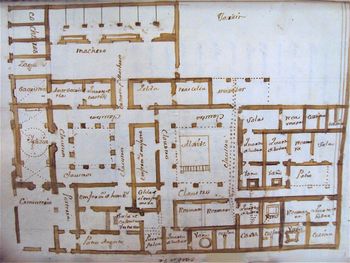
What did hospital life look like, and how did San Hipólito's charitable and medical practices reproduce Spanish colonialism? Answers to these questions can be partially addressed through a close analysis of the Order of San Hipólito's earliest statutes, dating to 1616. Although the statutes represent an idealized portrait of hospital life, there is no reason to suspect that the brothers of San Hipólito did not strive to conduct themselves and administer the institution according to the rules and procedures laid out in this document.Footnote 76 Moreover, when supplemented with other archival records such as the hospital's account books and what appears to be its earliest existing ground plan (Figure 3), an even more coherent depiction of the hospital's activities and interior life surfaces. Taken together, this evidence suggests that San Hipólito's role as a “tool” of empire resided not so much in its repressive capabilities, which, on a numerical scale, were always minimal. Rather, the hospital operated as an instrument of colonial governance through the reproduction of Iberian charitable and medical models that supported Spanish hegemony and lent legitimacy to the ideal (if not necessarily the reality) of benevolent colonial rule.
Potential Ground Design of the Hospital de San Hipólito, c. 1690s
Source: AGN, Tierras, vol. 3082, exp. 8.

While the layout shown in Figure 3 cannot be definitively confirmed as belonging to San Hipólito, or one of the other institutions administered by the brotherhood, San Hipólito likely followed a similar design.Footnote 77 The spatial configuration illustrated in Figure 3 was typical for a hospital of its place and time, underscoring the interdependence of religion and medicine and ensuring that the imposition of Catholicism and the salvation of souls remained a central facet of its function. While it deviated from the popular cruciform plan adopted by larger Spanish hospitals and exported overseas, it adhered to a traditional monastic model in combining the cloister and the infirmary into a single architectural unit.Footnote 78
The hospital's main entrance, located adjacent to the cemetery, led directly to one of the main cloisters and to the hospital chapel, which would have been frequented by ambulatory patients and the public at large. The infirmary was located to the north of the chapel; it comprised two patient wards (one for men, one for women), a smaller fevers unit (sala de calenturas) for treating patients stricken with frenzy (frenesí), and the nurse's quarters. The presence of a women's ward is striking. While hospital documents make no reference to the gender of the pobres dementes, the inclusion of a women's ward in the layout, coupled with stipulations on the treatment of female mental patients in the order's statutes, suggest that San Hipólito may have admitted women well into the middle of the seventeenth century.Footnote 79 The infirmary was located in close proximity to the chapel, following a pattern documented for the Hospital de los Inocentes in Valencia.Footnote 80 This enabled patients who were too ill to attend church, or under physical restraint, to listen to the mass and thus receive the spiritual sustenance that was vital to the healing process. In this way, the hospital's design united spaces of healing and spaces of worship, materializing in the most literal sense the hospital's dual function to “cure the body” and “cure the soul.“Footnote 81
In comparison to the hospital in Zaragoza, San Hipólito was a humble establishment. Nevertheless, its statutes attest to a relatively developed system of care and an elaborate division of labor, organized along racial lines. The hospital, in short, was meant to embody an orderly institutional space that in many ways would mirror the world beyond its walls, in theory if not necessarily in practice. Overseeing the hospital's daily operations was the chief brother or the hermano mayor. Appointed through a special election process for a three-year term, this individual directed the activities of a spiritual and manual workforce that included an official alms-seeker (demandante), doorman (portero), cook (cocinero), apothecary (boticario), the head nurse (enfermero mayor) and his assistants, the sacristan who safeguarded the chapel and the instruments of worship, the refitolero who looked after the table linens and dishes, the procurador who purchased supplies, and a number of servants.
Like its patients, San Hipólito's personnel reproduced racial hierarchies. While the brothers of San Hipólito were primarily Iberian in origin, the hospital's servants were usually Indians or blacks or of mixed race.Footnote 82 Local vendors, such as the atolera who sold atole (a drink derived from cornmeal) and the “yndio” who delivered beef, would have also infiltrated the hospital's spaces on a routine basis.Footnote 83 In addition, the brothers of San Hipólito may have collectively owned a small number of slaves. A 1675 record shows that Alonso de Arellano y Ocampo willed his slave Blas to San Hipólito. (However, Blas appears to have fled shortly following his owner's demise.)Footnote 84 Indeed, it was not uncommon during this period for slave owners to will their slaves to a hospital or monastery as an act of Christian beneficence. The statutes in fact made reference to the potential for wealthier patients on their deathbeds to bequeath money or goods—including slaves—to the hospital in gratitude for its services.Footnote 85
The onus of caring for the sick and mad was primarily undertaken by the brothers of San Hipólito, who delivered both spiritual and physical medicine.Footnote 86 Given the dearth of university-trained physicians in the Spanish Americas, the role of those in religious orders in the care of pobres dementes was accentuated.Footnote 87 Membership into the brotherhood could in fact grant access to a career in medicine, as the hermano general who oversaw the entire congregation received instructions to choose from among those members that seemed the most “suitable and inclined to this ministry so that they may practice and study medicine and surgery.” Brothers with appropriate training could then serve as hospital nurses, with the most experienced and skilled among them acting as the enfermero mayor, or head nurse.Footnote 88
The head nurse's duties and obligations were minutely detailed in the statutes. One of them was to ensure that patients confessed and took communion within three days of their arrival. For, only once the “cure of the soul” was addressed, the statutes stipulated, was the patient poised to “best receive the medicines of the body.” Patients who resisted confession and communion were admonished and eventually expelled from the hospital. In addition to confession and communion, the nurse was instructed to provide the patient “with spiritual nourishment through good counsel and doctrine.” If time permitted, he was encouraged to “read some spiritual book,” while “consoling and uplifting” the patient's spirits; these services were especially critical in situations of life-threatening illness. When a physician was available, the head nurse was supposed to accompany him on his routine rounds through the hospital's wards and record notes concerning each patient's condition and the corresponding method of treatment, ensuring the proper management of the patient's diet and medications.Footnote 89
The treatment of mad patients continuously oscillated between benevolence and coercion. Upon admission, the pobres dementes usually had their feet washed, which was not only a hygienic measure, but also a symbolic one that rehearsed Christ's washing of the feet of the disciples.Footnote 90 Their entire bodies were washed as well, and then they received a haircut. Once their feet and bodies were clean, the patients were issued a new set of hospital clothes, which consisted of a jacket and gown made of sackcloth, a shirt, stockings, and shoes; the clothing was to be changed on a weekly basis.Footnote 91 The harmonious characterization of hospital life depicted in the statutes would have been punctuated by moments of chaos as patients engaged in fits and violent outbursts. According to fray Francisco López, a member of the brotherhood of San Hipólito who testified on its behalf in 1645, although the “pobres inocentes y faltos de juico” (feeble-minded poor and those without judgment”) were given two sets of clothing to ensure “cleanliness,” many ran around topless, having torn their own clothes out of “excessive fury.”Footnote 92
While all colonial hospitals engaged in the inculcation of moral and religious rectitude, San Hipólito partook in the use of physical force, marking it as distinct space that dramatized the forceful and contradictory nature of colonial charity. Following Old World precedent, it enforced sharp distinctions between the furiosos and inocentes, reserving harsher treatment for the former. During especially aggressive episodes, the furiosos were usually placed into physical restraints called prisiones. The statutes stressed that placing the restraints be accomplished with the greatest “charity and docility” possible, “although on the exterior, in order to intimidate [atemorizar] and domesticate them, one should demonstrate roughness [aspereza] and appropriate rigor, enclosing and punishing them in the form that was necessary.” In the most extreme cases, where the patient's fury proved too much to handle, the patient was to be locked inside a cage or a special chamber (aposento) with “great care and precaution.” Because they did not pose any real danger to themselves or others, the inocentes were treated less forcefully. It was even customary for the most harmless patients to accompany the hermano demandante, or alms-seeker, as he begged for charity throughout the city.Footnote 93 Thus, whether through harsh or gentle tactics, the hospital was implicated in the production of docile and pious colonial subjects.
The treatment of female patients was essentially supposed to follow the procedures outlined for the men, except that women were to be looked after by “mujeres negras, o españolas” (black or Spanish women) of “age, virtue, and honesty.” The brothers were expressly forbidden from entering the women's ward because it was thought that such close contact with female patients, who were exposed and vulnerable, challenged not only the limits of decorum, but the brothers’ vow of chastity. To ensure that the brothers remained faithful to their vows, the statutes required that the door to the women's ward stay shut with two locks and two sets of keys, one in the possession of the head female nurse and the second belonging to the hermano mayor. The only exceptions permitting male access into the ward were to assist in pacifying violent patients or to address a medical condition that required the attention of a skilled physician or surgeon. The doors were also permitted to remain open on Sundays and holidays so that the female patients could hear the mass.Footnote 94
It is difficult to discern the precise types of treatments that were performed on the patients of San Hipólito and the degree to which humoral theories of madness—more precisely, melancholy, mania, and frenzy—entered into daily practice. Certainly, the fevers unit, outlined earlier in the hospital's layout, indicates knowledge and engagement with the learned medical consensus of the time. Medical writers working within the humoral framework inherited from the Greco-Roman world identified frenzy (frenesi) as an acute form of madness signaled by the onset of fever, and it was customary in Spanish hospitals to place patients stricken with this condition into special rooms designated exclusively for fevers.Footnote 95 The most common malady of humoral origin that would have been treated within San Hipólito's wards was melancolía (melancholy), an illness associated with the superfluity of black bile, which resulted in prolonged bouts of sadness along with symptoms such as irrational fear, anxiety, and clouded or distorted judgment, including delusions. However, beyond the allusion to the hospital's spaces for the treatment of frenzied patients, references to medical theory are evasive.
It is likewise difficult to determine the extent to which indigenous beliefs about health and illness, and madness specifically, informed medical practice and treatment. It is likely that the medicines that were concocted by the hospital's boticario or apothecary would have incorporated local plants and herbs as well as indigenous knowledge about their healing properties.Footnote 96 As a number of scholars have discussed, while the Spanish tended to dismiss indigenous healing beliefs and customs as superstitious, they demonstrated keen interest in native knowledge of botany and pharmacy, widely assimilating indigenous materia medica into European categories and paradigms. Moreover, the hospital's location on the outskirts of the capital, away from the “hustle and bustle” (trafago) of the city where patients could be exposed to the salubrious effects of the clean ayres (or airs), reflected not only European understandings of the role of the air in the transmission of disease, but also pre-Hispanic views of the air's potentially curative effects.Footnote 97
These speculations aside, therapeutics at San Hipólito reflected the imposition of Iberian medical models that stressed the centrality of regimen (diet, rest, exercise, and other practices) to health and recovery, complemented by spiritual counsel and medicines derived largely from local plants and herbs.Footnote 98 Hospital medicine during this period made no sharp demarcation between care and cure, placing preventive measures and spiritual services on par with medical intervention. The hospital's earliest account books, all dating to the late seventeenth century, generally confirm this characterization of hospital life. Specifically, the account books indicate that San Hipólito's expenditures were modest and overwhelmingly devoted to liturgy (church-related expenses such incense, wine, candles, and hosts); food, shoes, and clothing for the patients; firewood and carbon for heating and cooking; minor repairs to the building; and occasionally extra hospital beds. Patients were generally fed a local diet that consisted of a ration of beef, bread or tortillas, beans, and atole.Footnote 99 They were fed three times a day, and their diets were sometimes tailored to address their individual medical needs.Footnote 100 On the feast day of Saint Hippolytus and the Day of the Holy Innocents, hospital life transcended its routine: the cook prepared an elaborate feast and patients were given an extra helping of food. On these days, the brothers also ensured that the inocentes were properly dressed and presentable to greet the citizens of Mexico City who paid the hospital and its occupants a visit. On the feast day of the Holy Innocents in 1673, for instance, the hospital purchased 60 pieces of sackcloth to dress the inocentes, along with stitching supplies, 20 handkerchiefs, and 20 pairs of shoes.Footnote 101
Taken together, these sketches of hospital life highlight the ways in which San Hipólito functioned to sanction the colonial enterprise. Through its therapeutic, religious, and quotidian practices, the hospital was meant to highlight the bounty and benevolence of the Hapsburg state towards its pobres dementes, who were viewed as deserving of charitable care and assistance. Of course, the cloak of charity and religion, no matter how heavy its fabric, could never fully mask the hospital's more coercive and disciplinary aspects, manifested in the physical use of restraints and cages to pacify, domesticate, and shut away the most unruly of its inhabitants. Confinement and force perpetually sullied San Hipólito's reputation, and dramatized the contradictions, tensions, and outright violence central to the colonial project writ large.
Conclusion
As the earliest hospital of the New World to specialize in the care and confinement of the mad, San Hipólito was part of the transfer and adaptation of practices, ideas, and institutions from Spain to the Americas. From its attention to mad paupers as a special type of miserable to the forceful measures it employed to subdue madness, the hospital embodied an Old World prototype in a New World setting. Yet, while it preserved core features of Iberian mental hospitals, its deployment in the Americas within a colonial context produced a new range of meanings and implications. For one, its evolution from a convalescent hospital with an expansive charitable agenda to a casa de locos that rivaled those across the Atlantic was driven by the shifting needs of a colonial society in flux and the improvisational nature of Spanish expansion and settlement.
As it developed into a full-fledged mental hospital during the following century, the hospital came to register the influences of its surrounding environment in a variety of ways: through its multiracial patient population and personnel that varyingly reproduced, distorted, and reinforced racial hierarchies; through its affinity with the capital's patron saint and participation in the formation of a creole culture; and through its charitable and religious practices, which served a legitimizing function. Although the hospital functioned as a tool of colonial governance, it hardly did so according to Foucauldian models of discipline and repression, and there was never a “great confinement” of the mad in the New World, a fact that parallels the findings of scholarship on early modern Europe that has exposed the phenomenon of mass internment as misleading.Footnote 102 Instead, the hospital's utility to the colonial project resided in its charitable, medical, and custodial services, which reinforced Catholicism and rehearsed the benevolence of the Spanish king toward its most vulnerable and marginal subjects. However, the degree to which it succeeded in legitimizing colonial rule warrants skepticism. Certainly, when it came to the indigenous population, its charitable message and institutional reach fell stunningly short.
By the late eighteenth century, Hapsburg models of charity would fall into full decline and San Hipólito too would plummet into a state of misery, driven by limited finances and monastic indiscipline among the brothers of San Hipólito. Under the broader umbrella of “reform” initiated by the Bourbon monarchs, the hospital would undergo a series of transformations, including physical amplification of its premises to accommodate a larger number of patients and the redefining of its charitable mission in terms of a utilitarian service to the state and the greater public.Footnote 103 While the details of this transformation reside outside the domain of this article, it speaks to the ways in which the hospital continuously registered larger processes occurring in the world beyond its walls and reproduced Spanish colonialism in all its ambitions and limitations.