Introduction
Climate change predictions show clear increases in temperature, concomitant increase in potential evapotranspiration and more frequent episodes of climatic anomalies, such as droughts and heat waves (IPCC, Reference Stocker, Dahe, Plattner, Tignor, Allen, Boschung, Nauels, Xia, Bex and Midgley2013). These changes will be most prevalent in most of the current semiarid areas (Vicente-Serano et al., Reference Vicente-Serrano, Lopez-Moreno, Begueria, Lorenzo-Molina, Moran-Tejeda, Revuelto, Trigo, Coelho and Espejo2014), including the North American temperate zones where lentil production occurs (Sauchyn and Kulshreshtha, Reference Sauchyn, Kulshrehtha, Lemmen, Warren, Lacroix and Bush2008). In the prairies, the most damaging effects of climate change will be the reduced availability of water given that the natural health and wealth of the prairies are intimately linked to both water quality and quantity (Sauchyn and Kulshreshtha, Reference Sauchyn, Kulshrehtha, Lemmen, Warren, Lacroix and Bush2008). Competition for water to produce annual crops including lentil, for domestic and industrial uses will increase (Hamdy et al., Reference Hamdy, Ragab and Scarascia-Mugnozza2003; Medrano et al., Reference Medrano, Tomás, Martorell, Flexas, Hernández, Rossello, Pou, Escalona and Bota2015). This competition can be reduced by increasing the efficient use of water extracted from the soil to produce more biomass [transpiration efficiency (TE)] and crop yield. In the case of lentil, this strategy may be achieved by developing crop cultivars with genetic introgression from wild lentil genotypes which require less water to complete their life cycle (Gorim and Vandenberg, Reference Gorim and Vandenberg2017a).
Although water use efficiency has traditionally been measured at the leaf, whole-plant and plot levels (Vadez et al., Reference Vadez, Kholova, Medina, Kakkera and Anderberg2014), results obtained can be misleading (Blum, Reference Blum2009). Thus, breeding improved cultivars for drought-prone areas should focus on water use and TE (Passioura, Reference Passioura1977). The effective use of water can enhance biomass production under drought stress, achieved primarily by maximizing soil water capture while diverting the largest part of the available soil moisture toward stomatal transpiration (Blum, Reference Blum2009). This is the major engine for agronomic or genetic enhancement of crop production under limited water conditions. Wild lentil genotypes can potentially contribute genes that confer drought tolerance mechanisms to cultivated lentils thereby, making them more water efficient. Apart from TE, Passioura (Reference Passioura1977) stated that harvest index (HI) and other traits contribute to yield under drought and fully watered conditions in wheat and grain legumes such as soyabean and groundnut (Lawn, Reference Lawn1989). Under fully watered conditions, high HI was shown to be the third key component required in breeding for high yield in common bean. However, breeders need to be cautious not to select exclusively for high HI, and should combine it with selection for high yield, high biomass and acceptable maturity (Wallace et al., Reference Wallace, Baudoin, Beaver, Coyne, Halseth, Masaya, Munger, Myers and Silbernagel1993).
Wild lentil species have been shown to employ different strategies to survive drought stress (Gorim and Vandenberg, Reference Gorim and Vandenberg2017a). How yields are affected when these strategies are employed, can be evaluated by assessing drought indices under both well-watered and drought conditions (Mitra, Reference Mitra2001). This study focuses on use water, TE and yield in cultivated and wild lentils under fully watered and drought stress conditions. Secondly, it attempts to identify drought indices that could be used to assess genotypes of cultivated × wild lentil populations in future. We hypothesize that wild lentils have higher TE and use less water when grown under moisture deficit conditions.
Materials and methods
Soil and plant materials
This experiment was carried out in the controlled environment facility at the College of Agriculture and Bioresources at the University of Saskatchewan, Canada (latitude 52.133 and longitude −106.631). Details of the soil characteristics, pre-germination conditions, experimental design and setup were similar to that reported in Gorim and Vandenberg (Reference Gorim and Vandenberg2017a). Plants maintained in soil at 40 and 25% field capacity (FC) were assumed to be under moderate and severe drought, respectively; fully watered plants were grown in soil maintained at 80% FC. The wild lentil species/genotypes (abbreviation in parentheses) were: L. orientalis (L. ori.), IG 72643, L. ori. PI 572376, Lens tomentosus (L. tom.) IG 72805, L. odemensis (L. ode.) IG 72623, L. lamottei (L. lam.) IG 110813, L. ervoides (L. erv.) L-01-827A, L. erv. IG 72815. Lens culinaris (L. cul.) Eston was the only cultivated genotype included in this experiment since it has been successfully crossed with some of the wild species. Data for all figures and tables are arranged phylogenetically so that results for the first four genotypes (primary gene pool) are followed by those in the secondary and tertiary gene pools as categorized by Wong et al. (Reference Wong, Gujaria-Verma, Ramsay, Yuan, Caron, Diapari, Vandenberg and Bett2015).
Parameters evaluated
Half of the plants were evaluated for growth parameters at 13 weeks after sowing (WAS). Roots were collected on a 0.5 mm mesh screen to minimize root loss prior to washing and placed in Ziploc bags. Debris and dead roots from the field soil were manually removed. The roots were placed in the labelled paper bags, and then oven dried at 70°C for 48 h to determine root dry weight. Tube weights were recorded every other day throughout the experiment and these data were used to estimate the total amount of water transpired from 3 to 13 WAS. Plants were grown under low vapour pressure deficit which varied from 0.62 to 2.36 kPa during the day to 0.29 to 1.26 kPa during the night for the duration of the experiment.
The other half of the plants were left to flower and set seeds. Prior to maturity, plants were bagged with a light mesh to capture dehiscent seeds. Seeds were harvested and weighed for each treatment and genotype when plants had more than 80% mature seed. All graphs and tables are arranged phylogenetically so that results for the first four genotypes (primary gene pool) are followed by those in the secondary and tertiary gene pools. We calculated TE and grain water use efficiency (WUEg) according to the formula stated in Vadez et al. (Reference Vadez, Kholova, Medina, Kakkera and Anderberg2014) and Stanhill (Reference Stanhill1987), respectively. The cumulative water used was calculated by summing up the water used or consumed over time. Mobilization index (MI) was calculated using the formula of Ray and Choudhuri (Reference Ray and Choudhuri1980), while HI was calculated by dividing seed weight by shoot dry weight. Drought indices for stress tolerance index (STI), drought susceptibility index (DSI), tolerance index (TOL), mean productivity (MP) and geometric mean productivity (GM) were calculated using the formulae of Ramirez-Vallejo and Kelly (Reference Ramirez-Vallejo and Kelly1998) and Golabadi et al. (Reference Golabadi, Arzani and Maibody2006).
Parameters were calculated as:
 $${\rm WU}{\rm E}_{\rm g}\left( {{\rm g}{\rm L}^{ - {\rm 1}}} \right) = {\rm Seed}\,{\rm yield}/{\rm Total}\,{\rm water}\,{\rm transpired \,(consumed)}$$
 $$\eqalign{ {\rm TE}\big( {{\rm g}{\rm L}^{ - {\rm 1}}} \big) &\,=\;\big( {{\rm Dry}\,{\rm weight}\,{\rm of}\,{\rm final}\,{\rm biomass}} \cr &- \;{\rm Dry}\,{\rm weight}\,{\rm of}\,{\rm initial}\,{\rm biomass} \big) / {\rm Total}\,{\rm water}\,{\rm consumed}}$$
 $$\eqalign{{\rm MI} & = {\rm Seed}\,{\rm weight}/{\rm Total}\,{\rm biomass} \cr & \quad \left({{\rm root} + {\rm shoot} + {\rm seed}\,{\rm dry}\,{\rm weight}} \right)}$$
 $${\rm HI} = {\rm Seed}\,{\rm weight}/{\rm Shoot}\,{\rm dry}\,{\rm weight}$$
 $$\eqalign{{\rm Total}\,{\rm water}\,{\rm consumed} & = \sum {\rm} \left[ {\left( {{\rm P1} - {\rm P2}} \right)/\left( {{\rm D1} - {\rm D2}} \right)} \right] \cr & \quad - \left[ {\left( {{\rm E1} - {\rm E2}} \right)/\left( {{\rm D1} - {\rm D2}} \right)} \right]}$$
where:
 $$\eqalign{& {\rm P1} = {\rm weight}\,{\rm of}\,{\rm tube}\,{\rm with}\,{\rm plants}\,{\rm at}\,{\rm initial}\,{\rm watering};\cr & {\rm P2} = {\rm weight}\,{\rm of}\,{\rm tubes}\,{\rm with}\,{\rm plant}\,{\rm at}\,{\rm next}\,{\rm watering}}$$
 $${\rm D1} = {\rm Day}\,{\rm of}\,{\rm initial}\,{\rm watering};\,{\rm D2} = {\rm Day}\,{\rm of}\,{\rm next}\,{\rm watering}$$
 $$\eqalign{& {\rm E1} = {\rm tube}\,{\rm with}\,{\rm no}\,{\rm plants}\,{\rm at}\,{\rm initial}\,{\rm watering}; \cr & {\rm E2} = {\rm Tubes}\,{\rm with}\,{\rm no}\,{\rm plants}\,{\rm at}\,{\rm next}\,{\rm watering}}$$
 $${\rm DSI} = \left[ {{\rm 1} - {\rm} \left( {{\rm Y}_{\rm s}} \right)/\left( {{\rm Y}_{\rm p}} \right)} \right]{\rm} /{\rm DII}$$
where DII is the drought intensity and calculated as: DII = [1−(Xs)/(Xp)] (Fischer and Maurer, Reference Fischer and Maurer1978)
 $${\rm STI} = [\left( {{\rm Y}_{\rm p}} \right) \times \left( {{\rm Y}_{\rm s}} \right)/\left( {{\rm X}_{\rm p}} \right)^{\rm 2}]$$
 $${\rm GM} = ({\rm Y}_{\rm s} \times {\rm Y}_{\rm p})^{{\rm 1}/{\rm 2}}$$
 $${\rm TOL} = ({\rm Y}_{\rm p} - {\rm Y}_{\rm s})$$
 $${\rm MP} = \left( {{\rm Y}_{\rm p} + {\rm Y}_{\rm s}} \right)/{\rm 2}$$
where Ys and Yp are the mean yield of genotypes evaluated under drought stress (40 or 25% FC) and fully watered conditions, respectively. Xs and Xp are the mean yields over all genotypes evaluated under drought stress (40 or 25% FC) and fully watered conditions.
Statistical analysis
Mean plant yield, TE, WUEg and drought indices were compared between genotypes grown at different soil moisture levels. Least significant difference between means was calculated using the PROC GLM procedure using Statistical Analysis System software (SAS 9.4, SAS Institute, Cary, a procedure in SAS 9.4. Significant differences are reported at α = 0.05. The figure was drawn with the aid of Sigma Plot (Sigma Plot 10, Systat Software Inc., Germany).
Results
Effects of moisture on water used and TE
A variable amount of water was consumed by both cultivated and wild lentil genotypes (Fig. 1). Under fully watered and moderate drought conditions, L. cul. Eston consumed significantly higher amounts of water compared with wild genotypes belonging to the primary, secondary and tertiary gene pools. The wild genotypes in each gene pool consumed similar amounts of water under fully watered condition. Under moderate drought and in the primary gene pool, L. ori. IG 72643 consumed significantly less water over time compared with L. cul. Eston and the other wild genotypes. A similar amount of water was consumed by wild genotypes in the secondary gene pool meanwhile in the tertiary gene pool, L. erv. L-01-827A had significantly lower water consumption compared with both L. erv. IG 72815 and L. cul. Eston. Under severe drought, some genotypes in the primary gene pool consumed more water than L. cul. Eston, while others did not (Fig. 1). There was no clear pattern for genotypes in the secondary gene pool meanwhile in the tertiary gene pool, the amount of water consumed over time, though similar for both Lens ervoides genotypes, was significantly lower than that of L. cul. Eston.
Cumulative amount of water used (transpired) over time in cultivated and wild lentil genotypes grown under three moisture levels and categorized into the primary, secondary and tertiary gene pools (Wong et al., Reference Wong, Gujaria-Verma, Ramsay, Yuan, Caron, Diapari, Vandenberg and Bett2015). FW, 40% FC and 25% FC denote plants grown under fully watered conditions, moderate and severe drought, respectively.

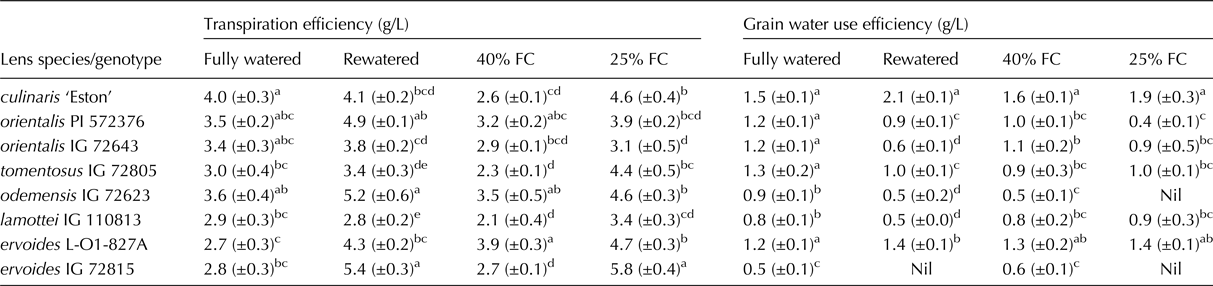
When plants were grown under fully watered conditions, the cultivated lentil had similar TE compared with both L. ori (PI 572376 and IG 72643) and L. ode. IG 72623 but had significantly higher (α = 5%) TE when compared with the other wild genotypes (Table 1). Rewatering greatly improved TE in both wild and cultivated lentils. When plants were rewatered, Lens odemensis IG 72623 and L. erv. IG 72815 had significantly higher (α = 5%) TE compared with all other genotypes. Under the moderate drought, both wild and cultivated lentil grown had lower TE compared with when they were grown under severe drought. Under moderate drought, L. erv. L-01-827A and L. ode. IG 72623 had significantly higher (α = 5%) TE compared with all other genotypes. For L. cul. Eston, TE was at its minimum under moderate drought and at its maximum when grown under severe drought (Table 1). Under severe drought, L. erv. IG 72815 had a significantly higher (α = 5%) TE compared with all other genotypes. The other wild lentil genotypes except for L. ori. IG 72643 and L. lam. IG 110813, had similar TE to L. cul. Eston under severe drought.
Transpiration efficiency and grain water use efficiency of cultivated and seven wild lentil genotypes gown under four different soil moisture levels

Numbers in brackets represent standard error.
Letters compare genotypes within columns – different letters indicate significant differences at α = 5%; [FC, field capacity].
When grouped on the basis of gene pools, under fully watered conditions, the TE of L. cul. Eston was similar to that of the other genotypes in the primary gene pool except for L. tom. IG 72805. For genotypes belonging to the secondary gene pool, the TE of L. cul. Eston was similar to that of L. ode. IG 72623 but was significantly higher (α = 5%) than that of L. lam. IG 110813, and had significantly higher TE (α = 5%) than that of all genotypes belonging to the tertiary gene pool. When plants were rewatered, similar TE values were observed between L. cul. Eston and all wild genotypes belonging to the primary gene pool. In the secondary gene pool, L. ode. IG 72623 had significantly higher (α = 5%) TE while L. lam. IG 110813 had significantly lower (α = 5%) TE when compared with L. cul. Eston. In the tertiary gene pool, L. erv. L-01-827A had similar TE compared with L. cul. Eston, and the TE of L. erv. IG 72815 was significantly higher (α = 5%).
When plants were sown under moderate drought, the TE of L. cul. Eston was similar to all genotypes in the primary gene pool. For the secondary gene pool, L. ode. IG 72623 had significantly higher (α = 5%) TE compared with L. cul. Eston which was similar to that of L. lam. IG 110813. For the tertiary gene pool, L. erv. IG 72815 had similar TE compared with L. cul. Eston, while the TE of L. erv. L-01-827A was significantly higher (α = 5%) TE. Under the severe drought treatment, TE of L. cul. Eston was similar to that of all wild genotypes of the primary gene pool except L. ori. IG 72643. The gene pool genotypes, L. lam. IG 110813 and L. ode. IG 72623 had significantly lower (α = 5%) and similar TE, respectively, in comparison with L. cul. Eston. The tertiary gene pool genotypes L. erv. IG 72815 and L. erv. L-01-827A had significantly higher (α = 5%) and similar TE, respectively, compared with L. cul. Eston.
Effects of moisture on grain water use efficiency
Under fully watered conditions. Lens culinaris Eston had similar grain WUEg compared with the other genotypes of the primary gene pool and to L. erv. L-01-827A of the tertiary pool. The remaining genotypes i.e. Lens odemensis IG 72623, L. lam. IG 110813 and L. erv. IG 72815 had WUEg that were significantly lower (α = 5%) than that of L. cul. Eston under fully watered conditions. When plants were rewatered, the WUEg of L. cul. Eston was significantly higher than those of all wild genotypes irrespective of their genetic categorization. Under moderate and severe drought, L. cul. Eston WUEg was similar to that of L. erv. L-01-827A and this was significantly higher (α = 5%) than that of the other wild genotypes. Lens odemensis IG 72623 and L. erv. IG 72815 did not produce seeds when they were either rewatered or grown under severe drought (Table 1).
Effects of moisture on mobilization and harvest indices
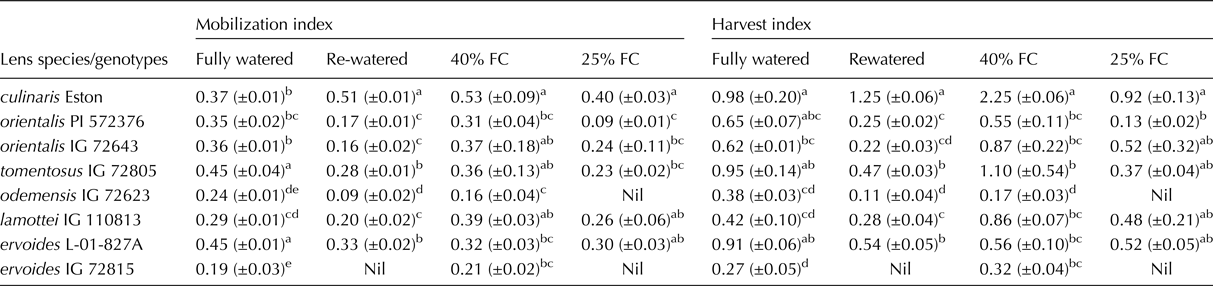
MI and HI ranged from 0 to 0.53 and 0 to 2.25, respectively. When plants were grown under fully watered conditions, both L. tom. IG 72805 and L. erv. L-01-827A had significantly higher MI compared with L. cul. Eston and the other wild genotypes (Table 2). However, when plants were rewatered, L. cul. Eston had significantly higher MI comparison with all other genotypes. For lentils grown under moderate drought, the MI of L. cul Eston was similar to that of L. ori. IG 72643, L. tom. IG 72805 and L. lam. IG 110813; while the rest of the wild genotypes had significantly lower (α = 5%) MI. Under severe drought, L. cul. Eston had similar MI with L. lam. IG 110813 and L. erv. L-01-827A and these MI were significantly higher (α = 5%) than those of the rest of the genotypes.
Mobilization and harvest indices of cultivated and seven wild lentil genotypes gown under four moisture levels

Letters compare genotypes in a given column with different letters denoting significant differences at alpha equals 5%; (FC: field capacity). Numbers in brackets denote standard error of the mean.
Under fully watered conditions, L. cul. Eston, L. ori. PI 572376, L. tom. IG 72805 and L. erv. L-01-827A had similar HI that was significantly higher (α = 5%) than that of the other genotypes. When plants were rewatered or grown under moderate drought, the HI of L. cul. Eston was significantly higher than that of all wild genotypes. When plants were grown under severe drought, the HI of L. cul. Eston was similar to that all genotypes except L. ori. PI 572376 which had significantly lower HI (Table 2).
Seed yield, drought indices and their correlation in wild and cultivated lentil
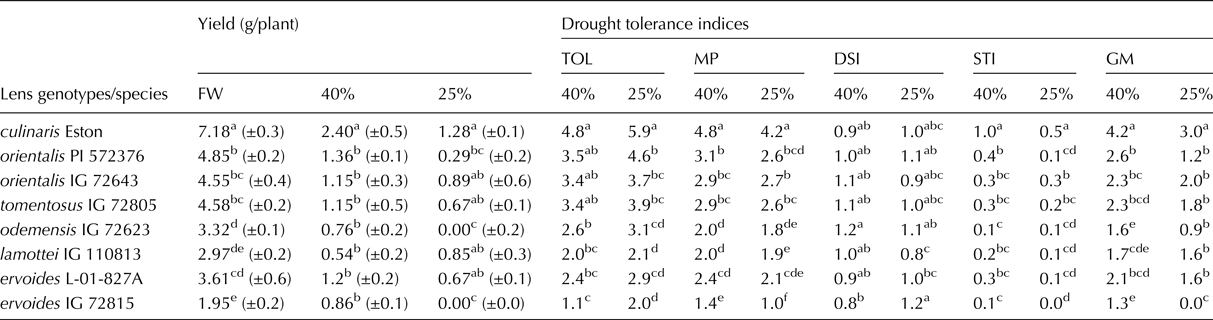
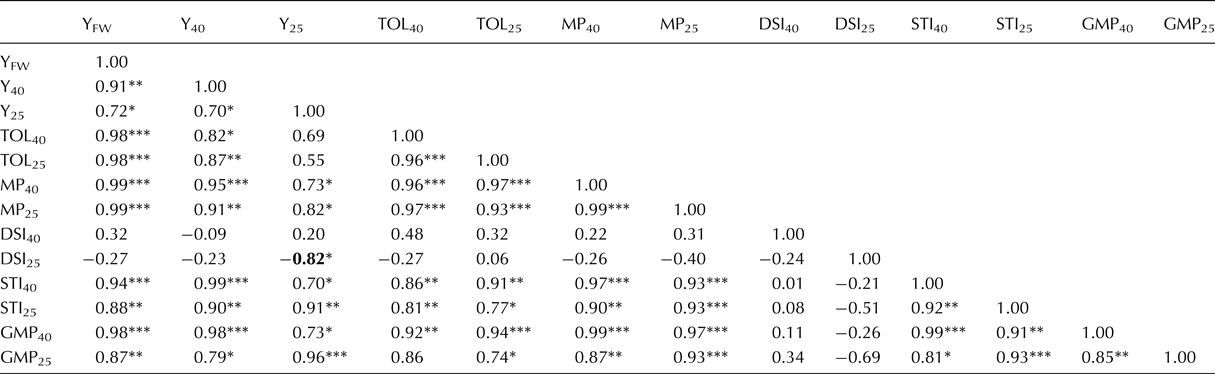
Lens culinaris Eston had significantly higher (α = 5%) yield compared with all wild lentils genotypes under fully watered conditions and under moderate drought. Under severe drought, similar yields were observed between L. cul. Eston, L. ori. IG 72643, L. tom. IG 72805, L. lam. IG 110813 and L. erv. L-01-827A, and were significantly higher (α = 5%) than that of the other genotypes (Table 3). When plants were grown under both moderate and severe drought, L. cul. Eston had the highest TOL and MP that was significant (α = 5%) compared with all wild genotypes. Similar DSI values were observed among most genotypes irrespective of moisture level (Table 3). There was highly significant correlation (P = 0.001) between TOL and MP, STI and GM, but no correlation between TOL and DSI (Table 4). TOL had a highly significant (P = 0.001) correlation with yield under fully watered conditions, a significant correlation (P = 0.01) with yield under moderate drought and no relationship with yield under severe drought. Although DSI had no relationship with other indices, it had a significant (P = 0.05) negative correlation with yield at 25% FC (Table 4). MP, STI and GM had significant positive correlation with yield irrespective of the moisture level. The level of significance between any pair of correlation indices depended on the stress level.
Seed weights under fully watered and two drought treatments and five drought tolerance indices of cultivated and seven wild lentil genotypes

Letters compare genotypes in a given column with different letters denoting significant differences at alpha equals 5%. (FW: fully watered; 40%: 40% of field capacity; 25%: 25% of field capacity). (TOL, tolerance index; MP, mean productivity; DSI, drought susceptibility index; STI, stress tolerance index; GM, geometric mean productivity). Numbers in brackets denote standard error of the mean.
Correlation coefficient matrix for yield and drought indices in cultivated and seven wild lentil genotypes

[*, **, *** indicate significant correlations at P < 0.05, 0.01 and 0.001, respectively]. TOL, tolerance index; MP, mean productivity; HM, harmonic mean; DSI, drought susceptibility index; STI, stress tolerance index; GMP, geometric mean productivity; (FW, RW, 40 and 25 were plants that were fully watered, rewatered, grown at 40 or 25% of field capacity, respectively). Y: mean yield for all genotypes at each moisture level.
Discussion
Continuous genetic improvement of lentil cultivars for the Canadian prairies is required to keep pace with potential increases in variability and extremes of precipitation (Sauchyn and Kulshreshtha, Reference Sauchyn, Kulshrehtha, Lemmen, Warren, Lacroix and Bush2008). The goal of breeding programmes is to develop a genetic base that will help avoid total yield failure in drought years, while maintaining high productivity in years with normal or above normal rainfall. To achieve this goal, the most promising genetic improvement strategy is to maximize genetic diversity by introgression of genes from candidate wild lentil genotypes. Cultivated lentil can be hybridized with wild species in the primary, secondary and tertiary gene pools. To date the main objectives for use of the wild species has been to transfer resistance to biotic stresses, primarily resistance to fungal pathogens (Ye et al., Reference Ye, McNeil and Hill2002; Tullu et al., Reference Tullu, Tar'an, Breitkreutz, Buchwaldt, Banniza, Warkentin and Vandenberg2006). Systematic investigations of abiotic stress resistances shows that wild lentils use a range of stress avoidance strategies, evidenced by their diverse rooting patterns (Gorim and Vandenberg, Reference Gorim and Vandenberg2017a). How much biomass and subsequent grain is produced per unit of water transpired can be used to identify water-efficient genotypes, which then can be used to breed for water-efficient cultivated lentil cultivars. We previously demonstrated that the wild lentil genotypes, L. erv. IG 72815, L. ode. IG 72623 and L. ori. PI 572376, possess deep root systems under moderate and severe drought stress and that others, such as L. ori. IG 72643 have roots with larger diameter; all wild genotypes also transpire different amounts of water during their life cycle (Gorim and Vandenberg, Reference Gorim and Vandenberg2017a). We also demonstrated that when wild lentil genotypes were grown under fully watered conditions, the root distribution in the A, B and C soil horizons was significantly different from that of Lens culinaris Eston (Gorim and Vandenberg, Reference Gorim and Vandenberg2017b).
In the current study, we compare the amount of water used, TE and related parameters for lentil genotypes of the primary, secondary and tertiary gene pools with L. cul. Eston to determine whether genetically related genotypes had similar outcomes. The actual amount of water used or transpired per genotype and water lost to evaporation was estimated as advised by Ludlow and Muchow (Reference Ludlow and Muchow1990) such that water-efficient genotypes can easily be identified. We observed variability in the amount of dry matter fixed per unit water extracted from the soil (TE) in both wild and cultivated lentils at different moisture levels. This was previously reported in sorghum and peanut by Vadez et al. (Reference Vadez, Kholova, Medina, Kakkera and Anderberg2014), who stated that TE is influenced by both genetic and environmental factors especially high vapor pressure deficit and soil drying. This study was conducted under low vapor pressure deficit conditions. We, therefore, assume that genotypic differences in TE resulted from differences in soil moisture levels. The amount of water consumed when plants were fully watered compared with when they were grown under moderate or severe drought (Fig. 1) was higher (3000–5400 ml) with corresponding low TE values. For example, both Lens ervoides belonging to the tertiary gene pool which consumed lower amount of water compared with L. cul. Eston, also had lower TE. Some wild species such as L. tom. IG 72805 and L. erv. L-01-827A had significantly higher MI than L. cul. Eston. This implies that even though L. cul. Eston had higher TE, these genotypes were channelling significantly more resources into seed production compared with biomass. A strategy for interspecific hybridization of wild and cultivate lentil, therefore, requires consideration of not only the changes that could occur with respect to root architecture but also changes in biomass and subsequent yield potential.
Although less water was consumed by genotypes in the primary gene pool under moderate drought, they had similar TE with L. cul. Eston implying that these wild genotypes were more efficient water users. For genotypes in the secondary gene pool, L. ode. IG 72623 used water more efficiently than L. lam. IG 110813 and L. cul. Eston evident in its water used and TE meanwhile for genotypes in the tertiary gene pool, L. erv. L-01-827A was a more efficient water user compared with L. cul. Eston. The possession of significantly longer roots might have enabled L. erv. L-01-827A and L. ode. IG 72623 to retain more water that is channelled towards biomass fixation.
Under severe drought, similar TE were found in genotypes in the primary gene pool except for L. ori. IG 72643; implying this genotype compared with the other wild lentils may be less efficient in using water. The physiological mechanisms involved need to be further investigated as this genotype is known to have larger root diameter (Gorim and Vandenberg, Reference Gorim and Vandenberg2017b). In the tertiary gene pool, L. erv. L-01-827A that consumed lower amounts of water over time had similar TE with L. cul. Eston; it was more efficient water user. However, L. erv. IG 72815 was the only wild lentil that had a significantly higher TE than L. cul. Eston under severe drought, but it failed to produce seeds under these conditions. Overall, comparing genotypes of the different gene pool revealed that under some conditions, e.g. under fully watered conditions, genotypes in the primary and tertiary gene pool used similar amounts of water and had similar TE; whether this was genetically controlled needs to be further investigated. Water use patterns of these genotypes under drought conditions may be linked to plasticity acquired over time at their centres of origin (Gorim and Vandenberg, Reference Gorim and Vandenberg2017a).
A situation that frequently occurs in the prairies is that the growing season normally starts with sufficient soil moisture for germination, is often followed by a period of drought, and then receives additional pre-harvest precipitation. It may be possible to breed improved germplasm that exhibits the response shown by the rewatered treatment. Lens ode. IG 72623 and L. erv. IG 72815 would be possible candidates for breeding given their significantly high TE under such scenario (Table 1). However, the mobilization and harvest indices of these wild genotypes could not be measured as they failed to produce seeds for the duration of the experiment. Lens lamottei IG 110813 had significantly lower TE compared with L. cul. Eston at all moisture levels, except under moderate drought. This low TE and HI need to be taken into consideration when crosses are made between this genotype and cultivated lentil in breeding programmes.
Another important aspect related to water use is the proportion of the extracted water that is actually channelled for grain production. When WUEg was compared among all genotypes, L. cul. Eston had similar WUEg with all genotypes belonging to the primary gene pool, whether this was genetically linked requires further assessments given that the root architectures of some of these genotypes are significantly different from that of L. cul. Eston. Under moderate or severe drought, L. cul. Eston had similar WUEg to L. erv. L-01-827A although they belonged to the primary and tertiary gene pool, respectively; this implies that crosses between them may not affect yield output. None of the other wild lentils channelled water towards grain production more efficiently than L. cul. Eston and the reasons for this behaviour need to be further investigated. During the course of our experiment, L. ode. IG 72623 and L. erv. IG 72815 failed to produce seed under severe drought, and for the latter, also under rewatered conditions. This delay in seed production under drought conditions coupled with the indeterminate growth habit of lentils may be a positive attribute that expresses the plasticity of these genotypes under said condition. However, further investigations are required to make meaningful conclusions. Furthermore, we expect that the characterization of first and second generation lines that are produced by introgression may lead to the identification of superior recombination of all traits.
The numerous, light weight, small seeds produced by wild lentils is lost in weight based, MI, HI and other calculations as weights calculated did not indicate seed number. We observed that the HI of some wild genotypes was significantly reduced under moderate drought, an observation reported in wheat genotypes by Solomon and Labuschagne (Reference Solomon and Labuschagne2003). Nonetheless, cultivated lentil and some wild lentils had significantly higher HI under moderate drought compared with fully watered conditions (Table 2). These behaviours have to be taken into consideration when introgressions are carried out within breeding programmes. Although, L. tom. IG 72805 and L. erv. L-01-827A were prodigious enough under fully watered conditions, the bias introduced by these weight-based calculations needs to be taken into consideration. One way to eliminate the bias is to calculate drought tolerant indices that compare seed weight differences for the same genotype under both fully watered and drought conditions. The resultant values can then be used to compare genotypes. Given that the wild lentil genotypes assessed in this study are the parents of recombinant inbred lines (RILs), identifying indices that can easily differentiate among drought-tolerant genotypes may be helpful for future assessments involving the RILs. For example, L. culinaris Eston which is an old lentil variety had the highest TOL that was significant (α = 5%) when grown under severe drought (Table 3), implying that it was the most susceptible genotype compared with its wild counterparts. However, much higher yielding culinaris varieties are now available for the second round of introgression with wild lentils. This study showed that TOL failed to differentiate lentil genotypes with low yield potential as previously reported in beans (Ramirez-Vallejo and Kelly, Reference Ramirez-Vallejo and Kelly1998). Also, there was no correlation between TOL and yields under severe drought (Table 4) implying it was inefficient in selecting tolerant lentil genotypes under said conditions. However, DSI showed a strong significant negative correlation with lentil yields under severe drought suggesting that it could be used as a tool to identify genotypes with high yield potential under such conditions. Other indices such as MP, STI and GM showed significantly high correlation with yield and with each other at all moisture levels. This implies that either of them can be used to identify lentil genotypes with both drought tolerance and high yield potential.
Conclusions
Wild lentil species are potential rich sources of genetic diversity to improve water use, TE and yield in cultivated lentil. Specifically the wild lentil genotypes, L. erv. L-01-827A, L. ode. IG 72623 and L. erv. IG 72815 would be good candidates for developing germplasm for moderate and severe drought conditions respectively. When resource mobilization into seeds was considered, either L. tom. IG 72805 or L. erv. L-01-827A would be useful sources of variation. The TE of both cultivated and wild lentil genotypes was influenced by soil moisture level; most wild lentil genotypes used water more efficiently to produce yield under fully watered and moderate drought compared with cultivated lentil. Drought susceptibility index was delineated as a possible index that can be used to identify drought tolerant genotypes under severe drought. Although most drought indices are based on dry matter accumulation, we suggest that formulae that also incorporate seed number be introduced in order to maximize the potential benefits represented by wild lentil introgression.
Acknowledgements
This research received financial support from Canada's NSERC Industrial Research Chair Program, Saskatchewan Pulse Growers and Global Crop Diversity Trust. The completion of this work was made possible by the technical support of the Pulse Crop Field Laboratory crew of the Crop Development Centre, University of Saskatchewan.
Funding
This research received financial support from Canada's NSERC Industrial Research Chair Program (#IRCPG 395994-09), Saskatchewan Pulse Growers (#BRE 1202), and Global Crop Diversity Trust.