Introduction
Maize (Zea mays L.) kernel drying is affected by genetic characteristics of hybrids and environmental factors (Troyer and Ambrose, Reference Troyer and Ambrose1971; Hunter et al., Reference Hunter, Mortimore, Gerrish and Kannenberg1979), in which temperature and wind speed mainly affected before physiological maturity (PM), while temperature and relative humidity mainly affected after PM (Gao et al., Reference Gao, Ming, Li, Xie, Xue, Hou, Wang and Li2018). The growth and development of maize in the field are mainly influenced by temperature, solar radiation and photoperiod, not only temperature mainly affects the growth process of maize, but it also determines the rate and duration of kernel drying, therefore, temperature is the main force of grain drying under drying period (Warrington and Kanemasu, Reference Warrington and Kanemasu1983). The base temperature of 8 or 10°C were often used to calculate the thermal time of a crop during growth and development (Jones and Kiniry, Reference Jones and Kiniry1986; Otegui et al., Reference Otegui, Ruiz and Petruzzi1996; Capristo et al., Reference Capristo, Rizzalli and Andrade2007), and generally, the growing degree-day is used interchangeably with thermal time (Yang et al., Reference Yang, Logan and Coffey D1995). However, when the temperature is above 0°C, the kernel moisture diffuses into the atmosphere (Muchow, Reference Muchow1990; Stewart et al., Reference Stewart, Dwyer and Carrigan1998; Tsimba et al., Reference Tsimba, Edmeades, Millner and Kemp2013), and it is usually expressed as accumulated temperature (AT). The kernel drying process can be divided into two different stages of moisture transfer, such as capillary action (constant-rate drying) and intracellular action (falling-rate period), which have different physiological activities due to diffusion (Brooking, Reference Brooking1990). In this study, kernel drying as a physical process was predicted with a base temperature of 0°C.
In Northeastern China, there are abundant heat resources for drying maize and the suitable harvest period is long, which is advantageous for mechanical harvesting (Li, Reference Li2017). In order to meet the huge market demand for maize with limited farmlands, selecting relatively late-maturing hybrids and making full use of heat resources has been used as a strategy to increase maize yield in Northeastern China in the past few decades (Chu et al., Reference Chu, Ming, Li, Xue, Zhang, Hou, Xie, Hou, Wang and Li2020). Maize usually reaches PM just a few days before the first frost in the autumn. Around this time, there is commonly a high kernel moisture content (KMC ~ 30%) at harvest, which is also an important factor influencing kernel quality and post-harvest management (Jennings, Reference Jennings1974; Chai et al., Reference Chai, Wang, Guo, Xie, Li, Ming, Hou, Liu, Chu, Zhang, Zhang, Liu and Li2017). Many farmers prefer to harvest after the first frost. On the one hand, high KMC can provide a high yield (Dwyer et al., Reference Dwyer, Ma, Evenson and Hamilton1994), but on the other hand, high KMC maize can be used as an animal feed or material for ethanol production, which is the traditional harvest scenario (THS) in Northeastern China. As labour costs rise, mechanical kernel harvesting, which is widely used in developed countries, is becoming extensive in China (Baute et al., Reference Baute, McDonald and Reid2002; Li, Reference Li2013). Meanwhile, with the emergence of new agricultural entities such as cooperatives, family farms and trust companies, mass production has become an inevitable trend. Previous studies have shown that when KMC is reduced to around 25%, the harvest quality can be improved and kernel drying costs can be reduced (Li et al., Reference Li, Lei, Xie, Wang, Hou, Zhang and Li2017). Currently, this kernel harvest is being promoted on a large scale with the changed harvest scenario (CHS). However, the kernels still need to be heated and dried after harvest. By reviewing the progress of maize production in the United States and European countries, it was found that a system of advanced and efficient maize production has been gradually established centring on mechanical kernel harvest through continuous improvement of hybrids and in-field management (Zhao et al., Reference Zhao, Li, Dong, Zhang, Wang, Xue, Gao, Sun, Zhang, Liu, Liu and Wang2011; Li, Reference Li2013). At present, KMC at harvest is largely dependent on weather conditions, production methods and hybrid drying properties and may not ever reach 16%. However, by breeding and planting early or mid-maturing hybrids with high-yield potential, maize kernels can be naturally dried in the field for approximately 30 days before harvest, and KMC can be reduced to 16–17% with the development of agriculture and the progress of science and technology. For future harvest scenario (FHS), the harvested kernels can be directly stored in bags by farmers or directly transported to warehouses by cooperatives and large-scale farms, thereby reducing drying costs and enhancing productivity. In the current study, we evaluated the effects of different sowing dates and harvest scenarios on maize grain drying times by using the historical climate data of the test site over many years and the AT demand of maize grains. This study will provide a theoretical basis for maize growing areas to cope with climate change and for farmers to reasonably choose the corresponding hybrids.
Materials and methods
Experiments and hybrids
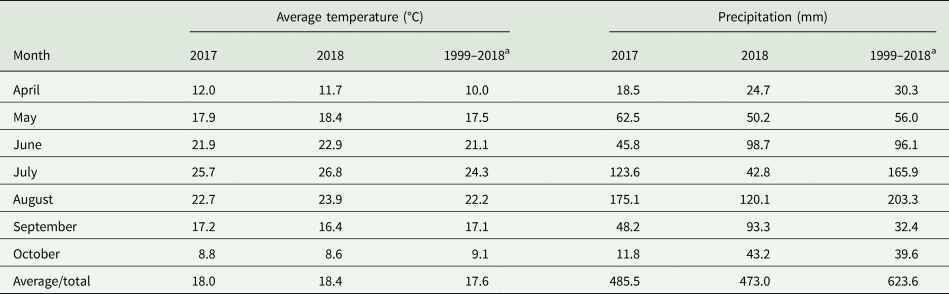
The experiments were carried out at an agricultural experiment station in Tieling, Liaoning Province, China, with geographical coordinates 123°63′ E, 42°35′ N, and typical of a temperate continental monsoon climate. The meteorological data of 2017, 2018 and from 1999 to 2018 are listed in Table 1, including average temperature and average precipitation.
Average temperature and monthly total precipitation during maize growing seasons in 2017 and 2018

a Mean values over 20 years from 1999 to 2018.
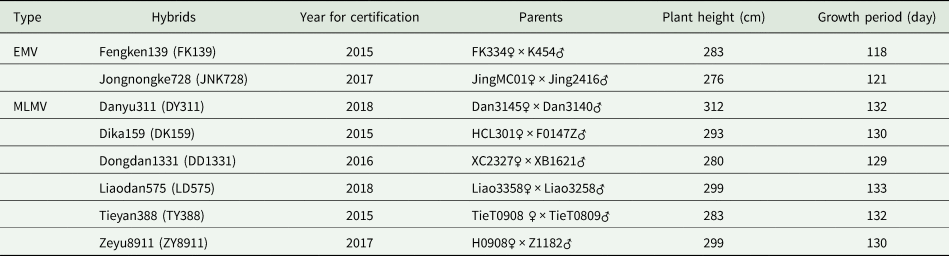
Hybrids that are currently planted in Northeast China were selected for this study, including two early-maturing hybrids (EMVs) (FK139 and JNK728) and six mid-late maturing hybrids (MLMVs) (DY311, DK159, DD1331, LD575, TY388 and ZY8911). All seeds were mechanically sown on 28 April 2017 and 4 May 2018 (Table 2). The planting density was 7.0 plants/m2 with a row spacing of 65 cm. The planting area for each hybrid was at least 667 m2, and other field management followed local practices. From 20 days after silking (50% of plants) until harvest (in late October), ears from five plants per hybrid line were collected at an interval of approximately 7 days. Entire ears with their surrounding husks were immediately transported to the laboratory. One hundred kernels were hand-picked from the middle of each ear for the determination of fresh weight (FW) and dry weight (DW). The FW was measured with an electronic scale and the DW was determined after drying the kernels in a forced-air oven at 85°C for 48 h (Gao et al., Reference Gao, Ming, Li, Xie, Wang and Li2021). The KMC (%, wet basis) was calculated as follows:

Certification time of tested hybrids used in this study and their characteristics

EMV, early-maturing hybrid; MLMV, mid-late maturing hybrid.
Simulation of maize kernel drying
To account for the environmental influences on the drying time of maize kernels at different stages of maturation by means of a stable correlation, this study analysed the AT and the KMC after silking (Cross and Zuber, Reference Cross and Zuber1972; Daynard, Reference Daynard1972; Russelle et al., Reference Russelle, Wilhelm, Olson and Power1984), thereby establishing a regression model for the relationship between AT and KMC as a means to estimate the post-silking KMC. In accordance with the scatter-plot distribution of KMC and AT, the logistic power nonlinear growth model was selected to establish the regression model, as shown in Eqn (2):

where KMCP is the predicted kernel moisture content (%, wb), b and c are regression parameters and AT (⩾ 0°C) is the accumulated temperature (°C day) starting from silking. It should be noted that the equation does not apply when the average air temperature is below 0°C, as the thermal time will not increase.
Determination of sowing date and harvest scenario
In warmer regions, many maize farmers plant hybrids with longer growth periods. However, early sowing results in seedlings that are prone to frost damage, and delayed sowing can retard maturation, which is detrimental to maize production due to cold damage after sowing and high KMC at harvest time, respectively (Dwyer et al., Reference Dwyer, Ma, Evenson and Hamilton1994; Liu et al., Reference Liu, Hou, Xie, Li, Zhang, Ming, Ma and Liang2013). Hence, this study assumed two sowing dates (the optimal sowing date, OSD; and the latest sowing date, LSD) to simulate the process of maize growth and kernel drying in different years. The OSD is the average date at which the temperature reached 10°C for 5 consecutive days from 1999 to 2018, which was 25 April, while the LSD was specified by statistical analysis from the national maize industry system of China (CARS-02-25), which was 10 May.
Based on the current maize production methods and the relevant technical progress in China, the harvesting technology and standards for KMC at harvest will both be improved in the future. In view of the development of maize production in China corresponding to the different development stages of maize harvest technology, three different harvest scenarios were designed in this study, namely, (1) the THS, (2) the CHS and (3) the FHS (Table 3).
Harvest method, purpose, KMC and applicative groups in different harvest scenarios

KMC, kernel moisture content.
With Excel 2016 and Sigma Plot 12.5, the data in this study were analysed, processed and plotted. Curve Expert Professional 2.6 was used for parameter fitting.
Results
Growth period and AT demand of hybrid maize lines
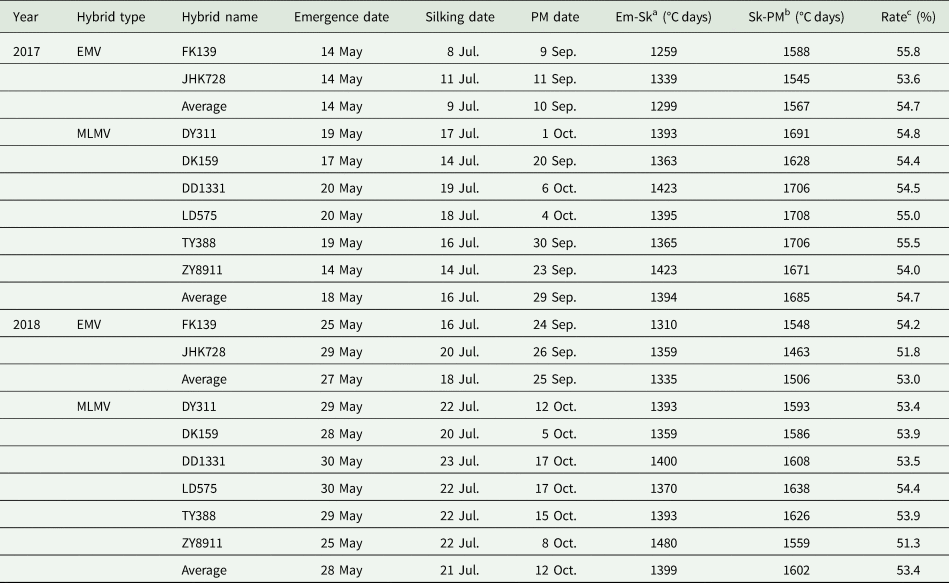
From 1999 to 2018, during the growing period of maize from April to October, the average temperature was 17.6°C and the average total rainfall was 624 mm. Compared to the average data from 1999 to 2018, the average temperatures were 0.5°C higher in 2017 and 0.8°C higher in 2018 while the average rainfall totals were 138 mm lower and 151 mm lower, respectively. The average temperature from June to August in 2018 was higher than that in 2017, but the rainfall in 2018 was lower than that in 2017 (Table 1). On average, the growth seasons (from emergence to PM) of EMVs were 119 days (from 14th May to 10th September) in 2017 and 121 days (from 27th May to 25th September) in 2018. For MLMVs, the growing seasons were 134 days (from 18th May to 29th September) in 2017 and 137 days (from 28th May to 12th October) in 2018. Therefore, the difference in the duration of the growing seasons between 2017 and 2018 was 2 days for EMVs and 3 days for MLMVs. The AT from emergence to PM was 1299°C days for EMVs and 1393°C days for MLMVs in 2017, and 1335°C days for EMVs and 1399°C days for MLMVs in 2018. Overall, the AT for the grain-filling stage accounted for 54.0% of the AT during the growth period, which was 53.6–55.8% with an average percentage of 54.7% in 2017, and 51.3–54.4% with an average percentage of 53.3% in 2018 (Table 4). These results implicate that the AT requirements of maize hybrids at different growth stages were relatively consistent, but that there were slight differences observed between the two years.
Growth stages of maize hybrids in 2017 and 2018

PM, physiological maturity.
a AT, accumulated temperature (⩾0°C) requirement from emergence to silking date.
b AT, accumulated temperature (⩾0°C) requirement from silking to PM date.
c Rate, the proportion of AT (⩾0°C) at grain-filling stage to the whole growth period.
Dynamics and modelling of kernel drying of tested hybrid lines
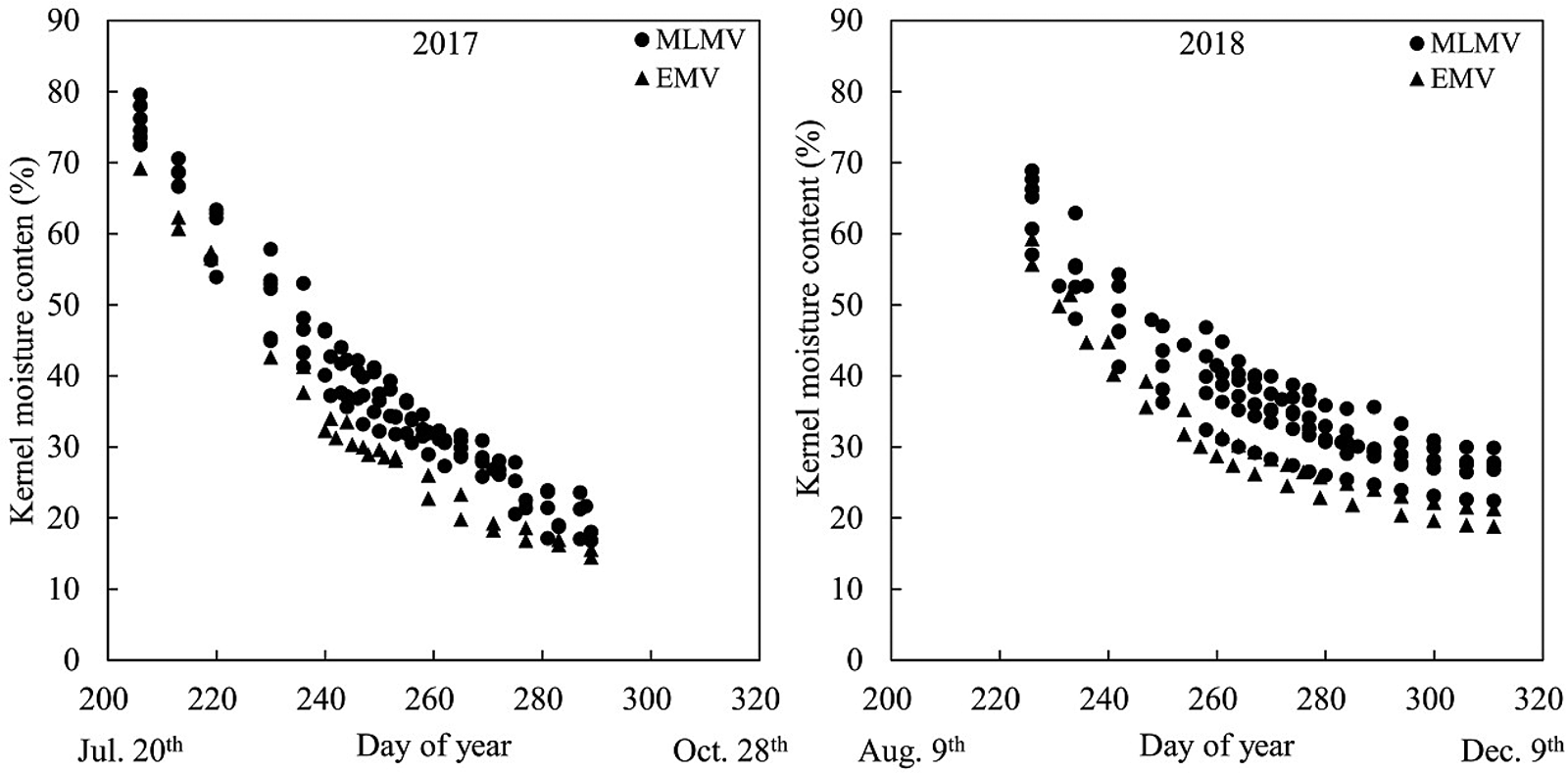
In 2017 and 2018, KMC observations began in late-July and early-August and finished in late-October and early-November, respectively. During these periods, KMC decreased gradually with the increased duration of field exposure (Fig. 1). Due to different maturity stages and dissimilar grain-filling processes, the drying processes of EMVs and MLMVs were significantly different. In both 2017 and 2018, the KMC of the EMVs was lower than that of MLMVs. However, in comparison, the average final KMC was higher in 2018, which was likely due to cooler/wetter ambient conditions.
Kernel drying dynamics of different maize hybrids from silking to PM in 2017 and 2018. EMV, early-maturing hybrid; MLMV, mid-late maturing hybrid.

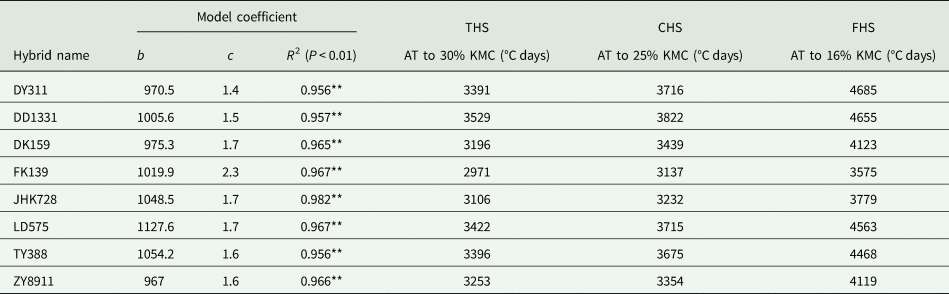
Concerning the kernel dehydration dynamics of each hybrid observed in the field and their corresponding AT requirements, the parameters involved in these metrics were determined to establish the kernel drying models for the tested hybrids. The coefficients between post-silking AT and KMC were determined to have R 2 values in the range of 0.956–0.982 in all tested hybrids. With high reliability, the prediction model can be used to calculate the KMC of each hybrid under different AT conditions (Table 5). Accordingly, our prediction model was used to calculate the AT for three harvest KMC levels (30, 25 and 16%) and the ATs from the sowing to silking stages (recorded during in-field observation) were determined. By adding the sowing to silking and post-silking AT values together, these values were used to determine the kernel-drying required ATs of all tested hybrids in different harvest scenarios. The AT requirements for hybrids were 2971–3529°C days in THS, 3137–3822°C days in CHS and 3575–4685°C days in FHS. It can be seen that when a certain harvest scenario calls for a relatively lower KMC, there is a larger difference among hybrid AT requirements.
KMC models and AT (⩾0°C) requirements of the tested hybrids used in different harvest scenarios

R 2 indicates the coefficient of determination, and b and c are parameters.
AT, accumulated temperature (⩾0°C); KMC, kernel moisture content.
The drying period of all tested hybrids in three harvest scenarios with different sowing dates
Inter-annual climate variation has caused variable maize harvest scenarios during different periods. By calculating the required AT and kernel dehydration for hybrid growth and development with the support of regional meteorological data in recent years (1999–2018), the inter-annual drying period difference of tested hybrids in different harvest scenarios was analysed.
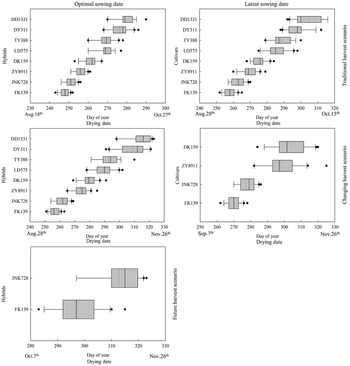
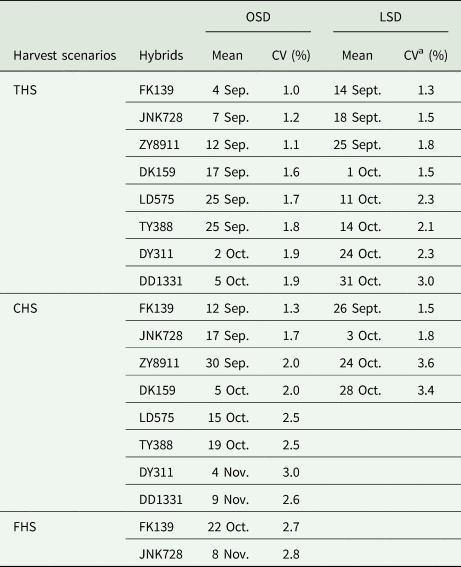
Using OSD and LSD conditions, the inter-annual drying period variations of hybrids in THS, CHS and FHS are shown in Fig. 2 and Table 6. Under the THS, assuming that farmers sow on the OSD, the tested hybrids were determined to be able to be harvested at the earliest on 4th September and at the latest on 5th October, with a variation coefficient of 1.0–1.9. When sowing on the LSD, farmers needed to postpone the harvest date to a period from 14th September to 31st October, with a variation coefficient of 1.3–3.0. Under the OSD conditions, the tested hybrids were harvested from 12th September to 9th November, with a variation coefficient of 1.3–3.0. However, under LSD conditions, only FK139, JNK728, ZY8911 and DK159 could be harvested between 26th September and 28th October, with a variation coefficient of 1.5–3.6. Other hybrids could not be harvested regularly in the CHS. Under the OSD and LSD conditions, the average harvest dates of different hybrids in the CHS varied over a range of 14–35 days. In the FHS under the OSD conditions, only FK139 and JNK728 could be harvested from 22nd October to 8th November. Moreover, all of the tested hybrids could not be harvested in the FHS under the LSD conditions.
Inter-annual variation of the drying date of maize in THS, CHS and FHS, under OSD/LSD conditions. Hybrids are defined in Table 1. The solid and dotted lines in the box plots are the medium and the mean, respectively. The black circles represent outliers.

Mean values and variation coefficients and kernel harvest dates of tested hybrids in different harvest scenarios sown at different times

CV, coefficient of variation.
Relationships between yield and AT
We found that the AT required for drying is closely related to yield, and the relationship between them can be fitted by a linear regression model. Although the drought in 2018 significantly reduced the total yield, a very significant positive correlation between AT and yield was observed (Fig. 3, P < 0.01). Based on these analyses, we identified hybrids with higher AT requirements for maturation and drying that have better yield performance, and this trend was consistent for both years.
Relationship between the yield and time from PM to the KMC drops to 25%. **indicates significance at a level of 0.01 (P < 0.01). PM, physiological maturity; KMC, kernel moisture content.

Discussion
Previous studies have shown that maize kernel drying was affected by genotype and environment (Schmidt and Hallauer, Reference Schmidt and Hallauer1966; Daynard and Duncan, Reference Daynard and Duncan1969; Carter and Poneleit, Reference Carter and Poneleit1973; Borrás et al., Reference Borrás, Zinselmeier, Senior, Westgate and Muszynski2009; Elmore and Abendroth, Reference Elmore and Abendroth2010). Neuffer et al. (Reference Neuffer, Jone and Zuber1968) and Kang et al. (Reference Kang, Zuber and Horrocks1978) studied different types of maize hybrids and found that late-maturing maize hybrids had higher KMCs during harvest and slower kernel drying rates during maturation. Crane et al. (Reference Crane, Miles and Newman1959) compared the changes in kernel drying under field drying conditions and suggested that there were obvious differences among maize hybrids. Hillson and Penny (Reference Hillson and Penny1965) and Nass and Crane (Reference Nass and Crane1970) also investigated that the physiological characteristics of different hybrids, and found differences in the rate of kernel drying after maturity, and that these differences were heritable. Daynard and Kannenberg (Reference Daynard and Kannenberg1976) also reported that crop heat units (CHUs) were significantly correlated with kernel drying rates, and proposed using the following equation to first predict the grain drying rate and then the grain moisture content at harvest:

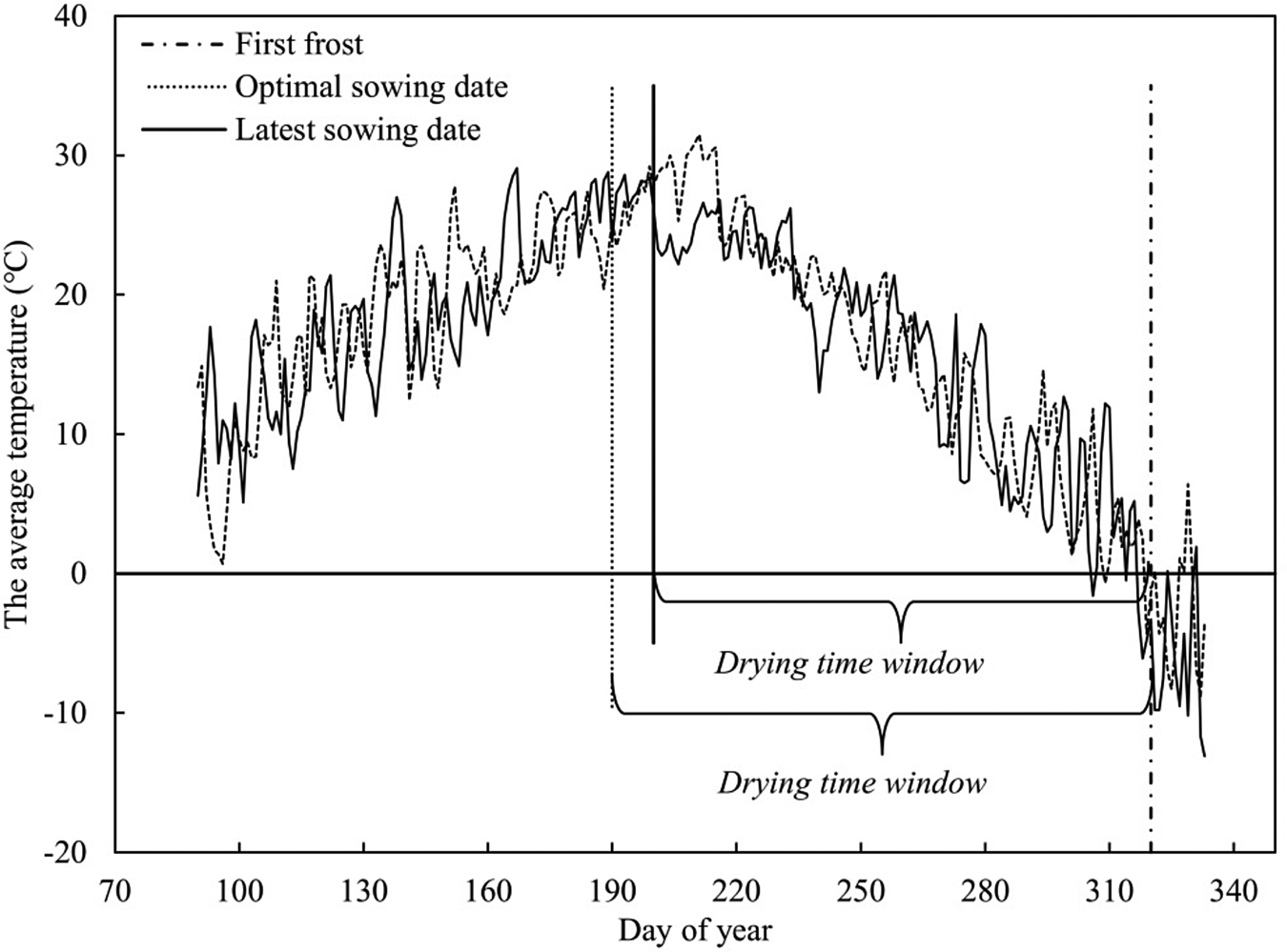
In the above equation, y is the KMC, c is the initial KMC, d is the maize kernel drying rate (percentage decrease in grain moisture content per CHU) and x is the accumulated CHU after silking. We also demonstrated that under ideal crop management, there were significant differences in AT requirements among tested maize hybrids at each of their growth and developmental stages (sowing, silking, ripening, kernel drying and different harvest scenarios). After PM, the kernel is isolated from the plant at the black layer stage. The drying of kernels then becomes a physical process of water loss. Due to the short duration of plant growth, EMVs can enter this drying stage earlier, which was also demonstrated in this study. For example, under the OSD conditions, FK139 is traditionally harvested from 1st to 9th September, while DD1331 is traditionally harvested from 25th September to 10th October. However, under the LSD conditions, FK139 can be harvested from 9th to 20th September, and DD1331 can be harvested from 18th October to 10th November. Furthermore, in the CHS, only FK139, JNK728, DK159 and ZY8911 can be harvested under LSD conditions. The main reasons for this restricted harvesting are as follows. Firstly, there are significant differences between the maturation period between hybrids and the drying characteristics of hybrids (Fig. 1). On the contrary, the period for kernel drying under the OSD conditions is longer than that under the LSD conditions (Fig. 4). Additionally, the average temperature during the drying period is also higher. Since the 1980s, the sowing dates during growing seasons have brought forward and the first frost date has been delayed (Ning et al., Reference Ning, Qin, Cui, Li and Chen2015; Zhao et al., Reference Zhao, Guo and Mu2015), making AT higher and more available for maize producing areas to not only move northwards but also to expand westwards into non-traditional climate zones. Therefore, in the future, MLMVs will be harvested according to the CHS, while EMVs will be harvested according to the FHS.
Average temperature during the maize drying period under OSD (dashed line) and LSD (solid line). The drying time window indicates the number of days from silking until the first frost.

According to maize harvest research and production experience abroad, when the KMC drops to approximately 30%, a maize combine harvest machine with good performance is selected for harvesting high-quality commercial maize. When the KMC reaches approximately 25%, it is most conducive for harvesting and is a critical stage for coordinating the economic trade-off between harvest quality and drying cost. When the KMC drops to 16%, most farmers can store grain in bags temporarily, and after a short period, be directly transported to warehouses for storage, thereby reducing drying costs. The variable drying characteristics and harvest time of maize hybrids also determine their KMCs at harvest (Li et al., Reference Li, Wang, Wang, Li and Zhang2010), with the temperature being the main weather factor affecting the rate and extent of kernel drying (Borrás and Westgate, Reference Borrás and Westgate2006).
A long growth period is generally considered to be required for high yields in maize, but late-maturing hybrids have a high KMC during the harvest period which makes it difficult to meet the requirements of high-quality mechanical kernel harvest (Wang and Li, Reference Wang and Li2017). The AT is significantly positively correlated with yield, where the higher the yield, the greater the AT requirement for hybrids. In order to pursue yield efficiency, the growth period of hybrids used in production is generally long, resulting in a higher KMC during harvest and reduced kernel quality. In addition, the temperature for maize hybrid planting and the initial kernel filling is relatively high, but it drops rapidly after the fall, hence, the heat conditions during the maturation and drying of the kernel are gradually reduced. The results of this study show that, based on the meteorological data of recent years, the estimated harvest time of the tested hybrids can differ by nearly 60 days. When increasing AT as required for hybrids and postponing sowing, kernel maturation and drying are both delayed. Additionally, the drying time for reaching the standard of KMC fluctuated under different meteorological conditions in the years monitored for this study. The later that the drying of mature seeds proceeds, the more impactful are late-season weather factors which then increase the uncertainty of environmental conditions and production. Therefore, from the perspective of production management, it is also reasonable to coordinate the maturation of hybrids with the sowing date. The restructuring of maize production, mechanical operation capacity and labour demand can be performed to reduce the risk of decreasing maize production and improving the efficiency of harvesting machinery. Thus, we identified additional agricultural factors that contribute to the unification of agronomic measures and processes for optimizing hybrid maize yield characteristics and boosting the efficiency of maize production.
Conclusion
The temperature drops sharply during autumn and there is a prominent reduction in heat resources that naturally dry maize kernels in the field. As the demand for AT increases during drying, the variability of kernel drying time gradually increased between sowing dates and harvest scenarios. Hereby, we recommend that farmers in maize production regions choose the OSD to sow hybrid maize hybrids and harvest MLMVs in the CHS and EMVs in the FHS. In addition, maize sowing date and grain drying methods should be taken into full consideration when selecting harvest scenarios under future climate conditions.
Financial support
This study was financially supported by the National Key Research and Development Program of China (2016YFD0300110), the National Natural Science Foundation of China (31971849), the earmarked fund for China Agriculture Research System (CARS-02-25) and the Science and Technology Innovation Project of Chinese Academy of Agricultural Sciences.
Conflict of interest
None.