The most fantastical or absolutely incredible of oriental pagodas cannot rival Seville Cathedral. It is a hollow mountain, an inverted valley. Nôtre-Dame could process with her head held high through the central nave, which is of a terrifying height.Footnote 1
With these evocative words Théophile Gautier described the rich fabric of the archiepiscopal see of Seville in the nineteenth century. According to the latest research by Alfonso Jiménez Martín, construction of the cathedral began in 1434.Footnote 2 I will take 1517 as the date of completion, when the dome was rebuilt by Gil de Hontañón following its collapse six years earlier. Further works were carried out after 1517 and continued throughout the sixteenth century, falling within a Renaissance iconographical programme that ranged from the plateresque to the mannerist styles and which included a series of buildings within or adjoining the Gothic structure, notably the bell-tower and the Royal Chapel.
This article focuses on musical developments in Seville Cathedral during the course of construction of the Gothic building, that is, within the chronological framework of 1434–1517.Footnote 3 I analyse the development of the musical resources and activities in the context of the transformation and generation of new ritual spaces with radically different acoustical properties from those of the Almohade mosque in which the ecclesiastical institution had performed its ritual for almost two centuries. I also consider the various aspects of the patronage of the endowment and expansion of musical forces, as well as of musical performance and dissemination. Study of the Sevillian liturgy will help to inform this account and will also support its findings. I take as my starting point the establishment of the diocese in order to clarify the extent to which certain ecclesiastical posts and liturgico-musical practices formed part of cathedral tradition and which can be considered to be innovative in the period that forms the focus of this article. The See of Seville, which had been dissolved when its archbishop and Mozarabic clergy fled to Toledo in the mid-twelfth century, was re-established following Fernando III's reconquest of the city in November 1248. The great mosque, built by the Almohad dynasty towards the end of the twelfth century, together with its magnificent minaret (now the Giralda), was consecrated and came to be richly endowed through legacies, taxes and real estate; this wealth supported the exceptional development of all aspects of divine worship as well as generous rewards for those responsible for its ministry.Footnote 4
The infante don Felipe, fifth son of Fernando III and his first wife, Beatriz de Suabia, had been sent to Paris to study theology, and was appointed the first Procurator (a style that probably resulted from the fact that he was not of the canonically required age to be appointed archbishop) of Seville Cathedral in 1249. This was a clear example of the interference of royal power in episcopal appointments on the part of his father. Following consecration of the cathedral, its structure was quickly established and endowed with a detailed set of regulations. Don Felipe was apparently responsible for the organisation of the ecclesiastical benefices, according to the authorisation granted by Pope Innocent IV on 17 May 1252.Footnote 5 Gonzalo García was appointed the first precentor, with responsibility for the regulation of all aspects pertaining to ecclesiastical chant in the newly founded institution.Footnote 6
A few years later, in 1261, the cathedral was reorganised according to new constitutions drawn up for the chapter by the recently appointed archbishop, don Raimundo de Losaña, by virtue of a bull issued by Alexander IV.Footnote 7 This bull decreed that the Sevillian rite should be observed in all the churches of the archiepiscopal see, and that rite continued to be observed until the Tridentine reforms were introduced into Seville early in 1571.Footnote 8 The constitutions of the Seville chapter conformed to those already instituted in other cathedral chapters in Spain, and resulted in the fixed hierarchy of the chapter clergy; it also allowed for the possibility, in accordance with the Fourth Lateran Council, of an increase in the number of benefices should the cathedral's income increase. This increase was justified by the desirability of greater solemnity in divine worship – the main aim of any cathedral chapter wherever possible. In a diocese such as that of Seville, a city only recently reconquered and still on the frontier, these constitutions sanctioned the increase of its ornamental as well as its spiritual and intellectual wealth, so that appointments to the position of dignitaries and canonries were made in favour of those with the status of master of sacred theology or in the laws, or doctors in both laws.Footnote 9
To ensure the participation of the prebendaries in the offices celebrated in the choir, their attendance was rewarded by distributions. Particularly important were those monies resulting from private foundations, such as commemorations, masses and responsories, the endowments being shared out only among those attending the corresponding service, a regulation from which even the archbishop was not exempt.Footnote 10 With the same aim, don Raimundo, in his constitutions, established a new source of income from the chapter (mesa capitular) so that distributions could be made to those serving the canonical hours. The distribution was to be made to the prebendaries who attended the daily Mass celebrated following Prime and Terce, with an extra 25 sueldos given to those who had served at Matins. Any monies remaining at the end of the year because of absences would be shared among the members of the chapter according to a fixed scale.Footnote 11 Don Raimundo's constitutions fixed the number of prebends at eighty: forty canons (including the ten dignitaries – dean, Archdeacon of Seville, precentor, treasurer, schoolmaster (maestrescuela), Archdeacon of Écija, Archdeacon of Cadiz (shortly afterwards of Jerez), Archdeacon of Niebla, Archdeacon of Reina and prior of the city), twenty prebendaries and twenty half-prebendaries.Footnote 12
The constitutions also detail the precentor's duties, which were carried out in the choir of the cathedral. The precentor could also appoint a vicar to help him in his role, and thus from the time of the restoration of the diocese the figure of the succentor (sochantre), as he was to become known, was envisaged. The precentor's duties regarding the services celebrated in the choir and at the altar included: to determine the order of the service (antiphons, responsories, readings, etc.), to lead the singing in the choir and in processions, to arrange the processions, and to allocate the singing of the invitatories, alleluias, proses and anything else pertaining to worship at the altar. He was also responsible for the placing of the liturgical objects on the altar and, when required by the liturgy, for distributing them, observing the established hierarchical ritual. As regards administration, his jurisdiction included the induction of new members of the choir, including the assessment of their suitability, which was left to his judgement (unless the archbishop was present, whose supreme authority prevailed). In terms of the precentor's judicial capacity, the members of the choir who were not prebendaries – the clergy of the choir and the alumni cori – came under his jurisdiction. These groups can be identified as the clergy of the veintena and the choirboys respectively.Footnote 13
According to don Raimundo's constitutions, the schoolmaster's duties included correction of the epistles and gospels, the reading, writing and sealing of all the chapter's correspondence, and finding a teacher able to give free grammar lessons to the clergy who served in the choir as well as in the town and diocese.Footnote 14 The establishment of the College or Estudio de Gramática of San Miguel can be dated to the fourteenth century; it was built near the cathedral, opposite the door of the Nativity of Christ (Puerta del Nacimiento).Footnote 15 There a grammar teacher, a priest whose salary was paid by both the chapter and the town council, and a graduate assistant were employed to teach grammar to the citizens of Seville.Footnote 16 Among their pupils were the choirboys, who were taught reading and grammar, which were fundamental to their understanding and pronunciation of the texts they had to read and sing.
DEVELOPMENT OF THE CATHEDRAL MUSIC
Thus, the presence of professional singers at Seville Cathedral dates back to the restoration of the diocese. The ‘cantori coro’ (the non-prebendaries) and the ‘alumni’ who came under the jurisdiction of the precentor were responsible for the singing of plainchant. In the later Middle Ages, their number was fixed at twenty, and they became known as the ‘uicenarius’, ‘veinteneros’ or ‘clergy of the veintena’. They were usually appointed by the succentor, following an assessment of their singing ability and ‘other relevant things’.Footnote 17 The earliest reference to this group as a clearly identifiable body dates from 1311. The will of María Sánchez stipulated the endowment necessary for ‘those of the veintena of Santa María’ and the ‘moços de coro’ ‘to sing the vigil and litany’ (‘digan la vegilia e la ledanía’).Footnote 18 As will be seen, the positions of veintenero and singer of polyphony were frequently related from at least the beginning of the fifteenth century; this post was sometimes supplemented by a chaplaincy or the position of sacristan in order to make it more financially stable. The presence of choirboys can also be dated from the time of Alfonso X; the endowment of their salary came from the Seville customs house and amounted to 1,000 maravedís.Footnote 19
Chaplaincies for the celebration of services for the dead proliferated in the course of this period. Endowment of chaplaincies was one of the means by which the cathedral chapter considerably increased its property holdings both within the city and the rural areas outside it.Footnote 20 By 1411 ninety-six chaplaincies had been endowed, and by the last quarter of the fifteenth century thirteen more were founded. Usually the family of the deceased determined the attributes of the chaplain who was to perform the offices, even though the chaplains were almost always formally appointed by the cathedral chapter.Footnote 21
Cathedral worship comprised a series of services performed at various altars and chapels as well as in the choir, resulting in many processions within the building. Such processions proliferated at Seville Cathedral; most were performed on the 106 first- and second-ranking feast days, and were endowed with varying amounts, from 60,000 maravedís on Assumption Day to 140 on the feast of St John the Baptist. In 1363, the chapter asked for a minimum endowment of 400 maravedís per annum for the solemn celebration of the feast of a particular saint: ‘with copes (capas), and organ and four gold copes and silver sceptres and a procession with copes’.Footnote 22 This is the earliest known reference to the organ (with the implication of an organist), which already at that time had an established role in liturgical ceremony in Seville Cathedral.
These are the musical positions that can be identified in Seville Cathedral from the restoration of the diocese until the fifteenth century, but it is difficult to establish exactly when polyphony began to be sung there as part of the liturgical celebrations. I recently discovered a fragment of a conductus in the binding of one of the books in the cathedral archive, which would suggest that Ars antiqua polyphony was known and practised there. The fragment, in pre-Franconian square notation, probably dates from the end of the thirteenth century or the beginning of the fourteenth century. No concordances have yet been found, so it may be unique, whether it was imported or produced locally in imitation of the polyphonic repertory that circulated throughout Europe.Footnote 23 Liturgically, this conductus might have belonged to one of the many processions held inside the cathedral,Footnote 24 and it would seem to confirm the practice of polyphony from almost the time of the restoration of the diocese. This would not be surprising given the financial endowment of the cathedral and its symbolic importance, resulting in both the high number of personnel and its magnificent tradition of divine worship.Footnote 25 Its significance for royal power stemmed from it being the burial place for the king who reconquered the city and established it as a royal mausoleum; archbishops such as St Leander and especially St Isidore linked it inextricably with the Visigothic past and endorsed its antiquity and prestige. In addition, Seville was, in the words of González Jiménez, ‘the main city of Castile, which, following its reconquest, became de facto the capital of the whole kingdom’.Footnote 26
It is difficult to ascertain how Ars antiqua repertory might have reached Seville; I would suggest two likely hypotheses that would not be mutually exclusive. Seville Cathedral, from its foundation, was a major centre of Marian devotion. In addition to being dedicated to the Virgin – the Holy Mother of the See being venerated at the high altar – there was the cult of the Virgin ‘de la Antigua’, with its roots in Visigothic myth, a tradition that would later be disseminated to other peninsular and American centres. Alongside these Marian traditions was the Virgin ‘of the Kings’ (‘de los Reyes’), whose image was placed by Alfonso X himself in the part of the mosque that was turned into the royal chapel, and the celebrations for which, held on the feast of the Assumption,15 August, rivalled those of Corpus Christi for their unparalleled magnificence and ceremony.Footnote 27 The Virgin ‘of the Pillar’ (‘del Pilar’) can be added to these dedications. The history of the origins and evolution of this Marian cult was compiled by the cathedral canon Juan de Loaysa, who drew on original sources that still survived at the beginning of the eighteenth century in the Hospital of Santa María del Pilar (or ‘of the King’, as it later came to be called), documents which he copied with a high degree of accuracy (‘puntualmente’).Footnote 28 The origins of the confraternity ‘del Pilar’ can be dated as early as the 1280s; Sancho IV and his daughter doña Maria were members. In 1317 Alfonso XI donated a plot near the Alcazar for the building of a hospital under that dedication. The reason given was that the image of Nuestra Señora del Pilar, for some years venerated in one of the chapels of the cathedral,
was held in such devotion by the faithful of the Spanish kingdoms and throughout the whole of Europe because of the miracles and marvels it wrought, that the poor and pilgrims from all over flocked to this chapel to seek a cure for their sufferings and sicknesses; these people, having nowhere to stay, wandered through the city, unable to find lodgings.Footnote 29
The rapid growth in pilgrimage must have had a major impact, since not only did various members of the royal family, the Archbishop of Seville, the dean and canons join the confraternity, but also ‘many other knights, citizens, merchants and other worthy men from Castile and from the city and archbishopric of Seville’.Footnote 30 By 1322, a great many bishops from elsewhere in the Spanish kingdoms were brothers, including the Archbishop of Santiago, don Juan Sánchez de Limia, who went on a pilgrimage to Seville in 1333 and became a member of the confraternity. Pardons and indulgences were granted to all those who became members and supported the confraternity in its charitable works. It is possible that the Ars antiqua reached Seville as part of the cultural dissemination made possible by Seville as a centre for pilgrimage.
Another possible means by which this musical repertory might have been transmitted would have been through the Cistercian monastery of San Clemente in Seville, whose foundation was linked with the three symbolic figures of the city: Fernando III (who gave the land for the building of the monastery), Alfonso X and Archbishop don Remondo, who undertook the administrative work and setting up of the institution around 1282. In the early years of its existence it became the burial place of doña Berenguela, daughter of Alfonso X, and the link with the crown was maintained in the first half of the fourteenth century, when the monastery became the temporary residence of doña María de Portugal (c. 1334), wife of Alfonso XI and mother of the future king Pedro I. She was also buried there. Years later, in 1396, on the death of her husband, doña Beatriz de Castilla, daughter of Enrique II and wife of the Count of Niebla, don Juan Alfonso de Guzmán, entered San Clemente and was buried there. Just as in the case of the Royal Convent of Las Huelgas in Burgos, undoubtedly the most important and powerful convent in the Crown of Castile, whence the first Cistercian nuns travelled to Seville, at that time San Clemente became a royal mausoleum and enjoyed royal protection. The early evidence of musical activity that can be traced at the convent might have resulted directly from the close links maintained with Las Huelgas from its foundation. In 1316, the widow doña Marina Gómez de Sotomayor, mother of the aguacil mayor of Seville, Rui Diaz Rojas, and former nursemaid (aya) to the infante don Pedro (1290–1319), son of Sancho IV and doña María de Molina, was a nun at the convent of Las Huelgas. A woman of high social standing and closely connected to the royal house of Castile, she moved to San Clemente, where she became a nun, in 1323. During the fourteenth century, Las Huelgas was twice ruled by abbesses from the Sevillian convent: the first, doña María Rodríguez de Rojas, daughter of the same doña Marina, had been abbess at San Clemente from 1324 to 1340, when she took up the same position in Las Huelgas. The second case is even more interesting; doña Leonor Rodríguez Barba, daughter of the Sevillian knight Rui Barba, was appointed abbess of Las Huelgas by Pedro I while she was a nun at San Clemente. After fourteen years as abbess at Burgos, she returned to Seville to take up that position at San Clemente.Footnote 31 The regular presence of female precentors and succentors in the convent from at least 1316 would confirm musical activity there; in 1478 five nuns who had held these positions at various times were residing in the convent.Footnote 32
Detailed analysis of the oldest surviving ceremonial of Seville Cathedral – the ‘Regla Vieja’ or ‘Regla de Coro’ (ACS, sección III, libro 1) provides important clues for polyphonic practice, at least from the second half of the fourteenth century. Polyphony was widely practised, performed at both the Office and the Mass by singers and on the organ, especially on major feast days (primera dignidad), reflecting its importance in the solemnification of the liturgy throughout the fourteenth century. The use of polyphony, plainchant and alternatim practice in the performance of hymns and certain sequences, the many references to parts of the Ordinary and Proper of the Mass being sung or performed in organis, cantando et discantando and with canto organicum, hints at the wide range of improvised and notated polyphony practised in the cathedral.Footnote 33
An interesting remnant of this repertory, which can be placed in the context of the ceremony in which it was performed, is a three-voice setting of the hymn Gloria laus, which from its notational features, simple note-against-note counterpoint and archaic appearance might suggest that it was a written-down example of improvised polyphony.Footnote 34 It represents the earliest polyphonic setting of this hymn in Iberian sources, and is based on a chant also found in Toledan liturgical books. The manuscript in which it was copied would appear to date from the end of the fourteenth century or first half of the fifteenth century, and it contains antiphons and verses for the processions held in the cathedral on Palm Sunday. This procession left through the door of the Nativity of Christ, proceeding around the outside of the cathedral to the door of the Entrance of Christ into Jerusalem (now known as the Campanilla), in the Olmos patio, where an altar was erected.Footnote 35 The ceremony continued there with the singing of the hymn, with the verse Gloria laus being sung polyphonically by the singers who remained inside the cathedral, behind the closed doors, while the other verses were sung in chant by the members of the choir who were outside. When the doors were opened, the procession proceeded to the choir, where Mass was celebrated.Footnote 36
Evidence confirming the early use of polyphony at Seville Cathedral can be gleaned from other sources; it was clearly an established practice from the beginning of the fifteenth century with roots deep in the previous century. The presence of the music theorist Fernando Estevan, ‘maestro de canto plano, e de contra punto … e de canto de órgano’, sacristan of the chapel of San Clemente – that is, the sacristy, which was at that time placed in the main body of the mudéjar cathedral – has long been assumed from a reference in his Reglas de canto plano è de contrapunto è de canto de órgano (1410). Two recently discovered notarial documents confirm that in 1401 and 1402 he was steward of the above-mentioned Sevillian confraternity of Santa María del Pilar.Footnote 37 His name has not surfaced in the cathedral documentation itself, although this is not conclusive, given its incompleteness. The name of only one of the two sacristans from the first quarter of the fifteenth century – Juan García (who was also a singer) – has so far appeared. In addition to the fragmentary nature of the documentation, it is also worth bearing in mind that the income of the cathedral personnel originated from different domains, and so Estevan's ‘absence’ to date is not altogether surprising.Footnote 38 In a census carried out in Seville in 1384, a reference to ‘the wife and children of Ferrant Estevan’ is found in the parish of El Salvador, close to the cathedral. This is almost certainly a reference to the author of the treatise, who happened to be absent from the city at that time, and would help to place his date of birth in around 1350.Footnote 39 This cathedral official, who was also found at the papal court in Avignon and at the royal courts of France, Aragon and Navarre, had been thought to be a performing musician without university connections.Footnote 40 The term ‘músico’ (that is, musicus or theoretical musician), found in the title of his treatise as well as one of the notarial documents, would suggest otherwise, and he may well have studied music at an academic institution. A reference on fol. 11v of his Reglas implies that he was familiar with the Parisian liturgy and might confirm his presence in that city: ‘The eighth accidental (coniuncta) is notated in high f-fa-ut with square b, and we say “ay mi”, and it takes its ut in high d-la-sol-re, as is shown in the antiphon Hodie Maria, according to the use of Paris.’Footnote 41 Estevan was apparently familiar with the rules of the Ars nova and polyphonic practice of the time since he cites Philippe de Vitry, Johannes de Muris, Egidius de Murino, Guillermo de Mascadio,Footnote 42 ‘and many others too numerous to mention’ (‘e otros munchos [sic] que sería luengo de contar’). He also mentions two other, unknown composers (possibly from the Iberian Peninsula?): his teacher Remón de Cacio (whom some consider the originator of the ideas expressed in the treatise),Footnote 43 and Albertus de Rosa.Footnote 44 Given that the newly discovered documents confirm Estevan's status as musicus, there can be no doubt that he was indeed the author of the Reglas, probably the earliest treatise to be written in Castilian, which undoubtedly contributed to its wide distribution, and, as Maricarmen Gómez Muntané has pointed out, it bears witness to ‘a pedagogical tradition in Seville at the end of the fourteenth century and the beginning of the fifteenth century’.Footnote 45
Three clauses in Alfonso X's will, dated 10 January 1284, reveal the importance of endowments in the cathedral and of processions as part of Marian devotions there. These clauses also reflect the way in which the donation of books enriched the Biblioteca Capitular, with specific reference to manuscripts of the Cantigas. The king's wish to have the cantigas performed within the cathedral building ‘on the feasts of the Virgin Mary and of Our Lord’ (‘en las fiestas de Sancta María e de Nuestro Señor’) must have reflected an established practice, since the Cantigas would have been sung during his many extended sojourns in Seville, where his court was regularly based.Footnote 46 Alfonso's will provides the earliest reference to the performance of vernacular-texted monody in the cathedral.Footnote 47 The romances commissioned by Alfonso X from the composer Nicolás in Seville in 1260 would also have formed part of this repertory: ‘trovas que le hizo para cantar en la su fiesta de San Clemente e de San Leandro’. The celebration of the feast of San Clemente, in commemoration of the taking of the city of Seville on 23 November, had been founded by the king on 12 December 1254, and would have been, like Corpus Christi, of an essentially civic and religious nature. Both Nicolás and Domingo Abad ‘de los romances’ reached Seville in the company of the troops who took the city, shared in the booty and took up residence there.Footnote 48
The practice of singing polyphonic songs in the vernacular was also well established in Seville Cathedral by the beginning of the fifteenth century. Payments from 1419 survive for the group of four singers who sang at Christmas Matins and for the five singers and five choirboys who, together with the succentor, sang the chanzonetas.Footnote 49 The document implies that this was an established practice, and its date coincides with the earliest known reference for Toledo Cathedral: the payment to the singer Pero Sánchez for copying the ‘chanzonetas de Sancta María e de Ihesuchristo’ in 1418.Footnote 50 The Sevillian document affords new insight into their inclusion in the liturgy: they were clearly intended to be sung at some point during Christmas Matins; the number of musicians involved would suggest that they were sung in polyphonic settings with more than one singer to a part, with, for the first time in 1423, a ‘tenor’, and joined by the choirboys serving at the cathedral. The earliest known reference to the term ‘chanzoneta’ in any context is found in the Archpriest of Hita's Libro de buen amor (1330).Footnote 51 Closer in time and place to the Sevillian reference is Juan Alfonso de Baena's Cancionero.Footnote 52 In the Marian song Generosa, muy fermosa by Alfonso Álvarez de Villasandino (c. 1350–1425) the sixth verse includes a clear reference to songs associated with the birth of Christ: ‘That you [the Virgin] would give birth to the Messiah / was foretold by the wise: / Jeremiah and Isaiah / Daniel and other prophets. / Poets / give you praise now and for ever / and the saints will sing / chanzonetas to you in Heaven.’ (‘Que parrías al Mexías / dixeron gentes discretas: / Geremías e Isaías / Daniel e otros profetas. / Poetas / te loan e loarán / e los santos cantarán / por ti en Gloria chançonetas’.) In the same poet's Profecía de Alfonso Álvarez contra el Cardenal, the last verse includes a further reference to chanzonetas sung in praise of the Virgin and performed by ‘inocentes’, that is children or, more specifically, choirboys: ‘The children sing chanzonetas / praising the Virgin Mary, / in beautiful music, with sweet melody’ (‘Los inoçentes canten chanzonetas / dando loores a Santa María, / en música fina, dulçe melodía’).Footnote 53 Villasandino, a player of the lute, rebec and citole, was renowned in Seville as a composer; the city council commissioned him to write an annual song in praise of the city for a hundred gold doblas, which was to be ‘performed by minstrels’ (‘cantada con juglares’) at Christmas time. The exact years for this practice are not known, but in any case it must date from before 1425, the date of his death.Footnote 54 Baena himself, or one of the other poets in the ‘Cancionero de Baena’, might have written the songs performed in the cathedral or in noble circles in Seville. Other famous minstrels resided there: in the 1389 census, among the freemen in the parish of San Andrés, was the juglar Pero Alfonso.Footnote 55 His free status and the date suggest that he was probably the renowned Pero Alfonso de Sevilla, lutenist in the service of Fernando I of Aragon (1413–1415), Alfonso V the Magnanimous (1415–20?) and Juan II of Castile (1423).Footnote 56
It is not possible at present to establish a clear link between the Cantigas de Santa María and the performance of chanzonetas at Christmas Matins in Seville Cathedral, nor when these ceased to be performed monophonically in favour of polyphonic settings. Villasandino's verses would suggest a connnection between his own ‘cantigas’ and the use of the term ‘chanzoneta’, and may hint at a continuity of practice that, together with other possible influences, encouraged the development of the genre. The earliest surviving polyphonic songs for Christmastide are the two-voice Nuevas nuevas de alegría, found in the Cancionero Musical de Astudillo, which was copied about 1450 for the Franciscan Real Monasterio de Santa Clara in Astudillo (Palencia), and the repertory preserved in the Cancionero Musical de la Colombina (CMC) (E-Sc 7-1-28), which can be dated from the second half of the fifteenth century (see below).Footnote 57
CONSOLIDATION OF THE MUSICAL RESOURCES
In the fifteenth century, Seville Cathedral, as an institution, would face the most important challenge of its restoration. At a chapter meeting in 1401 the decision was taken to create ‘another church so great and good that no other could equal it’; one canon is supposed to have said ‘let's build a church such that, when it is finished, people will think we were mad’.Footnote 58 It is perhaps surprising that such a radical transformation of the acoustic and ritual space should be so little reflected in the surviving documentation, especially as regards the development of ceremonial. Information is largely restricted to successive changes in the location of the choir as the building work progressed, and to the position and distribution of the tombs, altars and devotional chapels. An idea of the mudéjar cathedral can be gleaned from the distribution and placing of the medieval naves, side chapels and altars in nearby Cordoba Cathedral.Footnote 59
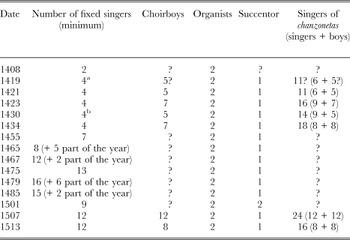
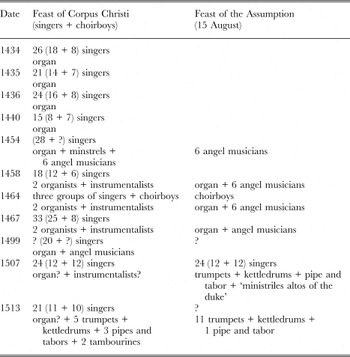
By the beginning of the fifteenth century, however, all the main elements of a well-organised musical entity were in place, although it is difficult to reconstruct exactly the number of professional singers formally contracted to sing polyphony since the documents from this period are incomplete. The complex system of remuneration, stemming from the different domains, and the fact that it was possible to accumulate various positions, makes it difficult to know exactly how many salaried singers were being paid at any one time. In addition to his usual duties, the succentor was clearly involved with the polyphonic choir, or capilla de música, throughout the century, and was paid extra for this role. It is more difficult to establish the situation as regards the clergy of the veintena since not all singers were necessarily veinteneros and neither were all its members involved in singing polyphony. Only from when the documentation for the different bodies – the mesa capitular, treasury and works department (or fábrica) – survives is it possible to extrapolate reliable information. The tables reconstructing the figures show the minimum number of singers who, whether or not they held other positions, could have formed part of the capilla for the performance of polyphony. To avoid distorting these figures, I have separated those who might have formed the fixed forces from those who participated in those feasts and processions that called for extra resources to endow them with greater solemnity, such as Christmas, Corpus Christi or Ascension Day, a phenomenon that is especially marked at the beginning of the fifteenth century, when the overall number of regular singers was smaller (see Tables 1 and 2). Thus, at the beginning of the century, it was not a question of the establishment of the capilla de música, but rather of how it developed and grew to accommodate new repertories and new performative spaces – in essence, new aesthetic and architectonic exigencies – in response to the regulatory and stabilising impulse generated by these new requirements, as was occurring in other major European cathedrals.
Minimum numbers of singers at Seville Cathedral

Sources: ACS, sección II, libros 1074–5, 1079; sección IV, 12–13, 23, 30.
a One of them was the succentor, one master of the boys, one a veintenero, and the other sacristan of San Clemente.
b Three salaried as singers, the fourth the succentor.
Minimum numbers of musicians in the main processions outside the cathedral

Sources: ACS, sección II, 1075; sección IV, 2B, 3, 7–8, 10, 13, 18, 22, 30.
A detailed analysis of the patronage of the individual cathedral prelates, dignitaries and other benefice holders lies beyond the scope of this study; I include here only a few examples of those who made an important contribution to fostering musical activity in the cathedral and who enabled contact and exchange with other institutions – those figures whose support enhances our understanding of Seville as a cultural as well as an economic centre. In the second half of the fourteenth century there were several archbishops of notable intellectual standing who, although they resided in the city for longer or shorter periods, influenced the provisions that emanated from the cathedral chapter with regard to the structure of the clergy and the regulation regarding their sojourns at Castilian, French and Italian universities, as well as the necessary economic support, all of which resulted in the detailed statute of 19 May 1395.Footnote 60 The first of the prelates was fray Alonso Fernández de Toledo y Vargas (1361–6), Doctor of Theology of the University of Paris and royal confessor to Pedro I, who apparently made several extended visits to Italy with Cardinal Gil de Albornoz, and who later visited the papal court at Avignon, shortly before he took up residence in Seville. Fernando Álvarez de Albornoz (1371–7), the cardinal's nephew, was Professor of Law at Bologna, and the true founder of the Spanish College of San Clemente there, bringing to fruition his uncle's original idea. Gil de Albornoz had been Archdeacon of Niebla and had endowed three scholarships (one in theology and two in canon law) for members of the clergy in the archiepiscopal see to be appointed by the cathedral chapter.Footnote 61 His successor as archbishop was a close relative, Pedro Gómez Álvarez de Albornoz (1378–90), who also held a doctorate in law from Bologna University. He resided in Seville and made a major contribution to the cathedral building works.Footnote 62 The many interests of Don Pedro, who had a solid cultural and humanistic education, is clear from his library, which he donated to the cathedral in 1387, and which formed, together with Alfonso X's legacy, the most important and best-known collection up to that time. It consisted of 120 volumes (some including more than one title) on law, theology, philosophy, Scripture, medicine, history and other branches of learning, with many texts by classical authors.Footnote 63
Among the archbishops of the second half of the fourteenth century, and the members of the Fonseca, Mendoza and Deza families who would fill the post until the end of the fifteenth century, the figure of Cardinal Juan de Cervantes stands out.Footnote 64 He was born in Seville in 1382, the paternal line of the family stemming back to the conquest of the city. Having studied at Salamanca, he returned to Seville and was appointed archdeacon before being made Bishop of Avila (1425) and a cardinal; shortly afterwards he moved to Rome, where he was given the title of Bishop of Ostia. He lived in Rome for some years, and was favoured by Pope Eugene IV, who made him his delegate at the Council of Basel, before he returned to Avila. He was promoted to Seville in 1448,Footnote 65 and died towards the end of 1453. He gave large amounts of money to further the cathedral works, including the building of the chapel of St Hermenegild (also known as the Cardinal's Chapel) and the sculpting of his tomb by Mercadante de Bretaña. In his will he left all that was needed to adorn the chapel and his endowment included provision for three chaplains to serve there. He also donated his collection of 306 volumes, which again boosted the chapter library, and which reflected his wide-ranging interests: law, theology, philosophy, arts, humanistic knowledge, history and poetry.Footnote 66
Among the cathedral dignitaries, and a contemporary of Cardinal Cervantes, was Rodrigo Sánchez de Arévalo, a member of the Castilian delegation to the Council of Basel from 1434 to 1439, who supported Eugene IV. While dean of Seville Cathedral he wrote El Vergel de Príncipes, which he dedicated to Enrique IV (1456–7).Footnote 67 This humanistic work, which draws largely on Aristotle, has a section dedicated to the beneficial effects of music, which inspires to devotion and solemnifies divine worship, thus justifying the use of music in the liturgy. In his Speculum vitae humanae he stresses the importance of precentors in the realisation of the Divine Office with the appropriate gravity, order and dignity, criticising those who do not fulfil their duties in this respect.Footnote 68
Private endowments existed from the time of the cathedral's restoration, but the building of the Gothic cathedral resulted in a marked proliferation. New plots of holy ground were offered to donors seeking the rest that would be granted them through salvation; their detailed foundations both increased and decentralised the performance of polyphony in the cathedral.Footnote 69 The model for including polyphonic masses in these foundations may well have been the monthly Mass known as ‘of the confraternity’, apparently linked with the Confraternity of Nuestra Señora del Pilar, and which was celebrated ‘con toda solemnidad y música’, and, by the mid-fifteenth century, with the intervention of singers and organ at the main altar.Footnote 70 A good example of this new trend in endowments is that of the cathedral canon Ruy González Bolante. In 1450, González Bolante founded his family pantheon in one of the first Gothic chapels to be built, that of St Francis. Among other things, he established three polyphonic masses to be celebrated there, and a fourth that was to be sung in one of the most symbolic spaces in the cathedral, the altar of the Virgen de la Antigua, which, at that date, was placed in the chapel of San Clemente. One of the chaplains designated to this chapel would officiate at the Masses in which the master of the choirboys, the six boys and two cathedral singers would perform.Footnote 71 The model for the inclusion of the endowment of votive antiphons can be dated back to that of the cathedral treasurer Ruy Gutiérrez de Villapadierna. Dating from 1362, this endowment was added to by his will of 1381, in which he stipulated ‘I establish the prayer of the Salve Regina for my legitimate heir’.Footnote 72 In 1456, the magister puerorum Pedro Martínez de la Caridad instituted the Salve service in the Capilla de la Antigua, in which this antiphon was solemnly sung by the succentor and choirboys.Footnote 73 Some years later, about 1480, the cathedral canon Pedro Díaz de Toledo expanded this service with polyphonic performance of several items, a model that was imitated over the course of time in several different spaces in the cathedral, thanks to other private endowments.Footnote 74 An important element of these endowments was formed by the responsories and Masses for the dead in which polyphony was also introduced during the fifteenth century.Footnote 75
During the building of the Gothic cathedral and at the time this increase in endowments was occurring, the diocese of Seville attained a papal bull (Ad exequendum) promulgated by Eugene IV (1439) and another (Votis illis) by Nicholas V (1454), which was issued shortly after the death of Cardinal Juan de Cervantes. These bulls, both influenced by prevailing humanistic trends, enabled the consolidation of the position of chapelmaster, enhancing, by means of attaching a prebend to that position, its social and economic prestige. Eugene IV's bull essentially reflected those that were issued in Italy with a similar aim: Turin (1435), Bologna and Florence (1436), Treviso (1437–8), Padua and Urbino (1439), and Verona (1440–2).Footnote 76
The position of master of the choirboys (attached to that of singer or ‘cantor’ in Seville Cathedral) can be traced back to at least 1419, when it was held by Alfonso Sánchez. The papal bull of 24 September 1439 specified that at the request of the dean and chapter, and on behalf of the boys ‘responsible according to tradition for the singing of certain responsories with their verses and versicles, as well as for other chants for the daily and nocturnal hours’ (‘encargados según la costumbre de cantar ciertos responsorios y sus versos y versículos, así como hacer otras clases de entonaciones en las horas diurnas y nocturnas’), a prebend should be allocated to ‘a master skilled in grammar and singing … who would direct, train and maintain the six designated boys … for the greater adornment and splendour of cathedral ritual’ (‘a un maestro perito en gramática y canto … el cual dirigiese, instruyese y sustentase a seis niños designados por ellos temporalmente … que resaltarían en la misma el mayor decoro y esplendor de su culto’). The allotted prebend would be given the number 20, and it would be attached in perpetuity to that position.Footnote 77 Clearly, there would be a delay in the granting of the prebend until it fell vacant; it was conferred for the first time on the master of choirboys who held the position at that moment: Pedro Martínez de la Caridad. The chapter had to confront the difficulty of finding a person who was expert in both music and grammar, which led them to send a new petition to the pope, the matter being resolved by Nicholas V, who, on 27 June 1454, expedited his bull Votis illis. This recapitulates the contents of Eugene IV's bull and the motive for the chapter's request: ‘it often happens that a master who is expert in both grammar and music cannot be found, and since the master's singing lessons are of more practical and immediate use than those of grammar for church ritual and more important for the enhancement of its brilliance and splendour …’. The bull also granted the chapter the possibility that should a vacancy occur ‘through the retirement, death or leaving of the master’ (‘por cesación, fallecimiento o separación del maestro’), they could appoint someone who was not necessarily expert in grammar, as long as he was in music (‘canto’).Footnote 78 It should be noted that the teaching of the choirboys had been covered (and would continue to be covered) by the post of master of grammar that had existed in the cathedral from at least the mid-fourteenth century.Footnote 79 In that same year, 1454, the cathedral singer Mateo Ximénez held the position of master of the choirboys and received the income and other benefits from the prebend.Footnote 80 Years later he would hold the same position in the Aragonese royal chapel of Juan II and then in that of Ferdinand of Aragon.Footnote 81 There can be no doubt that the choirboys sang polyphony at this time; the payment for the Corpus procession in 1440 explicitly states ‘I paid to six choirboys who sang polyphony before the float, five maravedís each’ (‘di a seys moços de coro que fueron cantando delante de las andas canto de órgano, cada cinco maravedís’).Footnote 82
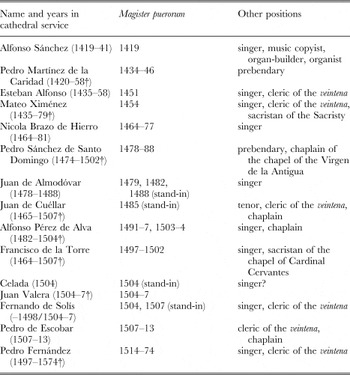
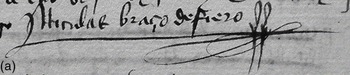
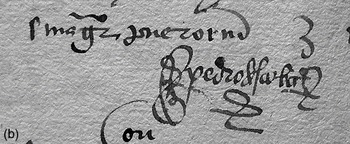
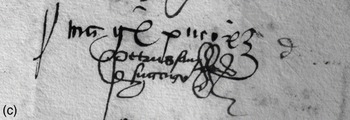
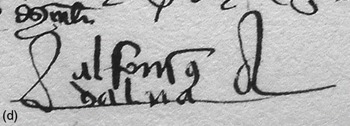
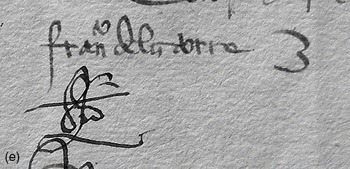
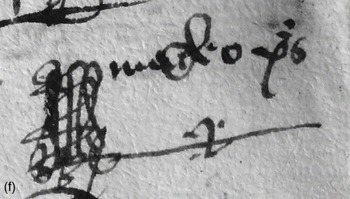
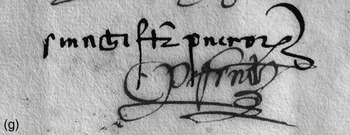
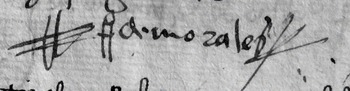
Throughout the fifteenth century the post of magister puerorum was held by a cathedral singer on a short-term basis, even when it became attached to the aforementioned prebend, but the situation changed at the end of the century with the appointment of Alfonso Pérez de Alva. From the time of Juan de Valera the duty became a fixed part of the post of chapelmaster from his appointment until he either left the cathedral or died. The income from the prebend (always difficult to assess) increased considerably from this time as the cathedral became dramatically more wealthy in the course of the sixteenth century. By the years 1515–18, the value of the prebend for the magister puerorum, then held by Pedro Fernández, amounted to an annual average of 63,136.75 maravedís.Footnote 83 Table 3 lists those singers who held the post during the period in question; Figure 1 reproduces those of their signatures that have been located so far.
Magistri puerorum at Seville Cathedral

Sources: ACS, AC 1–9; sección I, libro 382; sección II, libros 2B, 249, 656, 668, 678, 683, 1074–5, 1077–9, 00373, 05983; sección IV, libros 2B, 8–13, 16, 32, 408.
Signatures of the magistri puerorum of Seville Cathedral: (a) Nicola Brazo de Hierro (ACS, sección II, libro 249, fol. 111v); (b) Pedro de Escobar (ACS, sección II, libro 251); (c) Pedro Sánchez de Santo Domingo (ACS, sección II, libro 00922); (d) Alfonso Pérez de Alva (ACS, sección II, libro 1079, fol. 202v); (e) Francisco de la Torre (ACS, sección II, libro 251); (f) Mateo Ximénez (ACS, sección II, libro 00373); (g) Pedro Fernández (ACS, sección II, libro 252)


As I have shown, from the 1440s a double-edged increase, both institutional and private, in economic resources dedicated to the musical aspects of cathedral ritual ran in parallel with the vast fund-raising project needed for the completion of the building works. The salaries allocated to the singers were always supported economically by both the fábrica and the mesa capitular, to which was added the extra payments stemming from participation in private devotions; these continued to increase throughout the sixteenth century. This economic situation enabled the consolidation of the music capilla, both in terms of the musical resources and in the amount of polyphonic repertory that was produced and used.Footnote 84
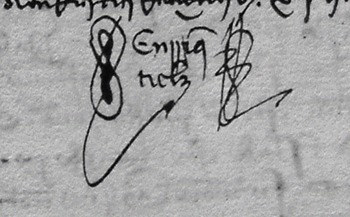
This is reflected in the anonymous treatise dated 1480 in Seville and preserved at El Escorial with the shelfmark c-III-23 (E-E c-III-23). The author of this work would seem to have been a performing musician, whose knowledge of Latin (which is used in the early chapters and in places throughout the text), and of liturgy, would suggest a possible link with the cathedral.Footnote 85 The work offers little that is original, either in its treatment of plainchant or in its exposition of the mensural system, but it does indicate quite clearly the presence of an international repertory in Seville in the fifteenth century, or at least that the author was familiar with such a repertory, since he mentions ‘the most skilled and outstanding composers Dunstable, Dufay, Johannes Okeghen, chapelmaster of the King of France, Binchois … Busnois …’. His praise for his contemporaries, whether composers of sacred or secular music, is noteworthy; he unashamedly commends their achievements, which correspond exactly with the period of growth in the cathedral's musical resources, saying: ‘they established and refined [the musical tradition] in the forty years from the 1440s to 1482’ (‘esclareçieron e purificaron en cuarenta años que fueron desde los cuarenta fasta los ochenta e dos que todos los pasados en mill e quatroçientos e quarenta años que fueron del nasçimiento de Ihu. Xpo’). The author did not limit his praise to composers but included the technical ability and virtuosity of the singers and instrumentalists who ‘have made music flourish in such an unprecedented manner both in composition and in singing and playing that I doubt their successors will be able to better them’ (‘han tanto florecido esta sçiençia así en el modo de componer como del cantar e tañer que dudo que los advenideros podrán pasar más adelante’).Footnote 86 This passage echoes the words of Johannes Tinctoris in the prologue of his Liber de arte contrapuncti, dated 11 October 1477, with which the anonymous author was apparently familiar only three years later, and which he adapts to the Sevillian context.Footnote 87 He also mentions: Guillaume Faugues (‘Vuillelmus Fauguens’), Jehan Pullois (‘Pulois’), Johannes de Wreede (‘Johanes ut rreode’), Johannes Martini, Henricus Thick (‘Enrricus Thik’) and Constans Breuwe (‘Constas’). The Seville treatise alludes to a mass by ‘Henrrique Thik’, and to a Mass ‘de felix puericia’, possibly based on Saint Rupert's antiphon Quia felix puericia.Footnote 88 I have found evidence to place the little-known composer ‘Henrrique Thik’ at Seville, which would explain the reference to him in this treatise and would open up a new route for the transmission of an international repertory to Castile. A prebendary by the name of ‘Enrrique Tich’ (Figure 2 shows his signature) is found in the cathedral documentation, sometimes referred to only as ‘Enrrique’ or ‘Henrrique’, and with his surname in various forms: ‘Thic’, ‘Thich’, ‘Tiq’, ‘Thichq’. He became a prebendary in 1468, the same year as Juan de Triana, and in 1485 was appointed to a canonry, which he held until his death three years later.Footnote 89 Reinhard Strohm has speculated that this composer might have lived in Bruges for some years, and that he might have been related to Jacobus Tick, succentor of St James's church in that city in 1463. This hypothesis might be confirmed by the fact that in Seville, Enrique Tich acted as guarantor for Maestre Enrique, a harpsichord maker, and his wife Violante Rodríguez, shortly after their arrival in 1470, in the renting of some houses belonging to the chapter in Sierpes street. The consistent omission of ‘maestre’ Enrique's surname, his profession and the fact that other foreigners acted as his guarantor through the ten years for which his workshop in Seville can be documented (1470–80) might suggest that he was of Flemish origin and that Tich was a compatriot.Footnote 90 It is difficult to establish Tich's precise musical activities in the cathedral, but it would seem likely that his works were known and performed there. As with other prebendaries who at some point dedicated themselves to being professional musicians, the chapter approved his musical abilities and delegated to him the responsibility of examining the cathedral singers and deciding which should not remain in the choir.Footnote 91 His successor in this prebend was Alonso de Sahagún, a singer in the Aragonese royal chapel.Footnote 92
Enrique Tich's signature (1470) (ACS, sección II, libro 1488, fol. 174r)

JUAN DE TRIANA, FRANCISCO DE LA TORRE AND ALFONSO PÉREZ DE ALVA
Aspects of music dissemination and circulation between Seville Cathedral and the royal chapels of Fernando and Isabel will form the focus for much of the remainder of this article.Footnote 93 Throughout the reign of the Catholic Monarchs, the musical organisations created in the fifteenth century were consolidated and standardised throughout the ecclesiastical institutions of Castile and Aragon. As a direct consequence, a marked increase in the number of composers and in musical repertory generated by church patronage, whether institutional or private, occurred, together with an increase in the amount of polyphony that was performed in both liturgical and devotional contexts. New evidence for the biographies of three composers – Juan de Triana, Francisco de la Torre and Alfonso Pérez de Alva – and for previously unknown aspects of the cathedral liturgy sheds new light on the dating of two important music manuscripts of the period: the Cancionero Musical de la Colombina and Choirbooks 2 and 3 of Tarazona Cathedral (E-TZ 2–3).
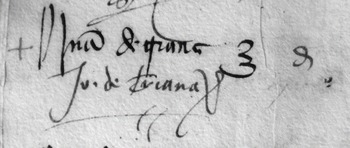
Just two pieces of information on Juan de Triana have been repeated many times over the years up to and including the most recent literature.Footnote 94 The first, discovered by Robert Stevenson, reveals that he was granted a prebend in Seville Cathedral in 1478.Footnote 95 The second was found among Barbieri's papers and refers to his appointment in 1483 at Toledo Cathedral as ‘singer with responsibility for teaching music to the six choirboys’ (‘cantor de música que tiene cargo de mostrar el arte del canto de la música a los seys niños cleriçones …’); this is the only reference to Triana at Toledo.Footnote 96 It is now clear that in 1483 Triana was in Seville receiving his salary as a singer as well as the income from his prebend as proven by his signature (Figure 3).Footnote 97 If he was in fact appointed in Toledo, he can never have taken up the position. Various absences on his part from Seville are recorded, whether on leave, or for other reasons, such as because of the plague that swept through the city in 1481 and 1486, which resulted, especially in the first case, in the exodus of many of the prebendaries for some months.Footnote 98 During these epidemics, the benefice holders were permitted, for a fixed period, to continue to draw on two-thirds of the incomes from their prebends even though they were absent from the cathedral.Footnote 99 It is possible that during these periods of absence Triana might have resided in Toledo, which would account for his familiarity with the Toledan villancico Bien vengades and the quotation from it that he makes in his chanzoneta Dinos, madre del donsel, although it might well have reached him by other indirect means since it is clear that this villancico was fairly widely disseminated and is also found in earlier sources such as the Cancionero Musical de Astudillo.Footnote 100 Juan de Triana, who had been appointed a singer at Seville in 1467 and secured his prebend the following year, never relinquished it, remaining in cathedral service until his death on 28 January 1494; he was buried near the gate of the chapel of the Virgen de la Antigua.Footnote 101 Throughout these years, Triana was active at the cathedral, fulfilling a number of confidential administrative duties such as accountant to the cathedral works and visitor for the chapter's property holdings in the city.Footnote 102
Juan de Triana's signature (1483) (ACS, sección II, libro 00922)

The previously known information on Francisco de la Torre indicated that he was born in Seville (according to Stevenson), and (according to Knighton) was a singer and chaplain in the Aragonese royal chapel from 1 July 1483 until at least mid-1494. Some years later, in February 1503, he reappears in Seville as master of the choirboys, although no trace of him in this post had been found before or after that date.Footnote 103 I have now been able to establish that he served as a singer in Seville Cathedral from at least 1464 until 1467, and that he probably remained linked with that institution until he would have left with the monarchs in March 1485.Footnote 104 He must have resided in Seville during the extended sojourn of the court there from the end of 1490 until March 1491, and probably during that time sought royal favour in the securing of a half-prebend at the cathedral, which he finally received in 1491.Footnote 105 The cathedral chapter routinely resisted the appointment of prebendaries who did not comply with or fulfil the required residence, the situation often leading to serious disputation. In May 1488, Francisco de la Torre claimed, in the first instance, to have been appointed to a half-prebend left vacant by its previous holder, Alonso Martínez de San Vicente. The chapter, defending its right to presentation, contested the appointment, and presented it to their candidate Juan de Alifón. A month later, La Torre's attorney, Bernal Muñoz, presented the chapter with the royal letter of appointment nominating the royal chaplain for the next half-prebend to fall vacant.Footnote 106 Having secured his half-prebend in 1491, he resided temporarily in Seville, using his leave entitlement to serve at court, until he moved permanently to the city in 1494.Footnote 107 He held the post of master of the choirboys in the interim period of Alfonso Pérez de Alva's tenure, from 1497 until early 1503, and from that time lived in the house that the chapter leased to Pérez de Alva for 5,000 maravedís per annum in the parish of Santa María, near the royal forge behind the cathedral.Footnote 108 He continued to hold his half-prebend until his death at the end of February 1507, possibly as a result of the plague that devastated the city in that year.Footnote 109
The biography of the third of the musicians considered here presents the most serious problems of identification because of two homonymous Alonsos de Alva and a third Alfonso Pérez de Alva, all of whom have been identified with the composer of a group of works attributed to ‘Alva’ or ‘Alba’.Footnote 110 In my view, there were two different people: the first, Alfonso Pérez de Alva, was a singer at Seville Cathedral from 1482, probably until the beginning of April 1491, when he entered the service of the Castilian royal chapel.Footnote 111 The court, as has already been mentioned, resided in Seville for over a year from the end of February 1490 until 11 April the following year,Footnote 112 and the royal letter patent for the appointment of Alfonso Pérez de Alva as a royal singer and chaplain is dated 8 April 1491 and must have been issued in Seville.Footnote 113 Possibly he stayed only a short while in Isabel's service since his name does not appear among the singer-chaplains of the Castilian royal chapel in the years 1491–6. On the contrary, in 1491 he was ‘maestro de los moços’ at Seville, and was still master of the choirboys on 18 January 1492, suggesting that either he never took up the royal appointment, or, if he did, that he served only for a short period. He left his cathedral post in 1497, and his whereabouts are unknown until his reappearance in early 1503, in the post of chapelmaster, which he held until his death in August 1504. In this last phase of his cathedral service, he also held the chaplaincy of the chapel of the Virgen de la Antigua.Footnote 114 In the Seville documentation the composer's name appears indiscriminately as Alfonso/Alonso Pérez de Alba/Alva, to the extent that in his payslips the major-domo writes Alfonso Pérez de Alva while he signs as ‘Alfonso cantor’ or ‘Alfonso Dalua’, confirming the idea of a single identity. The second Alfonso de Alva was paid as sacristan and chaplain in the Castilian royal chapel from 1497 until Isabel's death in 1504 and subsequently in the service of her daughter Juana until his death in 1522, and would not appear to have been a singer.Footnote 115 Thus, I believe that Alfonso Pérez de Alva, singer and chapelmaster of Seville Cathedral, is most likely to have been the composer not only of the Agnus dei attributed to Alfonso Pérez de Alva in the composite mass Rex Virginum (which will be discussed further below), but also of those works attributed to ‘Alonso/Ao Dalua’ in E-TZ 2–3 and the Cancionero Musical de Palacio (CMP) (E-Mp II-1335).
Several conclusions can be drawn from the new biographical data for these three composers. First, it is noteworthy that all three belonged to the same generation and that all three sang at some time in the cathedral choir. Second, the Sevillian origin of at least Francisco de la Torre and Juan de Triana is confirmed, and these two composers both worked at Seville in the early part of their careers, Triana securing the most valuable prebend shortly after he entered the institution, undoubtedly a substantial factor in his decision to remain there as singer and composer for the rest of his life. As far as is known at present, both began their professional careers while Nicola Brachio de Hierro was chapelmaster, a post he held from at least 1464 until 1477. Although it is impossible to ascertain at present, the name ‘Nycola Brachyo de Fierro’, ‘Bracho de Ferro’ or ‘Miçer Nicola’ would suggest that he was of Italian origin, which would have implications for the musical practice and repertory of the cathedral.Footnote 116
WERE THE COLOMBINA SONGBOOK AND TARAZONA MANUSCRIPT COPIED IN SEVILLE?
This leads to a consideration of the two music manuscripts already mentioned, which up till now have been associated and disassociated with Seville and their dating has given rise to various hypotheses. The most recent study of the CMC is that by Kenneth Kreitner, who re-examines the cancionero from the point of view of its dating and compilation. He suggests at several points that more biographical information on Triana, whom he considers to be ‘somewhere near the centre of this mystery’, would help resolve the questions surrounding the manuscript. Since seven times more works are attributed to Triana in both sections of the manuscript than to any other composer, Kreitner proposes that he ‘was nearby, or at least familiar, throughout its assembly’, and reiterates that ‘what we need, of course, is more biographical information’.Footnote 117 Since, as has been shown, Triana worked in Seville Cathedral between 1467 and his death in 1494, a Sevillian provenance for the manuscript seems much more likely. His presence as a singer, together with other cathedral musicians, at the court of the Duke of Medina Sidonia, don Enrique de Guzmán, ‘a las misas los días solemnes’ following the cathedral procession, can also now be documented.Footnote 118 His secular works would have been entirely suited to the range of musical activities promoted in the ducal palace, a range similar to that found in the palace of his friend, don Miguel Lucas de Iranzo, where cosautes and French rondeaux (rondeles) were sung, both genres being represented in the CMC and the Paris manuscript.Footnote 119 There is no evidence to suggest a provenance for the CMC other than Seville; rather, it would seem to be confirmed by the identified composers and its contents. Both the inclusion of works by Triana in other manuscripts associated with aristocratic households, such as the CMP, and of works by Cornago, Urrede, Enrique and Madrid in the CMC can be explained by the presence of the royal court in Seville for extended periods of time and the considerable exchange of musicians and repertory that inevitably resulted between royal, noble and cathedral capillas de música. I have recently shown that this manuscript belonged to Ferdinand Columbus' library, and that the bibliophile probably acquired it in Seville in 1534.Footnote 120
I wish to draw attention here to three works in the CMC that I believe can be linked to Seville Cathedral. These three works can be associated with liturgical plays. The two settings of the Song of the Sibyl attributed to Triana were almost certainly performed as part of the Sevillian liturgy. The above-mentioned ‘Regla Vieja’, as might be expected from the date in which it was compiled, refers to monodic performance of the Song of the Sibyl in Latin.Footnote 121 The date at which it began to be performed in the vernacular is unknown, though the practice is clearly reflected in the setting by Triana (CMC, fols. 104v–105r), as well as the anonymous version of the same text Juyzio fuerte sea dado (CMC, fol. 88r): these are the earliest known polyphonic settings. References can be found to dramatised versions of the Officium pastorum in Seville, in both the cathedral and aristocratic households, but not to specific representation of the Sibyl.Footnote 122 The third piece, Dic nobis, Maria, relates to an Easter play, being the earliest known polyphonic setting of part of the sequence Victimae paschali laudes, associated with representations of the Visitatio sepulchri performed in various parts of the peninsula.Footnote 123 Such plays were performed at Seville from at least 1434, when references to them first appear along the lines of ‘to the boy who played Mary at Easter time’ (‘al moço que hizo la María en la fiesta de Pascua’), or ‘to the Mary Magdalene who performed at the Easter service’ (‘a la María Magdalena que hizo el ofiçio de la Resurrección’), who would have responded to the polyphonic fragment from the Sepulchrum Christi.Footnote 124 Such references, together with the surviving pieces in the CMC, reflect the early introduction of polyphony into these plays.Footnote 125
The new biographical information on Triana would support a date towards the end of the 1460s for the earlier part of the CMC.Footnote 126 I agree with Gómez Muntané that lines in the villancico Merced, merced le pidamos (‘let's ask him politely / as to a human being / that he grant us good luck / in the century to come’ (‘pidámosle por mesura / como a humana criatura / que nos de buena ventura / en el siglo que speramos’)) refer to the New Year of 1500, giving a new terminus post quem for the manuscript as a whole.Footnote 127 Possibly this song was performed in the cathedral or one of the noble palaces in the city at Christmas Matins in 1499. If this hypothesis is correct, the song could have been composed by Francisco de la Torre, in accordance with his duties as chapelmaster at that time. The use of a pictogram of a tower (‘torre’) to refer to his surname by the villancico Dime triste coraçon might also reflect a close relationship between this manuscript and his own working environment.
Finally, as regards the CMC, I would propose the following hypothesis, which is essentially compatible with those put forward by Fallows and Kreitner. It may well have belonged to a singer-composer in the service of a noble chapel, an example of the type of musician's manuscript that circulated in private hands and which occasionally appears in an inventory, a will or is sold or left to lay or ecclesiastical institutions. It was bound together, as was customary, after the varied fascicles had been copied. This process could have taken place in Seville, with materials of different provenance being brought together, although the use of the same paper throughout would suggest a single environment. The manuscript was acquired by Ferdinand Columbus, very possibly through an auction of a musician's belongings, or through the family member, heir, pupil or later owner (perhaps also a musician) who might have added the final gatherings.Footnote 128 On folios 7r, 19r and 34r, fragments of text are found which refer to a ‘Doña Ana, mi señora [?]’, and to ‘juan de [crossed out]’. This might refer to Ana de Aragón (d. 1477), first wife of Luis de la Cerda (1438–1501), Duke I of Medinaceli and Count I of Puerto de Santa María. Christopher Columbus lodged in the palace of Puerto de Santa María for two years and the Duke supplied him with a letter of introduction to the Catholic Monarchs. It was Luis de la Cerda himself who wrote to his uncle, Cardinal Pedro González de Mendoza, on 19 March 1493 to inform him of Columbus's return following the discovery of America.Footnote 129 I have been able to document musical activity at the Medinaceli court at this time, and it is highly plausible that this manuscript was at some time used in such circles.Footnote 130 Kreitner has suggested that the scribe of the manuscript may have been none other than Juan de Triana, but at present there is no conclusive proof either way. The question should be left open for now, although, as Rey has observed, Triana may have been directly involved in the copying of an incomplete piece preserved at fol. 90v.Footnote 131
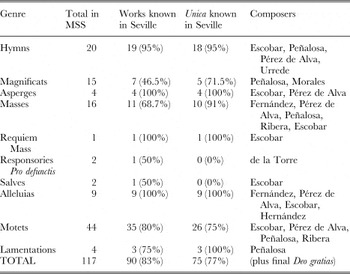
The second source to be considered here is E-TZ 2–3, one of the most important and complete collections of sacred polyphony from the end of the fifteenth century and beginning of the sixteenth century.Footnote 132 While some scholars, such as Roberta Freund, have seen it as the largest collection ‘of liturgical works by composers in the service of Fernando and Isabel’,Footnote 133 I would rather propose ‘of composers and repertory from Seville Cathedral’ of the period under consideration here, although these suggestions would not necessarily be mutually exclusive. A statistical study of which works might have originated in Seville, or might have been found and performed there, based simply on the composers represented, references to the copying of their works and the preservation at the cathedral of other manuscripts containing their works affords interesting results (see Table 4).Footnote 134 The works have been grouped by genre and the proportion of unica within each group is also indicated.Footnote 135
Works in E-TZ 2–3 possibly originating in Seville or known and performed in the cathedral*

* The composers included are: Pedro de Escobar (not Porto), Alfonso Pérez de Alva, Francisco de Peñalosa, Antonio de Ribera, Francisco de la Torre, Urrede (1), Rodrigo de Morales (1), Pedro Fernández (1+ Sanctus).
The first decade of the sixteenth century witnessed increased activity in the acquisition of polyphonic books for the cathedral. In 1504 several books were bought, one of them from the cathedral singer Fernando Sánchez de Guzmán,Footnote 136 and several others from the auction of the possessions of the chapelmaster Alfonso Pérez de Alva, manuscripts that surely contained his own works among others.Footnote 137 These would not have been isolated examples of the circulation of substantial music books in the city in about 1500. Another large music book was purchased by Ferdinand Columbus in about 1511 (no. 3327 in Registrum B) and later formed part of the Biblioteca Colombina thanks to the legacy of his collection to the cathedral. Table 5 presents a comparison between this manuscript and E-TZ 2–3 in order to give an idea of their respective sizes;Footnote 138 both were carefully organised volumes.
Comparison of the contents of E-TZ 2–3 and book no. 3327 in Registrum B

Perhaps the most striking acquisition in this period was made by the cathedral chapter, which in 1510 ordered ‘that the chapter have copied the book of polyphony in the possession of Canon Francisco de Peñalosa’ (‘que el libro que tiene Francisco de Peñalosa, canónigo, de canto de órgano, que el cabildo lo faga trasladar’).Footnote 139 In the years 1510–11, Pedro Martínez de Estabillo, singer and chaplain of the Archbishop Diego de Deza, was commissioned to buy the parchment and copy the works to be included in this manuscript. Over the course of a year, thirty cuadernos or gatherings and six extra leaves were purchased and copied for this large-format book, its size being very similar to that of E-TZ 2–3, since each gathering had eight leaves (a cuaternión), giving, with the six extras, a total of 246 folios (if all the payments for the copying of this book have been located).Footnote 140 All this information would suggest a strong degree of homogeneity in the copying of this manuscript, which would have included works by Peñalosa, but not necessarily exclusively by him. Possibly it contained works that he had gathered together during his period of service in the Aragonese royal chapel. This manuscript cannot be identified with E-TZ 2–3, since one is copied on vellum and the other on paper; presumably Peñalosa's own copy (or copies) would have been returned to him after the copying process was complete. No other copy, with such proximity to the composer, and with such a large number of his works, is known.Footnote 141 The Seville choirbook would have been copied when Escobar was chapelmaster and it is quite possible that works by him were also included. In the earliest surviving inventory of ‘la librería de canto de órgano’ at Seville Cathedral, dating from 1588 and copied during Guerrero's tenure as chapelmaster, only two books can be linked with these composers: the ‘book of masses by Peñalosa, Archdeacon of Carmona, notated on parchment of medium size, old’ (‘libro de misas de Peñalosa, arcediano de Carmona, puntadas en pergamino en marca mediana, viejo’) and the ‘book of medium size of masses, Credos and ‘Et incarnatus’ by Pedro Hernández, Escobar and others, on parchment, bound in boards covered in white leather’ (‘libro de marca mediana de misas y credos e yncarnatus de Pedro Hernández y Escobar y otros autores, en pergamino, encuadernado en tabla y cuero blanco’). The first of these entries almost certainly refers to the volume copied in 1510–11.Footnote 142 If the volume of Peñalosa masses was indeed copied in 1510–11, then they were composed before his visit to Rome.Footnote 143 The second volume in the 1588 Seville inventory may well refer to a large and elaborate book, illuminated and compiled in 1531–2 in which the chapelmaster Pedro Fernández (purchase of vellum), Fernando Morales (binding and illumination), Andrés Gutiérrez and Juan Ramírez (illumination), Francisco Martín Arroyo and Cristóbal Bernal (copyists) all participated.Footnote 144
Given the repertory by Alva, Peñalosa and Escobar in the possession of Seville Cathedral in the first half of the sixteenth century, and the fact that the majority of the works in E-TZ 2–3 are attributed to these composers, it seems likely that, even though it was clearly not the book compiled in Seville in 1510–11, this volume of masses may itself originally have served as one of the exemplars for E-TZ 2–3, given that both sources appear to have been closely linked to that city. It may even have been the case, though it is difficult to prove, that the copyist was the same for both manuscripts, Pedro Martínez de Estabillo, whose proximity to Archbishop Deza and the sources for his copy would make him a likely candidate. Until now, the principal objection to this hypothesis might have been the known dates of the composers represented, but, as I will show below, the presence of Pedro Fernández as a singer at Seville Cathedral can now be backdated to 1497, and that of Antonio de Ribera until 1498 can be confirmed. Both these datings would contradict the assumption that their works in E-TZ 2–3 must have dated from later, even from as late as the 1530s. The debate on whether the setting of the Magnificat attributed to Ro de Morales was actually by Cristóbal de Morales can now be laid to rest, given that the abbreviation must surely refer to the cathedral organist Rodrigo, an abbreviation which was commonly used to refer to him, as in a payment made to him in 1549 and in his own signature (Figure 4). A reference, dated 1540, to a cathedral organist by the name of Rodrigo de Morales has long been known, but I have recently discovered that this organist was in the service of the fifth Duke of Medina Sidonia, Alonso Pérez de Guzmán, in 1516, and that two years later he was appointed organist in the chapel of the Virgen de la Antigua. This new biographical information would allow the copying of his Magnificat in E-TZ 2–3 to have been considerably earlier. At the same time, the fact that this Magnificat setting was produced locally would strengthen the argument for the copying of the Tarazona choirbook in Seville.Footnote 145
Rodrigo de Morales's signature (1549) (ACS, sección VI, leg. 11.351, exp. 3 (2))

A Sevillian provenance for the repertory copied in E-TZ 2–3 is also suggested by analysis of three other works. The first of these is the composite Missa Rex Virginum, with the Kyrie attributed to Escobar, the Gloria and Credo to Peñalosa, the Sanctus to Pedro Hernández and the Agnus dei to ‘Alfonso Pérez de Alva’. The Rex virginum trope (which is found in both of the composite mass settings in E-TZ 2–3) is specified in the ‘Regla vieja’ for several feasts. In addition, the use of Alva's full name is encountered almost exclusively in the cathedral documentation. Pedro Hernández became a singer in 1497 as ‘Pedro Fernandez’, both spellings of his surname (Hernández/Fernández) being used from his appointment as chapelmaster in 1515 until at least 1527.Footnote 146 Thus, Hernández began his career at Seville under the direction of a succession of chapelmasters: Francisco de la Torre, Alfonso Pérez de Alva, Juan Valera and Pedro de Escobar, whom he eventually succeeded in that position. The confluence of all these composers at Seville and nowhere else (as far as is known) would suggest that Seville was the likely provenance for this multi-authored unicum.
The second work to be considered here is Escobar's Requiem Mass, studied in detail by Wagstaff in his doctoral thesis. Polyphonic performance of the Requiem Mass in Seville Cathedral can be traced back to the fifteenth century, as is testified by several private endowments established there at that time.Footnote 147 Important funerary ceremonies financed by the cathedral chapter were also solemnified by the performance of polyphony by the cathedral choir. Among these, the ceremonies held for the former Archbishop of Seville, Diego Hurtado de Mendoza, who died in Madrid, when his remains were transferred for burial in the chapel of the Virgen de la Antigua in May 1504 when Alfonso Pérez de Alva was chapelmaster, would have been of considerable significance.Footnote 148 Two of the texts set by Escobar – the tract Sicut cervus and the communion antiphon Absolve Domine – would appear to have been strongly linked to the Sevillian liturgy.Footnote 149 This tract appears not only in Escobar's Requiem, but also that by Morales dedicated to the Count of Ureña, that by Juan Vázquez and in the earlier of the two settings by Guerrero. Although this text would appear to have been commonly used in these early Requiems, it does not appear in Toledo, nor in the few other Andalusian sources consulted by Wagstaff. Eleanor Russell, in her study of Morales's Missa pro defunctis, identified only two sources with this text among the twenty Spanish books she studied, both of them monastic: a Dominican processional from Salamanca and a Benedictine processional from Valladolid. The Absolve Domine is especially interesting in that it is not the text usually found in the liturgy for the Requiem Mass in Spain (Lux aeterna, a variant of that used in the Roman missal). The version used by Escobar is only found in a chant book from the thirteenth or fourteenth century preserved in Burgos, which includes the tracts Dicit Dominus and Absolve. As Wagstaff has shown, the texts used by Escobar are the same as those used by Vásquez in his Agenda Defunctorum of 1556. An anonymous polyphonic setting of this text is also included as an appendix to Morales's Requiem Mass in E-V s.s., together with the usual Lux aeterna. Morales's Requiem, as it is preserved in this manuscript, includes three tracts and two communions, whose texts link it to a Sevillian provenance, as might be expected given that he wrote it for Juan Téllez Girón, Count of Ureña, patron of the collegiate church of Osuna (near Seville), where his exequies were held in 1558.Footnote 150 Inscriptions found on the last folio of this manuscript include the name ‘doña Juana de la Cerda’, as well as a reference to its possession by Valladolid Cathedral dated 1581. This reference to ‘doña Juana de la Cerda’, which has not previously been noted, can probably be linked to the doña Juana de la Cerda who was married to Don Lorenzo Manuel de Villena de Rojas, lord and lady of Cívico de la Torre and Belmonte de Campos, parents of Juan Manuel de Villena de la Cerda, a canon and later dean of Seville Cathedral (1546), who went on to become Bishop of Zamora (1565–74) and Sigüenza (1574–9). He retired to his native city of Valladolid and died there in 1589.Footnote 151 I believe that he might well have been involved in the transmission of this manuscript to Valladolid, and that this source contains the version of Morales's Requiem Mass closest to the composer.
Texts found in Seville Cathedral can help to elucidate this point and suggest a filiation with its liturgy. The Sevillian books that include the Missa pro defunctis display a number of minor discrepancies resulting from when they were copied and from the extent to which the texts were fixed. The Misal hispalense copied and illuminated for Pedro de Toledo (1428–33) indicates: ‘Tractus De profundis clamaui ad te domine … Quando celebratur aniuersarium Tractus Sicut cervus desiderat … Tempore resurrectionis siue celebretur aniuersarium siue non Tractus Dicit dominus ego sum resurrectio … Aliud Tractus Absolue domine animas eorum … Communio Absolue domine animas eorum’.Footnote 152 Another missal from the second half of the fifteenth century (1460) indicates: ‘Pro sacerdotibus’ for the tract Sicut cervus and makes no mention of the anniversaries nor of the possibility of the Absolve domine tract.Footnote 153 The ‘Regla Vieja’ indicates Sicut cervus ‘quando fit aniuersarium’, but introduces a small but significant modification as regards the text Absolue domine animas eorum, which appears only as a communion text ‘In tempore resurrectionis’, while also referring to the Lux aeterna lucebit for this part of the Mass: ‘Trattus. De profundis. Quando fit aniuersarium solemne trattus Sicut ceruus desiderat. In tempore resurrectionis trattus Dicit dominus ego sum resurrecio … Communio. Lux eterna lucebit. In tempore resurrectionis. Communio Absolue domine animas eorum’.Footnote 154
Thus, Escobar's polyphonic setting as found in E-TZ 2–3 would appear to conform to the Sevillian missal for a Mass of the Dead as celebrated at the cathedral's anniversaries, and may well have been composed while he was chapelmaster there.Footnote 155 The possibility that the text Absolve domine animas eorum could be used for both the tract and the communion in ‘Tempore Resurrectionis’, at least at one point in the cathedral liturgy, would mean that this setting could have been sung throughout the liturgical year. It is worth reiterating that the name Escobar is used only in Seville (as in his signature reproduced in Figure 1); the name Pedro de Porto is found only in the documentation for Isabel's chapel before Escobar went to Seville and in later references in Portugal. As I have already argued, it seems unlikely that these two musicians were the same person, which has important ramifications for works attributed to ‘Escobar’ in other manuscripts from the period when he was chapelmaster at Seville.Footnote 156
The polyphonic Requiem that might have been performed at Seville before Escobar's arrival, for example at the aforementioned exequies for Cardinal Diego Hurtado de Mendoza, has not survived. By contrast, the composition of Francisco de la Torre's Ne recorderis (also found in E-TZ 2–3) might be linked to two specific cathedral occasions. This responsory for the dead was sung at the above-mentioned anniversaries in Seville from the beginning of the fifteenth century.Footnote 157 The first, and perhaps the most likely, is the unexpected death in 1497 of prince Juan, heir to the thrones of Castile and Aragon.Footnote 158 As has been shown, in that year Francisco de la Torre held the position of chapelmaster at Seville Cathedral, and must have been responsible for organising the music for the celebration of royal exequies for the prince, who had been baptised in that church. It is possible, given his position as chaplain and singer in the Aragonese royal chapel, that he knew the prince personally; Juan's passion for music is well documented, and the composer may have written this work in his memory. The second occasion, no less solemn, would have been the death in 1502 of Cardinal Diego Hurtado de Mendoza, when la Torre was still chapelmaster.
Finally as regards works with Sevillian connections in E-TZ 2–3, I will consider two hymns by Alva – Beata nobis gaudia and Veni creator spiritus – which bear the rubric: ‘In die sancto pentecostes’.Footnote 159 According to tradition, the first of these hymns was sung at Lauds at Pentecost, both in pre-Tridentine Spanish sources (Intonarium Toletanum, 1515, fol. ixr) and Roman breviaries from before and after the reforms of Pius V.Footnote 160 The hymn Veni creator spiritus follows immediately after Beata nobis gaudia and this order is observed in two anonymous settings of these texts preserved in Seville Cathedral Cantoral no. 2 (fols. 40v–46r) containing polyphonic psalms and hymns which I have identified as being by Francisco Guerrero.Footnote 161 The ‘Regla Vieja’ is alone in allocating Beata nobis gaudia to Vespers of the feast of Pentecost, with Veni creator spiritus being prescribed for Terce, before the main Mass on the feast day itself and for its octave.Footnote 162 The Tarazona Breviarium also allocates Veni creator spiritus to Terce, although the Intonario General, dedicated to the Archbishop of Zaragoza don Hernando de Aragón and compiled by Pedro Ferrer, priest of that diocese, gives only the chant with the rubric ‘tempore Pentecostes’.Footnote 163 In their settings of Beata nobis gaudia, both Alva and Guerrero use the chant melody preserved in a cathedral hymnal.Footnote 164 This chant is a variant of that found in the Intonarium Toletanum, and different from that sung in Tarazona Cathedral. It is thus highly improbable that Alva's setting would have been used in the liturgy at Tarazona.Footnote 165
CIRCULATION AND EXCHANGE OF MUSICIANS AND MUSIC
The musicians, singers and composers themselves undoubtedly had an important role in the transmission of this repertory through copying works from different places, whether singly in fascicles or in bound books.Footnote 166 Other means of circulation and exchange of potential importance between the cathedral repertory and that of the royal chapels are afforded by the aforementioned Mateo Ximénez, Francisco de Useda and Juan de las Heras. Their professional careers began at Seville Cathedral and progressed to the royal chapels; Ximénez later returned to Seville as a singer (he held a veintena prebend) and remained there until his death in December 1479. Francisco de Useda had been a tenor at the cathedral since 1464 and remained there until he was recruited for the Aragonese royal chapel while the monarchs were residing in the city in 1478. He continued to serve the king until his death in July 1488. Juan de las Heras entered the cathedral as a singer and veintenero in 1459; from 1467 he also held the position of succentor. He appears to have left Seville in 1482, in the company of Archbishop Pedro González de Mendoza, and is listed as a member of his chapel in 1494. On the Cardinal's death in January 1495, he entered the Castilian royal chapel, where he served until Isabel's death in 1504.Footnote 167 All these singers were trained and worked professionally at the cathedral for extended periods during the second half of the fifteenth century. In Seville they would have sung at the lectern with La Torre and Triana, and in the royal chapels with Cornago, Urreda and Anchieta, among others.
Singers of the Castilian royal chapel who were ‘vecinos’ or residents of Seville included: Fernán Pérez de Medina (1479), Juan de Coimbra (1486), Cristóbal de Morales (who was in the service of the Duke of Medina Sidonia in 1503),Footnote 168 and Alonso de Baena (1504), as well as Francisco Muñoz de Jaén (1502). To be a ‘vecino’ or inhabitant of Seville implied ownership of a house and main residence there. For someone from outside the city to acquire the status of ‘vecino’ a fixed period of residence – a year and a day – was stipulated, and so as not to lose that status that person would have had to live there for a further period of five or twelve years, according to circumstances.Footnote 169 This would confirm the hypothesis that some singers in the royal chapels resided in other institutions from time to time, serving at court only on certain occasions or during specific periods. To the roster of Seville musicians with works linked to the repertory of the royal and noble courts (including some pieces of conflicting attribution in E-TZ 2–3) can be added Antonio de Ribera, whose presence in Spain has not previously been documented.Footnote 170 In 1496, Antonio de Ribera took the role of Mary Magdalene in the Easter play performed in Seville Cathedral while Alva was chapelmaster. This role was normally taken by younger singers, sometimes by choirboys, a reflection of their training in the time of Alva and La Torre, who was responsible for organising the play the following year. Two years later, on 19 September 1498, the cathedral chapter agreed to appoint Juan de Villafranqueza as a singer, and gave him the singing place formerly held by Antonio de Ribera, who left to take up an unknown position; he subsequently went to Rome, where some years later he would sing alongside canon Francisco de Peñalosa.Footnote 171 This information adds another point of contact between Seville Cathedral and the repertory of E-TZ 2–3, since three motets and a four-voice mass are attributed to Ribera in that manuscript.
Another aspect of this exchange between Seville Cathedral and the singers of the royal chapels is that several of them ended their days as prebendaries in that city; in some instances, they also held posts that included musical activities. Peñalosa's situation is well known, but there is also the case of canon Francisco de Morales, who in 1503 examined, together with Alva, the singer Fernando Ropanegra to establish whether he had the ability to be appointed. Similarly, in 1504 the prebendary Fernando de Estremoz was involved, with La Torre, in valuing a book of polyphony bought from Fernando Sánchez, or assessing the skill of Alonso Sánchez for the position of cleric of the veintena in 1505.Footnote 172
This coming and going of musicians would also have been enabled by the sojourns of the royal court in Seville, where the monarchs resided in the Alcázar; this had been restored in the fourteenth century by Pedro I, who had made Seville his city. Seville was the setting for many events of great importance for the royal family, events that were marked by liturgical ceremonies in the cathedral. The most important of these were the baptism of prince Juan in 1478 and the wedding of princess Isabel in 1490. There was surely no other cathedral, not even Toledo, that established such a close exchange of music and musicians with the royal chapels in the second half of the fifteenth century. Moreover, the city of Seville was clearly an exceptional centre for the development of sacred and secular polyphony in this period. In addition to the cathedral's capilla de música, there were those of the most important noble familes of the city: the Guzmán, the Ponce de León and the Ribera, as well as those of the archbishops such as Alonso de Fonseca (1454–73), Pedro González de Mendoza (1473–83), Diego Hurtado de Mendoza (1495–1502) or Diego de Deza (1504–23),Footnote 173 and singers in the service of canons and other high-ranking members of Sevillian society. These other bodies must have contributed to and reinforced the cathedral's musical resources on certain ceremonial occasions as well as the processions held on major feasts such as Corpus Christi or Assumption Day, and others of special significance celebrated in the city.Footnote 174
In the light of the evidence presented here, Seville Cathedral's major contribution to the polyphonic tradition that flourished during the reign of the Catholic Monarchs cannot be doubted. Indeed, it lay at the heart of a thriving musical life, enriched by its early exposure to Franco-Burgundian influence and fomented by the civic and ecclesiastical patronage as well as the many private endowments that increased exponentially from the mid-fifteenth century.
Translated by Tess Knighton