Introduction
Cutaneous squamous cell carcinoma (SCC) is common in the Australian population, with a reported incidence of 250–300 per 100 000 per year.Reference Andruchow, Veness, Morgan, Gao, Clifford and Shannon 1 Cutaneous SCC has been reported to be more aggressive in immunocompromised patients, including those with haematological malignancies such as non-Hodgkin lymphoma and chronic lymphoid leukaemia.Reference Hartley, Searle, Breach, Rhys-Evans and Henk 2 , Reference Moore and Bhattacharyya 3 Although the rate of metastatic spread is low overall and thought to account for less than 5 per cent of all presentations with cutaneous SCC,Reference Forest, Clark, Veness and Milross 4 , Reference Vauterin, Veness, Morgan, Poulsen and O'Brien 5 in patients with non-Hodgkin lymphoma and chronic lymphoid leukaemia, the diagnosis of metastatic cutaneous SCC requires a high index of suspicion and presents a particular diagnostic challenge. Furthermore, the management of these conditions requires multidisciplinary involvement and co-ordination of various treatment modalities including surgery, radiotherapy and chemotherapy.Reference Flezar, Prevodnik, Kirbis and Strojan 6 Prompt diagnosis is thus critical to tailoring optimal management plans. There is a lack of evidence to guide clinicians in the optimal management and surveillance of patients with non-Hodgkin lymphoma or chronic lymphoid leukaemia presenting with synchronous or metachronous metastatic SCC.
18F-fluorodeoxyglucose positron emission tomography (PET) is an imaging modality that is well established as a useful staging tool in a number of malignancies.Reference Stokkel, Moons, ten Broek, van Rijk and Hordijk 7 There is minimal evidence supporting its role in differentiating cervical lymphadenopathy from non-Hodgkin lymphoma or metastatic SCC in the head and neck region. 18F-fluorodeoxyglucose PET may have a role in assessing low-grade non-Hodgkin lymphoma patients who present with progressive cervical lymphadenopathy. It may also have a role in the assessment of patients with high-risk cutaneous SCCs or multiple cutaneous SCCs, and aid selection of patients to undergo surgical excision of the regional draining lymph nodes.
This study aimed to determine the utility of 18F-fluorodeoxyglucose PET in differentiating cutaneous SCC metastases in the head and neck region from concurrent low-grade non-Hodgkin lymphoma or chronic lymphoid leukaemia related lymphadenopathy. It was hypothesised that cutaneous SCC metastases would have a higher standardised uptake value on 18F-fluorodeoxyglucose PET imaging when compared to nodes with either normal lymphoid tissue or lymphoma in the head and neck region. The secondary aim was to report the experience, at the Central Coast Local Health District of New South Wales, Australia, of managing patients with dual metastatic SCC and low-grade non-Hodgkin lymphoma or chronic lymphoid leukaemia, in order to highlight the diagnostic and management dilemmas faced in such patients.
Materials and methods
Following approval by the Hunter New England Human Research Ethics Committee and the Central Coast Local Health District research governance office, a retrospective review of the Central Coast Local Health District head and neck multidisciplinary records was undertaken. This review aimed to identify patients presenting with histopathologically confirmed, regionally metastatic cutaneous SCC in the five-year period from 1 July 2009 to 30 June 2014. The list of patients was crosschecked against hospital and haematology departmental records to identify those patients who also had biopsy-confirmed, synchronous or metachronous low-grade non-Hodgkin lymphoma or chronic lymphoid leukaemia. Patients with mucosal primary SCC were excluded from the study.
Data on patient, tumour and treatment characteristics were collected. A nuclear medicine physician reviewed all available computed tomography and 18F-fluorodeoxyglucose PET imaging datasets. The nuclear medicine physician was blinded to the histopathology results. The standardised uptake values of individual lymph node levels were recorded and examined against surgical histopathology reports. A receiver operator characteristic curve was generated and the optimum standardised uptake value cut-off for PET was calculated by maximising the Youden index. Anatomical lymph node levels were defined in accordance with the American Academy of Otolaryngology – Head and Neck Surgery guidelines.Reference Robbins, Clayman, Levine, Medina, Sessions and Shaha 8
Any significant delay in diagnosis or compromise in management was recorded. A delay in diagnosis was defined as a delay greater than two months or any time period that led to an adverse patient outcome. Compromise in management was defined as treatment that did not meet the National Comprehensive Cancer Network guidelines for appropriate management. Treatment type, recurrence rates, morbidity and mortality were also assessed. Descriptive statistical methods were employed to analyse the data.
Results
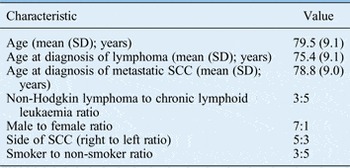
Eight patients presented with synchronous or metachronous metastatic cutaneous SCC of the head and neck and low-grade non-Hodgkin lymphoma or chronic lymphoid leukaemia between 1 July 2009 and 30 June 2014. Five of the patients had a primary cutaneous index lesion at the time of presentation with metastatic SCC. There were seven males and one female, with a mean age of 79.5 years (standard deviation (SD) = 9.1 years). The mean time between diagnosis of low-grade non-Hodgkin lymphoma or chronic lymphoid leukaemia and metastatic SCC was 3.4 years (SD = 2 years). The demographics of the patients are presented in Table I.
Patient demographics*

* Total of eight patients. SD = standard deviation; SCC = squamous cell carcinoma
Mean age at diagnosis of low-grade non-Hodgkin lymphoma or chronic lymphoid leukaemia was 75.4 years (SD = 9.1 years). Four of the eight patients had their low-grade non-Hodgkin lymphoma or chronic lymphoid leukaemia treated with chemotherapy prior to their diagnosis of metastatic SCC. Two of the eight patients had their low-grade non-Hodgkin lymphoma or chronic lymphoid leukaemia treated symptomatically; this treatment included the appropriate transfusion of blood products. One patient underwent chemotherapy and radiotherapy for low-grade non-Hodgkin lymphoma. One patient was diagnosed simultaneously with metastatic SCC and low-grade non-Hodgkin lymphoma, and had not commenced any treatment for their low-grade non-Hodgkin lymphoma.
Mean age at diagnosis of metastatic SCC was 78.8 years (SD = 9.0 years). Four of the eight primary cutaneous SCC lesions were poorly differentiated, three were moderately differentiated and one tumour could not be fully assessed because of partial treatment with cryotherapy prior to biopsy. One of the eight patients was diagnosed simultaneously with metastatic SCC and low-grade non-Hodgkin lymphoma after 18F-fluorodeoxyglucose PET and biopsy revealed both metastatic SCC deposits and chronic lymphoid leukaemia in the one lymph node.
Six of the eight patients underwent neck dissection followed by adjuvant radiotherapy for curative management of their metastatic SCC. Two patients were deemed unsuitable for a general anaesthetic because of co-morbidities and therefore did not undergo neck dissection. They were managed with palliative intent. One of these patients was treated with high-dose palliative radiotherapy. The patients’ tumour characteristics and management details are summarised in Table II.
Tumour characteristics and management details

Pt no. = patient number; SCC = squamous cell carcinoma; TNM = tumour–node–metastasis; SUV = standardised uptake value; PET = positron emission tomography; +ve = positive
The diagnosis of metastatic SCC was significantly delayed in two patients, as their development of cervical lymphadenopathy was attributed to their low-grade non-Hodgkin lymphoma. One patient underwent an initial core biopsy that was reported to reveal non-Hodgkin lymphoma; subsequent re-sampling, on progression of the cervical lymphadenopathy, demonstrated metastatic SCC. The second patient had been monitored clinically for cervical lymphadenopathy presumed to be related to lymphoma for a period of months and was only further investigated when the progressive lymphadenopathy was noted to be limited to the unilateral neck.
The treatment of 38 per cent of patients in the present study required compromises in care as a result of having dual malignancies. The management of metastatic SCC was prioritised, and chemotherapy for low-grade non-Hodgkin lymphoma or chronic lymphoid leukaemia was deferred in two patients. One patient was unable to undergo surgery for metastatic SCC because of mediastinal lymphadenopathy from progressive non-Hodgkin lymphoma which impacted on their fitness for a general anaesthetic.
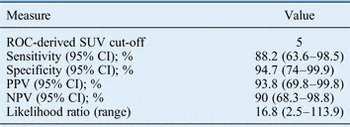
There were a total of 36 evaluable lymph nodal levels and parotid specimens from the 6 patients who underwent surgery and the 2 patients who underwent a core biopsy. The area under the receiver operator characteristic curve was calculated to be 0.9628 (95 per cent confidence interval (CI) = 0.91–1), and receiver operator characteristic curve analysis determined the optimum standardised uptake value cut-off to be 5. The area under the receiver operator characteristic curve at 5 was 0.91 (95 per cent CI = 0.82–1).
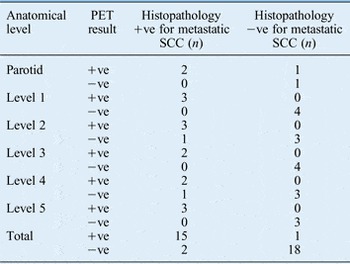
Seventeen of 36 lymph nodal levels were found to have metastatic SCC on histopathology. On comparison of the histopathology results with 18F-fluorodeoxyglucose PET findings, 15 of the 17 levels returned a maximum standardised uptake value of 5 or above, with a mean maximum standardised uptake value of 9.3 (SD = 2.9). Of the eight cases, there was one false positive result (maximum standardised uptake value of 5.6) and two false negative results (maximum standardised uptake values of 2.8 and 2.5). A comparison of PET findings with histopathology results by anatomical level is presented in Table III.
Comparison of pet and histopathology results

PET = positron emission tomography; +ve = positive; SCC = squamous cell carcinoma; −ve = negative
18F-fluorodeoxyglucose PET was able to differentiate head and neck metastatic SCC from either low-grade non-Hodgkin lymphoma or chronic lymphoid leukaemia, or normal lymph node tissue, with a sensitivity of 88.2 per cent (95 per cent CI = 63.6–98.5) and a specificity of 94.7 per cent (95 per cent CI = 74–99.9) when comparing 18F-fluorodeoxyglucose PET findings with histopathology on an anatomical level basis. The positive predictive value, negative predictive value and likelihood ratio are presented in Table IV.
Pet diagnostic measures

PET = positron emission tomography; ROC = receiver operator characteristic; SUV = standardised uptake value; CI = confidence interval; PPV = positive predictive value; NPV = negative predictive value
Discussion
There is a growing body of evidence to demonstrate that people with low-grade non-Hodgkin lymphoma or chronic lymphoid leukaemia are immunosuppressed, either through the disease itself or as a direct result of its treatment. This leaves them more susceptible to other malignancies that can potentially be biologically and clinically aggressive.Reference Levi, Randimbison, Te and La Vecchia 9 Furthermore, advances in low-grade non-Hodgkin lymphoma or chronic lymphoid leukaemia management in recent decades have resulted in these immunosuppressed patients surviving longer in an immunosuppressed state.Reference Kristinsson, Dickman, Wilson, Caporaso, Bjorkholm and Landgren 10 When combined with Australia's high prevalence of cutaneous SCC, the dual diagnosis of synchronous metastatic SCC and low-grade non-Hodgkin lymphoma or chronic lymphoid leukaemia can be expected to become increasingly common.
Optimal management of patients with both metastatic SCC and low-grade non-Hodgkin lymphoma or chronic lymphoid leukaemia is dependent on the accurate diagnosis and staging of both malignancies.Reference Stokkel, Moons, ten Broek, van Rijk and Hordijk 7 , Reference Asaumi, Yanagi, Konouchi, Hisatomi, Matsuzaki and Kishi 11 Early diagnosis of metastatic SCC can limit the associated morbidity and mortality, and allow for the tailoring of treatment to the individual patient. 18F-fluorodeoxyglucose PET is a useful tool in the diagnosis of metastatic SCC in patients with synchronous or metachronous low-grade non-Hodgkin lymphoma or chronic lymphoid leukaemia, as demonstrated in the current study. It is acknowledged that transformation of low-grade non-Hodgkin lymphoma or chronic lymphoid leukaemia to high-grade lymphomas, which typically have higher standardised uptake values on PET compared to low-grade non-Hodgkin lymphoma, does occur uncommonly. Such clinical scenarios may pose additional diagnostic difficulties, and 18F-fluorodeoxyglucose PET is less likely to differentiate between this and metastatic SCC. The specificity of 18F-fluorodeoxyglucose PET in the present study is similar to that reported elsewhere.Reference Tomaszewski, Lau and Corry 12 Interestingly, the sensitivity of 18F-fluorodeoxyglucose PET is much greater when compared to the histopathology of anatomical or surgical lymph node levels and not on an individual node basis. It can be argued that this is a more clinically and surgically relevant comparison.
Further to difficulties with diagnosis, there is limited published evidence to guide clinicians when constructing treatment plans for patients with synchronous or metachronous metastatic SCC and low-grade non-Hodgkin lymphoma or chronic lymphoid leukaemia. This extends not only to the type but also the timing of various treatment modalities. This is of particular significance given that, in isolation, metastatic SCC and low-grade non-Hodgkin lymphoma or chronic lymphoid leukaemia are managed with greatly contrasting treatment aims and modalities. Metastatic cutaneous SCC is generally treated in the first instance with surgery and adjuvant radiotherapy with curative intent. In contrast, apart from facilitating diagnosis, there is a limited role for surgery in the management of low-grade non-Hodgkin lymphoma or chronic lymphoid leukaemia. Chemotherapy is the mainstay of treatment, with radiotherapy for local control and symptom management. Delayed diagnosis and treatment of metastatic SCC in those with low-grade non-Hodgkin lymphoma or chronic lymphoid leukaemia can result in ongoing or even accelerated SCC spread, especially if the chemotherapy compromises patients’ immune defences. Ensuring optimal treatment of the metastatic SCC, the malignancy that infers the poorer five-year survival outcome of the two malignant processes, needs to be prioritised during management decisions for these patients.Reference Watanabe, Inohara, Akahani, Yamamoto, Moriwaki and Kubo 13
Literature regarding the management of patients with a dual diagnosis of low-grade non-Hodgkin lymphoma or chronic lymphoid leukaemia and metastatic SCC is currently limited to a small number of individual case reports and small case series.Reference Watanabe, Inohara, Akahani, Yamamoto, Moriwaki and Kubo 13 , Reference Millwaters, Khan and Halfpenny 14 In addition to specific treatment, the follow up of patients with dual pathology has received little attention in the existing literature. Our study highlights the wide variations in management that typically occur in these situations and the need for evidence-based guidelines for management. The available literature indicates that patients with a dual diagnosis of metastatic SCC and low-grade non-Hodgkin lymphoma or chronic lymphoid leukaemia have poorer outcomes than patients with either single malignancy, demonstrating the need for further investigation.Reference Moore and Bhattacharyya 3
-
• Head and neck synchronous or metachronous metastatic squamous cell carcinoma (SCC) in the setting of low-grade non-Hodgkin lymphoma or chronic lymphoid leukaemia was investigated
-
• This dual diagnosis poses unique diagnostic and management dilemmas
-
• 18F-fluorodeoxyglucose positron emission tomography (PET) utility in diagnosing and managing patients with this dual diagnosis was also examined
-
• The sensitivity (88.2 per cent) and specificity (94.7 per cent) of 18F-fluorodeoxyglucose PET reported here add to the limited literature
-
• The findings indicate that 18F-fluorodeoxyglucose PET is useful in diagnosing metastatic SCC in dual pathology patients
This study is limited by its small sample size. Additionally, the inherent risk of bias and confounding factors associated with retrospective analysis is acknowledged. The authors recognise that the cohort is heterogeneous, with patients having different lymphomas, in various stages of treatment. The independent review of 18F-fluorodeoxyglucose PET imaging data by a nuclear medicine physician is a notable strength of the current study.
Conclusion
The diagnosis and management of metastatic SCC can be challenging in patients with low-grade non-Hodgkin lymphoma or chronic lymphoid leukaemia. Compromises in care are often required in the management of one condition in order to prioritise management of the other. Undoubtedly, a heightened clinical suspicion is key to early diagnosis and treatment of metastatic SCC in patients with dual pathology. 18F-fluorodeoxyglucose PET is a useful adjunct in the diagnosis of metastatic SCC in patients with low-grade non-Hodgkin lymphoma or chronic lymphoid leukaemia.