Ronald Reagan famously called for the elimination of the federal Department of Education (DOE). Footnote 1 Yet some twenty years later, another Republican George W. Bush, pushed through the No Child Left Behind Act (2001), the most significant expansion of the federal government’s role in education in over 35 years. Democrats have long been associated with K–12 education policymaking, and increased funding, particularly to poor and minority schools, has been their central policy prescription. Yet Barack Obama’s signature education initiative, the Race to the Top program, emphasized accountability and school choice reforms long opposed by Democrats. Why did Republicans move toward what has traditionally been a Democratic party domain (ambitious education policy-making), while Democrats shifted toward new and even traditionally-Republican policies, such as school choice? Particularly given historic levels of party polarization, Footnote 2 how can we explain this partisan convergence on education policy?
The puzzle of the parties’ changing positions on education has not escaped the notice of journalists, policy experts, and social scientists. Footnote 3 The explanations offered tend to be ad hoc, treating the parties’ transformations on education largely in isolation, rather than as following a general pattern of party issue-position adoption and change. Existing models of party issue-positioning privilege the influence of groups in the parties’ coalitions; Footnote 4 yet in this case, both parties have taken positions opposed by important components of their bases—in particular, small-government conservatives for Republicans and teachers unions for Democrats. Footnote 5
We propose a general model of party issue-position adoption and change that highlights the central role of issue definition. In doing so, we are following the directive of Kathleen Bawn and colleagues who recently argued that scholars should “put tremendous energy into understanding the construction of party programs.” Footnote 6 While political scientists have sought to explain party position-taking on individual issues, Footnote 7 fewer have put forward general models. Footnote 8 Our ultimate aim is to articulate a framework for understanding party issue position adoption and change across multiple issues in American politics.
In this article, we apply that framework to K–12 education policy in the postwar era. Footnote 9 We first outline our general theory of party issue-position adoption and change, emphasizing the role of issue definition in this process. We then draw from both original content analysis and policy histories to describe the puzzle of the shifting and converging positions of the Democratic and Republican parties on education policy, and how the education policy debate has been defined and redefined, from the late 1940s through the first decade of the twenty-first century. Next, we describe how issue redefinition has shaped the shifting policy preferences of important members of both parties’ coalitions. We detail how issue redefinition and the associated reshaping of coalition preferences helps explain the shifting positions of the parties, and in particular, how parties have navigated conflict within their respective coalitions. In the conclusion, we discuss the potential application of this framework to other cases of party issue position change, as well as the broader implications of these developments for our understanding of American democracy.
Our research, we argue, highlights how the ways in which issues are defined shapes how interests are understood and preferences are identified. If politics is fundamentally about “who gets what, when, and how,” Footnote 10 political scientists ought to be keenly interested in “who wants what and why.” This is a particularly relevant question for the partisan politics of education policy. Schools occupy a unique position among political institutions as a means by which government facilitates both social mobility and political equality. Footnote 11 In that sense, every citizen has an interest in education policy. Yet, we show that the ways in which the issue of education has been defined and redefined has had consequences for how various groups, and the parties that represent them, perceive their interest in and preferences for education policy outcomes.
Explaining Party Issue-Position Adoption and Change
Most scholars (and citizens) assume, explicitly or implicitly, that parties adopt the positions advocated by the groups that comprise their political coalitions. Most prominently, David Karol has shown how parties manage their coalitions (existing, evolving, or aspirational) of policy-demanding groups in part by adopting the policy positions those groups favor. Change in party positions results from change in coalition composition and/or change in coalition preferences, including the adoption of preferences where none previously existed. Footnote 12
A focus on the parties’ coalitions is not incorrect, we argue, but incomplete. Existing explanations cannot tell us why group preferences change or emerge, what parties do when coalition groups disagree, or why parties sometimes diverge from the preferences of coalition group members. At the same time, scholars have highlighted the ways in which ideas shape how coalitions are assembled, policy preferences are developed, and public policy is made. Footnote 13 Our approach to explaining party position-taking—outlined in detail in the sections that follow—seeks to integrate the established influence of policy-demanding groups in the parties’ coalitions Footnote 14 with the role of ideas in the dynamics of issue politics.
Understanding Issue Definition
A more complete explanation of party issue position-taking requires attention to the ways in which issues are defined in public discourse. Every issue can be understood, or defined, in multiple ways. Issue definition draws attention to some dimensions of an issue rather than others, determines which values, goals, and ideas are understood to be germane to a policy choice, and shapes understandings of the most relevant considerations when contemplating an issue. Our conception of issue definition is grounded in the policy process literature. Footnote 15 That literature is fundamentally concerned with how policy change occurs, which Frank Baumgartner and Bryan Jones in particular have shown is related to shifting understandings of the nature and meaning of the issue itself. Footnote 16 For example, the shift in the nuclear power issue from a focus on scientific progress to a focus on environmental threats and workplace safety was associated with important changes in policy making. Footnote 17
In seeking to understand party position-taking, we highlight two aspects of issue definition: problem definition and policy alternatives. The former draws attention to what is understood as the central problem (or problems) in need of a policy solution. Policy analysts have long understood that how a problem is defined determines not only its presence on the active political agenda, but its perceived meaning, significance, and implications. Footnote 18 Should we understand the problem of recreational drug use, for example, as a criminal or a public health problem? Footnote 19 Attention to policy alternatives highlights how policy choices are understood. Policy makers cannot and do not consider every possible policy solution to an identified problem; rather, at any one time, a relatively short list of policy solutions tends to dominate debate. Footnote 20 These policy alternatives further define the issue and shape the perceived impacts and values associated with the policy choice. These two aspects of issue definition are often related, but they are distinct; a policy problem defined one way may permit multiple, diverse potential solutions, and a particular policy solution might be applied to more than one policy problem or problem definition. Footnote 21
Dominant issue definitions inform the creation of public law and policy institutions, which then sustain and reproduce that issue definition through policy implementation. Footnote 22 The policy communities which build up around those policy venues—comprised of government actors, interest groups, policy experts, and so on—are often “policy monopolies,” characterized by limited participation and a shared understanding of the policy problem and alternatives. Footnote 23 As a result, redefinition is difficult and infrequent.
When issue redefinition does occur, the causes are amorphous and varied. Yet certain patterns emerge from a rich policy literature featuring multiple and diverse case studies. Footnote 24 Notably, issue redefinition rarely if ever results from a single cause, but rather is the product of multiple, interacting developments, indicators, and actors. Sometimes issue redefinition occurs in response to changed realities, but issue definition can shift without a change in reality; in other cases, reality changes, but perceptions of the issue do not change or lag considerably. Footnote 25 In retrospect, the material for issue redefinition often appears to be gathering for some time—new facts or indicators, new interpretations of existing facts, broader movements (e.g., environmentalism, social welfare backlash), or new perspectives in other arenas come to have resonance for the policy at hand. In many (but not all) cases, a dramatic event draws attention to and accelerates issue redefinition. Footnote 26 However, focusing events are almost always the culmination of various developments, not the instigation. For example, a number of media stories regarding the health risks associated with pesticides appeared prior to the publication of Rachel Carson’s landmark Silent Spring in 1962; Silent Spring “solidified a movement that had already gathered considerable steam.” Footnote 27
Given the importance of issue definition to policy outcomes, policy entrepreneurs (interest groups, policy experts, and so on) actively seek to define policy problems and specify policy solutions. Footnote 28 Under the right circumstances, such actors can help to bring about broadly-recognized issue redefinition. However, the actions of a single individual or group are rarely sufficient to cause issue redefinition. Footnote 29 For example, the idea that nuclear power was a potential environmental danger was advocated by various groups and actors long before that conception was widespread. Footnote 30 It is broadly-recognized issue redefinition (even if still contested) which is consequential, for both policy-making and, we argue, party position change.
Issue Redefinition and Party Position Change
By shaping the ways in which political actors understand and evaluate an issue, we expect issue definition to affect party positioning. First, issue definition helps explain the preferences of party coalition groups and why those preferences might shift over time. A change in issue definition may lead groups with established positions to reconsider and revise their position or abandon the issue entirely. Alternatively, issue redefinition may motivate groups not previously active in the debate to develop a preference. At least since E.E. Schattshneider’s famed discussion of the “scope of conflict,” political scientists have understood that how an issue is defined shapes the distribution of interests active in the debate and where they stand. Footnote 31
Specifically, problem definition tells members of the parties’ coalitions (and the parties themselves) who has a stake in a policy choice and how. If the problem of public lands is defined in terms of access for grazing or hunting, then interest in public lands policy is likely to be limited to ranchers and hunters. If the problem of public lands is redefined to include concerns about nature preservation or the quality of water resources, then tourists, environmentalists, public utilities, and others may come to believe they also have a stake in public land management. The policy alternatives tell coalition groups (and the parties themselves) the extent to which proposed policy solutions are consistent with their values, who benefits from policy solutions, and how policy solutions relate to other interests and issues. Different health care reform proposals elicit very different responses from various stakeholders (e.g., insurance companies, doctors, patients, and so on) based on the expected impact on profits, pay, and quality of and access to care, for example. Footnote 32 The meaning and consequences of both problems and alternatives can be contested; who has a stake and the expected consequences of policy alternatives for particular interests are not necessarily objective, but can be debated and negotiated.
Second, issue definition can help explain outcomes when, as is not uncommon, a party’s coalition groups have divergent issue preferences. Footnote 33 We expect that as parties manage their coalitions, the choice between competing group demands may be in part a function of which group’s preferences are most in line with dominant understandings of the issue, and thus most persuasive to those elites and the voters to whom they wish to appeal. Issue definition sets the terms of policy debate—the understanding of the problem that characterizes the context in which all actors are, in a sense, compelled to make their case. In doing so, issue definitions advantage some arguments and ideas over others.
We would particularly expect issue definition to affect the balance of influence within party coalitions when the issue becomes more salient among national-level policy makers. Most issues are limited to policy monopolies characterized by circumscribed membership and a shared issue definition most of the time. A change in issue definition is often associated with expanded salience and a shift to the level of “macro-politics,” Footnote 34 which encourages party elites to reassess their established positions. Salience may affect the relative influence of arguments and actors. When an issue is largely limited to a policy monopoly, parties have considerable leeway to respond to the intense policy-demanders in their coalitions. When policy monopolies are destroyed, newly active groups or those with less intense preferences may become more influential.
Finally, we expect that issue definition is also directly consequential for the ways in which partisan elites themselves evaluate issues. Party elites constantly evaluate the perceived utility of issue positions for maintaining and expanding a successful electoral coalition; by shaping perceptions of the meaning and consequences of various positions, issue redefinition may well influence that evaluation. Issue definition also may shape how party elites view the fit between their party’s ideological standpoint and an issue position. Both parties are characterized by broad ideologies at any one time—a general preference for government organization and activism, the goals of political action, and the balance of various values, such as social order, equality, and liberty. Footnote 35 Changes in issue definition may affect elites’ evaluations of how a specific policy choice relates to their party’s broader ideological commitments. Finally, party elites also have ideological and policy preferences of their own. Footnote 36 Just as issue redefinition may shape the preferences of various groups, the changing considerations and perspectives associated with issue redefinition may cause party elites themselves to understand issues in new ways.
Attention to issue definition thus provides a fuller explanation for party position change—an explanation that accommodates both electorally- and policy-motivated behavior on the part of party elites. In both cases—the pursuit of votes and the pursuit of policy—issue definition influences how elites understand and weigh the meaning and consequences of policy alternatives.
The Puzzle of Party Positioning on Education Policy
That both parties have shifted their education policy positions over time and in relation to each other has been widely noted. Footnote 37 Yet, American parties are both decentralized and famously undisciplined. There is in a very real sense no one party position, but party policy tendencies reflected in the actions of various party elites—the parties’ delegations in Congress, presidents, candidates, and leaders. Footnote 38 As a result, party positions are understood by observers, and measured by scholars, on the basis of multiple documents, statements, and actions. Consistent with other scholarship on party position-taking, Footnote 39 we track the parties’ positions, over time and relative to each other, via formal party platforms and major congressional votes, as well as the characterization of the parties’ positions offered by policy experts.
We are interested in the degree to which each party supports—both over time and relative to each other—proposals to improve K–12 public schools, that is, proposals to change the status quo and move education policy toward a more preferred state. Examples of such proposals include expanded funding, mandating academic standards, expediting desegregation, or reintroducing school prayer. Reasonable people can and do disagree about whether and to what extent any such policies improve schools or are appropriate public actions; such disagreements are indeed at the heart of this research. This principle can be taken too far; for example, some have argued that racial segregation produces a preferable school system. We do not view the improvement of public education as the goal of proposals to racially segregate schools. Rather, we coded desegregation efforts as policy proposals intended to improve public schools. The policy proposals examined here were ostensibly put forward with the goal of improving public education for some, if not necessarily for all, children. Footnote 40
Party Platforms
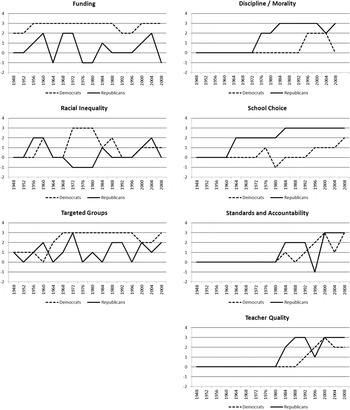
We coded each party platform (1948–2008), in its entirety, on seven types of policy proposals that have dominated education policy debate during this period: federal funding, racial inequality, targeted groups (e.g., special education), discipline/morality (e.g., character education or school prayer), school choice, standards and accountability, and teacher quality (refer to Appendices A and B for information on data, definitions, and full coding rules). Following Brian Feinstein and Eric Schickler, Footnote 41 we coded the position of each party each election year in each category on a scale ranging from -1 (opposition to such proposals) to 3 (strong, specific support for policy proposals). If that issue was not discussed in a platform, the platform received a score of 0 on that dimension. Footnote 42
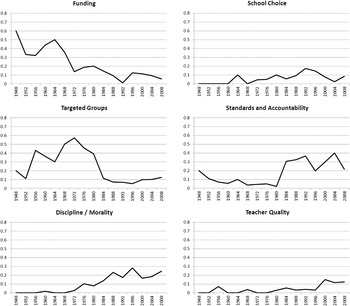
We first examine the parties’ relative positions on each kind of policy proposal over time. Figure 1 reveals that the parties’ positions have indeed changed both over time and relative to each other. The data highlight two points: First, some policy proposals are characterized by consistent support from one party and consistent opposition or inattention from the other. Second, other policy proposals have been characterized by shifts in the positions of both parties over time and relative to each other. Thus, changes in the overall relative positions of the parties across time are not only a function of changes in the agenda.
Education policy positions, by policy type: Party platforms, 1948–2008

On federal funding, Democrats have been consistent advocates, while Republicans have run the gamut from strong opposition to moderate support. On policies to address racial inequality, the parties were either silent or Republicans were as or more supportive through 1968. In the 1970s and 1980s, Democrats strongly supported and Republicans opposed such policies, while party differences narrowed in the 1990s and 2000s. The parties were back and forth on policies targeted at specific populations (such as English language learners or the disabled) through the 1950s, but from 1964 onward, Democrats were almost always more supportive, and in the mid-1970s through mid-1980s, far more so. On both discipline/morality and school choice, Republicans emerged as supporters earlier than Democrats, and tended to remain stronger supporters throughout. On standards and accountability and teacher quality proposals, Republicans were initially more supportive, but Democrats tended to close the gap toward the end of the period.
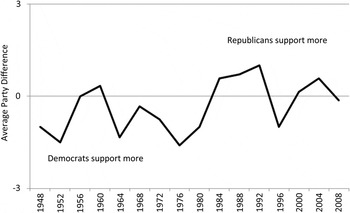
We also can examine each party’s overall stance on education policy-making, relative to the other, at any one time. Figure 2 reports the average difference on the active policy agenda in any one year (maximum possible difference = 4); that is, which party is more likely, on average, to propose improvements to the education policy status quo? Focusing on the active agenda provides insight into how contemporary observers would have understood the relative level of support of each party for efforts to improve the public school system at any one time. In 1972, for example, the education agenda included four issues: funding, racial equality, targeted groups, and school choice. A contemporary observer would have understood the parties’ relative positions on education policy in terms of those issues. By the 2000s, all seven agenda categories were under active debate, and our interparty difference scores take that into account.
Relative party positions on education: Party platforms, 1948–2008

Figure 2 shows that the parties’ relative positions on education have shifted considerably over time. In 1948 and 1952, Democrats were more supportive of changing the education policy status quo, but in 1956 and 1960, the parties ran nearly even. Democrats were then more supportive of proposals to improve schools than were Republicans throughout the 1960s and 1970s. Beginning in 1984, the parties became more equal in their advocacy of change, with Republicans tending to be slightly more supportive of education proposals. Footnote 43 In the 2000s, the parties were fairly evenly matched, with more Republican support in 2004.
CQ Key Votes
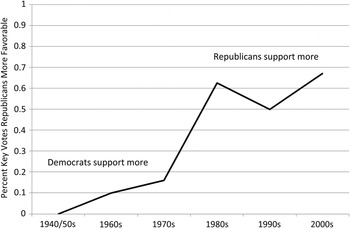
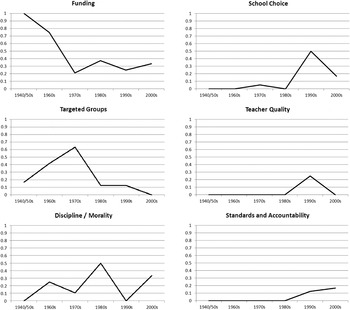
We tracked the positions of the parties’ delegations in Congress by using Congressional Quarterly (CQ) Key Votes to identify the most important education roll call votes across this 60-year period (refer to Appendix A). Due to the small number of CQ Key Votes on K–12 education—rarely more than two a year and sometimes none—we aggregated by decade and focused on the parties’ relative positions on education policy overall. Figure 3 reports the percentage of education CQ Key Votes in which more Republicans voted in favor than did Democrats. Footnote 44
Relative party positions on education: CQ Key Votes, 1948–2010

We find a clear pattern of shift from Democratic dominance to a more even split between the parties. From the late 1940s and 1950s through the 1970s, Democrats were more likely to support education policy initiatives than were Republicans on almost every single CQ Key Vote. The situation then shifts dramatically with Republicans more likely than Democrats to support education policy proposals on more than half of the CQ Key Votes in the 1980s. Republicans remained as or slightly more likely than Democrats to support proposals to improve education policy that reached the floor of the House or Senate in the 1990s and 2000s.
Party Positioning on Education
The platform and CQ Key Vote data are consistent with the characterization of the parties’ positions found in policy analyses. Prior to the 1980s, Democrats supported, and Republicans opposed, a number of proposals intended to improve public education. Democrats were more likely than Republicans to cast votes for landmark policies such as the National Defense Education Act of 1958 and the Elementary and Secondary Education Act (ESEA) of 1965. Following civil rights realignment in the 1960s, Democrats were stronger advocates for desegregation. Footnote 45 Democrats led the charge for bilingual and special education in the 1970s and for the creation of the DOE in 1979. Footnote 46
Beginning in the 1980s, both parties favored some proposals to improve public schools and opposed others. While Reagan favored abolishing the DOE, Republicans in the 1980s began to support some education policy proposals, such as offering greater school choice and returning prayer to schools. George H.W. Bush campaigned to be the “education president” and facilitated the effort toward national standards and accountability, particularly through his 1989 Charlottesville education summit. In subsequent years, Democrats began to endorse new education policies as well. In the 1990s, both Bush and Bill Clinton championed major education legislation—Bush’s failed America 2000 bill and Clinton’s successful Goals 2000 Act (1994)—which shared many aspects related to standards and accountability, but differed in the extent of the federal role and on private school choice. Footnote 47
In the 2000s, George W. Bush made education reform the centerpiece of his 2000 campaign, tying it to his “compassionate conservatism” theme. His signature domestic policy, No Child Left Behind (NCLB 2001), entailed important standards and accountability reforms and a significant expansion of the federal role in education. Footnote 48 In the years that followed, prominent Republicans called for the federal government to take the lead in encouraging states to adopt strong national academic standards. Footnote 49 On the Democratic side, Obama’s Race to the Top initiative leveraged federal funds to entice states to adopt accountability and school choice reforms. Indeed, Obama “promotes many solutions that were once Republican talking points” Footnote 50 and Republican governors hailed his education initiatives. Footnote 51 By the 2012 election, observers could claim that the candidates’ rhetoric about difference “belies the areas of agreement between many Democrats and Republicans on policies such as charter schools and performance pay for teachers.” Footnote 52
At the same time, both parties have been beset by some internal division over education policy. Following passage in 2001, NCLB, and strong federal leadership on such issues as the Common Core education standards, were controversial among some Republicans. Footnote 53 GOP presidential nominees have differed in their embrace of the new GOP position; Bush I and II both pushed their party to support new education policy alternatives, while 1996 nominee Bob Dole did not. On the Democratic side, Race to the Top has been opposed by some Democratic members of Congress, who continued to prioritize funding for traditional “input-based” policies like early childhood education, teacher pay, and smaller class size. Footnote 54
Yet, on the whole, by the first decade of the twenty-first century, the two parties had shifted their positions on education policy overall and on specific kinds of policy proposals, both relative to each other, and to their prior positions. The parties once clearly diverged on education policy, with Democrats favoring, and Republicans opposing, changes to American education policy. Beginning in the 1980s and especially since the 1990s, both Republicans and Democrats favored some proposed changes to American education and opposed others. Sometimes the parties favored different proposals—Republicans were more enthusiastic about school choice, for example. By the 2000s, however, the parties tended to favor similar changes: a rigorous set of academic content standards, greater school accountability, and a transformation of the policies that govern the teaching profession, in particular. Significantly, both parties favored policies they once opposed—greater support for federal leadership in education among Republicans and for various reform proposals among Democrats. The result was a shift from significant polarization on education policy (prior to 1980) to some (but not complete) convergence on the most salient education policy proposals by the 2000s.
Defining the Issue of Education
We argue that issue redefinition can help explain this shift in the education policy positions of the American parties. Policy experts widely acknowledge that important changes in the debate over American education have occurred and have been consequential for education politics. Footnote 55 However, we are the first, to our knowledge, to systematically track education issue definition over time.
Education Issue Definition and Redefinition
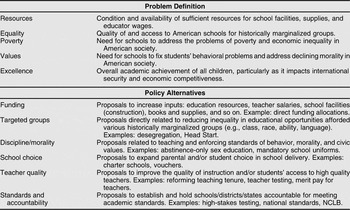
As discussed above, we examine two related aspects of education policy definition: problem definition and policy alternatives. Based on prior work on education politics, table 1 identifies five major education problems and six kinds of policy alternatives that have characterized debate over the previous six decades. Footnote 56 Our data sources for problem definition were the mass media (specifically, the CBS Evening News) and the parties’ platforms. We tracked education policy alternatives through the parties’ platforms and CQ Key Votes (refer to Appendices A and B). Footnote 57
Education issue definition: Problem definition and policy alternatives

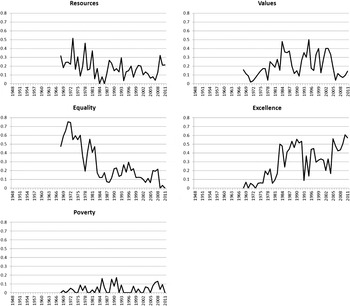
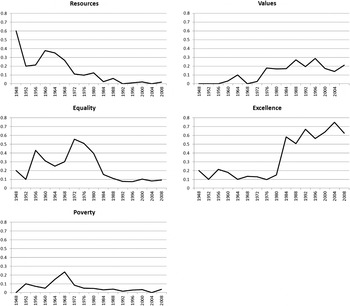
The percentage of all CBS Evening News stories and of Democratic and Republican party platform lines (combined) that employ each problem definition each year are reported in figures 4 Footnote 58 and 5. While they differ in some respects, both sources tell a similar story. Before the 1980s, education debates were dominated by the problems of inequality and inadequate resources. By the late 1970s and early 1980s, these problems decline precipitously in both data series. Attention to values began to grow in the 1970s and then increased dramatically in the early 1980s and remained fairly significant through the 1990s, with some decline later on. Attention to excellence rose dramatically in the early 1980s and remained high through most of the series. Concerns about resources and equality did not disappear, but they lost the dominance they jointly held prior to the 1980s.
Education problem definition: Media (CBS Evening News), 1968–2011

Education problem definition: Party platforms, 1948–2008

We can tell a similar story about the shift in the debate over policy alternatives. The percentage of the platform and CQ Key Vote Footnote 59 data which concern each policy alternative category are reported in figures 6 and 7, respectively. Until the mid-1970s, policy alternatives almost exclusively concerned the provision of new resources or directly addressed educational inequalities. The policy agenda diversified slightly in the 1970s and then dramatically in the 1980s. Beginning in the mid-1970s and expanding in the 1980s, discipline/morality alternatives comprised an increasingly large slice of the agenda. Even more striking was the expansion of attention to proposals to reform how public school systems are organized and run: School choice proposals emerged as early as the 1960s but became a larger part of the education agenda in the 1990s. Proposals to establish standards and hold schools accountable for learning outcomes became increasingly prominent in the mid-1980s and through most of the rest of the period. Proposals to improve teacher quality were likewise present from an early period, but became a more substantial part of the agenda in the final decades of our analysis.
Education policy alternatives: Party platforms, 1948–2008

Education policy alternatives: CQ Key Votes, 1948–2010

Explaining Education-Issue Redefinition
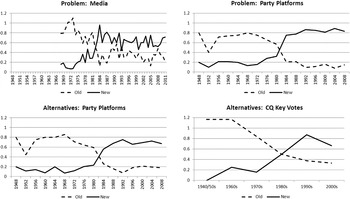
Across three different data sources and two different coding schemes, we observe dramatic shifts in both education problem definition and policy alternatives over this period (refer to figure 8), Footnote 60 consistent with the characterization of policy experts. Footnote 61 A full accounting of the causes of education issue redefinition is beyond the scope of this paper—our objective is to establish that redefinition took place and to trace its consequences for party position-taking—but we can identify some important factors. Consistent with the general pattern of issue redefinition described earlier, the causes are complex, characterized by interactions and feedback, and include policy indicators, external events, interest groups, and broader ideological shifts. We emphasize that while party elites certainly seek to capitalize on different education issue definitions, they were not the primary drivers of issue redefinition in this case.
“Old” and “new” education issue definition, problem and alternatives, 1948–2011
Note: “Old” problem definition = resources, equality, and poverty. “New” problem definition = values and excellence. “Old” policy alternatives = funding and targeted groups. “New” policy alternatives = discipline/morality, school choice, standards and accountability, and teacher quality.

From the 1950s through the 1970s, the Brown v. the Board of Education (1953) decision and the civil rights movement (schools were, of course, a central site for civil rights advocacy and resistance) in particular helped place the problem of schooling for historically-excluded and disadvantaged groups at the forefront of education debates. At the same time, the strained resources of schools as the Baby Boomers reached school age, the launching of Sputnik (1957), and heightened attention to class inequality (e.g., the War on Poverty) contributed to defining education in terms of the need for resources. Footnote 62 This understanding of education policy problems was widely shared by members of the education policy community and institutionalized in public policy. In particular, the historic ESEA of 1965, an important component of Johnson’s War on Poverty and the central means through which the federal government influences schooling policy, institutionalized the dominant definition of education policy as resource allocation and inequality mitigation. Footnote 63
Various events and developments disrupted this issue definition. Social movements (ranging from the civil rights to the women’s movement) as well as other political and social changes and events (such as the Supreme Court’s prohibition of school prayer in 1962) transformed society and institutions—including public schools—in the 1950s, 1960s, and 1970s. These developments also helped bring about a counter-movement intent on resisting these changes, seen most clearly in the emergence of the Religious Right in the 1970s. Issues related to public schools—the place of religion, sex education, multiculturalism, and so on—were central concerns for social conservatives from the start. Footnote 64 The resulting so-called “culture war”—the broader public debate about cultural symbols, ideals, and values Footnote 65 —permeated the politics of education. As a result, education problems were increasingly defined in terms of values and discipline; that is, the transmission and enforcement of social norms and beliefs.
Even more dramatic was the redefining of education in terms of the problem of excellence in the early 1980s. Consistent with other cases of issue redefinition, multiple indicators, events, and actors presaged this shift in the preceding decade. Governors, particularly in the South, began to view shortcomings in public education as a key challenge for state economic development and competitiveness. Footnote 66 A wave of studies claimed that the status quo approach to education policy was not only failing to improve educational outcomes, but that student achievement appeared to be deteriorating. Footnote 67 While policy data had long been limited to statistics on resource investments and completion rates, the creation of the National Assessment of Education Progress (NAEP) in 1969 would eventually provide measures which would permit the analysis, both overtime and comparatively, of educational achievement and learning. Footnote 68
Again consistent with the common pattern for issue redefinition, an event—a widely-publicized report—served as the “catalyst” Footnote 69 for redefining the education debate. A Nation at Risk, released by the National Commission on Excellence in Education (NCEE) in 1983, is universally acknowledged to have had a profound impact in focusing the education policy debate on the overall academic quality of American schooling. Footnote 70 After President Reagan rejected his proposal for a presidential commission on the state of American education, Education Secretary Terrell Bell created his own cabinet-level commission, staffed with academics, state and local officials, and members of the private and non-profit sectors. Contrary to the recommendations and expectations of both Bell and Reagan (that is, contrary to the wishes of partisan actors), the NCEE drew attention to significant achievement gaps between US schoolchildren and their counterparts around the world. Rather than endorse Reagan’s preferred recommendations, A Nation at Risk advocated the establishment of more rigorous academic standards and improved teacher quality through merit pay and teacher testing, among other proposals. Footnote 71 Importantly, the report highlighted evidence of stagnation or decline in education outputs (e.g., test scores) both relative to the past and to other nations, despite considerable investments (especially from the federal government) in schools. In doing so, the report redefined the education policy debate in terms of measurable outcomes and cast doubt on the ability of status quo policies to improve student performance, thus motivating the school reform agenda. Footnote 72
How can we explain the impact of A Nation at Risk and the broader issue redefinition it helped to bring about? Certainly, the report effectively and dramatically drew attention to real-world conditions—available indictors of stagnating or declining student achievement—which resonated with the experiences of employers, universities, and other actors with poorly-prepared public school students. Footnote 73 Yet shifting real-world conditions alone are rarely sufficient for issue redefinition. Footnote 74
Education-issue redefinition also was rooted in the broader pushback against government as a positive problem solver and against a robust social welfare state from the late 1970s onward. Footnote 75 The argument that direct government funding at minimum did not help alleviate—and at most caused—poor outcomes was consistent with this critique and thus helped fuel dissatisfaction with the current education policy regime. Moreover, if social welfare programs would no longer minimize inequalities, schools faced growing pressure to prepare every student to compete in a postindustrial economy that required new, education-dependent skills. Footnote 76
The associated emergence of the “new” education policy alternatives also intersected with broader developments in public policy making. Cognizant of resistance to direct entitlements, policy-makers have increasingly achieved policy goals through the tax code, regulation, and other indirect policies. Footnote 77 School reform policy alternatives—such as instituting national curricula or eliminating teacher tenure—provided another opportunity to shape social policy without necessarily allocating additional funds. Footnote 78
Interest groups contributed to education issue redefinition as well. In particular, businesses expressed alarm as they increasingly confronted challenges in securing qualified workers and competing in a context of increased economic instability and globalization. Footnote 79 Similarly, civil rights organizations (CROs) emerged as important instigators and developers of new education policy alternatives, particularly related to standards and accountability. As with business interests, the contribution of CROs to education-issue redefinition was a response to relevant experiences and developments—particularly the growing evidence of stagnation and achievement gaps for students of color and attacks on the social welfare state. Footnote 80
The redefinition of the issue of education in American politics thus appears to follow the general pattern of other cases of broad issue redefinition: The causes are multiple and complex, and the process, while characterized by key focusing events (such as A Nation at Risk), unfurled over time. The actions of multiple actors and interests, policy indicators, political and economic developments, and a broader ideological mood all contributed to the redefinition of education to focus on the problems of excellence and values, and on the reform-agenda policy alternatives.
Education Redefinition and the Parties’ Coalitions
We now highlight how issue redefinition helps to explain the shifting positions, participation, and influence of key members of the parties’ coalitions. Where an education policy monopoly was once characterized by a shared understanding of the terms of the policy debate, issue redefinition has been associated with shifting preferences and expanded group participation, which has undermined and transformed that monopoly.
Teachers Unions
While Democrats have a long history of alliance with the labor movement, Footnote 81 the party’s relationship with teachers unions specifically solidified in the 1970s. In recent decades, teachers unions have provided a significant portion of Democratic fundraising and the largest share of Democratic convention delegates. Footnote 82 From the 1950s, both the American Federation of Teachers (AFT) and the National Education Association (NEA), Footnote 83 as well as the broader labor movement, strongly favored federal funding of schools. Footnote 84
As the problems of resources and equality were supplanted by the problems of values and excellence, teachers unions generally nonetheless maintained that increased funding should be the central policy priority and steadfastly opposed attempts to overhaul the underlying structure of public education (e.g., school choice and teacher accountability reforms). Footnote 85 As it became increasingly clear that the changed issue definition had transformed the policy debate, there were some signs of a softening of teacher union opposition to reform, particularly from the AFT. Footnote 86 Teachers unions also faced weakening support for their funding-only position from the rest of the labor movement; e.g., Andrew Stern, president of the Service Employees International Union, suggested in 2004 that an emphasis on funding had failed to improve public schools (where his low-wage-earning members largely send their children) and that more radical reforms might be the answer. Footnote 87
Most importantly, issue redefinition had a significant impact on the strategic position of the teachers’ unions. The shift in problem definition away from inputs (resources) and toward outputs (student achievement) was associated with a new research agenda in education. Most significantly, education researchers began to establish that the quality of a child’s classroom teacher is the single most important school-level variable influencing student achievement. Footnote 88 The accumulation of such findings by the mid-1990s, while the impacts of other factors (e.g., per pupil spending and class size) were discredited or less clear, Footnote 89 lent particular credence to policy alternatives which address teachers’ own effectiveness.
Consequently, education issue redefinition meant teachers unions faced a context less conducive to their uncontested influence; in Jal Mehta’s apt phrasing, the change “put teachers on the rhetorical defensive.” Footnote 90 By altering the terms of the debate, issue redefinition made the ability of teachers unions to persuade Democratic party elites to their position an increasingly challenging task, while the shift in the preferences and expanded participation of other coalition groups we will describe (that is, the crumbling of the education policy monopoly) created a more competitive political environment. Footnote 91
Business Interests
While business interests are in many ways the consummate Republican coalition partner, Democrats also rely on such interests, Footnote 92 and thus the shifting positions of business interests have been important to both parties. Until the late 1970s—during the era characterized by the “old” issue definition—business organizations (such as the Chamber of Commerce and the National Association of Manufacturers) strongly resisted any federal education policy-making. Footnote 93 In the late 1970s, concerns about economic instability, international competitiveness, and workforce preparedness pushed business interests to prefer more ambitious education policy-making, especially standards and accountability reforms. Footnote 94
Reform advocacy among business leaders initially occurred at the state level. By the early 1990s, however, business interests were increasingly frustrated with the slow pace of change in the states, and began to advocate for federal leadership. Footnote 95 We emphasize the importance of issue redefinition in bringing about this shift. Footnote 96 When the problem of education was defined in terms of resources and equality, business leaders tended not to advocate for greater federal intervention. However, when business leaders became aware that schools were failing to prepare all students adequately (to be, in particular, productive and competitive workers), business interests embraced a federal role and developed policy preferences about the organization of American schools. Policy alternatives which emphasize the application of business concepts—measurement, outputs, standards—to the organization and management of public schools were a natural fit for business interests. Footnote 97 Moreover, new policy alternatives often run counter to the interests of organized labor and thus serve other business goals.
Civil Rights Organizations and Minority Voters
Schools have long been a central concern of civil rights organizations (CROs). While initially opposed to federal funding to segregated schools, Footnote 98 in the wake of Brown and the civil rights acts of the 1960s, CROs emerged as an important Democratic coalition partner and as proponents of education funding and desegregation efforts. Footnote 99
Not surprisingly, CROs have continued to highlight race and class inequality even as education has been redefined to focus on other problems. Yet the new definition’s highlighting of deficiencies in school outputs, despite considerable inputs, and the framing of the alternatives as a choice between the status quo and more fundamental reforms, have been key for CROs. As racial (and class) achievement gaps persisted, Footnote 100 a number of CROs, as well as minority voters in general, increasingly concluded that status quo policies (funding and desegregation) were insufficient. As a result, by the 1990s, CROs emerged as instigators and advocates of some forms of choice, standards, accountability, and other reforms, Footnote 101 although minority voters and organizations have not always been unified or supportive of every new item on the reform agenda. Footnote 102
Small-Government Conservatives
Small-government conservatives, a long-time GOP constituency, have opposed a federal role in education, of any kind, since the earliest debates in the 1950s, Footnote 103 and that general opposition was largely resistant to education issue redefinition. Footnote 104 Some of the new policy alternatives, such as school choice, have attracted support, but small-government conservatives generally preferred that reforms originate from the state and local level. Footnote 105 Unlike other voices in the education debate, small-government conservatives were less motivated by the issue of education per se, than by the size and function of the federal government. In recent years, generally heightened concern about federal government power reinvigorated small-government conservative opposition in general (e.g., the Tea Party movement) and to any federal education reform initiatives specifically. Footnote 106
Social Conservatives
While the groups described thus far are long-term participants in education debates, social conservatives are an example of issue redefinition motivating new actors to participate and in doing so, to disrupt the education policy monopoly. Footnote 107 The Religious Right emerged as a political movement and a key Republican constituency in the 1970s. Footnote 108 Social conservatives have both contributed to and responded to a redefining of the problem of education in terms of values and morality. That problem definition increasingly helped inspire new education policy alternatives—e.g., banning inappropriate sex education, reintroducing school prayer, teaching creationism, and supporting home schooling. School choice was particularly attractive to social conservatives who saw opportunities to boost enrollment at religious schools and a normative defense of parental rights in education. At the same time, social conservatives opposed national standards and curricula, fearing that such programs would not reflect their values. Footnote 109
Education Reform Advocacy Organizations
In another example of issue redefinition expanding the “scope of conflict,” Footnote 110 recent decades have witnessed the explosion of “education reform advocacy organizations” (ERAOs); Footnote 111 indeed, together with health, the sector experiencing the largest growth in interest group representation in the last 30 years is education. Footnote 112 These groups tended to favor aggressive education reform, particularly standards and accountability, and were important sources of research and advocacy, as well as an alternative voice for education professionals. Footnote 113 While some ERAOs, such as Democrats for Education Reform (DFER), focused their efforts within one political party, most sought to influence both parties.
It is only a slight over-simplification to say that education issue redefinition provided the impetus for the very existence of these groups. By calling attention to the failure of the traditional public school system and status quo policies to deliver results, the new education problem definition inherently promoted the search for alternative models of schooling. In turn, these groups contributed to the increased salience and expanded policy agenda by developing and promoting reforms. The emergence of these groups increased competition and provided a counterbalance to the interests that long-dominated education debates. Footnote 114 Indeed, ERAOs represent a classic disruption of a policy monopoly, which is so often the consequence of issue redefinition. Footnote 115
Issue Definition and the Preferences of Party Coalition Groups
Issue redefinition thus has shaped the policy preferences of key members of the parties’ coalitions. All groups that perceive a stake in education policy likely have mixed motives. It seems likely, for example, that business interests supported efforts to undermine collective bargaining by teachers unions in part because it is in the economic interests of business to weaken unions generally. At the same time, by all accounts much of the business community believed that workforce preparedness was a serious problem for economic development, and that improving education was necessary to solve it. Footnote 116 Similarly, teachers unions favored increased resources not only because they experienced resource scarcity and believed more resources improve schools, but because more resources would likely mean better pay and other benefits for members. Footnote 117 The key point is that regardless, what drove groups’ perceptions of whether they have a stake in an issue and what policy outcome they prefer were their understandings of the policy problem and the perceived consequences of policy alternatives—that is, the issue definition.
Explaining Party Change on Education
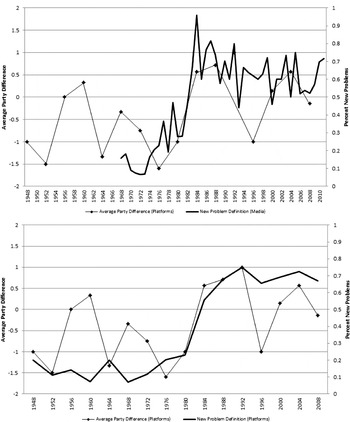
We now turn to the task of showing how issue redefinition, together with the associated changing preferences of the parties’ coalitions, helps explain changed party position-taking, particularly when members of the parties’ coalitions disagree. The general relationship between education issue definition and party position-taking is displayed in figure 9. Both panels graph the percentage of attention to the new problem definition (values and excellence), in the media (top) and in the parties’ platforms (bottom) respectively, against the average relative party difference (from figure 2) as reflected in the parties’ platforms. As both panels show, education issue definition dominated by the “old” problems of resources and equality is associated with greater relative Democratic advocacy for changing and improving education policy. Footnote 118 As education issue definition begins to shift toward the “new” problems of excellence and values, average party differences become smaller or favor Republican advocacy for K–12 reform. The new definition of education is thus associated with a convergence of party position-taking.
Education problem definition and relative party positions, 1948–2008

How did this shift come about? Prior to the 1980s, education issue definition, and the resulting alignment of various groups, made for a fairly clear position-taking context for both parties. For Democrats, education policy defined in terms of the need for resources and to address racial and class inequalities was consistent with a Democratic party ideology that emphasized civil rights, inclusion, and an activist government, particularly on behalf of the marginalized. Footnote 119 Important Democratic coalition members—CROs, social welfare advocates, and especially teachers unions—preferred the dominant policy alternatives, particularly from the 1960s onward. As a result, while a few tensions existed, on the whole members of the Democratic party lined up as strong supporters of education policy alternatives: increased funding, aggressive desegregation, programs intended to address racial and class disparities (e.g., Head Start), and the creation of the DOE.
Republican elites faced a similarly straightforward context in the 1950s through the 1970s. Education policy alternatives that emphasized federal intervention to solve resource and equality problems were inconsistent with an antistatist, small government Republican ideology. Footnote 120 Important members of the Republican coalition—business interests and small government conservatives, in particular—opposed a federal role in schools. White Southerners—an important coalition expansion target for Republicans from the 1960s on—opposed desegregation efforts. Footnote 121 The Republican party thus tended to oppose the education policy alternatives of the period: funding, desegregation, and programs designed to address racial and class inequality.
From the early 1980s onward, the redefinition of education created a far more complicated position-taking context for both parties. First, issue redefinition was associated with the increased salience of education in state and national politics. As Patrick McGuinn writes, “School reform was not a salient issue in the 1960s and 1970s because the majority of voters saw public schools as doing a good job, and the major debates around schools centered on equity, integration, and social issues rather than concerns about academic performance.” Footnote 122 The initial response to the change in definition largely occurred at the state level. Footnote 123 By the 1990s, however, education was increasingly on the national agenda. Presidential candidates became more likely to highlight education in their campaign advertisements. Footnote 124 In public opinion polls, education went from being identified as among the least important issues in presidential elections (often listed last or not listed at all) in the 1960s and 1970s, to among the top 10 most important issues (and in the 2000 election, the top issue) between 1988 and 2000. Footnote 125
This increased salience among both politicians and citizens put pressure on national party elites to reassess and articulate solutions to education policy problems as now defined. Republicans sought acceptable policy proposals so that the party could “do something” on education, an issue traditionally “owned” by Democrats. Footnote 126 On the other side, Democrats were viewed as “owning” an issue where the status quo—the current state of American schools—was defined as at least insufficient and at most a failure. That framing of education inherently calls into question the status quo policies—resource investment into traditionally-organized schools—which had long-comprised the Democratic position. The logic of the excellence problem definition, we argue, put pressure on Democrats to reevaluate their policy positions.
Second, both parties faced a changed distribution of policy preferences within their respective coalitions. Where once the Republican coalition was unified in opposition to any policy initiatives, in the later period members of the Republican coalition favored various proposals to reshape American education, although not always the same ones. The business community emerged as strong advocates of standards and accountability reforms. Social conservatives opposed standards and accountability, but supported proposals related to morality and school choice. Small-government conservatives remained opposed to a federal role in education. Ideologically, federal intervention continued to conflict with Republican antistatism, but specific reform proposals—school choice, accountability, teacher quality reforms (especially weakening teachers unions)—meshed well with free market principles.
Democrats also faced a divided coalition and ideological conflict. CROs and ERAOs increasingly favored the new education reform agenda. Yet, supposedly-powerful teachers unions continued to oppose most reforms. Footnote 127 Arguments that cast school reform as solutions to schools that are failing students, particularly poor and minority children, appealed to Democratic ideological commitments to civil rights and social welfare. Yet, to the extent that reforms were framed as undermining another disadvantaged population (and Democratic constituency)—unionized teachers—they conflicted with those same Democratic values.
Issue redefinition can help us understand how the parties have negotiated their divided coalitions. The redefinition of education, particularly the emergence of policy alternatives consistent with Republican ideological principles, advantaged those within the GOP coalition who favored fundamental changes to education policy. Footnote 128 Thus despite opposition from some coalition members, Republicans increasingly responded to those coalition members who favored fundamental reforms at the state and national level. Republicans, in a sense, chose to advocate for a bundle of policies that offered something for every stake-holding member of their coalition: school choice and values policies (e.g., abstinence-only sex education) for social conservatives, standards, accountability, and teacher quality reforms for business interests. Parties sought to appease coalition members who lost out at times—social conservatives who opposed national standards, for example—by supporting other education agenda items they favored such as school choice.
Issue redefinition helps explain how Democrats negotiated their coalition as well. The shift in the problem definition away from funding and equality, and toward excellence and values, advantaged coalition members whose arguments fit the latter rather than the former. Specifically, as teachers unions generally continued to argue that the education policy problem was inadequate and unequal resources, those arguments were less persuasive to the extent that the education policy debate had shifted toward questions about how that money ought best to be spent. Footnote 129 Research showing the persistence of achievement shortcomings and gaps despite resource investments, and the impact of teachers on educational outcomes, both bolstered the new issue definition and those groups who support the reform agenda. Democratic coalition members—CROs and ERAOs, as well as business organizations—whose preferences and arguments were in line with the dominant issue definition could be expected to be more successful, particularly when attention to the issue has expanded beyond the original policy monopoly. Thus, Democrats increasingly backed standards and accountability and teacher quality reforms over the opposition of, most notably, teachers unions, despite their considerable contributions and activism. As in the GOP, “coalition management” Footnote 130 meant Democrats attempted to satisfy teachers unions by remaining committed to other policy alternatives they favored—e.g., increased funding, smaller class size, union rights—while taking other positions unions opposed. This strategy was not always successful, as the 2012 Chicago teachers strike Footnote 131 and teacher union outreach to Republicans Footnote 132 suggested, but reflected ongoing attempts at coalition management in light of the complicated political context created by education issue redefinition.
The specific case of teachers unions and the Democratic party—one of the central puzzles motivating this research—highlights two important aspects of our theoretical argument. First, the experience of teachers unions is consistent with the observation that actors on their own do not (re)define issues. Teachers unions for the most part continued to advocate for the “old” definition of education as a problem of insufficient resources for which the appropriate policy alternatives are resource investments. Despite their considerable political clout, that issue definition no longer structured the terms of the debate.
Second, and related, the case of teachers unions highlights the impact of system-wide issue redefinition. Teachers unions were increasingly unsuccessful in convincing Democrats to take their preferred policy positions because the way in which the issue is broadly understood by political elites had changed. The debate was once defined by questions about equal access and resources. It came to be defined by questions about the relationship between achievement outcomes and the organization and staffing of schools. Even persistent questions about race and class achievement gaps (what we might think of as the “old” equality problem definition) were defined in terms of observable inputs and outputs. That framework advantaged some arguments and policies and disadvantaged others. A focus on issue definition thus helps us to understand not only the policy preferences of members of the parties’ coalitions, but also why parties adopt the positions they do, even when opposed by members of their coalition.
Finally, issue redefinition has shaped how party elites themselves have understood the issue of education, strategically, ideologically, and in terms of their own evaluations of the policy alternatives. Governors, especially in the South, concerned about economic and workforce competition, were early converts to and proponents of the idea that the education status quo was failing to produce results. Footnote 133 It is perhaps not a coincidence that the president who did the most to move the Republican party toward federal leadership on education reform was George W. Bush, a Southern governor whose own experience provided him with ample evidence of the importance of education both to the economy and (given the new issue definition and related salience) as a political wedge issue. Footnote 134 Similarly, Republican Governors Jeb Bush (Florida), Mitch Daniels (Indiana), Donald Carcieri (Rhode Island), and Tim Pawlenty (Minnesota) were education reform leaders in their states, helping to push the party nationally in a more activist direction. Footnote 135 Particular Democratic elites, also concerned about economic competition as well as civil rights, were similarly receptive to the new issue definition’s logic of results-based education policy and inherent critique of the status quo. In light of the increased pressure to address education shortcomings, Democratic mayors (e.g., Newark’s Cory Booker, District of Columbia’s Adrian Fenty, Chicago’s Rahm Emanuel) and governors (e.g., Colorado’s Roy Romer) pushed their party toward a more reform-oriented position. Footnote 136 In a similar way, Obama’s experiences, including as a community organizer in Chicago, made him sympathetic to the key argument of education redefinition that resources alone are insufficient to address the problems of public schools and thus inclined to promote the sort of reform agenda Race to the Top represents. Footnote 137
Conclusion: Who Wants What and Why
We have shown how education issue redefinition shaped the decision-making context for parties when adopting education policy positions in the postwar era. These developments have been important for both the task of coalition management Footnote 138 as well as for the way party elites themselves conceived of education policy options. Consider 2012 Republican presidential nominee Mitt Romney explaining his switch from favoring abolition of the DOE to supporting its continued existence, albeit in a smaller or combined form: At a private donor meeting, Romney explained that “part of his reasoning behind preserving the agency [DOE] was to maintain a role in pushing back against teachers’ unions.” Footnote 139 When the education agenda was defined as a choice between federal funding to address perceived inequalities, and leaving schooling to states and localities, a federal role consistent with Republican interests and ideology was hard to imagine. As teacher quality, standards, and accountability came to dominate the education agenda, and were viewed as (among other things) challenging public sector unions with whom Republicans have traditionally clashed, Republicans advocated for changes to education policy which serve their coalition and were consistent with an ideology that opposes unions, and favors the application of business principles to public functions. Indeed, while we cannot establish the counterfactual, we posit the possibility that Ronald Reagan, the famous opponent of the DOE, might have been more sympathetic to a cabinet-level education department if he, like Romney, could envision a role for the agency in undermining public sector unions. The important point is that not only has the shift in issue definition led the parties to favor (or oppose) new education policy proposals, but issue redefinition has contributed to a change in the parties’ positions on long-standing policies, such as the existence of the DOE.
We have sought to apply a general framework for understanding party position change to the specific case of education policy. We believe our framework may illuminate other cases of party change. For example, Democrats have recently liberalized on gay rights. Footnote 140 David Karol rightly points to the emergence of gay activism within the Democratic coalition as a causal factor. Yet, we suspect these groups are relatively small in numbers and financial pull; their advocacy alone seems insufficient to explain the shift. Footnote 141 Over the last 30 years, public discourse about homosexuality shifted from a focus on sexuality and a distinctive gay counterculture to an emphasis on equality and inclusion into such well-regarded social institutions as marriage and the military. Footnote 142 While controversial, this issue redefinition links gay rights to a civil rights tradition of expanded equality and inclusion that we might expect to resonate strongly with other Democratic coalition members and with Democratic ideology. As Karol argues, Democrats have shifted toward greater support because “at least to some degree . . . support for gay rights has become a standard part of the liberal belief system and the Democratic program in a way it was not a generation ago.” Footnote 143 Thus, issue redefinition may have helped make gay rights supporters of many (but not all) of the progressive groups that comprise the Democratic coalition, and of Democratic elites themselves.
Party change on women’s rights was characterized by similar dynamics. In the 1950s and early 1960s, when most women’s rights proposals, especially the Equal Rights Amendment (ERA), were framed as pitting intrusive protective labor laws (the status quo) against legal equality, Republican support for policy change—the ERA—was consistent with the party’s general inclination toward antistatism and free market capitalism, as well as the preferences of the business interests and professional women in the GOP coalition. Democratic opposition was in keeping with the party’s social welfare ideology, and with the preferences of members of the Democratic coalition, particularly organized labor and progressive women. With the emergence of the second wave of the women’s movement, among other changes, in the early 1970s, the issue of women’s rights became defined as equality (policy change) versus traditional gender roles (status quo). Democrats came to favor women’s rights proposals as part of their general orientation toward civil rights and inclusion, and to help incorporate the women’s movement into their coalition. Other Democratic coalition members, most notably labor, changed their position in response to the changed definition. Republicans, on the other hand, reversed themselves by 1980, coming to view the ERA and other women’s rights proposals as unnecessary government intrusions and a challenge to traditionalism, both contrary to the party’s persistent ideological commitment to social order and neoliberal antistatism. Opposition to women’s rights also helped accommodate the social conservative movement (which emerged in large part in response to the redefining of women’s rights) as part of an expanded Republican coalition. Footnote 144
In recent work on civil rights realignment, Feinstein and Schickler emphasize how the Democratic party’s shift to an ideology based on “programmatic liberalism, governmental activism, and universalistic, rights-based arguments” during the New Deal made opposition to civil rights an increasingly untenable and inconsistent position for the party in the 1940s and 1950s, despite strong opposition from important Democratic coalition groups. Footnote 145 This is a case not of a party seeking to reconcile a new issue definition with its ideology, but of a party’s new ideology being inconsistent with how its established position (opposition to civil rights) is defined. Feinstein and Schickler further argue that as civil rights policy alternatives shifted from political rights in the South toward fair employment and housing laws in the North, business interests emerged as important opponents of civil rights proposals, with consequences for Republican party positioning. Footnote 146 Finally, Feinstein and Schickler point to the importance of issue salience in compelling party elites to reassess and shift positions: The authors argue that state-level Democratic activists had shifted to a more progressive civil rights position by the mid-1940s, but only “once civil rights issues reached the top of the nation’s agenda in the 1960s, and national party elites were forced to choose sides” did national Democratic elites reassess the strategic political context and “adopt a liberal position on civil rights issues.” Footnote 147
Our emphasis on the role of ideas does not contradict the basic premise that what is at stake in policy debates are real conflicts over real interests with real consequences. We have highlighted, for example, how education issue redefinition related to a broader pushback against a robust welfare state, and how new education policy alternatives shared common themes with the hidden welfare state policies identified in previous research. Footnote 148 And just as critics point out that the hidden welfare state, and indeed public policy making in general, tends to benefit the economically advantaged, Footnote 149 the question of whether the newer education policy alternatives, such as school choice and high-stakes testing, alleviate or aggravate inequality remains contested. Footnote 150
Yet the view that education issue redefinition is part and parcel of conservative retrenchment is too simplistic; as Jesse Rhodes shows, civil rights organizations have played a leading role in promoting the school reform agenda in the sincere belief that such policies would benefit disadvantaged students of color. Footnote 151 Indeed, one irony is that while the new issue definition and associated reform policy proposals emerged during an era characterized by backlash against activist government and relative conservative influence over policy-making, federal control over and spending on education expanded dramatically during the same period. Footnote 152 In a very real sense, this is an example of policies making politics; as elites came to accept established federal funding of education (through the ESEA of 1965) as a reality, the question was not whether, but what sorts of school structures and policies those funds should support. Footnote 153
Why should we emphasize the role of issue redefinition in the development of party issue positions? At the end of the day, don’t groups just demand policies that serve their own interests, and don’t parties build electoral coalitions by providing a package of policy promises and actions the groups in their coalition want? At one level, we do not disagree with this basic premise. Yet interests are not objective; they must be discovered, understood, and negotiated. The defining of issues—problems and alternatives—is key to that process of interest discovery and understanding. Or, as perhaps the ultimate authority on party politics, E.E. Schattschneider, wrote, “It is futile to determine whether men [sic] are stimulated politically by interests or by ideas, for people have ideas about interests.” Footnote 154
Supplementary Materials
-
Appendix A: Education Policy Data
-
Appendix B: Measuring Party Positions in the Platforms
-
Replication Data File
-
To view supplementary material for this articles, please visit http://dx.doi.org/10.1017/S1537592714001613