1. Introduction
Aglaspidida Walcott, Reference Walcott1912 (= Aglaspidida sensu stricto cf. Van Roy, Reference Van Roy2006; P. Van Roy, unpub. thesis, Ghent University, 2006; Lerosey-Aubril, Ortega-Hernández & Zhu, Reference Lerosey-Aubril, Ortega-Hernández and Zhu2013; Ortega-Hernández, Legg & Braddy, Reference Ortega-Hernández, Legg and Braddy2013) represents a major and diverse – yet historically problematic – group of early Palaeozoic euarthropods typified by a biomineralized phosphatic exoskeleton (Briggs & Fortey, Reference Briggs and Fortey1982). Although aglaspidids are relatively poorly understood, recent studies have produced significant insights into their morphology (e.g. Van Roy, Reference Van Roy2006; P. Van Roy, unpub. thesis, Ghent University, 2006), biostratigraphic range (e.g. Fortey & Rushton, Reference Fortey and Rushton2003, Reference Fortey and Rushton2009; Lerosey-Aubril et al. Reference Lerosey-Aubril, Ortega-Hernández, Kier and Bonino2013), palaeobiogeographic distribution (e.g. Van Roy, Reference Van Roy2006; P. Van Roy, unpub. thesis, Ghent University, 2006; Ortega-Hernández et al. Reference Ortega-Hernández, Braddy, Jago and Baillie2010; Lerosey-Aubril, Ortega-Hernández & Zhu, Reference Lerosey-Aubril, Ortega-Hernández and Zhu2013) and phylogenetic position within the evolutionary context of Artiopoda Hou & Bergström, Reference Hou and Bergström1997, and even the entire phylum Euarthropoda Lankester, Reference Lankester1904 (Ortega-Hernández, Legg & Braddy, Reference Ortega-Hernández, Legg and Braddy2013; see also Legg, Sutton & Edgecombe, Reference Legg, Sutton and Edgecombe2013).
It is possible to draw three major conclusions from these findings. (1) The presence of postventral plates (paired sclerotized structures located underneath the posterior trunk tergites and covering the base of the tailspine ventrally) and anterior tergal processes represent the only autapomorphic characters for the clade (Van Roy, Reference Van Roy2006; P. Van Roy, unpub. thesis, Ghent University, 2006). (2) Aglaspidida is monophyletic and subdivided into two groups: a ‘Cambrian-type’ clade whose overall morphology reflects the ‘traditional’ aglaspidid diagnosis (e.g. 11 trunk tergites, subtriangular glabella, genal and pleural spines, long tailspine) and an ‘Ordovician-type’ clade that includes taxa with derived features (e.g. effaced cephalon, reduction/loss of dorsal eyes, rounded genal angles, reduced tergite count, short tailspine) (Ortega-Hernández, Legg & Braddy, Reference Ortega-Hernández, Legg and Braddy2013). (3) Most of the evolutionary history of aglaspidids is obscured due to their poor fossil record, most likely as a consequence of their general preference for relatively shallow-water environments (Lerosey-Aubril et al. Reference Lerosey-Aubril, Ortega-Hernández, Kier and Bonino2013).
Aglaspidid fossils are remarkably rare, and the paucity of well-preserved material often makes it difficult to recognize new species that may provide additional information on the evolutionary history of these enigmatic euarthropods. Here we describe a new aglaspidid from the Lower Ordovician Fezouata Konservat-Lagerstätte in Morocco (see Van Roy et al. Reference Van Roy, Orr, Botting, Muir, Vinther, Lefevbre, El Hariri and Briggs2010; Martin et al. Reference Martin, Pittet, Gutiérrez-Marco, Vannier, El Hariri, Lerosey-Aubril, Masrour, Nowak, Servais, Vandenbroucke, Van Roy, Vaucher and Lefebvre2015; Van Roy, Briggs & Gaines, Reference Van Roy, Briggs and Gaines2015). Despite having an unusual morphology for the group, the new taxon is recognized as an Ordovician-type aglaspidid, and indicates that these problematic euarthropods possessed a greater degree of morphological disparity than previously considered.
2. Geological setting and preservation
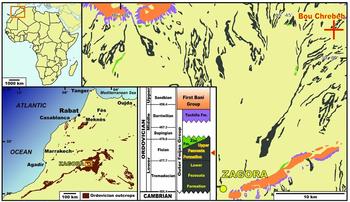
The new taxon is described based on a single almost-complete individual collected from Bou Chrebeb, an outcrop ca 35 km NE of Zagora in south-eastern Morocco (Fig. 1). This locality was originally considered to belong to the Upper Fezouata Formation, having a Floian age (Vidal Reference Vidal1998a, Reference Vidalb; Destombes Reference Destombes2006; P. Van Roy, unpub. thesis, Ghent University, 2006; Van Roy et al. Reference Van Roy, Orr, Botting, Muir, Vinther, Lefevbre, El Hariri and Briggs2010). However, in a recent study, Martin et al. (Reference Martin, Pittet, Gutiérrez-Marco, Vannier, El Hariri, Lerosey-Aubril, Masrour, Nowak, Servais, Vandenbroucke, Van Roy, Vaucher and Lefebvre2015) situated this locality at the top of the Lower Fezouata Formation, claiming a latest Tremadocian age (Hunnegraptus copiosus biozone) for the site. This attribution, however, has now been shown to be incorrect, based on an erroneous stratigraphic correlation to another site in the wider area; Bou Chrebeb in fact does fall within the Floian of the Upper Fezouata Formation, and has a middle Floian age, as considered previously (J.C. Gutiérrez Marco, pers. comm.). The Lower and Upper Fezouata Formations represent a globally transgressive sequence of mudstone and siltstone, except for the upper part of the Upper Fezouata Formation, which records a substantial shallowing of the depositional environment. The Fezouata Formations have yielded rich assemblages of non-biomineralised organisms including a wide range of iconic Burgess Shale-type elements co-occurring with forms typical for the post-Cambrian Palaeozoic. These non-biomineralised biotas are accompanied by diverse classical ‘shelly’ faunas, including abundant trilobites and echinoderms (Van Roy et al. Reference Van Roy, Orr, Botting, Muir, Vinther, Lefevbre, El Hariri and Briggs2010; Van Roy & Briggs Reference Van Roy and Briggs2011; Van Roy, Briggs & Gaines, Reference Van Roy, Briggs and Gaines2015; Van Roy, Daley & Briggs, Reference Van Roy, Daley and Briggs2015; Vinther et al. Reference Vinther, Van Roy and Briggs2008; Martin et al. Reference Martin, Pittet, Gutiérrez-Marco, Vannier, El Hariri, Lerosey-Aubril, Masrour, Nowak, Servais, Vandenbroucke, Van Roy, Vaucher and Lefebvre2015; Fortey Reference Fortey2009, Reference Fortey2011, Reference Fortey2012; Lefebvre & Fatka 2003; Sumrall & Zamora Reference Sumrall and Zamora2011; Kröger & Lefebvre Reference Kröger and Lefebvre2012). The Fezouata biota is preserved essentially in situ and is considered to have lived in fairly shallow water, near storm-wave base (Martin et al. Reference Martin, Pittet, Gutiérrez-Marco, Vannier, El Hariri, Lerosey-Aubril, Masrour, Nowak, Servais, Vandenbroucke, Van Roy, Vaucher and Lefebvre2015); the biomineralised taxa are typical for an Early Ordovician fauna living in a normal, open-marine environment (Sepkoski, Reference Sepkoski1979, Reference Sepkoski1984).
Ordovician outcrop map of the area north of Zagora, southeastern Morocco. Crosshairs indicate the position of the Bou Chrebeb locality where Brachyaglaspis singularis gen. et sp. nov. was found. Insets show the position of the map below in Africa, the study area within Morocco and the stratigraphic context with the position of the Fezouata biota (arrow).

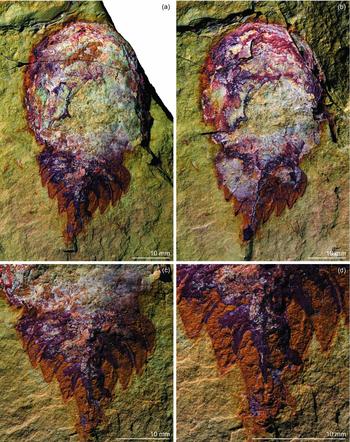
The holotype (YPM 226552) represents a dorsoventrally flattened individual exposed from its dorsal side, as evidenced by the pattern of trunk tergite overlap and degree of convexity (Fig. 2). The specimen exhibits the typical vivid colouration usually associated with Fezouata fossils. The yellowish and reddish colours are related to the presence of iron oxides; these minerals are the result of pyrite oxidation, the precipitation of which permitted the preservation of soft tissues (Vinther, Van Roy & Briggs, Reference Vinther, Van Roy and Briggs2008; Van Roy et al. Reference Van Roy, Orr, Botting, Muir, Vinther, Lefevbre, El Hariri and Briggs2010; Gaines et al. Reference Gaines, Briggs, Orr and Van Roy2012; Van Roy, Briggs & Gaines, Reference Van Roy, Briggs and Gaines2015; Van Roy, Daley & Briggs, Reference Van Roy, Daley and Briggs2015). The more restrained brownish colour of parts of the trunk is typical of originally biomineralized structures that have been replaced by clay minerals (Vinther, Van Roy & Briggs, Reference Vinther, Van Roy and Briggs2008; Van Roy et al. Reference Van Roy, Orr, Botting, Muir, Vinther, Lefevbre, El Hariri and Briggs2010), suggesting that YPM 226552 originally had a lightly biomineralized exoskeleton. The light-coloured mineralization in the cephalic region probably results from the presence of further authigenic clays.
Brachyaglaspis singularis gen. et sp. nov., holotype and only specimen YPM 226552, Upper Fezouata Formation, middle Floian (Lower Ordovician), Bou Chrebeb, Morocco: (a) part; (b) counterpart, inverted lighting and mirrored to create false positive relief image; (c) part, close-up of trunk; and (d) part, close-up of postventral plates and tailspine.

3. Materials and methods
The specimen was mechanically prepared using PaleoTools MicroJack1 and 5 air scribes, needles and scalpels. It was glued with Paraloid B-72 dissolved in acetone, after which it received a protective coat of consolidant, consisting of a 5% solution of Butvar B-98 in ethanol. For photography of the complete specimen, the fossil was illuminated by a 500 W tungsten floodlight with an Aflash Photonics linear polarizer in front; for close-up imaging, a Schott KL2500 cold light source was used with polarizers attached to the tips of the goosenecks. A Cokin XPro X164 circular polarizer was mounted on the camera lens and crossed with the polarizer of the light source to enhance contrast. The part was lit from the NW while the counterpart was illuminated from the SW and mirrored in Adobe Photoshop CC 2014 to create a false positive relief image and facilitate direct comparison of part and counterpart. The specimen was photographed dry. All photographs were taken with a Hasselblad H4D-200MS medium frame digital SLR connected to a computer and operated remotely in 6-shot mode through Hasselblad Phocus 8.2.1 software to acquire images of 200 MP resolution. A Hasselblad HC Macro 4/120 mm II lens stopped down to f/9.5 was employed for photography. Lens distortion was corrected using Hasselblad Phocus 8.2.2 software. Stacks of between 26 and 38 images were taken in aperture priority mode, with manual focusing through the focal plane. After exporting the FFF format digital negatives to TIFF from Hasselblad Phocus 8.2.2, the photographs were stacked in Zerene Stacker Pro 1.04 (64 bit) using the PMax pyramid stack algorithm. The stacked images were then post-processed in Adobe Photoshop CC 2014, first applying the ‘Sharpen more’ and ‘Sharpen’ functions, followed by removal of the background. Levels were then manually balanced while holding down the ‘alt’ key to prevent clipping of pixels in the specimen; the grey level was always retained at 50%. The high-resolution images were down-sampled in Adobe Photoshop CC 2014 to lower-resolution TIFF files for use in the plates.
YPM 226552 is deposited at the Yale Peabody Museum of Natural History in New Haven, Connecticut (USA). Abbreviations: dia. – diameter; sag. – sagittal; T1–6 – trunk tergites 1 to 6; t.l. – total length; t.w. – total width; tr. – transverse.
4. Systematic palaeontology
Phylum Euarthropoda Lankester, Reference Lankester1904 (see Ortega-Hernández, Reference Ortega-Hernández2014)
Order Aglaspidida Walcott, Reference Walcott1912
Emended diagnosis: Euarthropods with a primarily phosphatic biomineralized cuticle. Except for a possible hypostomal suture, cephalon completely devoid of visible ecdysial sutures. Eyes primarily dorsal and sessile; may be lost in derived taxa. Four, or possibly five, cephalic appendages present. All trunk tergites freely articulating, with pleurae carrying a pair of anterior tergal processes. Paired postventral plates located beneath posterior-most one, two or three tergites and base of tailspine, possibly resulting in the loss of appendages associated with those otherwise undifferentiated terminal tergites (emended from Van Roy, Reference Van Roy2006, p. 341).
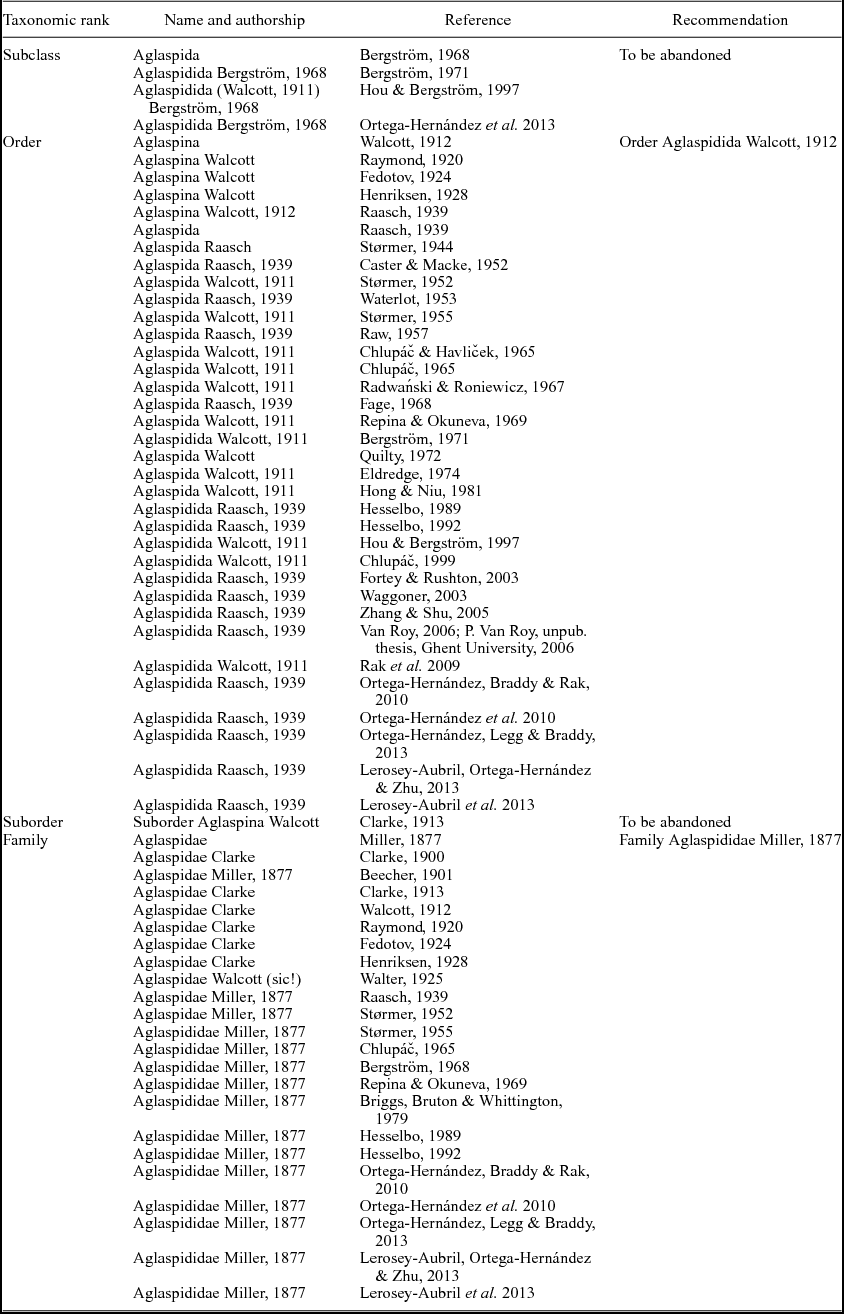
Remarks: There is considerable disagreement regarding the spelling and authorship of the higher taxonomic units (i.e. order and family) that encompass the genus Aglaspis Hall, Reference Hall1862 and its allies (Table 1). The order Aglaspina Walcott, Reference Walcott1912 was the first taxonomic unit to be proposed above the family level, but all later mentions of it have erroneously cited Walcott (Reference Walcott1911). According to Walcott (Reference Walcott1912, p. 199), the taxa included in this group are characterized by: an elongate and trilobed exoskeleton; a head with or without sessile eyes and bearing a hypostome (‘epistoma’) and five pairs of appendages; a trunk with 8–11 appendage-bearing segments; and an ‘abdomen’ with 1–3 segments. This order was originally composed of the sole family Aglaspididae (then called ‘Aglaspidae’; see discussion below), which included the genera Aglaspis, Emeraldella Walcott, Reference Walcott1912, Habelia Walcott, Reference Walcott1912 and Molaria Walcott, Reference Walcott1912. Clarke (Reference Clarke, Eastman and von Zittel1913) agreed with the grouping of these taxa, but proposed a subordinal rank for the Aglaspina Walcott, Reference Walcott1912. This was not followed by Raymond (Reference Raymond1920, p. 149), who agreed with Walcott's concept of Aglaspina except for his exclusion of the genus Emeraldella. Later on, Raasch (Reference Raasch1939) discussed the applicability of this concept of Aglaspina and considered that, as initially defined, this group did not adequately represent its constituent taxa. Instead of simply emending the diagnosis, Raasch (Reference Raasch1939, p. 3) proposed to abandon Walcott's Aglaspina and created a new order called Aglaspida which included Aglaspis, Beckwithia Resser, Reference Resser1931 and Strabops Beecher, Reference Beecher1901, along with the new taxa described in his monograph; Emeraldella, Molaria and Habelia were excluded. Interestingly, Raasch's diagnosis of Aglaspida acknowledged for the first time the presence of a phosphatic exoskeleton and postventral plates, two characters that are now regarded as critical to the definition of the clade (Van Roy, Reference Van Roy2006; P. Van Roy, unpub. thesis, Ghent University, 2006; Ortega-Hernández, Legg & Braddy, Reference Ortega-Hernández, Legg and Braddy2013). Despite Raasch's recommendation (Reference Raasch1939, p. 3), Walcott was recognized as the author of this taxon by most subsequent workers (Table 1) until Hesselbo (Reference Hesselbo1989, Reference Hesselbo1992) re-described Beckwithia and the aglaspidid fauna from the upper Cambrian deposits of the Mississippi Valley; here, Raasch was credited the authorship of the order grouping all the known aglaspidid species, a practice that has been adopted in most recent studies (Table 1).
Evolution of the names and authorships of the taxonomic units comprising the euarthropod genus Aglaspis and allies. The first mention of the family name Aglaspidae Clarke is found in Clarke (Reference Clarke, Eastman and von Zittel1900), but it is unclear whether this marks the creation of the family or if the author was referring to an unknown contribution published by him a few years earlier. In any case, a family Aglaspidae comprising the sole genus Aglaspis had already been created by Miller (Reference Miller1877). See text for further explanations concerning our recommendations.
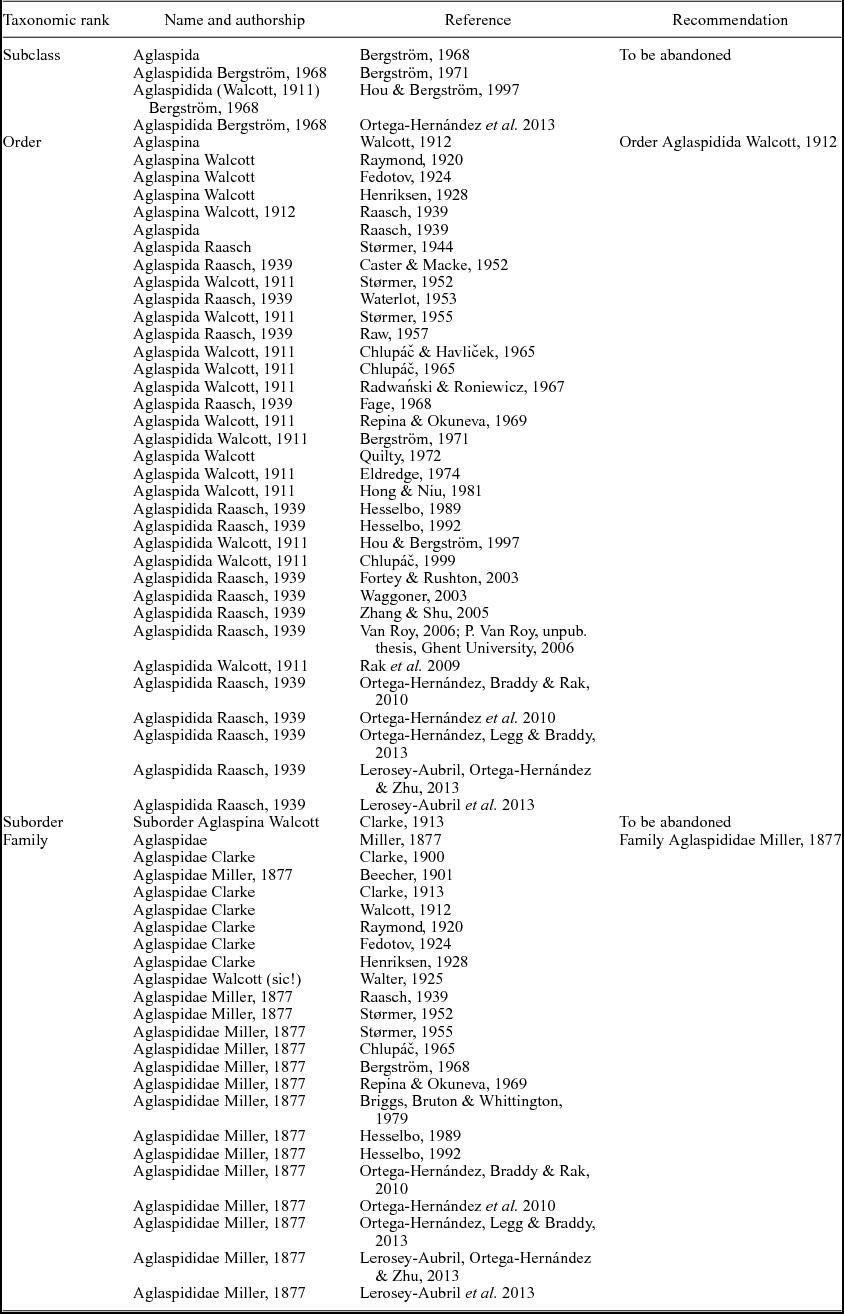
For the last three decades, the order has been referred to not as ‘Aglaspina’ or ‘Aglaspida’, as proposed by Walcott (Reference Walcott1912) and Raasch (Reference Raasch1939), respectively, but rather ‘Aglaspidida’. This spelling was introduced by Bergström (Reference Bergström1971, p. 397) probably for the sake of consistency, after Størmer (Reference Størmer and Moore1955, p. xiii, P12) had replaced the family name Aglaspidae Miller, Reference Miller1877 with Aglaspididae Miller, Reference Miller1877. This change was justified on the grounds of complying better with the International Code of Zoological Nomenclature (ICZN), but its article 29.3.1.1 clearly states that if the stem of a family name ends in -id (e.g. aglaspid-), those two letters may be elided before adding the family-group suffix -idae. In other words, replacing ‘Aglaspidae’ by ‘Aglaspididae’ and ‘Aglaspida’ by ‘Aglaspidida’ might have been unnecessary, especially since those spellings were in prevailing usage at that time. Since ‘Aglaspidida’ has been widely used since 1971, regardless of whether Walcott or Raasch was regarded as the author of the taxon, we recommend maintaining this spelling over ‘Aglaspina’ or ‘Aglaspida’.
The question of the authorship is more delicate. Walcott (Reference Walcott1912) was the first to create and tentatively diagnose an order including and named after the genus Aglaspis Hall, Reference Hall1862. Conversely, Raasch's (Reference Raasch1939) monograph describing the aglaspidid fauna from Wisconsin is traditionally regarded as the most significant contribution ever published on this enigmatic group. Walcott's (Reference Walcott1912) choice of Aglaspis as the type genus of his new order may seem surprising, considering the fact that it is the only genus initially included in this order that he had not created himself. In all likelihood, this decision was dictated by the pre-existence of the family Aglaspididae (see below). Also, Raasch (Reference Raasch1939, p. 83) is probably correct in stating that Walcott might have mostly considered Emeraldella, Habelia and Molaria (rather than Aglaspis) when defining his order Aglaspina. However, it remains that Walcott's diagnosis of this order (imperfect as it was) is in accordance with the morphology of Aglaspis. Because of that, Raasch's order Aglaspida cannot be regarded as a new concept totally distinct of Walcott's order Aglaspina. Instead, it was a significantly improved version of it, both quantitatively (two aglaspidid species were known in 1912 and almost 20 after Raasch's publication 27 years later) and qualitatively (significance of postventral plates and phosphatic cuticle for defining the group). However, because it is priority and not merit that prevails when determining the authorship of a taxon according to the rules defined by the ICZN (albeit for lower taxonomic units), we believe that Walcott (Reference Walcott1912) should be regarded as the author of the order Aglaspidida.
Finally, the subclass Aglaspida Bergström, Reference Bergström1968 was proposed to treat aglaspidids, xiphosurans and eurypterids at equivalent taxonomic ranks within a new classification scheme of the Merostomata Dana, Reference Dana1852. The spelling was later replaced by ‘Aglaspidida’ by Bergström (Reference Bergström1971, p. 397; Table 1), again most likely to follow the nomenclature introduced by Størmer (Reference Størmer and Moore1955). The subclass Aglaspida Bergström, Reference Bergström1968 has virtually the same definition and composition as the order Aglaspidida Walcott, Reference Walcott1912 (as redefined by Raasch, Reference Raasch1939). Given the fundamental synonymy between these classifications, we recommend abandoning the subclass Aglaspidida Bergström, Reference Bergström1968 as it offers no added practical systematic value and contributes to a greater confusion about this name.
Family Aglaspididae Miller, Reference Miller1877
Remarks: Family Aglaspidae Miller, Reference Miller1877 represents the earliest confirmed record of a suprageneric classification for aglaspidid euarthropods (Table 1). A few early publications referred to Clarke as the author of this family (e.g. Clarke, Reference Clarke, Eastman and von Zittel1900, Reference Clarke, Eastman and von Zittel1913; Walcott, Reference Walcott1912; Raymond, Reference Raymond1920). It is not clear whether the first of them (i.e. Clarke Reference Clarke, Eastman and von Zittel1900) represents the publication where this family was supposedly created or whether it refers to an older work from the same author. In any case, it cannot be older than Miller's work as the first publication by Clarke dates precisely from 1877 and dealt with a different topic (Schuchert Reference Schuchert1926). Despite Beecher's (Reference Beecher1901) clear statement about Miller's priority, this fact was only acknowledged by all after the publication of Raasch (Reference Raasch1939). As already discussed above, the spelling of the family name was (unnecessarily) changed to Aglaspididae by Størmer (Reference Størmer and Moore1955) and, since then, all the publications discussing this family referred to it as the Aglaspididae Miller, Reference Miller1877 (Table 1). Accordingly, we recommend maintaining the spelling ‘Aglaspididae’ in line with Article 29.5 of the ICZN and referring to the family as the Aglaspididae Miller, Reference Miller1877.
After demonstrating the absence of fused posterior trunk tergites in Beckwithia typa Resser, Reference Resser1931, the family Beckwithiidae Raasch, Reference Raasch1939 was regarded as a subjective junior synonym of Aglaspididae Miller, Reference Miller1877 by Hesselbo (Reference Hesselbo1989). However, Hou & Bergström (Reference Hou and Bergström1997, p. 96) considered this decision as premature, arguing that it should await the availability of further data on the morphology of this species and the chemical composition of its cuticle. Lerosey-Aubril, Ortega-Hernández & Zhu (Reference Lerosey-Aubril, Ortega-Hernández and Zhu2013) detected phosphorus in the exoskeleton of B. typa, but also stated that new material of this species confirms that its morphology cannot be accommodated within the current definition of the Aglaspidida. Likewise, the recent phylogenetic analysis of Ortega-Hernández, Legg & Braddy (Reference Ortega-Hernández, Legg and Braddy2013) suggests that B. typa is particularly close to, but definitely outside the Aglaspidida sensu stricto (sensu Van Roy, Reference Van Roy2006; P. Van Roy, unpub. thesis, Ghent University, 2006). This position likely stems from the absence of postventral plates in this species, a feature that remains uncertain considering the paucity of material described to date. As a result, we concur with Hou & Bergström (Reference Hou and Bergström1997) that the fate of the family Beckwithiidae should await the description of new material of its type species.
The so-called ‘Ordovician-type’ aglaspidids with their distinct morphology (see Ortega-Hernández, Legg & Braddy, Reference Ortega-Hernández, Legg and Braddy2013) may represent another suprageneric group within Order Aglaspidida Walcott, Reference Walcott1912. We nevertheless consider it premature to formally erect a new family to accommodate these forms, and prefer to retain them within Aglaspididae Miller, Reference Miller1877 for now, pending detailed study of additional post-Cambrian forms.
Genus Brachyaglaspis gen. nov.
Type species: Brachyaglaspis singularis sp. nov. (by monotypy).
Derivation of name: Conflation of the Latin ‘brachy’ (short) and Aglaspis, referencing the peculiarly short trunk that typifies the new taxon.
Diagnosis: Aglaspidida characterized by a large cephalon, both longer (sag.) and wider (tr.) than the trunk region, without apparent dorsal eyes. Trunk composed of six overlapping tergites. Paired postventral plates small, subrectangular and broadly attached to one another sagittally. Postventral plates located underneath the last trunk tergite and base of tailspine. Tailspine short and almond-shaped, with a rounded termination.
Brachyaglaspis singularis sp. nov. Figures 2–5
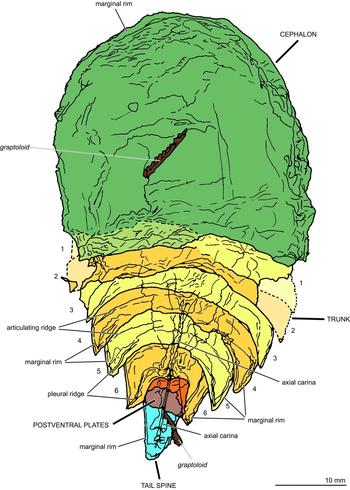
Composite camera lucida drawing combining information from both part and counterpart of Brachyaglaspis singularis gen. et sp. nov., holotype and only specimen YPM 226552, Upper Fezouata Formation, middle Floian (Lower Ordovician), Bou Chrebeb, Morocco. Numbers indicate trunk tergites.

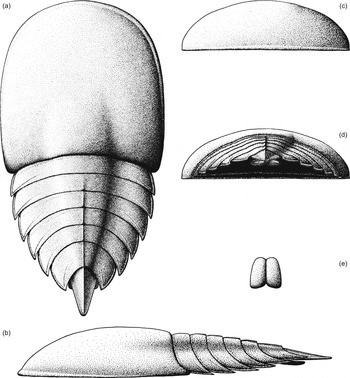
Morphological reconstruction of the dorsal exoskeleton and postventral plates of Brachyaglaspis singularis gen. et sp. nov.: (a) dorsal; (b) left lateral; (c) frontal; (d) rear; and (e) ventral view of postventral plates.

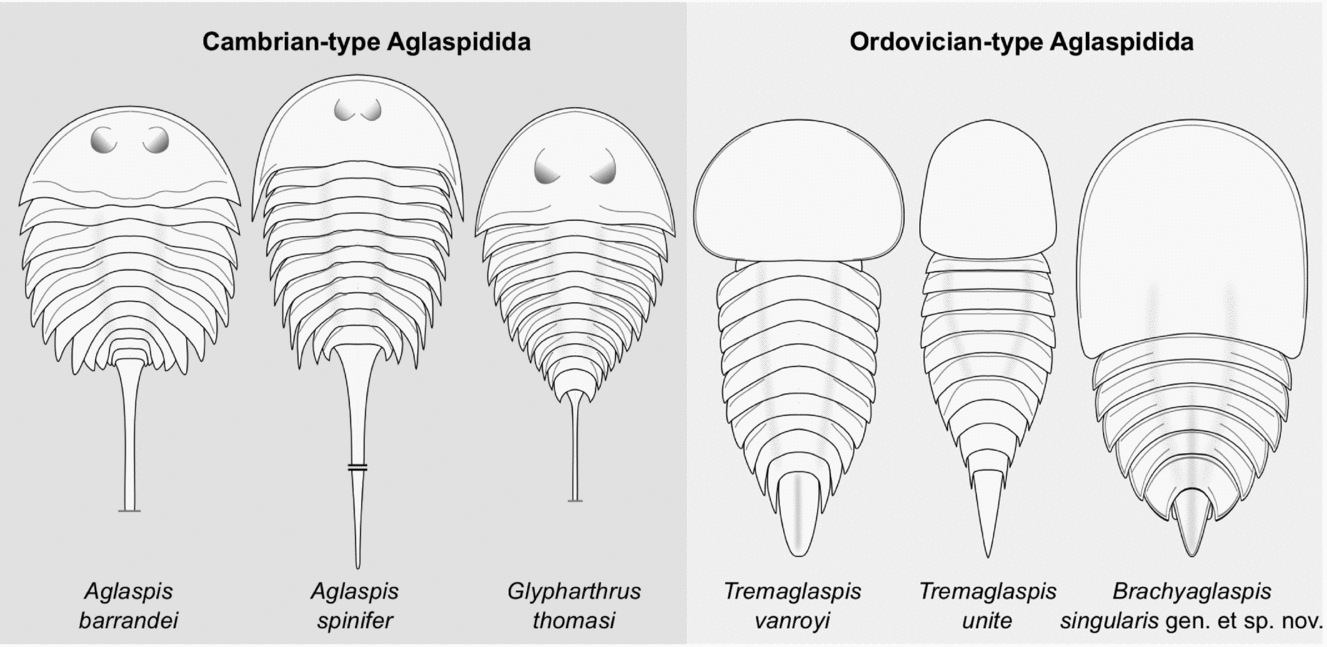
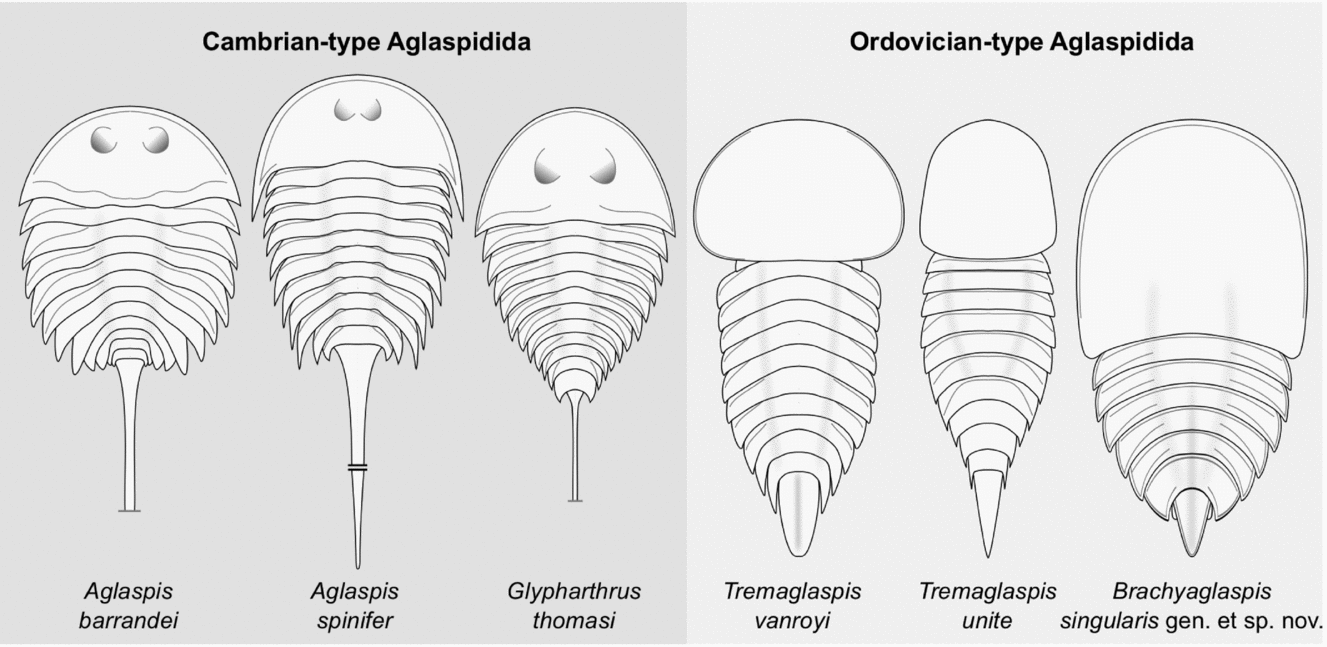
Comparison of aglaspidid euarthropod morphotypes (sensu Ortega-Hernández et al. Reference Ortega-Hernández, Legg and Braddy2013). Cambrian-type aglaspidids (left) are typified by the possession of 11 well-developed trunk tergites, dorsal sessile eyes, genal and pleural spines, and an elongate tailspine. By contrast, Ordovician-type aglaspidids (right) are characterized by an effaced cephalon, reduction or loss of dorsal eyes, rounded genal angles, reduced tergite count and a short trailspine (see text for discussion). Note that although T. vanroyi possesses 11 trunk tergites (Lerosey-Aubril et al. Reference Lerosey-Aubril, Ortega-Hernández, Kier and Bonino2013), T1 is substantially reduced. Brachyaglaspis singularis gen. et sp. nov. represents the most extreme case of trunk tergite reduction among Ordovician-type aglaspidids known to date.
Derivation of name: singularis, from Latin, referring to the unusual morphology for an aglaspidid.
Diagnosis: as for genus.
Description: Holotype (YPM 226552) is a complete, mostly articulated individual consisting of part and counterpart, with a total original articulated length (sag.) of c. 69.6 mm. Cephalon large (c. 52% t.l., sag.), c. 36.0 mm long and 37 mm wide, with a rounded and convex anterior margin, almost straight lateral margins and slightly concave posterior margin. No dorsal eyes or ecdysial sutures visible. Marginal rim widest anteriorly (c. 1 mm), gradually narrowing towards the posterior. Axial region poorly differentiated (Figs 2a, b, 3); dorsal convexity moderate. Trunk short (c. 23.4 mm t.l., sag., excluding telson, i.e. c. 33% t.l. sag.), composed of six freely articulating tergites and preserved rotated c. 10° clockwise relative to cephalon (Figs 2a–c, 3). Axial region weakly developed, approximately one-third to one-quarter of t.w. (tr.). Median carina present on at least T3–6, becoming more pronounced rearwards. Trunk width (tr.) decreasing posteriorly, due to width reduction and increasing backwards curvature of pleurae. Pleural tips point sharply backwards. Each pleura bears a rather large articulating facet anterolaterally, the posterior margin of which is bordered by a faint articulating ridge which is situated just ahead of the midline (tr.) of the tergites. In their posterior third, the pleurae exhibit a ridge running towards pleural tip and vanishing abaxially. The lateral margins of the pleurae show a very narrow marginal rim of constant width (c. 0.5 mm). Overlap between adjacent tergites is broad (tr.) but limited (sag.). T1–5 roughly similar in length (sag.), but T6 is c. 50% longer. T1 and T2 poorly preserved medially and their lateral margins are missing, leaving only faint impressions. T1 covered by cephalon on the left and c. 31.5 mm in width (tr.). T2 is c. 30.5 mm in width (tr.). Exposed length (sag.) and width (tr.) of T3, T4, T5 and T6 are: c. 3.7 mm and c. 25.1 mm; c. 3.3 mm and c. 20.5 mm; c. 4.4 mm and c. 16.0 mm; and c. 6.8 mm and c. 9.1 mm, respectively. Strongly recurved pleurae of T6 point almost straight backwards, and form an embayment for the base of the tailspine. Tailspine short (c. 10.2 mm exposed length, i.e. c. 15% t.l., sag.), almond-shaped and terminating in a rounded, blunt tip (Figs 2, 3). Dorsal median carina and narrow marginal rim (c. 0.3 mm wide) present. Postventral plates small (c. 4.5–5 mm long sag., 5.8 mm wide tr.), subrectangular in outline, slightly tapering towards the anterior and with rounded corners; they seem to be broadly attached to one another, form a median notch anteriorly and posteriorly and cover ventrally posterior region of T6 and base of tailspine medially (Figs 2b, c, 3, 4).
Remarks: Brachyaglaspis is recognized as a member of Aglaspidida Walcott, Reference Walcott1912 based on the presence of paired postventral plates, which are autapomorphic for the group (Van Roy, Reference Van Roy2006; P. Van Roy, unpub. thesis, Ghent University, 2006; Ortega-Hernández, Legg & Braddy, Reference Ortega-Hernández, Legg and Braddy2013, character 74). This assignment is further supported by the presence of articulating facets on the pleural regions (see Hesselbo, Reference Hesselbo1992; Van Roy, Reference Van Roy2006; P. Van Roy, unpub. thesis, Ghent University, 2006), although similar features also occur in a few other Cambrian non-trilobite artiopodans such as Emeraldella and Molaria (see Stein & Selden, Reference Stein and Selden2012).
Although the large cephalon and trunk composed of only six tergites make Brachyaglaspis rather unusual compared to other aglaspidids, the new taxon also exhibits characters found in more orthodox members of this group. An effaced cephalon, apparent absence of dorsal eyes, trunk with less than 11 tergites and short tailspine make Brachyaglaspis most similar to the Ordovician-type aglaspidid species Tremaglaspis unite Fortey & Rushton, Reference Fortey and Rushton2003 (see also Fortey & Rushton Reference Fortey and Rushton2009) (Fig. 5). The new taxon is mainly distinguished from T. unite in the comparatively larger proportions of the cephalon, the presence of only six trunk tergites and apparently unfused postventral plates. Given that these morphological features are not observed in any similarly sized specimens of Tremaglaspis sp., which represents the only other aglaspidid known from the Fezouata Biota (e.g. P. Van Roy, unpub. thesis, Ghent University, 2006; Van Roy et al. Reference Van Roy, Orr, Botting, Muir, Vinther, Lefevbre, El Hariri and Briggs2010, fig. 2a), or any congeneric species (Fortey & Rushton, Reference Fortey and Rushton2003, Reference Fortey and Rushton2009; Lerosey-Aubril, Ortega-Hernández & Zhu, Reference Lerosey-Aubril, Ortega-Hernández and Zhu2013), it can be concluded that YPM 226552 does not represent a juvenile specimen of any known species of Tremaglaspis. Brachyaglaspis also shares similarities with the Late Ordovician aglaspidid Chlupacaris dubia from Morocco (Van Roy, Reference Van Roy2006), including an effaced cephalon and a short tailspine; because Chlupacaris is only known from disarticulated material, the exact tergite count for this taxon is uncertain but was probably larger than that of the new taxon (Van Roy, Reference Van Roy2006; P. Van Roy, unpub. thesis, Ghent University, 2006). In any case, Brachyaglaspis is easily differentiated from Chlupacaris by the overall shape of the cephalon, absence of medially placed dorsal eyes and the different organization of the postventral plates.
The trunk of Brachyaglaspis is composed of only six overlapping tergites, and is therefore unusually short for an aglaspidid euarthropod (sag.; see Discussion section below); however, the broad (tr.) tergite overlap and the trend towards an increased curvature and a reduction of tergite pleurae rearwards are two characters reminiscent of the morphology of several Cambrian-type aglaspidid genera (e.g. Aglaspis, Glypharthrus, Aglaspella; see Ortega-Hernández, Legg & Braddy, Reference Ortega-Hernández, Legg and Braddy2013, characters 44 and 61; Fig. 5). Finally, the small postventral plates, which are widely attached to each other medially and display straight posterior margins, somewhat recall those of the late Cambrian Australaglaspis stonyensis Ortega-Hernández et al. Reference Ortega-Hernández, Braddy, Jago and Baillie2010 from Tasmania. In this regard, the new taxon strongly differs from T. unite (Fortey & Rushton Reference Fortey and Rushton2003, Reference Fortey and Rushton2009); the latter species exhibits long postventral plates that are apparently fused medially and possess straight anterior and pointed posterior margins.
5. Discussion
A reconstruction of the dorsal exoskeleton and postventral plates of Brachyaglaspis is given in Figure 4. Brachyaglaspis singularis represents the second confirmed aglaspidid euarthropod in the Fezouata biota (see Van Roy et al. Reference Van Roy, Orr, Botting, Muir, Vinther, Lefevbre, El Hariri and Briggs2010, fig. 2a) and, along with T. unite and C. dubia, the third unequivocal representative of this group formally described for the Ordovician (but see also Fortey & Theron Reference Fortey and Theron1994, fig. 6a; Ortega-Hernández, Legg & Braddy, Reference Ortega-Hernández, Legg and Braddy2013, p. 22). Although Brachyaglaspis increases the taxonomic diversity of Aglaspidida for this poorly known time interval of their history, the broader significance of this new euarthropod stems from its unusual morphology within the evolutionary context of the group (Fig. 5); most aglaspidid species known from complete individuals possess 11 trunk tergites (e.g. Hesselbo, Reference Hesselbo1992; Ortega-Hernández et al. Reference Ortega-Hernández, Braddy, Jago and Baillie2010), the exceptions being T. unite and Tremaglaspis sp. from the Fezouata biota that exhibit 10 trunk tergites only (P. Van Roy, unpub. thesis, Ghent University, 2006; Fortey & Rushton, Reference Fortey and Rushton2009; Van Roy et al. Reference Van Roy, Orr, Botting, Muir, Vinther, Lefevbre, El Hariri and Briggs2010). The late Cambrian T. vanroyi Lerosey-Aubril, Ortega-Hernández & Zhu, Reference Lerosey-Aubril, Ortega-Hernández and Zhu2013 possesses 11 trunk tergites, suggesting that this tergite count represents a symplesiomorphy for Aglaspidida, while the lower tergite counts observed in the Ordovician representatives of this genus and Brachyaglaspis represent derived conditions. In this regard, it is noteworthy that the presence of 11 trunk tergites is a widespread feature in phylogenetically basal early Palaeozoic euarthropod groups (e.g. Edgecombe, García-Bellido & Paterson, Reference Edgecombe, García-Bellido and Paterson2011; Lamsdell, Reference Lamsdell2013; Ortega-Hernández et al. Reference Ortega-Hernández, Lerosey-Aubril, Kier and Bonino2015). The fact that T. unite, Tremaglaspis sp. from the Fezouata biota and Brachyaglaspis are restricted to Ordovician deposits raises the possibility of a trend towards reduction of the number of trunk tergites in post-Cambrian aglaspidids. However, considering that T. unite and the new taxon share other similarities (e.g. shape of cephalon, apparent absence of dorsal eyes), an alternative hypothesis could be that the trend to reduce the number of trunk tergites is restricted to a particular lineage within Aglaspidida. As argued above (see Section 4), it is unlikely that Brachyaglaspis represents a juvenile stage of a known aglaspidid species, including the co-occurring Tremaglaspis sp. However, the reduced tergite count in this otherwise rather large specimen (t.l. c. 6.9 cm) indicates that maturity was reached before the development of the full complement (at least 10) of tergites characterizing the aglaspidid trunk. This suggests that the evolution of this atypical morphology might have involved heterochronic processes – possibly some type of neoteny – considering the large size of the specimen. In the absence of a definite trunk tergite count for Chlupacaris, and with virtually no ontogenetic data on these extinct euarthropods, testing any of these evolutionary scenarios will unfortunately have to wait for further discoveries.
Regardless, Brachyaglaspis indicates that the body plan of aglaspidid euarthropods was much more variable than previously considered from the study of Cambrian representatives alone (see also Van Roy, Reference Van Roy2006; P. Van Roy, unpub. thesis, Ghent University, 2006). This observation mirrors patterns of increased morphological disparity observed in trilobites slightly later during Middle Ordovician time (e.g. Foote, Reference Foote1991; Hughes, Reference Hughes2007, p. 416–8), which suggests that the complex environmental and palaeoecological conditions resulting in the ‘Great Ordovician Biodiversification Event’ (e.g. Servais et al. Reference Servais, Owen, Harper, Kröger and Munnecke2010) also influenced the evolution of aglaspidid euarthropods. Soon after their appearance in the fossil record during the late Cambrian, aglaspidids greatly diversified morphologically and, as evidenced by Brachyaglaspis, this dynamic continued until (at least) Floian times. Such a pattern of diversification further underscores the variation in timing among different clades for the onset of a supposedly ‘Ordovician’ radiation event (Webby et al. Reference Webby, Paris, Droser and Percival2004; Harper, Reference Harper2006), something that has recently also been documented in several non-biomineralized clades (Van Roy et al. Reference Van Roy, Orr, Botting, Muir, Vinther, Lefevbre, El Hariri and Briggs2010; Van Roy, Briggs & Gaines, Reference Van Roy, Briggs and Gaines2015; Van Roy, Daley & Briggs, Reference Van Roy, Daley and Briggs2015).
Acknowledgements
The specimen was collected by Mohamed ‘Ou Said’ Ben Moula. Susan Butts and Jessica Utrup curated specimens and facilitated access to the collections. JOH is supported by a Research Fellowship at Emmanuel College, University of Cambridge (UK), and acknowledges additional funding generously provided by the Yale Peabody Museum of Natural History (Schuchert and Dunbar Grant). PVR acknowledges support from NSF Grant EAR-1053247 and the Division of Invertebrate Paleontology, Yale Peabody Museum of Natural History. RLA acknowledges support from the Agence Nationale de la Recherche (Project RALI; France). The paper benefitted from the reviews of two anonymous referees.