1. Introduction
Research into the drivers of protest participation has arguably taken an emotional turn in the last two decades. The emotions encountered by protest participants and their fellow communities have been adopted to explain the upsurge and development of social movements worldwide (Goodwin, Jasper and Polletta, Reference Goodwin, Jasper and Polletta2001; Aminzade and McAdam, Reference Aminzade and McAdam2002; Reed, Reference Reed2004). Some studies have examined the respective influences of negative and positive valences and their mediating roles in motivating or boosting movement participation, while others have tried to unpack the relationships between individual cognitions and group emotions (see Van Zomeren, Postmes and Spears, Reference Van Zomeren, Postmes and Spears2008; Chan, Reference Chan2015). Although these studies have opened a new research agenda, the relational dynamics underpinning the emotions of different generations and social groups that drive multiple forms of repertoire remain underexplored.
The Anti-Extradition Law Amendment Bill (Anti-ELAB) Movement in Hong Kong serves as a pertinent case to examine the relationships between affective emotions and protest radicalization. The Anti-ELBA Movement began with a peaceful mass rally on 9 June 2019, but a clash between the protesters and the police outside the Legislative Council 3 days later promptly triggered the radicalization process. In the following months, peaceful demonstrations and radical actions often coexisted. Confrontations with the police, vandalism, arson, and violent conflicts between pro-government and pro-movement citizens also became increasingly common (Chung, Reference Chung2020; Holbig, Reference Holbig2020). A longitudinal survey shows that the proportion of people who deemed radical actions reasonable and legitimate consistently stood at over 50% during the first 6 months of protests (Lee et al., Reference Lee, Yuen, Tang and Cheng2019). Another population poll, conducted in May 2020, shows that 45.6% of the city's population of 7 million participated in the movement, making it the city's broadest expression of dissent in its history (Cheng et al., Reference Cheng, Lee, Yuen and Tang2021b). In the context of Hong Kong, in which there were continuous internal disputes between the radicals and the moderates, the persistent solidarity among the protesters in the Anti-ELAB Movement was unprecedented (Lee, Reference Lee2020). Notably, senior citizens, who were supposedly conservative, initiated a number of ‘gray hair’ groups to openly support young protesters and sympathized with radical actions.
These phenomena are puzzling for three reasons. First, they contradict Hong Kong's political culture, which has traditionally respected the moral authority and effectiveness of peaceful and orderly protest actions (Ku, Reference Ku2007). Second, they contest the widely held cross-national observation that senior citizens are generally more conservative toward radical activism (Zukin et al., Reference Zukin, Keeter, Andolina, Jenkins and Delli Carpini2006; Dalton, Reference Dalton2021). Third, they offer new empirical evidence to identify the pathways through which group solidarity may be strengthened instead of weakened by mobilizing radical and violent actions.
This paper's research problem rests not in the radicalization of protests, but in how movement supporters accept the radicalization process relationally (Lee et al., Reference Lee, Cheng, Yuen and Tang2021a). It examines how cross-generational support for radicalism was instituted to understand the persistence of group solidarity. It, then, explores the role of guilt in building and mediating support for radical actions and solidarity among elderly protesters. Compared to other positive and negative valences – including anger, grievance, hope, and fear – the discussion on guilt is relatively thin in the literature. This paper also elucidates the impact of guilt in creating ingroup identification among political conservatives to support nonnormative radical actions. In doing so, it critically analyzes how trauma that is developed in a transformative event welds people together through shared emotions and a sense of affective community, thereby allowing protest supporters to quickly abandon established norms and repertoire in protest participation (Hutchison, Reference Hutchison2016).
2. Emotions in social movements
Through the emotional shift in social movement studies, emotion is no longer believed to be merely a matter of irrationality (Jasper, Reference Jasper2011). Instead, it is known to be the vital force that shapes people's sense of agency and directs their action (Barbalet, Reference Barbalet1998). It is a factor that affects people's preferences for commitment and action (Kim, Reference Kim2002). It is also the product of belonging to social groups and is thereby dependent upon the social identity of the individuals (Smith and Mackie, Reference Smith and Mackie2015).
Although emotion is believed to be personal, it can be studied from a structural perspective to analyze patterns of the cause and impact of emotions (Kemper, Reference Kemper, Goodwin, Jasper and Polletta2001). Moreover, how to position emotions is also a topic of discussion. Considering that emotion is not equivalent to pure irrationality, which may imply unpredictability, emotion is rarely a direct cause of a behavior (Calhoun, Reference Calhoun, Goodwin, Jasper and Polletta2001). Instead, the relations of emotions to the other components in a protest are explored. Emotions enable people to be more impressed by a movement's framing, for example, through an injustice frame (Jasper, Reference Jasper1998). The associations among emotions, efficacy, and identification are also discussed. Emotions can change the degree of political efficacy and the strength of a collective identification, which can affect political behavior (Van Stekelenburg and Klandermans, Reference Van Stekelenburg and Klandermans2013). The interrelationships among emotions can also be articulated. Kleres and Wettergren (Reference Kleres and Wettergren2017) argue that guilt can lead to increased anger toward a situation. Fear can restrain people from active participation, yet it can be overcome by hope. Needless to say, emotions also relate to people's attitudes toward a politician, a social and political issue, or a social group (Ferguson and Branscombe, Reference Ferguson and Branscombe2010; Tang, Reference Tang2015).
The relational approach of social movement studies recognizes that protest events often involve the copresence of multiple actors and different forms of actions (Alimi, Bosi and Demetriou, Reference Alimi, Bosi and Demetriou2012; Della Porta, Reference Della Porta2018). Participants can shift from certain modes of actions to others considering movement dynamics. Although certain social groups might be less prone to practice or support radical actions, the relational approach views most people as capable of being radicalized through specific interactive dynamics (Della Porta and Tarrow, Reference Della Porta and Tarrow2012). This understanding is particularly relevant to our case, which features a dominant conservative political culture. Specifically, protest events often amplify the affective and relational dimensions of emotions. Traumatic events are moments and sites where activists and their supporters experience emotional upheavals (Cheng and Chan, Reference Cheng and Chan2017; Ku, Reference Ku2020). The sense of shared understanding between groups is particularly strong when the challengers and their sympathizers encounter state repression in the same community or common space (Hess and Martin, Reference Hess and Martin2006; Hutchison, Reference Hutchison2016). Under this circumstance, different groups of actors are positioned to negotiate with each other, build networks, and evaluate tactics. Here, the effect of emotions on protest participation is not only dependent on the intensity with which individuals feel them, but also is embedded in protest dynamics and group identities.
Moreover, extant research on emotions tends to focus on the mobilizing potential of negative valences such as anger, fear, sadness, or contempt (see Van Troost, Stekelenburg and Klandermans, Reference Van Troost, Van Stekelenburg, Klandermans and Demertzis2013). These negative emotions are salient, as they tend to be directed against authorities. Among all the emotions, guilt has not been as widely studied as the others, as it is less relevant to the potential for mobilization. However, the role of guilt in building ingroup identification, which can be inferred to be a solidarity among different participants in a mass protest, cannot be overlooked.
Guilt is an emotion generated by having done or wanting to do something that a community regards as ‘having transgressed a moral imperative.’ It can be felt deeply when someone has done something that harms an innocent other, directly or indirectly (Lazarus, Reference Lazarus1991: 240). Although guilt is an emotion for individuals, it is also group-based. Guilt can be generated when an individual resonates with the moral attributes and norms of a community to which he or she belongs. Of course, some of the moral norms can be internalized and are thought to be universal values shared by most human societies. Nevertheless, some of the norms are compiled in some groups based on the discursive context of those groups. For example, some environmentalists feel guilt after consuming shark fins, but this guilty feeling can be shared only among the group of environmentalists. As a group-based emotion, guilt is not only a consequential emotion of having done something, but also is characterized as a prosocial feeling that includes an empathic concern over the group members who are suffering (Hoffman, Reference Hoffman and Eisenberg1982). This explains why some people experience ‘survivor guilt’ after witnessing other group members having sacrificed for their common virtues.
On the contrary, the guilt generated based on group membership is defined as collective guilt, and it is associated with a sense of responsibility. Some people may feel responsible for their group members' wrongdoings. They, thus, participate in reparative actions for their group members (Wohl, Branscombe and Klar, Reference Wohl, Branscombe and Klar2006). Collective guilt sharing among Germans in the aftermath of World War II is one example (Rensmann, Reference Rensmann, Branscombe and Doosje2004). When Thomas, McGarty and Mavor (Reference Thomas, McGarty and Mavor2009) explain how prosocial emotions can lead to social change, they posit that guilt could mediate the relationship between social identity and social action. Other scholars define guilt as a ‘bystander emotion’ in social movement studies, as it is mainly generated among people who do not participate or have a low degree of involvement in mobilization (Kemper, Reference Kemper, Goodwin, Jasper and Polletta2001). Hence, guilt as a concept is rarely studied during social mobilization. The exception is that guilt can be effective at mobilizing people to support the cause of environmentalism (Ferguson and Branscombe, Reference Ferguson and Branscombe2010; Kleres and Wettergren, Reference Kleres and Wettergren2017). However, political advocacy is different from the street mobilization that is directed against an authority.
Given that guilt is related to ingroup identification, its role in building solidarity in a radical mass protest merits further research. The following conceptual elements of guilt are explained before this paper describes the Hong Kong context and states its hypotheses: first, ingroup identification can be contextual and relational instead of rigidly defined as a specific community. As Van Troost, Stekelenburg and Klandermans (Reference Van Troost, Van Stekelenburg, Klandermans and Demertzis2013) discuss, an emotion results from a group's assessment of its interaction with its social context. In an eventful movement, certain emotions can be especially effective for a particular group of actors to build solidarity. It can be a result of the dynamics between the actors and the authority during a movement. The biographical background of some actors can also affect how they assess their relationship with their sociopolitical context, which leads them to be more sensitive to certain emotions. Second, when a group of members are divided between an advantaged side and a disadvantaged side, the former is more likely to feel guilty when they witness the other members from the same social group suffering from an excessive use of power. In this case, guilt can strengthen the cohesion of a group in which different actors have different interests and therefore cannot obtain consensus on all issues. Through the feeling of guilt, the advantaged can comprehend inequality within their group and accept the differences between the advantaged and the disadvantaged (Thomas, McGarty and Mavor, Reference Thomas, McGarty and Mavor2009).
This review concerning guilt reveals the potential role of guilt in explaining cross-generational solidarity in the Anti-ELAB Movement. Although the protesters and the other movement supporters belonged to the same group in terms of their attitudes toward the movement, they were diverse in terms of their views toward violent protests. In a social movement, nonnormative violent actions can lead to the disidentification of a few protesters who are not the core supporters of the movement. Therefore, the overall basis of supporters and solidarity can be weakened by certain nonnormative violent actions (Becker et al., Reference Becker, Tausch, Spears and Christ2011; Muñoz and Anduiza, Reference Muñoz and Anduiza2019). In the Anti-ELAB Movement, the movement's supporters were a broad group of people, which comprised of both young and elderly protesters. The elderly protesters were relatively conservative in their mode of protest and were more reluctant to support radical protests than young protesters. In the following section, we further describe how elderly protestors' backgrounds led them to resist radical protests. Next, hypotheses are articulated to explain how guilt can lead elderly protesters to accept radical protests and maintain their solidarity with young protesters.
3. The context of the Anti-ELAB Movement and hypotheses
Hong Kong's social movement was dominated by the ideology that favors peaceful protests. It was not merely a discursive practice of ‘order imagery’ (Ku, Reference Ku2007). At the structural level, it was also due to the ongoing democratization of the political system and improvements in political accountability that began in the 1980s. From the 1980s to the early post-handover period, Hong Kong's government was responsive to public opinion, and various consultation bodies worked to channel public opinion to the executive. This opportunity structure did not facilitate the mobilization of radical protests during that period (Lui and Chiu, Reference Lui, Chiu, Chiu and Lui2000; Ma, Reference Ma2007). However, this period defined the ‘foundation moment’ of the position of political groups and the political attitudes of a cohort of Hong Kong citizens, who perceived that protest actions did not need to be radical to be effective and disliked radical collective actions in general (Lau and Kuan, Reference Lau and Kuan2000).
Since the late 2000s, Hong Kong's social movements have experienced obvious conflictual dynamics between their moderate and radical flanks. Although both were gradually radicalized, the conflicts between the two flanks did not stop but became more hostile toward each other. The Umbrella Movement was a critical juncture that represented the alignment between youths and radicalism (Tang and Cheng, Reference Tang and Cheng2021). Ku (Reference Ku2019) identifies the Umbrella Movement as the theater for the construction of a new political subjectivity that led a generational shift concerning the conception of activism. The surge of localism, which was mainly supported by young people, after the Umbrella Movement was the peak of the tension between the two flanks. Localism represented not only a radical protest repertoire, but also a radical ideology that was against the Hong Kong–China integration (Tang and Yuen, Reference Tang and Yuen2016). The localists and moderates openly criticized each other in public discussion. In numerous radical protests initiated by the localists, the moderates condemned localists' direction rather than maintaining an image of the unity of the pro-democracy camp. Within the history of social movements in Hong Kong, the conflicts between the moderates and the localists exemplified a difference in the perceived political opportunity structure and the attitudes toward social protests between these two cohorts of Hong Kongers. Young people who had no experience with the relatively open political structure and the more accountable government often doubted the effectiveness of moderate protests (Cheng, Chung and Cheng, Reference Cheng, Chung and Cheng2021a).
Given the background of the deeply rooted conflicts between the moderates and the radicals in Hong Kong's social movements, the persistent solidarity during the continuous radicalization of the Anti-ELAB Movement was a puzzling phenomenon. Lee (Reference Lee2020) provides a comprehensive explanation for this persistent solidarity by evaluating its social, experiential, and discursive bases. The social basis of solidarity entailed that many of the young protesters in the movement were too young to understand the disputes among the moderates and radicals. Therefore, they were able to more easily accommodate both radical and moderate protests taking place in the movement. The experiential basis indicated that the state's repression was so strong that it breached the public's limits of acceptance. Reactive radicalization from the protesters did not harm the solidarity of the broader ingroup. The discursive basis reflected the discursive power of the norms and slogans that promoted solidarity among protesters.
The experiential basis of solidarity that Lee (Reference Lee2020) proposes is echoed by other studies as well. Focusing on the police's tactics in handling the movement, Scott et al. (Reference Scott, Ho, Radburn, Chan, Kyprianides and Morales2020) argue that the continuous escalation of the movement through persistent public support was because the police continuously made errors in handling the movement. Furthermore, studying radicalization from a relational perspective, Lee et al. (Reference Lee, Cheng, Yuen and Tang2021a) argue that the radicalization of the Anti-ELAB Movement was legitimized by several contextual factors that led the protesters to recognize the need for a radical response. These factors included the urgency for a radical protest to generate an instant response from the government, a violent repression from the state, and the countermobilization of pro-government groups. Choi (Reference Choi2020) infers that when protests become daily events and daily events become protests, ordinary people can no longer maintain neutrality and claim that they are just distant spectators. Being witnesses, they are forced to make a moral judgment and take a stand.
Despite the macro- and meso-explanations for the persistent solidarity among the general protesters, a precise explanation of why senior citizens, who were more likely to be moderates, would accept radical protests and share in their solidarity is still lacking. Focusing on guilt, several hypotheses are tested in this paper to examine how guilt contributes to individuals maintaining solidarity with a broader ingroup.
The first hypothesis posits that elderly protesters had stronger guilt than young protesters. This hypothesis is partially inspired by the qualitative observations via the onsite participation and focus group research conducted by the authors. On both occasions, elderly protesters apologized to the young protesters, despite that they might or might not support political radicalization in principle. They thought that the young protesters were bearing the costs of their generation's inaction in the past. On 14 July, a crowd of bystanders gathered near the mass transit after an approved rally had concluded. They made the following conversations when witnessing the crash between frontline protesters and the police on live television in the shopping mall connecting to the mass transit in Shatin.
‘Our generation only focused on making money when we faced the political transition in the 1980s. We could have done more for Hong Kong's future…. Yes, we could have voiced when we had the leverage. And our kids would not need to sacrifice.’
In early September, a total of seven movement participants were invited to join a focus group interview. This focus group included interviewees who are diversified in gender, age, and occupation. A male, elderly architect made this testimony while speaking and looking into the eyes of the young people in the focus groups.
‘We are the one who created this unaffordable housing crisis in Hong Kong, and now the young people are suffering. They are facing huge inequalities. This is the root cause of the radical protests. I feel responsible. And we owe our apologies to you.’
Another female, middle-aged teacher nodded her head. She echoed that ‘our generation are responsible…’ but contended that ‘we [referring to the citizen as a group instead of her generation] are having serious inequalities because we don't have a democratic government. The lack of accountability produces favoritism.’
The above confessions can also be found in public discussion. There was opinion from baby-boomers making confessions, stating that they did not contribute much for the next generation because of the political uncertainty before the change in sovereignty (Hon and Chau, Reference Hon and Chau2006; Lui, Reference Lui2007). This hint allowed us to hypothesize that elderly protesters, although they were more likely to be moderates, had a stronger guilt:
Hypothesis 1 (H1): Elderly protesters had stronger guilt than young protesters.
The next two hypotheses aim to examine the respective impact of guilt on support for radical actions and the feeling of solidarity. As the suggestions from the literature indicate, guilt can drive people to accept a difference between them and other ingroup members who belong to the same broader ingroup. Among the advantaged members, the drive can be derived from a sense of responsibility (Berndsen and Manstead, Reference Berndsen and Manstead2007). Although the sense of responsibility is not covered in this research, the suggestions from the literature are sufficient for us to hypothesize a positive impact of guilt on support for radical actions and the feeling of solidarity:
Hypothesis 2 (H2): The feeling of guilt positively relates to support for radical actions.
Hypothesis 3 (H3): The feeling of guilt positively relates to the feeling of solidarity.
Following H1–H3, the next two hypotheses indicate the indirect effects of age on support for radical actions and the feeling of solidarity, which are both mediated by feeling guilty:
Hypothesis 4 (H4): Age has an indirect effect on support for radical actions, mediated by guilt.
Hypothesis 5 (H5): Age has an indirect effect on the feeling of solidarity, mediated by guilt.
The final hypothesis examines the extent to which the hypothesized association between age and guilt is related to personal experience. Although this is not experimental research, we still hope to identify the impact of the personal experience of a particular individual with protests on the increase in guilt. In numerous circumstances, a heavy-handed state's repression has led to a more radical response from protesters and wider support for protesters from the public (Hess and Martin, Reference Hess and Martin2006; O'Brian and Deng, Reference O'Brien and Deng2015; Yuen and Cheng, Reference Yuen and Cheng2017). This was also what happened in the Anti-ELAB Movement (Scott et al., Reference Scott, Ho, Radburn, Chan, Kyprianides and Morales2020). Although elderly protesters were less likely to initially have a radical response, the experience of encountering the state's repression could strengthen their feelings of guilt.
Hypothesis 6 (H6): The relationship between age and the feeling of guilt stipulated in H1 was stronger among the respondents who encountered the state's repression in the Anti-ELAB Movement.
4. Data collection and variables
The data for this study were collected through onsite surveys conducted on 8 December 2019 and 1 January 2020. Following the period when the most violent protests took place in November 2019, these two protests were relatively peaceful and allowed us to conduct onsite surveys. Onsite surveys are a popular method in the study of collective actions (Giugni and Grasso, Reference Giugni and Grasso2019). As emotions emerge only during internal experience, self-reporting is considered the most appropriate measure of emotions (Barrett-Cheetham et al., Reference Barrett-Cheetham, Williams and Bednall2016).
Referencing the established methods of Walgrave and Verhulst (Reference Walgrave and Verhulst2011), we sampled by using the spatial distribution of the protesters as the sampling frame and a systematic sampling procedure to select individual respondents. Interviewers were assigned to different locations along the marching route or throughout the rally site. They were instructed to follow a designated procedure to invite respondents (e.g., in protest marches, the interviewers remained at their location and invited every tenth person walking by to participate). The targeted respondents filled in the questionnaire either online (through a QR code) or using paper and pencil. To leverage the uncertainties that might have forced us to stop the survey, we dispatched a small number of assistants to distribute leaflets onsite and invite participants to complete the questionnaire online. In any case, participation was voluntary. The data sets in use did not include any personal information regarding the protesters (Yuen et al., Reference Yuen, Tang, Lee and Cheng2021).
The sample sizes of the survey on 8 December 2019 and 1 January 2020 were 478 and 1,306, respectively. For the survey in December, the response rate for face-to-face invitation was 88.0% and that for invitations through leaflets was 15.1%. For January, the two response rates were 84.4 and 18.6%. The variables covered in this study were included in both surveys. The two sets of data were combined into a single set in the following analysis. The sample comprised of 51.2% females. The majority of the respondents were young people in the age groups of ‘20 or below’ (15.6%) or ‘21–30’ (38.5%). Similar to the protesters in the earlier stage of the movement, young people constituted the largest proportion of protesters (Lee et al., Reference Lee, Yuen, Tang and Cheng2019). At a range of ‘20 or below’ = 1 to ‘61 or above’ = 6, the mean age was 2.76 (S.D. = 1.35). They were well educated in general; 77.4% of them had obtained tertiary education or above. The percentages of the respondents who claimed to be from the lower and upper classes were 10.3 and 30.3%, respectively. Furthermore, 87.9% of them were born in Hong Kong. With regard to political identification, 40.6% claimed to be moderates, and 33.3% believed that they were localists. Moreover, for 26.2% of the respondents, the Anti-ELAB Movement was the first time they had participated in a protest.
With regard to their experience of facing repression, 70% of the respondents had encountered tear gas during the protests. Furthermore, 11.3% experienced being stopped and searched by the police, 30.8% witnessed people being subdued by the police during protests, and 40.2% had the experience of evading the police with other protesters during a protest.
The following is the operationalization of the key variables and other control variables.
4.1 Guilt
The Anti-ELAB Movement featured broad public support despite its unconventional radical actions. This study adopts a relational perspective to emphasize the contextual dynamics among actors. Guilt is conceptualized as due to the interplay among actors, including moderate protesters, radical protesters, and the state. Unlike generic psychological constructs that measure respondents' degree of feeling according to adjustments related to guilt (Kim, Reference Kim2002; Ferguson and Branscombe, Reference Ferguson and Branscombe2010), guilt was operationalized in the surveys as a feeling toward militant protesters in a stated context. Respondents were asked to express, through a 5-point Likert scale (1 = strongly disagree, 5 = strongly agree), if they agreed with the following statements that describe the militant protesters: (1) I think they substituted for peaceful protesters to sacrifice for the movement; (2) I think the peaceful protesters owe them; (3) they made me feel like I am paying too little for this movement; and (4) I felt guilty when I saw them being arrested. The answers were averaged to form the index (α = 0.81, M = 4.42, S.D. = 0.65).
4.2 Support for radical actions
Respondents were asked to answer, through a 5-point Likert scale (1 = strongly against, 5 = strongly support), if they supported the following protest actions that were considered to be radical and violent: (1) road blocking; (2) vandalizing train stations and their facilities; (3) vandalizing shops that were either pro-government or supported by Chinese capital; (4) arson; (5) doxing the personal information of police officers and political figures; (6) physically attacking police officers; and (7) physically attacking pro-government citizens who attacked or disrupted protesters. The answers were averaged to create the index (α = 0.93, M = 4.03, S.D. = 0.86).
4.3 Feeling of solidarity
Respondents were asked to answer, through a 5-point Likert scale (1 = strongly disagree, 5 = strongly agree), if they agreed with the following statements to describe the radical militant protesters: (1) I think they are speaking for me; (2) I think we are in the same boat; and (3) I feel I am one of them. The answers were averaged to create the index (α = 0.80, M = 4.48, S.D. = 0.60).
4.4 History of political participation
A list of eight major protests, including ‘others,’ was provided to the respondents. They were asked to indicate the protests that they had been a part of. The variable ‘history of political participation’ was constructed by summing the number of protests that the respondents had been part of (M = 2.01, S.D. = 1.65).
4.5 Use of traditional media
The respondents were asked about the frequency that they used traditional media, such as newspapers and television, to obtain information related to the Anti-ELAB Movement. The answers were provided by rating on a 5-point Likert scale, from 1 = never to 5 = always (M = 3.56, S.D. = 1.27).
4.6 Use of social media
The respondents were asked to indicate the frequency that they used Facebook, Instagram, or WhatsApp to obtain information related to the Anti-ELAB Movement. The answers were given by rating on a 5-point Likert scale, ranging from 1 = never to 5 = always. Of course, these three platforms differ slightly from each other in terms of their digital affordances and the attributes of users. However, compared to the ‘protest-active media,’ Facebook, Instagram, and WhatsApp were the general social networking sites that were popular in an array of sectoral and informal mobilizations (Ma and Cheng, Reference Ma and Cheng2021). They were commonly used to disseminate movement-related information because they had been widely used before the movement. The variable ‘use of social media’ was constructed by averaging the responses for these three platforms (α = 0.50, M = 3.86, S.D. = 0.91).
4.7 Use of protest-active media
LIHKG and Telegram are known to have been significant platforms for protesters to obtain movement-related information and to coordinate tactics and actions among active protesters (Urman, Ho and Katz, Reference Urman, Ho and Katz2020; Lee et al., Reference Lee, Liang, Cheng, Tang and Yuen2021b); therefore, they were grouped as protest-active media. The respondents were asked to indicate the respective frequency that they used these two media to obtain the information related to the Anti-ELAB Movement. The answers were given by rating on a 5-point Likert scale, ranging from 1 = never to 5 = always. The answers were averaged to form the index (r = 0.53, M = 3.90, S.D. = 1.16).
4.8 Participation frequency
The respondents were given 15 major protests in the Anti-ELAB Movement and were asked to indicate the protests that they joined. The variable ‘participation frequency’ was constructed by summing the number of protests that the respondents joined (M = 9.16, S.D. = 4.89).
4.9 Participation variety
The respondents were given 14 types of protest actions found in the Anti-ELAB Movement, including donating, forming a human chain, and joining petitions, and were asked to indicate the actions that they had engaged in to participate. The variable ‘participation variety’ was constructed by summing the number of actions that the respondents engaged in (M = 7.68, S.D. = 3.22). A larger participation variety entailed participation in more types of protest actions.
5. Findings and analysis
Before testing the hypotheses, the distribution of political identification, history of political participation, frequency of participation in the Anti-ELAB Movement, variety of protests participating in the Anti-ELAB Movement, guilt, support for radical actions, and the feeling of solidarity across different age groups is presented in Table 1 to comprehend the intergenerational differences in political attitudes and political participation. First, members of the younger generation were more likely to identify themselves as localists rather than moderates. This was consistent with the intergenerational difference in attitudes toward radicalism. Second, all protesters in the Anti-ELAB Movement were not active in social protests in general. For the 0-to-8 index of the history of political participation, the range of results was from 1.00 to 2.64. Of course, to some people, who were only active in the ritualistic protest events, such as the annual rally on 1 July and the memorial for the 1989 Tiananmen Square Incident on 4 June, their participation in these kinds of protests was underrated; they were only asked to indicate whether they participated in the listed protests on at least one occasion. However, this finding, at the least, revealed that most of the respondents did not have comprehensive participation in most of the protests. The youngest cohort of protesters had a thinner history of participation than the rest of the protesters because they were too young to have joined some of the listed protests. Age did not have a significant relationship with the frequency of participation in the Anti-ELAB Movement in general.
Comparison of political identities, behaviors, and guilt among age groups

Note. The entries share same subscript in the same column indicate that the mean differences are significant in the post-hoc Bonferroni test with P < 0.05, *P < 0.05, ***P < 0.001.
The protesters from 21 to 40 years old were the most active in the Anti-ELAB Movement in terms of both the number of protests that they attended and the variety of actions that they participated in. This finding was consistent with the results from the aggregated data of an onsite survey, which shows that young people were the main body of the Anti-ELAB Movement (Lee et al., Reference Lee, Yuen, Tang and Cheng2019). However, protesters who were 20 years old or younger were less active than the more senior protesters. This was probably because they were subject to stronger monitoring from their schools and families.
Young protesters were found to significantly support radical protests more than elderly protesters. The negative relationship between age and the support for radical actions was so impressive that there was a significant reduction in the degree of support for radical actions with the increase in almost every age group. The same association was also found between age and variety of participation. Elderly protesters were probably less likely to participate in any radical actions; therefore, their variety of participation was thinner than that of young protesters. Young protesters also had a stronger feeling of solidarity, but their degree of association was not as strong as their degree of association in support of radical protests. This pattern supports the expectation that young people can have the type of ingroup identification that better supports radical protests. However, the feeling of guilt was almost evenly distributed among all age groups. Although the feeling of guilt was hypothesized to be the mediator that could lead elderly protesters to support radical protests more and have a stronger feeling of solidarity, elderly protesters were not found to have more feelings of guilt in the descriptive figures.
Zero-ordered correlations among guilt, support for radical actions, and the feeling of solidarity were also examined before moving to hypothesis testing. As expected, support for radical actions and the feeling of solidarity were impressively correlated (r = 0.555, P < 0.001). The feeling of guilt correlated with both support for radical actions and solidarity positively to a promising degree (r = 0.561 and 0.411, respectively, P < 0.001 for both). These are the preliminary findings that support H2 and H3.
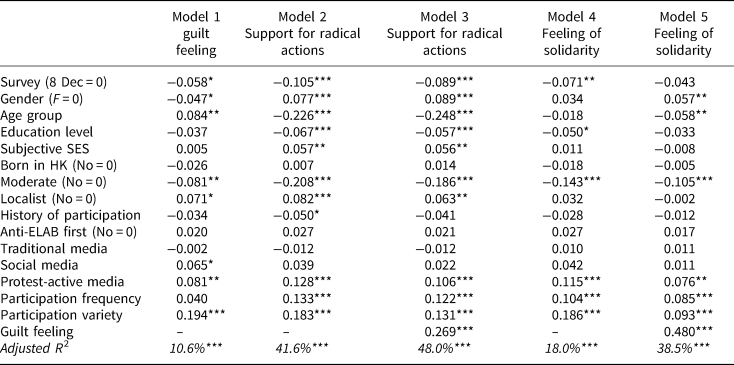
Table 2 presents the regression analysis for the feeling of guilt (model 1), support for radical actions (models 2 and 3), and the feeling of solidarity (models 4 and 5). With the control variables included, elderly protesters were found to have stronger guilt (β = 0.084, P < 0.01). Thus, H1 was supported. Moderates were also found to be less likely to feel guilty (β = −0.081, P < 0.01). As elderly protesters were more likely to be moderates (r = 0.228, P < 0.001), the contrasting impacts of age and political identification on guilt reveal that there were alternative factors leading to a few elderly protesters having stronger guilt.
Regression analysis for guilt feeling, support for radical actions, and feeling of solidarity

Note. The entries are standardized coefficients. Missing values are replaced by means. N = 1,784.
***P < 0.001, **P < 0.01, *P < 0.05.
Consistent with the descriptive findings shown in Table 1, the relationship between age and support for radical actions was negative (β = −0.226, P < 0.001). Elderly protesters had weaker support for radical actions than young people. However, age and the feeling of solidarity had no significant relationship.
Consistent with the zero-order correlations, the protesters with stronger guilt supported radical actions more and had stronger feelings of solidarity (β = 0.269 and 0.480, respectively; P < 0.001 for both). Thus, H2 and H3 were supported. The association of guilt with solidarity was particularly impressive. It contributed to almost 20% of the variance to be explained by model 5. This extraordinary association of guilt and solidarity echoes the literature that posits that guilt enables a stronger ingroup identification, despite all the internal differences among the groups within a broader ingroup (Thomas, McGarty and Mavor, Reference Thomas, McGarty and Mavor2009).
The findings in Table 2 indicate that guilt can mediate the respective impact of age on support for radical actions and the feeling of solidarity. The older protesters, who were supposed to be against radical actions, could shift to support those actions because of guilt. Guilt could also direct older protesters to have a stronger sense of solidarity. The results from the Sobel test reveal that guilt was a significant mediator of the indirect effect of age on support for radical actions and solidarity (z = 3.08 and 3.13, respectively, P < 0.01 for both). To further examine the indirect effect, a bootstrap test with 5,000 boot samples was conducted. The results revealed that both indirect effects via guilt were significant. This could reduce the negative impacts of age on both support for radical actions and solidarity. Therefore, H4 and H5 were supported (Table 3).
Bootstrap test and Sobel test for the mediating effect of guilt

Note. The entries for the results of the bootstrap test are unstandardized coefficients. N = 1,443 (DV = support for radical actions) and 1,446 (DV = feeling of solidarity).
***P < 0.001, **P < 0.01, *P < 0.05.
The last part of the analysis examined whether an experience of the state's repression could strengthen the impact of age on guilt. Four scenarios of the state's repression were covered in the analysis: encountering tear gas during a protest, being stopped-and-searched by police officers during a protest, witnessing protesters being subdued by the police, and evading the police during a protest.
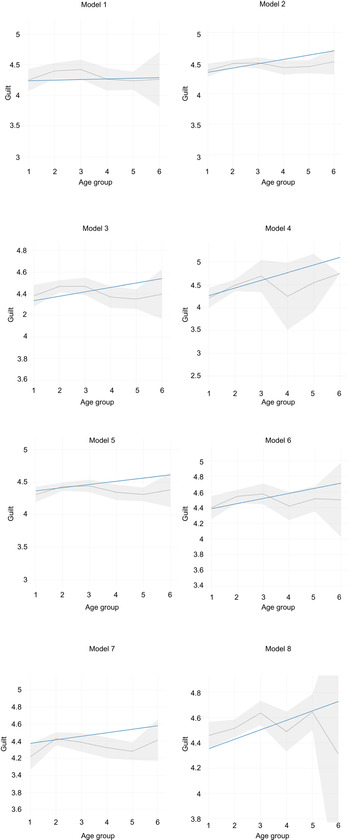
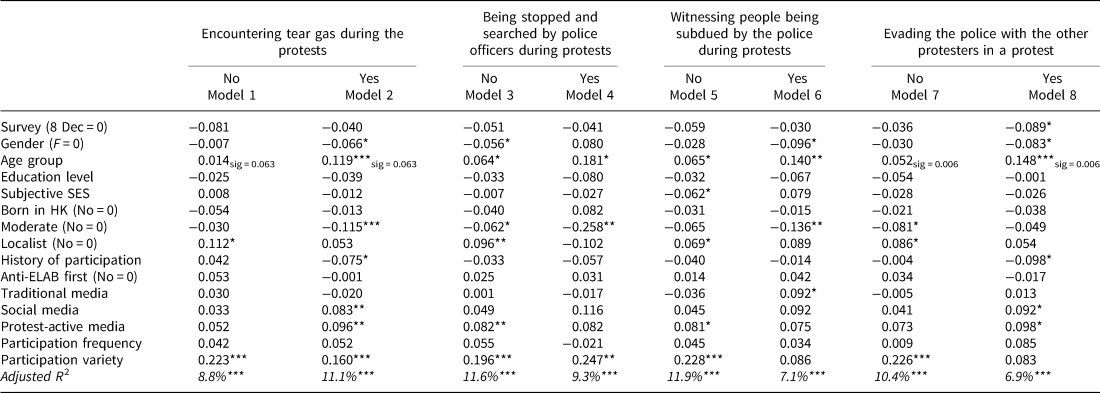
In Table 4, the regression analysis presented as part of model 1 in Table 1 was run again, after dividing the samples in accordance with whether the respondents experienced the repression of their respective state. Then, the coefficients of the relationship between age and guilt were compared to determine whether a repression experience would lead to stronger guilt among the elderly protesters. The graphical illustration of the findings is presented in Figure 1. The eight figures were the relationships between age group and guilt, referring to the eight models in Table 4. The findings partially support H6. For encountering tear gas during the protests (models 1 and 2) and evading the police (models 7 and 8), significant relationships between age and guilt were found only among the respondents who had both of these experiences. Moreover, the differences of these two pairs of coefficients were statistically significant (sig. = 0.006) or almost significant (sig. = 0.063). In fact, the coefficients of the relationship between these two variables were stronger among the respondents who experienced being stopped and searched by police officers during protests and witnessed people being subdued by the police during the protests; however, they were not significantly larger than those who did not encounter such an experience. Accordingly, this set of findings could be consistent support for the argument that the personal experience of state repression can stimulate an individual's emotions toward building identification with an ingroup.
Graphical relationships between age group and guilt reported in Table 4.

Comparison of the coefficients of the relationship between age and guilt by the experience of repression by the state

Note. The entries are standardized coefficients. Missing values are replaced by means. N = 1,784.
***P < 0.001, **P < 0.01, *P < 0.05.
6. Conclusion
Hong Kong is a city with a deeply rooted ideology favoring peaceful protests. However, it was already experiencing severe conflicts between the conventional moderates and rising radical activism before the Anti-ELAB Movement. The persistent and strong solidarity among the protesters in the movement was, therefore, an unusual phenomenon that must be explained. As senior citizens were generally more reluctant to support radical protests, the mediating role of guilt was examined to explain how cross-generational support for radical actions and solidarity was possible in the Anti-ELAB Movement. The indirect effects of age on support for radical actions and on the feeling of solidarity via guilt are supported by statistical analysis. Moreover, the results also show that the experience of state repression can strengthen the relationship between age and guilt.
At the theoretical level, the findings of this research could be useful to delineate the relationships among radicalization, solidarity, and state repression. As drawn from the literature, the respective relationship between these three situations is not unidirectional, and it is difficult to identify which is cause or consequence. Radicalization can be driven by a solidarity pathway (Bosi and Della Porta, Reference Bosi and Della Porta2012), but radical actions can simultaneously weaken the solidarity of mass protesters (Muñoz and Anduiza, Reference Muñoz and Anduiza2019). On the contrary, violent repression from the state can stimulate more public support for radical protests (O'Brien and Deng, Reference O'Brien and Deng2015). In this research, guilt, as a form of emotion, was included as a condition for the solidarity of a large crowd of protesters to be sustained, and this condition can be more powerful when encountering the repression of the state.
This research also provides a framework that highlights the function of guilt that leads to cross-generational solidarity. The findings provide three clues for follow-up research to substantiate the impact of guilt. First, as mentioned in this paper, the idea of this research partly stemmed from qualitative observations from the authors. In the qualitative articulation, the two senior citizens both emphasized that they did too little for the next generation when they were young. Their confession was related to Hong Kong's history of political development in which a large number of Hong Kongers during the transition period from the 1980s to 1997 were not enthusiastic about the democratic development of the city (Lau and Kuan, Reference Lau and Kuan1995). This implies that part of their feeling of guilt stemmed from their personal life history, which was in addition to witnessing the state's repression. Based on the statistical findings from this research, further investigation on the reflexive feeling of guilt and its impact on supporting youth activism among Hong Kong's senior citizens is possible. This study also invites a more comprehensive survey of affective solidarity. Fear has been adopted to study social change in Hong Kong because of its relation to mainland China (Li, Reference Li2019). Guilt, in contrast, has not been utilized to study Hong Kong politics, although it is salient in other political communities, such as Germany (Rensmann, Reference Rensmann, Branscombe and Doosje2004). Although earlier research suggests that guilt can be a driving force for citizens' active participation in the three-decade-long 4 June commemoration of the 1989 Tiananmen Square Incident, the mechanism has not been thoroughly elaborated (Lee and Chan, Reference Lee and Chan2013; Cheng and Yuen, Reference Cheng and Yuen2019). Given the occurrence of many eventful moments in recent years, affective solidarity offers a new lens for studying Hong Kong's sociopolitical transformations.
Second, although this study finds that guilt has significant impacts on support for radical actions and the feeling of solidarity, the data do not provide adequate information to interpret how they are related. Drawing from insights from the literature, guilt-driven solidarity could be linked by a sense of responsibility, a feeling of injustice, and guilt-stimulated anger (Berndsen and Manstead, Reference Berndsen and Manstead2007; Thomas, McGarty and Mavor, Reference Thomas, McGarty and Mavor2009; Kleres and Wettergren, Reference Kleres and Wettergren2017). The cross-generational solidarity in the Anti-ELAB Movement showed cross-generational solidarity invites further research into the attributes related to generational differences. For example, is guilt correlated with a paternalistic sense of duty and compassion toward the young people among the elderly protesters? Is guilt among the elderly protesters linked toward a stronger tolerance rather than support for radical protests? Further study would be needed to fill in this gap.
Third, the impact of guilt on the overseas Hong Kongers could be studied. Many overseas Hong Kongers supported the Anti-ELAB Movement, but they could not participate in the movement physically. Of course, many of them contributed to the movement through online petition, crowdfunding, and diasporic activism. Yet, the scope and intensity of their participation remained limited. Being an event-driven and group-based emotion, the attributes and impact of guilt depend on the social and physical proximities of its group members. When guilt could drive the elderly protesters to accept radical protests and maintain solidarity with the militant protesters, its impact on the overseas Hong Kong communities should also be studied to unpack the role of guilt in forming an affective community, in terms of both the diasporic and domestic movement's supporters.
Clarification of the possible limitations of this research must be addressed. The first concerns timing and measures. Due to the constraints of online surveys, we did not have the space to include questions regarding feelings of guilt prior to the later stage of the movement. After the peak of the violent conflicts in November 2019, we acknowledged the importance of guilt, and relevant questions were asked about the two major protests on 8 December 2019 and 1 January 2020. Inevitably, a few moderates might have been less active in joining street protests due to safety concerns. Otherwise, a greater variety of variances might be able to generate a more impressive statistical finding. However, this limitation did not imply a sampling bias for the most persistent protesters. Over the course of the movement, some people quit in the middle for many reasons, while some protesters became active in the middle. Although these two surveys only covered the protesters at the later stage of the movement, the demographic formation of these protesters was still similar to the demographics of the protesters across the whole movement, as disclosed by the aggregated findings of all the onsite surveys in the early stage of the movement (Lee et al., Reference Lee, Yuen, Tang and Cheng2019).
The second possible weakness concerns the generalizability of operationalization. This study aims to explain solidarity from a relational perspective to see how the dynamics between protesters and the state foster the impact of guilt on cross-generational solidarity, despite the potential disputes among protesters concerning radical protests. Therefore, the operationalization of guilt focuses on attitudes toward radicals; the actors facing heavy state repression among the broader ingroup. This measurement fosters a richer interpretation of affective solidarity as compared to examining emotion on a generic scale.
Third, as most of the quantitative research about emotions and social movement tends to discuss the impact of a single emotion, some scholars attempt to examine each emotion's respective strength within a movement (Asún et al., Reference Asún, Rdz-Navarro, Zúñiga and Louis2020). Although this paper focuses on the role of guilt, this does not entail ignoring the impact of other emotions, such as anger, on the Anti-ELAB Movement (Scott et al., Reference Scott, Ho, Radburn, Chan, Kyprianides and Morales2020). Instead, it gives more attention to an underresearched emotion and surveys the intercohort differences among different ingroup members during a traumatic event. This relational perspective highlights the traumatic conditions under which different social actors are welded together by shared emotional upheaval to facilitate ingroup identification and solidarity.
Supplementary material
The supplementary material for this article can be found at https://dataverse.harvard.edu/dataset.xhtml?persistentId=doi%3A10.7910%2FDVN%2F9TULQF&version=DRAFT
Acknowledgement
We would like to thank the editor and two referees for their helpful comments.
Financial support
The work reported in this study was partially supported by a grant from the Hong Kong Research Grants Council (Project Number 22608518).
Gary Tang is an Assistant Professor in the Department of Social Science at the Hang Seng University of Hong Kong.
Edmund W. Cheng is an Associate Professor in the Department of Public Policy at the City University of Hong Kong.