Introduction
Many cases of epistaxis arise from Little's area on the anterior nasal septum, and can be managed by direct treatments (nasal packing and cautery), whilst controlling underlying risk factors.Reference Tan and Calhoun 1 In some cases, and particularly those involving posterior site bleeding, primary direct treatment may be ineffective, and affected patients may require surgical or endovascular treatment.Reference Viducich, Blanda and Gerson 2
Whilst epistaxis may sometimes be managed by cautery performed under general anaesthesia, the focus of surgical intervention is usually the ligation of vessels supplying the nasal mucosa, performed via an open or endoscopic approach. Historically, the surgical treatment of refractory posterior epistaxis consisted of transantral surgical ligation of the internal maxillary artery, with or without ligation of the anterior ethmoidal artery. More recently, endoscopic ligation of the sphenopalatine artery has become the mainstay of surgical treatment for epistaxis in most UK hospitals. Despite this, evidence is lacking with regard to the superiority of sphenopalatine artery ligation over transantral maxillary artery ligation or embolisation. There is no standardised threshold for surgical intervention, with significant variation seen in pre-operative management.
Interventional neuroradiology is an evolving field.Reference Jindal, Gemmete and Gandhi 3 First described for epistaxis in 1974 by Sokoloff et al.,Reference Sokoloff, Wickbom, McDonald, Brahme, Goergen and Goldberger 4 endovascular embolisation of the internal maxillary artery appears to represent an effective alternative to surgery. Current practice involves super-selective embolisation of distal branches of the internal maxillary artery and other extracranial collaterals, guided by angiography. This procedure is usually performed under local anaesthetic, with or without sedation, using a variety of embolisation materials. In the UK, endovascular procedures for epistaxis are only performed in selected centres.
The appropriate place for surgery and interventional radiology in the stepwise management of refractory epistaxis, and their associated risks, have not been well characterised. As a result, the UK currently has no best practice guidelines regarding the appropriate indications for these treatments in patients with epistaxis.
Aims
This review aimed to address the following key clinical questions that were identified relating to the management of epistaxis with surgery and interventional radiology: in patients treated in hospital with refractory epistaxis, how effective is surgery compared to direct treatments (nasal packing and cautery)?; and, in patients treated in hospital with refractory epistaxis, how effective is interventional radiology compared to direct treatments and surgery?.
Materials and methods
This work forms part of a set of systematic reviews designed to summarise the literature prior to the generation of a UK national management guideline for epistaxis. This review addresses the final identified research domain: surgical management and radiological intervention. A common methodology has been used in all reviews, described in the first of the publications.Reference Khan, Conroy, Ubayasiri, Constable, Smith and Williams 5 Studies were only included if they primarily included patients aged 16 years and above who were treated for epistaxis within a hospital environment. The search strategy for this review can be found in the online supplementary material that accompanies this issue.
All forms of endovascular embolisation were included in the current review. Surgical management was included where a named vessel was targeted, whilst endoscopic cautery of the nasal mucosa was excluded. The topics of particular interest were: efficacy of haemostasis, appropriate timing of the interventions, economic assessment, patient-reported outcomes and adverse effects. Adverse effects were defined as minor if they were transient and local. Complications associated with permanent or significant morbidity, or mortality, were defined as major.
All randomised controlled trials, controlled and uncontrolled longitudinal studies, and cross-sectional studies were accepted for analysis. Controlled surgical studies were included where the comparator was non-surgical direct management (nasal packs or cautery) or other forms of surgical ligation. Studies that compared surgical ligation to embolisation are discussed within the interventional radiology section.
Surgical intervention
Results
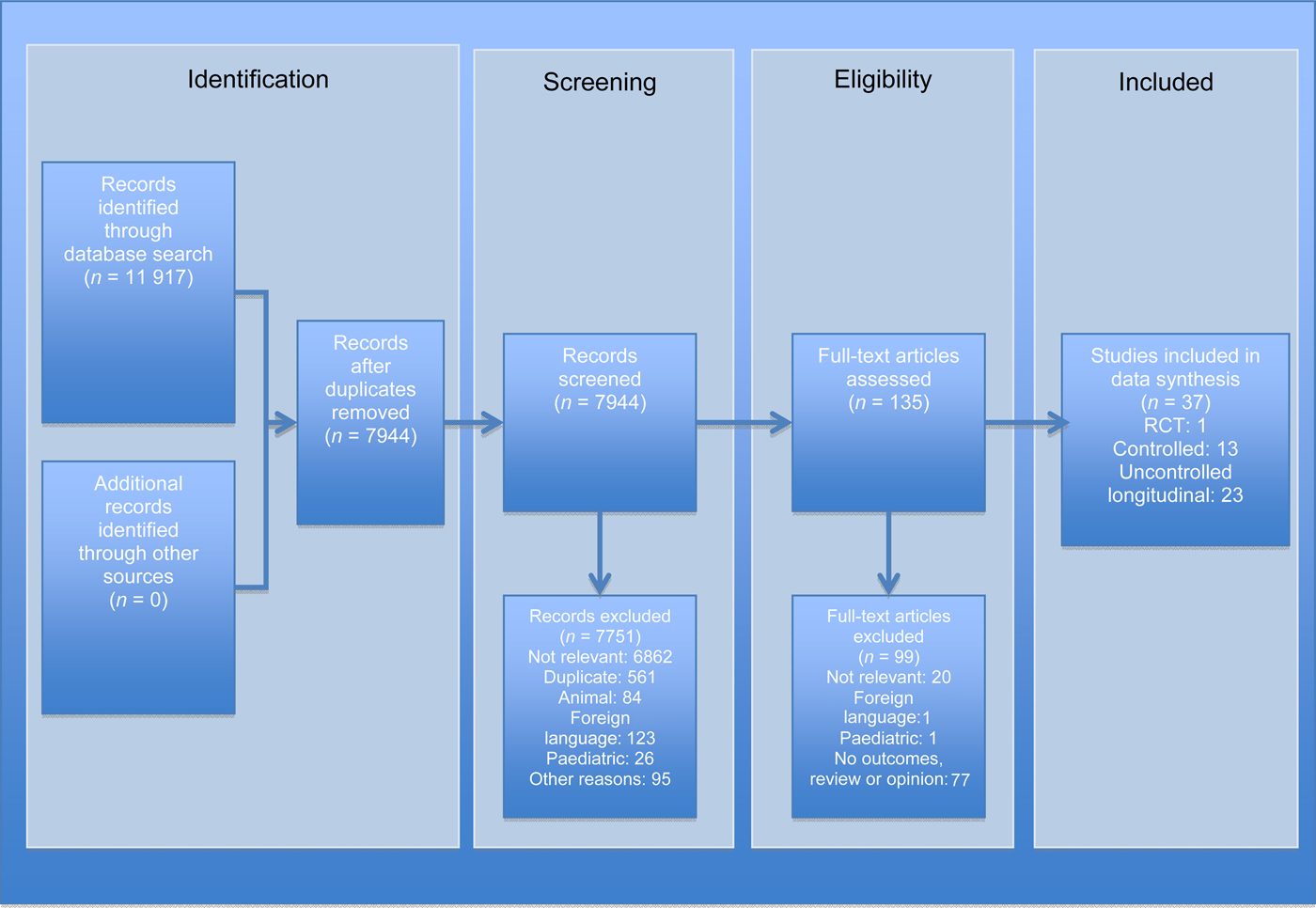
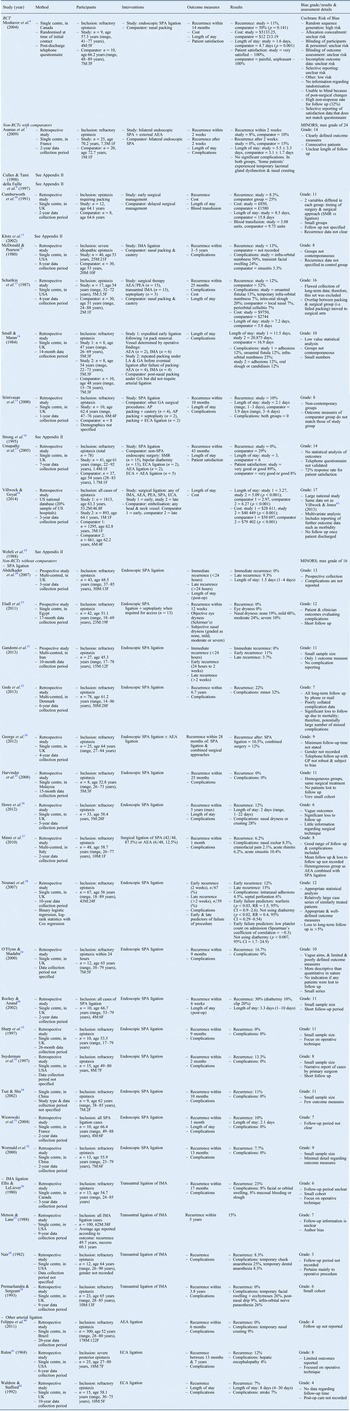
In the surgery review, 37 studies were included for analysis (Appendix I). Figure 1 illustrates the search and article selection process.
Preferred Reporting Items for Systematic Reviews and Meta-Analyses (‘PRISMA’) diagram for the surgery review, mapping the number of records identified, included and excluded during different review phases. RCT = randomised controlled trial

Only one of the included studies was a randomised controlled trial.Reference Moshaver, Harris, Liu, Diamond and Seikaly 6 Thirteen retrospective controlled studiesReference Asanau, Timoshenko, Vercherin, Martin and Prades 7 – Reference Wehrli, Lieberherr and Valavanis 19 and 23 retrospective uncontrolled longitudinal studiesReference Abdelkader, Leong and White 20 – Reference Waldron and Stafford 42 were accepted for analysis. The number of participants in the included studies varied from 8 to 4662. No sample size calculations were performed in any of the studies. Five studies were multicentre.Reference Villwock and Goyal 18 , Reference Abdelkader, Leong and White 20 – Reference Gede, Aanaes, Collatz, Larsen and von Buchwald 22 , Reference Minni, Dragonetti, Gera, Barbaro, Magliulo and Filipo 27 Settings included hospitals within the UK, USA, Canada, France, Egypt, Iran, Italy, China, Brazil and Malaysia.
The only identified randomised controlled trial compared sphenopalatine artery ligation to packing.Reference Moshaver, Harris, Liu, Diamond and Seikaly 6 Regarding the controlled retrospective studies, three analysed early versus delayed surgical management, three compared sphenopalatine artery ligation to other surgical options, two compared surgical ligation to nasal packing, and the final five studies compared surgery to embolisation. Although the latter studies were identified during the surgical systematic review, the results will be discussed in the embolisation section to prevent duplication.Reference Cullen and Tami 8 , Reference della Faille, Schmelzer, Vidts, Kunnen, Cammaert and Katz 9 , Reference Klotz, Winkle, Richmon and Hengerer 11 , Reference Strong, Bell, Johnson and Jacobs 16 , Reference Wehrli, Lieberherr and Valavanis 19
Of the uncontrolled longitudinal studies, 16 evaluated sphenopalatine artery ligation, 4 evaluated internal maxillary artery ligation, 1 investigated anterior ethmoidal artery ligation and 2 studies evaluated external carotid artery (ECA) ligation. There has been a shift towards more recent publications reporting outcomes of sphenopalatine artery ligation, reflecting a change in clinical practice.
Summary of evidence
Different surgical techniques
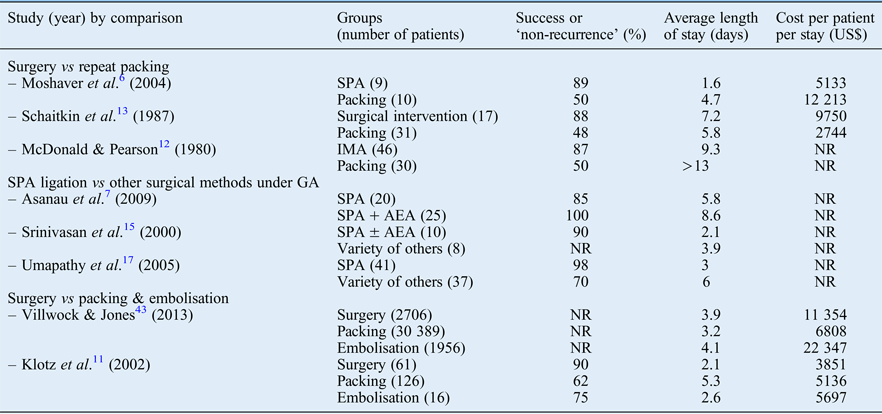
Results from studies relating to the surgical treatment of epistaxis are summarised in Table I.Reference Moshaver, Harris, Liu, Diamond and Seikaly 6 , Reference Asanau, Timoshenko, Vercherin, Martin and Prades 7 , Reference Klotz, Winkle, Richmon and Hengerer 11 – Reference Schaitkin, Strauss and Houck 13 , Reference Srinivasan, Sherman and O'Sullivan 15 , Reference Umapathy, Quadri and Skinner 17 , Reference Villwock and Goyal 18
Summary of studies comparing surgery to packing and other techniques

SPA = sphenopalatine artery; IMA = internal maxillary artery; NR = not reported; GA = general anaesthesia; AEA = anterior ethmoidal artery
Three single-centre, retrospective controlled studies compared sphenopalatine artery ligation to other surgical methods. Srinivasan et al.Reference Srinivasan, Sherman and O'Sullivan 15 and Umapathy et al.Reference Umapathy, Quadri and Skinner 17 reported on sphenopalatine artery ligation with a variety of comparators: submucous resection, ECA ligation and isolated anterior ethmoidal artery ligation. The third study compared isolated sphenopalatine artery ligation to sphenopalatine artery ligation with the addition of anterior ethmoidal artery ligation.Reference Asanau, Timoshenko, Vercherin, Martin and Prades 7 The average follow-up period ranged from 10 to 43 months. Umapathy et al. reported success rates of 98 per cent for sphenopalatine artery ligation compared to 70 per cent for other surgical methods.Reference Umapathy, Quadri and Skinner 17 Srinivasan et al. reported a comparable success rate (90 per cent); however, the authors did not publish the success rate for non-sphenopalatine artery surgery.Reference Srinivasan, Sherman and O'Sullivan 15 Asanau et al. reported that the long-term success rate (more than two weeks after surgery) may be increased to 100 per cent with the concurrent use of anterior ethmoidal artery ligation, compared to a 85 per cent success rate with isolated sphenopalatine artery.Reference Asanau, Timoshenko, Vercherin, Martin and Prades 7 However, the difference between the two groups was not statistically significant and sample sizes were small (n = 20 and n = 25, respectively).
Uncontrolled longitudinal series reported comparable long-term success rates for sphenopalatine artery ligation (73–100 per cent), internal maxillary artery ligation (64–100 per cent), isolated anterior ethmoidal artery ligation (100 per cent) and ECA ligation (88–93 per cent). The average success rate across all studies was 88 per cent for sphenopalatine artery ligation and 84 per cent for internal maxillary artery ligation.
Surgery versus nasal packing
Four studies compared surgery to nasal packing in posterior epistaxis, including one randomised controlled trial over follow-up periods ranging from one month to three years.Reference Moshaver, Harris, Liu, Diamond and Seikaly 6 , Reference Klotz, Winkle, Richmon and Hengerer 11 – Reference Schaitkin, Strauss and Houck 13 All studies reported higher success rates for surgical ligation compared to nasal packing (87–90 per cent vs 48–62 per cent). In addition, Schaitkin et al. reported long-term success rates of up to three years.Reference Schaitkin, Strauss and Houck 13 However, this dataset included patients who had already undergone surgery within the packing arm and the results were interpreted with flawed methodology. The long-term data were excluded from further analysis.
Surgical technique
A variety of procedural steps were described in detail for endoscopic sphenopalatine artery ligation; these can be subdivided into pre-operative decongestion, vessel ligation selection under general anaesthesia and post-operative nasal care. The following pertains to endoscopic sphenopalatine artery ligation.
Pre-operative nasal preparation was recognised to be important; however, there was no agreed standard. Examples included Moffett's solution, a combination of lignocaine and adrenaline (e.g. Lignospan®), and xylocaine either applied topically or via infiltration. One modification described the infiltration of local anaesthesia with adrenaline to the sphenopalatine foramen to slow vascular flow.Reference Harvinder, Rosalind and Gurdeep 25
Techniques used to perform vessel ligation include metal clips, and bipolar electrosurgery with or without monopolar electrosurgery (wattage not specified). One single-centre, retrospective study evaluated predictors of procedural failure in endoscopic sphenopalatine artery ligation over a 10-year period.Reference Nouraei, Maani, Hajioff, Saleh and Mackay 28 The use of diathermy was associated with a lower risk of early and late recurrence (p < 0.02 and p < 0.007, respectively).
Following ligation, the use of post-operative packing, topical vasoconstrictors, and topical or systemic antibiotics varied, and there was no evidence to support one over another. No studies directly analysed the use of antimicrobial prophylaxis. Most studies recommended the use of saline spray, a saline douche or Otrivine® nasal spray.
A transantral approach was described for internal maxillary artery ligation using metal clips. The two studies reporting ECA ligation performed the procedure using either local or general anaesthesia, depending on patient selection.Reference Rulon 41 , Reference Waldron and Stafford 42
Cost effectiveness
The largest contemporary study addressing the cost effectiveness of surgical treatment for epistaxis was a multicentre analysis of the American Nationwide Inpatient Sample.Reference Villwock and Jones 43 However, it was limited to US medical centres, where costs may differ from the UK. This study analysed the management of 57 039 patients admitted to hospitals between 2008 and 2010, and compared those treated with surgical ligation, embolisation or packing. Data relating to embolisation are discussed in the ‘Radiological intervention for epistaxis’ section below. With respect to surgical ligation and nasal packing, length of stay data were comparable, whilst cost per patient stay was higher with surgical ligation compared to packing ($11 354 vs $6808). The nasal packing group did not distinguish between anterior and posterior sources of epistaxis.
Of the remaining studies, two of three reported higher financial costs associated with repeated packing compared to surgery. Klotz et al. demonstrated that this cost more than doubled if packing failed ($3851 surgery vs $5136 successful packing vs $9117 failed packing).Reference Klotz, Winkle, Richmon and Hengerer 11 In contrast, the third study, published in 1987, illustrated lower financial burden in those patients treated with packing.Reference Schaitkin, Strauss and Houck 13 All patients initially underwent nasal packing; anterior ethmoidal artery ligation with or without internal maxillary artery ligation was used as second-line therapy in those patients for whom packing failed.
Whilst it was possible to extrapolate information regarding length of stay or requirement of blood transfusion, there is no direct evidence regarding the cost effectiveness of surgical intervention in the UK.
When should surgery be considered?
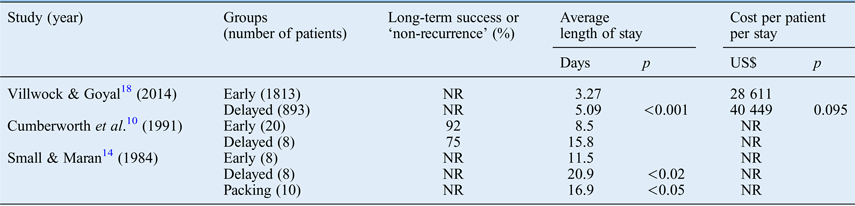
Three controlled retrospective studies suggested that expedited early vessel ligation was associated with lower cost, reduced length of stay and fewer blood transfusions (Table II).Reference Cumberworth, Narula and Bradley 10 , Reference Small and Maran 14 , Reference Villwock and Goyal 18 The timing of early surgery varied between the three studies. Two studies performed targeted surgical therapy and ligation following treatment failure after removal of the first nasal pack.Reference Cumberworth, Narula and Bradley 10 , Reference Small and Maran 14 Comparatively, the most recent multicentre study performed vessel ligation within 24 hours of admission.Reference Villwock and Goyal 18
Summary of studies comparing outcomes following early versus late surgery

NR = not reported
Adverse effects
Two-thirds of studies evaluating sphenopalatine artery ligation reported on complications. Across all studies, there were no major complications. The average transient complication rates were: 5.5 per cent for local nasal symptoms (such as crusting and obstruction), 7 per cent for lacrimal gland dysfunction, 0.1 per cent for epiphora and 0.3 per cent for facial pain.
Seven of nine studies on transantral internal maxillary artery ligation reported their complications. The average complication rates were: 1.9 per cent for oroantral fistula, 15.6 per cent for permanent cheek numbness and 0.6 per cent for permanent palatal numbness. In addition, average rates of transient complications were: 3.9 per cent for nasal symptoms, 11.7 per cent for facial swelling and 2.6 per cent for intra-oral slough.
Patient-reported outcomes
An important consideration when assessing adverse effects is the patient's perspective. Patients were more satisfied with sphenopalatine artery ligation compared to packing, and opted for internal maxillary artery ligation over packing when given the choice.Reference Moshaver, Harris, Liu, Diamond and Seikaly 6 , Reference Nair 38 In one controlled longitudinal study, 89 per cent of patients rated sphenopalatine artery ligation as ‘good’ or ‘very good’, compared to 8 per cent for non-sphenopalatine artery surgery.Reference Umapathy, Quadri and Skinner 17 Patient-reported outcomes were not consistently reported in the included studies, but these data suggest that patients prefer surgical management, specifically sphenopalatine artery ligation, compared to repeat nasal packing.
Radiological intervention
Results
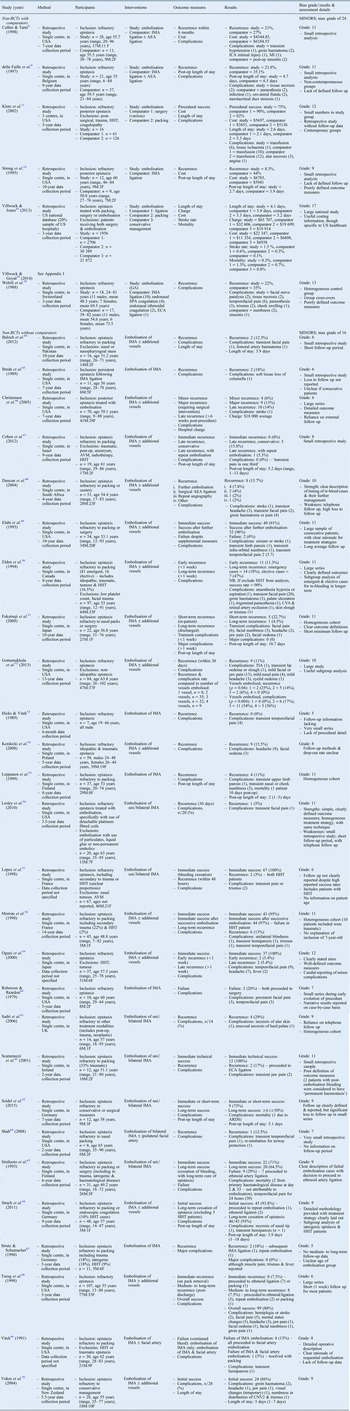
In the interventional radiology review, 34 studies were included for analysis (Appendix II). Figure 2 illustrates the search and article selection process.
Preferred Reporting Items for Systematic Reviews and Meta-Analyses (‘PRISMA’) diagram for the interventional radiology review, mapping the number of records identified, included and excluded during different review phases. RCT = randomised controlled trial

No eligible randomised controlled trials were identified. Seven retrospective controlled studiesReference Cullen and Tami 8 , Reference della Faille, Schmelzer, Vidts, Kunnen, Cammaert and Katz 9 , Reference Klotz, Winkle, Richmon and Hengerer 11 , Reference Strong, Bell, Johnson and Jacobs 16 , Reference Villwock and Goyal 18 , Reference Wehrli, Lieberherr and Valavanis 19 , Reference Villwock and Jones 43 and 27 retrospective uncontrolled longitudinal studiesReference Baloch, Awan and Nabeel 44 – Reference Vokes, McIvor, Wattie, Chaplin and Morton 70 were included for analysis. The number of participants in the identified studies ranged from 7 to 57 039.
Summary of evidence
Embolisation versus surgery or packing
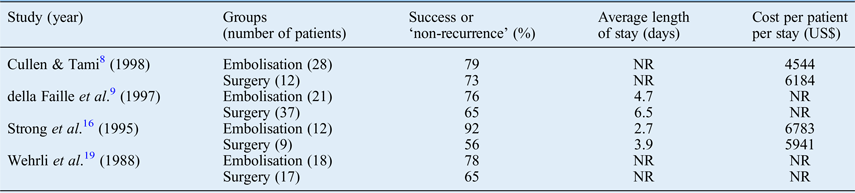
Five single-centre, retrospective controlled studies compared embolisation to surgical intervention.Reference Cullen and Tami 8 , Reference della Faille, Schmelzer, Vidts, Kunnen, Cammaert and Katz 9 , Reference Klotz, Winkle, Richmon and Hengerer 11 , Reference Strong, Bell, Johnson and Jacobs 16 , Reference Wehrli, Lieberherr and Valavanis 19 Results from these studies are summarised in Table III. The predominant surgical method used in these studies was transantral internal maxillary artery ligation, with or without additional terminal ethmoid artery branch ligation. In Klotz and colleagues’ 2002 study, only 15 per cent of patients undergoing surgical intervention underwent sphenopalatine artery ligation, demonstrating that at the turn of the century the published data still preceded the now widespread adoption of endoscopic sphenopalatine artery ligation.Reference Klotz, Winkle, Richmon and Hengerer 11 Embolisation success rates were reported as 75–92 per cent, although the definition of success was variable. These rates were comparable to or better than those for surgical or direct measures (56–90 per cent), but with small sample sizes statistical significance was not demonstrated. Twenty-six retrospective case series reporting single-centre experience of embolisation for epistaxis were identified, with success rates (71–100 per cent) similar to those from controlled studies. The average success rate of embolisation as an epistaxis treatment was 88 per cent across all studies.
Summary of studies comparing embolisation to packing or surgery

NR = not reported
Embolisation technique
The technique used was described in detail in most studies. This invariably involved a diagnostic angiogram of the internal and external carotid arteries to look for active bleeding or potentially dangerous anastomoses between the extracranial and intracranial vessels. This was followed by micro-catheterisation of the distal internal maxillary artery, and super-selective embolisation with one or a combination of materials, including polyvinyl alcohol, Gelfoam and microcoils. Most procedures were carried out under local anaesthetic via a femoral approach. Although there were no published patient-reported outcomes of tolerance or comfort, there were no reports of significant difficulty in performing the procedure under local anaesthetic with or without sedation.
One study found an inverse relationship between the number of vessels embolised and recurrence (p = 0.04); however, there was a concomitant increase in complications (p = 0.004), including soft tissue necrosis, facial pain and, in one case, transient ischaemic attack.Reference Gottumukkala, Kadkhodayan, Moran, Cross de and Derdeyn 52
The published evidence cannot support one method of embolisation over another, and controlled studies comparing embolic materials or embolisation technique are lacking. However, numerous studies described a technique of targeted super-selective embolisation of the distal ipsilateral internal maxillary artery where possible, with additional embolisation of facial artery collaterals or the contralateral internal maxillary artery when necessary.
Cost effectiveness
Amongst single-centre controlled studies, there are limited data comparing embolisation with surgical costs. The same is true for length of stay, although one study demonstrated a shorter length of stay when embolisation was compared with packing (2.6 days vs 5.3 days; p < 0.01).Reference Klotz, Winkle, Richmon and Hengerer 11 The largest multicentre study reported a comparable length of stay, but significantly higher costs per patient stay with embolisation when compared to surgery or packing ($22 347 vs $11 354 vs $6808; p < 0.01) (Table I).Reference Villwock and Jones 43
When should embolisation be considered?
Patient selection was not directly addressed in the published literature. The majority of studies assessed the outcomes of patients with predominantly idiopathic epistaxis, who undergo embolisation after failed packing, or failed packing and failed surgical intervention. The largest controlled study excluded patients who underwent both surgical and radiological intervention, but unfortunately it did not provide data on procedure success or follow up.Reference Villwock and Jones 43 However, it demonstrated that in the USA, embolisation is being used as a primary method to treat refractory epistaxis in large numbers, in comparison with surgical ligation (3.4 per cent vs 4.7 per cent of 57 039 admissions with epistaxis). Of those treated with embolisation, early intervention (within 24 hours of admission) resulted in a significantly shorter length of stay than delayed embolisation (3.0 vs 6.3 days; p < 0.001), supporting earlier intervention where possible. There was no evidence to guide clinicians on patient selection with regard to age, co-morbidity, bleeding location or bleeding severity.
Adverse effects of embolisation
There was variation in how complications are reported, particularly in the stratification of complication severity. However, across all case series, the summative rate of transient ischaemic temporofacial pain was around 10 per cent. When collating evidence from all single-centre studies, the rate of stroke was 1.1 per cent, the rate of tissue necrosis was 0.9 per cent and the rate of blindness was 0.3 per cent. In the only multicentre analysis, there was no significant influence of intervention modality (embolisation, surgery or packing) on the odds of mortality, but embolisation increased the odds of stroke (1.5 per cent) when compared to nasal packing (0.6 per cent) and conservative management (0.3 per cent; odds ratio = 4.660, p = 0.003).Reference Villwock and Jones 43
Limitations
There was some low- to medium-quality evidence to support surgical ligation and embolisation for refractory epistaxis. However, the number of well-designed, prospective, controlled trials assessing these interventions is limited. There was considerable heterogeneity between studies, and a resulting inability to pool results or perform meta-analysis. The key limitation in evidence is a lack of multicentre randomised trials that assessed the efficacy and safety of surgical and radiological interventions in comparison to other treatments. The majority of studies are retrospective single-centre reports, with wide variability in follow-up methodology and reporting (follow-up periods ranged from the in-patient period only to 6.7 years post-operation). Many studies only reported in-patient recurrence, leaving the potential to miss treatment failure. Conversely, those reporting recurrence of epistaxis extending several years after intervention may have limited value.
A thorough economic or cost analysis is lacking, although data from the USA do give an insight into the higher cost of embolisation as a treatment modality in comparison to surgery. It is not clear whether this holds true for other geographical areas and healthcare markets. Patient-reported disease-specific and quality-of-life outcomes were also absent in most studies.
A high risk of bias in the studies reviewed was apparent when analysed using the Cochrane Collaboration's tool for assessing risk of bias and the methodological index for non-randomised studies (‘MINORS’) criteria. Two of the principal outcome measures of this study, success rate and complications, were poorly defined in all of the studies, with little consistency in definition. The inter-study variation in terms of the definition and timeframe of success rate raises the question of whether this outcome was sufficiently clearly defined to be a valid outcome metric.
Conclusion
Endoscopic sphenopalatine artery ligation appears to be effective, and was associated with a favourable adverse effect profile when compared to internal maxillary artery ligation or packing. Limited evidence appears to support early surgical intervention. Most studies proposed adequate pre-operative decongestion and nasal preparation. Limited evidence suggested that use of diathermy as a method of endoscopic sphenopalatine artery ligation was associated with a lower risk of early and late recurrence rates.
Embolisation is being used as a mainstream treatment modality for refractory epistaxis in the USA within larger teaching hospitals. It is unclear whether it is being used as frequently in other countries worldwide. Success rates reported in controlled studies and case series were comparable to those for surgical intervention; however, these studies primarily performed transantral internal maxillary artery ligation, as opposed to endoscopic sphenopalatine artery ligation. Benefits of embolisation included the ability to capture diagnostic angiographic information regarding the site of bleeding, and an accurate, targeted approach to vessel occlusion. Embolisation is usually performed via a femoral approach under local anaesthetic, with or without sedation. It does require compliance with positioning. Although endoscopic sphenopalatine artery ligation can be performed under local anaesthetic, it is not done widely; radiological intervention may provide an option for those who have an absolute or relative contraindication to general anaesthetic.
Ischaemic pain and tissue necrosis are widely reported following embolisation. It could be argued that embolisation is the most appropriate option where an initial surgical intervention has failed. However, when using embolisation as a salvage procedure after failed sphenopalatine artery ligation, the source of continued bleeding is more likely to be in the territory of the ethmoidal arteries, which, being indirect branches of the intracranial circulation, give an inherent risk of retrograde embolisation and stroke.
There is evidence to suggest that, for patients with refractory epistaxis, surgical artery ligation and embolisation are beneficial in reducing recurrence rates. Endoscopic sphenopalatine artery ligation has a better adverse effect profile and success rate compared to other forms of surgical management. However, there were no well-designed trials comparing endoscopic sphenopalatine artery ligation with embolisation. The available evidence, in the form of uncontrolled trials, indicated that success rates were similar. The more restricted availability of interventional radiology and the costs associated with embolisation may make it less desirable in routine cases, particularly when the risk of stroke of 1.1–1.5 per cent is considered.
Adequately powered randomised controlled trials that compare endoscopic sphenopalatine artery ligation with embolisation are needed to further assess the management of refractory epistaxis. Future research should prioritise the long-term multicentre comparison of surgery and embolisation, with emphasis placed on patient-reported outcomes. Adequately powered studies that detect the clinical and economic effects of early intervention are required.
Acknowledgement
This review was part of an epistaxis management evidence appraisal and guideline development process funded by ENT-UK. The funding body had no influence over content.
Summary of studies included in surgical intervention review

Summary of studies included in radiological intervention review